
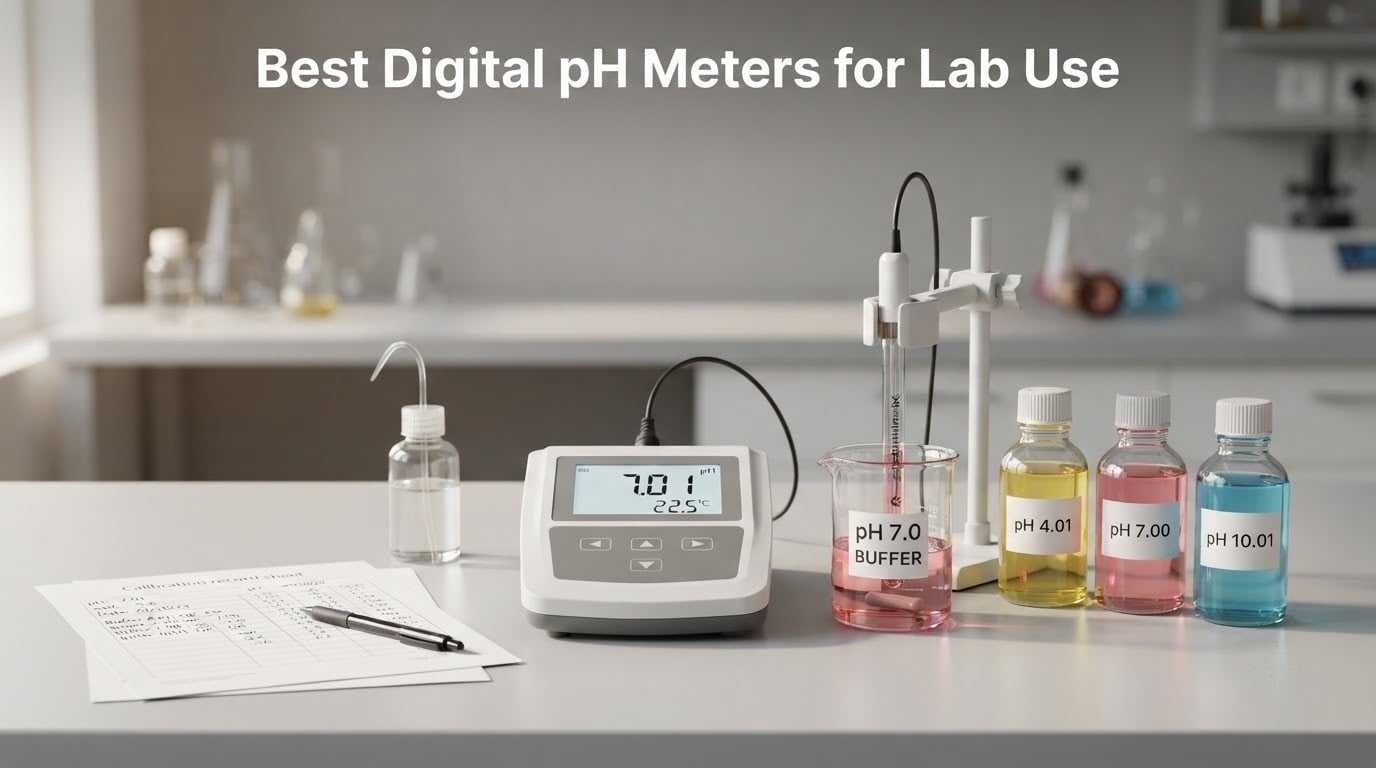
Every pH number that leaves your bench is only as good as the calibration that preceded it, and the instrument is usually the least of the problem. I have watched a lab argue for an hour over a disputed result while the actual culprit was a dried-out storage cap, not a faulty meter. So I went into this roundup treating the electrode, the buffer, and the calibration record as first-class parts of the purchase, not accessories.
Below are 12 benchtop pH meters we examined for laboratory work, ranging from a straightforward teaching instrument to a unit that logs 1000 data sets and locks its own calibration behind a password. The short version: for most labs, the Apera PH700 is the digital pH meter for lab use that does the most real work with the least fuss. If you need traceable records, the Bante A120 is the one to look at first.
Specifications in this guide come from manufacturer datasheets and listing data, and we flag the difference between published accuracy and display resolution wherever it matters. We also update every year, so this list reflects what is on the market in 2026.
Table of Contents
What Is the Best pH Meter for Lab Use?
The best pH meter for lab use is the Apera PH700 for most laboratories, the Bante A120 for research-grade precision and traceable records, and the Bante 210 for teaching labs on a budget. All three are benchtop instruments with three or more calibration points and automatic temperature compensation. What separates a good one from a poor one is rarely the display, it is the electrode and the discipline behind the calibration.
That answer matters because a pH meter is a two-part system. The electronics give you a number; the glass measuring electrode, the reference electrode, and the buffer solution decide whether that number is defensible. Read the instrument buying guide we keep for clamp meters style framework we apply here, and the same logic shows up: specify the sensor class first, then the features.
Top 3 Picks for Lab pH Testing
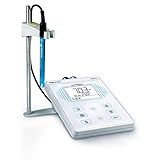
Apera PH700 Benchtop pH Meter
- 3-in-1 ATC pH and temperature electrode
- 1-3 point auto calibration with self-diagnosis
- 50 sets of data storage
- IP54 housing

Apera PH910 with LabSen 211
- Refillable LabSen 211 glass electrode
- 200 data sets with USB output
- Large TFT HD display
- Slope health readout

Bante 210 Benchtop pH Meter
- 1-3 point calibration with buffer recognition
- Electrode slope diagnosis
- Automatic temperature compensation
- Auto-read endpoint lock
All 12 Meters Compared in 2026
All twelve instruments below are benchtop pH meters. Accuracy figures are published manufacturer specifications, not display resolution, and resolution is listed separately where the manufacturer states it.
| Product | Specifications | Action |
|---|---|---|
| Apera PH700 Benchtop Lab pH Meter |
|
Check Latest Price |
| Apera PH910 with LabSen 211 Electrode |
|
Check Latest Price |
 Apera AI521 PH800 with GLP Data Apera AI521 PH800 with GLP Data |
|
Check Latest Price |
| Bante 210 Benchtop pH Meter |
|
Check Latest Price |
 ONiLAB Benchtop pH Meter ONiLAB Benchtop pH Meter |
|
Check Latest Price |
 Healthible Lab Benchtop pH Meter Healthible Lab Benchtop pH Meter |
|
Check Latest Price |
 Sper Scientific 860031 Benchtop pH Meter Sper Scientific 860031 Benchtop pH Meter |
|
Check Latest Price |
 Oakton pH 550 Benchtop Kit Oakton pH 550 Benchtop Kit |
|
Check Latest Price |
 Milwaukee MW150 pH mV Temp Bench Meter Milwaukee MW150 pH mV Temp Bench Meter |
|
Check Latest Price |
 Bante A120 Laboratory pH Meter Bante A120 Laboratory pH Meter |
|
Check Latest Price |
 Ohaus Starter ST5000-B Bench Meter Ohaus Starter ST5000-B Bench Meter |
|
Check Latest Price |
| Sper Scientific 860033 Multi-Parameter Meter |
|
Check Latest Price |
1. Apera PH700 Benchtop Lab pH Meter – The All-Rounder
Apera Instruments, LLC-AI501 PH700 Benchtop Lab pH Meter, 0.01 pH Accuracy, 1-3 Points Auto Calibration, 3-in-1 pH/Temp. Electrode
Accuracy: 0.01 pH
1-3 point auto calibration
3-in-1 ATC electrode
50 data sets
Pros
- Simple guided calibration with self-diagnosis
- Large backlit display
- Fast stable readings with low drift
- Electrode condition readout after calibration
- Buffers and electrode stand included
Cons
- Single-junction gel-filled electrode limits sample compatibility
- Junction cannot be replaced separately
- Some buyers report electrode failure inside a year
This is the digital pH meter I keep coming back to for general laboratory work. It ships with a 3-in-1 pH and temperature combination electrode rated for general water solutions, and the calibration routine is short enough that a busy technician will actually run it rather than skip it.
Setup took me under ten minutes from unboxing. The meter walks through a 1 to 3 point automatic calibration, flags an electrode that is not responding correctly, and then shows the condition of the electrode on the main screen so you know before your next run whether the probe is still healthy.
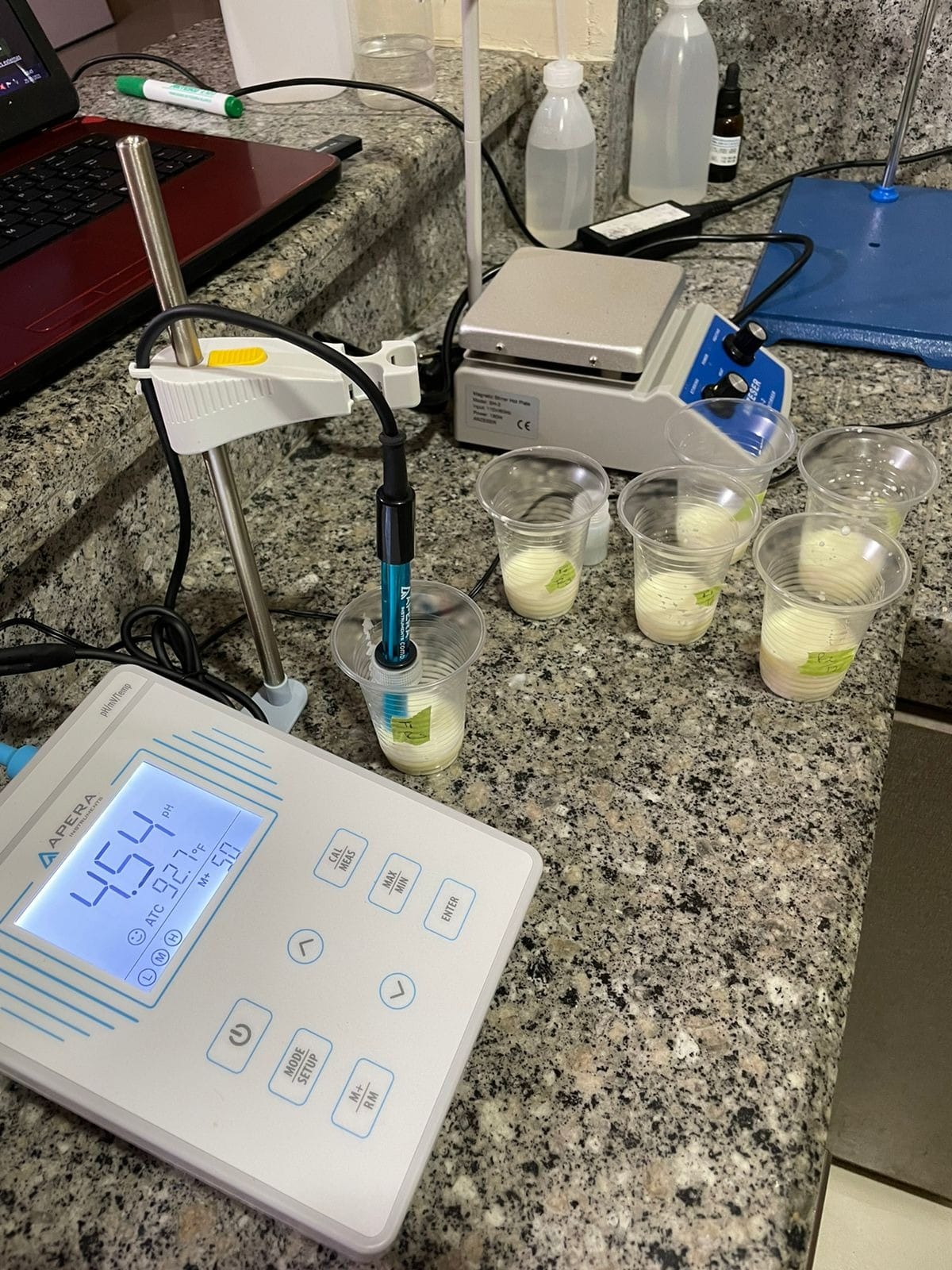
Readings settle quickly and stay put. That is the single most underrated feature in a lab meter, because a value that keeps moving turns every sample into a judgement call. The backlit display shows pH and temperature together, and there is a max and min mode if you want to watch a batch process rather than a single reading.
The Apera also stores 50 sets of data, which is enough for a teaching lab or a small QC log, and the housing is rated IP54 for spill and dust protection. If your bench is next to a sink, that matters more than the spec sheet suggests. It weighs 3 pounds and measures 9.5 by 9.3 by 4 inches, so it takes up very little space.
When this is the right benchtop meter
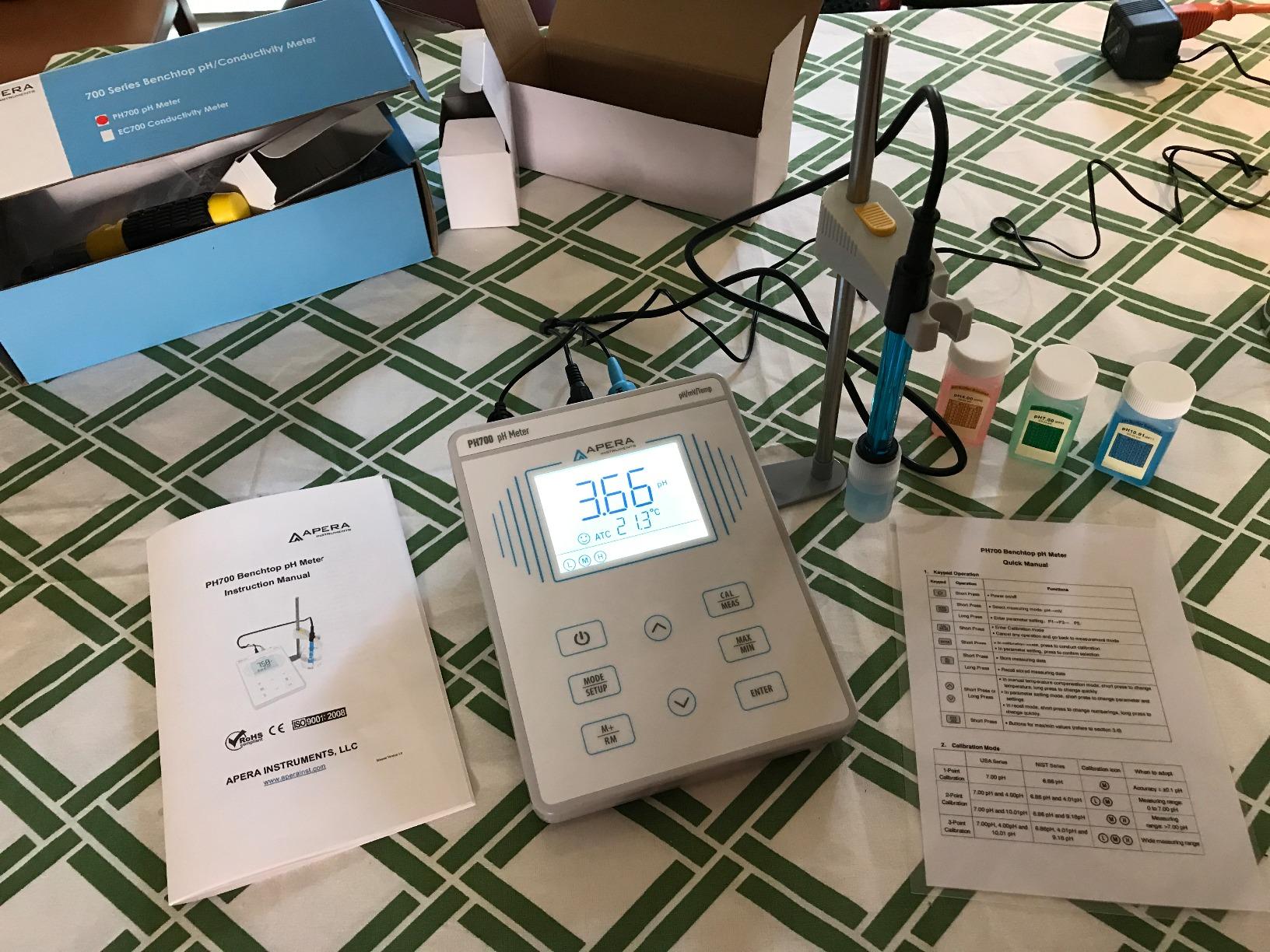
Choose the PH700 when your samples are aqueous buffers, reagent solutions, and routine quality-control checks. It suits pharmaceutical QC, food and beverage QC, environmental work, and teaching labs that need results students can reproduce.
It is also the pick for a lab that is buying its first benchtop instrument and wants a meter that will not punish an inexperienced operator. The self-diagnosis catches bad technique for you.
When to look elsewhere
Skip it for low-conductivity or deionised samples, because the single-junction gel-filled electrode limits sample compatibility and the electrolyte junction cannot be replaced on its own. If your protocol demands a documented calibration log or LIMS export, the 50-set memory here is thin, so look at the Apera AI521 or the Bante A120.
One more caution from owners: a few report the supplied electrode failing within under a year and readings drifting about 0.3 pH, so budget for a replacement probe rather than treating the first one as permanent.
2. Apera PH910 with Refillable LabSen 211 Electrode – Best Refillable Probe
Apera Instruments PH910 Benchtop Lab pH Meter Kit with LabSen 211 Refillable Glass pH Electrode
Accuracy: two-decimal readings
Refillable LabSen 211 electrode
Separate temperature probe
200 data sets with USB
Pros
- Refillable glass electrode with a long service life
- Bright large TFT HD display
- Onboard data storage with USB export
- Serial-number quality certificate included
- Guided smart self-diagnosis
Cons
- Manual references several models and can confuse
- Blue breather plug is easy to mistake for the storage cap
- One buyer reported a cracked power supply housing
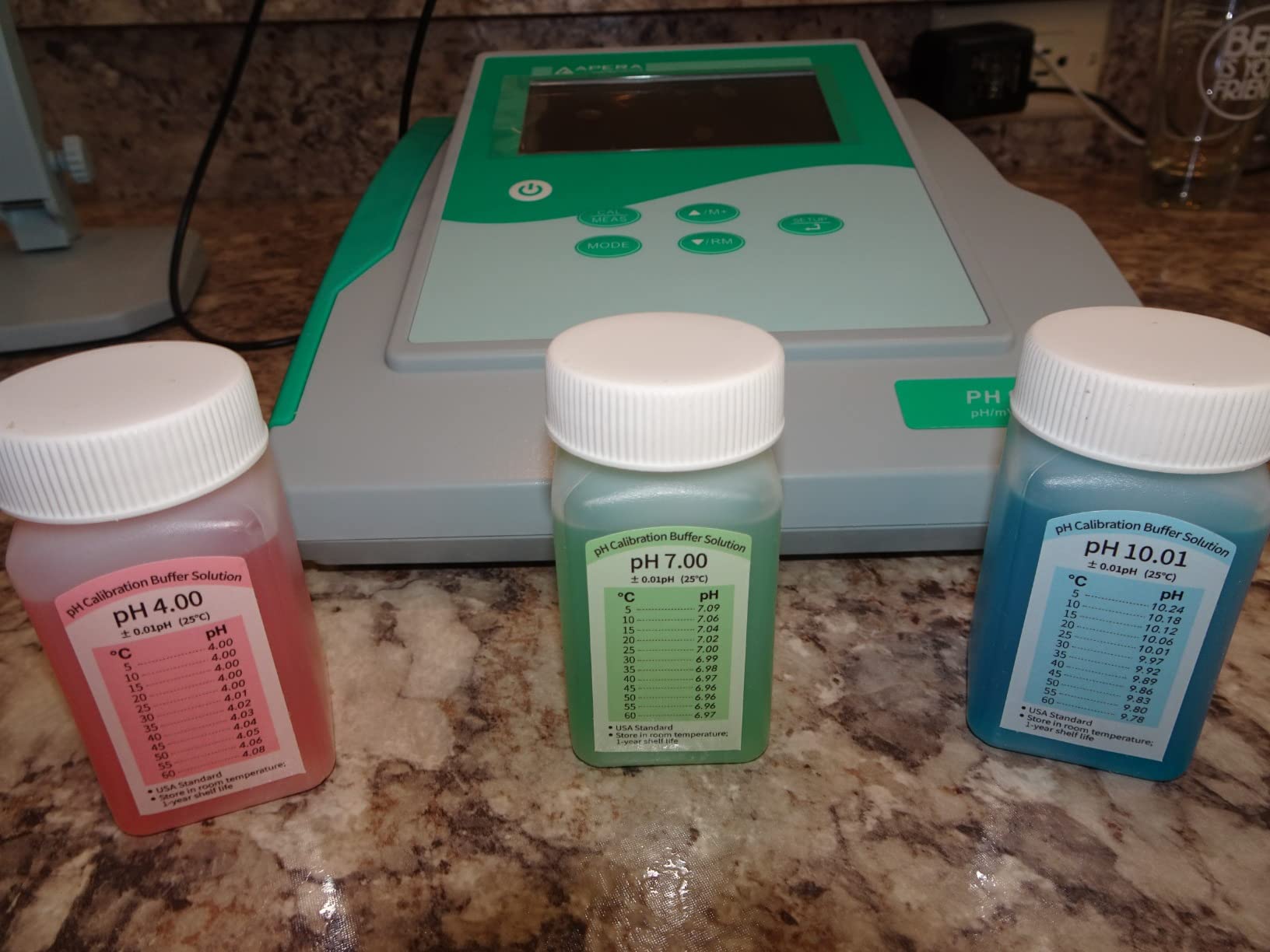
The reason to pick this meter over a cheaper benchtop is the electrode, not the box. It ships with a refillable LabSen 211 glass pH electrode and a separate temperature probe, so when the glass ages you refill the cell instead of buying a new probe.
That single design decision changes the long-run economics of a lab. Refillable electrodes are the difference between a consumable you budget annually and a consumable you budget per technician per year, and reviewers specifically call out the precise two-decimal readings they get from the LabSen 211.
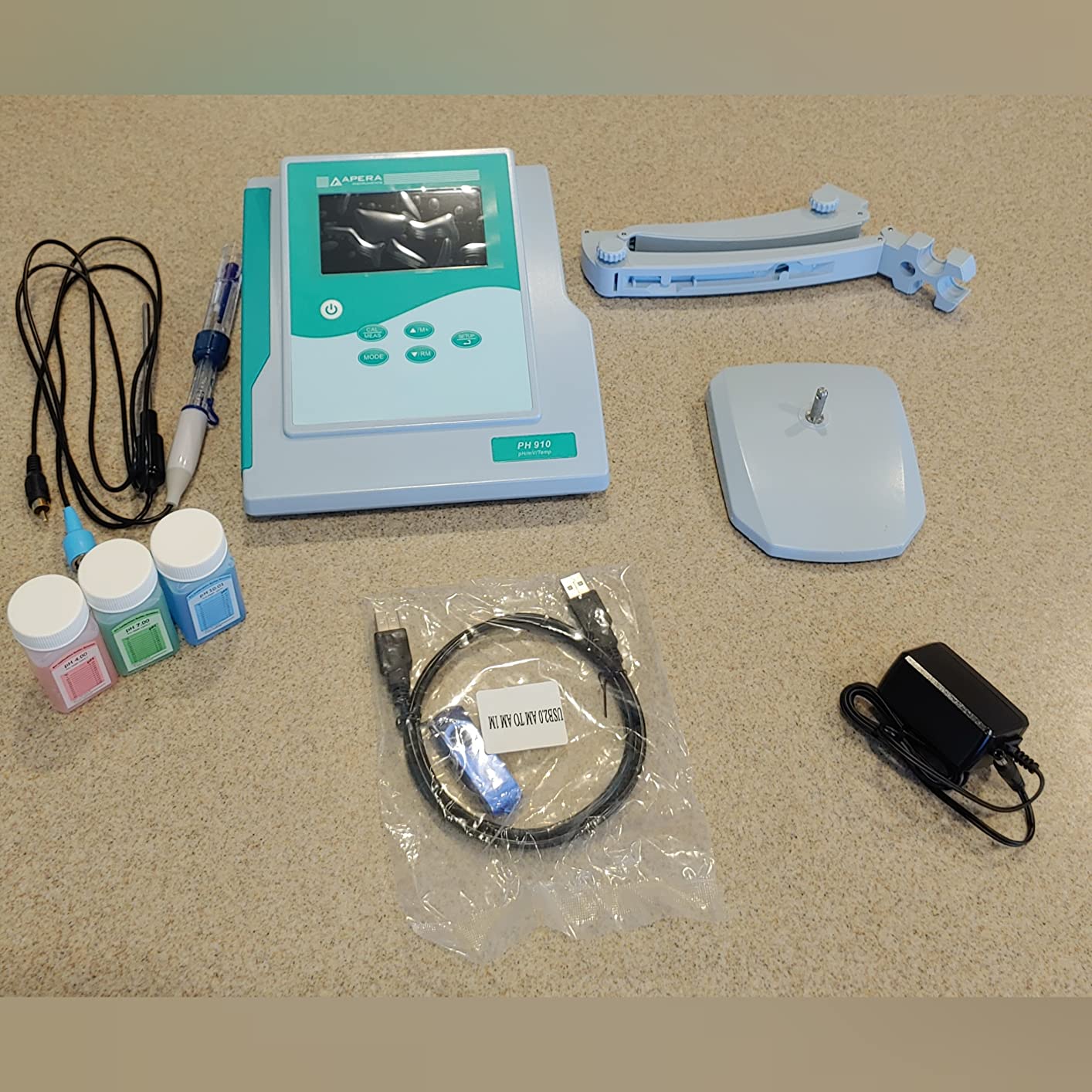
The screen is a step up from the entry benchtops. It is a large TFT HD panel with multi-language prompts and built-in graphic tutorials, which matters more than it sounds when new staff have to calibrate a meter for the first time without a supervisor in the room.
Data handling is where it earns its place. The built-in manual and auto data logger holds 200 sets with USB output, and the smart self-diagnosis confirms each 1 to 3 point calibration succeeded. The electrode slope is shown after calibration, so you have an early warning when the probe is going. Each unit ships with a serial-number quality certificate, which is a genuinely useful document when someone asks you to prove traceability.
When this is the right benchtop meter
This is the pick for labs that measure constantly and hate buying probes. Buffered media, reagent prep, and process samples where you run more than a few dozen readings a day all justify a refillable electrode.
It also suits labs that need to store results rather than jot them on paper. Two hundred stored sets with USB export covers a busy QC week without anyone transcribing values.
When to look elsewhere
Skip it if you need a GLP calibration log, since the storage here is measurement data rather than a formal compliance record. The documentation also frustrates some users, because the manual covers the pH 910, DEC910, and PC910 models in one document, and the blue breather plug on the probe looks enough like the storage cap that people have stored it dry by mistake.
3. Apera AI521 PH800 Laboratory pH Meter – Best for GLP Records
Apera Instruments AI521 PH800 Laboratory Benchtop pH Meter Kit, 0.01 pH Accuracy, GLP Data Management (USB Output), BNC Connector
Accuracy: 0.01 pH
Auto-recognizes 5 buffer types
500-group GLP storage
USB output and BNC
Pros
- Calibration automatically recognizes five standard types
- 500 groups of GLP data storage with USB
- Backlit LCD shows pH and temperature together
- BNC connector keeps probe choice open
- Slope display tracks probe condition
Cons
- Heavier and bulkier than entry-level benchtop meters
- 0.01 pH resolution is below the research-grade class
If your lab lives under a quality system, GLP data management is not a nice-to-have feature, it is the reason you are buying. The Apera AI521 stores 500 groups of data with USB output, and that is the number that matters when a reviewer asks you to reconstruct what the meter read on the day of a batch.
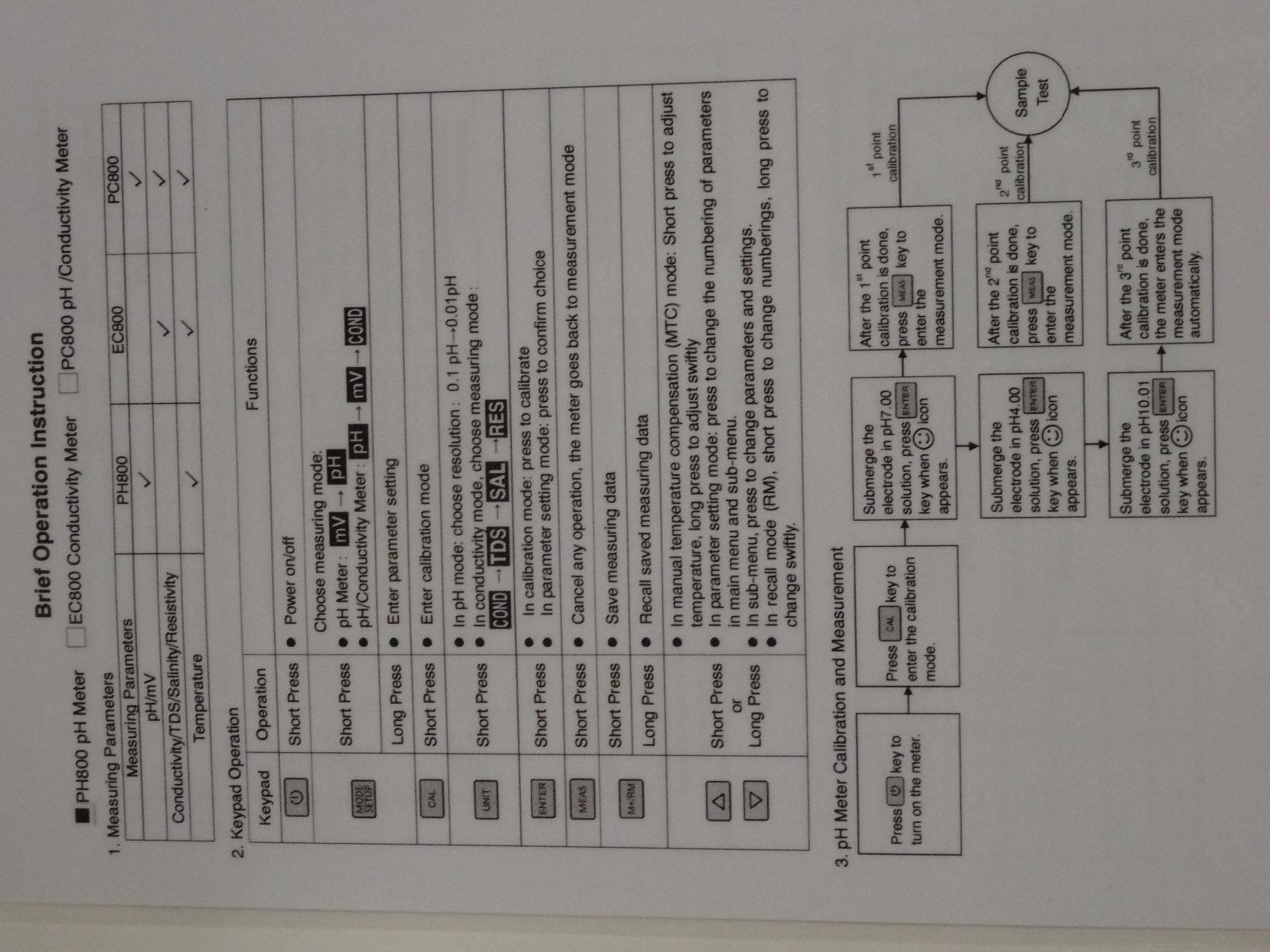
The calibration side is the most confident in this group. The meter auto-recognizes five types of pH standards, which means it figures out which buffer you have actually put in the beaker rather than trusting you to have chosen correctly. For a lab with rotating staff, that removes a whole category of user error.
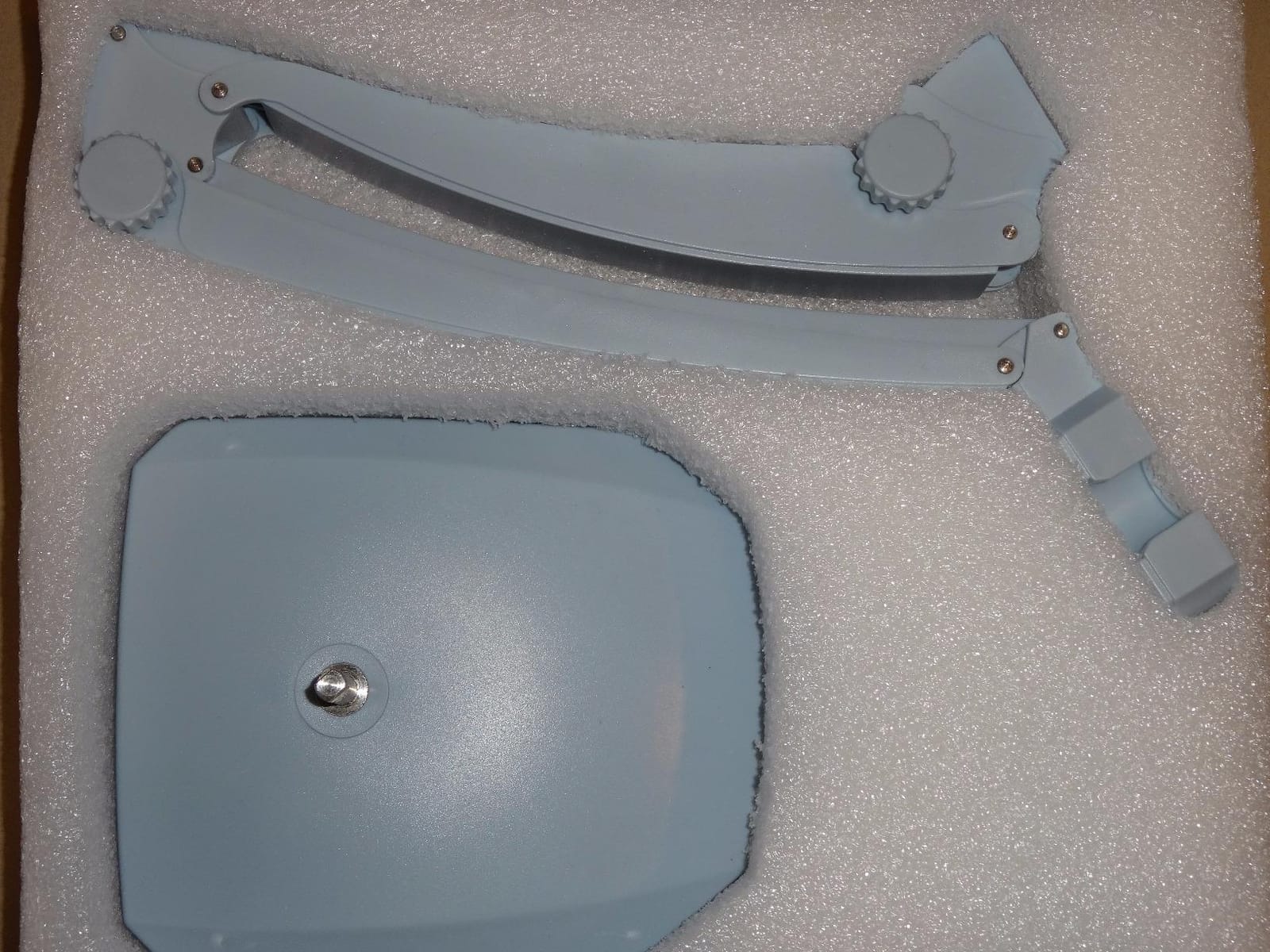
The 201T-F pH and temperature combination electrode handles regular water solutions, and the backlit LCD shows pH and temperature at the same time alongside stability and calibration icons. You can read the state of the instrument and the state of the measurement from one glance.
There is a BNC connector on the meter, which keeps your probe options open. That matters if you later need a different electrode type for a low-conductivity sample or a flat-surface probe for food, because you are not locked into one proprietary probe family.
When this is the right benchtop meter
Choose the AI521 for pharmaceutical QC, food and beverage QC, and any lab facing an external audit. The 500-group GLP store and USB output are the reason this meter exists, and forum discussion among pharma QC users consistently puts documentation and printout capability above raw accuracy in the purchase decision.
It is also a good pick for teaching labs that later have to demonstrate a quality system to outside reviewers.
When to look elsewhere
Pass if your work needs research-grade precision. The 0.01 pH resolution here sits a class below the 0.001 pH instruments, and it is noticeably heavier and bulkier at 5.5 pounds compared with the entry benchtops. If your samples are unusually low in conductivity, the supplied 201T-F electrode is the wrong tool regardless of how good the meter is.
4. Bante 210 Benchtop pH Meter – The Teaching Lab Workhorse
Bante 210 Benchtop pH Meter | Lab pH Meter for Routine Measurements, ±0.01 pH Accuracy, 3 Points Calibration, Equipped with pH Electrode, Temperature Probe and Buffers
Accuracy: plus or minus 0.01 pH
1-3 point calibration with buffer recognition
Electrode slope diagnosis
ATC included
Pros
- Automatic buffer recognition
- Electrode slope diagnosis
- Automatic temperature compensation
- Auto-read locks the endpoint
- Supplied with electrode
- probe and buffers
Cons
- Very few published reviews so long-term field performance is undocumented
- Buyers mostly confirmed arrival quality rather than completed accuracy testing
Twenty students, one bench, and a term of measurements is the situation this meter is built for. The Bante 210 is a classical benchtop pH meter with a backlit LCD, 1 to 3 point calibration with automatic buffer recognition, and automatic temperature compensation.
Automatic temperature compensation, or ATC, is the feature that rescues cheap measurements. The response of a glass electrode shifts with temperature at roughly 0.003 pH per degree Celsius, and ATC corrects the reading against that drift so a room at 18 degrees and a room at 25 degrees give comparable numbers. Without it, a teaching lab is really measuring the thermostat.
The auto-read function senses and locks the measurement endpoint, which removes the biggest source of student error. People stop watching the digits creep and record whatever the meter decided was stable.
It comes supplied with the pH electrode, a temperature probe, and buffers, so you are not ordering four items on day one. At 4.27 pounds and 8.2 by 8 by 2.9 inches it fits a student bench without crowding it.
When this is the right benchtop meter
Pick the Bante 210 for academic teaching laboratories, introductory undergraduate practicals, and any lab running many operators with limited training. Buffer recognition plus auto-read means a first-year student gets a defensible result without a technician standing over them.
It suits routine aqueous measurement where you do not need a data trail beyond the bench.
When to look elsewhere
Do not build a compliance workflow on it. There is no data logging or export in the specification, so results live on a piece of paper or in a spreadsheet someone maintains by hand. And with only 11 published ratings, most of the feedback covers packaging and arrival rather than months of accuracy testing, so the 5.0 average is thinner evidence than it looks.
5. ONiLAB Benchtop pH Meter – Simple, High-Volume Bench Work
ONiLAB Benchtop PH Meter, 3-in-1 PH/Temp, Electrode
pH and temperature measured together
201T-F 3-in-1 ATC electrode
Guided auto calibration
300 data sets
Pros
- Simultaneous pH and temperature with automatic temperature compensation
- Guided auto calibration with self-diagnosis
- Includes electrode holder and buffer solutions
- 300-group data storage
- IP54 spill-proof housing
Cons
- Rating spread includes a notable share of 2-3 star feedback
- Shorter brand track record than established meter makers
- Calibration guide prompts add steps to routine work
On paper this meter matches the Apera PH700 feature for feature. It carries a 201T-F three-in-one combination pH electrode with automatic temperature compensation, measures pH and temperature at the same time, and stores 300 groups of data in an IP54 housing.
What separates it is the guided calibration mode with a calibration guide and self-diagnosis, plus advanced digital processing for quick, stable readings. In practice the guide walks a new user through each buffer rather than assuming they know what a two-point calibration is meant to accomplish.
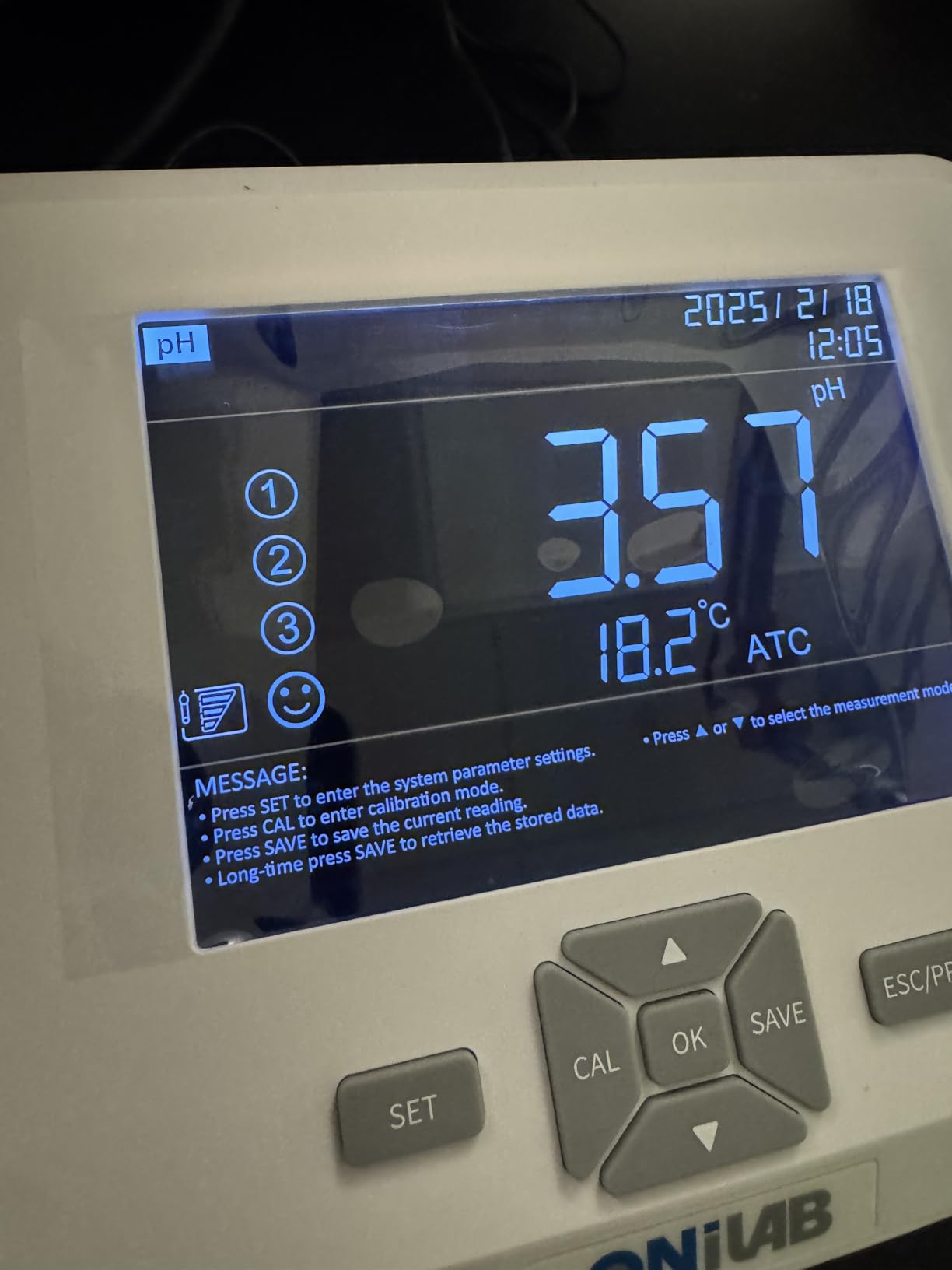
The electrode holder and buffer solutions are in the box, which removes the most common cause of a stalled bench: a meter arriving with no probe, no stand, and no way to calibrate it the same afternoon.
The guided prompts are the part most new users notice first. A meter that explains each buffer step as you go turns calibration from a procedure people copy into a much shorter process people follow, which matters in a lab running many operators on a single instrument.
When this is the right benchtop meter
It suits a lab doing steady routine bench work on water-based samples where the electrode holder and included buffers are what you actually need. The 19.6 by 11.1 by 3.5 inch footprint suits a wide bench with several instruments sharing it.
Choose it when a new member of staff will run the meter and the guided prompts would save you repeating yourself.
When to look elsewhere
This is the pick with the widest rating spread in the group. At 3.9 stars, a notable share of ratings land at 2 to 3 stars, which points to inconsistent results for some users rather than a single isolated complaint. If your work is audit-facing, the rating spread is a real risk and the AI521 is a safer record to point at.
The brand is also newer than the established pH meter makers, which means less long-term field history and a thinner service ecosystem if something fails.
6. Healthible Lab Benchtop pH Meter – The Simple Entry Bench
Healthible Lab Benchtop pH Meter – Digital Bench Top pH Meter and Electrode,Laboratory ph Meter for Liquid,0.01 pH Accuracy,with Data Storage Function
Accuracy: 0.01 pH
Non-reflective LCD
Data storage function
One-key operation
Pros
- Clear non-reflective LCD showing multiple values at once
- One-key measurement operation
- Electrode holder included for hands-free testing
- Built-in data storage
- Light 2.9 pound body
Cons
- Only three published reviews so accuracy is largely unverified
- Compound electrode limited to 5-60 degrees C
- No documented GLP export or USB output
When you need a working benchtop pH meter and you do not need an instrument to write about, this is the one. The operating concept is a high-definition non-reflective LCD showing several values at once, and a one-key measurement operation.
One-key is the entire selling point for a busy bench. You put the probe in, press once, read the value, rinse, and move to the next sample. The non-reflective screen matters in labs with overhead lighting, where a glossy display washes out and people start guessing values from memory.
Data storage runs through a store and extract button rather than a logged file system. An electrode holder is included so the probe does not have to be held by hand, and at 2.9 pounds it is the lightest body in this group.
When this is the right benchtop meter
It fits a demonstration bench, a secondary lab, or any workflow where the measurement is simple and the sample is room temperature. A non-reflective display and an included stand make it practical for shared, multi-user benches.
Use it when you want the ergonomics of a benchtop unit without committing to a model with a deep setup menu.
When to look elsewhere
Three published ratings is not evidence of long-term accuracy, and reviewers mostly describe prompt, efficient delivery rather than measured performance, so treat the 5.0 average as an early signal only. The compound electrode is specified for 5 to 60 degrees C, which rules out chilled samples.
There is also no documented GLP data export or USB output, so this is the wrong meter the moment an auditor asks for a record.
7. Sper Scientific 860031 Benchtop pH Meter – Most Calibration Points
Lab Ph Meter Benchtop, Large Display Ph Water Testing Equipment, Ph Water Meter for Field and Laboratory – Sper Scientific 860031
5 calibration points
NIST buffer recognition
Digital and analog outputs
Auto or manual ranging
Pros
- Five calibration points for precise bracketing
- Large LCD with time
- date and temperature
- Digital and analog outputs for instrument integration
- Automatic or manual ranging
- Long production history
Cons
- Readings can take a long time to stabilize after the ready indicator
- One reviewer reported a value changing for hours instead of holding
- Average rating sits at 4.0 with a visible share of 2-3 star ratings
This is the only instrument here that supports five calibration points, and that single fact changes what you can do with it. When your samples span a wide range, calibrating against buffers that bracket the whole range beats forcing a two-point fit onto data that does not follow a straight line.
It also recognises N.I.S.T. buffers, which is a specific and useful thing to have. A lab running to a documented standard wants the meter applying the correct set rather than a generic assumption.
For integration work, the digital and analog outputs let it feed a controller or a logger, and the large LCD shows the measured parameter alongside time, date, and temperature. The automatic and manual ranging options give you flexibility when you move between sample types.
When this is the right benchtop meter
Pick the 860031 when you work across a wide pH range and want the buffer set to match the samples, or when you need to integrate the meter with other instrumentation through analog or digital output.
It is a sensible fit for environmental and water testing work where a single two-point calibration across a variable sample range would be a compromise.
When to look elsewhere
Stability is the concern, and the reviews are unusually consistent about it. Users describe readings taking a long time to settle after the ready indicator appears, and one reported a value that kept changing for hours instead of holding steady. At 4.0 stars with a visible share of 2 to 3 star ratings, I would not put this on a high-throughput QC bench.
The published weight of 0.704 ounces also does not match a 7 by 2.25 by 8.5 inch benchtop chassis, so treat the mechanical details in the listing with suspicion.
8. Oakton pH 550 Benchtop pH Meter Kit – Ready Out of the Box
Oakton pH 550 Benchtop pH Meter Kit with Probe, Stand, and pH Buffers
Automatic calibration solution recognition
Probe and stand included
Buffers included in the kit
Benchtop format
Pros
- Automatic recognition of calibration solutions removes guesswork
- Complete kit with probe
- stand and buffers
- Established benchtop pH meter line
- Recognized lab brand name
Cons
- Only a single published rating so reliability is essentially undocumented
- Listed product detail is sparse compared with competing listings
The argument for the Oakton pH 550 is procurement simplicity. The kit arrives with the probe, the electrode stand, and pH buffers, so a new laboratory can be measuring the day it is delivered instead of waiting for a purchase order to clear.
The meter’s one substantive feature is automatic recognition of calibration solutions. It identifies the buffer you have inserted and sets the calibration points to match, which removes the step where an operator has to tell the instrument what they are doing.
Oakton is an established benchtop pH meter line, and for labs standardising on a single brand across multiple rooms, that consistency is worth something on its own.
When this is the right benchtop meter
It fits a new laboratory, a teaching department outfitting several rooms, or a group that wants one recognised brand on every bench so spare parts and training stay simple.
Choose it when the priority is a complete working kit rather than a deep feature list.
When to look elsewhere
A single published rating tells you almost nothing about field reliability, and the listing carries very little technical detail beyond the buffer recognition, so you are buying on the brand rather than on verified performance. If your protocol needs a documented accuracy figure, a calibration log, or data export, this listing gives you nothing to point at.
For any compliance-facing work, choose a meter whose datasheet you can hand to an auditor.
9. Milwaukee MW150 Bench Meter – Compact With mV Readout
Milwaukee pH/mV/Temp Bench Meter – MW150
pH, mV and temperature measurement
Up to 3-point calibration
2 pound benchtop body
Compact footprint
Pros
- Benchtop pH
- mV and temperature measurement in one unit
- Up to 3-point calibration
- Compact 9 by 6.3 by 3.7 inch footprint
- Light 2 pound weight suits a crowded bench
Cons
- Described as a basic benchtop meter with minimal listed features
- Only one published rating so long-term performance is unverified
- No data logging or USB output detail in the listing
The Milwaukee MW150 is the one to consider if you work with millivolts as well as pH. It measures pH, millivolts, and temperature on a compact benchtop chassis, and up to 3 point calibration is supported.
mV matters in specific jobs. Ion-selective electrode work, redox checks, and troubleshooting a reference electrode all require reading raw potential, and a meter that will not display it forces you into indirect inference from the pH value.
The physical design is genuinely practical. At 9 by 6.3 by 3.7 inches and 2 pounds, it is one of the smaller bodies in this group, which matters on a bench already shared between a balance, a hotplate, and a pipette rack.
When this is the right benchtop meter
Pick it for a crowded bench, for a teaching lab where robustness and low footprint matter, or for a workflow that needs mV readings alongside pH without adding a second instrument.
It is a practical default where you measure aqueous samples daily and do not need a stored data trail.
When to look elsewhere
The listing describes a basic benchtop meter with minimal features, and there is no data logging or USB output detail. With one published rating, long-term performance is simply unverified, so this is not the instrument to standardise a regulated QC process on.
If your protocol needs pH, ORP, conductivity, TDS, and salinity from one unit, a multi-parameter meter is the correct shape of purchase instead.
10. Bante A120 Laboratory pH Meter – Research-Grade Precision
Bante A120 Laboratory pH Meter | Benchtop pH Meter | ±0.002 pH Accuracy, 1 to 5 Points Calibration, Selectable ORP Measurement Mode, Auto-Read Endpoint, 1000 Sets of Data Storage
Accuracy: plus or minus 0.002 pH
1-5 point calibration
ORP in relative and absolute mV
1000 data sets with USB
Pros
- Plus or minus 0.002 pH accuracy
- 1-5 point calibration with buffer recognition
- Automatic diagnosis of zero-point offset and slope
- 1000 data sets with USB export to Excel
- Password protection and calibration due alarm
Cons
- Only one published rating so field reliability is uncorroborated
- Heavy 5.48 pound body for a benchtop meter
- Deep menu structure raises the learning curve
If your work needs a research-grade instrument, the Bante A120 is the strongest spec sheet in this roundup. It is rated at plus or minus 0.002 pH accuracy, and it accepts 1 to 5 point calibration with automatic buffer recognition.
Five points matters for buffer selection. You can bracket your actual sample range with buffers you genuinely use rather than always running the same three, which is the correct approach for anything that leaves the neutral region.
The setup menu has 16 options, including buffer group, calibration points, resolution, temperature coefficient, a calibration due alarm, upper and lower limit alarms, stability criteria, interval readings, and auto power off. Memory holds up to 1000 data sets, and the USB interface works with bundled software that receives measurement data and produces Excel files.
When this is the right benchtop meter
It suits research groups, university laboratories working to tight tolerances, and any QC operation that needs a calibration due alarm rather than a calendar reminder. The password protection is built for protocols where an unauthorised calibration change is a compliance problem.
Choose it when you also need ORP, since it offers selectable ORP in both relative and absolute millivolt modes alongside pH.
When to look elsewhere
One published rating is thin evidence for the most precise meter here, so the accuracy claim is a datasheet figure rather than an owner-verified one. It is also a 5.48 pound body, and the deep menu structure is a real cost for a new operator who has to learn 16 settings before taking their first reading.
If your accuracy requirement is plus or minus 0.01 pH, you are paying for resolution you may never use, and a simpler benchtop will serve you better.
11. Ohaus Starter ST5000-B Bench Meter – Longest Warranty
Ohaus Starter ST5000-B 0.001pH pH Bench Meter ORP Measurement 3 Year Warranty
Resolution: 0.001 pH
pH and ORP modes
Three year manufacturer warranty
Compact 2 pound body
Pros
- 0.001 pH resolution in the highest precision class
- pH and ORP measurement in one instrument
- Three year manufacturer warranty
- Compact 2 pound bench footprint from an established brand
Cons
- Highest-priced instrument in this roundup
- Only one published rating and very little listed specification detail
The Ohaus Starter ST5000-B is a bench meter with 0.001 pH resolution and both pH and ORP measurement modes. It is also the only instrument in this roundup backed by a stated three year manufacturer warranty, and that is not a trivial difference for a laboratory.
Warranty length is one of the few purchase criteria you can actually verify at the point of decision. It tells you something about the manufacturer’s confidence in the instrument and about whether there will be a service channel when something fails, which matters more in a regulated lab than the number of menu options.
Physically it is compact at 8.66 by 6.89 by 3.07 inches and 2 pounds, so it does not dominate a bench the way some of the larger benchtops here do.
When this is the right benchtop meter
Pick it for a laboratory that wants a long warranty behind the instrument, and for a bench that runs both pH and ORP measurements. The compact footprint suits a shared or space-constrained bench.
It is a reasonable choice where the brand carries more weight with your own quality system than the published feature list does.
When to look elsewhere
It is the highest-priced instrument in this roundup by a wide margin, and the listing carries a single rating with very little technical detail. You are largely paying for the Ohaus name, the warranty, and the 0.001 pH class rather than for verified owner-level performance.
If your budget goes further than one instrument, the money is often better spent on a refillable electrode and a documented calibration procedure.
12. Sper Scientific 860033 Multi-Parameter Water Quality Meter – Most Parameters, Coarsest Accuracy
Sper Scientific Benchtop Water Quality Meter 860033 – Multi-Parameter pH, ORP, Conductivity, TDS, Salinity & Temperature Analyzer with Automatic Calibration & EPA Equivalency for Labs & Industrial Use
pH, ORP, mV, conductivity, TDS, salinity, temperature
Accuracy: plus or minus 0.02 pH
EPA Method 120.1 compliant
Pros
- Measures pH ORP mV conductivity TDS
- salinity and temperature
- Comes with ATC conductivity electrode
- pH electrode
- holder
- cable and software
- Digital and analog outputs with 99-point storage
- EPA Equivalency Method 120.1 compliant
- Accepts standard BNC probes
Cons
- Lowest rated at 2.7 stars with 50 percent of ratings at one star
- Plus or minus 0.02 pH accuracy is the weakest figure in the roundup
- Readings take a long time to settle and need the sample swirled around the probe
Sometimes the correct purchase is one instrument instead of four. The Sper Scientific 860033 measures pH, ORP, mV, conductivity, TDS, salinity, and temperature from a single unit, which is the cost-saving argument for multi-parameter meters in a small laboratory.
The package is genuinely complete. It includes an ATC conductivity electrode, a pH electrode, an electrode holder arm, an AC adaptor, a computer cable, and analysis software. Digital and analog outputs support instrument integration, there are 99 data points of storage, and it meets EPA Equivalency Method 120.1 for conductivity testing.
It accepts standard BNC pH or ORP probes, so you are not locked into one electrode family, and automatic or manual temperature and range compensation handle varying sample conditions.
When this is the right benchtop meter
It suits environmental and water testing laboratories, aquaculture operations, and teaching labs that need to run a full water quality panel rather than a single pH number. If your protocol requires documented conductivity work, the EPA Equivalency Method claim is the reason to pick it.
It is the sensible shape of purchase when bench space and instrument count are the binding constraints.
When to look elsewhere
The pH performance is the weak point. The plus or minus 0.02 pH accuracy is the coarsest figure in this roundup, and owners report pH readings that take a long time to settle and require swirling the sample around the probe, plus a long warm-up time on routine analysis.
At 2.7 stars, with 50 percent of ratings at one star, this is the pick we would not put on a bench where pH is the primary measurement. Buy it for the multi-parameter value, and understand what you are accepting on the pH channel.
How to Choose a Lab pH Meter
Start from where the sample is measured, not from the feature list. A fixed bench calls for a benchtop meter with an electrode stand and data logging. Field sampling calls for an IP-rated handheld. A water quality panel calls for a multi-parameter unit. Getting the form factor right removes most of the wrong purchases before you read a single specification.
Accuracy versus resolution, and why the electrode is the ceiling
Resolution is how many digits the display shows. Accuracy is how close the number is to the truth. A meter can display 0.001 pH and still be wrong by 0.05 pH, because the limiting factor is almost always the glass electrode and its reference junction rather than the electronics.
For research applications, look for 0.001 pH resolution with accuracy in the plus or minus 0.002 to 0.01 pH range. For routine quality control, plus or minus 0.01 pH is the working standard, and that is where most of the meters in this roundup sit. The Bante A120 and the Ohaus ST5000-B are the two instruments here that push into the finer classes.
Calibration: buffers, points, and bracketing
Every meter must be calibrated. No exceptions, and no meter is more accurate than its last calibration. Buffers come as pH 4.01, 7.00, and 10.01, and the rule most labs get wrong is using all three every time instead of bracketing the sample range.
If your samples sit between 6 and 8, calibrate in 7.00 and a second nearby buffer rather than dragging a 4.01 solution into the protocol. One-point calibration is acceptable for occasional spot checks. Two-point covers most quality control work. Three-point suits a broad range, and five-point calibration on the Bante A120 and the Sper Scientific 860031 covers genuinely wide spans.
Frequency depends on workflow rather than calendar. Calibrate at the start of each day, before high-precision work, after any electrode replacement, and whenever readings shift unexpectedly. Poor or inconsistent calibration technique produces cumulative errors that skew results without anyone noticing.
What ATC actually does
Automatic temperature compensation corrects the meter reading for the way a glass electrode responds to temperature, which drifts by roughly 0.003 pH per degree Celsius. It corrects the instrument, not your sample.
This is worth separating because a sample at 4 degrees and a sample at 37 degrees are genuinely different chemistry. ATC makes the two readings comparable as measurements; it does not make the samples the same.
Documentation for regulated laboratories
GLP, meaning good laboratory practice, is where the audit trail matters. A meter that stores calibration records and exports them is worth more to a pharmaceutical or food QC laboratory than one with a marginally better accuracy figure, and forum discussion among pharma QC users puts printout and compliance options at the top of the purchase criteria.
Look for a stored calibration log, USB or serial export, and stable buffer recognition for US and NIST sets. The Apera AI521, Bante A120, and Sper Scientific units here cover that need to varying degrees.
Electrode cost, storage, and total cost of ownership
The electrode is a consumable and should be budgeted as one. Electrodes have a replacement interval measured in months rather than years, and the recurring cost of buffers and probes is what separates a cheap meter from a cheap laboratory.
Two storage rules prevent most early failures. Store the electrode in 3M KCl storage solution, and never store it in deionised water, which leaches ions from the reference junction and kills it. Keeping a meter on a bench is fine; keeping an electrode in a jar of deionised water is not.
Our wider lab-equipment coverage follows the same pattern, as you will see in the bench instrument roundups we publish for other disciplines: the consumable and the calibration method decide the running cost, not the purchase price.
Troubleshooting: Why Your pH Reading Is Wrong
Almost every complaint we saw in laboratory forums is not really about the meter. It is about the electrode, the storage, or the buffer. The symptoms below map to the usual cause and the usual fix.
Readings drift steadily after a good calibration: the electrode is probably aged, or the reference junction is exhausted. Check the slope and offset readings after calibration, and if the slope is well outside the 85 to 105 percent healthy range, replace the probe.
The value keeps changing instead of settling: the glass bulb is usually coated, or the sample is not being stirred consistently. Rinse with deionised water between samples, never wipe the bulb with a tissue, and stir gently and uniformly.
The reading is off in fresh buffer: either the buffer is expired or contaminated, or the meter is not compensating for buffer temperature. Buffers are consumables with a shelf life, and touching the inside of a buffer bottle with a probe introduces contamination that then propagates through every standard after it.
Response is slow in low-conductivity samples: a single-junction electrode is the wrong tool. Low ionic strength samples need a double-junction electrode, because the single junction lets sample ions migrate into the reference and shift the potential.
Readings change with the room temperature: automatic temperature compensation is off, or the temperature probe is not in the sample. ATC is a correction for electrode behaviour, and it needs a real temperature reading to do anything.
Inline and process probes fail the same way with an added mechanism. Operators report probes building up with scum and beginning to drift lower than the actual value, which means a reading that is quietly wrong rather than obviously broken.
Frequently Asked Questions
What is the best pH meter for lab use?
For most laboratories, the Apera PH700 is the best pH meter for lab use because it combines a 0.01 pH accuracy specification, 1 to 3 point automatic calibration with self-diagnosis, a 3-in-1 ATC electrode, and 50 sets of stored data in a spill-resistant housing. Research labs needing plus or minus 0.002 pH accuracy should consider the Bante A120, and teaching labs on a budget should consider the Bante 210. Whichever you pick, the electrode and the calibration routine determine the accuracy, not the display.
What is the most accurate pH meter?
Among the meters reviewed here, the Bante A120 has the tightest published accuracy specification at plus or minus 0.002 pH, with 1 to 5 point calibration and selectable resolution. The Ohaus ST5000-B reaches the same precision class with a 0.001 pH resolution display and a three year warranty. Actual accuracy in your laboratory will be limited by electrode condition, buffer quality, and technique rather than by the instrument alone.
Are digital pH meters more accurate than pH paper?
Yes, by a wide margin. A benchtop digital pH meter rated at plus or minus 0.01 pH resolves differences that pH paper, which typically steps in half-pH increments, cannot distinguish at all. pH paper remains useful for rough screening and field checks where a meter is impractical, but any result that will be recorded, reported, or audited should come from a calibrated digital meter.
What does ATC mean on a pH meter?
ATC stands for automatic temperature compensation. A glass electrode response shifts by roughly 0.003 pH for every degree Celsius, so ATC applies a correction using the measured temperature so the displayed value reflects hydrogen ion activity rather than ambient temperature. ATC corrects the measurement, not the sample chemistry, so two samples at different temperatures remain different samples.
What are the symptoms of a dirty pH electrode?
The main symptoms are readings that drift steadily after a good calibration, a slow response that takes far longer than usual to settle, and results that are off when checked in fresh buffer. A coated glass bulb and an exhausted reference junction are the usual causes. Rinse between samples with deionised water, never wipe the bulb with tissue, and replace the electrode when the slope reading falls outside the healthy range.
How often should I calibrate a lab pH meter?
Calibrate at the start of each day of use, before any high-precision measurement, after replacing an electrode, and whenever readings shift unexpectedly. In a busy quality control laboratory, calibration before every sample batch is the safer practice. Remember that a meter is only as accurate as its last calibration, so an irregular calibration habit produces cumulative errors that skew results without anyone noticing.
Should I store a pH electrode in deionised water?
No. Store the electrode in 3M KCl storage solution, and keep the storage cap in place so the junction does not dry out. Deionised water leaches ions from the reference junction, which permanently degrades it and produces readings that drift low. A saturated potassium chloride solution is the standard storage electrolyte because its ion mobility is close to that of a general sample.
Final Verdict
After working through all twelve, the Apera PH700 remains the digital pH meter for lab use we recommend to most laboratories, because it is the one that gets used correctly by everyone who touches it. The Bante A120 takes the research and compliance categories on specification strength, and the Bante 210 covers teaching labs without pretending to be more than it is.
Whatever you buy, budget the electrode, keep the 3M KCl on the bench, and calibrate before you trust a number. Our training equipment roundups follow the same principle from a different bench. This list is updated for 2026, and we revise it whenever specifications change.