
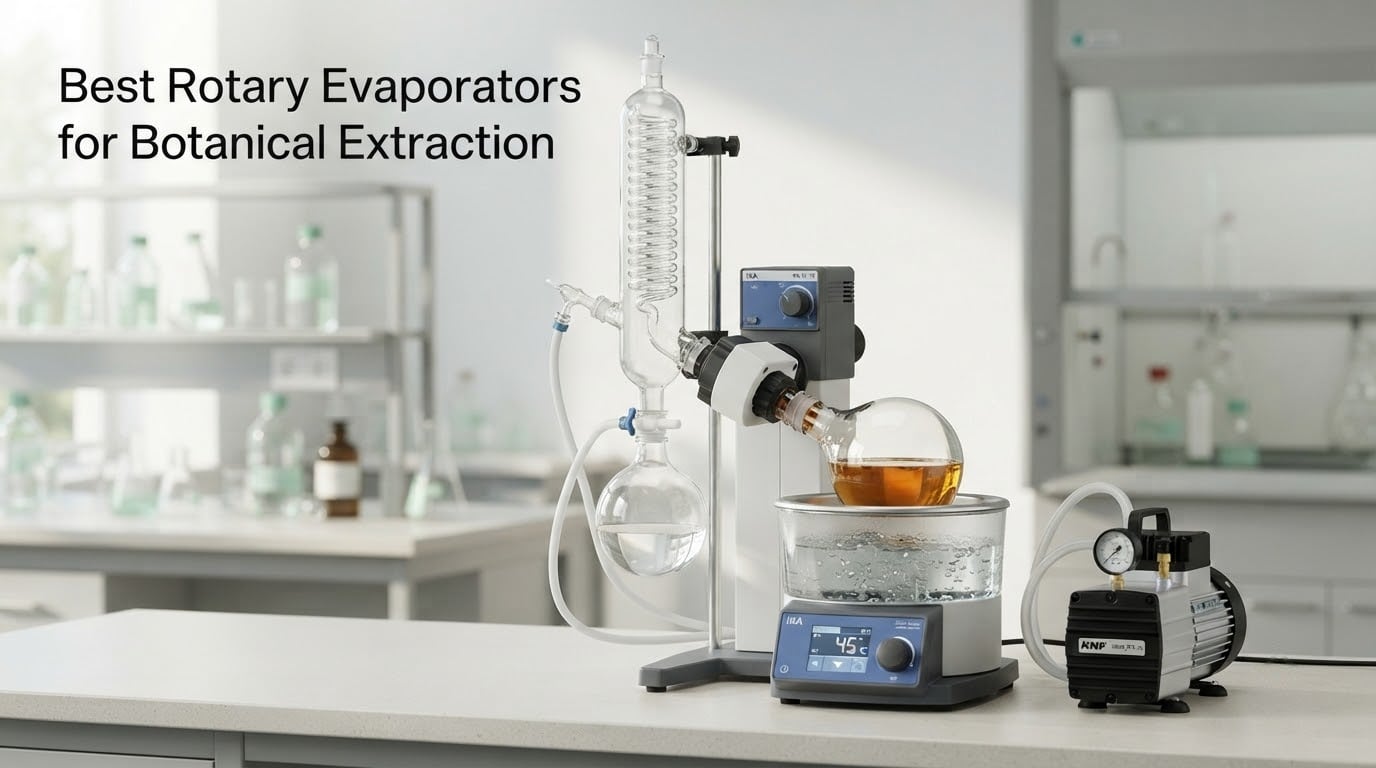
Every botanical extraction run ends with the same unglamorous problem: a large volume of solvent-laden extract has to become a small volume of thick concentrate. A rotary evaporator, or rotovap, is the machine that closes that gap. It spins a flask of crude botanical extract in a temperature-controlled bath while a vacuum pump pulls the pressure down, so the solvent boils far below its normal boiling point, travels into a condenser, and lands in a receiving flask as recovered liquid.
That vacuum step is the whole point, and it directly answers one of the questions people search for most: a rotovap decreases pressure inside the sealed flask, it never increases it. Dropping pressure lowers the boiling temperature, which is exactly what you want with heat-sensitive terpenes and cannabinoids. The same principle behind a good cordless rotary hammer selection, choosing the right tool for the actual job, is what matters here.
This guide covers the best rotary evaporators for botanical extraction for 2026, from 1L benchtop models built for small herbal tincture work up to 5L turnkey sets with a chiller and cold trap. I worked through the specifications, the review history and the failure points on every model here, and I flag the ones where the listing says less than the spec sheet suggests. If you run cannabis and hemp crude oil, hydroalcoholic herbal extracts, essential oil concentrates or botanical supplements, the right flask size and the right bath temperature will save you more money than any other single purchase in the lab.
Table of Contents
Top 3 Picks for Botanical Extraction
TECHTONGDA 2L Rotary Evaporator
- 1L evaporating and 1L collecting flasks
- 0-120 rpm rotation
- 1KW PID digital bath
- Double-layer serpentine condenser

HNpuxing PX-2001 2L Rotary Evaporator
- Built-in vacuum controller at +/- 1 mbar
- PTFE plus fluororubber dual seals
- 150mm lifting stroke
- Inclined double-layer condenser

Rotovap with Pump, Chiller and Cold Trap
- Pump and chiller bundled
- Cold trap condenser cooling to -20C
- Triple sealed structure
- Manual lift at 110V
Best Rotary Evaporators for Botanical Extraction in 2026
All ten models below are compared on the four specs that decide whether a rotovap can handle plant material: evaporating flask capacity, rotation range, bath heating and control, and condenser cooling area. Three of them bundle a vacuum pump, and two bundle a chiller as well. Read the capacity column first, since flask size is the hardest limit to work around later.
| Product | Specifications | Action |
|---|---|---|
| TECHTONGDA 2L Rotary Evaporator, 1L Flasks, 0-120rpm |
|
Check Latest Price |
 HNZXIB RE-201D 1L Rotary Evaporator, 304 Steel Bath HNZXIB RE-201D 1L Rotary Evaporator, 304 Steel Bath |
|
Check Latest Price |
| HNpuxing PX-2001 2L Rotary Evaporator with Vacuum Control |
|
Check Latest Price |
 TECHTONGDA 2L Rotary Evaporator with 15L Circulating Pump TECHTONGDA 2L Rotary Evaporator with 15L Circulating Pump |
|
Check Latest Price |
 INTBUYING RE-2000A 2L Auto-Lift Rotary Evaporator INTBUYING RE-2000A 2L Auto-Lift Rotary Evaporator |
|
Check Latest Price |
 Huanyu 2L Rotary Evaporator for Solvent Removal Huanyu 2L Rotary Evaporator for Solvent Removal |
|
Check Latest Price |
 4E’s USA RV131 1000mL Rotary Evaporator 4E’s USA RV131 1000mL Rotary Evaporator |
|
Check Latest Price |
 USA Lab RE-501 5L Rotary Evaporator, 180C USA Lab RE-501 5L Rotary Evaporator, 180C |
|
Check Latest Price |
| Rotovap with Pump, Chiller and Cold Trap Condenser |
|
Check Latest Price |
 Haocheng 5L Electric-Lift Rotovap with Chiller and Pump Haocheng 5L Electric-Lift Rotovap with Chiller and Pump |
|
Check Latest Price |
1. TECHTONGDA 2L Rotary Evaporator, 1L Flasks, 0-120rpm – Best Overall
TECHTONGDA 2L Rotary Evaporator, 110V Lab Manual Lifting Rotavap with Digital Screen, 0-120rpm Speed, Lab Evaporator
1L evaporating and 1L collecting flasks
0-120 rpm rotation
1KW PID digital bath
-0.098 Mpa vacuum
Pros
- Manual 120mm lift clears the bath quickly for solvent removal
- High borosilicate glass and stainless structure resist heat and corrosion
- PID digital bath control with live speed readout
- Drains foam from the downward condenser mouth
Cons
- No vacuum pump bundled so you need a separate pump
- 1L flasks limit botanical batch size
- Fluoro rubber seals and the coil condenser are wear parts
This is the model I keep coming back to for botanical work, and the reason is the review record rather than the spec sheet. Eight reviews is the largest verified sample of any model on this list, and the average holds at 4 out of 5 with most buyers landing on five stars. It is also the only model here with a documented category position, sitting at number 14 in Lab Rotary Evaporators on the Industrial and Scientific chart, which tells me real labs are ordering it rather than hobbyists. Our broader approach to testing budget lab gear is covered in the hands-on coverage on rotary tool kit picks, which uses the same evidence-versus-marketing test.
The machine itself is straightforward. You get a 1L evaporating flask, a 1L collecting flask, rotation from 0 to 120 rpm, a 40W gear-reduced motor with overload protection and a -0.098 Mpa vacuum rating. The bath is 304 stainless steel with PID digital control, and the condenser is a double-layer serpentine coil. Fluoro rubber sealing throughout handles the corrosive side of botanical solvent work better than plain rubber would.
What stands out in practice is the manual 120mm lift. On a repeated batch schedule, the ability to drop the bath clear of the flask in seconds and get moving again is worth more than an electric lift. The downward-facing condenser mouth also lets bubble and foam drain without you shaking the glass, which matters when a crude extract emulsifies partway through a run.
The honest limitation is that no vacuum pump is included. You will be sourcing a water-circulating or dry pump separately, which also means you can choose a pump matched to your solvent rather than settling for whatever is included in the box. Several of the packages below bundle one; the TECHTONGDA does not.
What a 1L flask means for botanical batches
A 1L evaporating flask is roughly 800 mL of practical working load, so a raw botanical tincture run of about three quarters of a litre in, concentrated down before you swap the flask. That is a research and pilot scale, not a production scale.
For a small herbal or essential oil operation running sample batches, a 1L flask forces constant changeovers on a busy day. A 2L flask halves that friction, and a 5L flask removes it for most craft operations.
What to watch before buying this model
Plan for a separate pump budget, because a complete system costs considerably more than the rotovap on its own. The condenser coil and the fluoro rubber seals are consumables that will need replacing across a season of long extraction runs.
Eight reviews is thin by industrial standards, so treat the reliability picture as encouraging rather than proven. Ask the seller for parts availability in your region before you commit.
2. HNZXIB RE-201D 1L Rotary Evaporator, 304 Steel Bath – Small-Batch Workhorse
HNZXIB Lab Rotary Evaporator #RE-201D, 1L High Borosilicate Glass, 304 Stainless Steel Water Bath, Digital Display & Stepless Speed Control, Manual Lifting, Vertical Coiled Condenser, 110V/60HZ
1L evaporation and 1L receiving flasks
0.2 m2 vertical coiled condenser
7.5L 304 steel bath to 399C
Stepless 0-120 rpm at 110V
Pros
- Largest published condenser cooling area in the 1L class
- High borosilicate glass handles sudden temperature changes
- Stepless speed control adapts to sample load
- 110V native design needs no adapter
Cons
- Manual bath lifting at every changeover
- One review leaves no long-term reliability history
- 1L flasks suit bench samples not bulk material
The single review on this model comes from a lab operator who also owns a name-brand rotavap costing several times more, and that buyer reports no practical difference in daily use with staff preferring this unit. That is a useful data point, but it is one data point, and I would not build a production schedule around it.
Where this machine genuinely earns its place is the condenser. The vertical coiled condenser carries 0.2 m2 of cooling area, and it has the largest published condenser cooling area of any 1L model here. Cooling area matters more than most buyers realise: solvent vapour that does not condense travels straight to the pump instead of your receiving flask, and a flood of oil or ethanol into a dry pump ends the conversation.
The 7.5L 304 stainless bath reaches 399C with plus or minus 2C precision, driven by a 1.1KW element, and rotation runs stepless from 0 to 120 rpm on a 30W high-torque motor. Voltage is 110V and 60Hz, so it works on a standard US bench without an adapter.
Where the 399C bath rating helps and hurts
The headroom helps when you need to push a high-boiling botanical solvent, and it protects you from a bath that simply cannot reach setpoint on a cold day. The 304 stainless construction also tolerates the aggressive cleaning routines a botanical line demands.
For heat-sensitive work the rating is irrelevant on its own, because you still set the bath by solvent vapour pressure rather than by maximum. Nobody is running a cannabinoid crude at 399C, whatever the spec sheet permits.
What to watch before buying this model
One review is essentially no reliability history at all, so weight the specification sheet more heavily than you otherwise would. Manual lifting means you raise and lower the bath by hand at every changeover, which adds up across a day of small herbal batches.
Confirm that a separate pump and a cooling source are available for your bench before purchase, because neither is included.
3. HNpuxing PX-2001 2L Rotary Evaporator with Built-In Vacuum Control – Budget Pick
2L Rotary Evaporator ,Lifting lab Evaporator Rotary, Vacuum Evaporator Digital Controller 0-120rpm Rotary Evaporator
2L borosilicate flask with 1L collector
Built-in vacuum controller at +/- 1 mbar
PID bath to 100C with oil mode to 185C
150mm lift stroke
Pros
- Built-in vacuum controller removes the need for a separate gauge
- PTFE and fluororubber dual seals suit corrosive solvents
- PTFE feed valve allows continuous addition under vacuum
- Overheat warning and dry-burn protection are standard
Cons
- Unbranded listing with a single review
- Listed weight of 7.7 lb looks understated for a glass unit
- Oil bath mode to 185C is an optional extra
- Recovery claims are not verified by any user
The reason I like this model for budget-conscious botanical work is the built-in vacuum controller. It adjusts to plus or minus 1 mbar and displays vacuum, temperature and speed on the same panel, which is the control granularity you want when you are chasing a specific vacuum depth to strip residual solvent from a hemp crude oil. Buying that control separately is one of the most common line items people forget.
The rest of the build is sensible. You get a 2L high borosilicate evaporating flask with a 1L collection flask, an inclined double-layer serpentine condenser rated at 0.15 m2 of cooling area, a PTFE-coated 304 stainless heating pot and dual PTFE and fluororubber sealing. The lift stroke reaches 150mm, the widest manual travel in this group, and the bath runs room temperature to 100C under PID control.
There is also a standard PTFE feeding valve that supports continuous addition under vacuum, plus a dual protection system for overheating and dry burning. For a botanical line that loads fresh solvent partway through a run, a feed valve is a real time saver.
Bath temperature and terpene retention
The 100C water bath ceiling is more than adequate for ethanol and isopropyl alcohol work, because you run those well below boiling under vacuum anyway. The optional 185C oil bath mode is the part to think hard about, since it lets a careless operator strip volatiles out of an extract.
Terpenes leave with the solvent vapour. Every degree of bath temperature you add is terpenes leaving the flask, and the review history here is a single rating, so nobody has verified how gently this unit holds temperature over a long run.
What to watch before buying this model
The listing appears under a generic brand name with one review, so build consistency from one machine to the next is unverified. The stated package weight of 7.7 lb is far below comparable glassware-loaded rotovaps, which suggests the stated figure is simply wrong rather than the machine being lighter.
Headline recovery-rate claims on this type of model come from marketing copy rather than from any user report. Treat them as unproven, and check the oil bath option is actually included before ordering.
4. TECHTONGDA 2L Rotary Evaporator with 15L Circulating Vacuum Pump – Best With Bundled Pump
TECHTONGDA 110V 2L Rotary Evaporator with Digital Screen 0-120rpm Speed, 15L Lab Water Circulating Vacuum Pump Flow Rate 60L/min, Suitable for Laboratory Evaporation
2L rotovap at 10-120 rpm
Bundled 15L circulating pump at 60 L/min
Dual vacuum taps with two gauges
Double-layer serpentine condenser
Pros
- Pump bundled so there is no second purchase
- Two taps let you run parallel or staged work
- Recirculated water cuts ongoing water use
- Check valve blocks backflow into the glassware
Cons
- One of the heavier 2L packages here at 84 lb
- Needs a drain and continuous water supply
- Rotation starts at 10 rpm not zero
- One review only
Almost no rotovap on its own completes a system, because the pump is a separate line item. This package avoids the extra step entirely, bundling a 15L water-circulating vacuum pump rated at 60 L/min flow and 0.098 Mpa vacuum alongside a 2L rotovap.
For botanical work specifically, a water-circulating pump has one advantage over an oil-sealed pump: there is no pump oil to absorb terpenes and volatiles out of your recovered solvent. When ethanol recovery economics matter, that is a real difference in what comes back out of the receiving flask.
The dual-tap configuration with two gauges is genuinely useful. One tap can run the rotovap while the other handles a second evaporator or a parallel stage, and the two pressure readings let you see stage separation happening. A check valve prevents circulating water flowing back into the evacuated glassware during an unplanned shutdown, which is exactly the kind of protection that saves a borosilicate flask.
Why a recirculating water pump suits botanical loads
Water circulation reuses tank water rather than running once-through, so ongoing water consumption drops sharply over a production week. For a small operation paying for plant water and discharge, that difference accumulates.
The trade-off is footprint and plumbing. At 84 lb with the pump and tank, this is one of the heavier 2L packages on the list, and you need a drain and a continuous water supply near the bench.
What to watch before buying this model
Rotation starting at 10 rpm rather than zero rules out the very slow distillation passes some people use for sensitive botanicals. The single review is 4 stars with no written explanation, so the reliability picture is genuinely unknown.
Decide where the pump will sit before you commit. Rearranging a 15L tank and a glass train is a two-person job.
5. INTBUYING RE-2000A 2L Auto-Lift Rotary Evaporator – Best for Hands-Off Bath Handling
INTBUYING Lab Rotary Evaporator, 2L Rotavapor, Auto Lift Rotary Evaporator with Temp Digital Display, 20-200rpm Vacuum Vaporizer for Concentration Crystallization, Evaporation Apparatus 110V
2L evaporating and 1L collecting flasks
Automatic 140mm lift
20-200 rpm gear and rack drive
1500W heating element with LCD
Pros
- Automatic 140mm lift removes manual bath handling
- Widest slow-to-fast range at 20-200 rpm
- 1500W element brings bath to temperature quickly
- PTFE seal tolerates heat and wear on long runs
Cons
- No pump chiller or cooling accessories included
- Very heavy at 156 lb for bench placement
- Weakest sales rank in this group
- Only one review available
The RE-2000A is the only 2L model in this group with a fully automatic lift, and that single feature changes how a long day of botanical runs feels. Instead of cranking a bath up and down by hand each time you change solvent or decant, the 140mm stroke moves the flask on its own, so you can run a sequence of concentrations without walking over to the machine every twenty minutes.
Rotation runs 20 to 200 rpm through a gear-and-rack transmission driven by a precision reduction motor, giving you the widest speed range of any 2L machine here. The 1500W heating element is the most powerful bath in the group, which gets a large warm solvent back to setpoint quickly after a cold load. PTFE sealing takes heat and wear well across extended botanical runs.
The frame is carbon steel and aluminum alloy for rigidity, with high temperature resistant glass on the wetted side. Item dimensions are 17 by 22 by 30 inches, and at 156 lb the weight is real.
What an auto lift changes in a long day of runs
Manual lifting is genuinely tiring, and it is where a lot of small-lab throughput quietly disappears. An electric lift lets a single operator run back-to-back batches and keeps the flask motion consistent between runs, which is exactly the consistency you want when comparing extract quality across a production series.
It also reduces the chance of a dropped or tilted flask, and of a bath being left engaged when you step away mid-concentration.
What to watch before buying this model
Nothing is included for vacuum or cooling, so budget the pump, the chiller and the condenser-cooling loop separately. At 156 lb, plan the bench position around the weight before the machine arrives rather than trying to slide it later.
The sales rank is the second weakest in this group, and the only review carries no written detail, so ask the supplier directly about parts and seals before you commit.
6. Huanyu 2L Rotary Evaporator – Best for Corrosive Hydrolysates
Huanyu 2L Rotary Evaporator Rotavap Rotovap for Efficient Removal of Solvents
2L evaporating flask
Corrosion-resistant construction
Special sealing structure and material
Modular connectable design
Pros
- Corrosion resistance suits acidic botanical hydrolysates
- Modular design interfaces with other glassware
- Special sealing structure supports sustained vacuum
- Easy to install and disassemble for cleaning
Cons
- No flask vacuum speed or temperature specs published
- Marked for home use which undercuts lab credibility
- Only one image and no verified spec sheet
- One review means no performance confirmation
Huanyu builds this one around corrosion resistance, and that is a specific answer to a specific botanical problem. Acidic hydrolysates, high-mineral hard-water botanicals and certain herbal extraction streams will attack ordinary sealing and glass fittings over a season of runs, so a model designed around a special sealing structure and sealing material is worth a look if your feedstock is aggressive.
The design is also modular and connectable, which means the unit can sit inside a larger glass train alongside other apparatus rather than as an isolated box. It is easy to install, disassemble and maintain, and on a botanical line that gets stripped down for cleaning between products, that matters.
I want to be direct about the evidence here, though. This is the thinnest listing in the group. There is no published flask capacity beyond the 2L designation, no vacuum figure, no speed range, no voltage and no bath temperature rating. The listing is also marked for home use, which does nothing for lab credibility.
Corrosion resistance for acidic hydrolysates
Seals and glass are what fail first when you concentrate acidic botanical material. A model engineered around corrosion resistance gives you more margin before the first replacement, and modularity means a damaged section is replaceable instead of the whole assembly.
For mild solvent work the advantage narrows, and you are paying for a build quality you cannot verify from the listing alone.
What to watch before buying this model
Ask the seller for a written specification sheet covering flask capacities, vacuum, rotation speed and voltage. If they cannot supply it, you are buying on brand name alone.
With one review and no independent confirmation of evaporation rate or recovery, budget extra for parts and a pump, and plan on doing your own servicing.
7. 4E’s USA RV131 1000mL Rotary Evaporator – Best for Rapid Small-Batch Turnarounds
4E’s USA Rotary Evaporator, 1000mL Rotovap with Adjustable Height, Double-Layer Vertical Condenser and 1300W Heating Power, 20 to 320 RPM Rotation Speed and 0 to 360° Tilt Angle
1000 mL evaporation and receiving flasks
20-320 rpm with timed cycles
1300W heating with LED touch keys
0-360 degree tilt and adjustable height
Pros
- Highest sales rank in this group at number 2 category
- Fastest rotation here at up to 320 rpm
- Tilt to 360 degrees drains the flask fully
- LED touch display is more legible than analog dials
Cons
- Flask capacity is 1000 mL not the 5L the imagery implies
- Listed weight of 25.5 lb looks light
- No pump or chiller included
- The single review is chiefly a capacity complaint
This model has the strongest category traction here, ranking second in Lab Rotary Evaporators, and the hardware backs up the headline features. Rotation runs 20 to 320 rpm, the fastest range in the group, with programmable cycle times from 5 to 999 seconds. The 0 to 360 degree tilt lets you drain the evaporating flask completely into a receiving vessel, which cuts product clinging to glass.
The 1300W heating element pairs with a large LED display and touch keys, which is a legibility upgrade over analog bath dials when you are adjusting temperature in a solvent-heavy room. Adjustable height lets you tailor the geometry to your bench and to the vessel you are loading. Built-in overload protection detects overload situations before they become a stall.
The condenser is a double-layer vertical design with 1500 cm2 of cooling surface, which is a mid-pack figure among the models here.
Rotation speed and the 360 degree tilt
High rotation speed builds a thinner film across the flask wall, which increases surface area and speeds solvent removal. On short herbal batches where the flask holds a litre or less, that is a real turnaround gain rather than a spec-sheet number.
The tilt matters more than most buyers credit. Draining a flask completely at the end of a run means less mother liquor carried into cleaning, and less residual product wasted down the drain.
What to watch before buying this model
Read the capacity carefully. The verified review is titled as a complaint about a 5L claim, and the actual evaporating and receiving flasks are 1000 mL each, with the 5L figure referring to the water bath.
No pump or chiller is included at this level, so your total system cost will climb. The listed 25.5 lb also looks light for a 1300W glassware-loaded machine.
8. USA Lab RE-501 5L Rotary Evaporator – True 5L Flask
New 110V 5L Rotary Evaporator Rotovap RE-501-180 Degrees Celsius – 1 Year Warranty – USAlab
True 5L evaporating flask
Temperature capability to 180C
110V operation for standard bench
One-year manufacturer warranty
Pros
- True 5L evaporating flask for larger botanical batches
- 180C rating covers higher boiling solvents
- One-year warranty from an established US brand
- Tall frame suits a dedicated rotovap station
Cons
- Listing publishes almost no engineering detail
- Categorised under evaporator accessories rather than rotovaps
- No pump chiller or cooling unit included
- Single review leaves recovery unverified
Five litres is the size at which a botanical operation stops babysitting the rotovap. The USA Lab RE-501 has a true 5L evaporating flask, which makes it the smallest model here that handles a real production batch without constant changeover, and it is backed by a brand with an established US service footprint rather than a marketplace-only name.
The 180C temperature rating covers higher boiling botanical solvents, and 110V operation means it sits on a standard North American bench without rewiring. The frame is tall at 24 by 22 by 40 inches, which reads as a dedicated rotovap station rather than a spot on a crowded bench, and the listed weight of 96 lb is consistent with a 5L glass train.
I will flag the gap plainly: the listing is almost specification-free. There is one bullet point of real detail, no speed range, no vacuum figure and no bath wattage published, and it sits under Lab Evaporator Accessories in the category listing rather than under Lab Rotary Evaporators. That blurs where the machine belongs and tells you the seller has not written a proper technical page.
When a 5L flask is the right jump
Buyers routinely overbuy and pick 20L class equipment for 1 to 5L craft batches, wasting floor space and capital. A 5L flask covers most small-production botanical runs without that mistake.
Step up beyond 5L only when you are running continuous volumes where changeover time, not flask size, is the limiting factor. At that point the conversation shifts toward thin film equipment.
What to watch before buying this model
Request the full specification sheet in writing, particularly rotation speed, vacuum rating and bath wattage, because none of it is published. Confirm that a vacuum pump and a cooling source are sourced separately.
With a single review there is no user confirmation of solvent recovery performance, so set your expectations from the manufacturer data rather than from reviews.
9. Rotovap with Pump, Chiller and Cold Trap Condenser – Turnkey Set
Rotary Evaporator with Pump and Chiller ,Cold Trap Condenser and Manual Lift, 110V (Pump)
Pump and chiller bundled
Cold trap condenser cooling to -20C
Triple sealed structure
Manual lift at 110V
Pros
- Complete turnkey package with pump and chiller
- Cold trap cooling to -20C suits volatile botanicals
- Reviewer praises tight joints solid stand and clamping arms
- Vendor replaced a fractured vapour tube and sent spares
Cons
- Listing model field reads pump so box contents are ambiguous
- Listed weight of 7.7 lb cannot be right for this bundle
- Warranty and support claims come from marketing copy
- Unbranded listing with a single review
This is the most complete configuration in the group, and the first one I would look at for volatile botanicals. A chiller reaching -20C paired with a cold trap condenser is the right answer when your extract is terpene-heavy, because the cold trap holds back the heavy vapour load that a standard water-cooled condenser would carry into the pump.
The condenser uses serpentine tubes with a dual-core condensation design and a patented gradient condensation approach, plus an anti-hanging-wall glass inner liner that resists condensate clinging to the wall. The triple sealed structure is rated through 100,000 durability tests according to the manufacturer, and vendor claims a recovery rate above 97% along with a 10-year main warranty.
The one verified review is worth reading closely. That buyer comments on tight-fitting joints on the labware, a high-quality rotary drive motor, and a heavy, solid stand with quality clamping arms, and reports that the vendor replaced a fractured vapour tube at their own cost and sent two spares plus two sets of seals. That is the kind of after-sales behaviour that matters when something cracks mid-production.
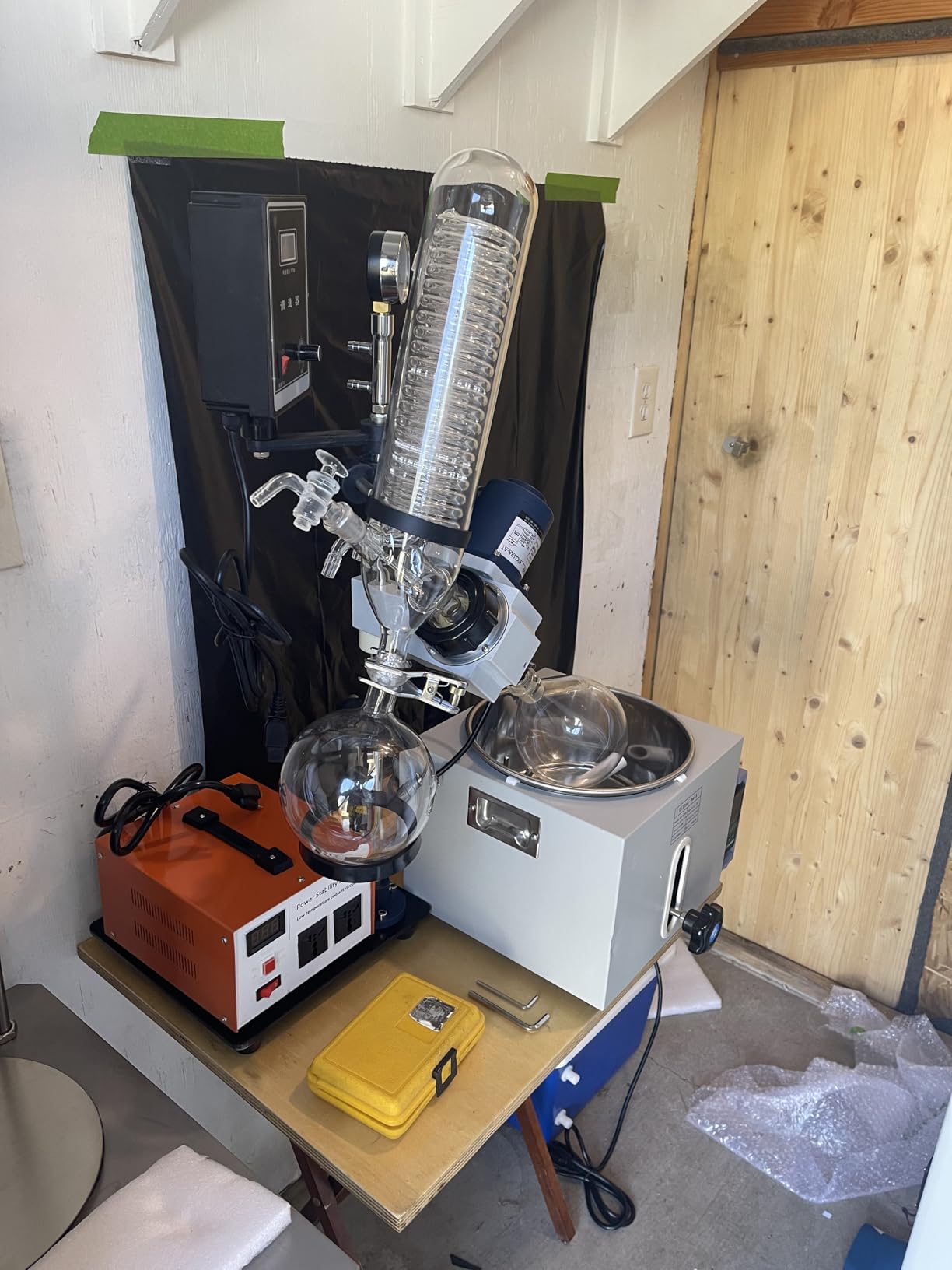
Operation is manual lift at 110V, and the machine measures 21.65 by 17.72 by 25.59 inches. There is one ambiguity you must resolve before ordering: the listing’s own model and variant field reads pump, so confirm in writing whether the box contains the full set or the pump accessory alone.
What a minus 20C cold trap does for volatile botanicals
Terpenes and ethanol vapour both load heavily on a condenser running at ordinary chilled water temperatures. A cold trap drops the condensing surface far below, capturing that vapour before it reaches the pump and before it leaves with your stream.
The trade-off is time. Chilling to -20C is slower to reach and slower to release, so cold-trap setups reward patience and punish rushed turnaround on short batches.
What to watch before buying this model
Confirm the exact contents of the box in writing, given the model field reads pump. The listed weight of 7.7 lb is impossible for a rotovap, pump and chiller combined, so the specifications on this listing are not reliable.
The 10-year warranty and 24/7 support claims come from marketing copy rather than from the listing itself, and there is a single review behind an unbranded name. Get written terms.
10. Haocheng 5L Electric-Lift Rotovap with Chiller and Pump – Best for Electric 5L Runs
5L Rotary Evaporator Electric Lifting with Chiller and Pump Rotavap 5L Distillation Solven
5L flask with electric automatic lifting
Bundled chiller from -20C to 20C
Vacuum pump rated to 0.098 Mpa
8mm borosilicate 3.3 glass
Pros
- Most complete package with 5L rotovap chiller and pump
- Electric lift removes handling on a heavy class machine
- Chiller to -20C supports heat-sensitive concentration
- 8mm borosilicate 3.3 glass and flange-buckle joints
Cons
- Biggest purchase commitment of anything reviewed
- Single review dated 2019 so hardware has moved on
- No receiving flask capacity split published
- Recovery rate and temperature accuracy unconfirmed by users
The Haocheng set is the full package: a 5L rotovap with electric automatic lifting, a matching 5L chiller and a vacuum pump rated to 0.098 Mpa, all from one supplier. For a buyer who does not want to engineer a system from four vendors, that single-source approach removes most of the integration risk.
The chiller runs from -20C to 20C, which covers low-temperature concentration of heat-sensitive botanicals, and rotation is digitally controlled from 0 to 140 rpm with live data on the display. The electric lift matters here, because manual bath handling on a 5L machine is two-handed and awkward.
On build quality, all glass parts are high borosilicate 3.3 glass at 8mm wall thickness, with high-quality flange buckles at every interface to hold vacuum and seal. The thicker glass is a genuine advantage on a machine that sees thermal cycling and pressure change repeatedly.
Why the 8mm glass and flange buckles matter
Thicker borosilicate glass tolerates repeated heating and cooling cycles and sudden temperature changes without stressing the wall. On a 5L flask that is cycling for hours every run, that tolerance is what keeps the glassware intact.
Flange-buckle joints at every interface are equally important, because vacuum integrity is only as good as the weakest joint in the chain. Rubber-stopper interfaces are where leaks usually start.
What to watch before buying this model
This is the largest single commitment in the group, and the single review is dated 2019, which describes the production run of that period rather than current hardware. Ask what has changed since.
The receiving flask capacity is not published, so confirm it against your batch plan. Nobody has independently confirmed the advertised recovery rate or temperature accuracy.
How to Choose a Rotary Evaporator for Botanical Extraction
Choosing well comes down to seven decisions, in this order. Work through them and the model choice takes care of itself. The same evidence-first habit we apply in our cordless rotary hammer roundup and our rotary laser level picks applies here: verified review counts and published specifications outrank marketing copy every time.
1. Match flask size to your real batch volume. A 1L evaporating flask handles roughly 800 mL of working load, a 2L flask about 1.6 litres, and a 5L flask about 4 litres. Buy the smallest flask that covers your typical run, not your best-case run. The most common sizing mistake we see is buying 20L class equipment for 1 to 5L craft batches, which wastes floor space and capital. For reference, the longest-running complaint on r/CannabisExtracts is not flask capacity at all but water showing up in the finished oil, which is a vacuum depth problem rather than a size problem.
2. Set vacuum depth against your solvent. Every 10 mbar you remove roughly lowers the boiling temperature of your solvent, which is how you keep heat-sensitive compounds intact. Check that the pump and seals can hold the vacuum depth your solvent needs rather than just quoting a maximum figure.
3. Keep the bath as cool as the job allows. If you evaporate water you are taking terpenes with it, because the boiling behaviour of isopropyl alcohol sits close to that of many terpenes. Run the lowest bath temperature that still drives the evaporation rate you need.
4. Match condenser cooling area to your solvent load. Cooling area published in square metres or square centimetres is the real predictor of how much solvent you recover per hour. Small models on this list range from 0.15 m2 to 0.2 m2, and the difference shows up in your receiving flask.
5. Decide lift type by run count. Manual lift is fine for a handful of small batches a day. Automatic or electric lift pays back quickly once you are running back-to-back concentrations, and it reduces the handling that causes dropped flasks.
6. Check what is bundled, in writing. Only three models here include a vacuum pump and two include a chiller. A main-unit-only listing leaves you sourcing a pump, a chiller and condenser cooling separately, and that total cost surprises people.
7. Verify certification and service. Retailer star ratings on this category are thin, mostly one to three reviews, so certification and parts availability carry more weight than review volume. Look for UL or CSA ETL listing, borosilicate and 316L construction, and a Class 1 Division 2 hazardous-location rating if you handle ethanol or hydrocarbon solvents at scale.
Solvent Compatibility and Pump Pairing for Botanical Work
Botanical extraction runs on a short list of solvents, and the pump you pair with the rotovap decides whether that pairing works at all.
Ethanol is the default for cannabis and hemp crude oil, and a dry scroll or water-circulating pump handles it cleanly. Isopropyl alcohol is a common finishing solvent and behaves similarly, though it is more aggressive on some seal materials. Heptane and other hydrocarbons demand a pump rated for flammable service and push harder on elastomer compatibility, which is where fluoro rubber and PTFE sealing earn their place. Ethyl acetate and acetone are aggressive enough that a cold trap and frequent seal replacement are normal operating costs.
Supercritical CO2 extraction is a different process entirely and never reaches a rotovap, because the CO2 is released by depressurisation rather than by boiling. Any seller who offers a rotovap as part of a CO2 system is describing a finishing step after the separator, not the extraction itself.
Between pump types, oil-sealed rotary vane pumps are the traditional low-cost choice, but the oil absorbs volatiles out of your recovered solvent. Dry scroll pumps avoid that entirely and run quietly, at higher cost and with seal replacement on a schedule. Diaphragm pumps sit between them on cost and are the practical choice for smaller herbal operations.
For ethanol and heptane work, electrical classification is the item people overlook. A Class 1 Division 2 rating matters as soon as you are in a room where solvent vapour can accumulate, and a household-rated unit in that space is a real hazard rather than a technicality.
How to Keep Terpenes in the Flask
Terpenes leave with the solvent vapour, so preserving them is a direct trade-off between bath temperature and vacuum depth rather than a single setting.
Push the vacuum harder and you can run a cooler bath, which is the combination that keeps volatiles in. Run a warm bath at shallow vacuum and you strip terpenes along with the solvent, no matter how well the condenser performs. A chiller with a cold trap condenser helps on the recovery side, but it cannot bring back what already boiled off.
Bumping is the other way you lose product. A thin rotating film can superheat, nucleate and throw a slug of liquid into the vapour path, which wastes a run and can damage glass. Anti-bumping powder, controlled rotation speed and a bath temperature that stays below the boiling point under working vacuum all help. Keep a vacuum gauge on the system, and if a batch clouds or the flask goes quiet, the depth has changed and something is leaking or the pump is loaded.
What a Rotary Evaporator Cannot Do
A rotary evaporator is a batch tool, and that single fact explains most of its limits. It processes one flask at a time, so throughput scales with flask size and operator patience rather than with automation.
A falling film evaporator feeds thin liquid film down a heated wall continuously, which is why vendors describe one unit as doing the work of several 50L rotary evaporators. It wins on continuous volume and loses on the gentle, low-shear handling that a rotating flask gives heat-sensitive material. Wiped film evaporators add a mechanical wiper for viscous product. Short-path distillation separates a target compound under vacuum with a fractionation column, which a rotovap cannot replicate at all.
The right call is simple. Batch botanical loads under about 20L per run, and where protecting delicate compounds matters, stay with a rotovap. Past that point, or when you are processing continuous crude material, a thin film system is the better investment. Our bench-tool notes on rotary tool categories follow the same logic of matching the tool to the material, and our concrete drilling rotary hammer picks apply it to a very different material entirely.
Frequently Asked Questions
How much does a rotovap cost?
Prices on this category span an unusually wide range because a main unit and a complete system are very different products. A 1L or 2L benchtop rotovap is the entry point, a 5L unit sits in the middle, and full turnkey sets with a chiller and cold trap condenser sit at the top. What moves the total most is whether a vacuum pump and cooling source are included, since main-unit-only listings leave you sourcing both separately. Judge the total system cost, not the head number.
What are common rotovap problems?
Water in the finished oil is the most common complaint, and the usual cause is inadequate vacuum depth or a leaking or undersized pump. Bumping and superheating show up when the bath runs hotter than the solvent boils under working vacuum, throwing a slug of liquid into the vapour path. Slow evaporation points to a condenser with too little cooling area for the solvent load. Loss of vacuum during a run means a failed seal or a loaded pump, and pump contamination is a leading cause of premature pump replacement.
What solvents can be used in a rotovap?
Most rotovaps handle a wide range of organic solvents, including ethanol, isopropyl alcohol, methanol, ethyl acetate, acetone and light hydrocarbons such as heptane. Fluoro rubber and PTFE sealing tolerate the more aggressive of these better than standard rubber. Supercritical CO2 never enters a rotovap because that process releases the solvent by depressurisation rather than boiling, and water-based work is possible but drags terpenes out with it. For maple syrup and similar food work, the same temperature and vacuum logic applies, though the water load is large.
What are the limitations of a rotavap?
A rotary evaporator is a batch tool, so throughput is limited to one flask at a time and scales with flask size rather than with automation. It cannot separate individual compounds the way a short-path distillation column can, and it cannot handle continuous feed the way a falling film evaporator does. Any volatile compound that boils off with the solvent is lost unless you add deep vacuum or a cold trap. Emulsions and aqueous material are hard to concentrate without upsetting the film.
Does rotovap increase or decrease pressure?
A rotovap always decreases pressure inside the sealed evaporating flask. The vacuum pump pulls the pressure down, and that lower pressure is what reduces the boiling temperature of the solvent, letting a botanical extract concentrate at a bath temperature far below the solvent’s normal boiling point. Pressure is never increased during normal operation.
What can I use instead of a rotary evaporator?
The main alternatives are falling film evaporators, wiped film evaporators and short-path distillation. A falling film evaporator runs thin liquid down a heated wall continuously and wins on throughput, which is why vendors describe one unit as replacing several large rotary systems. A wiped film adds mechanical wiper blades for viscous product. Short-path distillation is the right answer when you want to isolate a target compound rather than simply remove solvent. A rotovap stays the best choice for small batch work where gentle handling protects heat-sensitive material.
How long does a rotary evaporation take?
The honest answer is that it depends on flask size, solvent, bath temperature and vacuum depth rather than on any fixed figure published by a manufacturer. The variables that speed a run are deeper vacuum, a larger condenser cooling area, and a bath set close to the solvent’s boiling point under working vacuum. Viscous botanical concentrates are slower than thin crude because the film stops flowing, which is where a slow rotation adjustment or anti-bumping step matters.
What size rotary evaporator do I need?
Size the machine to your typical working volume, not your best-case volume. A 1L evaporating flask handles roughly 800 mL of working load, a 2L flask about 1.6 litres, and a 5L flask about 4 litres. Staying at the smallest size that covers your runs keeps changeover time short. Step up past 5L only when flask size rather than operator attention has become the limit on throughput.
Conclusion
Match the flask to your batch, not to your ambition. If your typical run fits inside a litre, the TECHTONGDA 2L is the pick, because it has the deepest verified review history in the group. Working at 2L, the HNpuxing PX-2001 gives you the built-in vacuum control that chasing residual solvent demands, the TECHTONGDA circulating-pump package removes the second purchase, and the INTBUYING RE-2000A takes the labour out of every changeover with its automatic lift.
When volatile botanicals drive your schedule, buy the cold trap configuration rather than trying to compensate with a cooler water bath later. And once flask size stops being your limit and changeover time starts to be, move toward thin film equipment instead of buying a larger rotovap.
Whichever route you take, the recurring theme across the 2026 buying guides here is the same: check what is bundled, verify the certifications in writing, and get the total system cost in front of you before the order goes in.