
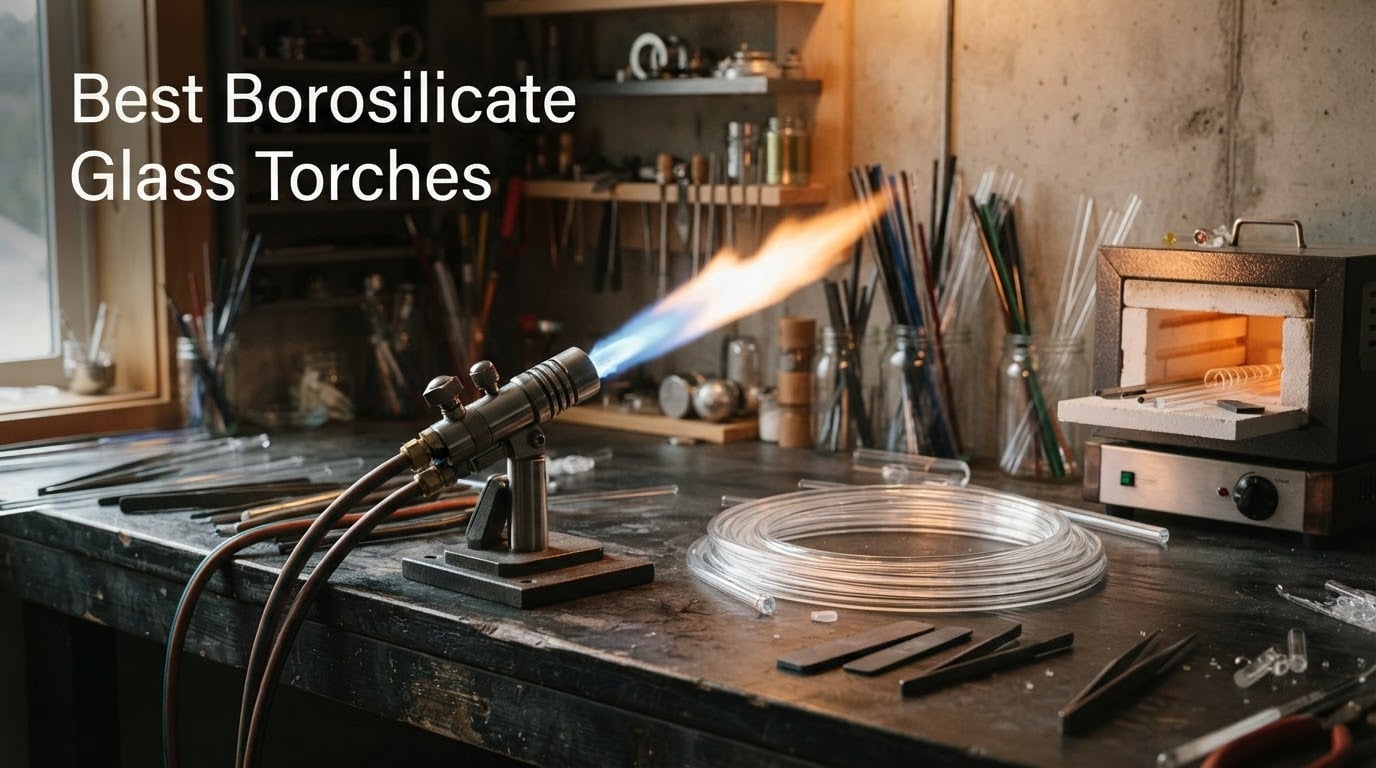
Borosilicate glass will not melt in an air or butane flame. It softens somewhere around 1500F, well above where soda-lime soft glass gives up, and only an oxygen-fed burner gets there fast enough to shape the glass before it sags. After comparing the eight boro-capable torches in this roundup, the Devardi Glass Spartan is the best borosilicate glass torch for most home makers, the Bethlehem Alpha is the best low-pressure bench burner, and the GTT Mirage is the right pick when you are doing production-scale solid boro.
I have spent a lot of time around bench burners, both shopping for my own studio and helping beginners avoid the classic first-purchase mistake. That mistake is almost always the same: buying a beautiful premix torch with no idea what oxygen supply it needs, then finding out the oxygen supply is what actually decides whether the torch works. Everything below is organised around that constraint, because a torch is one part of a system and the burner is the part most people research worst.
Here is the short version of how I ranked these. The Devardi Spartan takes the top slot on the strength of review volume and a genuinely usable flame envelope. The GTT Bobcat earns its place as the detail specialist. Bethlehem’s Alpha and Bravo are the stainless steel workhorses that shrug off studio abuse. The two GTT two-stage torches, Phantom and Mirage, are the answer when you need broad heat and pinpoint detail from the same manifold. And the two blast burners sit apart from the lampworking crowd entirely, because their multi-inlet control is a different way of solving the same problem.
If you are also mapping out a workshop, our guides to glass front bookcases for collectors and glass display cases for offices cover the storage and furniture side of things, which matters more than people expect when boro tubing starts stacking up.
Table of Contents
Top 3 Borosilicate Glass Torches for 2026

Devardi Glass Spartan Surface Mix Torch
- Surface mix design
- Stays cool to the touch
- Melts COE 33 borosilicate
- Cleaner burn

GTT Bobcat Glass Blowing Torch
- 7 jet surface mix flame
- Flame length 2 to 13 inch
- Stainless steel base

Bethlehem Alpha Glass Bead Burner
- All stainless steel construction
- 7 cu ft per hr at 2 psi
- Works with 7 psi concentrator
The Spartan leads because it is the only torch in this group with a meaningful body of customer feedback and a surface mix flame that stays cool to the touch, which matters when you are working in a small room. The Bobcat is the better tool for fine beadwork and pendants, with a 7 jet surface mix flame and an adjustable range from 2 to 13 inches. The Alpha is the one to buy if your oxygen comes out of a concentrator at 7 psi rather than a tank.
Borosilicate Glass Torches at a Glance in 2026
| Product | Specifications | Action |
|---|---|---|
| Devardi Glass Spartan Surface Mix Torch |
|
Check Latest Price |
 Glass Blowing Torch Air Gas and Oxygen Blast Burner Glass Blowing Torch Air Gas and Oxygen Blast Burner |
|
Check Latest Price |
| GTT Torches Bobcat Glass Blowing Torch |
|
Check Latest Price |
| Alpha Glass Bead Burner |
|
Check Latest Price |
 Glass Blow Pipe Blast Burner with 2 Interchangeable Nozzles Glass Blow Pipe Blast Burner with 2 Interchangeable Nozzles |
|
Check Latest Price |
 Bravo Bench Burner Torch Bravo Bench Burner Torch |
|
Check Latest Price |
 GTT Torches Phantom Glass Blowing Torch GTT Torches Phantom Glass Blowing Torch |
|
Check Latest Price |
 GTT Torches Mirage Glass Blowing Torch GTT Torches Mirage Glass Blowing Torch |
|
Check Latest Price |
Read the flame language in that table carefully. Jet and port counts tell you how much flame area a torch can command, but they do not tell you the boro ceiling, and no listing in this roundup publishes a boro ceiling. That number is the real specification, and it comes from the manufacturer rather than the retailer page.
One thing to flag before the reviews: the retail listings for the GTT Bobcat, the two larger GTT torches and the two blast burners carry no customer ratings at all. Where that is the case I have left the star rating off rather than guessing at it, and I have leaned on manufacturer specification instead. Every weight, jet count, pressure figure and temperature I quote below comes from the product data, not from my own bench measurements.
1. Devardi Glass Spartan Surface Mix Torch – Best All-Round Entry Torch
Devardi Glass Spartan Oxygen/Propane Surface Mix Torch, Lampworking, Beadmaking
Brass surface mix
Weighs 1.2 pounds
Handles COE 33 rod up to roughly 19mm
Stays cool to the touch
Pros
- Genuinely melts borosilicate rather than scorching it
- Cool to the touch during a long session
- Light at 1.2 pounds so it moves easily
- Best reviewed torch in this roundup
Cons
- Capped at around 19mm glass diameter
- Brass body rather than stainless
- Only 21 reviews so far
I chose the Spartan as my overall pick because it solves the boro problem honestly at a size most beginners can handle. It is a surface mix torch, which means fuel and oxygen are metered separately and mixed at the flame head rather than pre-combined in a mixing tube, and that design is why the body stays cool to the touch while the flame is hot. Reviewers consistently call it a good first torch, and several specifically mention that it melts smaller COE 33 glass well.
The honest limit is diameter. Owners report it suits glass up to about 19mm, which covers rod for pendants, charms, beads and most small sculpture, but it will not heat a large solid gather efficiently. If your project list is full of pipe and heavy tubing, skip down to a two-stage torch.
What I like most is that it does not punish a beginner. Reviewers mention good value and quick replacement service, and the whole unit weighs 1.2 pounds, so you can carry it to a table or move it off a bench without a fight. The listed temperature behaviour is the other selling point: a cooler running surface mix flame means less chance of burning the glass you are trying to shape.
Check the gas and oxygen demand before you commit. This is a small surface mix burner, so a modest concentrator is the right starting point, but you still need a proper regulator and a flashback arrestor on the fuel line. Budget for those, not just the torch.
Who the Spartan suits
It suits a first-time maker working in a home studio who wants to make pendants, charms and beads from COE 33 rod and already owns or is planning to buy an oxygen supply. It also suits anyone who has been burned by a torch that overheats its own body and clouds the glass.
It also fits small, portable setups, because at 1.2 pounds it is the easiest torch here to move between a bench and a table. For a maker who works seated in a small room, the cool-running body is a genuine quality-of-life gain.
Who the Spartan does not suit
It does not suit anyone whose goal is pipes, punty work, or large solid boro sculpture. That is a heat-volume problem, and a 19mm ceiling is a hard stop regardless of how well you run the valves.
Nor is it the right pick if you want the last word on flame chemistry. Surface mix torches give you less independent control than a premix burner with three separate inlets, and if your work depends on very specific flame character you will spend your time fighting the torch rather than the glass.
2. Multi-Inlet Blast Burner – Most Manually Controlled Flame
Glass Blowing Torch,Air,Gas and Oxygen Lamp Working Blast Burner with 2 Interchangeable Nozzles
Three stop cocks for air gas and oxygen
Three nozzles at 1.9 2.2 and 2.8mm
Cast iron base with swivel ball joint
Pros
- Air gas and oxygen each have their own stop cock
- Three machined nozzles give real flame size steps
- Heavy cast iron base stays put
- Threaded holders keep spare nozzles on the base
Cons
- No customer ratings to guide you
- Generic branding means support is uncertain
- Metal body adds bulk to a bench
Most lampworking torches run fuel and oxygen through two valves. This one has three stop cocks, one each for air, gas and oxygen, and that extra inlet is the whole point. Adding a metered air stream to an oxygen flame is how you dial the flame character by hand rather than by turning two knobs and hoping.
The three interchangeable nozzles are the other feature worth knowing. They carry single bores of 1.9mm, 2.2mm and 2.8mm and are finely machined for a sharp flame pattern, so you are choosing the flame you want rather than living with one fixed geometry. Swapping nozzles is a screw-in operation and the base has threaded holders for the ones you are not using.
The base is heavy cast iron on a steel swivel ball joint, which means the torch aims easily and stays aimed. That is a real advantage on larger work where you are repositioning around a piece, and it is also why the unit is heavier than a lampworking bench burner.
The listing has no customer ratings, so I will not pretend this is a proven purchase. What I can tell you is that the specification is coherent and aimed at laboratory and large-piece glass work, and that a three-inlet torch is genuinely harder to buy as a purpose-built lampworking burner.
Who this burner suits
It suits a maker who works on larger pieces of toughened glass and wants to steer flame chemistry manually. If you have spent time on a scientific glassblowing bench, the three-inlet layout will feel immediately familiar.
It also suits anyone who likes a stable base more than a light one. The cast iron and swivel ball joint are built for heavy repositioning, and a torch that does not walk across the bench mid-session is worth a lot on a big piece.
Who this burner does not suit
It does not suit a beginner who wants point-and-shoot. Three stop cocks and three nozzles is more variables than a new maker needs, and there is no customer feedback to fall back on if something behaves unexpectedly.
It is also a poor match for a compact kit bench. The metal body and cast iron base take up real space, and without published review history you carry more of the risk personally.
3. GTT Bobcat – Best Detail Torch for Beads and Pendants
GTT Torches Bobcat Glass Blowing Torch
7 jet surface mix flame
Adjustable flame 2 to 13 inch
Stainless steel base with 4 mounting holes
Pros
- Surface mix flame tuned for detailed work
- Very wide flame length range
- Bolts flat to the bench with four holes
- Standard B fitting hose couplings
Cons
- Built to order rather than pulled from a shelf
- No customer ratings yet on this listing
- Small jet count limits heavy gathers
The Bobcat is the torch that comes up most often when lampworking people argue about a first serious purchase, and the reason is the 7 jet surface mix flame. Seven jets give a tight, well-behaved cone that is easy to keep centred on a small rod, which is exactly what pendant and bead work needs. It is not a heat monster, and that is fine for this job.
The flame length range is the spec I would point a buyer at. Adjusting from 2 inches to 13 inches means one torch covers both a pinpoint flame for line work and a broader envelope for a gather, and having that range in one head avoids the usual beginner habit of buying a second torch within a year.
On the build side it is a stainless steel base with four mounting holes and standard B fitting hose couplings. Both details matter more than they look. Four holes means the torch is bolted down rather than balanced on a surface, and B fittings are the common standard, so hoses from other setups will connect without adapters.
What to understand is the trade. r/lampwork consensus repeatedly places the Bobcat and Bethlehem’s Alpha as the small single-stage torches that genuinely handle boro, with the Bobcat the most-recommended first boro torch. The same community puts the practical gather ceiling for a tanked setup around the one inch mark, which is a real constraint for larger work and the reason I keep pushing people toward a two-stage when their project list has pipes on it.
Who the Bobcat suits
It suits a maker focused on pendants, beads, marbles and small figures who wants a flame they can hold steady. Seven jets at a small bore is the geometry beadmakers ask for, and reviewers of similar GTT torches consistently praise the evenness of the cone.
It suits anyone who wants a fixed bench setup. Four mounting holes and a stainless base mean the torch stays exactly where you put it, session after session, which is where consistency in flame placement actually comes from.
Who the Bobcat does not suit
It does not suit heavy solid work. A 7 jet head is sized for detail, and pushing it toward a large gather is how beginners end up with a torch that never quite performs the way they expected.
It is also a poor choice if you want something next week. GTT builds to order, and the listed production window runs from a few days to a few weeks, so this is not a last-minute purchase before a show or a class.
4. Bethlehem Alpha – Best Low-Pressure Bench Burner
Bethlehem Burners Alpha Glass Bead Burner
All stainless steel construction
7 cu ft per hr at only 2 psi
Runs on household gas and 7 psi oxygen
Rated to 2800C
Pros
- Works with an oxygen concentrator at 7 psi
- All stainless steel and stays cool
- Higher fuel volume at lower inlet pressure
- Highest rated torch with a real review base
Cons
- Only 7 reviews to judge it by
- Cost sits above true entry torches
- Needs a proper regulator to run at spec
The Alpha is the one I recommend when oxygen comes from a concentrator rather than a tank, and the reason is written into its design. It moves 7 cubic feet of fuel per hour at only 2 psi inlet pressure, and the manufacturer specifies operation on household gas at a quarter psi with an oxygen concentrator at 7 psi. That low-pressure envelope is the whole reason the burner exists.
Full consumption figures are published, which is rare and useful. The listed figures are propane gas at 2 to 5 psi running 3 LPM, and tanked oxygen at 8 to 20 psi running 10 LPM. If you are sizing an oxygen supply, those numbers let you plan before you buy rather than after.
Construction is all stainless steel and the listing states it stays cool while the flame runs super hot. Maximum temperature is given as 2800C. A metal body that runs cool is a genuine advantage in a home studio, because the alternative is a brass head that radiates heat into your hands and slowly cooks the bench.
Bethlehem Burners is a long-standing name in this field, and in the lampwork community the Alpha sits alongside the GTT Bobcat as one of the small single-stage torches that honestly work for boro. It has the highest rating of any torch here with a review base worth trusting, at 4.4 stars from 7 reviews, which is still a small sample but is real feedback from real use.
Who the Alpha suits
It suits a home studio powered by an oxygen concentrator at 7 psi. That is the environment the burner was designed around, and forcing it onto a tank or onto household natural gas without understanding the pressure difference is how people end up with a weak flame.
It also suits anyone who wants a burner that tolerates a busy studio. Stainless steel throughout and a cool-running body mean it will not crack or deform the way lighter metal heads can, and the published consumption figures make it easy to budget your gas.
Who the Alpha does not suit
It does not suit a maker chasing the largest boro work. A single-stage bench burner at this size is built for beadmaking and medium work, and pushing past its comfort zone costs you control long before it costs you glass.
Nor is it the cheapest way in. The entry torches in this roundup cost meaningfully less, and if your oxygen is already a small concentrator and your work is small, the extra spend may not earn itself back.
5. RS Instruments Premix Blast Burner – Best for Lab and Lathe Work
Glass Blow Pipe Blast Burner New Advanced Torch with 2 Interchangeable Nozzles
Premix torch design
Three nozzles at 1.9 2.2 and 2.8mm
Chrome plated brass body and brass needle valves
Pros
- Hot focused flame aimed at borosilicate
- Barrel lifts off the base for lathe work
- Threaded holders for spare nozzles
- Fine machined nozzles give a sharp flame
Cons
- Premix needs flashback arrestors and check valves
- Chrome plated brass is heavy and needs care
- No customer ratings on this listing
This is the only premix design in the roundup, and the difference matters. In a premix burner the fuel and oxygen are combined before they reach the flame, which produces a hotter, more focused, more chemically consistent flame. In a surface mix torch they meet at the head and the body stays cool. You are choosing between two different engineering philosophies, not between a better and a worse torch.
The safety consequence is the part people miss. The listing is explicit that this torch requires flashback arrestors and anti-backflow check valves, and that is not optional advice. A premix torch with a plain fuel valve is a genuine hazard, so budget for the arrestors and the valves before the burner.
Mechanically it is a serious piece of kit. The entire body is heavy chrome-plated brass with brass needle valves and chromed brass knobs, the base is cast iron on a swivel ball joint, and the barrel can be moved laterally or lifted off entirely by loosening a clamping screw. Gas and oxygen enter through 3/8 inch OD barbed fittings, and the three nozzles are long and finely machined for a sharp flame pattern.
It is also the most transferable torch here. The listing states it may be adapted for lathe use, and scientific glassblowing is the stated design target, which makes it a natural fit for custom distillation tubing and laboratory glass where boro runs continuously rather than in small gathers.
Who this burner suits
It suits a maker doing laboratory-scale borosilicate work, where long continuous runs of boro tubing need a steady, hot, focused flame rather than a wide cone. The removable barrel helps when you are working close to a lathe or a fixed jig.
It suits anyone who already has premix safety equipment or works in a shop where that equipment is standard. Coming into premix cold means buying arrestors, check valves and getting a feel for backflow, and that learning curve is real.
Who this burner does not suit
It does not suit a first torch. Premix combustion with no backflow experience is how people damage a nice burner, and the added cost of the safety hardware is money you have not budgeted for.
Nor is it a lampworking-first choice. The flame is built for focused boro work rather than the broad, forgiving cone that beadmaking wants, and there is no customer feedback on this listing to reassure you.
6. Bethlehem Bravo – Best Stainless Bench Burner for Heavy Work
Bethlehem Burners Bravo Bench Burner Torch
All stainless steel construction
15 cu ft per hr at only 2 psi
Compatible with household gas and concentrators
Pros
- Highest fuel volume of any torch in this roundup
- All stainless steel and cool running
- Concentrator and household gas compatible
- Replaces the older Barracuda burner
Cons
- Only a single customer review
- Built for a commercial scale of work
- Replaces the Barracuda if you already own one
The Bravo is the Bravo bench burner, and its single most important number is 15 cubic feet of fuel per hour at 2 psi inlet pressure. That is more than double the Alpha’s 7 cubic feet at the same pressure, and it is what separates a burner for a working studio from a burner for a hobby bench.
Everything else follows from that. All stainless steel construction, stays cool while the flame is super hot, and it can operate on household gas at a quarter psi and on oxygen concentrators at 7 psi. The low-pressure tolerance is the Bethlehem design signature, and it is why this brand keeps showing up in conversations about running heavy burners off a concentrator instead of paying for tanked oxygen.
I want to be straight about the evidence here. The single customer review on this listing is a five, and it is glowing, but one review is one review. I am including the Bravo because the specification is specific and coherent, not because the feedback record is deep.
There is a practical overlap worth flagging. This burner is the improved replacement for the popular Barracuda, so if you already own a Barracuda you are looking at a generational upgrade rather than a new tool, and that changes how you should think about the purchase.
Who the Bravo suits
It suits a working studio or a maker moving into large solid boro and heavy pipe work. The fuel volume is what lets you open the flame wide without starving it, and starving a boro torch produces a weak, dirty flame no matter what the burner cost.
It also suits anyone who wants stainless and low-pressure operation in one package. Running cool under a heavy flame is what lets a studio burner survive years of daily use without warping.
Who the Bravo does not suit
It does not suit a beginner or a small home kit. This is industrial scale equipment, and a 15 cubic feet per hour burner paired with a small concentrator is a mismatch that ends in frustration rather than glass.
Nor is it a good value if you already own a Barracuda. In that case the question is whether you need the extra fuel volume, not whether the Bravo is a good burner.
7. GTT Phantom – Best Two-Stage Torch for Pipes and Medium Boro
GTT Torches Phantom Glass Blowing Torch
22 jets split 15 outer and 7 center
Two independent oxygen valve sets
4 stud two stage and foot pedal ready
Pros
- Outer ring and center fire controlled separately
- Dual oxygen valves widen the flame range
- Four stud manifold accepts a foot pedal
- Hose adaptors and cleaning kit included
Cons
- Two stage control takes practice
- Premium spend for a home maker
The Phantom is where a torch stops being a bead burner and starts being a workhorse. It is a two-stage design with 22 jets, split 15 in the outer fire and 7 in a center fire inside it. The center fire gives you a small, intense inner cone you can bring up without changing the outer ring, which is how you get pinpoint detail and broad heat from the same head.
GTT calls this Triple Mix, and the practical difference is the two independent sets of oxygen valves. One set feeds the outer ring, the other feeds the center fire, and the two let you move between a reducing character flame and an oxidizing one without swapping tips. In the lampwork community the trade-off is stated plainly: Triple Mix torches take longer to learn, and the extra heat only shows up once you are actually running both valve sets.
The manifold is a four-stud arrangement with two oxygen and two fuel intakes, and it is set up for optional foot pedal use. That matters more for production than for learning, because it lets you hold heat with your foot and keep both hands on glass. The base is powder coated steel with two mounting holes, and the box includes a foot of 3/16 inch hose, adaptors with filter screens, instructions and a cleaning kit.
In r/lampwork the Phantom comes up as the aspirational step above the Lynx for people who can afford it, and for pipes and medium boro that framing is fair. It is a step up in capability, and also a step up in the amount of oxygen a session pulls.
Who the Phantom suits
It suits a maker whose work has outgrown a single-stage bench burner, especially if pipes and medium solid boro are on the list. The 7 jet center fire gives you a detail tool nested inside a broad-heat tool.
It suits a production-minded maker who likes the idea of hands-free control. The four-stud manifold is already set up for a foot pedal, so adding one later does not mean rebuilding anything.
Who the Phantom does not suit
It does not suit someone still learning where to put their hands. Two oxygen valve sets and a center fire is a real learning curve, and buying complexity before you have control usually ends in a torch that gets ignored.
Nor is it the right pick on a small oxygen supply. A two-stage head running both fires is a high-consumption tool, and an underfed torch produces a weak dirty flame regardless of what you paid for it.
8. GTT Mirage – Best Production Torch for Large Solid Boro
GTT Torches Mirage Glass Blowing Torch
40 jets split 33 outer and 7 center
Two independent oxygen valve sets
4 stud two stage and foot pedal ready
Pros
- Largest jet count in the roundup at 40
- Same Triple Mix control as the Phantom
- Dual oxygen intakes on a four stud manifold
- Kit includes hose adaptors and cleaning kit
Cons
- Highest spend in the roundup
- Built to order with a long build queue
- Overkill for small-scale and hobby work
The Mirage is the same architecture as the Phantom with a much larger fire. Forty jets split 33 in the outer ring and the same 7 jet center fire inside, on the same Triple Mix layout with two independent oxygen valve sets and the same four-stud two-stage manifold with two oxygen and two fuel intakes for optional foot pedal use.
That 33 jet outer ring is the difference. It is a broad heat envelope that can cover a large gather or a wide section of pipe, and combined with the center fire it covers both ends of the flame range from one burner. For large solid boro sculpture and production-scale pipe work, that is the heat volume a single-stage bench torch simply does not have.
It includes the same accessory package as the Phantom: a foot of 3/16 inch hose, adaptors with filter screens, instructions and a cleaning kit, on a powder coated steel base with two mounting holes. Made in the USA and built to order, with the listed production window running from a few days to a few weeks.
You will also need real oxygen for this one. A 40 jet surface mix head running both fires will not be fed comfortably by a small concentrator, and this is a torch I would pair with tanked oxygen or an industrial supply rather than a home unit.
Who the Mirage suits
It suits a working studio producing boro pendants, marbles and pipe at volume, where the outer ring needs to cover a large area quickly. The 33 jet fire is the point, and nothing else in this roundup matches it.
It also suits a maker who has already mastered two-stage control on a smaller torch and wants the same feel with much more heat. The valve layout is identical to the Phantom, so the technique transfers directly.
Who the Mirage does not suit
It does not suit a hobbyist or a first purchase. The spend and the oxygen demand are both far beyond what small work needs, and the extra heat is wasted on a 19mm rod.
Nor is it a torch you can bring online this week. It is built to order, and planning a session around the build window is part of owning it.
How to Choose a Borosilicate Glass Torch in 2026
Start with the oxygen, not the burner. Every torch in this roundup is oxygen-fed, and the difference between a good flame and a disappointing one is usually the supply rather than the torch. Borosilicate needs heat density, and heat density comes from putting oxygen into the flame in a controlled way. A torch starved of oxygen makes a weak, dirty flame no matter what it cost, and that is the single most common complaint in the community about underpowered setups.
Bethlehem publishes the clearest numbers here, and they are worth learning to read. The Alpha lists propane gas at 2 to 5 psi running 3 LPM, with tanked oxygen at 8 to 20 psi running 10 LPM. The Bravo moves 15 cubic feet of fuel per hour at 2 psi. Those figures tell you immediately whether a torch fits the supply you already own, and a lot of disappointing first torches turn out to be supply mismatches in disguise.
Concentrator or tank is the next fork. A home oxygen concentrator puts out a limited flow at modest pressure, and low-pressure burners like the Bethlehem units are designed around exactly that. The larger GTT two-stage torches and the blast burners want more flow than a home unit comfortably delivers, and pairing a 40 jet head with a small concentrator is a recipe for a weak flame. If you are building a home studio, a single-stage surface mix burner on a concentrator is the honest combination.
Surface mix versus premix, in plain terms
Surface mix torches keep fuel and oxygen separate until they meet at the flame head, which is why the Spartan and the GTT units run cool to the touch. Premix torches combine them before ignition, which produces a hotter and more focused flame at the cost of needing flashback arrestors and anti-backflow check valves. Neither is better; they are answers to different kinds of work.
For pendants, beads and line work, surface mix wins, because the broad forgiving flame is easier to hold on a thin rod. For laboratory-scale boro, continuous tubing runs and lathe work, premix wins, because the focused flame stays stable over a long session.
Single stage versus two stage
A single-stage torch, like the Bobcat or the Alpha, has one fire that you control with a gas valve and an oxygen valve. A two-stage torch adds a separately valved center fire inside the outer ring, which is what the Phantom and the Mirage are built around. The center fire is a detail tool nested inside a heat tool.
The honest warning from the community is that single-stage torches are not the beginner’s first stepping stone. People in r/lampwork repeatedly say a first-torch buyer will outgrow a small quick burner and should jump straight to a solid single-stage or two-stage model. If you already know you will be making boro, buy for boro rather than for soft glass.
Jets, ports and what they actually tell you
Jet and port counts tell you flame area, not heat output and not boro capacity. Seven jets describes a tight, well-behaved cone; 22 and 40 describe broad envelopes. The number you actually need is the boro size ceiling, and no retail listing in this roundup publishes one, so go to the manufacturer and treat dealer specs as a starting point.
Bench versus hand is the smaller decision but worth naming. A bench burner is bolted down and anchored to a table, which gives you stability and no portability. A hand torch is lighter and lets you move around a piece, at the cost of holding your own weight and aiming one-handed. For boro specifically, a fixed bench head gives you a repeatable flame position, and repeatability is where most technique actually comes from.
Buying a used torch without overpaying
The used market for glass torches is noisy, and the same-sounding burner appears at wildly different points. Check whether the listing says oxygen-fed or air-fed, because air-fed units are the most common mis-buy in this niche and they cannot bring boro to working temperature. Look for the jet or port count and the model number in the photos, not just the title.
Ask about valve condition specifically, since seized needle valves are the most common failure on an older burner and they are the expensive thing to fix. Confirm that the hoses, couplings and regulators come with it or are included in the ask, and treat any seller who cannot tell you the oxygen demand as a warning. Finally, factor the pre-mix safety hardware into a premix torch, because arrestors and check valves are consumables that age.
What not to buy for boro
Do not buy an air or butane canister torch for borosilicate. This is the single most common mis-buy in the field, and the reason is physical rather than commercial. Those tools cannot reach boro working temperature, so the glass either refuses to move or moves unevenly and cracks. Every row in the table above is a legitimately oxygen- or multi-inlet-fed borosilicate tool, which is exactly why they are in this roundup and the canister torches are not.
Do not buy a torch you cannot feed. A burner that outruns your oxygen supply will disappoint you every session regardless of its specifications. And do not skip the fuel-side flashback protection, which is inexpensive and which every safety-conscious shop in this field treats as non-negotiable.
Frequently Asked Questions
What type of torch do you need to melt glass?
An oxygen-fed surface mix or premix bench burner, running propane or natural gas alongside oxygen. Surface mix torches suit bead, pendant and line work because the flame is broad and forgiving. Premix burners suit laboratory-scale boro and long tubing runs because the flame is hotter and more focused, and they require flashback arrestors and anti-backflow check valves. Air and butane canister torches cannot reach borosilicate working temperature.
What glass is used for lampworking?
Two families dominate. Soda-lime soft glass, sold as stringers, rods and beads, softens well below borosilicate and is the traditional beadmaking material. Borosilicate, sold as COE 33 rod, tube and cane, has an expansion coefficient of about 33 times 10 to the minus 7 per degree Celsius and needs far more heat to move, which is why it demands an oxygen-fed flame. Color compatibility between the two is limited, so plan your palette around one or the other.
What temperatures can borosilicate glass withstand?
Borosilicate softens for working somewhere near 1500F, which is well above where soda-lime soft glass becomes workable. Annealed borosilicate also handles far higher service temperatures than soft glass, which is why it is used for lab glass and heat-resistant ware. The practical number for a maker is the working temperature, because that is the figure your torch has to reach and hold.
Can I use a butane torch for glass?
Not for borosilicate. A butane or air-fed torch burns far too cool to bring COE 33 to working temperature, so the glass either will not move or softens unevenly and cracks. Air and butane torches are the most common mis-buy in lampworking for exactly this reason. They work on soft glass beads in a pinch, and nothing beyond that.
Do I need an oxygen concentrator for lampworking?
You need an oxygen supply of some kind, and the type depends on the torch. A single-stage surface mix burner on a home studio is a good match for a concentrator, and low-pressure burners such as the Bethlehem Alpha and Bravo are designed to run on household gas at a quarter psi with oxygen at 7 psi. Large two-stage torches such as the GTT Phantom and Mirage want more flow than a home concentrator delivers and are better paired with tanked oxygen. Always check the published consumption figures before buying.
Where can I buy a glass blowing torch?
Specialist lampworking and glassblowing suppliers carry the full range, from GTT, Bethlehem Burners, Nortel Manufacturing and Carlisle Machine Works. General marketplaces list a narrower selection and mix oxygen-fed burners with air-fed units in the same results, so check the specification before buying. On the used market, read the listing for jet or port counts, confirm the burner is oxygen-fed, and ask about valve condition, since seized needle valves are the most common problem on an older torch.
Best Borosilicate Glass Torch: The Final Verdict
For most people reading this, the best borosilicate glass torch is the Devardi Glass Spartan, because it is the only one in the roundup with enough customer feedback to trust, it genuinely melts COE 33 rather than scorching it, and it stays cool to the touch while it does it. The 19mm ceiling is real, so if your project list is full of pipes, read past it.
For fine bead and pendant work, the GTT Bobcat is the specialist, with a 7 jet surface mix flame and an adjustable range from 2 to 13 inches. For a concentrator-powered home studio, the Bethlehem Alpha is the right call, because it is built for household gas and 7 psi oxygen and publishes its consumption figures. For a working studio, the Bethlehem Bravo raises the fuel volume to 15 cubic feet per hour, and the GTT Phantom and Mirage cover two-stage work from medium boro through production scale.
Whatever you pick, size the oxygen first and the burner second. A torch that is fed properly outperforms a better torch that is starved, and in this field that single decision explains more disappointing first purchases than any spec sheet does.