
A Geiger counter is a handheld instrument that detects and measures ionizing radiation by counting the ionization events produced inside a gas-filled Geiger-Muller tube or a scintillation crystal, and it displays the result either as a raw count rate in CPM or CPS or as an estimated dose rate in microsieverts per hour. It reads beta, gamma and X-ray radiation readily, and alpha only when the source is pressed close against a suitable probe window. For a hobbyist that is the entire point: it is the only way to turn “this looks interesting” into “this specimen measures four times background.”
We spent weeks going through the hobbyist market to put this roundup of the best Geiger counters for hobbyists together, reading owner reviews, and cross-checking what the detector literature actually says about detection limits. We also looked hard at the thing most roundups skip entirely, which is what these instruments quietly fail to tell you. That part matters more than any spec sheet, and we give it its own section below.
A few grounding points before the picks. Natural background in a typical house sits somewhere around 0.1 to 0.2 microsieverts per hour, and that number is your baseline for every reading you will ever take. Most hobbyist meters are rate meters, not dosimeters, so their dose-rate conversion is a calculated estimate unless the instrument carries a traceable calibration. And none of these devices detect neutrons or radon, no matter what the box says. If you want the detail, the rock tumbler guide makes a good companion read for anyone screening specimens before they go in a tumbler.
With that groundwork laid, here is what we found. The honest summary: the difference between a 40-dollar meter and a 250-dollar meter is not a better display, it is a real detection floor, real energy compensation, and a number you can defend to somebody else.
Table of Contents
Top 3 Picks for Hobbyist Geiger Counters in 2026
These three cover the most common situations. One is the do-everything choice, one is the cheapest credible way in, and one is the value pick that surprises people with how sensitive it is for what it costs.

GQ GMC-500Plus
- Dual GM tubes with independent calibration factors
- Detection range limit raised 10x over earlier models
- Built-in flash memory with server logging
- Rechargeable battery
- 1.76 oz and 5 x 3 x 1 inches

GQ GMC-300S
- Logs every second to internal memory
- Free data viewer PC software
- Dosimeter
- CPM and graph modes
- Rechargeable battery
- 4.75 x 2.75 x 0.75 inches

GQ GMC-800
- Large TFT colour LCD with light and dark modes
- Five alarm types including voice and vibration
- Memory for data storage up to 10 years
- Reads CPM uSv/h mR/h and CPS
- Type-C charging and data transfer
All 10 Meters Compared in 2026
Every meter below is a genuine GM-tube or scintillator instrument. That filter matters, because marketplace listings mix in plenty of semiconductor novelty devices that cannot read ordinary background radiation at all. Nothing in this table made that cut.
| Product | Specifications | Action |
|---|---|---|
| GQ GMC-500Plus |
|
Check Latest Price |
| GQ GMC-300S |
|
Check Latest Price |
| GQ GMC-800 |
|
Check Latest Price |
 FNIRSI GC-01 FNIRSI GC-01 |
|
Check Latest Price |
 Radiacode RC-102 Radiacode RC-102 |
|
Check Latest Price |
 MOESAPU FS-5000 MOESAPU FS-5000 |
|
Check Latest Price |
 Sooguard HFS-Black Sooguard HFS-Black |
|
Check Latest Price |
 Aranet Radiation Detector Aranet Radiation Detector |
|
Check Latest Price |
 Images SI GCA-07W Images SI GCA-07W |
|
Check Latest Price |
 FNIRSI GC-03 FNIRSI GC-03 |
|
Check Latest Price |
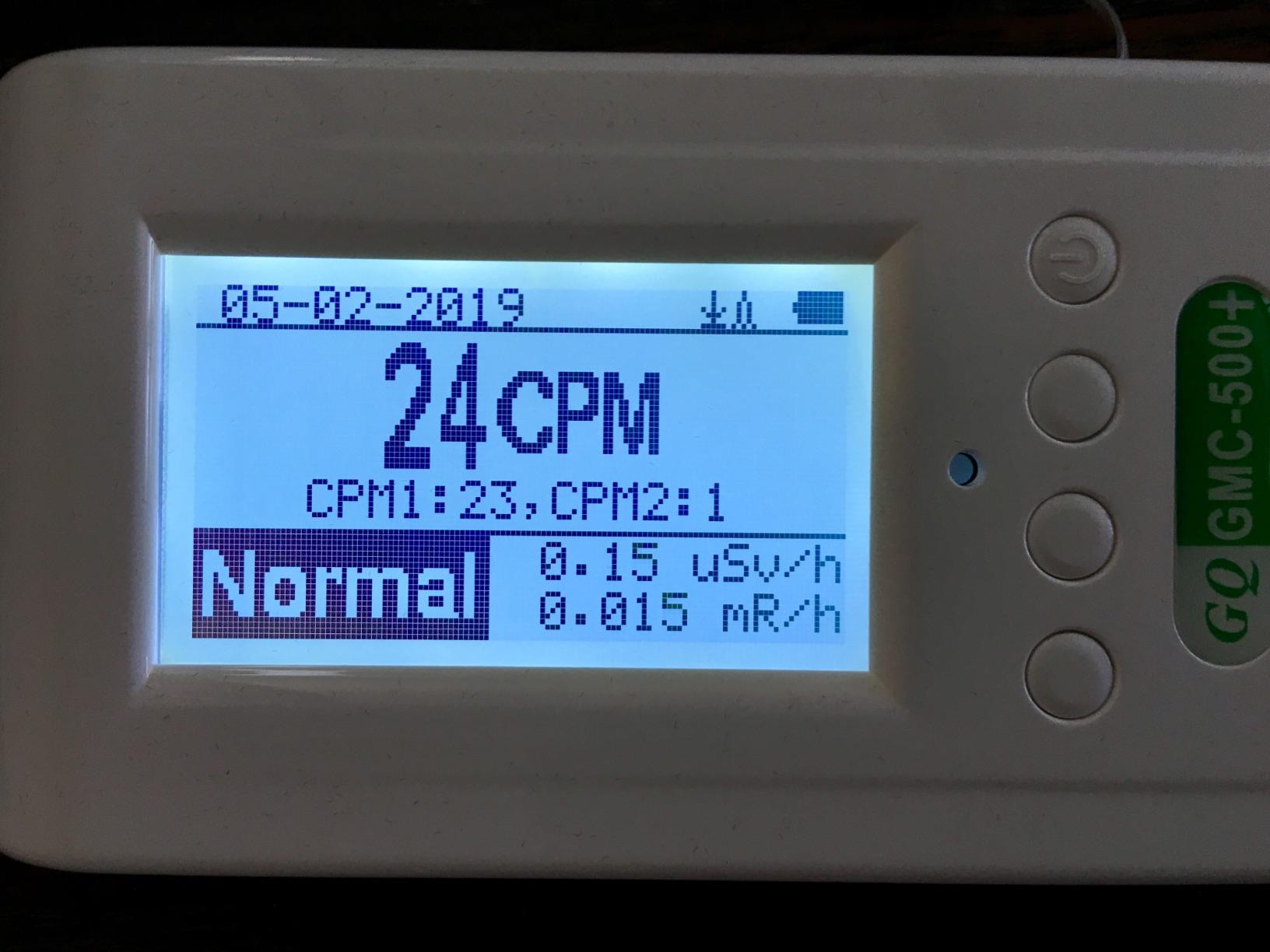
1. GQ GMC-500Plus – Best Overall Dual-Tube Meter
GQ GMC-500Plus Geiger Counter Nuclear Radiation Detector Monitor Dosimeter, White
Dual GM tubes with independent calibration factors
Detection range limit raised 10x
Flash memory, speaker, server logging
1.76 oz, 5 x 3 x 1 in
Rechargeable cell included
Pros
- Dual-tube design tolerates high fields without saturating
- Reads normal background easily
- Around 7 days of runtime at background
- Reasonable out-of-the-box calibration
- Open programming API with free PC software
Cons
- Poorly labeled buttons create a learning curve
- Shipped with an unprotected 2600mAh cell
- No beta or alpha shield and no mobile app
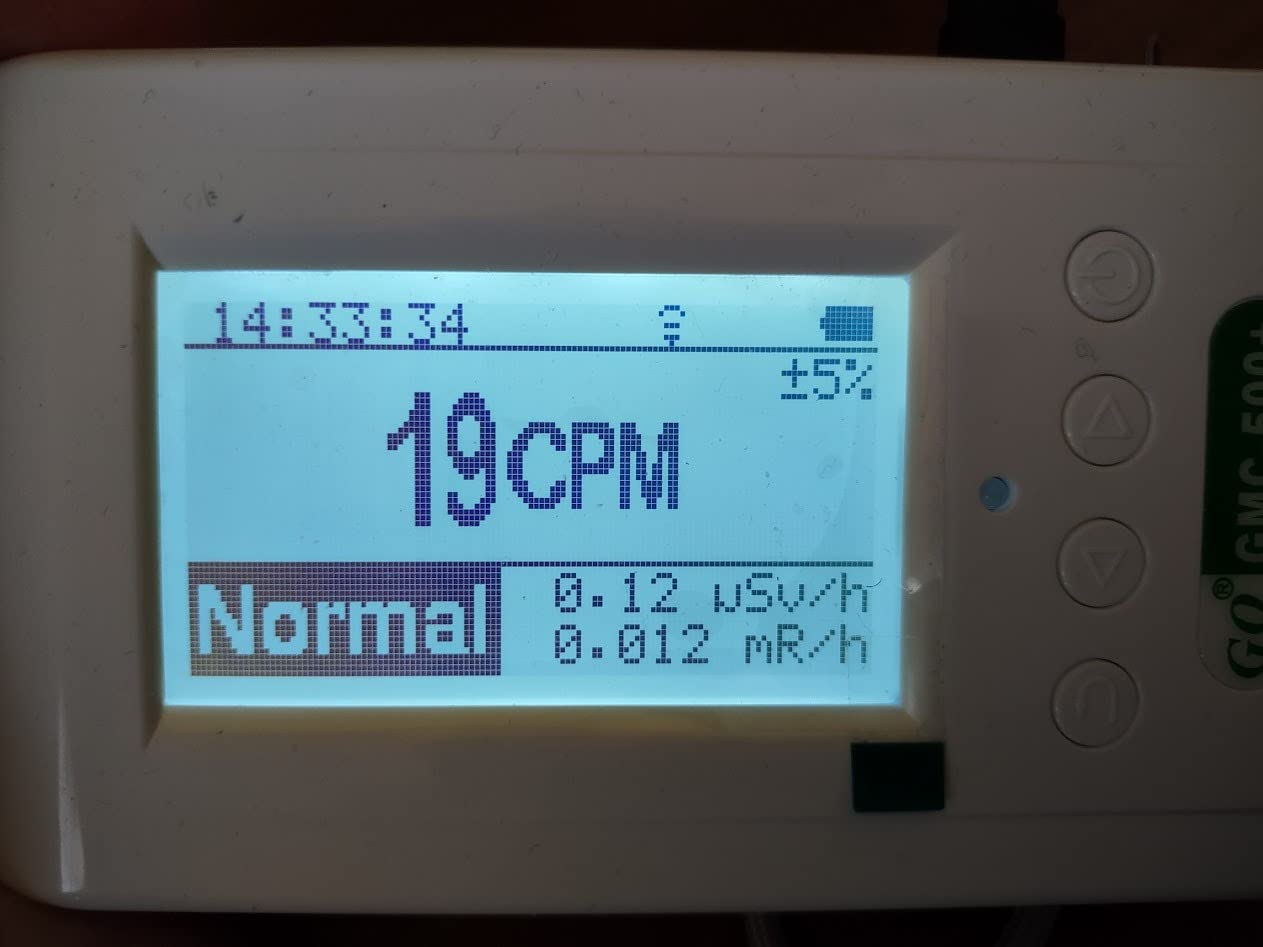
Best overall: this is the meter I keep reaching for when a sample is genuinely hot and I do not want to wonder whether the number on the screen is real. The dual-tube layout is the reason. Two GM tubes with independent calibration factors means one tube can be in a low range catching background and faint specimens while the other handles a strong source, so the display does not simply peg out and stop helping you.
Owners consistently describe it as the middle ground between a 40-dollar novelty meter and a professional instrument. It reads ordinary background without drama, it holds up in a high field, and the calibration has been checked against a certified source by enough buyers that I am comfortable treating its dose rate as indicative rather than guesswork. The 1,903-review base is by far the deepest of anything in this roundup, which matters for exactly the reason you would hope: longevity reports are real here, not theoretical.
The upper range limit was raised ten times over earlier GQ models, and in practice that is the difference between “very high” and “overflow” when you point it at a smoke detector or a strong mineral. Owners report the audible clicks tracking the count rate accurately rather than flattening into a solid tone, which makes it usable as a searching tool, not just a display. The rechargeable cell is installed in the box and the whole thing weighs under two ounces, so it disappears into a pocket.
Data handling is the mixed part. There is built-in flash memory, an onboard speaker with audio output, and unlimited server logging where you can push data to any server in the world. What there is not is a phone app. The companion is desktop software, and if your workflow lives entirely on mobile this will feel like a step backwards from the newer rivals.
What you gain by choosing it
High-field tolerance is the headline. If you work around strong specimens, contaminated finds, or anything industrial, a single-tube meter that saturates tells you nothing useful once you are past a certain count rate. This one keeps reporting.
The build is solid and light for a hand tool, and the calibration out of the box is close enough to costlier units that I would trust it for comparative work on rocks, antiques and scrap.
Where it will frustrate you
The buttons are badly labeled. Owners describe a real learning curve with the interface, and the styling reads as dated next to a colour TFT screen. If you are handing this to someone new, expect to show them how it works.
There is no beta or alpha shield in the box and no mobile app, and the shipped battery is an unprotected 2600mAh cell rather than a protected higher-capacity one. Neither is dangerous, but both are things you will want to know before you rely on it.
2. GQ GMC-300S – Best Budget Starter With Real Logging
GQ GMC-300S Digital Nuclear Radiation Detector Monitor Meter Geiger Counter Radiation Dosimeter
Real-time logging every second to internal memory
History downloadable to computer
Free data viewer PC software
Dosimeter, CPM and graph modes
Rechargeable, 7.8 oz, 4.75 x 2.75 x 0.75 in
Pros
- Pocketable and genuinely light
- Hold the power button and it measures immediately
- Cycle between CPM
- uSv/h and mR/h
- Graph view with exportable data
- Audible clicks at a sensible volume
Cons
- Small 800mAh 14500 Li-ion cell
- J305 tube rather than the more sensitive M4011 or SBM-20
- Menu system takes getting used to
Best budget: if the question is what is the cheapest meter that is not junk, this is the answer, and the reason is the tube. A lot of the anonymous marketplace devices use commodity semiconductor sensors that cannot even register normal background. This one has a real J305 Geiger-Muller tube, which puts it in a different class entirely.
It is the size of a deck of cards and does exactly one thing on power-up: it starts measuring. That simplicity is genuinely valuable when you are standing in a field with gloves on, holding a rock in one hand and the meter in the other. Owners use it for practical jobs rather than collecting dust, including checking antique dishware and doing casual mineral shopping.
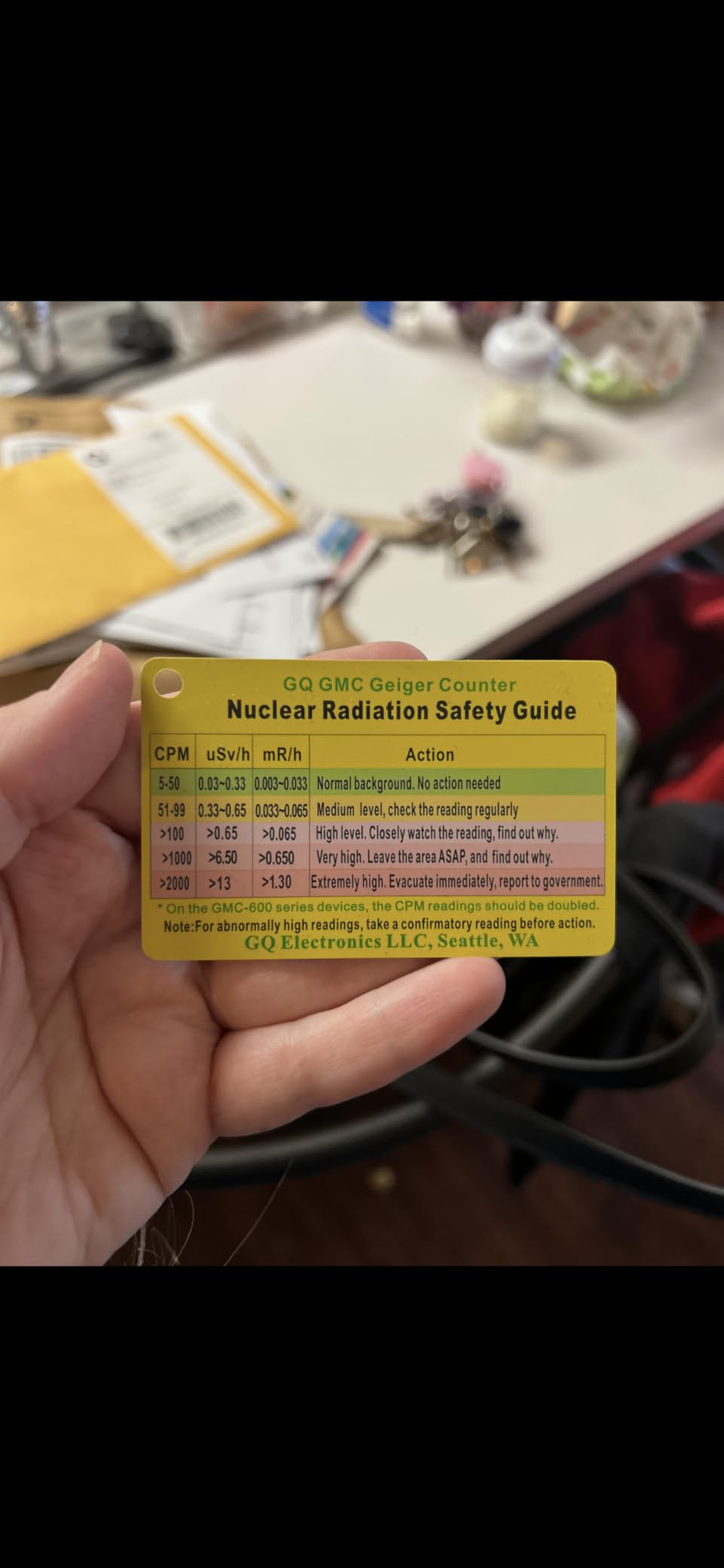
The real differentiator at this tier is the logging. It records a data point every second into internal memory, and the history downloads to a computer through free viewer software, with a graph mode for reviewing what a survey actually looked like over time. Almost nothing else in this price bracket logs at all, and I have personally found the graph is the feature that turns a snapshot into evidence.
Battery life is good. The cell arrives charged and holds across many hours, and the unit fits in a shirt pocket. The audible clicks are distinct without being loud enough to be rude in a shop or a flea market.
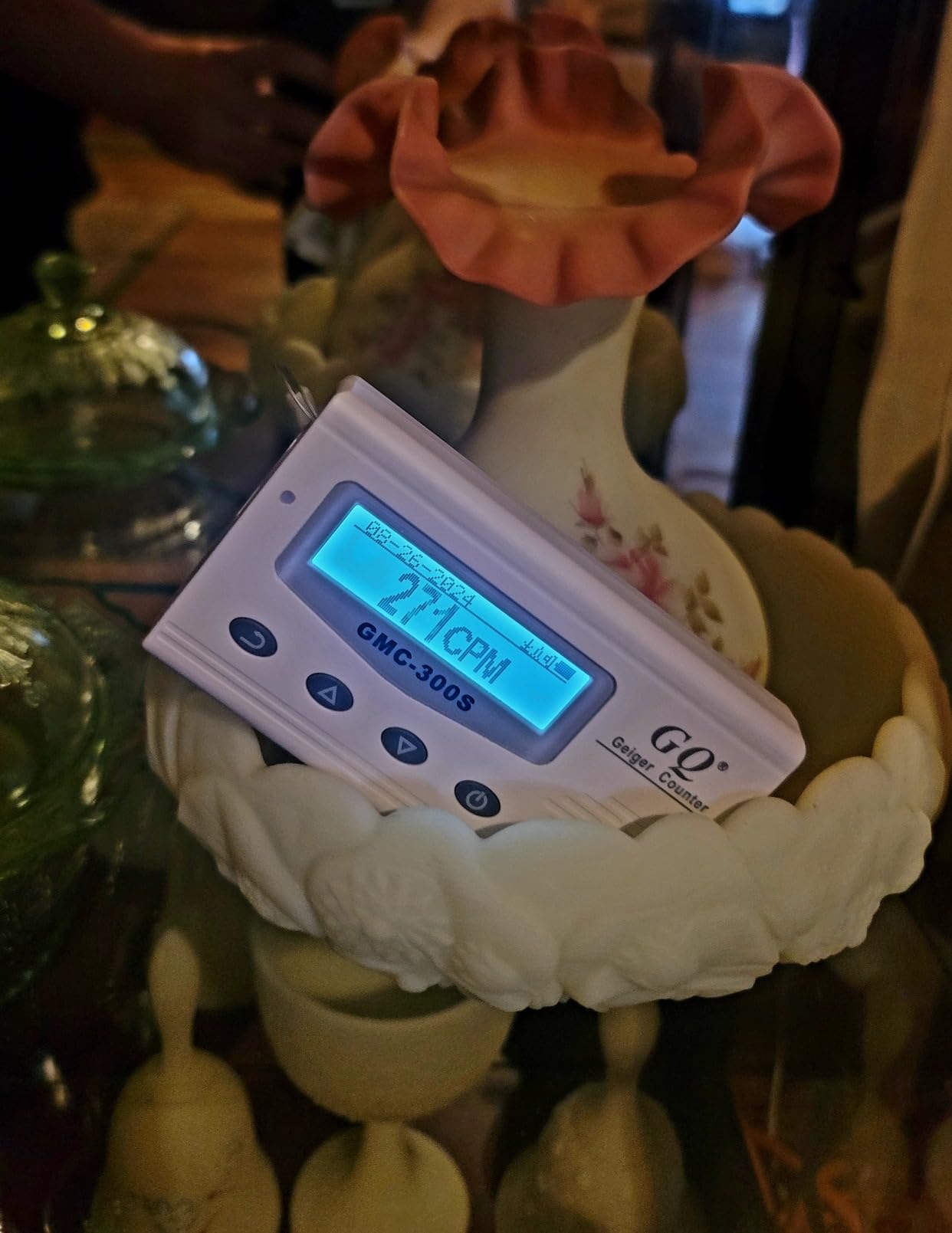
What you gain by choosing it
You get a genuine GM tube and a real dose-rate readout at an entry price, which is a rarer combination than it should be. Background reads properly and the cycling between CPM, microsieverts per hour and milliroentgens per hour is right there on the device.
The second-by-second internal logging is the feature that makes this more than a toy. If you are mapping a room, surveying a property, or documenting a specimen, you get a downloadable record.
Where it will frustrate you
The J305 tube is less sensitive than the M4011 or SBM-20 tubes used in higher-end hobbyist meters. For faint specimens you will be closer, or you will need to wait longer.
The 800mAh 14500 cell is a small, less common format than a standard 18650 or AA, so replacement batteries are a fussy purchase. The menu system also takes a few goes to learn.
3. GQ GMC-800 – Best Value With a Color Screen
Nuclear Radiation Detector GQ GMC-800 Geiger Counter USA Design Product US National Standard Large Color LCD Display 5 Alarm Types Dosimeter Data Save & Global Share Beta Gamma X-ray Portable Device
Large TFT colour LCD with light and dark schemes
Five alarm types including voice, vibration
Built-in clock and memory to 10 years
Reads CPM, uSv/h, mR/h and CPS
Type-C charging and data transfer
Pros
- Noticeably more sensitive than the price class suggests
- Reads a test card at 30 inches
- Battery lasts several days per charge
- Sunlight-readable colour TFT display
- Colour-coded danger bar with green
- yellow and red zones
Cons
- Front cover and screen scratch easily
- Graph display is predefined and not customisable
- GM sensor sits on the side of the unit not the front
Best value: this is the one that most often makes people say “that cannot be right” when they see the reading against a known source. Owners who have measured it report it capturing around 3,200 CPM on a known source and reacting visibly as they increase the distance, which is not what most people expect from a meter in this bracket.
The display is a large TFT colour panel with user-selectable light and dark schemes and a large-font mode. There is a colour-coded danger bar running green through yellow to red plus a blinking indicator, which sounds like a gimmick until you are the one holding it. It is calibrated to a design meeting USA national standard requirements, and it reads CPM, microsieverts per hour, milliroentgens per hour and counts per second, so you can stop doing conversions in your head.
Five alarm types are on offer, covering visual LED, audio, vibration and voice, with thresholds you set yourself. The built-in clock and memory store data for up to ten years, and the free software, firmware updates and open protocol mean the device is not a sealed box. Charging and data transfer both run over Type-C, and the battery is removable and rechargeable.
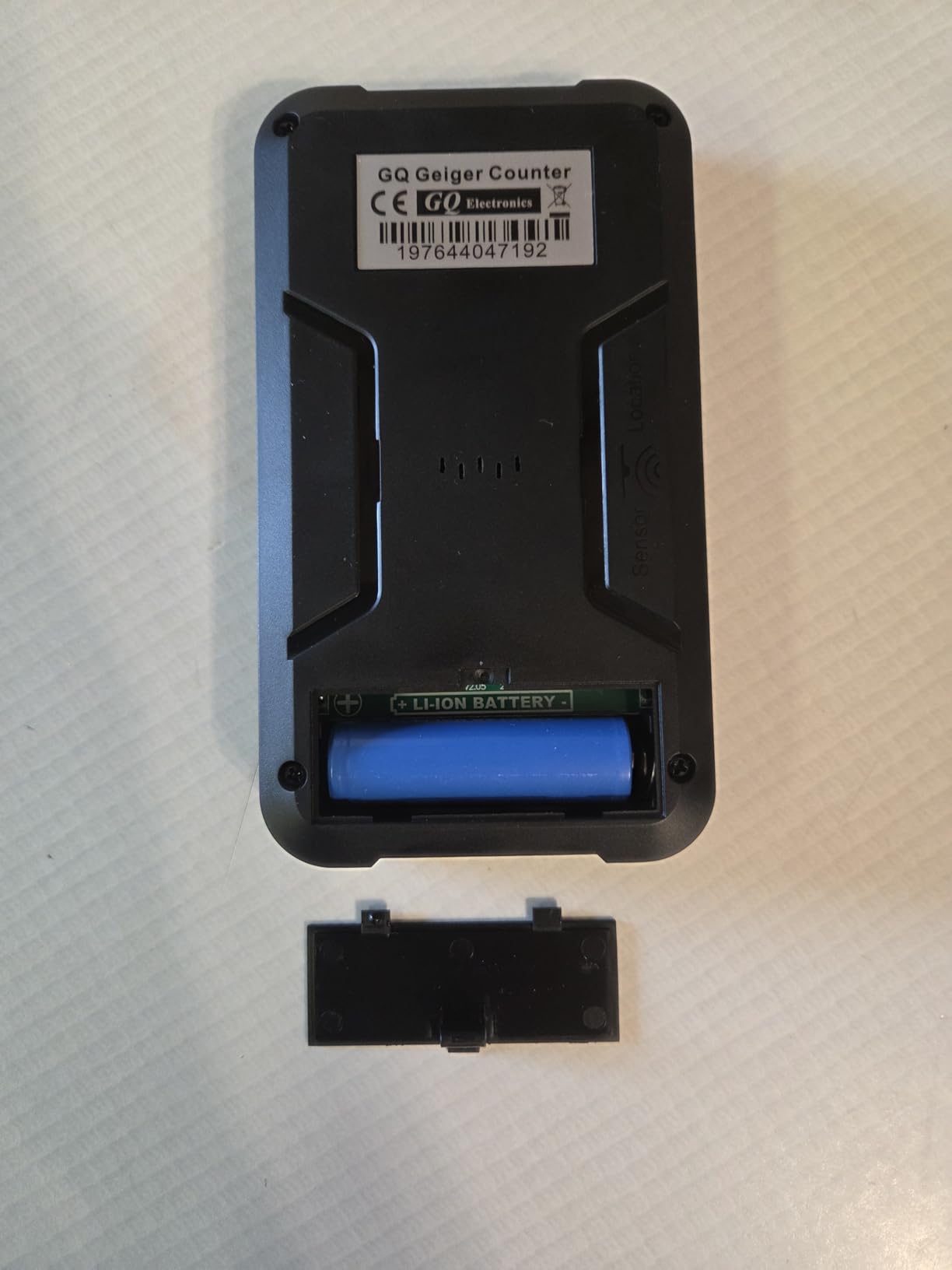
Popular uses in owner reviews include field surveys of uranium-bearing formations, checking fossil and petrified wood, screening antique glassware, and verifying smoke detectors. It weighs 8.4 ounces and measures 2.75 by 4.92 by 0.59 inches, so it is genuinely pocketable in a jacket.
What you gain by choosing it
Sensitivity relative to cost is the whole pitch, and it holds up in owner testing. A readable response at 30 inches from a test card is not a claim I would expect at this level.
Battery life of several days per charge and a sunlight-readable colour screen make it the most pleasant unit here to carry around and interpret at a glance.
Where it will frustrate you
Build quality is the recurring complaint. The front cover feels like cheap plastic, scratches easily, and the screen finish scratches readily and can develop burn-in over time. Handle it like a tool, not like a phone.
The graph display is predefined rather than user-customisable, and the GM sensor is mounted on the side of the body rather than the front, so aim the edge, not the face.
4. FNIRSI GC-01 – Best for Rock and Mineral Collecting
FNIRSI GC-01 Geiger Counter Nuclear Radiation Detector,Curve Display
Built-in GM sensor for gamma, beta and X-ray
48 KeV to 1.5 MeV, plus-minus 30 percent at Cs-137
Cumulative dose 0.00 uSv to 500.0 mSv
Light, vibration and sound alarms
Curve display of readings
Pros
- Reads normal background around 0.02 to 0.11 uSv/h
- Verified against a cobalt-60 source
- Good-quality feel with a high-quality screen
- Long integrated battery life
- Firmware is flashable and owners have improved it
Cons
- No history logging or screenshot saving
- No Bluetooth or phone connectivity
- Case blocks beta and owners have drilled it out
Best for rock and mineral collecting: this is the meter I would hand to somebody whose interest is specimens rather than surveys, because the curve display and the sensitivity-to-a-known-source behaviour suit showing a rock to a group. Multiple owners confirmed it picking up cobalt-60, uranium ore seen on a nuclear facility tour, the americium in a smoke detector, and even banana potassium as a joke reference point.
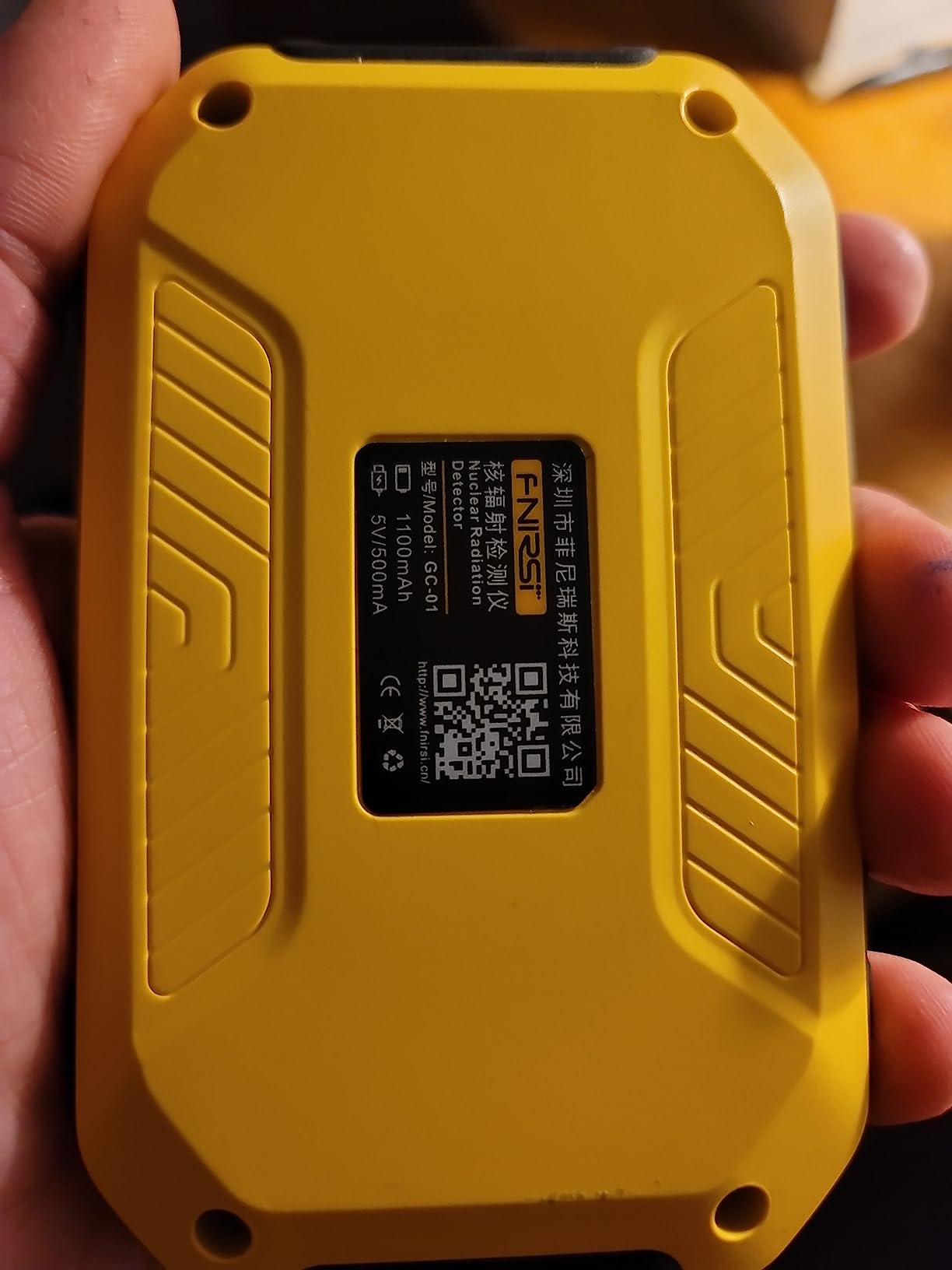
The energy range is 48 KeV to 1.5 MeV with a stated plus-minus 30 percent for Cs-137 gamma, which is a common and honest figure for this class. Cumulative dose equivalent runs from zero to 500 millisieverts. Background reads land between about 0.02 and 0.11 microsieverts per hour, which lines up with what you would expect in a normal room.
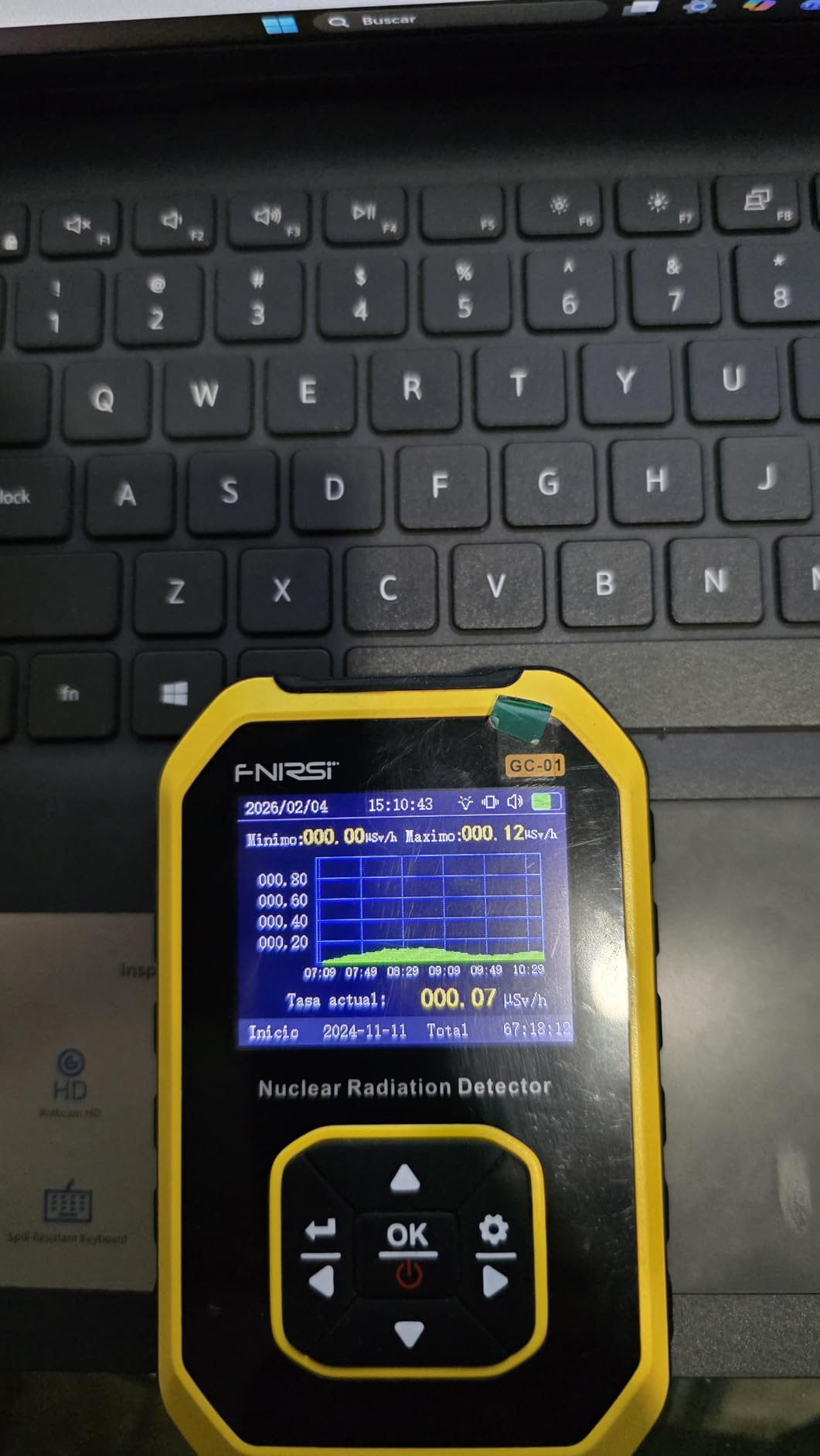
Alarm handling is more thoughtful than the price suggests. There are three modes, light, vibration and sound, with separate settable thresholds for dose rate and cumulative dose, and those thresholds still fire in sleep state. If you leave it in a jacket pocket overnight on a hunt, that is the difference between a useful tool and a dead one.
What it will not do is remember anything. There is no history logging, no screenshot saving, no Bluetooth and no phone app, so the display is your only record. That is fine for a spot check on a specimen and useless for a survey, which is the honest trade here.
What you gain by choosing it
It detects real sources reliably, verified by owners against cobalt-60 and smoke detectors, which is more than plenty of devices claiming to be Geiger counters manage. The firmware is flashable, and enthusiasts who open the unit typically find a GM-1011 tube and install Rad-Pro firmware for better response.
It reacts quickly to short sources, and the cumulative dose record plus sleep-state alarms make it a good companion for long collecting trips.
Where it will frustrate you
There is no data history of any kind, so if you want a record of a survey you have to write it down. Several owners found the supplied case blocks beta particles and drilled holes in the shell, which is a modification you should think twice about.
Reviews are mixed on long-term stability, with some owners reporting drifting background readings and rapid battery drain on early units, and the sharp reaction means instantaneous spikes cannot be averaged out easily.
5. Radiacode RC-102 – Best for Isotope Identification
Smart Geiger Counter Radiacode-102 with Free Mobile App. Nuclear Radiation Detector
Gamma spectroscopy with spectrum visualisation
9.5 percent FWHM spectral resolution
Identifies Cs-137, Ra-226, Th-232, U-238
Real-time GPS radiation maps in the app
Measures in CPS, CPM, uSv/h, uR/h
Pros
- Spectroscopy identifies the isotope not just the presence of radiation
- Measures up to 20 times faster than regular devices
- Free apps for iOS
- Android
- macOS and Windows
- GPS heat maps reveal hot spots
- Battery commonly runs 4 to 7+ days
Cons
- Sealed scintillator is not built for alpha and is far less sensitive to beta than a GM tube
- iOS app lags the Android app
- Bluetooth dropouts need the app fully relaunched
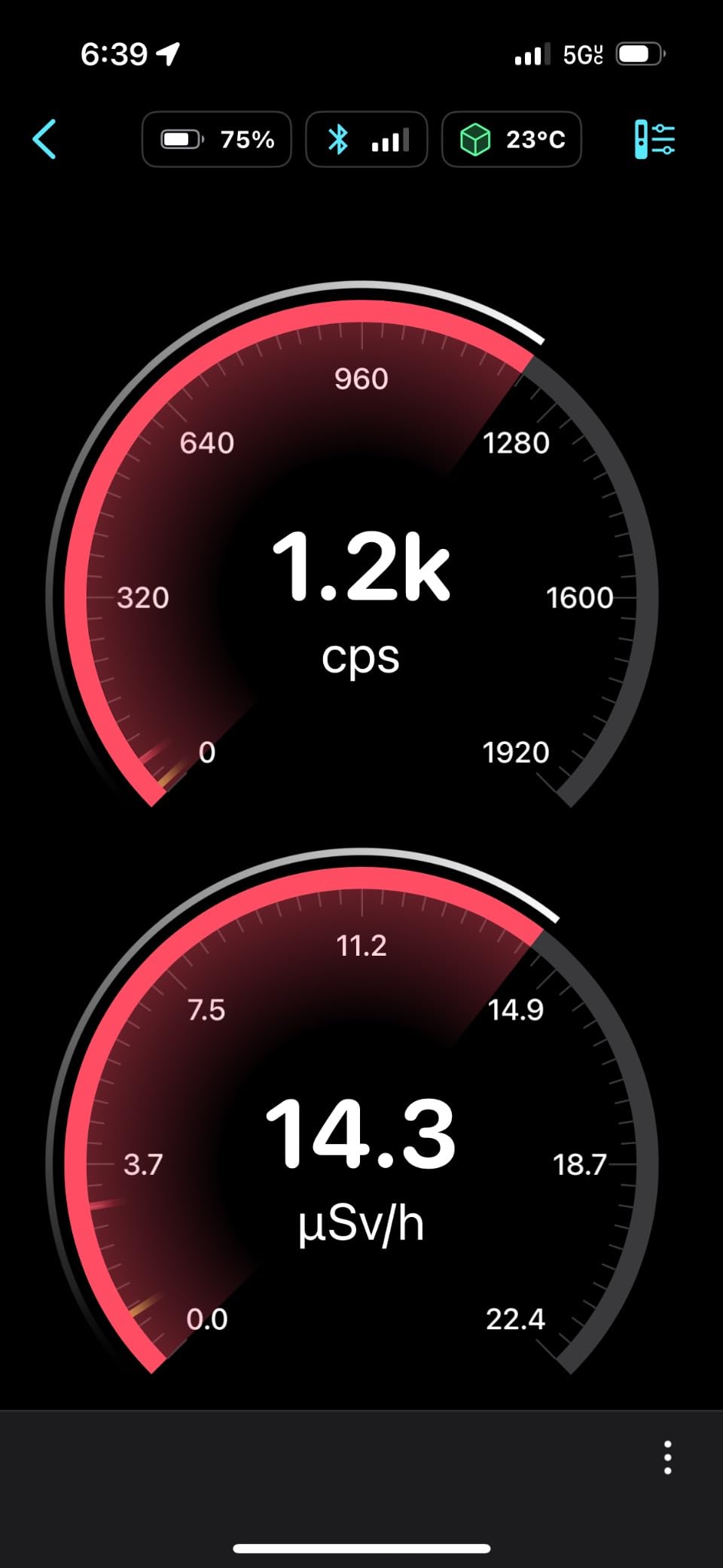
Best for isotope identification: this is the only meter in the roundup that tells you what is radiating, not just that something is. It performs gamma spectroscopy and draws the spectrum, which means a reading of a rock can come back labelled as potassium-40, thorium-232 or uranium-238 rather than an anonymous count rate. Owners describe it as a pocket gamma spectrometer rather than a click counter, and for a physics-minded hobbyist that is a different instrument entirely.
Speed is the second headline. It measures up to 20 times faster than regular devices, with a reference count rate of 1 microsievert per hour equalling 30 counts per second on Cs-137. Owners report roughly seven times the sensitivity of a Mazur PRM-9000 pancake GM tube for gamma, and the measurement is fast enough to sweep a building in a reasonable time rather than standing still for minutes at each point.
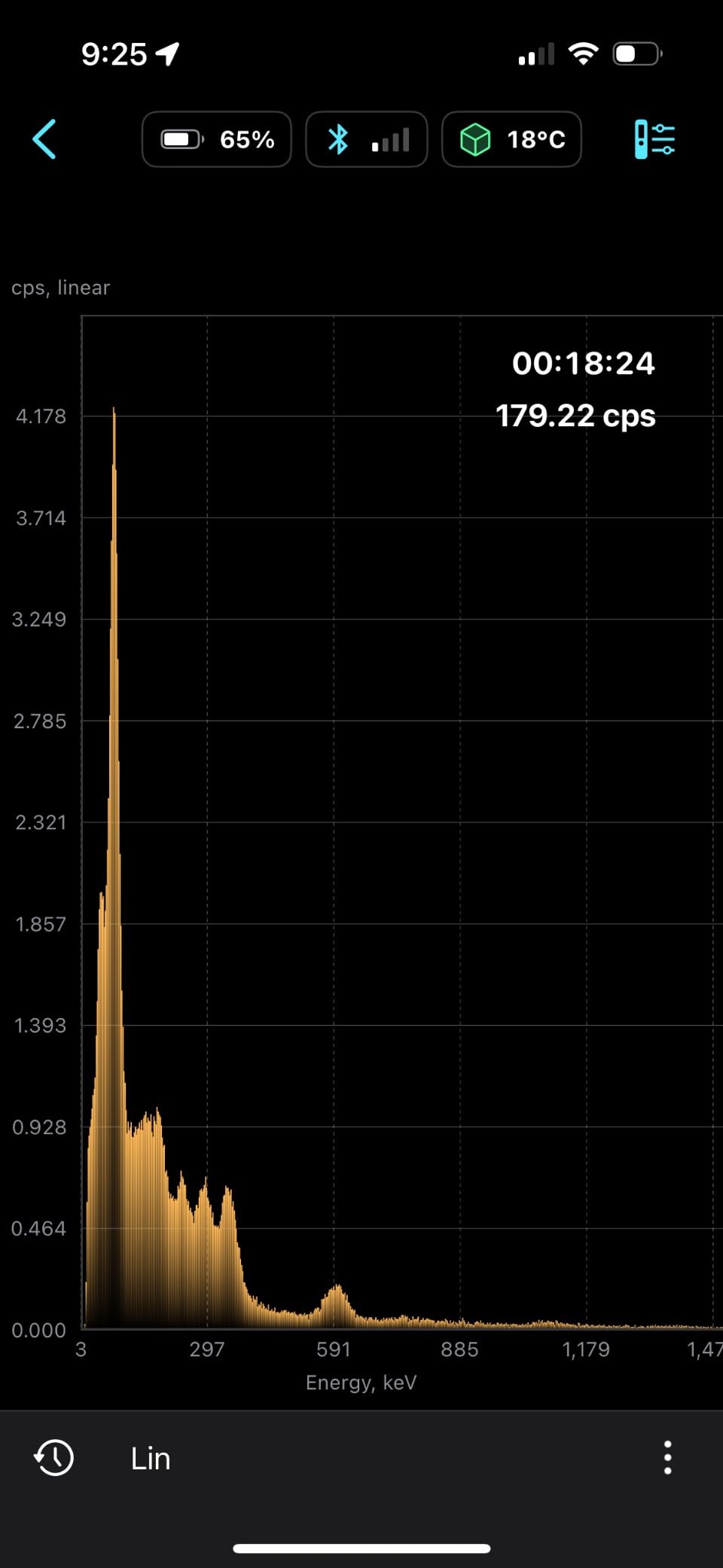
The app side is the real differentiator. It logs real-time GPS-tagged radiation maps, colour-coded, on Google Maps or offline OpenStreetMap, and the same free software covers dose rate graphs, spectrum analysis, spectrogram, event logs and a food analyser. When you walk into a dentist’s office or a hospital CT suite and the map lights up, that is a demonstration you cannot get anywhere else in this price class.
Reported Cs-137 resolution lands around 9.8 percent, which the manufacturer states as 9.5 percent FWHM. That is enough to identify common isotopes but it is not lab-grade resolution, and it is worth being clear about that difference. There are variants at 8.4 percent FWHM if you want more.
What you gain by choosing it
Isotope identification. Knowing whether a hot rock is a uranium or thorium mineral changes what you do with it, and no other meter here can do that.
Mapping and history are handled properly, with free apps across all four major platforms, continuous updates, and a battery that commonly runs four to seven days or more on a charge. The after-sales support and replacement handling are praised by owners.
Where it will frustrate you
Alpha is out. It is a sealed scintillator, so it is not built for alpha and it is far less sensitive to beta than a GM tube. If contamination is your concern, this is the wrong instrument.
The iOS app is less mature than the Android one and lags on spectrum saving and other features, and Bluetooth occasionally drops out and needs the app fully quit and relaunched. The battery percentage is a voltage-based estimate that can jump, and it needs a case or sleeve to survive drops.
6. MOESAPU FS-5000 – Best for Long Field Days
MOESAPU Geiger Counter Nuclear Radiation Detector, Rechargeable Handheld Radioactive Dosimeter with 2.4“ TFT Display GM Tube Detects X Ray Beta Gamma Portable Radiation Testing Device, FS5000 (Yellow)
J321 sensor, 1 CPS per uSv/h, 0.5s response
Real-time monitoring 0.01 uSv/h to 50 mSv/h
Total dose 0 uSv to 1000 Sv with timed dose
Up to 30 days runtime, 720 hours standby
2.4 inch TFT with 6-level brightness
Pros
- Fast 0.5 second response from a J321 tube
- Up to 30 days runtime on a full charge
- Live dose-rate graph across a wide range
- Data retained in memory even without power
- Customisable audio
- visual and vibration alarms
Cons
- Mixed reports on real-world accuracy
- Runtime claim depends heavily on backlight and sleep settings
- No smartphone connectivity or isotope identification
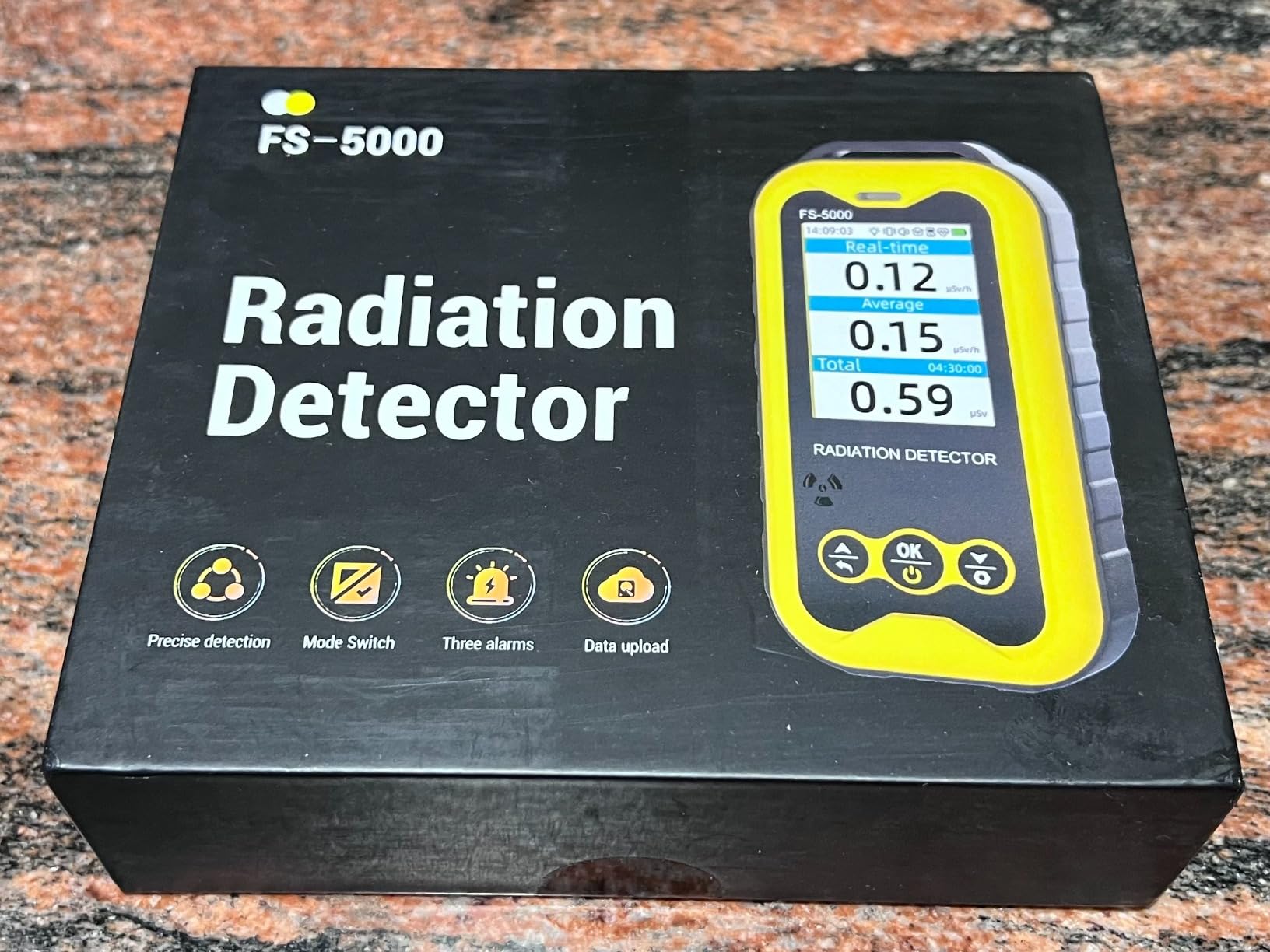
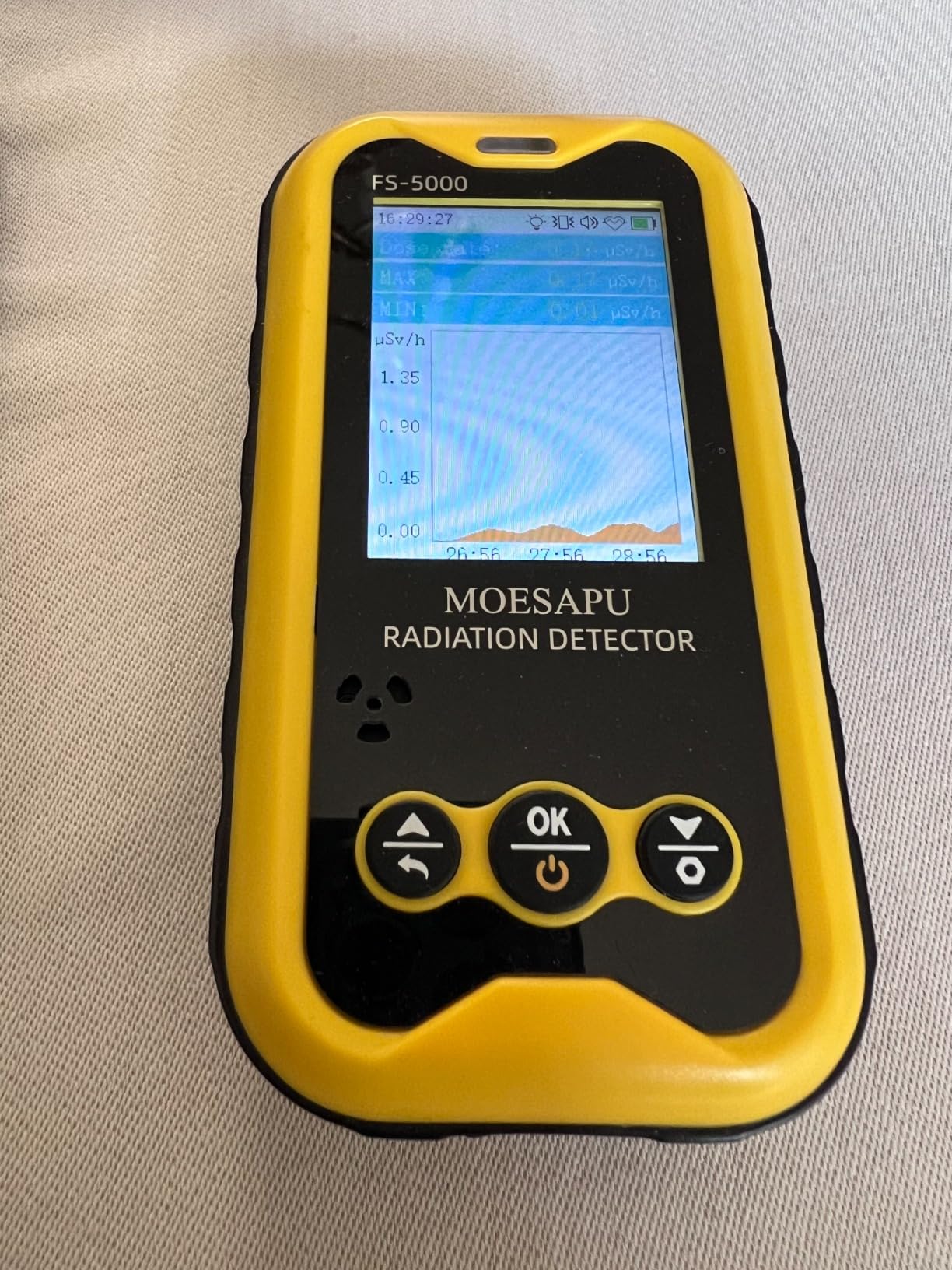
Best for long field days: the FS-5000 is built around one number that matters when you are away from a car socket, which is runtime. The 1800mAh rechargeable battery is rated at up to 30 days of operation and 720 hours of standby, and the 2.4-inch TFT-LCD has six levels of brightness so you can dial it down when the sun is not the problem.
Under the bonnet is a J321 GM tube rated at 1 CPS per microsievert per hour with a 0.5 second response time, which is genuinely quick. Real-time dose rate monitoring spans 0.01 microsieverts per hour up to 50 millisieverts per hour with a live graph, and total dose runs from zero to 1000 sieverts with a timed-dose mode for long integration.
One detail I like: the latest reading is retained in memory even without power, and downloads to a computer through PC software. Most budget meters lose everything when the cell dies, so this matters in practice when a trip ends and the meter has been off for two days in a pack.
Alarms are audio, visual and haptic, firing above 2.5 microsieverts per hour or 1 millisievert total dose by default, with thresholds you can change. The clip design makes it easy to wear rather than hold, which is how you should be using a monitor while walking a property.
What you gain by choosing it
Runtime that removes charging from your planning, and a wide live monitoring range with a fast response so short passes over a floor do not get missed.
Persistent memory plus a wide dose range and adjustable alarm thresholds make it a good working tool for scrap metal and field inspection rather than a display piece.
Where it will frustrate you
Accuracy reviews are mixed, and the 4.2 average reflects that. Treat its dose rate as an indication of relative level, not as an instrument you would report from.
The 30-day runtime figure depends heavily on backlight and sleep settings, so manage those deliberately. There is also no smartphone connectivity and no isotope identification, so logging is a desktop software affair.
7. Sooguard HFS-Black – Best for Quick Spot Checks
Sooguard Geiger Counter Nuclear Radiation Detector – Portable Handheld Beta Gamma X-ray Radiation Monitor Meter, Nuclear Wastewater, Seafood Detection Radiation Dosimeter with LCD Display,Rechargeable
Built-in GM sensor, fast response, gamma beta and X-ray
Sensitivity 80 CPM per uSv
48 KeV to 1.5 MeV plus-minus 30 percent
Cumulative dose 0.00 uSv to 500.0 mSv
1800mAh battery, four alarm modes
Pros
- Lowest credible entry price in this roundup for a true GM-tube meter
- 1800mAh battery supports long continuous work
- Fast response with adjustable thresholds
- Alerts in sleep as well as active state
Cons
- No data logging
- graphing or phone connectivity
- Cheapest build in the group with no isotope ID or beta shielding
- Smaller review base gives less long-term field evidence
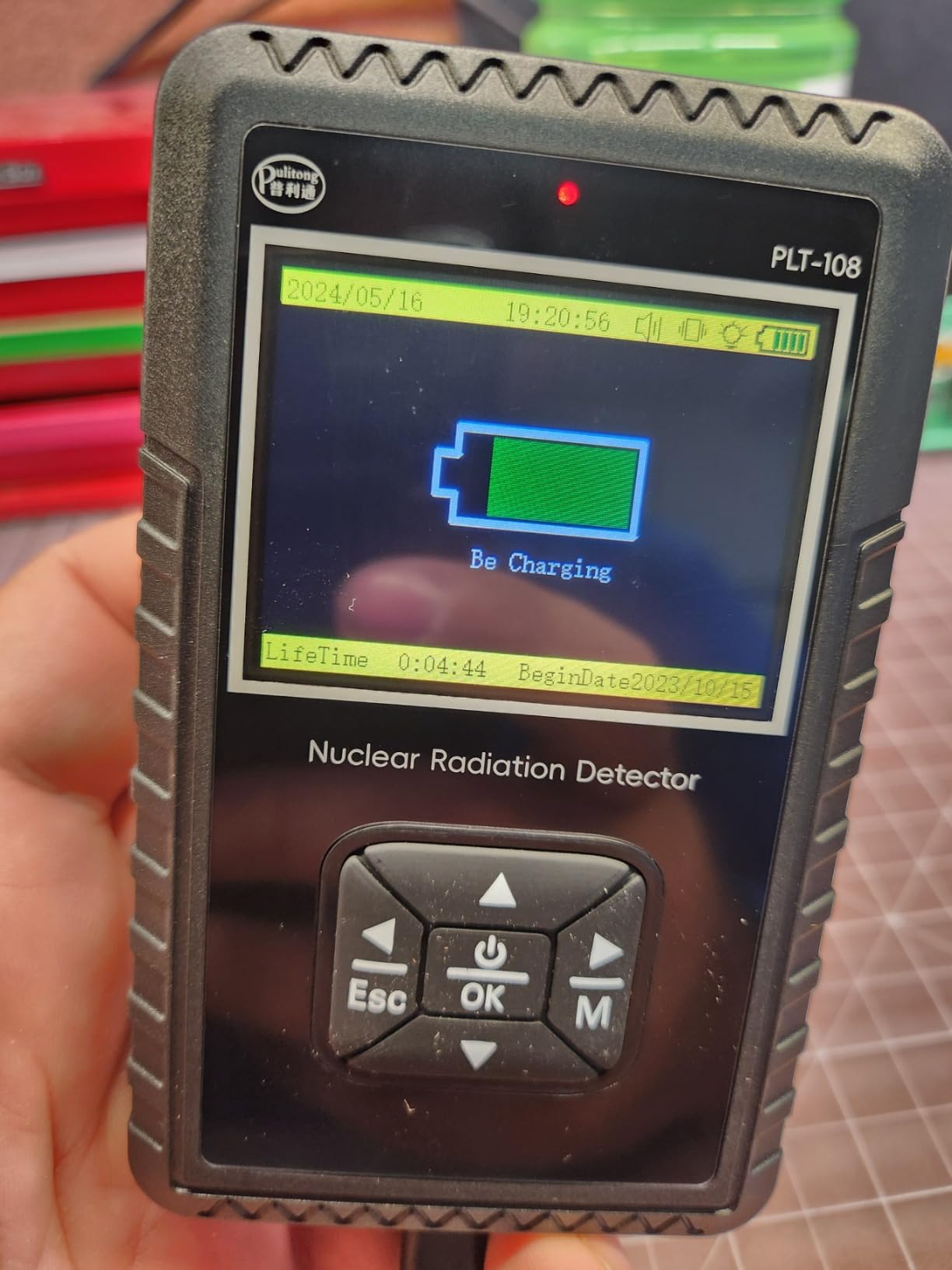
Best for quick spot checks: this is the cheapest meter here that uses a real GM sensor rather than a novelty semiconductor, and that distinction is the entire reason it is on this list. It quotes the same 48 KeV to 1.5 MeV energy window and the same 80 CPM per microsievert sensitivity figure that more expensive models in this roundup publish, which tells you the tube is doing the work rather than a marketing department.
Owners use it for exactly the kind of thing a first meter is bought for: checking imported food, marble and stone, and home improvement materials. There is an 1800mAh lithium battery supporting long continuous work, and the cumulative dose equivalent runs from 0.00 microsieverts to 500 millisieverts, which is a generous range for a spot-check tool.
Settings are more adjustable than the price suggests. You can set alarm thresholds, choose the alarm mode, switch measurement units, and change screen brightness and language, with four alarm types covering sound, vibration, an alarm light and the display itself. Those alerts fire in sleep state as well as while operating, so leaving it running in a coat through a flea market trip still works.
The LCD colour display gives real-time readings with a straightforward interface. I would not build a survey workflow around it, but for “is this slab of granite worth a second look”, it does the job with a genuine detector behind the number.
What you gain by choosing it
It is a real GM-tube meter at the bottom of the price range, which is more than most devices at this level manage. The sensor is honest about the energy window it covers.
Configurable units, thresholds, brightness and language, plus sleep-state alarms, make it flexible for casual use around the house and workshop.
Where it will frustrate you
There is no logging, no graphing and no phone connectivity, so every reading you want to keep has to be written down by hand.
It is the cheapest build in the group, with no isotope identification and no beta shielding, and the smaller review base means less long-term field reliability evidence than the higher-rated rivals have.
8. Aranet Radiation Detector – Best for Home Background Monitoring
SAF Aranet Radiation Detector, Dosimeter, Portable, Measures Dose Rate & Total Dose of Ionizing Radiation, E-Ink Display, 4-Year Battery Life, Bluetooth Connection, Free App with Graphics & Alarm
Dose rate plus total dose to 1000 mSv
E-ink display with up to 4 year battery
Bluetooth app with graphics and history
Gamma, beta and X-ray detection
Slim sit-anywhere form factor
Pros
- E-ink display extends battery life dramatically
- Accurate readings that build a usable multi-week history
- Bluetooth app logs and graphs history
- Slim footprint that sits discreetly for whole-home monitoring
- Easy Bluetooth pairing
Cons
- Lowest sampling interval is 1 minute with no faster option
- Default beep can only be disabled with a physical DIP switch
- Cannot be wall mounted
Best for home background monitoring: this one solves a problem the handheld meters cannot. A survey meter tells you what a room reads right now. A monitor tells you what a room reads over weeks, so a granite countertop or a radon-affected basement shows up as a slow drift rather than a single number you forgot. Owners report building genuinely usable multi-week histories of local background with it.
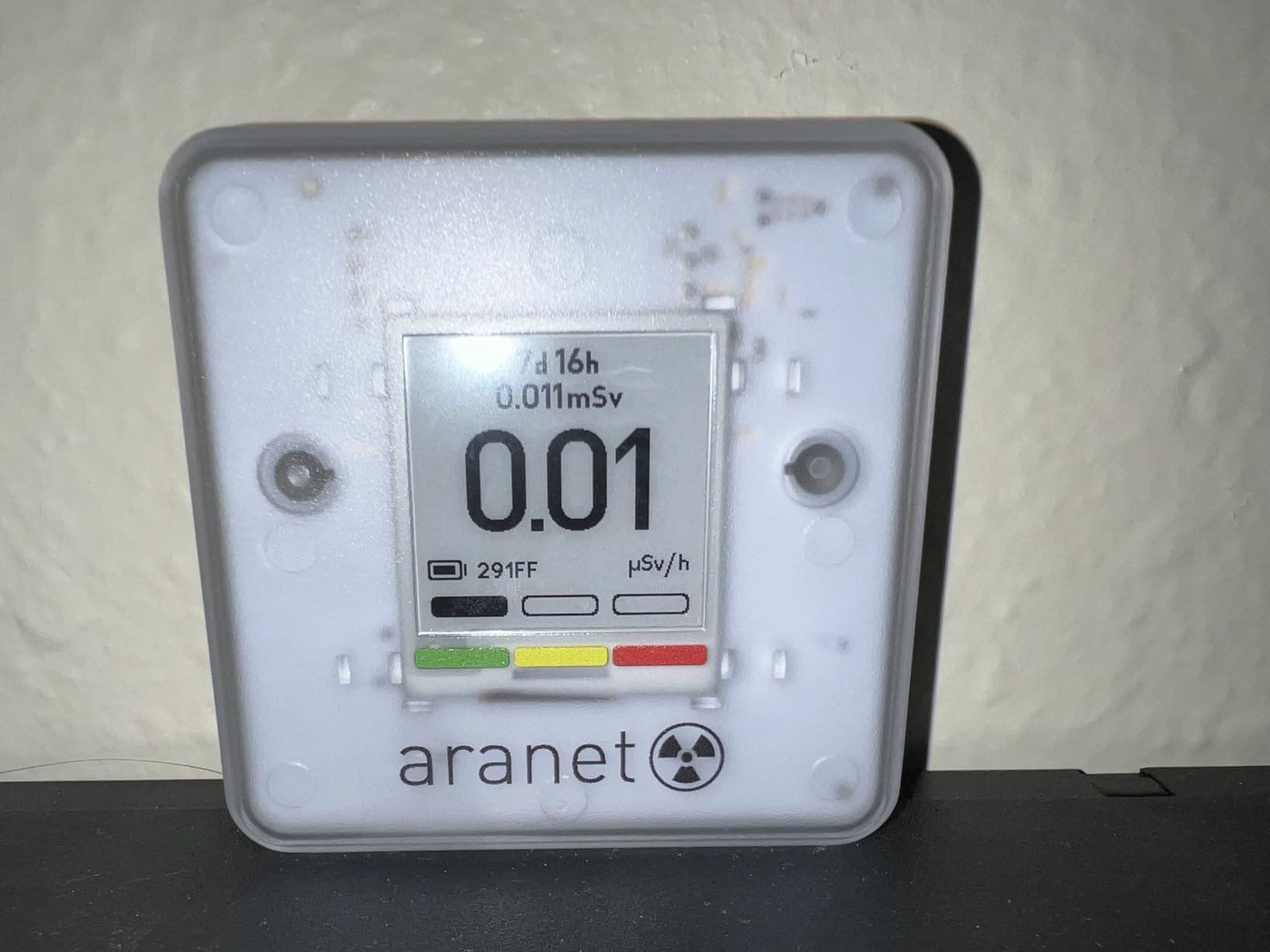
The e-ink display is the reason it works. It is readable from wide angles and it does not meaningfully drain the battery, which is what lets the manufacturer claim up to four years of battery life. Owners confirm it still reads nearly full after a hundred days of continuous operation. Total dose range is zero to 1000 millisieverts, or zero to 100 rem, over up to two years.
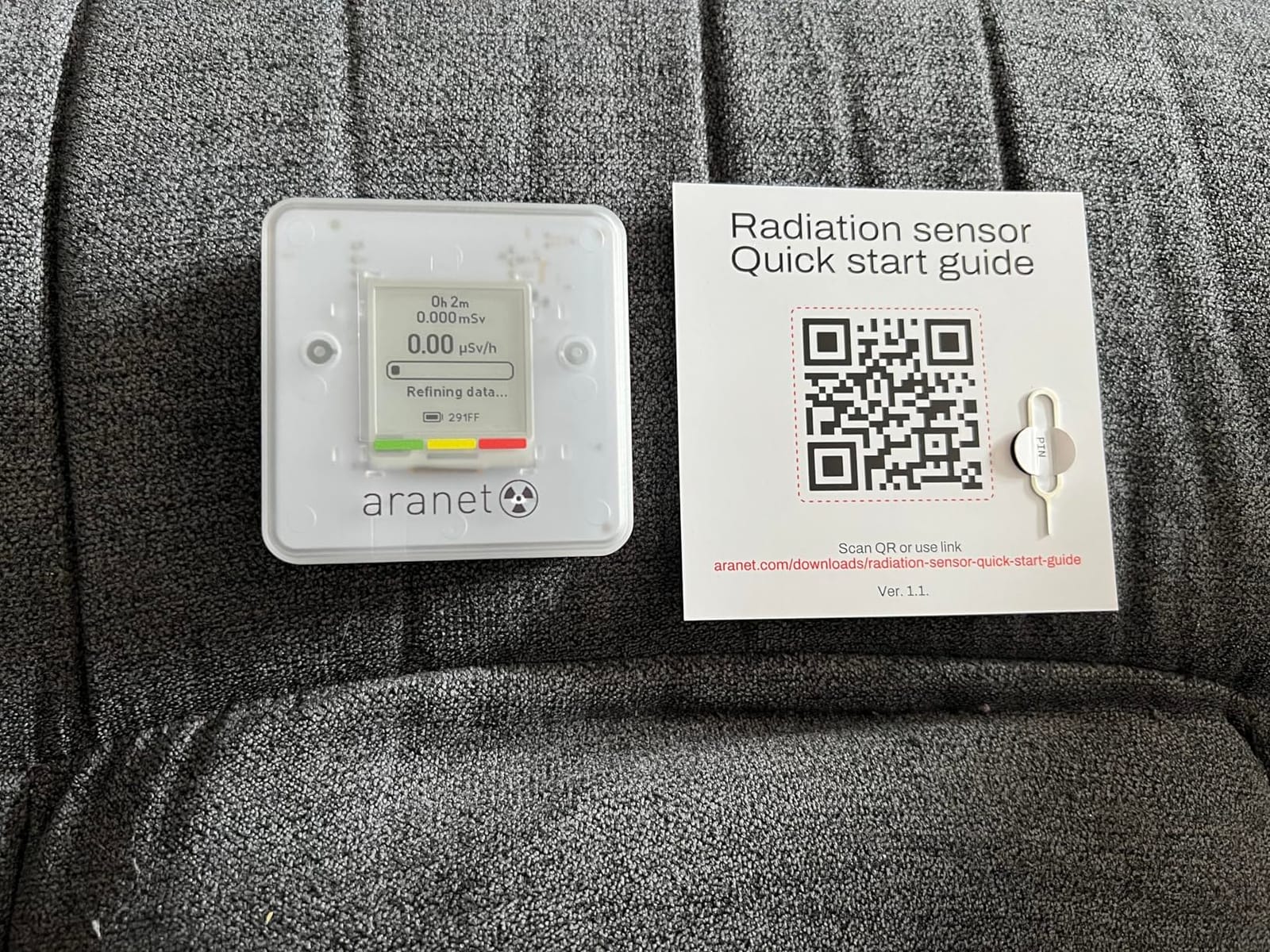
Bluetooth connects to a free companion app with graphics and historical logging, so the phone becomes the data store rather than the meter. If you are already familiar with the Aranet 4 app, setup is straightforward. The alarm system triggers on high radiation levels based on scientific recommendations, and the slim footprint sits or mounts discreetly for whole-home coverage.
It is 7.8 ounces and measures 4.96 by 4.65 by 1.65 inches packaged. It measures ambient equivalent dose rate plus ambient equivalent total dose for gamma, beta and X-ray.
What you gain by choosing it
A real baseline. Run it in each room for a week and you will find out where your home geology shows, which is the number every other reading on this list is meaningless without.
Set-and-forget operation. The e-ink screen and multi-year battery mean you put it somewhere and stop thinking about it, and the app handles the history so nothing is lost.
Where it will frustrate you
The lowest sampling interval is one minute with no faster option, which makes it useless as a portable survey meter or for scanning a suspicious object.
The default per-detection beep is enabled and can only be disabled with a physical DIP switch inside the battery compartment, it cannot be wall mounted like the Aranet 4, and there are no traditional Geiger clicks for quick spot scanning.
9. Images SI GCA-07W – Best for Wand-Probe Survey Work
Geiger Counter – Digital – Professional – Model # GCA-07W External Wand Probe – ANSI N323A Certification Ready- 0.001 mR/hr Resolution – 1000 mR/hr Range
External wand probe for localised source isolation
American-made LND712 GM tube
Alpha above 3 MeV, beta above 50 KeV, gamma above 7 KeV
1 CPM to 10000 CPS counting range
0.001 mR/hr resolution over a 1000 mR/hr range
Pros
- Wand probe isolates a small source instead of measuring whole-body background
- Best-in-group low-energy threshold at 7 KeV for gamma and X-ray
- Wide 1000 mR/hr range with 0.001 mR/hr resolution
- Handles low-energy background and NORM detection
- US-based technical support
Cons
- ANSI N323A certification is not included and must be purchased separately
- Heaviest unit here at 1.46 pounds
- Bulky industrial form factor with no app or wireless logging
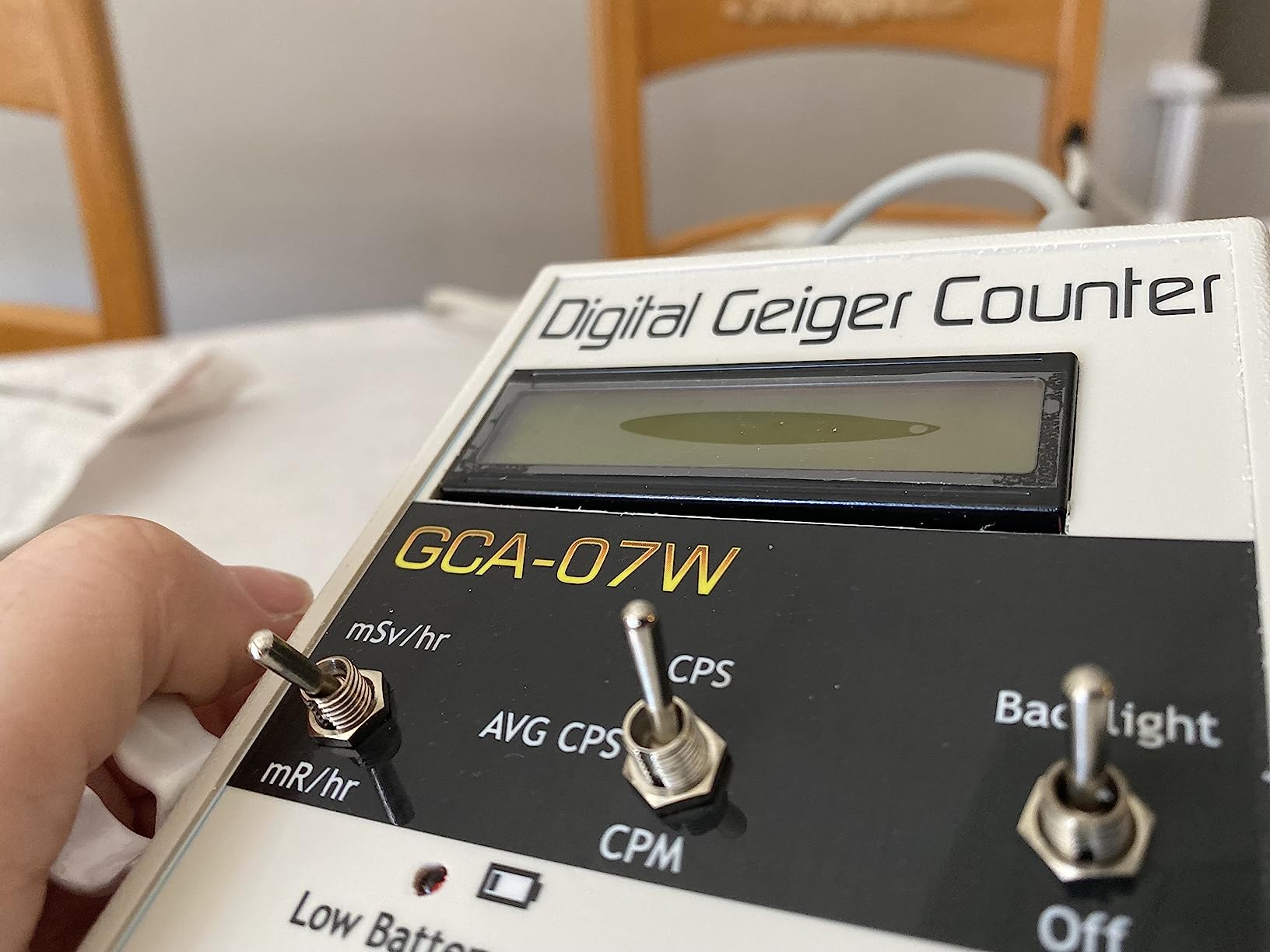
Best for wand-probe survey work: when you need to know whether a specific item in a pile is the hot one, a handheld meter with an internal tube is the wrong shape. The external wand lets you bring the detector to a small source without the rest of the instrument dominating the reading, which is the whole point of the design. It is assembled in the USA with US technical support, and it is aimed at regulatory inspection and NORM detection work.
The tube is the star. The American-made LND712 is specified at alpha above 3 MeV, beta above 50 KeV, and X-ray and gamma above 7 KeV, which is the lowest energy threshold in this group. If you are chasing low-energy gamma from building materials or vintage material rather than an obvious hot source, that threshold is the specification that matters. Counting resolution runs from 1 CPM to 10000 CPS.
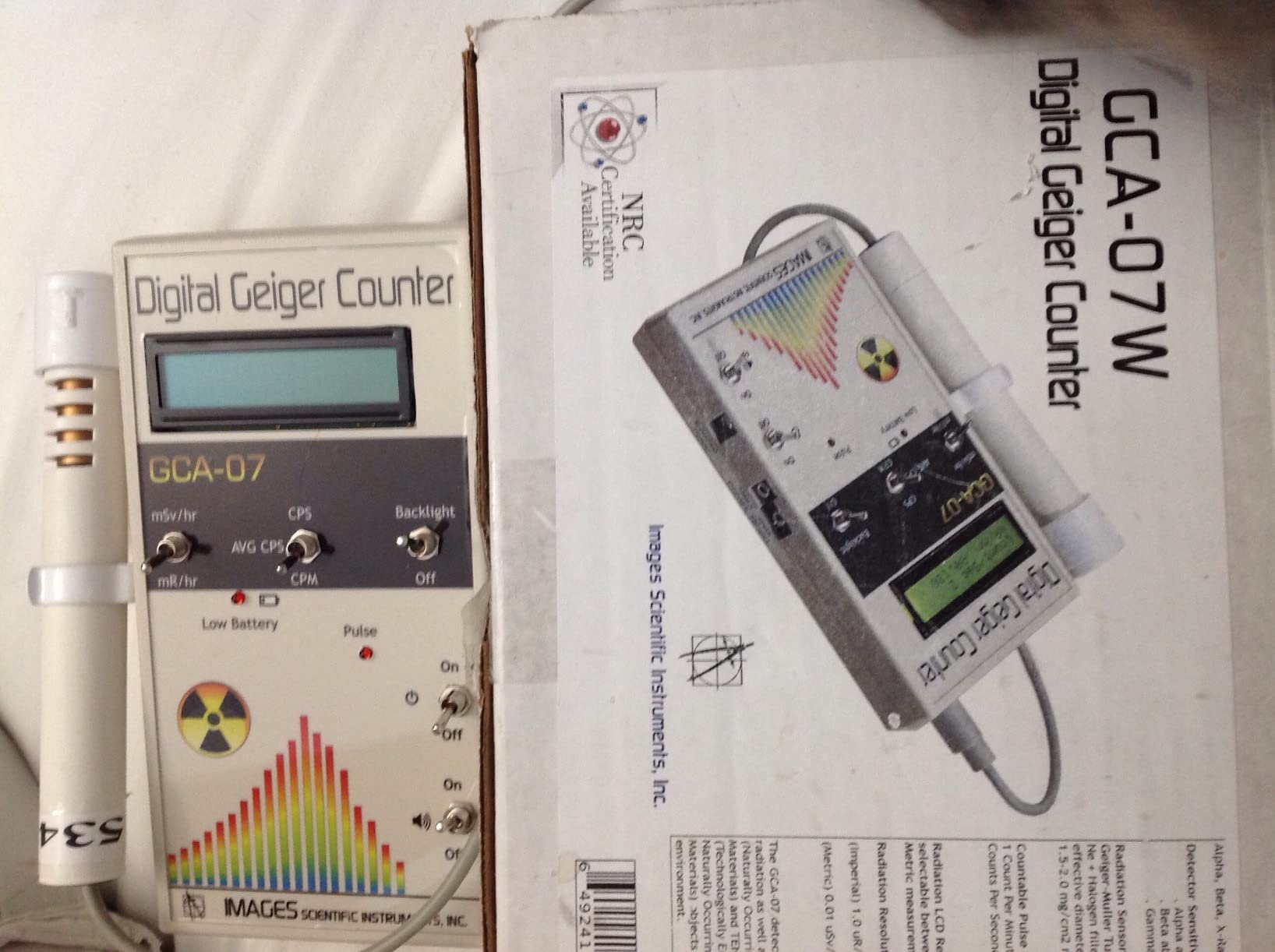
Resolution is 0.001 milliroentgens per hour over a 1000 mR/hr range in imperial, or 0.01 microsieverts per hour over a 10 millisievert per hour range in metric. That is roughly a thousand-fold improvement in display resolution over a pocket meter, and it is the number that lets you separate 0.05 from 0.06 microsieverts per hour instead of watching a single coarse digit.
It measures 7.5 by 4.1 by 1.2 inches and weighs 1.46 pounds. Owners value it for antique, scrap and NORM inspection work where a cheap pocket meter is not enough, and it is a longstanding product with support behind it.
What you gain by choosing it
A 7 KeV gamma and X-ray threshold, the lowest here, which is what low-energy sources actually require. The wand geometry also lets you localise a source inside a mixed pile instead of averaging the whole thing.
Fine display resolution and a 1000 mR/hr range mean you can work with weak sources where a handheld would show background and nothing else.
Where it will frustrate you
ANSI N323A certification is not included and has to be bought separately from the manufacturer, which matters if you need certified documentation for any formal purpose.
At 1.46 pounds it is the heaviest meter here and a poor all-day carry, the industrial form factor dates from the early 2000s with no app, graphing or wireless logging, and there is no isotope identification.
10. FNIRSI GC-03 – Best for Combined Radiation and EMF Checks
FNIRSI GC-03 3-in-1 Geiger Counter Nuclear Electromagnetic Detector
Three-in-one: radiation monitor, EMF meter, dosimeter
Three display modes
Rechargeable lithium polymer battery
Gamma, beta and X-ray dosimetry
5.3 oz, 5.51 x 2.36 x 1.18 in
Pros
- Combines a radiation monitor and an EMF meter in one device
- Rechargeable and light at 5.3 ounces
- Three display modes for switching between readings
Cons
- Lowest rated pick in the lineup at 4.0 stars
- No RF detection despite the three-in-one positioning
- No data logging
- app connectivity or isotope identification
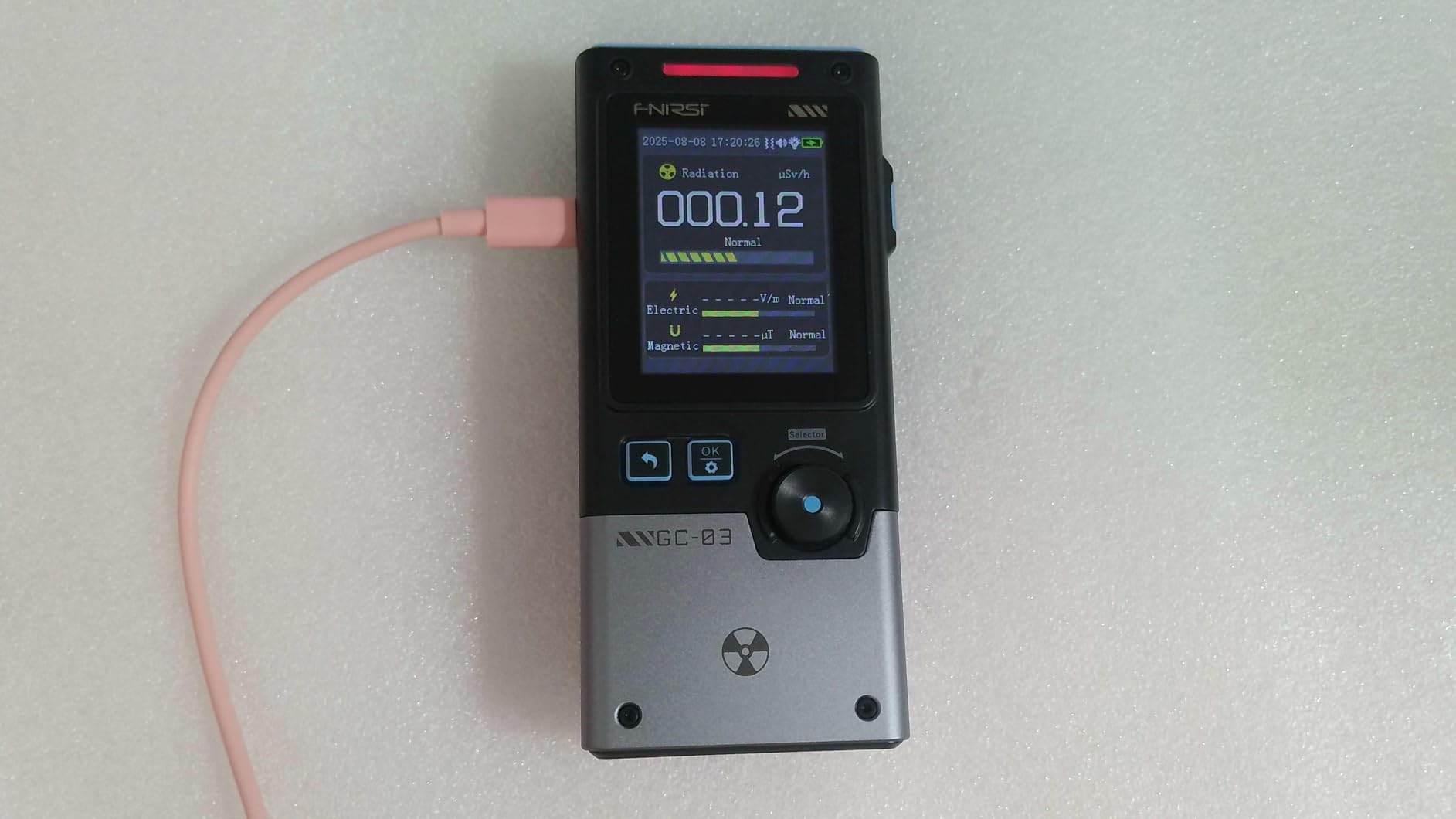
Best for combined radiation and EMF checks: the reason this one is here is straightforward, and it is convenience. It pairs a real-time radiation monitor with a rechargeable EMF meter and a portable gamma, beta and X-ray dosimeter in a single body weighing 5.3 ounces. If you are auditing a room for a home and want both numbers from one device, that is a reasonable proposition.
Three display modes let you switch between readings, and the lithium polymer battery is rechargeable so there is no consumable to think about. The form factor is 5.51 by 2.36 by 1.18 inches, which is slim enough for a bag or a pocket.
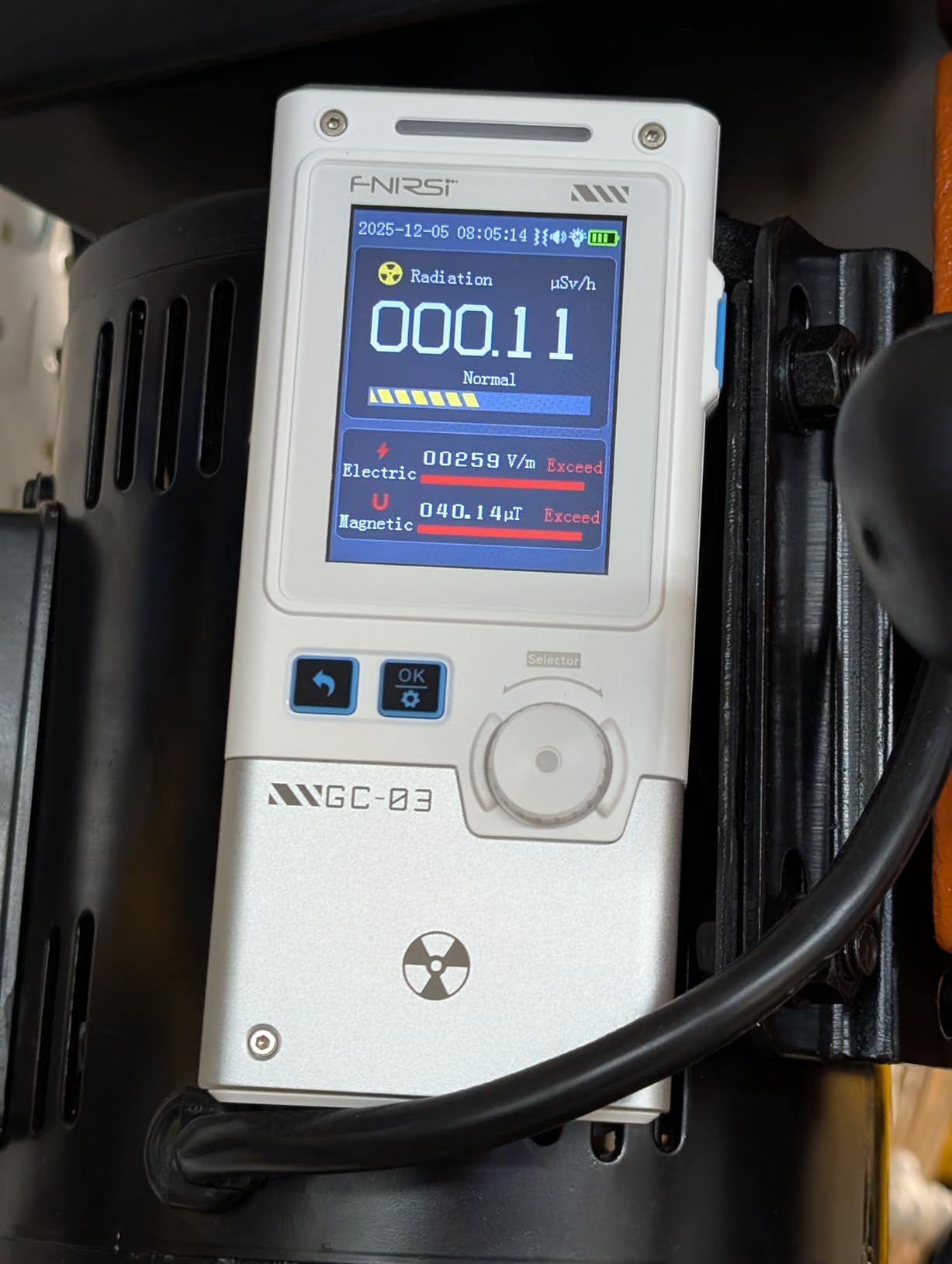
I want to be straightforward about the rest. Despite the three-in-one label there is no RF detection, and there is no data logging, no app connectivity and no isotope identification. The 4.0 average is the lowest in this roundup, with the weakest share of five-star reviews at 52 percent, and the 97-review base is the smallest.
Owners mostly describe it as adequate. That is the right word: it is convenient and rechargeable, and buyers end up disappointed relative to dedicated single-purpose meters in the same price band. If you already know you want an EMF meter, buying a combined device costs you something in the radiation reading too.
What you gain by choosing it
One device covers two measurements instead of two devices, which removes a bag item and a charging cable from your kit.
It is light, rechargeable and pocketable, and the three display modes make it easy to keep both readings visible.
Where it will frustrate you
It is the lowest-rated pick here, and the three-in-one promise does not include RF detection. You get less than the label implies.
There is no logging, no app and no isotope identification, and the small review base means there is less field history behind it than the other nine.
The Alpha Trap: What Your Geiger Counter Will Never Tell You
A cheap beta and gamma meter gives a false sense of security, and that warning appears repeatedly from people who work with radioactivity for a living. It is also the single most useful thing on this page that no marketplace listing will tell you. A radiation lab worker asked a public forum for home counter recommendations and got exactly this advice back: do not waste your money on a cheap beta and gamma monitor, because it will just give you a false sense of security.
Here is the physics. Alpha particles are helium nuclei, and they are stopped by a few centimetres of air. Hold a standard handheld probe even a few centimetres from an alpha source and the count drops to background. Worse, the actinides that dominate contamination concerns, including americium-241, emit gamma in only about 40 percent of their decays. A gamma-only instrument sees roughly two in five of the emissions from a sample and misses the rest entirely, and a meter with a limited detection floor sees rather less than that.
Alpha-capable monitors reach detection limits of a few becquerels, which a consumer gamma meter will not approach by any margin. The professional answer for contamination work is a Ludlum 26-1 or a mini monitor with an EP15 alpha probe, both real instruments that hobbyists can aspire to but rarely need. The practical hobbyist answer is to know what your meter cannot do and use the right complementary tool for the job.
Two of the meters here extend further than most. The Images SI GCA-07W uses an LND712 specified to respond to alpha above 3 MeV, and it reaches a 7 KeV gamma and X-ray threshold that nothing else here matches. Neither fact turns it into a contamination monitor, but both widen the envelope. The Radiacode RC-102 is the clearest example of the opposite trade: a sealed scintillator that is explicitly not built for alpha and is far less sensitive to beta than a GM tube.
Also missing from every meter in this roundup: neutrons, radon, and low-energy X-ray below the stated threshold. A Geiger counter does not measure radon, and no amount of clever use changes that. If radon is your actual concern, a dedicated radon sensor is the instrument you need, and if you are building electronic test gear or want to understand the circuit, our soldering station guide covers the bench side of that.
How to Actually Take a Reading
Most hobbyist readings are wrong not because the meter is bad but because the technique is. Six steps, and every one of them takes ten seconds.
1. Record your background first. Put the meter where you are going to work, away from any suspect object, and let it settle. Write that number down. Every subsequent reading means nothing without it.
2. Watch for saturation. A GM tube that pegs at its maximum is not telling you the dose rate is very high, it is telling you the number is meaningless. Back away until the count rate moves.
3. Know your probe before you approach. An end-window probe with a thin window responds to beta and some alpha, and the window is fragile enough to be damaged by careless handling. Never set it down window-first on a dusty bench.
4. Place the probe close, or in contact. For alpha the reading falls off fast with air distance, so a probe held at arm’s length is effectively blind. Touch the window to the sample gently, or as near as you can get.
5. Hold position and let the average settle. A fast-response meter reacts sharply to a short source, so a single glance at a spiking number is not a measurement. Give it ten seconds of stable counts.
6. Compare to background and log it. Ratio to background is the most honest comparison you can make at hobbyist level, and if you want the record, take a photograph or export the graph before you put the specimen down.
For survey work, use the same gridding every time. Walk a room in a fixed pattern at a fixed distance from surfaces, and you can compare rooms against each other honestly. For instrument work, remember that a pulse counter is a diagnostic tool; our oscilloscope guide is a better read on why a reading is or is not real.
How to Choose a Geiger Counter: 7 Decisions That Matter
1. GM tube or scintillator
A GM tube is a gas-filled chamber that costs little, tolerates rough handling, saturates in high fields, and gives you no information about the energy of what it detected. A scintillator uses a crystal that flashes when struck by radiation, which makes it far more sensitive, energy-compensated, and able to identify isotopes by their gamma signature. If you want to know what a specimen is, you want a scintillator. If you just want to know whether something is hot, a GM tube is the value choice.
2. End-window, pancake, or neither
An end-window probe has a thin window, responds better to beta than a wall probe, and blocks most alpha. A pancake probe is wide and flat, with maximum sensitivity to high-beta and alpha, and must be held almost in contact with the sample. Neither appears in this roundup as a standard accessory, which is exactly why the wand-probe GCA-07W earns its place and why anyone chasing contamination should look past this list.
3. Energy compensation, and why cheap meters misread
Without energy compensation, a meter’s dose-rate conversion is tuned to one gamma energy and is systematically wrong at every other one. Community consensus, cited in the AI Overview for this query, holds that units at the lower end of the market often lack energy compensation and calibration, making them unreliable for precise dose-rate measurement. Practical consequence: use a cheap meter for comparison, not for numbers you intend to report.
4. What accuracy you actually get
Expect a wide margin of error at the entry level. Industry and hobbyist guidance puts typical measurement error in the range of 30 to 40 percent for low-cost instruments, around 20 to 25 percent for the middle tier, and 5 to 6 percent for calibrated professional equipment with a proper certificate. If you need the last of those, buy from a supplier that offers a traceable calibration, and note that even the GCA-07W is certification-ready rather than certified.
5. Logging and connectivity
Decide whether you want a record. Internal logging exists in the GMC-300S, the GMC-800, the GMC-500Plus, the FS-5000 and the Sooguard. Bluetooth and a real app exist only in the Radiacode and the Aranet. The FNIRSI GC-01 and GC-03 log nothing at all, and a survey you cannot export is a survey you will forget.
6. Units and what the reading means
CPM and CPS are raw count rates, a measure of detected events rather than a dose. Microsieverts per hour is the standard dose unit, but the conversion on an uncalibrated hobbyist meter is an estimate. A CPM figure tells you something is radiating; a defensible dose figure needs calibration, a known source, and a stated energy.
7. What you will not detect
Neutrons, radon, alpha through sealed containers, alpha through most building materials, and anything below your instrument’s limit of detection, which is the smallest amount it can reliably distinguish from background. Budget for a second tool, such as a radon-specific sensor, if your real question involves one of those.
On test sources and dosimetry: many hobbyists buy a small check source to verify their meter responds. Ownership rules for radioactive material vary by country and by state, and the rules around distribution and registration are not always intuitive, so check with your national radiation protection authority before acquiring anything. These pages are buying guidance, not safety advice, and none of the meters here is a substitute for a calibrated occupational dosimeter.
Frequently Asked Questions
Do Geiger counters detect all radiation?
No. A Geiger counter detects beta, gamma and X-ray radiation, and alpha only when the source is held against or very close to a suitable probe window. It does not detect neutrons, it does not measure radon, and it cannot see alpha through a sealed container or most building materials.
What can a Geiger counter not detect?
Commonly missed: neutrons, radon without a dedicated radon sensor, alpha through sealed containers, alpha through most building materials, low-energy X-ray below the detector’s energy threshold, and any source weaker than the instrument’s limit of detection. Household GM tubes are typically blind to alpha beyond a few centimetres of air.
What is the difference between a Geiger counter and a scintillation counter?
A Geiger counter uses a gas-filled GM tube that ionises when radiation passes through, producing countable pulses. A scintillator uses a crystal that flashes when struck, and a photomultiplier turns those flashes into pulses. Scintillators are far more sensitive, energy-compensated, and can identify isotopes by their gamma energy. GM tubes are cheaper, more rugged, and tolerate high dose rates better.
How much does a decent Geiger counter cost?
Expect roughly 30 to 40 percent measurement error on entry-level units, around 20 to 25 percent in the middle tier, and 5 to 6 percent on calibrated professional instruments with a certificate. A credible GM-tube meter with logging starts in the low hundreds; a scintillation spectrometer with an app sits near the top of the hobbyist range.
What is a good, cheap Geiger counter for radiation detection?
Look for a genuine GM tube rather than a commodity semiconductor sensor, since many ultra-cheap marketplace devices cannot even read normal background. Check that the listing specifies an energy range around 48 KeV to 1.5 MeV and a sensitivity figure, and treat the dose rate as an indication of relative level rather than a calibrated measurement.
Is it worth buying a Geiger counter?
Yes, if you screen rocks and minerals, check antiques and vintage glass, inspect scrap metal or building materials, or want a baseline reading for your home. It is the only way to turn suspicion into a measurement. It is not worth buying as a substitute for a calibrated occupational dosimeter for workplace monitoring.
How much radiation is safe on a Geiger counter?
There is no safe reading on a meter; a dose rate is a measurement, not a verdict. Typical natural background is roughly 0.1 to 0.2 microsieverts per hour in many regions depending on geology. Hobbyist meters are indicative rather than dosimetry-grade, so base any real safety decision on guidance from your national radiation protection authority.
What Geiger counter does the military use?
Military and emergency response teams use ruggedised AN/PD-series and similar general survey instruments, built to meet military standards for shock, dust and temperature resistance. These are far beyond hobbyist reach in cost and certification, and they use the same detection principles as the meters in this roundup.
Where to Start: Our Recommendation by Use Case
If you want one answer, the GMC-500Plus is our pick among the best Geiger counters for hobbyists because it holds up across more situations than anything else here, from faint background work to a genuinely strong field, with the deepest owner base of the group behind it.
If your budget is the deciding factor, the GMC-300S gets you a real GM tube and second-by-second logging for the least money of anything credible in this roundup. If you want to know what a specimen is rather than just whether it is hot, the Radiacode RC-102 is the only one here that can name the isotope. If you are establishing a background for your home rather than hunting hot objects, the Aranet monitor does that job better than any handheld because it runs for weeks on a charge. And if contamination or low-energy gamma is the actual question, look past this list toward a pancake probe or a wand-style instrument, because none of these ten can do that job well.
Whichever you pick, measure your background first, compare everything against it, and treat the dose rate as a comparative number until somebody hands you a calibration certificate.