
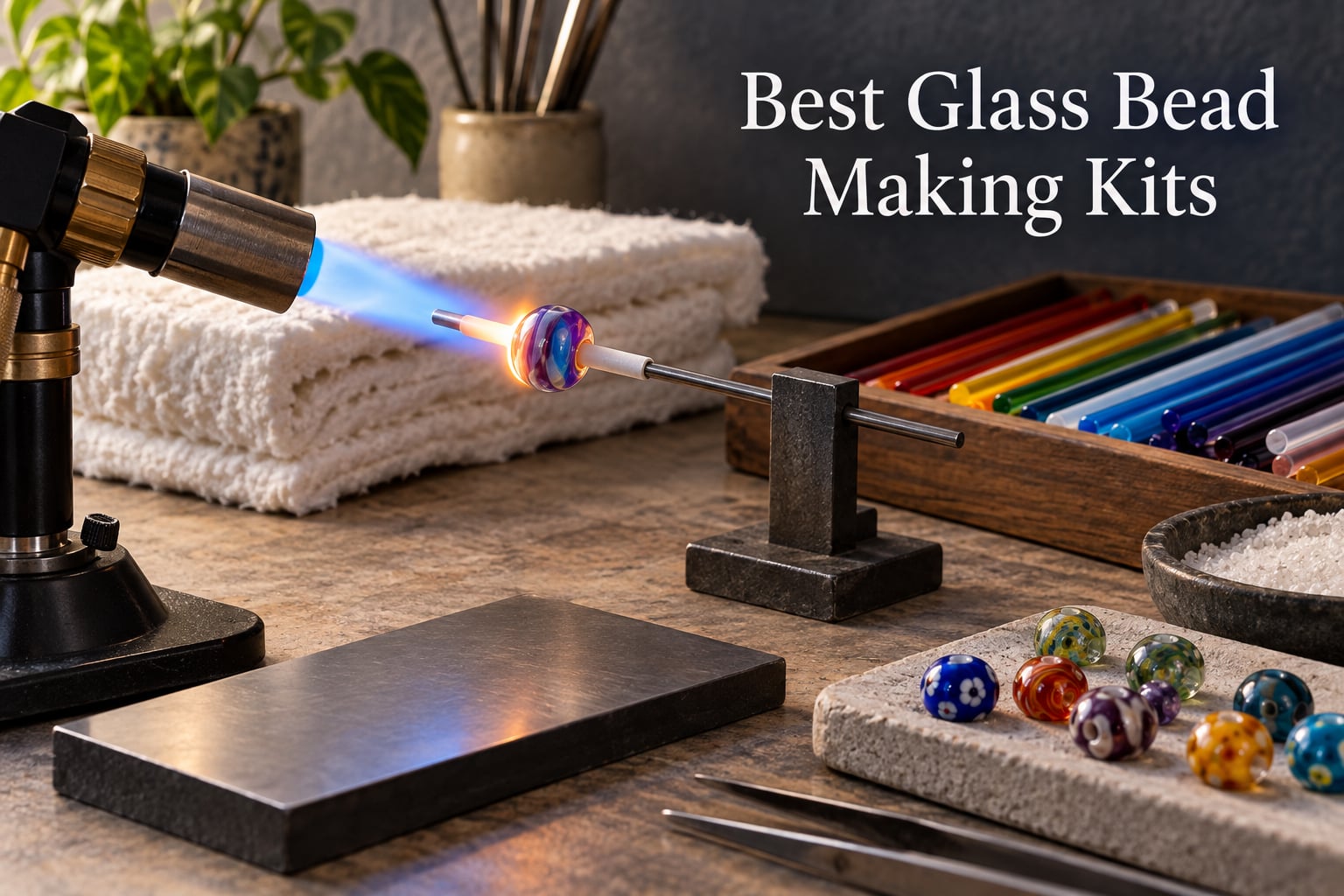
Shopping for a glass bead making kit is harder than it looks, because the word “bead” covers two completely different crafts. A lampworking kit gives you a hand torch, steel mandrels, bead release and glass rods, and you make beads one at a time in a flame. A no-heat jewelry kit gives you a tray of pre-made seed beads, stringing cord and charms, and you assemble bracelets. The search results mix these two categories constantly, so most buyers end up paying for a torch they will never light.
This roundup covers only the hot-glass end. We compared seven genuine lampworking kits across torch type, glass compatibility, what is actually in the box, and what you still have to buy afterwards. We spent our sessions on the beginner decisions: which torch a first maker can learn on, which kits ship protective eyewear, and which ones quietly leave safety gear out.
One warning before we start. Lampworking kits carry very few reviews compared to jewelry bead kits, and several of the ones here have single-digit review counts. Treat any five-star score on a three-review listing as a promise rather than a verdict. Our picks lean on how complete the kit is and whether the maker stands behind it, not on the star count alone.
If you are still deciding which kind of bead work suits you, our wine making kit roundup covers a similar buyer’s first-kit decision from a completely different craft, and the same component-by-component logic applies.
Table of Contents
Top 3 Picks for the Best Glass Bead Making Kits
Three kits stood out once we sorted the boxes open. The Devardi COE 104 beginner kit has the broadest feedback base in the group and the least to add on day one. The Fuseworks Beginner’s Essentials has more reviews than anything else here. The Fireworks Beadmaking kit is the only one holding a perfect rating with no lower scores at all, though the sample is tiny.
Devardi COE 104 Beginner Kit
- COE 104 soft glass rods
- 2 hour instructional DVD plus email support
- Beginner focused tool set
- Needs a separate fuel canister

Fuseworks Beginner’s Essentials Kit
- Diamond Tech Crafts build
- Made in United States
- Compact package footprint
- Largest review sample in the group

Fireworks Beadmaking Bead Kit
- Fuseworks branded entry kit
- Perfect five star feedback
- Compact beading kit format
- Small review sample
All Seven Kits at a Glance in 2026
Every kit below heats glass in a hand torch. The differences are in the torch, the glass, and how much of the safety gear arrives in the box.
| Product | Specifications | Action |
|---|---|---|
| Devardi Glass COE 104 Beginner Starter Kit |
|
Check Latest Price |
 Devardi Glass Marble and Bead Making Kit Devardi Glass Marble and Bead Making Kit |
|
Check Latest Price |
 Devardi Glass Lampwork Kit with Propane Oxygen Torch Devardi Glass Lampwork Kit with Propane Oxygen Torch |
|
Check Latest Price |
 Delphi Glass Hot Head Bead Making Kit Delphi Glass Hot Head Bead Making Kit |
|
Check Latest Price |
 Fireworks Beginner’s Bead Kit Fireworks Beginner’s Bead Kit |
|
Check Latest Price |
| Fuseworks Beginner’s Essentials Kit |
|
Check Latest Price |
| Fireworks Beadmaking Bead Kit |
|
Check Latest Price |
Lampworking, Glass Blowing or Stringing: Which Kit Do You Actually Want?
Lampworking means shaping molten glass with a handheld flame at a bench, one bead at a time, and it is the only category on this page. Glass blowing uses a furnace or a much larger bench burner, makes bigger hollow forms, and realistically belongs in a shared studio. Fusing puts glass in a kiln to melt as a solid sheet, which is a different craft again.
Here is how the four categories divide, and this is the distinction most retail listings blur:
- Lampworking kits give you a hand torch, mandrels, bead release and rods. Home-friendly, bead-sized, and what everything in this roundup belongs to.
- Glass blowing kits need an oxygen and fuel gas supply, a larger burner and ventilation. Studio-grade cost and scale.
- Fusing kits are kiln-first. The torch is optional and the heat work happens in an oven, not a flame.
- No-heat jewelry kits contain pre-made seed beads, cord, clasps and charms. No flame, no goggles, no ventilation, and none of the safety discussion that follows applies.
The difference matters because the two categories have completely different risk profiles. A no-heat kit has none. A lampworking kit puts a 2000 degree flame a few inches from your face, and that is why safety glasses show up so often in the negative reviews below.
1. Devardi Glass COE 104 Beginner Starter Kit – Best All-Round Entry Point
Devardi Glass Lampworking, Blowing, Beadmaking COE 104 Beginner Starter Kit – Basic
Lampwork kit
COE 104 soft glass
7 pounds
2 hour DVD plus email support
Pros
- Largest review base in the group at 60 reviews
- COE 104 soft glass suits a fuel-air torch
- Two hours of instructional video plus email support
- Lightest of the fully equipped kits at 7 pounds
Cons
- Safety lenses are not included
- No factory box in the shipment
- Needs a separate propane or MAPP canister
- 17 percent of reviews are three star
This is the kit we kept coming back to. It is the only one in the group with enough reviews to tell you something useful about the experience, and what the sixty reviews describe is a coherent beginner package rather than a pile of loose parts. At 7 pounds it is also the easiest to carry to a friend’s kitchen table.
The glass is COE 104 soft glass, which is the right first choice. It melts at a lower temperature than COE 96 or COE 90 and is far more forgiving on a modest torch, which is exactly the argument experienced makers make about picking a first glass system.
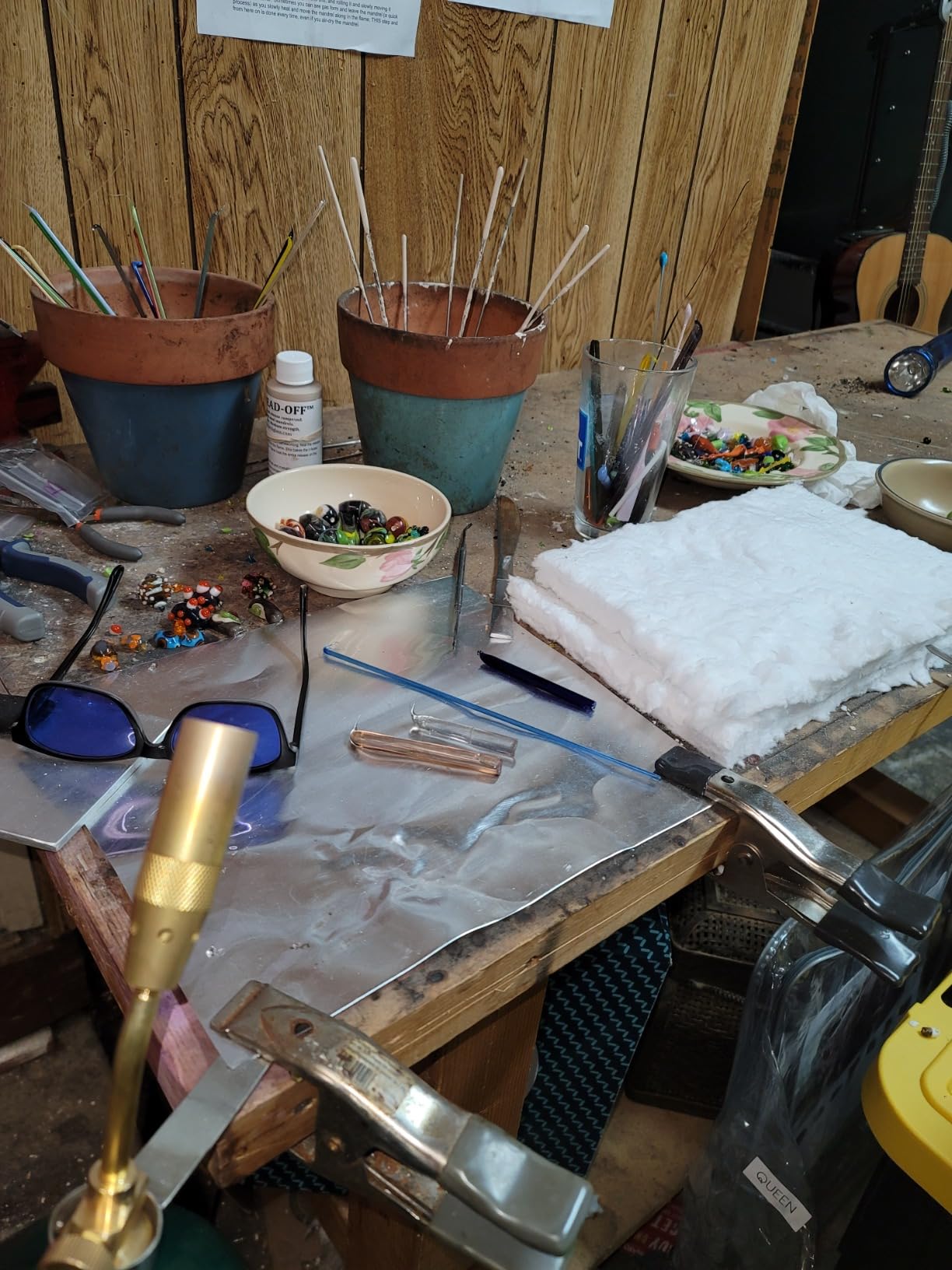
Two hours of instructional video and full email support are the quiet strength here. Lampworking is a skill you learn by watching someone’s hands, and having a manufacturer answering beginner questions by email removes a lot of the friction that makes people give up in week two.
One thing to plan around: the listing is explicit that safety lenses are not included, and you will need didymium eyewear rated for lampworking before the first session. Experienced makers on the talkglass and The Melting Pot forums are blunt that welding glasses are not an adequate substitute, because they are designed to block a different spectrum of light than a sodium flare produces.
Is this the right kit if you have never held a torch?
Yes, this is where we would start. The review distribution is telling: 62 percent five star and 12 percent four star, with the friction concentrated in three-star feedback. That pattern reads like normal learning-curve frustration rather than a defective product.
Budget for a fuel canister and a pair of didymium glasses as separate purchases before your first session. Once those two items are in your hands, the kit does the rest of the work for you.
What should you watch out for with this kit?
The glass is soft glass from a manufacturer that experienced makers describe as shocky, meaning it is more prone to thermal stress than German or Italian brands. That is a technique issue as much as a product issue, and it improves as your heat control does.
Second, the seventeen percent of three-star reviews is the largest share of middling feedback among the well-reviewed kits. The recurring complaint is about the included tooling and the learning curve, not about missing components.
2. Devardi Glass Marble and Bead Making Kit – Best for Marbles and Multi-Color Work
Devardi Glass Lampwork, Glass Blowing, Beadmaking Starter Kit – Marble & Bead Making Kit – COE 104
Marble and bead kit
COE 104 soft glass
12 pounds
DVD plus written tutorial
Pros
- Covers both marble making and bead making
- Written tutorial supplements the DVD video
- Manufacturer email support included
- Heavier 12 pound build for stability
Cons
- Only 2 reviews make the rating hard to interpret
- Safety lenses not included
- No factory box in the shipment
- Needs a separate propane or MAPP canister
Where the beginner kit is focused, this one is broader. It is built for advanced marble making or bead making, and the tooling list reflects that wider scope. If your interest extends past simple round beads into patterns, this is the more interesting box to open.
COE 104 soft glass is the same system as the beginner kit, so the glass knowledge transfers directly between the two. If you start with the entry kit and later want marbles, you are not learning a new glass family.
The written tutorial is the detail that separates this bundle. A DVD teaches you by demonstration; a written guide lets you re-read the shaping steps while the glass is cooling, which is genuinely useful in a craft where your hands are busy and hot.
Who benefits most from the wider scope?
Anyone who wants to make marbles and beads in the same session. The overlap means one torch setup serves both crafts, and a marble maker who is learning beads gets the shaping practice for free.
It is also a sensible second kit rather than a first kit, for anyone who started with the entry-level box and outgrew simple bead shapes quickly.
What are the drawbacks?
The honest limitation is the two-review sample. A 3.8 star average from two reviews, split between five star and three star, tells you almost nothing about the broader buyer experience, and we would not build a purchase decision on it alone.
Same omissions as the entry kit: no safety lenses, no factory box, no fuel canister. Add those three to your list before ordering.
3. Devardi Glass Lampwork Starter Kit with Propane Oxygen Torch – Most Complete Kit
Devardi Glass Lampwork, Starter Kit w/Propane/Oxygen Torch
27 piece kit
Pre-mix propane oxygen torch
16 pounds
Didymium glasses included
Pros
- Most complete kit with 27 listed components
- Didymium protective glasses included
- Handles COE 104 soft glass and boro
- Full hose kit with regulators and flashback arrestors
Cons
- No propane or oxygen tanks included
- Heaviest and largest kit at 16 pounds
- Only 3 reviews behind the perfect score
This is the only kit here that arrives essentially complete, and the difference is immediately obvious when you open it. Twenty-seven listed components cover the torch, a 15 foot dual gas hose with flashback arrestors and check valves, both regulators, a full mandrel set in three sizes, a rod warmer, a cooling fiber blanket, and didymium protective glasses.
Including the protective eyewear is the single most important line on that list. It is the omission that experienced makers complain about most across forum threads, and it is the one component you should never try to work around.
The torch is a pre-mix surface mix design rather than a fuel-air torch, and that is a meaningful difference. The flame runs hotter and more stable, which is why this kit can also work boro for functional hollow work, not just soft glass beads.
Is this too much kit for a first-time bead maker?
Possibly, and we would not call it the wrong purchase either. If you are confident you will stay in the hobby past the first hundred beads, buying once at the top of the range is defensible, because you are not re-buying a torch and a mandrel set in three months.
The gas setup is the part that takes planning. You need a propane source and an oxygen source, and neither arrives in the box. For anyone in an apartment or a small workspace, that is a real constraint to think through before ordering.
Where does the 5.0 rating hold up?
It holds up thinly. All three reviews are five star, and the detailed one says the kit contained everything needed and more, specifically praising the customer support for answering lampwork questions directly. That is a good signal about the maker, and a small signal about the product.
At 16 pounds this is the heaviest kit in the group, which is a genuine portability limit if you plan to move between rooms or teach from a class.
4. Delphi Glass Hot Head Bead Making Kit – Best for Classes and Demos
Delphi Glass Hot Head Bead Making Kit
Hot Head Turbo torch
Table clamp and holder
UV glasses included
Adult rated
Pros
- Hot Head Turbo torch built for faster bead making
- Table clamp and torch holder included for a stable setup
- UV protective glasses bundled with the torch
- Graphite paddle and fiber blanket and rake included
Cons
- Lowest average rating in the set at 2.8 stars
- 54 percent of reviews are one star
- No dimensions or weight published
- Only 2 reviews behind the score
The reason to like this kit is specific: a table clamp and a torch holder. Almost nothing in this roundup gives you a way to mount the torch securely, and a clamped torch is what makes demonstrations and teaching setups possible. It also just makes long sessions safer and steadier.
The fuel-air torch here is the Turbo version, designed to work faster than a standard head. The supporting cast is genuinely complete for a first kit, with a mandrel set, bead release, a stainless steel rake, an Italian rod assortment, a graphite paddle and a fiber blanket.
The protective glasses are described as clear UV protective lenses. That is worth checking against your own standards, because the forum consensus is clear that eyewear should be rated for the specific radiation a sodium flare produces rather than generic UV protection.
Why is this a good teaching kit?
Mounting hardware is the answer. When you are demonstrating to a group, a torch that sits on a clamp instead of in your hand frees both hands, keeps the flame at a consistent distance, and removes the most obvious accident risk in the craft.
It is also a coherent bundle. Torch, clamp, holder, eyewear, mandrels, release, rods and blanket all come from one system, so nothing is mismatched.
Why is the rating so low?
Two reviews averaging 2.8, split almost evenly between five star and one star, is a result you should read as unresolved rather than as a clear signal in either direction. With a sample that small, a single very bad experience moves the average by half a star.
It is also the only kit here with no published weight or dimensions, so if portability or storage matters to you, you are buying without that information.
5. Fireworks Beginner’s Bead Kit – Best for Families and First Beads
Fireworks Beginner’s Bead Kit Includes Tools, Supplies, Glass Rods and Instructional DVD
Self igniting torch head
15 Italian rods
6 pounds
Kid oriented
Pros
- Self igniting torch head needs no separate ignition
- 15 Italian glass rods is the largest rod count here
- 12 mandrels plus a rake and two texturizing marvers
- Rod scrubber and heat resistant work surface included
Cons
- No warranty offered
- 15 percent of reviews are two star
- Listed as kid oriented so the guidance may feel pitched low
The self-igniting torch head is the design decision that sets this kit apart. There is no lighter and no ignition step, which removes the single biggest practical barrier for a parent setting up a supervised craft session with a child for the first time.
On materials it is generous. Fifteen Italian glass rods is the largest rod count among the kits that include rods, and Italian glass is one of the brands experienced makers consistently recommend for beginners because it behaves predictably. Twelve stainless mandrels, a bead rake and two texturizing marvers give real tooling depth.
The 4.0 star average across 32 reviews is the second-largest sample in this roundup, which makes it one of the more trustworthy scores here. The distribution is 59 percent five star with a 15 percent two-star cluster, and that cluster is most plausibly about setup expectations versus the limits of a self-igniting head.
Is it suitable for a child learning with an adult?
It is the kit in this list explicitly listed as kid oriented, and the no-ignition design supports supervised sessions well. Any torch work with a child needs a responsible adult working at the torch, not beside it.
Two marvers in the box is unusual value for a first kit. Texturing tools are normally a later purchase, and having them from day one means a first bead can be more interesting than a plain round.
What are the trade-offs?
No warranty is offered, and on a kit with a torch that is worth knowing before you buy rather than after.
Experienced makers on the talkglass and The Melting Pot forums give unqualified advice against learning on a self-igniting kit torch, describing it as the wrong tool to build heat control on. That is a real argument, and a parent buying for a supervised session has a different tradeoff than an adult learning the craft seriously.
6. Fuseworks Beginner’s Essentials Glass Bead Making Kit – Best Value
Fuseworks Diamond Tech Crafts Fireworks Beginner’s Essentials Glass Bead Making Kit
Diamond Tech Crafts kit
Made in USA
4 x 14.75 x 10 inch package
Compact build
Pros
- Largest review sample in the group at 43 reviews
- 4.1 star average with only 9 percent one star feedback
- Made in United States
- Compact package footprint for small workspaces
Cons
- Listing gives no component breakdown
- Published weight of 1 pound looks low for a torch kit
- Confirm what the box includes before ordering
On paper this is the best-evidenced kit in the roundup. Forty-three reviews is the largest sample here, the average is 4.1 stars, and 9 percent one-star feedback is the lowest negative share of any well-reviewed kit in the group.
The distribution matters more than the average. Sixty percent five star and 16 percent four star means most buyers are happy and a meaningful minority are not, which is a normal shape for a craft kit rather than a red flag.
It is built by Diamond Tech Crafts and made in the United States, with a compact 4 by 14.75 by 10 inch package footprint. For a small apartment or a shared studio shelf, that footprint is a genuine advantage over the deep kits that need their own shelf.
Why does a large review count matter so much here?
Because this entire niche is thin on buyer signal. Most lampworking kits carry between two and five reviews, which means a normal retail star rating is close to meaningless. Forty-three reviews gives you a distribution you can actually reason about, and a 9 percent negative share is a real quality signal.
That evidence base is the main reason this kit sits near the top despite the thin listing detail.
What should you check before buying?
The listing is sparse. It gives no component list, and a published weight of 1 pound seems low for a kit that involves a torch. We would confirm what the box actually contains, particularly whether protective eyewear and fuel are included, before committing.
Treating it as a beginner essentials package is reasonable, but treat the missing detail as a question to ask rather than an assumption to make.
7. Fuseworks Fireworks Beadmaking Bead Kit – Highest Rated
Beginner’s Essentials, Glass Beadmaking KitFQ
Fuseworks bead kit
Ranked in beading kits
Compact format
Small review sample
Pros
- Perfect 5.0 rating with 100 percent five star feedback
- Strong category placement in beading kits
- Compact beading kit format
- Clean entry point for a first purchase
Cons
- Only 5 reviews make the perfect score fragile
- No component breakdown or weight or dimensions published
This one holds a perfect 5.0 with every single review at five stars. No four stars, no three stars, no complaints in the sample at all. That is appealing, and we want to be precise about what it means.
Five reviews is a small enough sample that the perfect score is fragile. A single different experience would move it substantially. The category placement in beading kits is a genuine positive signal that the kit is configured for bead making rather than assembled as a general craft bundle.
We included it because a flawless small-sample record is still real data, and because a compact beading kit format is a legitimate reason for a buyer to pick one product over a large multi-component box.
Should you trust a five star average from five reviews?
No, not on its own. Treat it as promising rather than conclusive, and cross-check the component list before buying, because the listing gives no breakdown at all.
What the sample does suggest is that the buyers who received this kit were happy with what was in it, which is worth something even at this size.
How does it compare to the larger Fuseworks kit?
The Beginner’s Essentials kit has 43 reviews and a documented component footprint; this one has 5 reviews and none. On available evidence, the Essentials kit is the safer recommendation.
This one is the pick if you want the most compact option in the category and you can verify the contents yourself.
How to Choose a Glass Bead Making Kit Without Wasting Money
Ask five questions before you order anything. The answers will narrow the seven kits above to one or two, and they will also tell you what you need to buy on top of the kit.
Is the torch included? Most kits at the entry end ship a torch or a torch head, but fuel does not travel with it. The Devardi entry-level kits both state plainly that a disposable propane or MAPP canister, or a bulk tank with a hose, is required before you can light anything.
Are protective glasses included? This is the question experienced makers answer first, and it separates the kits sharply. The Devardi propane and oxygen kit and the Delphi Hot Head kit bundle eyewear. The two cheaper Devardi kits explicitly do not.
Which glass system comes in the box? Almost everything here is COE 104 soft glass, which is the right beginner default. One kit handles boro as well. Whichever you choose, buy your extra rods in the same COE.
What is the cooling setup? A cooling fiber blanket is included in three of the seven. That is enough to start, and it is a real gap in the kits that omit it.
Is there instruction and support? The three Devardi kits ship instructional video and include manufacturer email support. That is a meaningful advantage in a craft where the first ten hours are where people quit.
If you want a parallel read on buying a first kit for a different hobby, our knife making kit roundup works through the same questions of tool quality versus tool bundle.
What a Kit Includes and What It Always Leaves Out
A complete lampworking kit has eight core items. A torch or torch head, a fuel supply, mandrels in at least two diameters, bead release, a marver, a rod rest or warmer, a cooling fiber blanket, and didymium safety glasses. Some kits add a rake, a graphite paddle, a rod scrubber and a heat resistant work surface.
Here is the honest part. Fuel is almost never included, because a pressurized canister cannot legally ship in the same box as the rest of the kit. A regulator and hose are frequently omitted, even from kits that include a torch. Protective eyewear is the most commonly skipped item, which is why two of the kits in this roundup say so in their own specifications.
A “mini annealer” is worth treating with suspicion. Veterans on the lampwork forums describe many of them as rod warmers rather than annealing chambers, and the cooling fiber blanket included with these kits is the more honest description of what you get.
Glass and COE: Which Rods to Buy First
COE is the coefficient of expansion, and it is the single number that decides whether a bead survives. Never mix COEs in one bead. The rule is not a guideline, it is a physics constraint, and violators get cracked beads.
COE 104 soft glass melts at the lowest working temperature of the common systems and is the most forgiving on a modest fuel-air torch, which is why it dominates this roundup. COE 96 works on a Hot Head but can devitrify or strike unpredictably, and experienced makers describe some 96 colours as burning. COE 90 is workable but demands a hotter, more controlled flame.
Borosilicate is the odd one out. It is much harder, needs a pre-mix or oxygen-enriched flame, and the practice is closer to glass blowing. Only one kit here is set up to try it, and it is the most complete one in the group.
On brand quality, the forum consensus names German Lauscha, Italian Vetrofond and Moretti, US Uroboros and Chinese CiM as well-behaved for beginners. Several makers describe Devardi glass as shocky, which means it stresses more readily and punishes uneven heating.
Annealing: Do You Need a Kiln?
No, not to start. A fiber blanket or a container of vermiculite will carry you through the first hundred beads, and the three kits with a blanket already include one. Many soft-glass beadmakers batch-anneal finished beads in the corner of a kiln they already own.
Learning to make crack-free beads before a kiln enters your life is described by experienced makers as a genuine advantage rather than a compromise. A kiln is a real expense, and it is not the first thing this hobby needs.
The failure mode to watch for is devitrification, where a bead turns cloudy and brittle because it cooled too fast. If your beads are going milky rather than staying clear, cooling slowly is the fix.
Kit Versus Buying the Parts Yourself
Here is the honest arithmetic that no roundup on this search page spells out. A kit’s sticker price is frequently the same as, or higher than, buying the same components separately. Experienced makers on talkglass and The Melting Pot raise this repeatedly, and it is a legitimate reason to walk away from a bundle.
There is one clear exception, and it is the exception worth paying for: a kit that includes proper didymium eyewear and a real torch. Buy that one, because the eyewear and torch are the two items you cannot substitute with a cheap alternative.
For everything else, the practical route is to buy the torch, the mandrels, the release, one marver, a blanket and a small rod bundle from the same maker, then add rods as you use them. Experienced makers also point out that overbuying rods wastes money, since a large rod bundle can take a year of regular work to use up.
Cheaper entry routes are worth considering too. Local studios rent bench time by the hour, glass clubs and regional chapters share torch time, and since people abandon this hobby regularly, a used hand torch is easy to find from classified listings.
Safety and Ventilation Setup
Work outdoors or in a space with real ventilation, on a heat resistant surface, with nothing flammable within reach. Glass and fibre blanket materials are cheap, and the absence of a proper workspace is the most common cause of a first attempt going wrong.
Wear didymium glasses rated for lampworking every time the torch is lit, including during the reheating pass. Welding glasses are not a substitute, because they filter a different spectrum of light than the sodium flare in a soft glass flame produces.
Have a soak bucket of warm water ready before you start. It is how release comes off, and it is the step beginners most often try to shortcut with heat, which cracks the bead they just spent twenty minutes making.
If you are weighing up other kit-based hobbies while you decide, our mead making kit roundup covers a starter kit where fermentation, not flame, sets the pace.
Frequently Asked Questions
What equipment do you need to make glass beads?
You need a hand torch with fuel, stainless steel mandrels in two or more diameters, bead release, a marver or graphite paddle, a rod rest, a cooling fiber blanket, didymium safety glasses and glass rods in one COE. Most kits cover the tools but omit fuel, a regulator and proper eyewear, so plan on buying those three separately.
What type of glass is best for bead making?
COE 104 soft glass is the best first choice for beginners because it melts at a lower temperature and is far more forgiving on a fuel-air torch. German Lauscha, Italian Moretti and Vetrofond, and US Uroboros are all well-behaved. Never mix COEs in one bead, because incompatible expansion rates crack it.
What is the difference between glass blowing and lampworking?
Lampworking uses a small handheld torch and makes beads one at a time, which is what home kits are built for. Glass blowing uses a furnace or a large bench burner to make larger hollow forms and needs oxygen and fuel gas, plus studio-scale ventilation. Fusing uses a kiln rather than a flame, and no-heat jewelry kits use none of either.
Can I make glass beads without a kiln?
Yes, for early work. A cooling fiber blanket or a container of vermiculite is enough for your first hundred beads, and three of the seven kits reviewed here include a blanket. A kiln is a real expense and most makers learn to make crack-free beads before adding one. Treat mini annealers sold with kits cautiously, as many are rod warmers.
Is a bead making kit worth it, or should I buy supplies separately?
For most tools, buying separately often costs the same or less than the bundle. The exception is a kit that includes proper didymium glasses and a real torch, because those two items should not be substituted with cheap alternatives. Everything else, from mandrels to marvers, is straightforward to source on its own.
What should I buy after my first sixty hours of bead making?
Spend your first sixty hours on heat control, gravity shaping and a marver rather than on glass presses, because heat control is the transferable skill and most first beads crack anyway. After that, a rod warmer, a second mandrel size and a proper annealing setup are the sensible next purchases.
The Best Glass Bead Making Kits in 2026: Final Verdict
The Devardi Glass COE 104 Beginner Starter Kit is our pick. Sixty reviews give it the most honest picture in a category where almost everything else has fewer than ten, the glass is the right system for a first torch, and two hours of instruction plus email support address the reason beginners give up.
Buy the Fuseworks Beginner’s Essentials if you want the best-evidenced option and a small package footprint. Buy the Devardi propane and oxygen kit if you already know you are staying in this hobby and want didymium glasses in the box. Buy the Fireworks Beginner’s Bead Kit for a supervised family session where no separate ignition step matters.
Whatever you choose, add fuel, a regulator if the kit needs one, and proper didymium glasses before the first session, and keep every rod you buy in the same COE. Those three steps decide whether your first hundred beads are a hobby or an expensive lesson.