
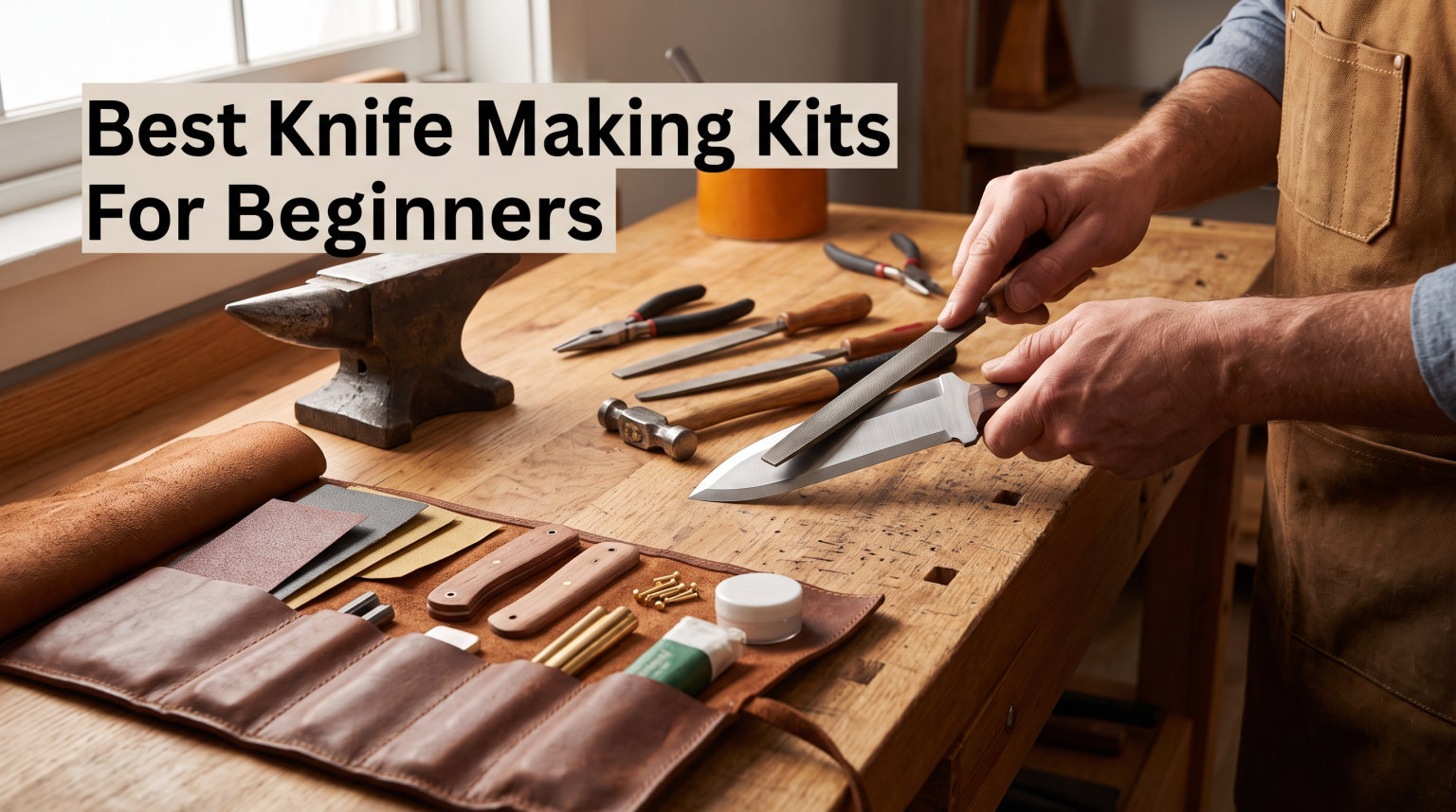
Knife making kits for beginners work best when the blade is already shaped and heat treated, leaving you to focus on fitting, shaping, and finishing the handle. For a first project, I would choose a fixed-blade kit with clear instructions and the supplies you can verify in the box, rather than begin with forging or heat treatment.
Our review covers ten verified DIY knife kits, from tool-inclusive projects to Damascus blanks and one folding knife. I compared the stated blade steel, handle material, included hardware, assembly requirements, ratings, and review volume so you can pick a project that matches the tools on your bench.
A kit is not a shortcut around care: blades are sharp, epoxy needs sensible handling, and sanding takes patience. Still, a pre-hardened blank removes a difficult step and gives a beginner a realistic path to a functional custom knife in 2026.
Table of Contents
The Top 3 Picks Give Most First-Time Makers a Clear Starting Point
The Three Way Cut kit is my all-in-one choice because its verified contents include a vise, files, sandpaper, epoxy, wax, a sheath, a manual, and tutorial video. Man Crates is a strong guided-project choice, while the Black Sierra Skinner is the simpler fixed-blade option for someone who already has basic hand tools.


Man Crates Knife Making Kit
- stainless skinner blade
- maple handle
- bench vise
- step-by-step guide

Black Sierra Skinner DIY Kit
- 8Cr14MoV blade
- two pakka wood handles
- drop point design
- outdoor focus
The Best Knife Making Kits for Beginners in 2026 Are Compared Below
Use this overview to narrow the field by project type rather than marketing language. A fixed blade with scales is generally the more straightforward first build; the EZSMITH folder adds moving parts, and the Damascus options call for more attention to storage and finish care.
| Product | Specifications | Action |
|---|---|---|
| Man Crates Knife Making Kit |
|
View Details |
| Black Sierra Skinner DIY Kit |
|
View Details |
| Three Way Cut Knife Making Kit |
|
View Details |
 Black Sierra Japanese Tanto Kit Black Sierra Japanese Tanto Kit |
|
View Details |
 AMJ Crafts Damascus Hunting Kit AMJ Crafts Damascus Hunting Kit |
|
View Details |
 EZSMITH FL006 Folding Kit EZSMITH FL006 Folding Kit |
|
View Details |
 Black Sierra Tactical Dual Edge Kit Black Sierra Tactical Dual Edge Kit |
|
View Details |
 ColdLand NB105 Damascus Kit ColdLand NB105 Damascus Kit |
|
View Details |
 Black Sierra Skinner Cleaver Kit Black Sierra Skinner Cleaver Kit |
|
View Details |
 SUSA Knives Damascus Fixed Blade Kit SUSA Knives Damascus Fixed Blade Kit |
|
View Details |
1. The Three Way Cut Kit Is the Best All-In-One First Project
Knife Making Kit DIY Gift for Men – Gift Set, Complete Tools, & Accessories to Make Knife, Stainless Steel Drop Point Blade, Beginners Guide, Husband Boyfriend Dad Handwork Hobbies, Gift for Him
440C blade
Beechwood scales
Vise, files, epoxy and sheath
Pros
- Includes core hand tools
- 440C stainless blade
- Video and printed manual
- Leather sheath
Cons
- Hand-wash care
- Some makers may add tools
This is the one I would put in front of a beginner who has an empty workbench. The verified kit contents cover the awkward early purchases: a bench vise, rasp and file tool, four sandpapers, two-ton epoxy, wood wax, a leather sheath, plus a tutorial video and printed instructions.
The drop-point blade is listed as 440C stainless steel, with beechwood handle scales, mosaic pins, bolsters, and pins. That package makes the sequence easy to understand: fit the scales, bond and pin them, shape the wood, then sand and finish.
The Tool-Inclusive Build Reduces the Setup Work
Forum discussions repeatedly point out that missing tools can turn a simple kit into a stalled project. This one directly addresses that concern with the holding, filing, sanding, and bonding items named in its listing.
I still recommend laying out the parts before mixing epoxy and reading the instructions from start to finish. That small pause helps you identify which sanding stage and hardware piece comes next.
The Drop-Point Shape Fits a Practical First Knife
A drop point gives this project a familiar, general-purpose silhouette rather than a highly specialized shape. The listing also describes the finished knife as suitable for utility or kitchen chores, which may appeal to someone making a gift project.
Stainless steel can make a sensible first material because it asks for less rust vigilance than carbon steel. Treat the stated hand-wash care as part of the finished knife’s routine.
2. The Man Crates Kit Is the Most Guided Workshop-Style Build
Man Crates Knife Making Kit, DIY Knife Crafting Gift Set for Men, Dad
Stainless skinner
Maple handle
Tools, sheath and guide included
Pros
- Step-by-step guide
- Maple scales
- Brass bolsters
- Tool set included
Cons
- Hand-wash care
- Availability can vary
Man Crates combines a Shawnee Skinner stainless blade with maple handle scales, brass bolsters, pins, a leather sheath, and a dedicated guide. Its listed accessory set also has a vise, rasp and files, graded sandpaper, epoxy syringe, and wood finish.
That is a well-defined first knife project because every main stage has a named supply. It has a 4.6 rating from 222 reviews in the analyzed data, giving it the second-largest review base in this group.
The Guided Sequence Makes the Handle Work Less Intimidating
Maple is the stated handle material, and the kit includes wood finish to support the final stage. A beginner can concentrate on keeping the handle contours even instead of hunting down products mid-build.
I would use the rasp for broad shaping and move through the supplied graded sandpaper patiently. Rushing from a coarse grit to finish is one of the common reasons first handles retain visible scratches.
The Skinner Profile Fits an Outdoor-Focused Project
The listing names a drop-point Shawnee Skinner blade and recommends camping use. Its seven-inch stated overall length makes it a compact fixed blade rather than a large chopper or a pocket folder.
Because the kit includes a leather sheath, the project has a stated carry solution after assembly. Let adhesive fully cure before placing any new handle in a sheath.
3. The Black Sierra Skinner Is a Simple Fixed-Blade Starter Kit
Black Sierra Skinner DIY Knife Making Kit – Stainless Steel Hammered
8Cr14MoV blade
3.5 inch drop point
Two pakka wood handle options
Pros
- 4.6 rating
- Two handle options
- Outdoor-ready drop point
- Corrosion-resistant steel
Cons
- Assembly tools not included
- Hand-wash care
This Black Sierra model starts with a 3.5-inch drop-point skinner blade made from 8Cr14MoV steel with a hammered finish. Two pakka wood handle choices give you a little personalization without changing the basic assembly path.
Unlike the first two picks, this kit lists a vise, epoxy, files, and sandpaper as recommended assembly tools rather than supplied items. It is a better fit if you already own those basics or want to choose your own abrasives.
The Straightforward Fixed Blade Keeps the First Build Focused
A fixed blade avoids pivots, springs, and centering adjustments. That matches the community advice I found: start with a pre-heat-treated fixed blade so you can learn fit and finish before taking on mechanical parts.
The stated 9.65-inch overall length gives the finished knife a full outdoor-tool footprint. The listing positions it for hunting, fishing, camping, survival, and everyday tasks.
The Handle Options Let You Practice a Personal Finish
Pakka wood is an engineered wood material, and this listing describes it as resistant to the elements. Pick one option early, then use the same side-to-side sanding routine on both scales so the handle stays balanced.
Check the kit contents on arrival before planning your session. The required hand tools are not a drawback if you own them, but they are not optional for a proper assembly.
4. The Black Sierra Tanto Is the Best Choice for a Distinct Point Shape
Black Sierra Japanese Tanto Knife Making Kit, DIY Fixed Blade with Stonewashed Steel and Deluxe Leather Sheath, Build Your Own Knife for Adults
4 inch tanto
Stonewashed steel
Full tang with pakka wood
Pros
- Full tang design
- Leather sheath included
- Traditional tanto profile
- Pakka wood handles
Cons
- Assembly tools not included
- Hand-wash care
The Black Sierra Japanese Tanto kit is for the new maker who wants a more angular finished profile. It has a four-inch carbon-steel tanto blade, stonewashed finish, pakka wood handles, a leather sheath, and a stated full-tang construction.
That full tang is helpful to visualize during assembly because the handle scales sit on both sides of the metal. The listing asks you to bring the same core tools as the Skinner kit: vise, epoxy, files, and sandpaper.
The Full Tang Makes Scale Alignment Easy to Inspect
With a full tang, you can look along the spine and perimeter while dry-fitting the scales. I would do that before epoxy, particularly around the transition from handle to blade where uneven material is easiest to feel.
This does not mean the project is automatic. It does mean the basic handle geometry is visible rather than buried inside a drilled block.
The Tanto Profile Suits Makers Drawn to Its Traditional Styling
The listing calls out traditional Japanese styling and a tanto point, so visual appeal is a central reason to choose it. It is also presented for display, collecting, and outdoor use.
Choose this model for the shape, not because it is the simplest first knife. The same patient preparation and hand-tool work still decide how clean the finished handle feels.
5. The ColdLand NB105 Is the Strongest Damascus Fixed-Blade Choice
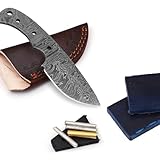
ColdLand 6″ Damascus Steel Knife Making Kits – Knife Making Supplies Include Blank Steel Damascus Blade, with Sheath, Wood Handle Scales – Build your Own NB105
Damascus 1095 and 15N20
Full tang
Wood scales and leather sheath
Pros
- 200-plus stated layers
- Full tang
- 58-60 HRC listed
- 253 reviews
Cons
- Prevent long sheath storage
- More finish care than stainless
ColdLand’s NB105 is a fixed blade kit built around a hand-forged Damascus blade made from 1095 and 15N20. The listing states more than 200 layers, a full tang, wood scales, a genuine leather sheath, and 58-60 HRC hardness.
It has the largest review count here at 253, though its 4.3 rating is a little below the top three. The materials make this a better choice for someone who wants visible blade patterning and accepts the care that carbon-rich steels can need.
The Full Tang Supports a Traditional Scale-Build Process
The full-tang layout pairs naturally with the included wood handle scales. Dry-fit the scales, pins, and sheath hardware first, then mark what you plan to remove before sanding.
The stated blade thickness is four to five millimeters, which can give the workpiece a substantial feel. Keep sanding strokes even around the tang edge so the wood and steel meet cleanly.
The Damascus Blade Needs Deliberate Post-Build Care
The product notes advise against long-term storage in the sheath to help prevent rust. That is practical advice for a leather-sheathed carbon-steel blade: dry it after handling and store it outside the sheath when it will sit unused.
Damascus patterning is a reason to choose this kit, but it does not reduce the importance of finish work. A careful handle contour lets the blade remain the visual center without making the grip uncomfortable.
6. The EZSMITH FL006 Is the Right First Folder for a Patient Builder
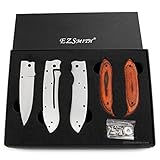
EZSMITH Framelock Knife Making Kit – Model FL006 – DIY Folding Knife Parts Kit – (w/Cocobolo Dymondwood Handles) – (Gift Boxed) – USA Design – (by KnifeKits)
440C folder
Framelock
Cocobolo Dymondwood
Thumb stud
Pros
- Heat-treated 440C blade
- Framelock construction
- Assembly hardware included
- Gift-boxed
Cons
- Moving parts add complexity
- Requires careful assembly
The EZSMITH FL006 is the only folding knife kit in this review, making it a different kind of lesson. Its stated parts include a 440C stainless double-ground blade heat treated to RC 56-58, Cocobolo Dymondwood handle scales, a thumb stud, nylon washers, and assembly hardware.
It is not the easiest first project, but it is a sensible first folder for someone willing to work slowly. The 3.75-inch listed blade length and 7.75-inch overall length create a modern pocket-knife format rather than a fixed blade with a sheath.
The Framelock Adds Mechanical Setup to the Project
A folding knife asks you to consider blade action and lock function in addition to handle shaping. Nylon washers are included for the blade action, and this is where small alignment changes matter.
I would not force any pivot hardware. Assemble according to the supplied instructions, test carefully, and stop if the action or lock engagement does not behave as described.
The Dymondwood Scales Offer a Different Finishing Experience
The listing specifies Cocobolo Dymondwood rather than natural wood. That gives the kit a distinctive handle look while keeping the material choice defined from the start.
Pick this kit if learning the folder mechanism excites you more than taking the shortest route to a finished tool. For a very first knife, the fixed-blade kits above leave fewer variables to manage.
7. The Black Sierra Tactical Kit Suits a Larger Dual-Edge Project
Black Sierra DIY Tactical Dual Edge Knife Making Kit, Build Your Own Fixed Stainless Steel Blade with Leather Sheath, Hobby Project for Camping, Hunting, Survival, Fishing
8Cr14MoV stainless
5 inch dual edge
Pakka wood and leather sheath
Pros
- Five-inch blade
- Stonewashed finish
- Leather sheath
- Pakka wood handles
Cons
- Requires separate assembly tools
- 13 reviews
This Black Sierra kit makes a 9.15-inch overall dual-edge fixed blade with a five-inch 8Cr14MoV stainless blade, stonewashed finish, pakka wood handles, and top-grain leather sheath. It is a notably different silhouette from a compact skinner or cleaver.
The analyzed review sample is only 13 reviews, so I would weigh the stated specification more heavily than the rating alone. As with other Black Sierra scale kits, plan to provide a vise, epoxy, files, and sandpaper.
The Larger Blade Calls for a Stable Workholding Plan
A longer workpiece has more handle material to shape and more leverage at the bench. Secure it carefully in a protected vise so you can work without chasing the blade across the bench.
Use slow, controlled strokes and keep the edge protected during handle work. The project category is outdoors-focused, but the assembly stage belongs in a stable workspace.
The Dual-Edge Design Requires Extra Thought Before Use
The listing describes a dual-edge blade, which is a specific design choice rather than an all-purpose beginner profile. Check your local rules and intended use before selecting any dual-edge knife project.
For a maker who mainly wants practice fitting wood scales, the construction steps remain familiar. For someone choosing a first finished knife to carry, a single-edge fixed blade may be the more straightforward option.
8. The Black Sierra Skinner Cleaver Brings a Kitchen-Style Shape to the Bench
Black Sierra Skinner Cleaver Knife-Building-Kit, Fixed Stainless Steel Blade with Leather Sheath, Hobbyist Chef cutlery, Carbon Steel Cutlery Meat Cutting Blade, DIY Knife Making Supplies
8Cr14MoV cleaver
3.75 inch blade
Burlwood and leather sheath
Pros
- Cleaver profile
- Satin stainless finish
- Engineered burlwood
- Leather sheath
Cons
- Smaller blade
- 13 reviews
The Skinner Cleaver kit gives a beginner an alternative to the usual drop point. Its stated 3.75-inch 8Cr14MoV stainless cleaver blade has a satin finish, while the handle material is engineered burlwood and the package includes a top-grain leather sheath.
The compact 8.4-inch overall length keeps it from being an oversized chef’s tool. I see it as a shape-driven project for a hobbyist who likes the cleaver look and wants to practice handle scales on a short fixed blade.
The Cleaver Profile Changes the Finished Knife’s Character
A cleaver outline is visually broad at the blade, making clean scale transitions especially noticeable. Take time to blend the front of the handle rather than leaving a sharp shoulder near the blade.
The product description mentions hobbyist chef cutlery and meat cutting, but it remains a DIY fixed-blade project. Follow the listed hand-wash care and assess the final edge before any food-related task.
The Engineered Burlwood Keeps the Material Choice Defined
The stated engineered burlwood handle is described as resistant to the elements. That gives a new maker a specified scale material instead of an open-ended search for knife making supplies.
Keep the sanding surface flat across both scales before rounding the edges. Symmetry is easier to correct early than after one side has been heavily contoured.
9. The SUSA Knives Kit Is a Decorative Damascus Build With Natural Materials
SUSA KNIVES Damascus Steel Blank Blade Hunting Knife Fixed Blade EDC Survival Knife for Men – Fixed Blade Making kit, Pins, with Sheath, Handle Scales for Making (LEADER WOOD)
176-layer Damascus
4 inch fixed blade
Stag horn and olive wood
Pros
- 1095 and 15N20 steel
- 176 stated layers
- Leather sheath
- Lifetime warranty
Cons
- Hole placement may vary
- Very limited availability
The SUSA Knives kit pairs a four-inch Damascus fixed blade with stag horn and olive wood handle material, a brass safeguard and spacers, and a leather belt-loop sheath. Its listing specifies 1095/15N20 alloy steels, 176 true layers, a twist pattern, and 58-60 HRC.
This is a more decorative custom knife kit than the basic tool-inclusive choices. The maker should also note the listing’s warning that handle-hole size and placement may vary, which makes dry-fitting more than a formality.
The Natural Handle Materials Reward Careful Layout
Stag horn and olive wood bring a less uniform look than engineered scales. Before adhesive, inspect grain direction, horn texture, and how each side meets the blade so the finished knife feels intentional.
Do not assume the holes will line up perfectly without checking. Mark your layout and adjust your approach to the actual parts in front of you.
The Brass Guard Supports a Traditional Hunting-Knife Look
The brass hand safeguard and spacers are part of the stated component list, along with a leather sheath. Those details make this a fitting choice for someone who values a classic hunting-knife appearance.
Choose it for the materials and pattern, not as the fastest route to learning. A plainer fixed-blade kit is easier when your main goal is learning the core sanding and assembly rhythm.
10. The AMJ Crafts Karambit Is a Specialized Damascus Project
AMJ Crafts Damascus Steel Hunting Knife Kit, 8.5 Inches Overall, Fixed Blade, Leather Sheath, DIY Knife making Supplies…
4.5 inch Damascus
Rain-drop pattern
Ring grip and leather sheath
Pros
- Hammer-forged Damascus
- Rain-drop pattern
- Leather sheath
- Lightweight stated design
Cons
- Handle material unspecified
- 27 reviews
The AMJ Crafts kit is the most specialized option on this list. It has a 4.5-inch trailing-point Damascus blade, a rain-drop pattern, a 25-millimeter ring, an eight-and-a-half-inch overall length, and a cowhide leather sheath.
Its analyzed listing does not specify the handle material, so that is a detail I would verify before deciding on a project plan. Its 4.5 rating comes from 27 reviews, a much smaller sample than the leading all-in-one kits.
The Ring Grip Makes Fit and Comfort the Main Decision
The listing says the 25-millimeter ring allows movement in the hand. That feature changes the feel and purpose of the project compared with a regular drop-point handle.
For that reason, I would not select this as a no-experience-needed starter knife. Select it only if this specific design is what you want to build and you understand how it will be handled and stored.
The Damascus Pattern Gives the Blade Its Visual Focus
The hammer-forged rain-drop Damascus pattern and leather sheath are the strongest stated attractions. Keep the finished blade dry and do not treat the sheath as long-term storage if moisture is a concern.
A specialized profile can be satisfying after you understand basic scale fitting. Beginners looking for a general bushcraft knife kit will get a more transferable first lesson from a conventional fixed blade.
The Right Buying Guide Starts With a Fixed Blade and Known Kit Contents
For most new makers, select a pre-hardened fixed blade with included scales, pins, and instructions. This removes forging and heat treatment from the task, which leaves you with the useful core skills: layout, dry-fitting, bonding, shaping, sanding, and finishing.
A Flat Tang Is the More Forgiving Beginner Construction
A flat or full tang runs through the handle, with scales attached on either side. It lets you see the material relationship during the build and makes it easier to inspect alignment before epoxy cures.
A hidden tang enters a drilled handle block and needs more precise drilling and fitting. The community advice in the research is consistent: start with a flat-tang knife kit before attempting a hidden-tang build.
A Pre-Hardened Blade Avoids the Most Technical First Step
A pre-hardened blade blank has already been shaped and heat treated, according to the basic kit format described in the research. That means you should not re-profile it aggressively or use heat that can damage the existing treatment.
For steel choice, the kits here include 440C and 8Cr14MoV stainless, plus Damascus made with 1095 and 15N20. Stainless options are lower-maintenance in daily care, while the Damascus and carbon-steel choices demand more attention to drying and storage.
The Small Hand-Tool Set Is Enough for Many Fixed-Blade Kits
You do not need a belt grinder to finish a beginner fixed blade. The forum research repeatedly identifies a vise, two-part epoxy, a rasp or files, and sandpaper as the core setup, and the Three Way Cut and Man Crates kits list these items in their packages.
- Use a padded vise or protective material to hold the blade without marring it.
- Use files or a rasp to establish the handle shape before fine sanding.
- Use a sanding progression; the research specifically highlights grits from 80 through 400 as meaningful for finish quality.
- Use the adhesive and curing directions supplied with the kit, with suitable ventilation and skin protection.
The Best First-Build Habits Prevent Frustrating Errors
First, inventory every part and dry-fit the handle scales, pins, bolsters, or guard before opening epoxy. This catches missing items and shows where alignment needs attention while changes are still easy.
Second, do not skip grits. Deep scratches left by a coarse abrasive do not disappear because a finishing compound is added later; they need to be removed gradually with the next abrasives.
Third, choose the kit for the project you truly want. A simple drop point is the sensible learning path, a folding knife adds mechanisms, and the decorative Damascus or karambit options reward a maker who is ready for more variables.
These Frequently Asked Questions Answer the Main Beginner Concerns
What is the best knife making kit for a beginner?
The best beginner option is a pre-hardened fixed-blade kit with handle scales, hardware, clear instructions, and preferably the core hand tools. In this review, the Three Way Cut kit is the strongest all-in-one starting point because its stated contents include a vise, files, sandpaper, epoxy, a sheath, a video, and a printed manual.
What tools do I need to start knife making as a hobby?
For a fixed-blade kit, start with a safe way to hold the workpiece, epoxy, files or a rasp, and a sanding progression. Some kits include these supplies, while others ask you to provide them. A belt grinder is not required for many first projects if you are prepared to work slowly by hand.
Are knife making kits suitable for beginners?
Yes. A kit with a pre-hardened blade removes forging and heat treatment, so a beginner can focus on fitting scales, bonding hardware, shaping the handle, and sanding. Begin with a fixed blade and read all instructions before starting the adhesive stage.
What is the difference between flat tang and hidden tang knife kits?
A flat or full tang runs through the handle with scales fitted to both sides, making alignment easy to inspect. A hidden tang fits inside a drilled handle block and asks for more precise drilling and fitting. For a first project, a flat-tang fixed blade is usually the more forgiving choice.
The Best First Choice Is the Kit That Matches Your Bench and Project Goal
For knife making kits for beginners, I would start with the Three Way Cut when you need a stated tool-inclusive package, or the Man Crates kit when a guided maple-handle project appeals more. Pick the Black Sierra Skinner if you already have hand tools and want a straightforward drop-point fixed blade.
Choose a conventional fixed blade, take the dry-fit and sanding stages seriously, and let your first project teach you the pace that works. The right kit in 2026 is not the most complicated one; it is the one whose listed parts and assembly demands you can confidently handle.