
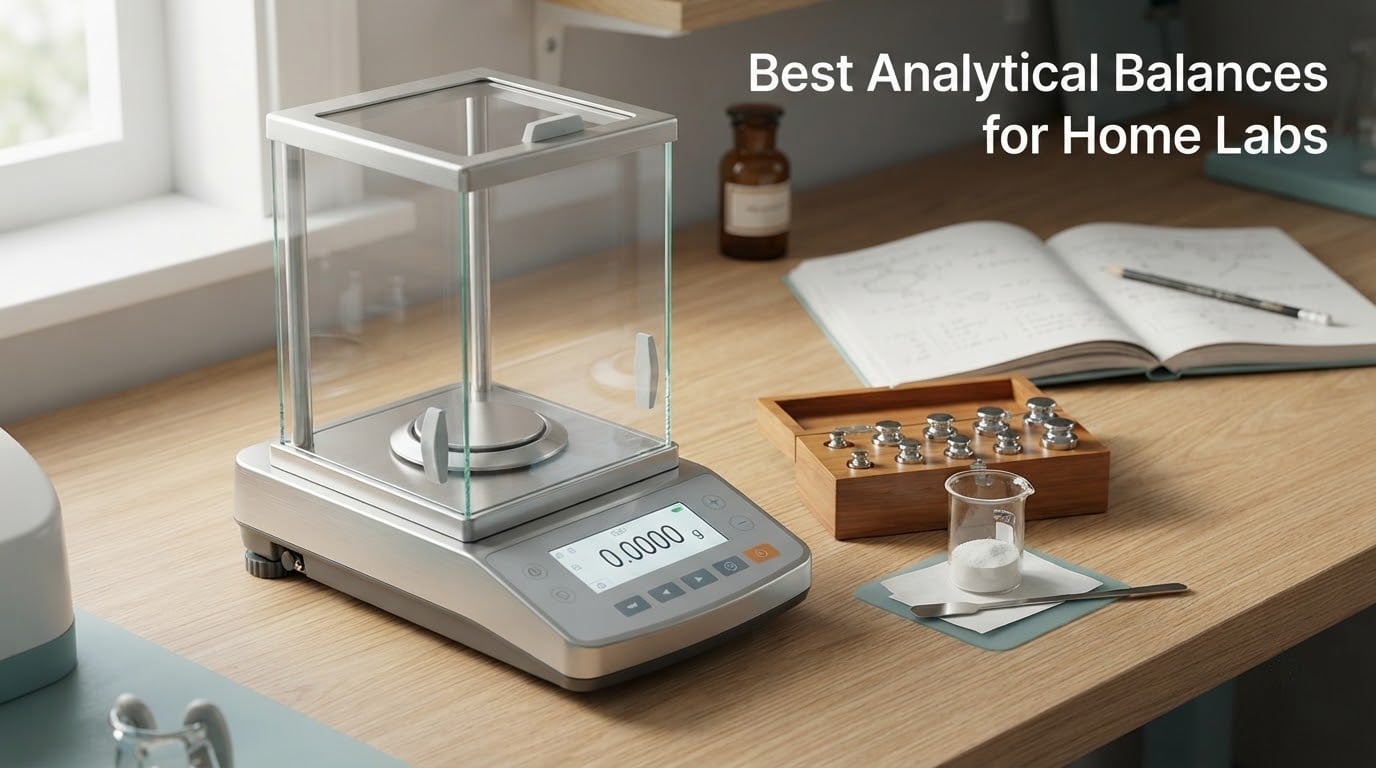
An analytical balance is a laboratory scale that reads to 0.1 mg, which is 0.0001 g, and it is the standard instrument for quantitative chemistry work. It uses an electromagnetic force restoration sensor: the sample on the pan shifts the sensor until the system returns to equilibrium, and the compensating current needed to get there becomes the mass reading on the display. Home labbers use them for reagent prep, molarity calculations, essential oil and tincture formulation, brewing and fermentation dosing, powder mixing, and precious metal work.
Here is the honest part, and it saves people real money. Most home experiments do not need a tenth of a milligram. A balance that reads to 0.001 g will carry the large majority of home chemistry, and we say so throughout this guide rather than pushing every reader toward the most expensive instrument on the list. Two of the twelve models below reach a true 0.1 mg readability, and those are the ones worth 0.1 mg money if your work genuinely needs them.
We put all twelve through the same filter: published readability, published capacity, what the calibration story is, whether a draft shield exists, and what owners actually report after living with the scale. Readability on a box is not accuracy, and the difference between those two numbers is the single most useful thing a buyer can learn before spending. Bench setup matters too, and a home lab has different vibration, drafts and temperature swings than a commercial lab. If you are still building out the room, our home lab server rack guide covers the bench-adjacent gear decisions that people regret later.
Table of Contents
Top 3 Analytical Balance Picks for Home Labs in 2026
These three cover the realistic range of home lab work. The first is the one most people should buy, the second is for high-capacity jobs, and the third is the milligram workhorse.

Bonvoisin 600g x 0.01g Lab Scale
- 600g x 0.01g capacity
- Large LCD readout
- Six unit conversions
- Tare and counting

Bonvoisin 5000g x 0.01g Lab Scale
- 5000g capacity
- Stainless steel pan
- Level bubble
- 13 unit conversions

Bonvoisin 500g x 0.001g Scale
- 500g x 0.001g readability
- Draft shield
- Linear and nonlinear calibration
All 12 Analytical Balances Compared in 2026
Every pick below appears in this table with the specifications that actually decide a purchase. Capacity and readability come first, then whether the scale protects against drafts and what the calibration situation is.
| Product | Specifications | Action |
|---|---|---|
| Bonvoisin 600g x 0.01g Lab Scale |
|
Check Latest Price |
| Bonvoisin 5000g x 0.01g Lab Scale |
|
Check Latest Price |
 UXILAII 5000g x 0.01g Balance UXILAII 5000g x 0.01g Balance |
|
Check Latest Price |
| Bonvoisin 500g x 0.001g Lab Scale |
|
Check Latest Price |
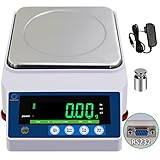 RUISHAN 5000g x 0.01g Lab Scale RUISHAN 5000g x 0.01g Lab Scale |
|
Check Latest Price |
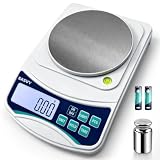 SASVY 1000g x 0.01g Scale SASVY 1000g x 0.01g Scale |
|
Check Latest Price |
 GOYOJO 500g x 0.001g Balance GOYOJO 500g x 0.001g Balance |
|
Check Latest Price |
 LACHOI 500g x 0.001g Scale LACHOI 500g x 0.001g Scale |
|
Check Latest Price |
 LACHOI 120g x 0.0001g Balance LACHOI 120g x 0.0001g Balance |
|
Check Latest Price |
 Hanchen 220g x 0.1mg Balance Hanchen 220g x 0.1mg Balance |
|
Check Latest Price |
 LACHOI 500g x 0.001g Windshield Model LACHOI 500g x 0.001g Windshield Model |
|
Check Latest Price |
 stigreun 5000g x 0.01g Lab Scale stigreun 5000g x 0.01g Lab Scale |
|
Check Latest Price |
1. Bonvoisin 600g x 0.01g Lab Scale – Most Owner Feedback of Any Pick
Bonvoisin Digital Lab Scale 600g x 0.01g Precision Electronic Scale LCD Display Analytical Balance Jewelry Scale Scientific Scale 0.01g Accuracy
600g x 0.01g readability
ABS mini body
LCD display
Six unit conversions
Pros
- Large clear LCD readout
- Reliable tare function
- Reads stably once calibrated
- Six unit conversions for jewelry and general work
- Compact and light for a 600g capacity
Cons
- Needs a reference weight to calibrate before first use
- Real accuracy nearer 0.03g than 0.01g
- Calibration weights and batteries not included
- Terse printed instructions
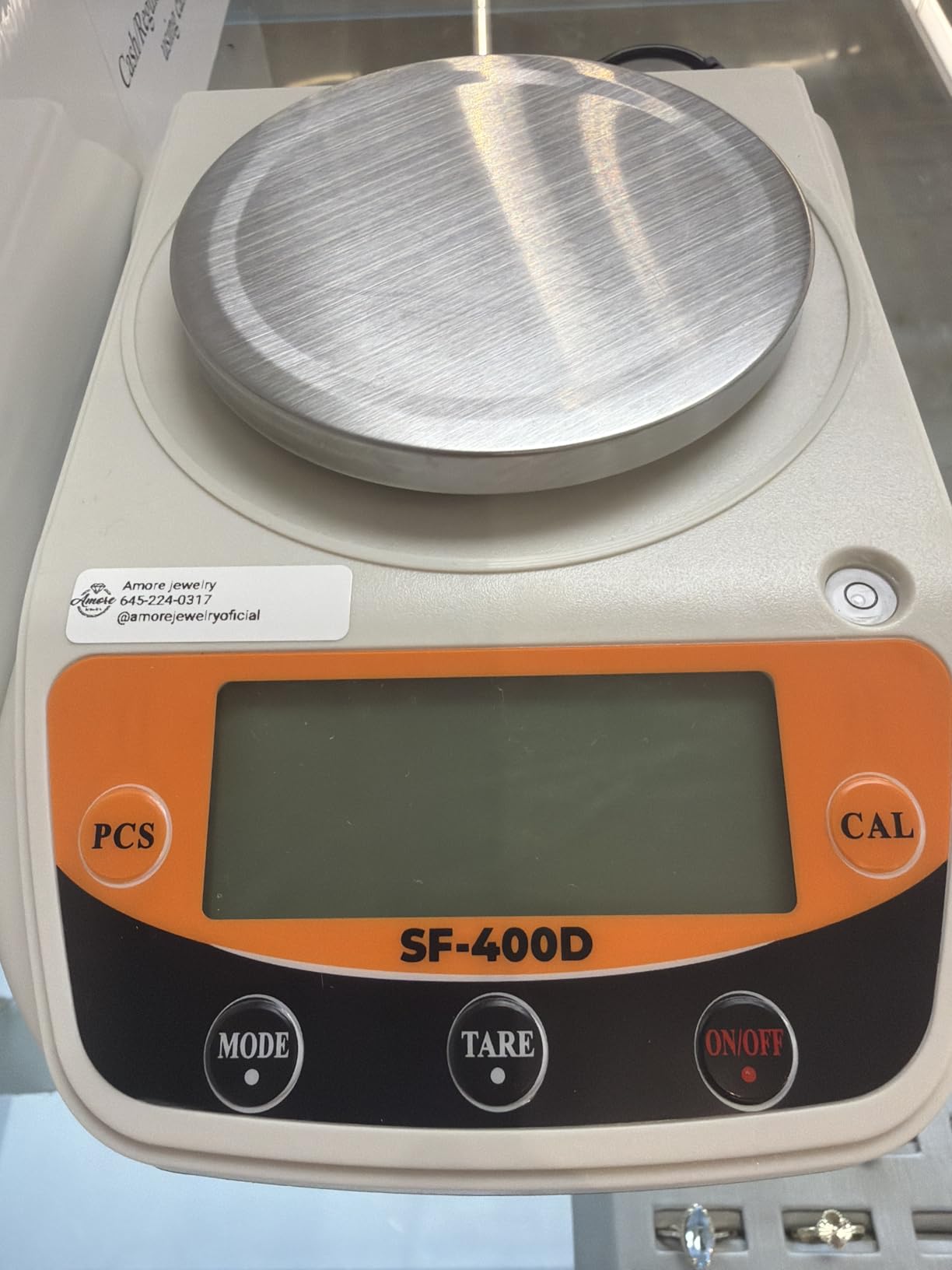
This is the scale I point most people toward first, and the reason is unglamorous: it has more owner feedback behind it than anything else in this list. At 576 ratings you can read a pattern rather than a couple of anecdotes, and the pattern is consistent. Owners describe a large, clear LCD, a tare that works the way you expect, and readings that settle quickly once the scale has been calibrated.
Its rating of 4.3 across 576 ratings reflects a scale that does what the box says for general work, with the usual caveat that you must calibrate it yourself before trusting it. The listing does not include a calibration weight, so add a reference mass to your setup before the first real weighing. Reviewers who compared it against reference weights report accuracy nearer 20 to 30 mg rather than the 10 mg headline, particularly in the low range.
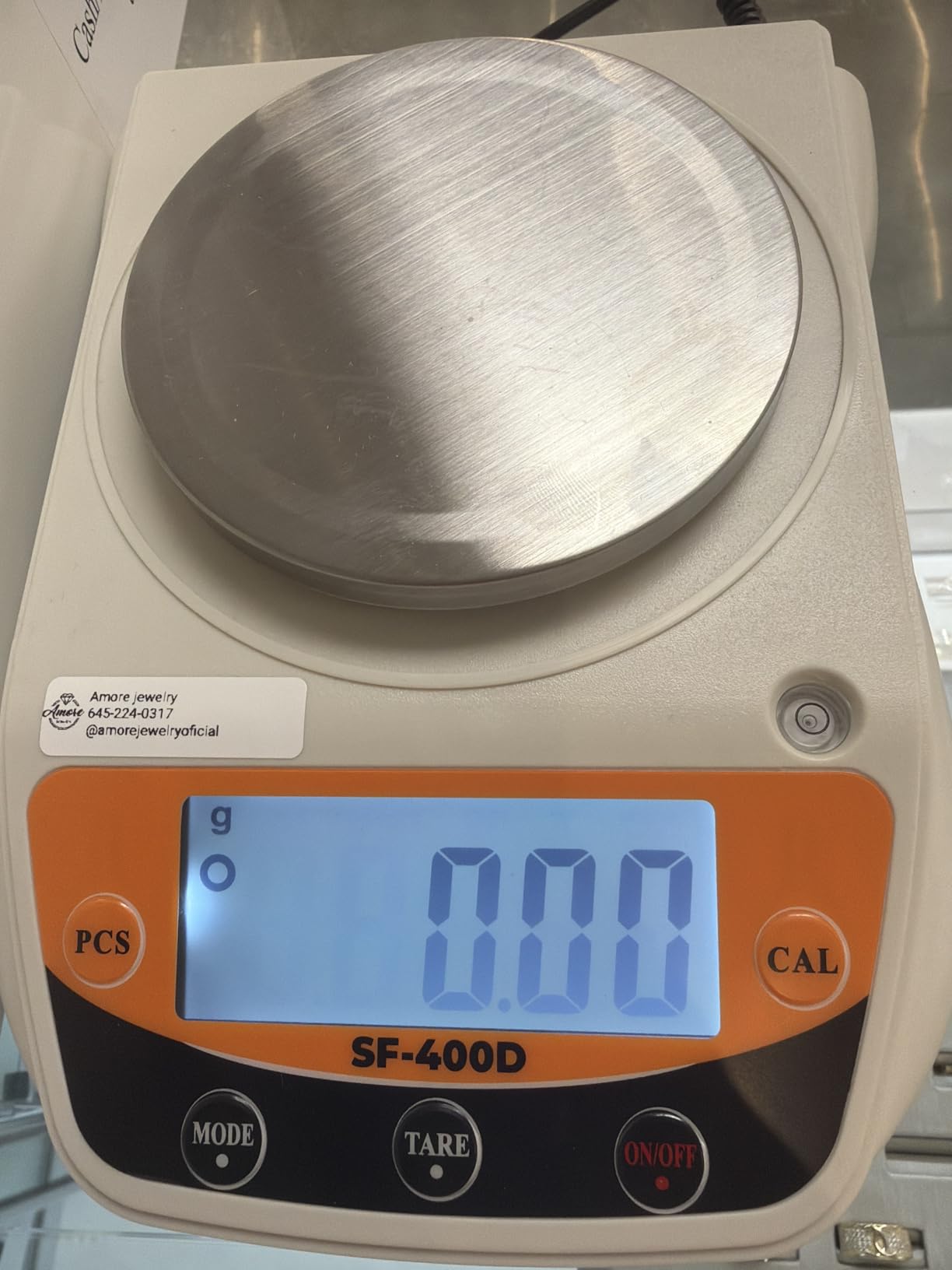
The body is acrylonitrile butadiene styrene in a mini form factor, and the whole scale weighs about 1 g, so it moves between a shelf and the bench without ceremony. Power comes from an AC adapter or two AA batteries, and it shuts off after 270 seconds of inactivity. Six unit conversions cover grams, ounces, carats, pennyweight, tola and grain, which is why it turns up in jewelry and coin work as often as in chemistry.
The six unit modes and the counting function are the features that get mentioned most approvingly. The counting mode is genuinely useful for batching identical small parts, and the large font means you can read the display from standing height without bending over it.
What works well in practice
General-purpose weighing, powder and reagent work in the 10 g to 500 g range, and anything where a tenth of a milligram is irrelevant. Tare behaves consistently, which is what actually matters when you are decanting into a container and want the weight of the contents only. Six units means fewer mental conversions during jewelry or coin work.
It also holds a top sales rank in its category, which usually means replacement parts and accessories exist somewhere if you need a pan or an adapter later. The double power option is useful if your bench has no outlet within reach.
Where it falls short
The 0.01 g figure is a readability claim, not an accuracy guarantee, and reviewers who tested it with reference weights found error closer to 0.03 g, especially below 1 g. Treat it as a centigram instrument in practice. Repeatability also varies enough that careful users take several readings rather than trusting the first one.
Documentation is the weakest part. The printed instructions are terse and hard to follow, and because no calibration weight ships in the box, you need a reference mass and a clear method before your first session. If you want a balance that is genuinely trustworthy below 1 g, look at the milligram models further down instead.
2. Bonvoisin 5000g x 0.01g Lab Scale – Built for Bulk Work
Bonvoisin Lab Scale 5000gx0.01g High Precision Electronic Analytical Balance 0.01g Accuracy Laboratory Precision Digital Scientific Scale (5000g)
5000g x 0.01g readability
180 x 140mm stainless pan
Thirteen unit modes
Level bubble and feet
Pros
- 5000g capacity removes the need for multiple scales
- Roomy stainless steel pan that is easy to clean
- Large legible LCD readable in low light
- Thirteen unit conversions plus counting and memory
- Non-slip mat and leveling feet aid stability
Cons
- Calibration weights not supplied with the 5000g model
- Accuracy depends on correct calibration and a stable bench
- Plastic-bodied overall so a small pre-load improves repeatability
If your work involves anything heavier than a few hundred grams, this is the one to look at. A 4.5 rating across 317 ratings is among the strongest in this group, and the reason owners rate it highly is unglamorous and real: the capacity removes the need to own two scales, and the pan is big and stainless steel.
At 180 x 140 mm the weighing surface handles bulkier work than the smaller models in this list, including jars, bowls and larger samples. Thirteen unit conversions go well past the usual set, including troy ounces and percent, and the counting and memory functions are genuinely useful for inventory work.
There are eight capacity ranges from 200 g to 5000 g, so you can order the same model family at different maximum loads. The scale includes adjustable feet and a level bubble, which matters more than it sounds on a home bench that is not perfectly flat. The sensor is an upgraded high-sensitivity built-in type, with overload alarm and error indication.
The most useful technique owners report is placing roughly 60 g of extra mass on the pan and taring before measuring. It stabilises the reading and noticeably improves repeatability, and it is the single most commonly shared tip in the reviews for this model.
What works well in practice
Bulk prep, larger reagent quantities, jewelry and coin batches, and any job where 500 g capacity would be the bottleneck. The stainless pan wipes clean without fuss, which matters when you are working with powders that get everywhere. Legible display and thirteen units cut down unit-conversion mistakes.
It is also a heavy, stable platform that does not shift when you add a sample, and the level bubble plus adjustable feet make setup forgiving on an imperfect bench.
Where it falls short
Calibration weights are not supplied with the 5000 g version, so budget for a reference mass at that capacity before you trust the readings. Accuracy is also sensitive to correct calibration and to bench stability, and a 5000 g scale feels bench vibration more than a small one does.
Body material is stainless steel for the pan but the housing is largely plastic, so a pre-load on the pan helps repeatability. This is a centigram instrument by design, and anyone needing milligram readings at this capacity should not expect them here.
3. UXILAII 5000g x 0.01g Balance – Calibration Weight in the Box
UXILAII Lab Scale 5000g x 0.01g Analytical Balance with 1kg Calibration
5000g x 0.01g readability
192 x 171mm stainless pan
1kg weight included
RS232 interface
Pros
- Highest average rating among the 0.01g models
- Calibration weights included in the box
- Large backlit display with quick unit switching
- Responsive support that answers technical questions
- Sturdy build that tolerates being moved
Cons
- Replacement battery not supplied and must be sourced separately
- Absolute accuracy closer to 0.10g in the low range
- RS232 cable not included
- Small number of defective units reported
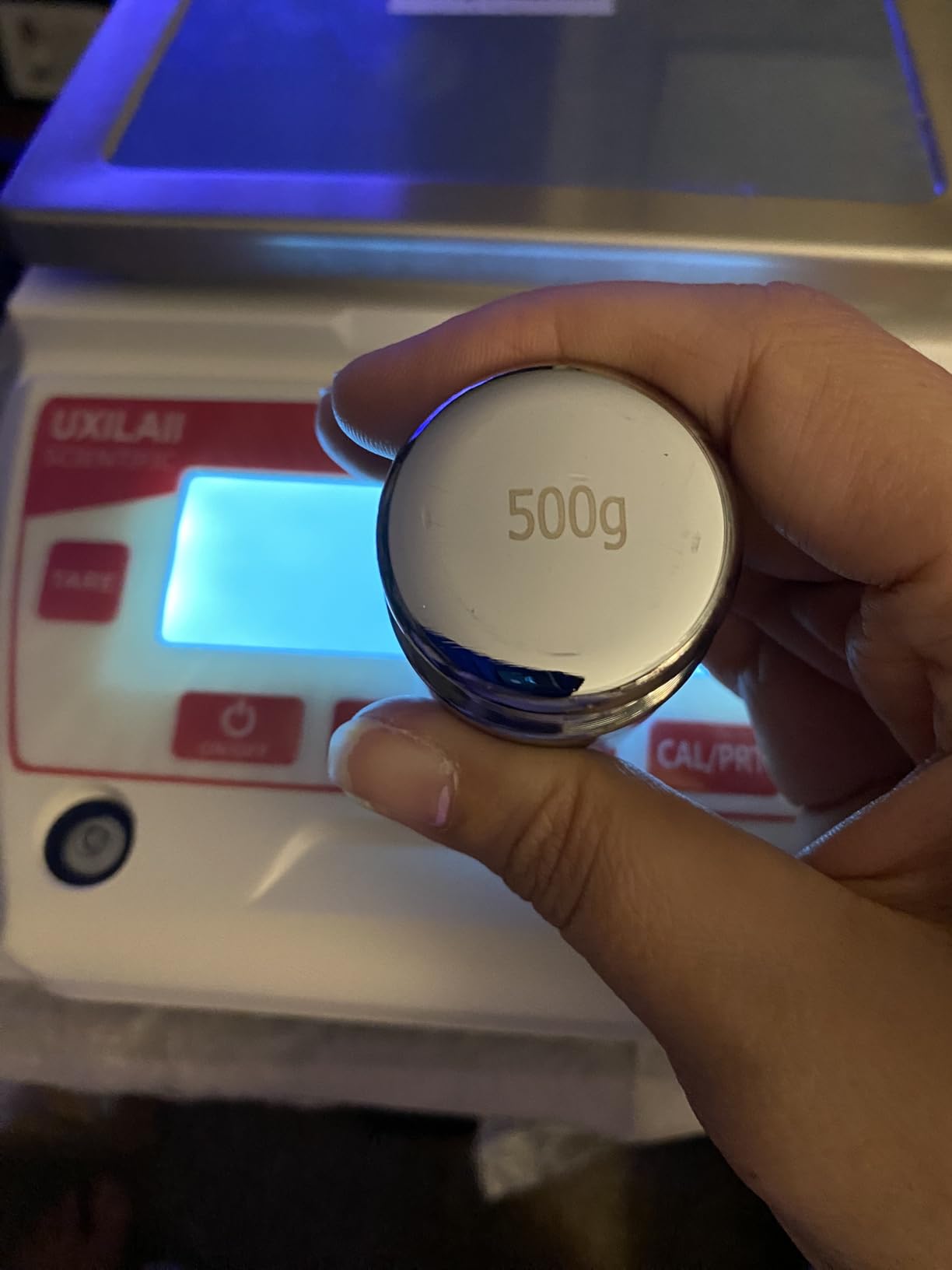
This is the first-time buyer pick, and the reason is the box contents rather than the specification. Calibration weights for the 100 g to 5000 g ranges ship with it, so you can actually perform a proper calibration on day one instead of hunting for a reference mass. Buyers consistently describe readings as accurate and consistent in normal use.
The 4.6 rating is the highest average among the 0.01 g models here, though the review count of 55 is small enough that you should read it as encouraging rather than conclusive. The support side is worth noting too, with owners reporting that the manufacturer answers technical questions within hours.
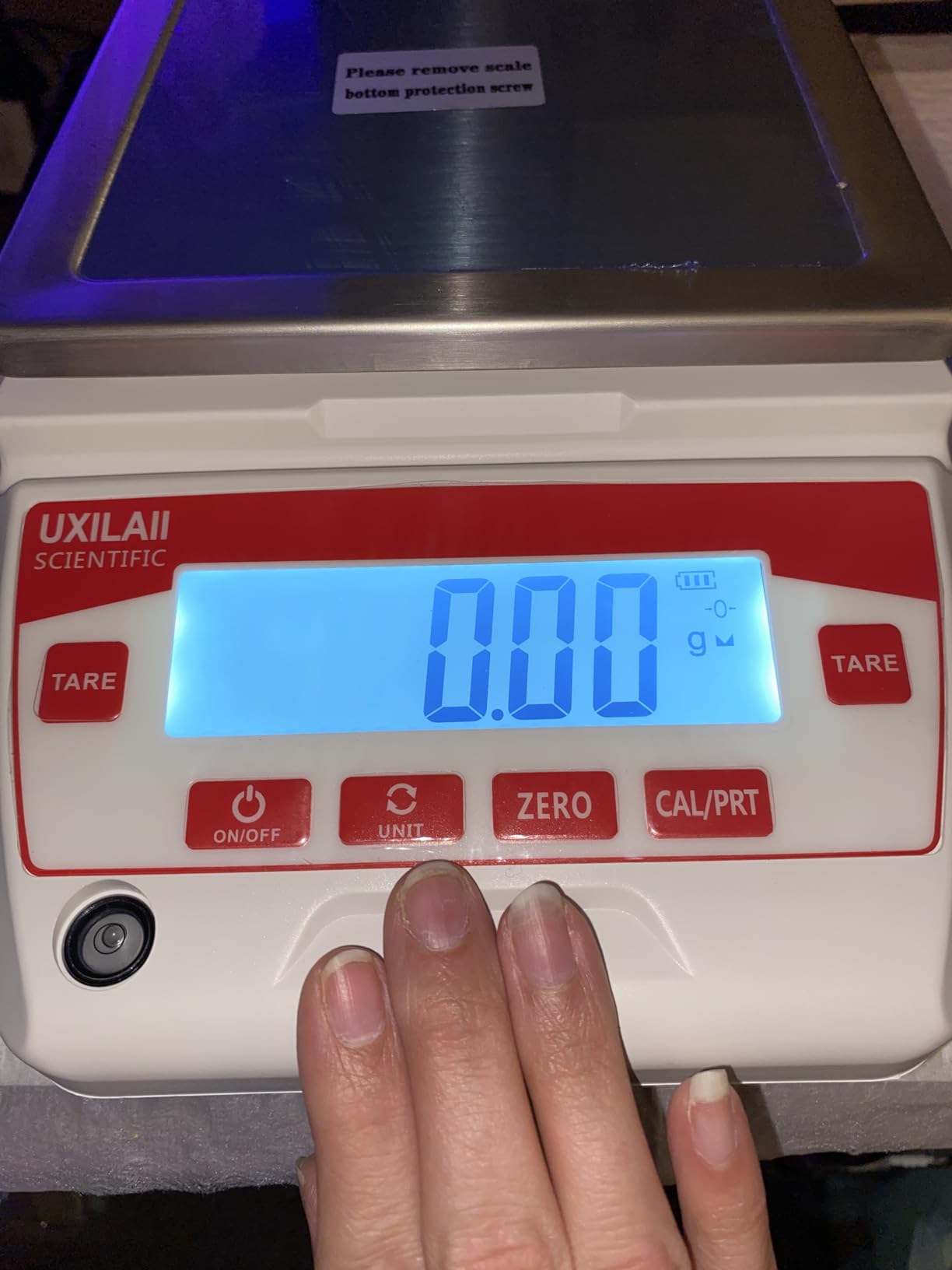
Construction is a 192 x 171 mm stainless steel pan on an aluminium base with a hard ABS shell and a strain gauge sensor. Unit conversion spans grams, kilograms, carats, ounces, troy ounces, pounds, pennyweight, percent, tola and millimetres. The RS232 interface is there for a thermal printer or a computer connection, and PCS counting, UNIT, CAL and TARE buttons sit on the front panel.
It is factory calibrated and tested before shipment, and the manufacturer backs it with a one-year replacement policy. The backlit display is large and switches units quickly, which is a small quality-of-life difference you notice during a long session.
What works well in practice
Anyone starting a home lab who wants a working calibrated instrument without sourcing a reference weight first. The included weight set and factory calibration remove the two biggest early friction points. The build tolerates being moved around, which matters in a room that is not a dedicated lab.
Large, quick-switching display and a genuinely responsive support channel make it approachable. The RS232 port is a real bonus if you ever want printed records.
Where it falls short
Absolute accuracy is closer to 0.10 g in the low range, so this is not the scale for milligram work below that. The RS232 cable is not included, so a data connection means sourcing one separately, and the replacement battery is also not sold with the scale.
With only 55 ratings, the small tail of defective units is worth watching for. Check the unit functions and switches modes immediately on arrival so any problem is easy to catch early.
4. Bonvoisin 500g x 0.001g Lab Scale – Real Milligram Readability
Bonvoisin Lab Scale 500g x 0.001g Digital Gram Scale Analytical Balance
500g x 0.001g readability
Plastic draft shield
Bubble level and feet
30-minute warm-up
Pros
- Genuine 0.001g resolution at 500g capacity
- Stable readings once warmed up and leveled
- Repeatability of about 1-2mg reported by careful users
- Single-point or multi-point calibration
- Calibration weight included with responsive service
Cons
- Draft shield can disturb readings if fitted loosely
- About five minutes of warm-up before the tare zero settles
- Sensitive to drafts and temperature swings above 1-2C
- Undisclosed plus or minus 0.004g error band
This is the milligram workhorse, and for most home labs doing quantitative chemistry it is the most capable pick in the list. A 500 g capacity at 0.001 g readability is a rare combination, and careful users report repeatability of about 1 to 2 mg once the scale is warm and level.
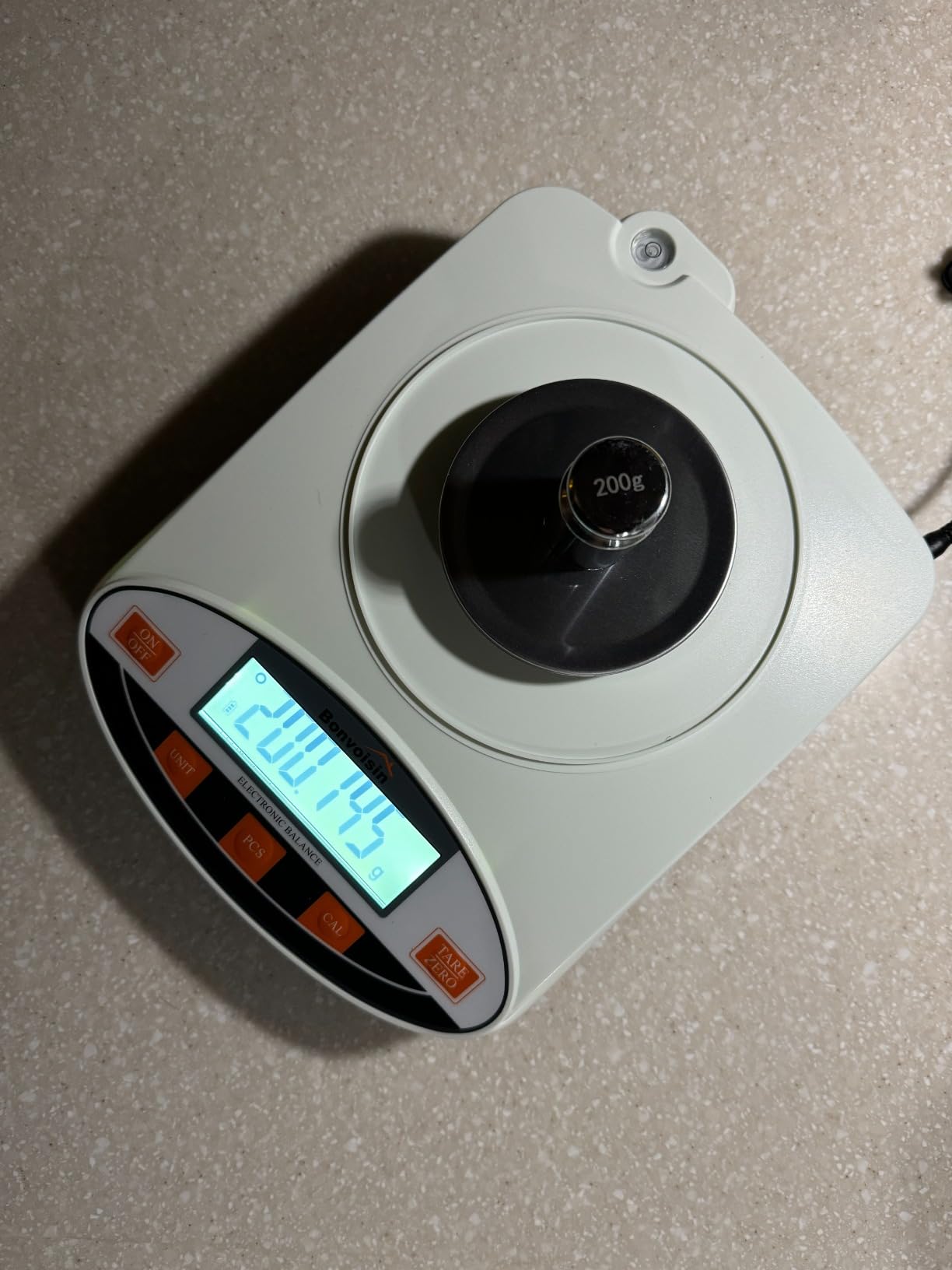
It includes a calibration weight, and it supports both linear and nonlinear calibration, with the linear calibration performed before shipment. The draft shield is plastic rather than glass, with four adjustable leveling feet and a built-in bubble level.
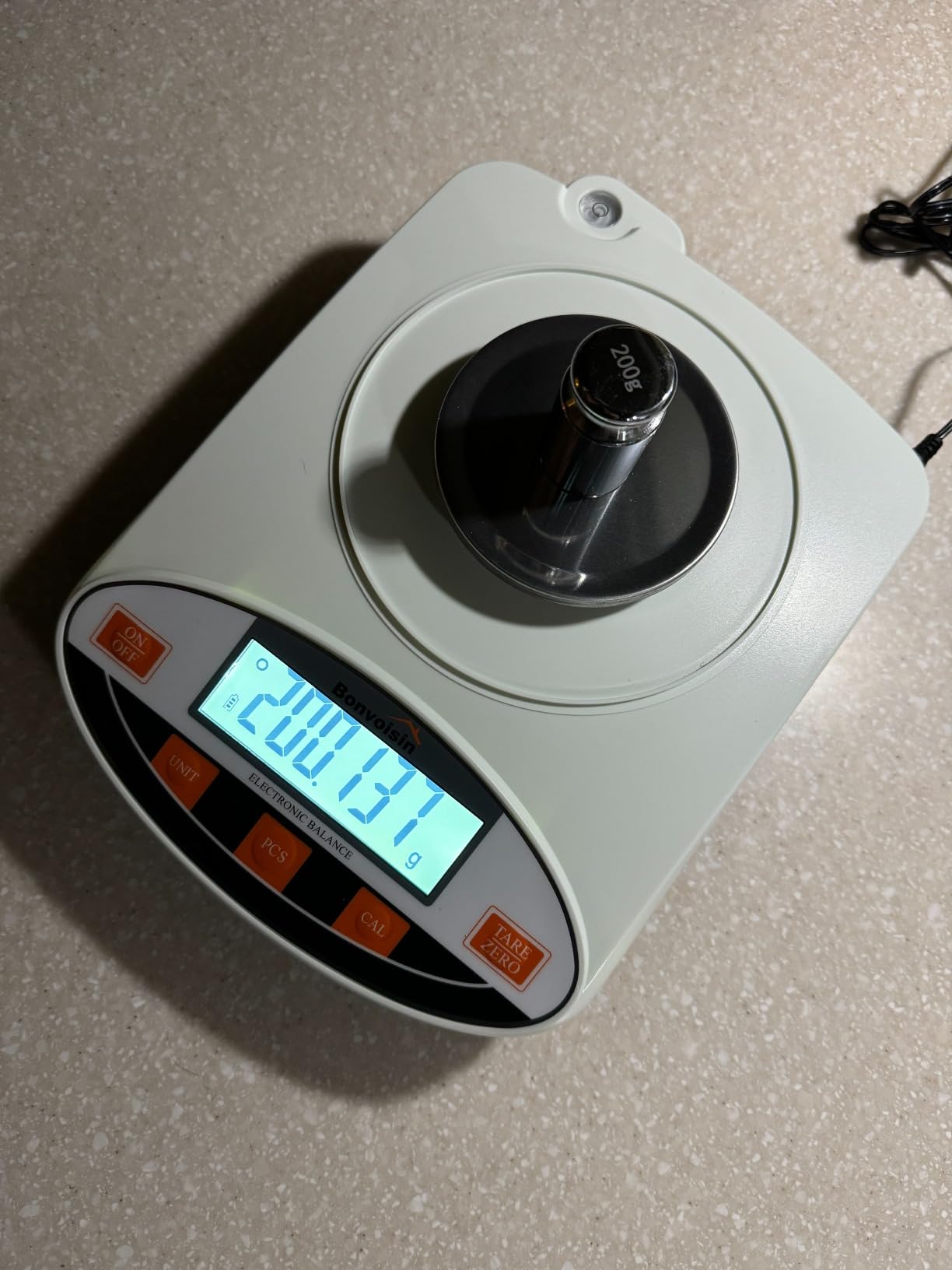
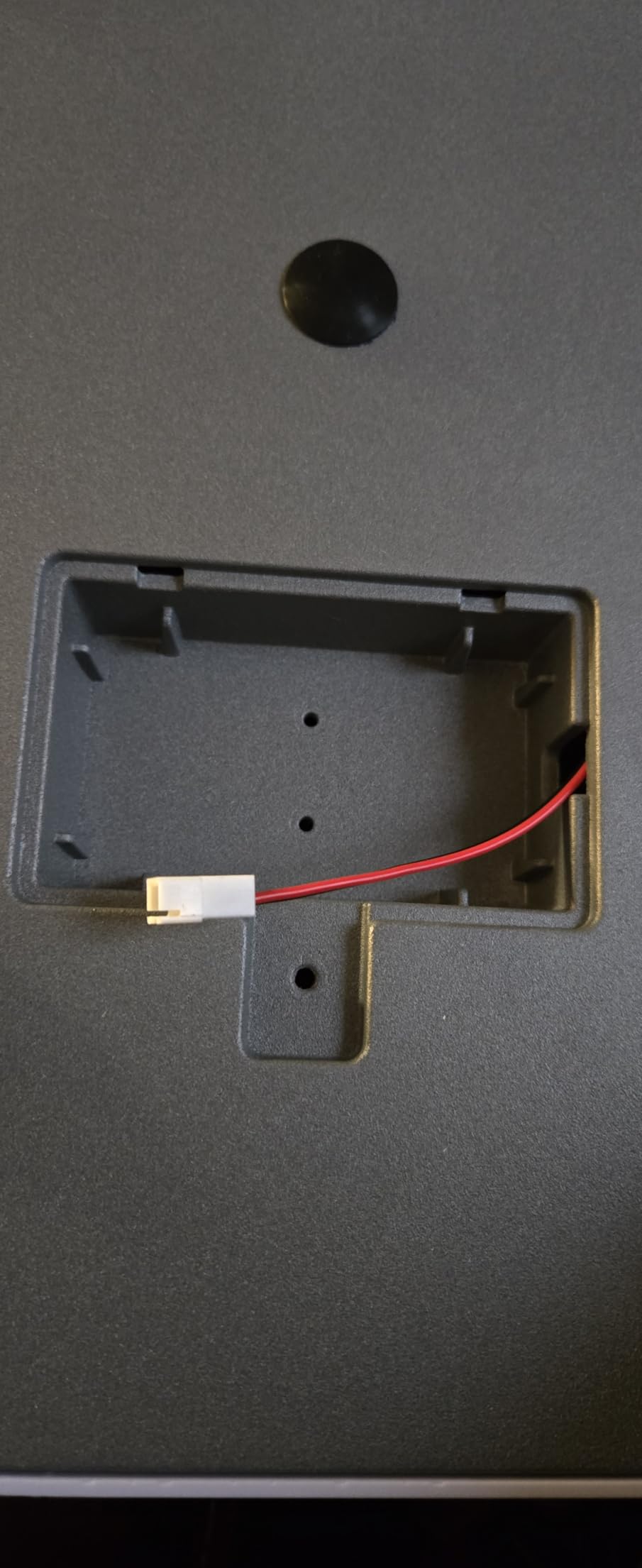
Power is a 110V AC adapter with a 9V battery slot as backup, though the battery covers roughly half an hour of use and is not included. The pan is detachable stainless steel with membrane-protected buttons, and thirteen unit conversions are switchable, including troy ounces, newtons and percent.
The manufacturer recommends a 30-minute warm-up before calibration, and owners report needing roughly five minutes after power-on before the tare zero is truly stable. Tare, counting and percentage weighing modes are all present, and the manual is one of the clearer ones in this category.
What works well in practice
Molarity work, reagent prep where the mass is small, stoichiometry calculations, and any experiment where a milligram of error would change your answer. The draft shield plus the leveling feet make it workable on a normal home bench once you accept the warm-up. Milligram repeatability is real when owners treat the warm-up seriously.
Multi-point calibration support and a supplied weight mean you can verify or restore accuracy yourself rather than depending on a service visit.
Where it falls short
The plastic draft shield can torque the pan surround if it is fitted loosely, and a misaligned pan shifts the zero point, which is a real problem because a knocked-out-of-alignment pan needs fixing before readings mean anything. The scale is also sensitive to drafts, direct lamp heat and temperature swings of more than one to two degrees.
Reviewers also flag an undisclosed plus or minus 0.004 g error band on the listing, which is wider than the readability figure suggests. The 9V battery backup lasts only a few hours, so treat it as a mains instrument.
5. RUISHAN 5000g x 0.01g Lab Scale – Wide Flat Pan for Powders
RUISHAN Lab Scale 5000gx0.01g High Precision Scientific Electronic Digital Laboratory Lab Weight Analytical Balance Scale .01g Accuracy Jewelry Pharmacy Chemistry Industria Calibrated Gram Scale
5000g x 0.01g readability
170 x 170mm stainless pan
Large LED display
External calibration
Pros
- Wide flat stainless pan suits powders and herbs
- Fast stabilization and a bright LED display
- Counting function speeds up inventory work
- Calibration weights included
- Calibrated and tested before shipping
Cons
- Published linearity error of plus or minus 0.03g
- RS232 data cable not included despite the port
- No batteries included
- Five to thirty minute preheat before readings are trustworthy
The distinguishing feature here is pan geometry rather than resolution. At 170 x 170 mm the stainless steel weighing surface is wide and flat, which is exactly what you want when you are spreading out a powder, weighing herbs, or working with a shallow tray of small parts. Owners rate the capacity-to-price ratio and the pan size as the main strengths.
Stabilization is within about five seconds once the preheat has run, and the LED display is bright enough to read in a dim corner of a room. The counting function for small-part inventory is called out as useful, and calibration weights are included in the box.
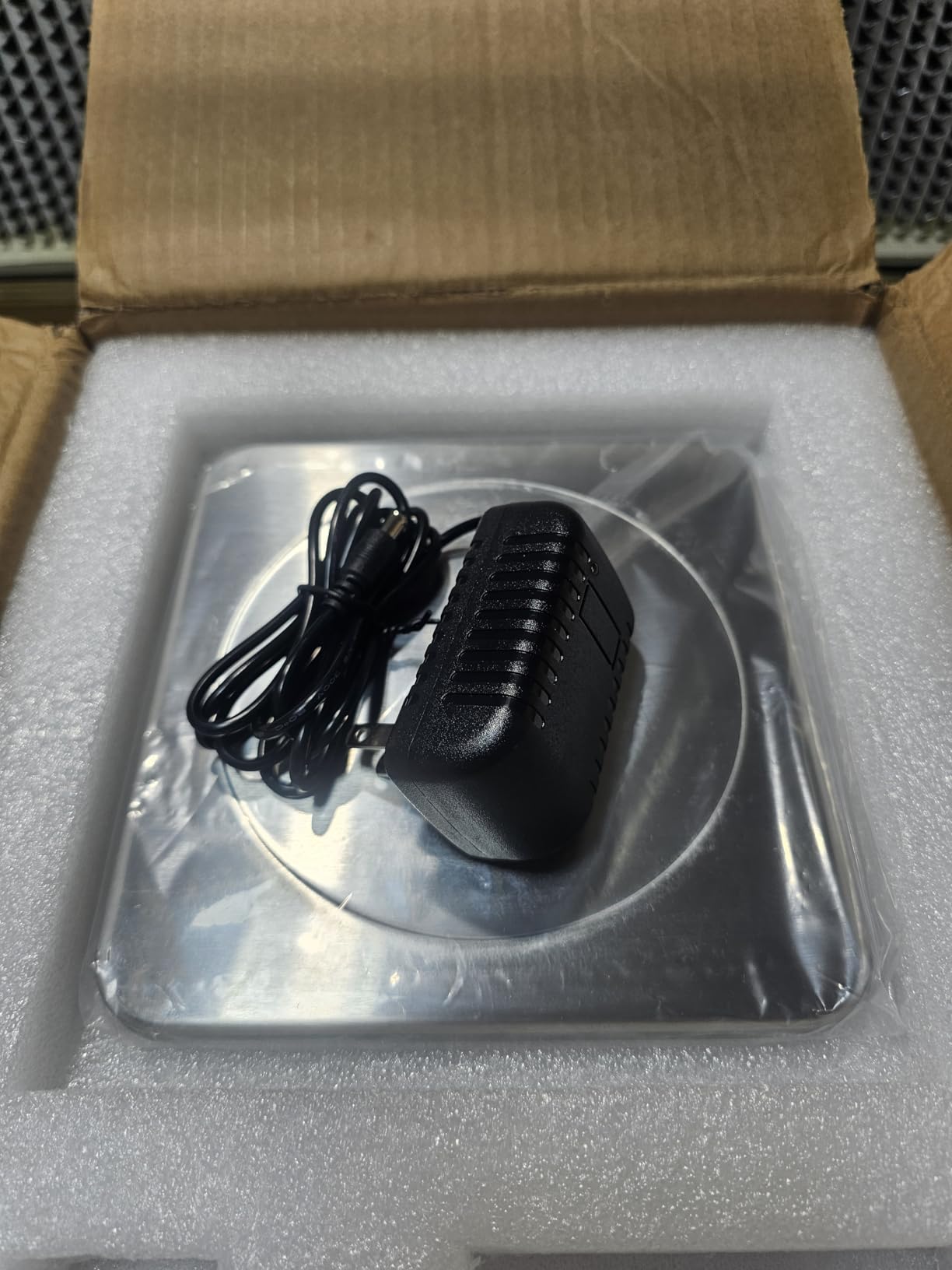
Specifications worth knowing before you commit: preheat time of 5 to 30 minutes, linearity error of plus or minus 0.03 g, and an RS232 interface whose data cable is not included. The scale is calibrated, tested and inspected before shipping, and the manufacturer offers 30-day returns with a one-year warranty.
Build is a stainless steel pan on a durable ABS body with a strain gauge sensor, and the front panel includes a level indicator, adjustable leveling feet, overload alarm and error indication. Unit conversion covers grams, ounces, carats and pounds.
What works well in practice
Powder and bulk reagent handling, botanical and herbal work, and small-part counting where you want a flat surface rather than a small circular pan. Fast stabilization keeps you moving during repeated weighings, and the included calibration weights remove the first-session friction.
The bright LED display is a genuine advantage over the LCD models when your bench is not well lit, and a one-year warranty gives a reasonable first line of support.
Where it falls short
The published linearity error of plus or minus 0.03 g is wider than the 0.01 g headline, and that gap is the most important number on this page for anyone doing quantitative work. Treat it as a centigram balance with a 0.03 g envelope, not a milligram one.
Preheat of 5 to 30 minutes has to happen before the readings are worth trusting, which is awkward for short sessions. The RS232 port is advertised without a cable, and batteries are not included.
6. SASVY 1000g x 0.01g Scale – Cheapest Calibrated Starting Point
SASVY Digital Lab Scale 1000g x 0.01g oz/g/ct/DWT/tl/gn/ozt Precision Electronic Scientific Scale Analytical Balance for Laboratory Jewelry Kitchen, Includes 100g Weight and 2 x AAA Batteries
1000g x 0.01g stated accuracy
4.9 inch stainless plate
100g weight included
Battery powered
Pros
- Lowest entry point with a calibration weight included
- 1000g capacity is high for the money
- Backlit display is clear and easy to learn
- Tare and piece counting are genuinely useful
- Battery power makes it portable
Cons
- Does not register reliably below 0.1g
- Readings lag about a second and shift with centering
- 100g weight limits accuracy checks below 100g
- One report of an internal short overheating the batteries
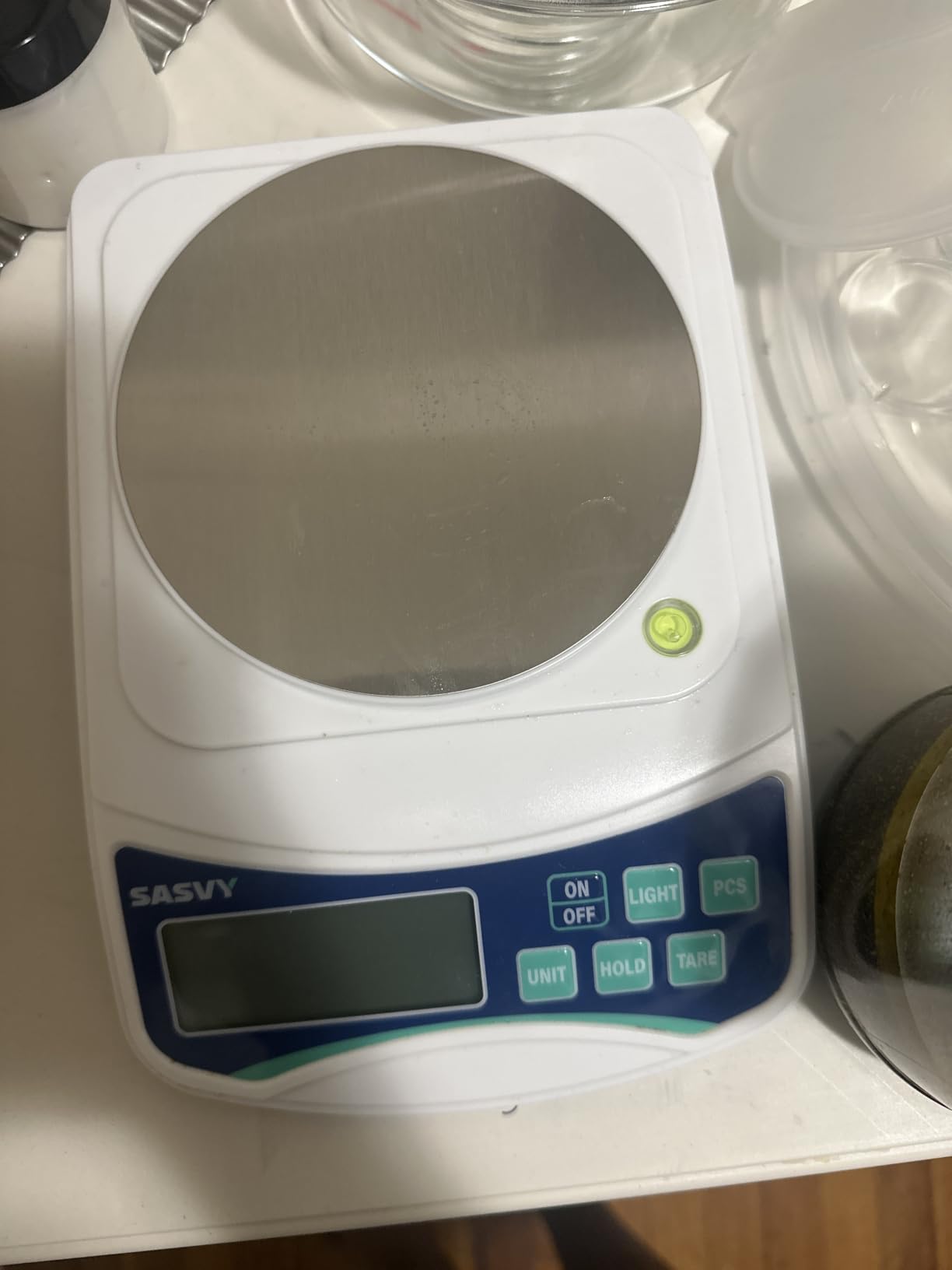
This is the budget pick, and its strongest feature is simply what arrives in the box: a 100 g calibration weight and two AAA batteries. Most of the category ships without a weight, so for a first instrument this removes the most common reason people cannot get trustworthy readings out of a new scale.
Capacity of 1000 g is unusually generous for a scale at this entry level, and the 4.9 inch stainless steel weighing plate is larger than the small precision models tend to use. The backlit LCD is clear in low light, and the unit is genuinely easy to learn.
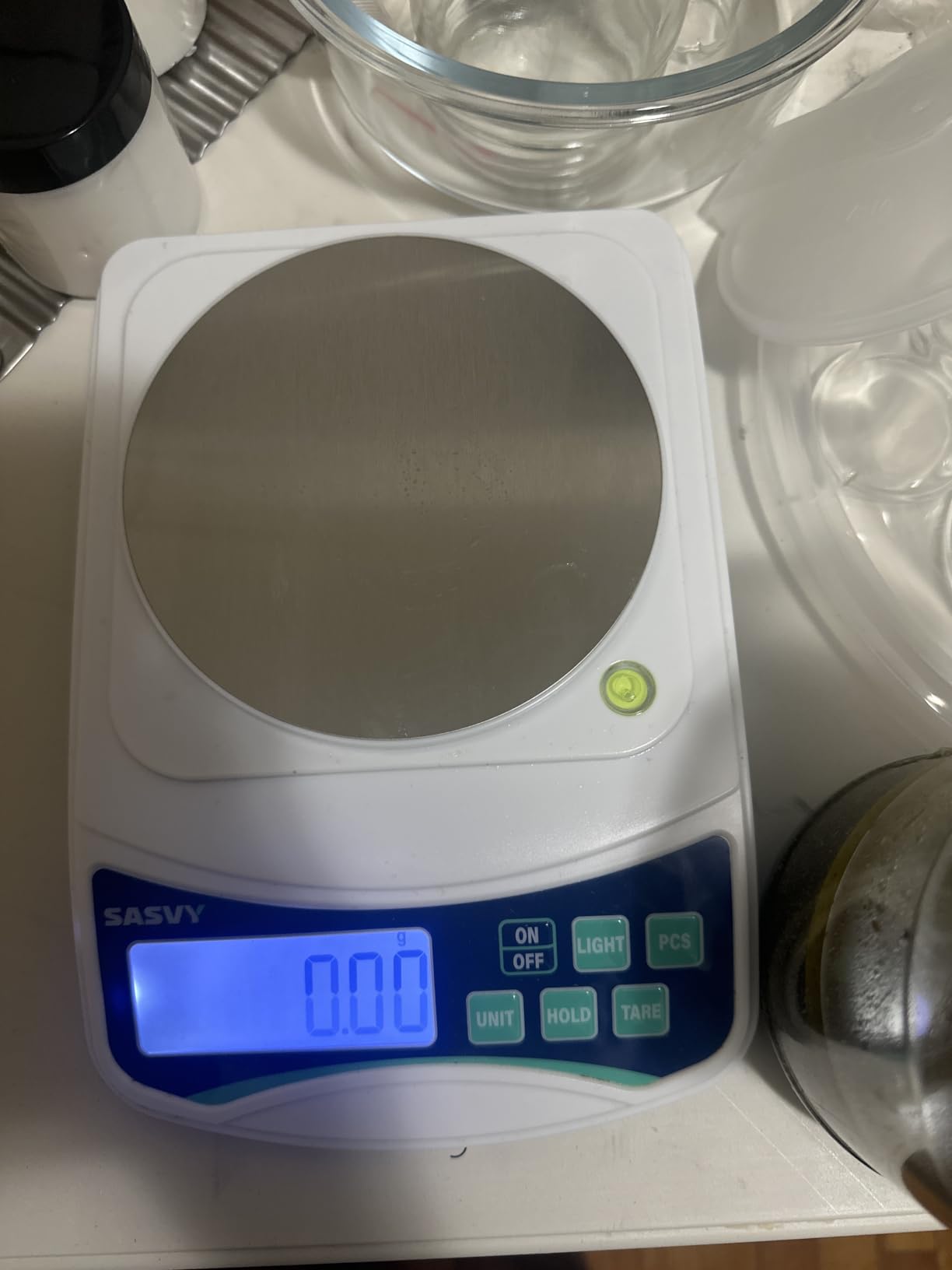
Adjustable feet and a level bubble are present, which is better than most scales in this price band. Unit conversion covers ounces, grams, carats, pennyweight, tola, grains and troy ounces, and tare, piece counting and calibration functions are all built in. Power is two AAA batteries, so it works away from an outlet.
Buyers mostly use it for kitchen, coin and small-craft weighing and find it accurate and easy to set up, with several noting that the bundled calibration weight alone is worth more than the scale. That is a fair way to look at it.
What works well in practice
Kitchen and craft work, coin and small-part weighing, and any home setup that needs a decimal place without laboratory formality. Battery power makes it portable for field or mobile work, and the included weight means you can calibrate before the first use. Tare and piece counting are the functions you will reach for most.
For a first balance on a bench that is not a dedicated lab, it covers the common cases with very little fuss.
Where it falls short
The honest limitation: it does not register reliably below 0.1 g, so the stated 0.01 g accuracy is optimistic at the bottom of its range. Readings also lag by about a second and shift depending on how the item is centered, which is a centering skill rather than a defect but does affect repeatability.
Because the supplied calibration weight is 100 g, you cannot use it to verify accuracy below that mass, which limits how far you can independently check the low end. There is also at least one report of an internal short that overheated the batteries, so stop using it if the case warms unexpectedly.
7. GOYOJO 500g x 0.001g Balance – Full Glass Windshield
Lab Analytical Balance 500g x 0.001g Precision Digital Scale, with Windshield and RS232 Interface, for Scientific Laboratories, Research, Industrial, Kitchen, Food, Jewelry, 19 Units, 500g Weight
500g x 0.001g accuracy
Glass sliding windshield
RS232 output
500g weight included
Pros
- Strong combination of 0.001g resolution and a tall glass windshield
- Sliding panels on the sides and top ease dispensing
- Stainless platform is sturdy and easy to clean
- Calibration is simple with multi-point instructions
- Fast replacement reportedly provided for a bad first model
Cons
- One model drifted over 30mg and would not return to zero
- Readings flutter until the windshield is fully closed
- One arrival had the pan detached from the pedestal
- Larger footprint than a typical kitchen scale
This is the pick if you want milligram readings with the most serious airflow protection in the group, because the windshield here is full sliding glass on multiple sides rather than a plastic shroud. Sliding panels on the sides and the top mean you can dispense into a beaker without lifting anything off the pan and disturbing the reading.
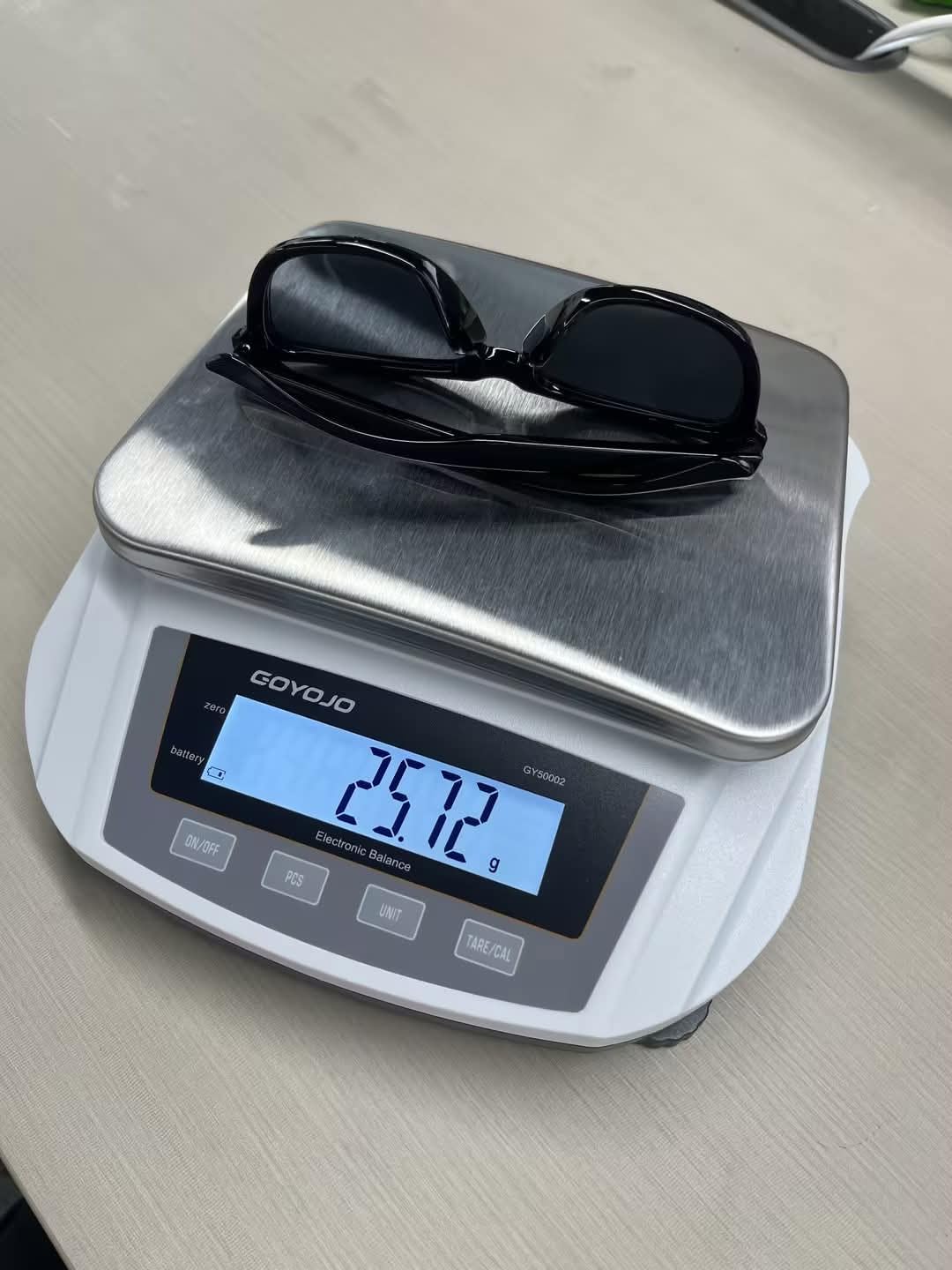
Specification is 0.001 g accuracy at a 500 g maximum capacity, with a 500 g calibration weight included. The stainless steel platform and body are easy to clean, and the backlit LCD is clear. Power is a plug-in supply with no batteries required, and multi-unit switching covers grams, carats, ounces and pounds.
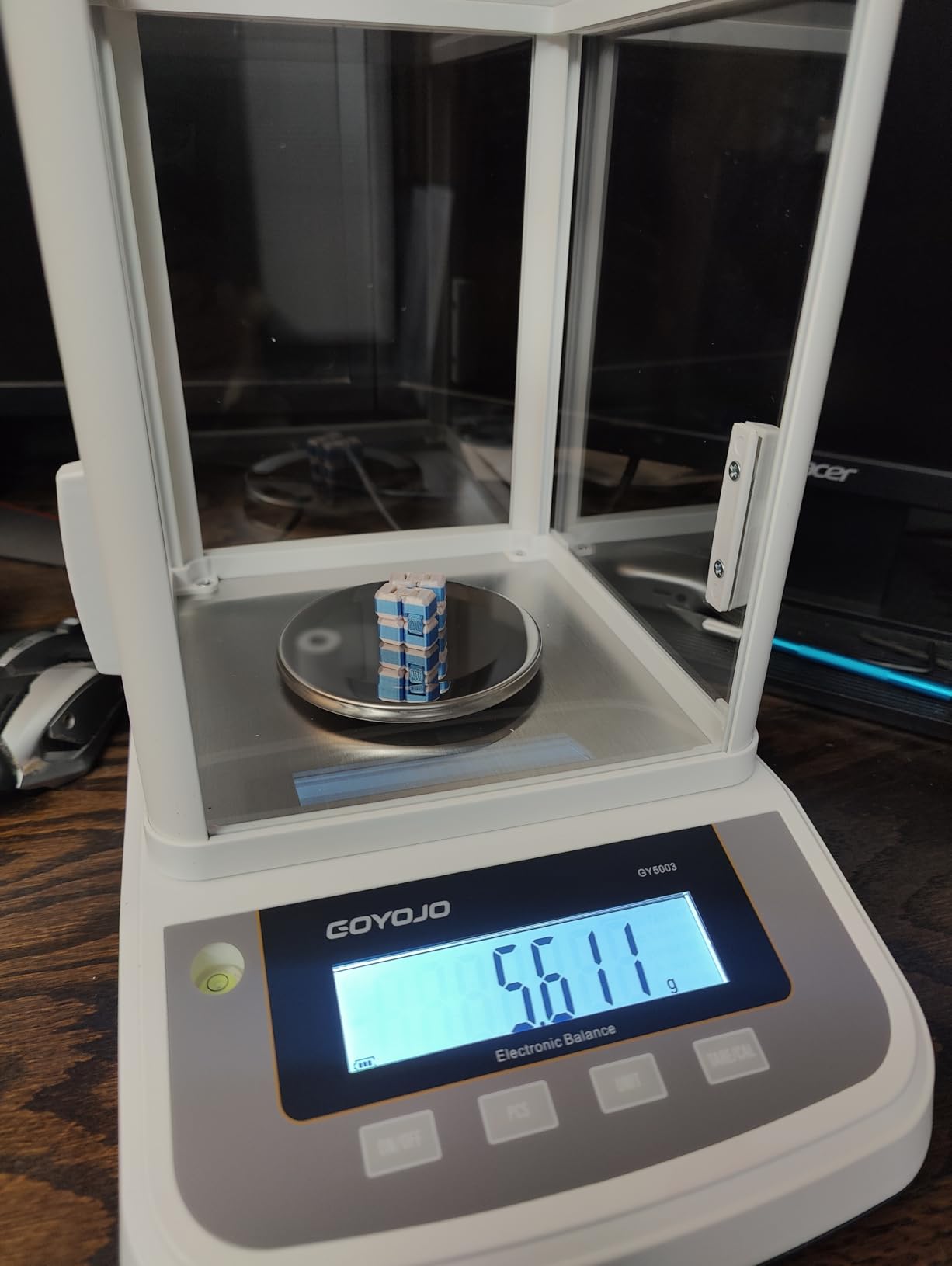
Owners are largely enthusiastic about getting 0.001 g resolution and a real glass windshield together, and the manufacturer is praised for replacing a faulty first model quickly. Calibration is described as straightforward, with multi-point instructions in the manual.
The RS232 interface is present for data output, though a cable is not mentioned in the box contents, so plan for that if you want logging. Stabilization is quick for a stainless platform of this size, which helps during repeated weighings.
What works well in practice
Milligram work in a room with air movement, which is most rooms. Glass panels block drafts far better than a plastic shield, and the side access makes dispensing into narrow vessels realistic rather than a juggling act. The included 500 g weight means calibration is available on day one.
Stainless surfaces wipe clean easily, which matters with fine powders, and the plug-in power removes battery life from the equation entirely.
Where it falls short
There is a documented failure mode: one model drifted by more than 30 mg inside the windshield and would not return to zero. That is exactly the symptom that ruins milligram work, so verify the zero return and the reading against a reference weight in the first week rather than assuming it is fine.
Readings can flutter until the windshield is fully closed, so close it before you read. Some arrivals have the pan separated from the pedestal, and one buyer got no support response, which is worth knowing. The footprint is also larger than a typical kitchen scale, so check your bench depth first.
8. LACHOI 500g x 0.001g Scale – 19 Conversion Modes and RS232C
LACHOI Analytical Balance 500gx0.001g Lab Scale 0.001g Accuracy
500g x 0.001g accuracy
Draft windshield
19 unit conversions
RS232C interface
Pros
- 500g capacity with 0.001g accuracy
- Nineteen unit conversions cover unusual fields
- RS232C port enables logging to a computer or printer
- Windshield helps stabilise readings
- Counting function included
Cons
- Lowest rating in this selection at 4.1
- Windshield is not fully sealed so airflow still affects low readings
- No calibration weight details given in the listing
- Needs a stable level draft-free bench
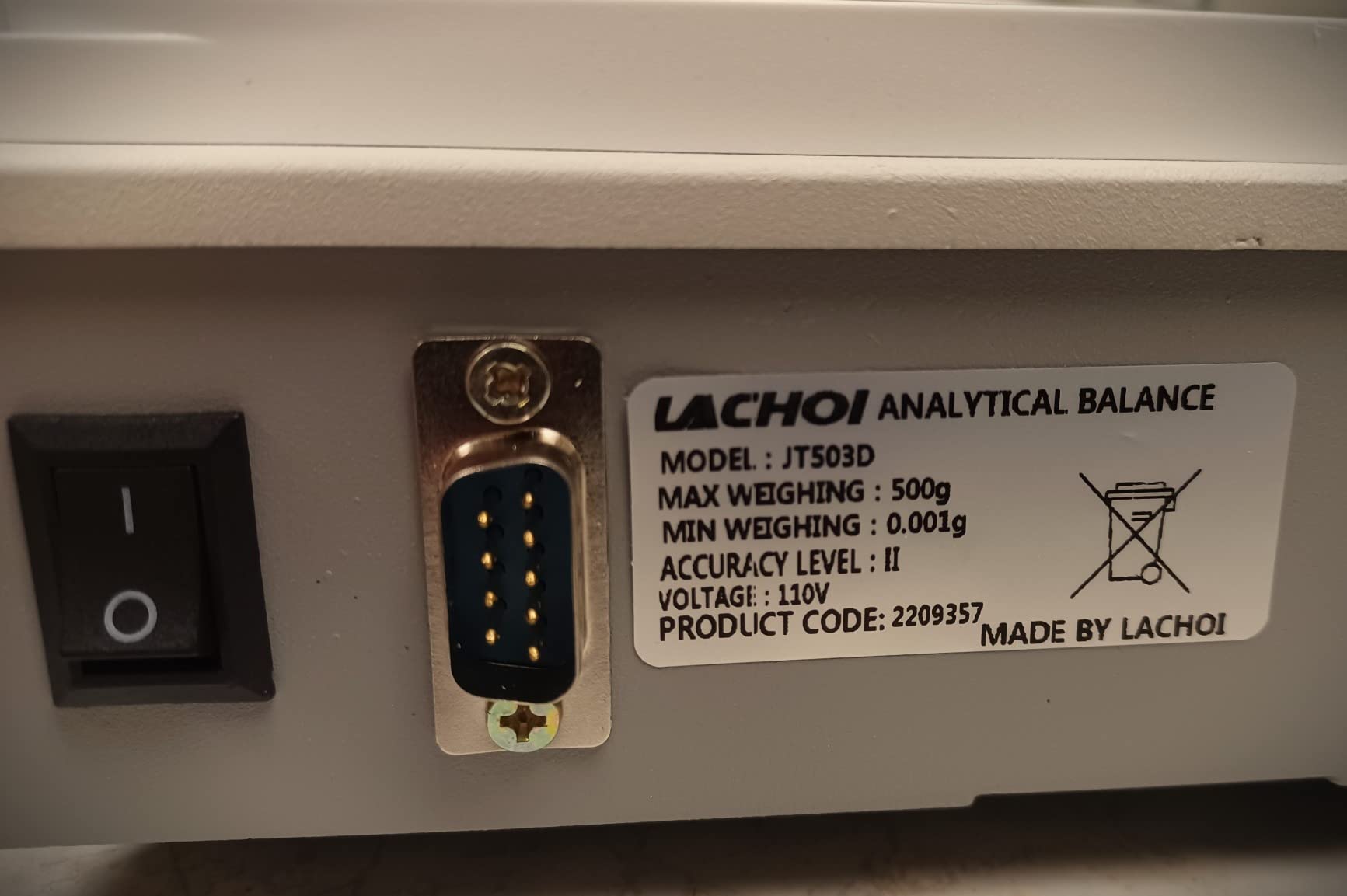
The reason to look at this one is the interface. It carries an RS232C port for printer and computer data exchange, and 19 unit conversions, which is the widest set in this group and includes less common fields like GSM and troy ounces. If you want to log every weighing from a home setup, that combination is unusual at this specification.
Specification is 500 g capacity with 0.001 g reading accuracy, with a windshield included to reduce external influence on measurements. Controls are tactile feedback buttons rather than a membrane, and the display is a standard LCD. A counting function is included for batch work.
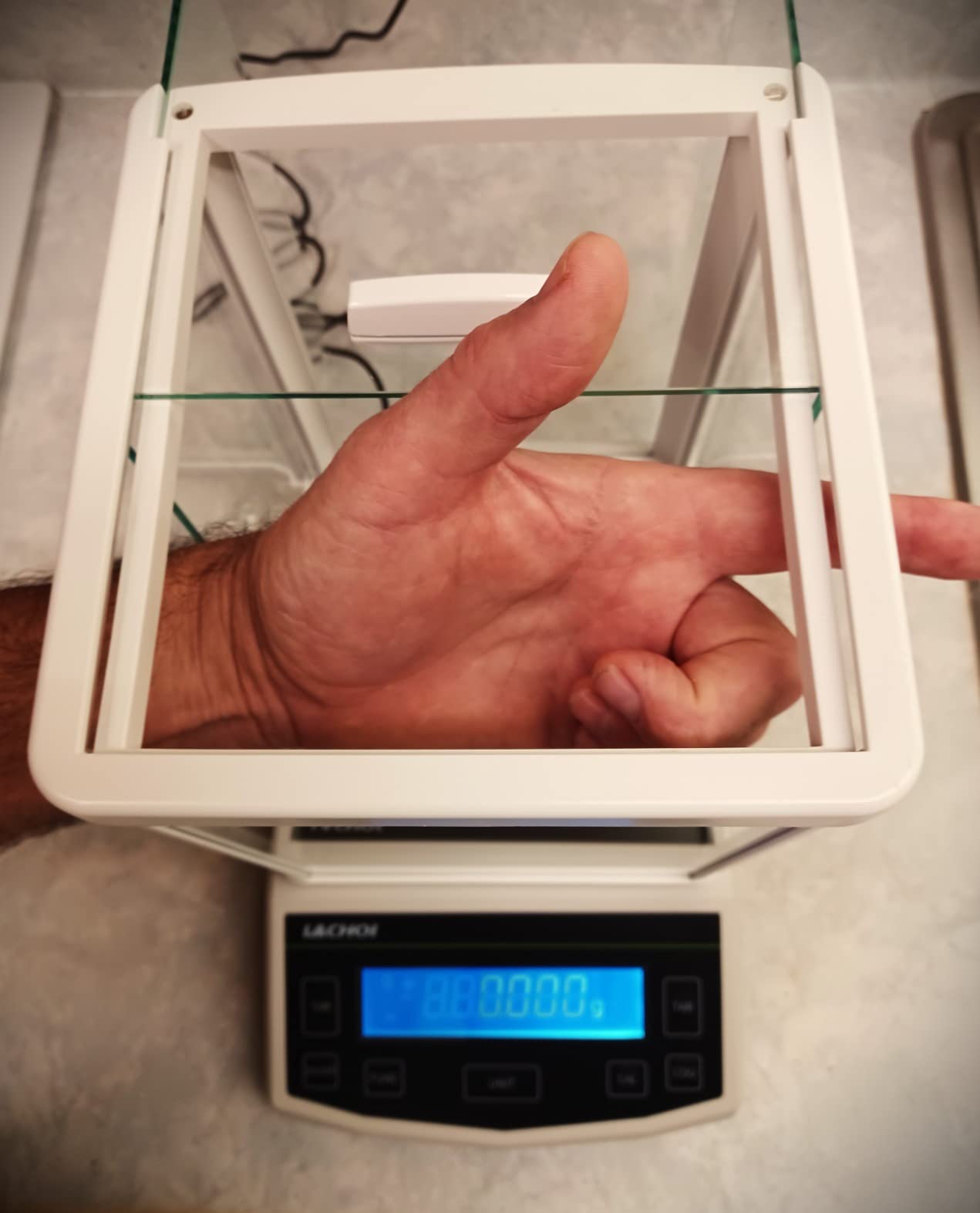
It is worth being direct about the numbers: a 4.1 rating is the lowest average in this selection, and with 48 ratings the picture comes from a small sample. The buyer base that does rate it focuses on the 500 g by 0.001 g specification and the RS232C data link, used in lab, pharmacy and jewelry settings.
Weight and dimensions are not listed for this model, so measure your bench before committing. The windshield reduces airflow effects but is not fully sealed, which is the main reason it does not perform like a four-sided glass chamber.
What works well in practice
Data logging and record-keeping, where printing or logging a run of weighings matters more than the last decimal place. The nineteen unit conversions are a real convenience in jewelry and postal work, and the counting function handles batch work without extra software.
For a bench where a printer is already in the workflow, the RS232C port is the feature that makes this the sensible choice over a similar model without it.
Where it falls short
It has the lowest rating here and the smallest meaningful review base, so you are buying on specification and the port rather than on a body of independent feedback. The windshield is not fully sealed, so airflow still moves low readings, and the listing gives no calibration weight details at all.
It also needs a stable, level, draft-free bench, kept away from direct sunlight and temperature swings. If your setup cannot meet that, spend the money on a sealed windshield model instead.
9. LACHOI 120g x 0.0001g Analytical Balance – True 0.1 mg Resolution
LACHOI Analytical Balance 0.0001g 120g Precision Lab Scale 0.1mg Accuracy
120g x 0.0001g accuracy
Electromagnetic sensor
Sliding glass doors
RS-232 port
Pros
- Reaches a true 0.1mg readability
- Drift held near 0.05mg for a reloading user
- Tares cleanly to 0.0000 and calibrates with the included 100g weight
- Compact footprint for a tight bench
- Sliding doors on the top and both sides
- Bubble level and adjustable feet
Cons
- Three-legged base can tip if the front buttons are pressed hard
- Glass door edges are sharp and unprotected
- Two-hour preheat before accurate readings
- Calibration instructions are vague and illustrations do not match the display
This is one of only two picks in the guide that reaches a genuine 0.1 mg, or 0.0001 g, readability, and it uses a high precision electromagnetic sensor rather than a strain gauge. Precision users report drift held to about 0.05 mg across reloads, and clean taring to 0.0000.
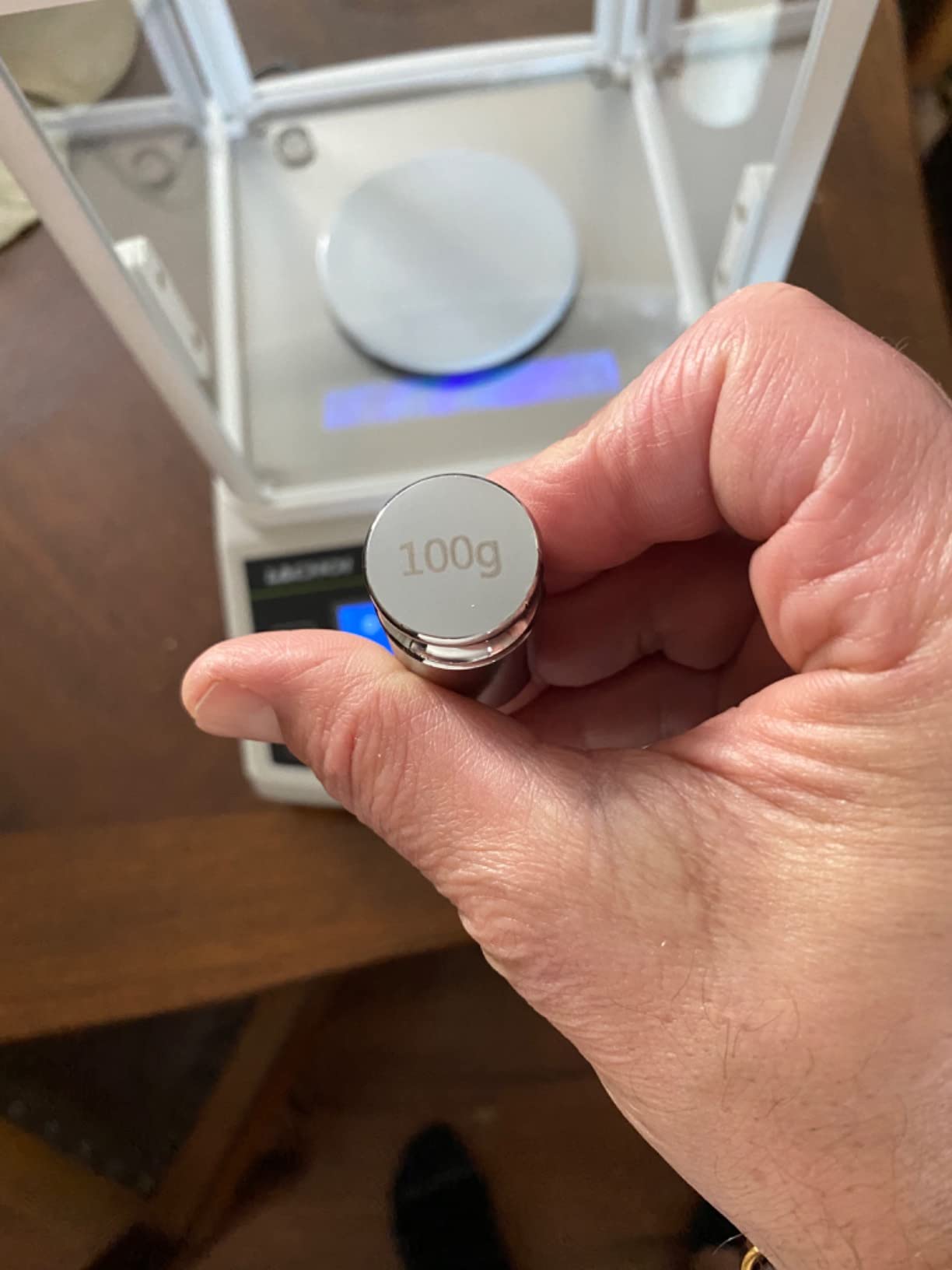
Capacity is 120 g, which is a genuine constraint worth planning around. Fine powders, jewelry stones, and small quantitative samples fit comfortably; anything heavier does not. The box includes the scale, adapter, pan, manual, a pair of gloves and a calibration weight, and the 100 g weight is enough to calibrate the working range.
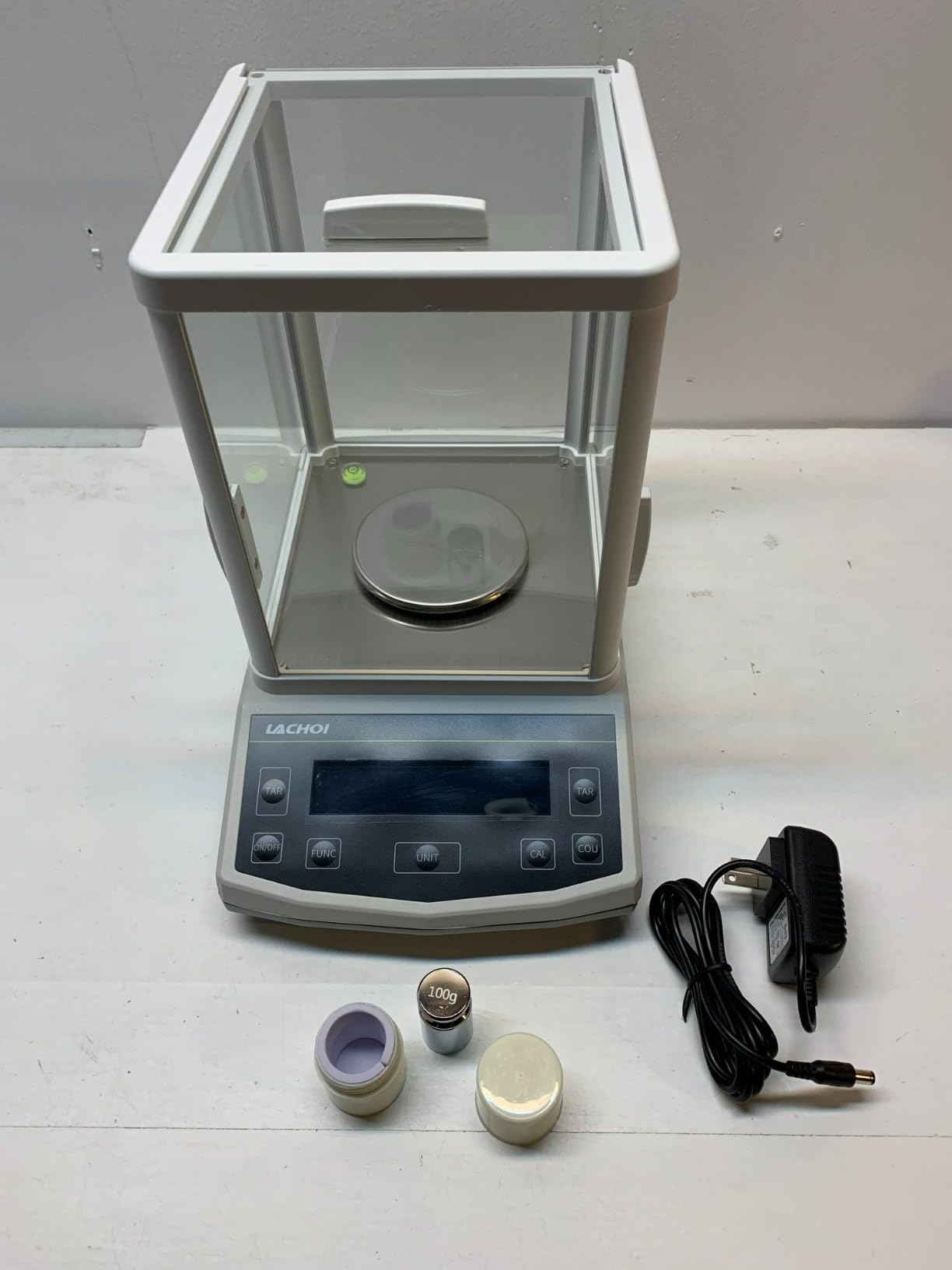
The windshield is glass with sliding doors on the top and both sides, so you can access the chamber from multiple angles without disturbing the reading. A built-in bubble level and adjustable feet make leveling straightforward, and the LCD supports full-range tare, overload protection, counting and a fault alarm.
Unit conversion covers grams, carats, ounces and milligrams, and there is an RS-232 interface for printers and computers, though the connection cable is not included. The preheat recommendation is two hours, which is the longest in this list and the hardest habit to build into a quick session.
What works well in practice
Work where the difference between 1 mg and 0.1 mg changes the answer. That means fine powders, single-stone jewelry work, and small-sample quantitative chemistry. Sliding glass access from the top and both sides makes dispensing into small vessels practical, and the compact footprint fits a tight bench better than a full glass chamber.
Bubble level plus adjustable feet means setup is quick, and the included 100 g weight means you can calibrate without sourcing anything. Gloves in the box is a thoughtful touch for handling small samples cleanly.
Where it falls short
The mechanical details are the honest drawbacks. It rests on three legs, so pressing the front buttons hard can tip it, and the glass door edges are unprotected and sharp. Neither is dangerous in normal careful use, but both are real quality signals.
The two-hour preheat is a genuine barrier to short sessions, and the calibration instructions are vague, with manual illustrations that do not match what the unit actually displays during calibration. There is no battery backup, and some readings vary with the same item depending on placement, which points back to centering technique.
10. Hanchen 220g x 0.1mg Balance – USB Logging and Temperature Compensation
Hanchen Electronic Analytical Balance, 0.1mg 220g Precise Digital Scale for Lab Pharmacy Chemical Plant Jewelry Store 220g/0.0001g
220g x 0.1mg readability
Three-sided glass draftshield
USB and RS232
Backlit LCD
Pros
- Draftshield and stable base give high repeatability
- Fast backlit LCD readout
- USB and RS232 data output with PC software
- Eight unit conversions for jewelry and pharmacy
- Compact footprint with a spacious weighing chamber
Cons
- One-year guarantee is shorter than higher-end analytical balances offer
- Draftshield is three-sided rather than four-sided
- Small review base of 28 ratings
The 4.8 rating across 28 ratings is the highest average in this selection, with 81 percent five-star and no rating below three stars. The sample is small, so treat that as encouraging rather than settled, but what owners do report is consistent: strong repeatability, solid build, and useful data output.
Specification is 220 g capacity at 0.1 mg readability, which is a more usable pairing than a very small capacity because it handles both jewelry-scale samples and modest reagent masses. The three-sided glass draftshield works with a compact electromagnetic load cell and a stable base to isolate airflow, vibration and temperature shifts.
The power board uses integrated SMT construction with temperature compensation technology, which is the spec that matters most in a room with temperature swings. Output is the distinguishing feature: USB and RS232 connectivity with matching PC software, which is the most complete data option in the guide. The backlit LCD is readable in a dark room, and eight unit conversions cover grams, kilograms, carats, pounds, grains, ounces, troy ounces and pennyweight.
Footprint is 12 by 8 inches with a spacious weighing chamber, so it is compact without feeling cramped. Manufacturer and brand are both Hanchen, and the unit is targeted at medicines, jewelry and chemicals.
What works well in practice
Jewelry and pharmacy work, where the 220 g capacity is a genuine advantage over a 120 g analytical balance, and where the USB and RS232 output with PC software lets you record results properly. The three-sided glass draftshield plus the stable base is the combination owners credit for repeatability.
Temperature compensation on the power board is the quiet advantage in a home lab, since HVAC cycles and daytime temperature drift are the norm rather than the exception. The backlit display helps in a dim workspace, and the 12 by 8 inch footprint is easy to find room for.
Where it falls short
The one-year guarantee is shorter than the multi-year coverage typical of higher-end analytical balances, and that matters if you expect to keep this for years. The draftshield is three-sided rather than four-sided, so one face remains more exposed to drafts than a full chamber.
With only 28 ratings, there is less independent feedback here than anywhere else in the guide, so buy it on the specification and the data output rather than on consensus. The manufacturer is also a smaller brand than the institutional names, which affects documentation and long-term parts access.
11. LACHOI 500g x 0.001g Scale – Lightweight Removable Windshield
LACHOI Analytical Balance 500g 0.001g High Precision Scale with Windshield
500g x 0.001g accuracy
Plus or minus 0.003g tolerance
Removable windshield
LED display
Pros
- Milligram accuracy reported as spot-on out of the box
- Windshield meaningfully reduces airflow drift
- Bright LED display with clean button response
- Adjustable leveling foot and simple calibration
- Compact platform suits a small home bench
Cons
- Highly sensitive to drafts and vibration from fans or open windows
- Requires manual calibration before use and is plug-in only
- Must sit on a stable dry non-slip surface away from sunlight
- One verified review reports 3-20mg drift between identical weighings
- Display brightness has no adjustment
The lightweight removable windshield is the distinguishing feature, and it is easier to live with day to day than a permanent glass chamber. You can take it off to load samples and put it back for the reading, and the lighter construction is simpler to assemble than a full glass enclosure.
Specification is 500 g capacity with 0.001 g accuracy and a stated weighing tolerance of plus or minus 0.003 g. Note that tolerance figure, because it is more informative than the readability number and it is published here, which is rarer than it should be. Most buyers find accuracy and value excellent for the price.
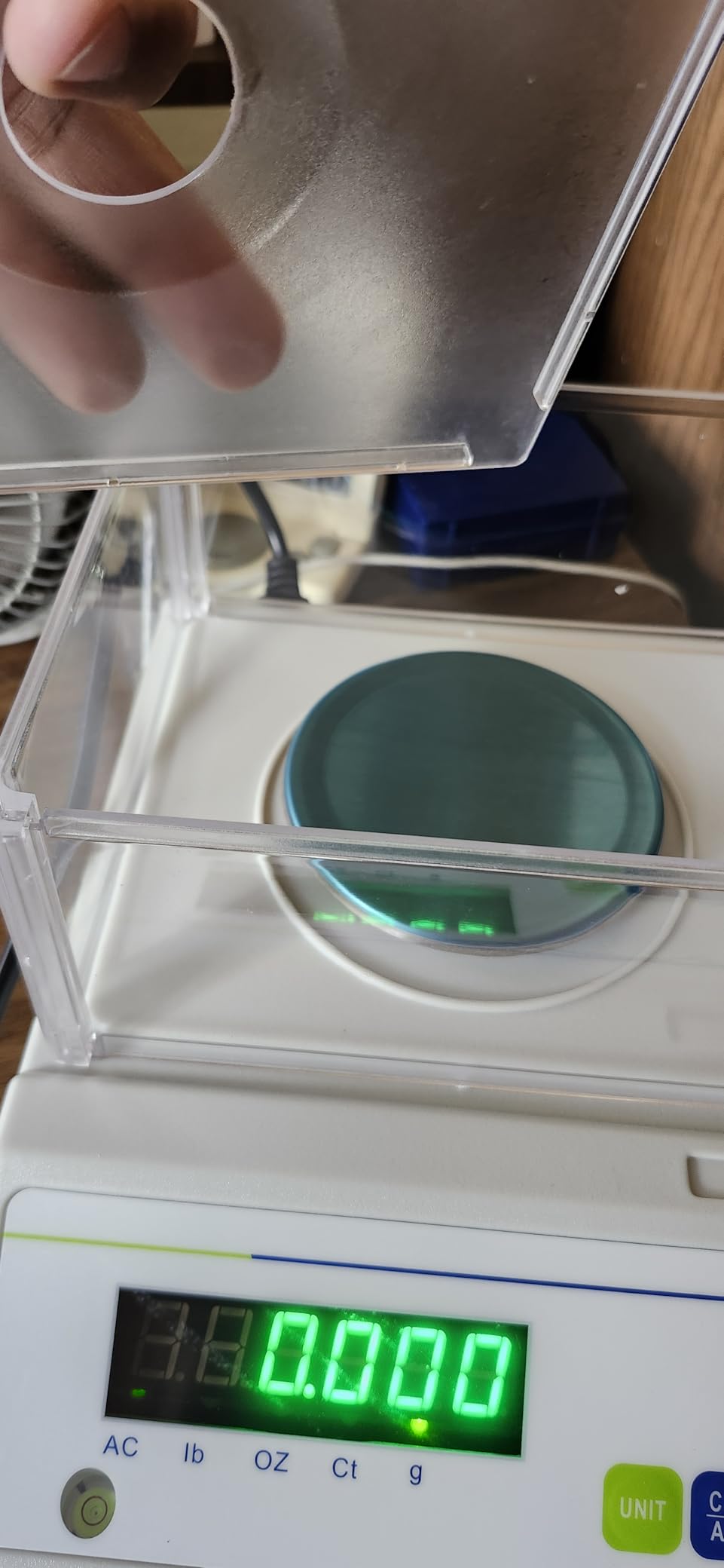
The windshield is credited with meaningfully reducing airflow-related drift, and the adjustable leveling foot makes leveling straightforward. The LED display is readable in dark environments, and tare and counting functions are included along with unit conversion across pounds, ounces, carats and grams.
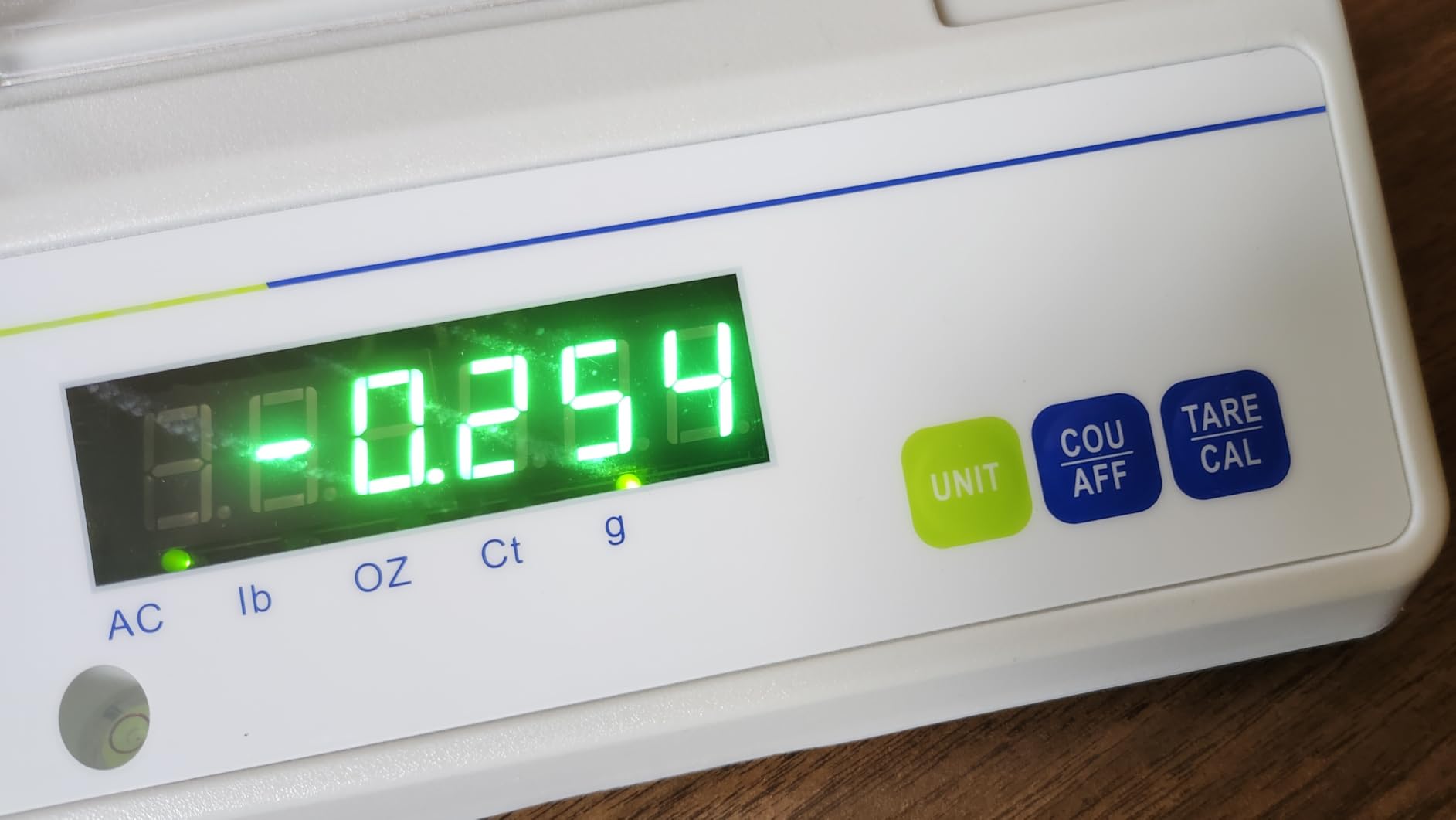
Power is plug-in AC only, and calibration is required before use. With 20 ratings the sample is the smallest in the guide, and the rating distribution includes a 10 percent one-star share, so the picture here is more variable than the headline 4.2 suggests.
What works well in practice
Small home benches where a permanent glass chamber will not fit, and users who want draft protection without a large footprint. The removable windshield is the reason to prefer it over an open-platform milligram balance of similar accuracy, and the published plus or minus 0.003 g tolerance makes verification straightforward with a reference weight.
Owners consistently report consistent readings across repeated measurements once the placement discipline is right, and the bright LED display is a real advantage over an unlit LCD in a dim lab corner.
Where it falls short
Environment sensitivity is the defining weakness. A breeze, an open window or a fan nearby will move the readings, and a verified review reports drift of 3 to 20 mg between identical weighings. That is a placement problem more than a defect, but it means this model only performs in a genuinely calm, stable spot.
It is plug-in only with no battery operation, calibration is manual before use, and the manufacturer requires a stable, clean, non-slip, dry, fire-resistant surface away from direct sunlight and magnetic interference. Display brightness has no adjustment, which is minor but irritating in bright rooms.
12. stigreun 5000g x 0.01g Lab Scale – Heavy Platform, One-Touch Tare
Lab Scale 5000g x 0.01g, High Precision Digital Analytical Balance
5000g x 0.01g accuracy
Backlit LCD with one-touch tare
175 x 155mm platform
Level bubble and feet
Pros
- 5000g capacity with 0.01g resolution covers bulk and fine work
- Clear backlit LCD readable in dim spaces
- Solid heavy build that resists tipping mid-weigh
- Level bubble and adjustable feet ease leveling on uneven benches
- Piece counting verified accurate on small hardware
Cons
- No draft shield or enclosure so readings are exposed to air currents
- One reviewer reported a small calibration offset on arrival
- Instructions are a single poorly written page
- 9V battery not included
A 4.7 rating is high, but with 18 ratings it is the smallest sample in the guide and I would not lean on it heavily. What the owners who did review it consistently praise is the build: a solid, heavy platform that does not shift when you add a sample, plus a backlit LCD that is readable in dim labs or bright kitchens.
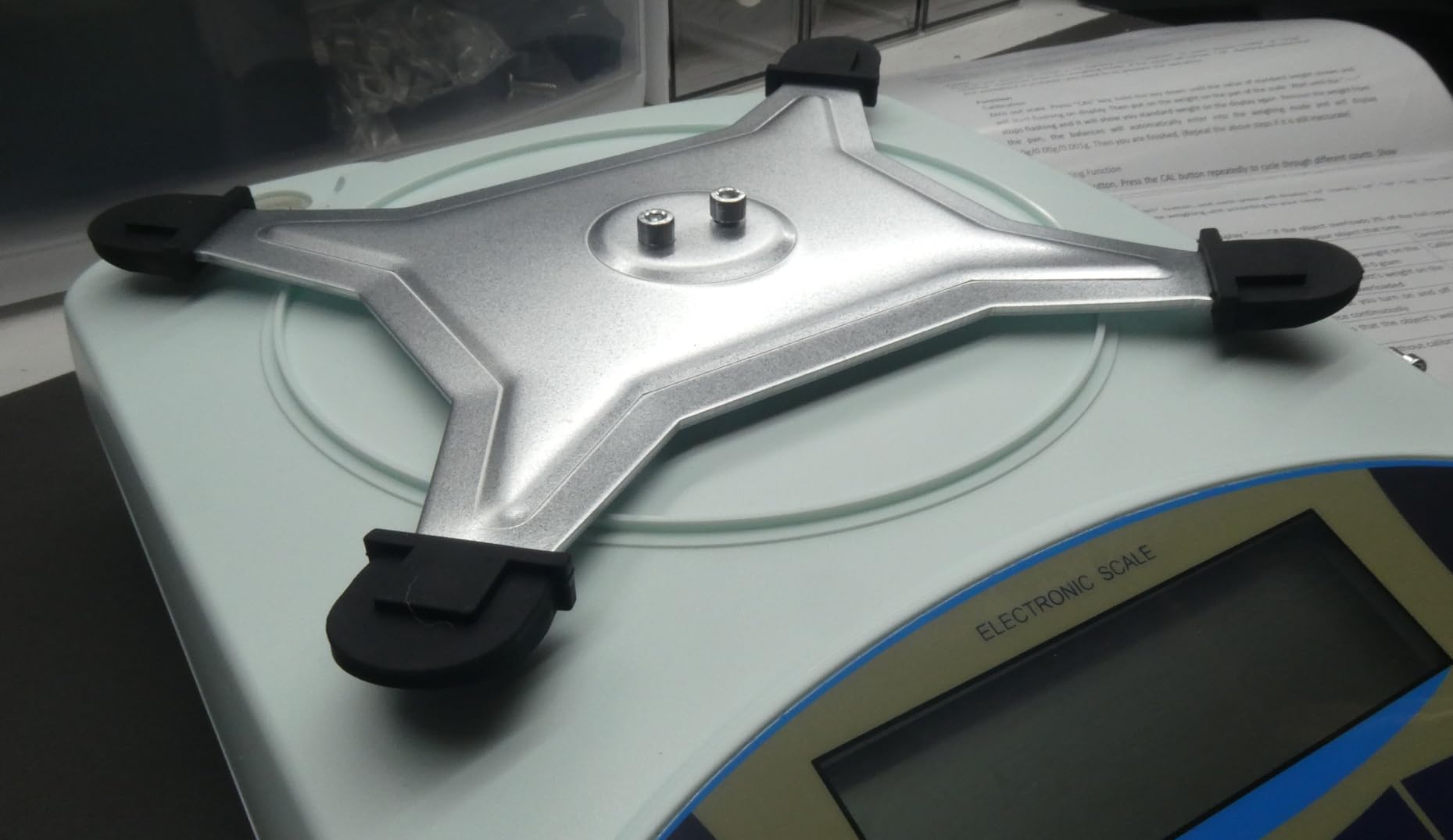
Specification is 5000 g capacity with 0.01 g readout accuracy, which covers both bulk and finer work in one instrument. The corrosion-resistant stainless platform measures 175 x 155 mm and comes with a non-slip mat, and the platform can be reversed to add a rim when you need to contain loose material.
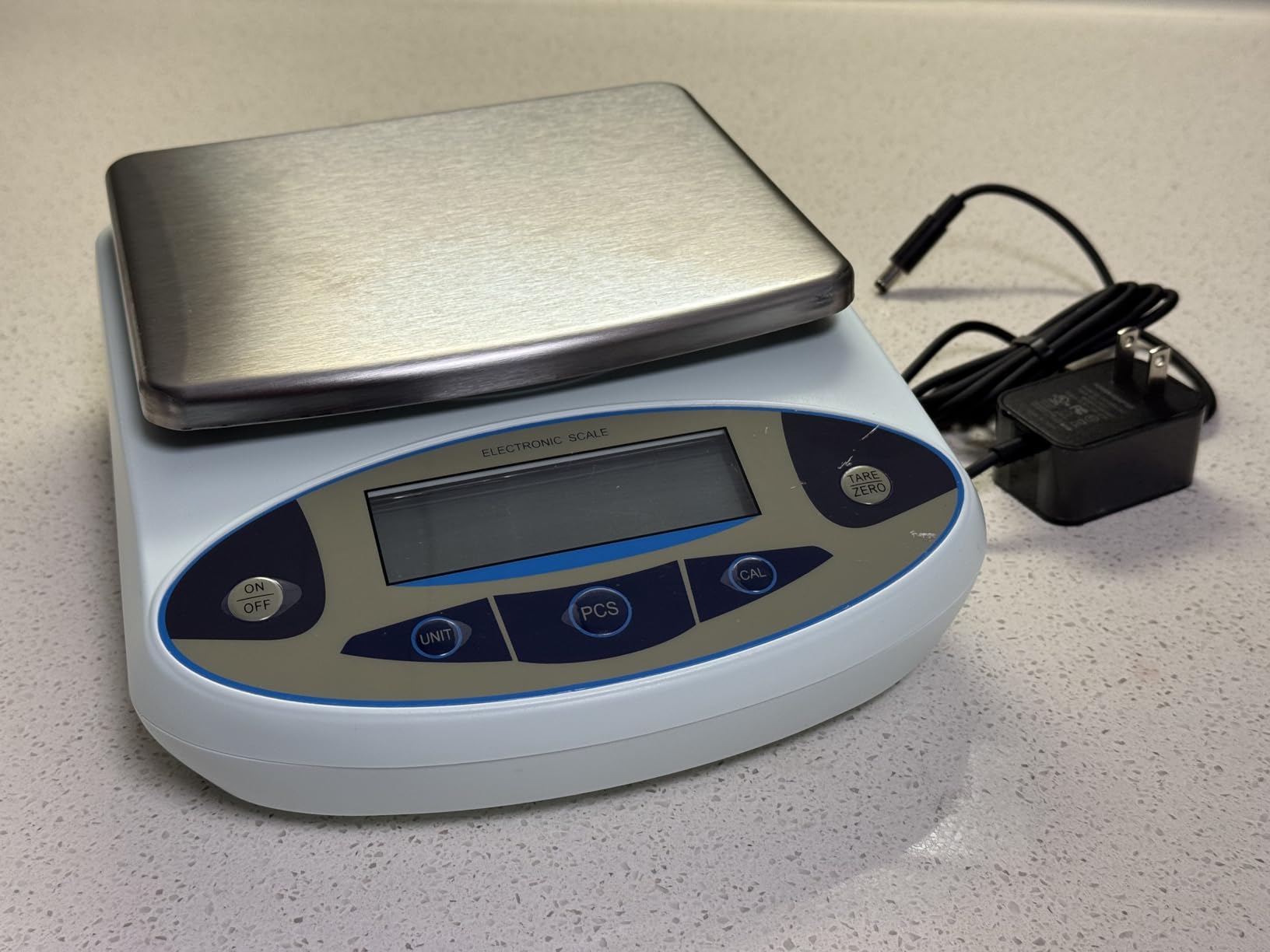
Features include auto-calibration technology with a high-stability sensor, a built-in level bubble, adjustable feet, one-touch tare on a large backlit LCD, 13 unit conversions including grams, carats, ounces, troy ounces, pounds and pennyweight, and a smart piece-counting function. Piece counting is reported as accurate on small hardware. Memory and overload protection are also present.
Power is dual: an AC adapter is included, or a 9V battery which is not. Owners cite the capacity-to-resolution combination, the stable platform and the easy one-touch tare as the main draws for kitchen, jewelry and general tinkering.
What works well in practice
Bench work that involves moving a heavy sample on and off the pan, where a light scale slides or shifts mid-weigh. The heavy build solves that, and the level bubble plus adjustable feet make leveling straightforward on an uneven bench, which is common in a home setup. One-touch tare keeps repeat weighings quick.
For general precision work above 1 g, the combination of 5000 g capacity with 0.01 g resolution is useful, and the reversible platform with a rim is a small touch that helps with loose material.
Where it falls short
There is no draft shield or enclosure, so readings are fully exposed to air currents. On a 0.01 g instrument that is tolerable for most work, but it is the reason this model cannot do milligram work, and it should not be bought for fine powders where a tenth of a milligram matters.
One reviewer reported a small calibration offset on arrival, so verify against a reference weight before trusting early readings. The instructions are a single page and poorly written, and the 9V battery is not included.
Precision vs Analytical vs Top Loading: Do You Really Need 0.1 mg?
Here is the decision most people actually need to make, and the answer is usually not the one the marketing suggests. A top loading balance is built for larger, robust samples and typically reads to whole or fractional grams. A precision balance reads to 0.001 g, or 1 mg. An analytical balance reads to 0.0001 g, or 0.1 mg.
Which is more accurate? In a well-set bench, an analytical balance is the most accurate of the three, because its resolution and its shielding are designed for small masses. In a home room with an open door, that advantage shrinks fast. Air movement moves the pan far more easily at 0.1 mg than at 0.01 g, which is why environment discipline matters more the finer the balance is.
My rule of thumb for a home lab: if your typical sample is under 10 g and you are calculating molarity, yield or stoichiometry, buy a precision balance at 0.001 g. Move up to 0.1 mg only when you are weighing something in the milligram range and the extra resolution changes your answer. Weighing live or moving samples, which home labbers report is common, introduces error far above 0.1 mg anyway, so the finest reading is wasted there.
Also weigh capacity honestly. Two models in this guide reach 0.1 mg but cap out at 120 g and 220 g, so a 200 g sample will not fit. Several of the 0.001 g models carry 500 g, and the 5000 g models cover bulk work at 0.01 g. Capacity and readability are two separate decisions and the balance has to satisfy both.
Calibration: Internal vs External, and What a Certificate Means
Do analytical balances need to be calibrated? Yes, and so does every balance in this guide, but the method differs. External calibration means you place a known reference mass on the pan and adjust the scale to match it. Internal calibration means the balance has a built-in motorised weight it moves on and off the pan by itself, on a schedule or at power-on.
None of the twelve picks here has internal calibration. That is not a defect at this price level, it is a category fact, and it is why a calibration weight matters so much when choosing. Only four of these models ship with weights in the box, so on the other eight you need your own reference mass before the first real weighing.
What calibration weight do you need? Match the working mass as closely as you can, and buy a class E2 weight if you want your checks to mean something. A 50 g class E2 weight is the useful one for a home lab, because it sits in the middle of the range for most 0.001 g balances. Cheap unclassified weights are only good enough to prove the scale switches on.
What does a calibration certificate actually tell you? A useful one names the mass used, the classification of that mass, the as-found and as-left error at each test point, the environmental conditions, and the traceability chain back to a national standard such as NIST. If the certificate only says the balance was calibrated and carries a logo, it tells you very little. A home labber checking a used balance should ask for the certificate before buying and confirm the test points cover the range you will work in.
Periodic external calibration is a real ownership cost that nobody mentions at purchase. A check with a proper weight is inexpensive, a full service visit from a manufacturer is not, and that difference is worth remembering if you are weighing a used purchase against a new one.
How to Place, Level and Test an Analytical Balance in a Home Lab
Placement decides more about your results than the model does. Put the balance on a solid, heavy, level surface away from the edge of a bench, and never on a lightweight folding table or a high shelf. Keep it away from doors, HVAC vents, radiators, windows and direct sunlight, because a draft or a hot lamp will move a fine reading instantly.
Level it every time. Every pick in this guide has either a bubble level or adjustable feet, and that takes under a minute. Then give it the warm-up the manufacturer specifies before you calibrate, because the zero drifts while the sensor and electronics reach temperature. Several models here specify a multi-minute preheat and one asks for two hours.
Calibrate with a reference mass close to your working mass, then close the draft shield fully before reading. If your work involves fine powders, an anti-static mat matters more than most buyers expect, since static cling makes a powder jump onto the pan wall and changes the reading without any airflow involved. A machine that runs constantly nearby, whether it is a kiln, a 3D printer or a pottery wheel, is worth thinking about for the same reason; our home studio pottery wheel guide covers what those setups sound like in a shared room.
Finally, test the accuracy yourself. Place a 50 g class E2 weight on the pan, close the shield, let the reading settle, and record it. Then remove and replace the weight three times and record each result. If the three readings agree within a milligram or two, the balance is behaving as it should. If the spread is wider, the problem is usually environment, centering or leveling rather than a faulty scale, and those are the first things to fix.
If you are still deciding how much of the surrounding room to invest in, our home recovery setup guide covers the adjacent habit-building side of building a dedicated space at home. Bench space, power access and a calm airflow environment matter more to a balance than any accessory you can buy.
Frequently Asked Questions
Which laboratory weighing balance is the best?
For a home lab, the best balance is the one whose capacity and readability match your smallest routine sample. Most home work is served by a precision balance reading to 0.001 g with a 500 g capacity and a draft shield. Choose a true 0.1 mg analytical balance only when milligram-level samples are routine, and keep 5000 g at 0.01 g models for bulk and prep work.
Which is more accurate, analytical balance or top loading balance?
An analytical balance is more accurate, because it reads to 0.0001 g and is built with a shielded weighing chamber, while a top loading balance reads in whole or larger increments and has no enclosure. The gap narrows in a real room, though, because airflow moves a 0.1 mg reading far more easily than a 0.01 g one. Environment discipline can erase the advantage.
Do analytical balances need to be calibrated?
Yes. Every balance needs calibration against a known reference mass, and none of the models in this guide has internal automatic calibration, so you calibrate it yourself. Match the weight to your working mass, a 50 g class E2 weight being the most useful at home, and allow the manufacturer’s warm-up period first. Recalibrate whenever you move the balance or the temperature shifts noticeably.
What are the uses of analytical balances in laboratories?
They are used wherever small masses must be measured precisely: preparing reagents and solutions at known concentration, running analytical chemistry coursework and titrations, checking purity and moisture content, and loss-on-drying work. In a home lab the same uses cover molarity calculations, essential oil and tincture formulation, brewing and fermentation dosing, powder mixing, and precious metal and jewelry work.
How do I choose an analytical balance for a home lab?
Start with your smallest routine sample, because that sets the readability you need, and your largest routine sample, because that sets the capacity. Then check draft protection, whether a calibration weight is included, warm-up time, and whether you need RS232 or USB data output. Finally, confirm the balance can be leveled and placed away from drafts on your actual bench.
Conclusion: The Analytical Balance to Buy for Your Home Lab in 2026
The best analytical balance for most home labs in 2026 is the Bonvoisin 600g x 0.01g scale in position one. It has the deepest owner feedback in the group, a reliable tare and a clear display, and it costs a fraction of what a buyer who never needs 0.1 mg would spend chasing resolution they cannot use.
If your work is bulkier, the 5000 g models cover prep and jewelry work in one instrument. If you genuinely weigh milligram samples, the 500g x 0.001g models with a real draft shield are the right step up, and the 0.1 mg units are for a specific, narrow job. Buy the calibration weight, level the balance every session, and it will keep working for years.