
Video magnifiers are the standard low vision aid for glaucoma, and the models below are the ones we rate highest after comparing screen size, magnification range, colour modes, battery life and glare handling across ten devices. Most buyers in this category start out wanting a cheap handheld unit, discover within a week that a small screen is exhausting to read on, and then wonder whether a large-screen device is worth the jump. This guide answers that question honestly, including where the expensive options genuinely earn their money and where they do not.
A video magnifier, also called a CCTV, electronic or digital magnifier, is a camera and screen in one. You place a document, a prescription label or an object under the camera, the image is enlarged live, and it appears on a built-in or connected display where brightness, contrast and colour can be adjusted to suit your eyes and your lighting.
Glaucoma makes that adjustment more important than it is for many other eye conditions. Glaucoma usually steals peripheral field first, so the centre of what you see stays sharp long after the edges have gone grey. That combination, clear centre plus shrinking edges, is why a magnifier that simply enlarges everything in the middle can still leave you hunting for the line you just lost. We weighed every pick below against that pattern rather than against general low vision criteria alone.
We cover ten devices, from a 3.5 inch pocket reader to two 12 inch screens that sit on a table. Every one is a real retail listing with a real customer review history, and every rating and review count in this guide is copied from that history. Last verified for 2026.
Table of Contents
Top 3 Video Magnifier Picks for Glaucoma Patients in 2026

Eyoyo 3.5 inch Portable
- 2X-25X zoom on 3.5 inch LCD
- 8 color and contrast modes
- Freeze and snapshot
- 4.8 ounces

Eyoyo 5 inch Foldable
- 4X-32X zoom on 5 inch LCD
- 17 color modes
- 4500mAh battery
- Remembers your settings

Koolertron 5 inch
- 5 inch screen with 4X-32X
- Freeze for close inspection
- Built-in stand for signing
- Removable battery
All 10 Video Magnifiers Compared Side by Side
| Product | Specifications | Action |
|---|---|---|
| Eyoyo 3.5 inch Portable Digital Video Magnifier |
|
Check Latest Price |
| Eyoyo 5 inch Portable with Foldable Handle |
|
Check Latest Price |
| Koolertron 5 inch Digital Video Magnifier |
|
Check Latest Price |
 Spolehli 5 inch Portable Reading Aid Spolehli 5 inch Portable Reading Aid |
|
Check Latest Price |
 RayHong 5 inch Auto Focus Reading Aid RayHong 5 inch Auto Focus Reading Aid |
|
Check Latest Price |
 Eschenbach Visolux Digital HD 7 inch Eschenbach Visolux Digital HD 7 inch |
|
Check Latest Price |
 ViSee LVM-500 5 inch Reading Aid ViSee LVM-500 5 inch Reading Aid |
|
Check Latest Price |
 HumanWare explore 5 Video Magnifier HumanWare explore 5 Video Magnifier |
|
Check Latest Price |
 Eschenbach Visolux Digital XL FHD 12 inch Eschenbach Visolux Digital XL FHD 12 inch |
|
Check Latest Price |
 Zoomax Snow 12 Inch Foldable Magnifier Zoomax Snow 12 Inch Foldable Magnifier |
|
Check Latest Price |
The table lists every device in this guide in the order we rank them. The four 5 inch units in the middle all do broadly the same job at a similar size, so the differences that matter between them are battery type, stand design and how many colour modes you get.
Why Glaucoma Patients Need a Different Magnifier Than Macular Degeneration Patients
Glaucoma and macular degeneration both reduce sight, but they damage different parts of the visual field, and that single fact changes which magnifier specifications matter to you.
Macular degeneration attacks the centre. The world around the object you are looking at stays intact while the object itself blurs or distorts, so the fix is to enlarge the centre of the frame and hold the target in the middle. A handheld glass works reasonably well for that job, which is why so much macular degeneration advice stays with optical magnifiers.
Glaucoma takes the periphery. The centre stays usable, sometimes for years, while the usable field narrows toward tunnel vision. Enlarging the centre does not help much if the enlarged image no longer fits inside the part of the field you can see. Three practical consequences follow. You want a wider screen, because a wide screen shows more text inside the narrow field you retain rather than fewer, larger letters. You want a stand or a stable resting position, because dragging a handheld across a page forces you to track movement through the exact visual field that has already deteriorated. And you want good contrast control, because reduced contrast sensitivity is common alongside the field loss.
Glaucoma also brings glare and halos around lights, which many generic low vision guides ignore. A screen with an anti-glare coating is not a cosmetic feature in this context, and neither is the ability to switch to a monochrome or high contrast palette that removes colour fringing entirely.
Do Magnifying Glasses Work for Glaucoma?
Yes, but usually not on their own for sustained reading. A handheld magnifying glass only enlarges whatever sits in the centre of your visual field, and glaucoma takes that centre away gradually. With tunnel vision, you still spend most of your energy hunting for the target rather than reading it.
A video magnifier solves the same problem differently. It captures a wide area, enlarges the part you want electronically, and places that image on a screen positioned directly in front of your eyes, so the enlarged text lands inside the small area of clear vision you still have. That is why low vision specialists usually recommend a video magnifier over a glass for daily reading, and why a handheld glass still has a place for quick spot checks like a price tag in a shop.
Optical magnifiers have not become obsolete, and you can read more about the difference between optical and electronic options in our guide to magnifiers and reticle optics. The short version: a glass gives you nothing but enlargement, while a video magnifier adds adjustable contrast, colour modes, a freeze frame and the option to send the image to a television.
1. Eyoyo 3.5 inch Portable Digital Video Magnifier – Our Pick for First-Time Buyers
Eyoyo 3.5″ Portable Digital Video Magnifier, 2X-25X Zoom Reading Aid White
3.5 inch LCD
2X-25X zoom
8 color modes
4.8 ounces
AV output
Pros
- Smallest and lightest pick here at 4.8 ounces
- Rated 4.6 out of 5 across 425 reviews
- Eight color modes including white on black and yellow on blue
- Freeze and snapshot for holding a line of text still
- AV output for a bigger screen when you want one
Cons
- Short focal depth so it must rest on the page
- Unsuitable for long books or novels
- No auto focus
Best for: anyone starting out, or anyone who needs a magnifier that fits in a shirt pocket and reads labels rather than pages.
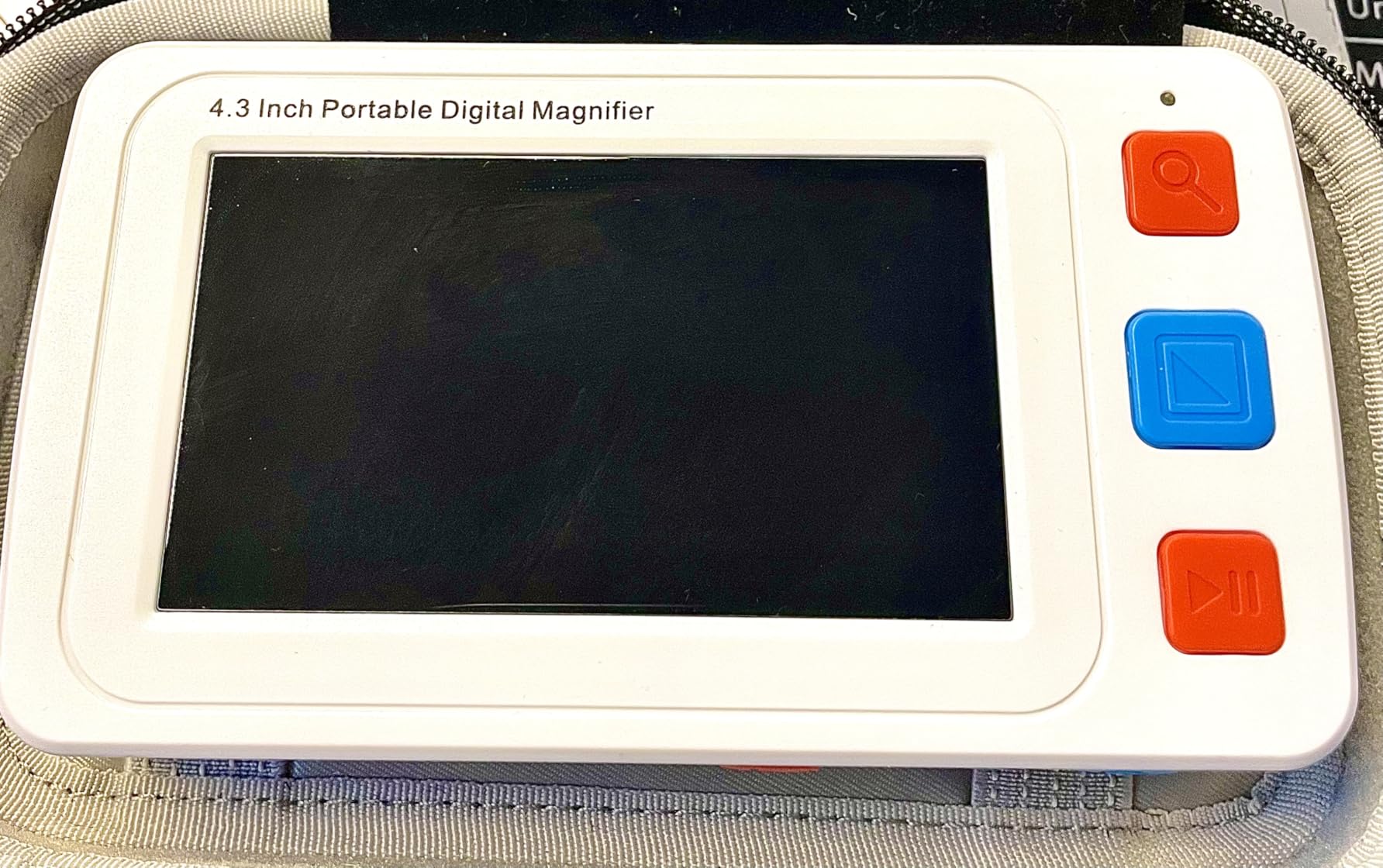
This is the device we hand to people who ask whether a video magnifier is worth buying at all. It weighs 4.8 ounces, runs on AA batteries that are included, and it has been the most reviewed product in this guide with 425 ratings averaging 4.6 out of 5. Buyers with glaucoma, macular degeneration and cataracts consistently report that it restores their ability to read labels, documents and everyday print.
The 3.5 inch screen is genuinely small, and we want to be straight about that rather than let the rating carry the point. It shows a few words at a time. For a mailer, a pharmacy label or a menu, that is exactly right. For a novel, it becomes a chore, and reviewers say so repeatedly.
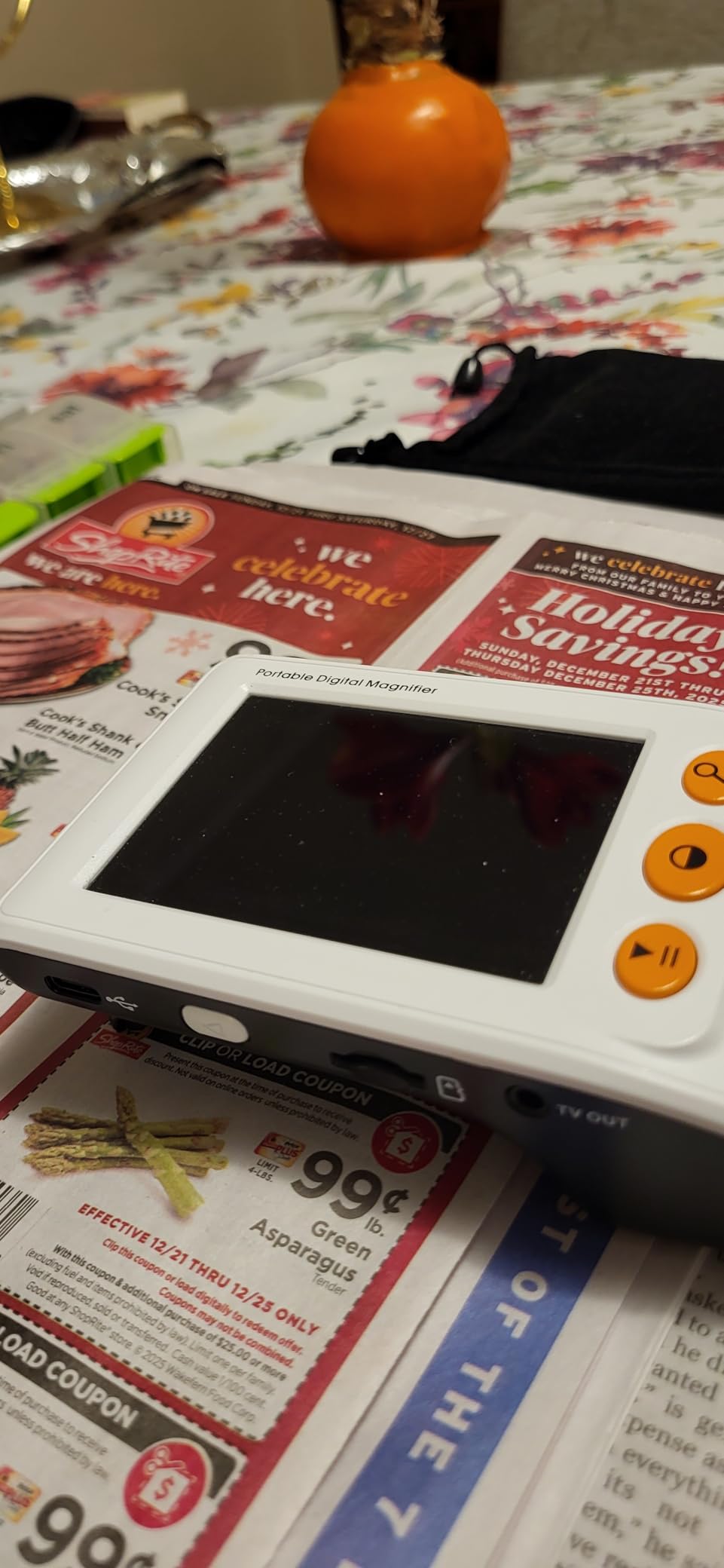
What makes it work as a glaucoma first step is the handling of contrast rather than the magnification ceiling. Among the eight colour modes are white on black, blue on white, white on blue, yellow on blue and blue on yellow, which lets you push a washed out printed label into a legible high contrast version. Magnification runs at stepped levels of 2x, 8x, 16x and 25x.
Two limitations are worth planning around. There is no auto focus and the focal depth is short, so lifting the device off the page blurs the image, which means you hold it down or use the folding bracket flat on a surface. And the small screen makes anything longer than a paragraph a test of patience.
Glaucoma Users Who Should Choose This One
Choose this if your daily list is short and specific: eye-drop bottles, prescription labels, price tags, restaurant menus, phone screens and short notes. The 4.8 ounce body means it goes in a pocket without you thinking about it, which matters more for independence than any specification on the list.
The white on black and yellow on blue modes are the useful ones here. If your contrast sensitivity has dropped along with your field, those modes often make a bigger practical difference than moving from 16x to 25x, and they reduce the glare that a bright white page creates.
Where This Pick Falls Short
It will not carry you through a book, and reviewers are blunt about that. The narrow focal depth also means it must sit on the page rather than hover, so one hand stays occupied and long sessions get tiring.
As a first device it is genuinely hard to argue with. If you find yourself finishing a newspaper article in one sitting rather than four, that tells you the next step is a bigger screen rather than a better brand.
2. Eyoyo 5 inch Portable with Foldable Handle – Best Value
Eyoyo 5″ Portable Digital Video Magnifier, 4X-32X Zoom w/Foldable Handle
5 inch LCD
4X-32X zoom
17 color modes
4500mAh battery
6.06 inch wide
Pros
- Larger 5 inch screen than most budget magnifiers
- 17 color modes and 5 brightness levels
- 4500mAh battery gives 4+ hours of continuous use
- Remembers your settings between sessions
- AV output to a television
Cons
- Must sit on the page to stay in focus
- Some owners report battery charging problems after a year or two
- Printed instructions are hard to read
Best for: daily reading on a budget, especially prescription paperwork and mail.
This is the pick we recommend to about half the people who ask us, and the 290 reviews averaging 4.0 out of 5 explain why. It does nearly everything the larger desktop readers do at a fraction of the cost, and owners regularly describe it as performing close to far more expensive desktop CCTV units.
The jump from the 3.5 inch model is meaningful rather than cosmetic. You get a 5 inch LCD, 4x to 32x zoom, 17 colour modes with 5 brightness levels, and a 4500mAh rechargeable battery that gives more than four hours of continuous operation. It also remembers your preferred settings, so you are not re-adjusting contrast every time you pick it up.
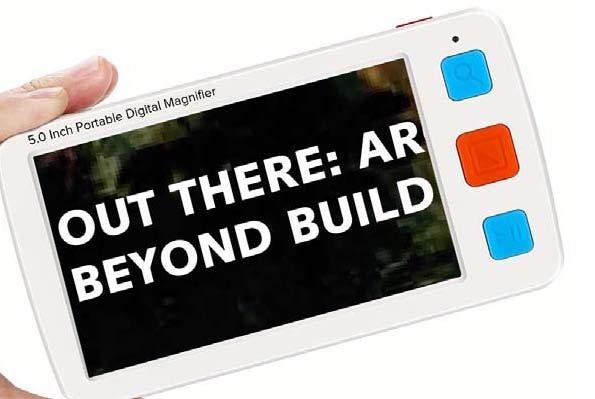
For glaucoma specifically, the settings memory and the wide colour palette both matter. With reduced contrast sensitivity, the right palette is personal and non-obvious, and having the device recall it removes a daily frustration that most cheaper models create.
The honest complaints are the same two that appear across most handheld magnifiers: a narrow depth of field that means you keep the lens on the page, and battery longevity, with a number of owners reporting charging problems after a year or two of use. The printed instructions also draw criticism, which is common in this category and worth knowing before you order.
Glaucoma Users Who Should Choose This One
This is the one to buy if you read a lot of mail, statements and prescription information and you want a device you can leave on the table with a foldable handle. A stand position keeps the image steady without you holding anything, which is the single biggest comfort change for someone with tunnel vision.
The 17 colour modes give you room to experiment. Try black on white first, then yellow on black, then the monochrome options, and give each a few days before ruling it out. Glaucoma patients who have halos around lights often find that dropping to a monochrome mode removes more frustration than lowering brightness does.
Where This Pick Falls Short
Four hours of battery is an average figure, and running the screen bright eats into it, so it will not comfortably cover a full day of heavy use away from a charger. If you plan to use it at a clinic appointment or on a long trip, charge it the night before.
At 32x on a 5 inch screen you are still reading a few words at a time. That is fine for forms and labels. It is not the answer if your goal is a comfortable magazine article.
3. Koolertron 5 inch Digital Video Magnifier – Most Versatile
Koolertron 5″ Digital Video Magnifier, Portable Reading Aid (5 inch, Black)
5 inch screen
4X to 32X steps
Freeze function
Removable 2500mAh battery
8.11 ounces
Pros
- Built-in stand lets you sign your name while viewing the screen
- Adjustable background colors for different vision conditions
- Removable 2500mAh battery rated for 4 hours
- Sturdy build with a protective storage pouch
- Flashlight function for dim environments
Cons
- Only a few words visible even at 4X
- Photo buttons on the base trigger beeps when touched
- Some owners report battery no longer holding a charge
Best for: signing forms, writing checks and anything that needs your pen and your eye at the same time.
The 152 ratings averaging 4.4 out of 5 make this the third most well reviewed pick in the guide, and the reason buyers single it out is unusual. The built-in stand and handle let the unit sit on a document while you write underneath it, which almost no other magnifier in this price range allows.
That matters more than it sounds. A signature, a cheque, a prescription label you need to record, a form you must fill in rather than just read, all of them need a hand free. A foldable bracket, a removable 2500mAh battery with a four hour runtime, a memory function that recalls your habits, and photo capture with HD storage round out a well judged feature list.
Reviewers frequently describe buying this for a parent with glaucoma or advanced low vision and calling it life changing for reading labels and small print. Brightness, the adjustable background colours and the value against desktop CCTV readers come up again and again in the positive reviews.
The complaints are specific rather than general. Even at 4x only a few words fit on screen, so book reading means constant movement. The photo buttons on the base are sensitive enough to trigger beeps and a missing memory card message when you brush them. And a number of owners report that the battery stopped holding a charge after a period of use, so treat the removable cell as a consumable you may replace.
Glaucoma Users Who Should Choose This One
Pick this if paperwork is a bigger part of your day than reading for pleasure. The stand is the differentiator: you can write while the text is enlarged and steady, which removes the most common reason people give up on a handheld device.
Adjustable background colours let you match the screen to the paper in front of you, which reduces the shadow and glare that a white page throws onto a bright screen. That matters when contrast sensitivity is reduced.
Where This Pick Falls Short
The narrow reading field is the real limit. Owners of this device often note that it performs like models costing several hundred dollars more for label reading, but for sustained text you are moving the page constantly.
The base buttons are also an irritation for anyone with tremor or reduced fine motor control, which is worth checking against your own hands before ordering.
4. Spolehli 5 inch Portable Reading Aid – Best for Short Tasks
Spolehli 5.0 Inch Portable Digital Magnifier, 4X-32X Zoom Electronic Reading Aid with Foldable Handle for Low Vision/Seniors/Kids, Ideal for Quick Reading – Not Recommended for Long Books or Novels
5 inch LCD
4X-32X zoom
17 color modes
4+ hour battery
Foldable handle
Pros
- 5 inch screen is larger than most entry level magnifiers
- 17 color modes and 5 brightness levels
- Light enough for restaurant and pharmacy use
- Handles labels
- maps and price tags well
Cons
- Shows only a few words at a time
- Image distorts badly when lifted off the page
- Review ratings trend close to average
Best for: short tasks on a tight budget, and for anyone who wants a second device for the kitchen or the car.
The 51 ratings averaging 3.9 out of 5 sit at the lower end of this list, and we would rather explain that than skip past it. This is a straightforward 5 inch reader with 4x to 32x zoom, 17 colour modes, 5 brightness levels, an external battery lasting more than four hours and a foldable handle, and the 3.9 rating reflects a device that does its stated job without excelling at it.
There is something refreshing about a product whose listing warns buyers away from a use case. The title explicitly says it is not recommended for long books or novels, and the 51 reviews confirm that accuracy: it is a spot reading aid. Prescription labels, maps, menus, price tags and short print, yes. Sustained reading, no.
The image also distorts significantly if you lift it off the page, so it works as a document reader rather than a camera you hold at a distance. Memory function, photo capture and replay, and TF card support up to 32GB are included.
Glaucoma Users Who Should Choose This One
Buy this if you need a dedicated device for short label reading without spending serious money. The foldable handle makes it easy to keep on a counter and pick up with one hand, and 17 colour modes give you room to find a palette that fights glare and washed out print.
For a glaucoma patient whose main frustration is a specific task rather than general reading, a cheaper dedicated device is often a better decision than an expensive one you do not use.
Where This Pick Falls Short
It will not read a page. Reviewers consistently describe moving the device across the text and losing the thread, and the rating itself tells you the experience is adequate rather than pleasant.
If your vision is still deteriorating, a device you will grow out of within a year is a poor investment. Consider a model with a replaceable battery and a wider screen instead.
5. RayHong 5 inch Auto Focus Reading Aid – Best for Ease of Use
5 Inch Low Vision Aids, Electronic Auto Focus Reading Aid Simplified Buttons Digital Video Magnifier for The Visually Impaired, Low Vision, Color Blindness, Amblyopia
5 inch screen
2X-32X with auto focus
800x480 HD LCD
Simplified buttons
270 g
Pros
- Simplified button layout suits older users and children
- Auto focus removes the biggest frustration of cheaper models
- Integrated folding bracket rests the unit at an angle
- Handle can be configured for either hand
- 800x480 HD LCD with DSP image processing
Cons
- Small review base with a noticeable share of one-star feedback
- Few owners mention a hands-free or larger-screen alternative
Best for: anyone whose hands or eyes make fiddly controls difficult, including people with tremor.
Almost every complaint we read about handheld magnifiers is about controls or focus, and this is the one in the guide built specifically to fix both. The 32 ratings average 3.9 out of 5, split between 50 percent five-star and 15 percent one-star, so the sample is small and mixed. Read that as a device with a genuinely good idea behind it and a limited track record.
Three things stand out. The button layout is simplified deliberately, for elderly users and for children with amblyopia. There is auto focus, which removes the constant hovering problem that frustrates people on cheaper handhelds. And the integrated folding bracket lets the unit rest on a page at an angle so you are not hunching over it, with a handle that can be configured for either hand.
The screen is an 800×480 HD colour LCD with DSP image processing, which reduces distortion and helps over longer sessions. Magnification runs 2x to 32x, a memory function recalls your habits, and the included cable connects to a television or a computer.
The enthusiasm in the reviews comes from owners using it for grocery shopping, menus, magazines and books, and the most common note is that the controls are the standout feature. The reservations are about the small sample and about owners wishing for a hands-free or larger-screen option.
Glaucoma Users Who Should Choose This One
Choose this if you are buying for someone else. A parent with glaucoma, a spouse with reduced hand control or a child with amblyopia, the simplified buttons and auto focus remove two of the three most common reasons these devices end up unused in a drawer.
The angled folding bracket is also quietly important for tunnel vision, because it puts the enlarged image directly in front of the eye rather than below the line of sight where you have to look down to find it.
Where This Pick Falls Short
The 32 reviews are too few to be confident about long term reliability, and a visible share of one-star feedback means you are taking a small bet. The 800×480 panel is also lower resolution than the larger screens in this guide.
It remains a 5 inch screen, so the reading field problem from picks three and four still applies.
6. Eschenbach Visolux Digital HD 7 inch – Best for Glare Sensitivity
Eschenbach Visolux Digital HD – 7″ Portable Video Magnifier – Macular Degeneration
7 inch 1024x600 LCD
Anti-glare coating
2X-22X magnification
Tactile buttons
0.5 kg
Pros
- Anti-glare coated 7 inch screen stays comfortable with glare and halos
- Large tactile buttons work without fine motor control
- 1024x600 panel is sharp for the size
- Zippered crush-proof case included
- Well regarded by low vision clinics
Cons
- On-board settings menu is hard to read
- Charge indicator light is ambiguous for color-blind users
- Printed manual is unusable for low vision readers
Best for: glaucoma patients who see halos around lights and who need tactile controls rather than a touchscreen.
This is the first device in the guide with an anti-glare coating, and in a condition where halos around lights and glare sensitivity are common, that specification deserves more weight than it gets in general low vision guides. The 7 inch 1024×600 LCD, 2x to 22x magnification and large tactile buttons sit on a body weighing half a kilogram, with a zippered crush-proof case in the box.
The 28 ratings average 3.8 out of 5. Owners and family members generally praise the screen quality, the tactile controls and the portability, and several mention that a low vision clinic recommended the device, which is a meaningful trust signal in this category.
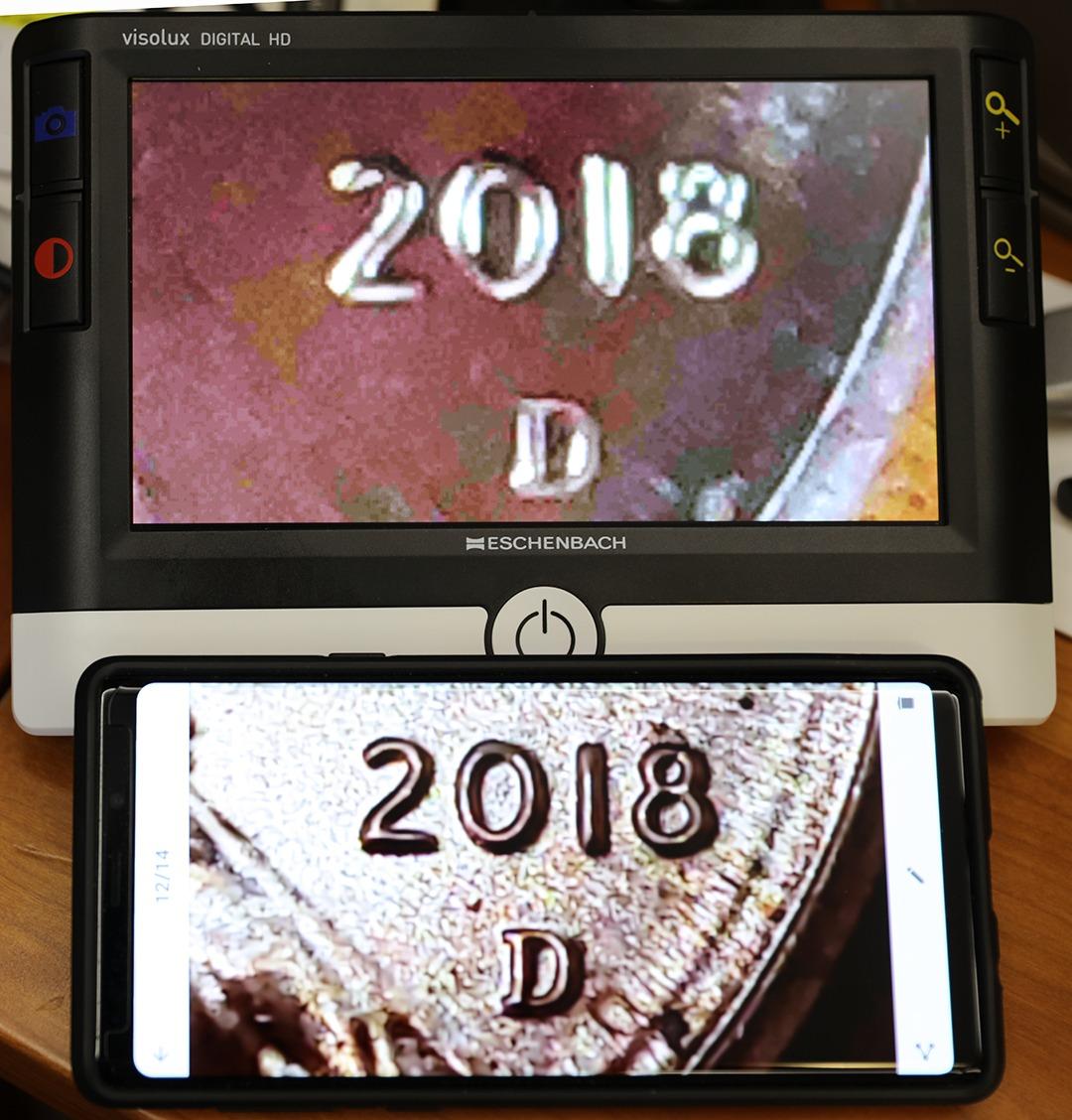
What the reviews criticise is the interface rather than the optics. The on-board settings menu is hard to read, the palette control does not change the menu icons, and the battery charge indicator uses a red and green light that is ambiguous for colour-blind users. The printed manual is described as essentially unusable for the very people who need it.
One detailed review also questions whether the 22x figure delivers meaningfully better results than a modern phone camera at lower zoom, and that criticism is fair given the digital zoom is working from a relatively low resolution sensor.
Glaucoma Users Who Should Choose This One
Choose this if glare is the symptom that bothers you most. The anti-glare coating on a seven inch screen is the reason it earns that place, and the tactile buttons can be identified by feel, which helps if you have tremor or reduced fine motor control.
Seven inches is also the first size in this guide where sustained reading starts to feel practical, and at half a kilogram it is still genuinely portable between rooms.
Where This Pick Falls Short
The interface is the problem. A device that requires you to read a small on-board menu to adjust contrast is working against you at exactly the moment your vision is least cooperative, and the manual will not rescue you.
It also costs several times more than the picks above without offering higher magnification, so you are paying for the screen size, the coating and the build rather than for power.
7. ViSee LVM-500 5 inch Reading Aid – Best for Connectivity
ViSee LVM-500 Portable Video Magnifier Reading Aide for Low Vision with 5 Inch Monitor and 15 Color Modes
5 inch HD LCD
Dual near and far cameras
4X-32X continuous zoom
15 color modes
HDMI 1080i60
Pros
- Dual cameras handle both near documents and distance viewing
- AV and HDMI 1080i60 output to a television
- Electronic curtain highlights text and cuts light interference
- Rechargeable battery with 4 hours of use
- Voice prompts and image transfer to a computer
Cons
- 5 inch screen is too small for the 32X range
- Far focus mode has limited practical usefulness
- Awkward power control
Best for: anyone who wants to send the magnified image to a television or a computer as well as view it on the built-in screen.
The LVM-500 is the only device in this guide with a genuine dual camera design, one for near viewing of documents and one for far viewing of a whiteboard, a face or a room. It also has the most complete output options: AV and HDMI 1080i60 television output, image capture, save, recall and transfer to a computer, plus voice prompts and music playback.
Its 26 ratings average 3.6 out of 5, the lowest in the group, with 34 percent five-star. We are including it because two features are genuinely useful for glaucoma patients and are missing elsewhere: the electronic curtain, which masks everything except a moving window of text and cuts the light interference that makes reading harder, and the HDMI output, which lets a family share a magnified view on a large screen.
Owners who find the sweet spot praise the clear optics, the light 8.5 ounce body and the long battery life, and describe the independence it gives a legally blind user. The recurring complaint is the mismatch between a 5 inch screen and a 4x to 32x zoom range, which produces word by word reading of magazines and newspapers, and at least one buyer returned the device for exactly that reason.
Glaucoma Users Who Should Choose This One
Choose this if you share your reading. HDMI output at 1080i60 means a modest 5 inch device can drive a television across the room, and a large screen shows a wide field of text, which is precisely what tunnel vision requires.
The electronic curtain is the quiet hero. Blocking out the surrounding page and lighting removes the glare wash that reduced contrast sensitivity makes so uncomfortable, and no other unit in this guide has that function.
Where This Pick Falls Short
The screen and zoom range are badly matched, and the reviews do not soften that. If you buy this, keep the magnification at the lower end where a useful number of words fits, and use the television output for anything longer.
The power control is awkward to operate and the far focus mode is of limited practical use, which undercuts the dual camera advantage somewhat.
8. HumanWare explore 5 Video Magnifier – Best for Pocket Spot Reading
HumanWare explorē 5 Video Magnifier for Low Vision
5 inch screen
HD autofocus camera
2X-22X
18+ contrast modes
Pocket-size body
Pros
- Autofocus keeps letters straight without distortion
- Angled mount gives a natural reading position
- Pocket-size body for spot reading on the move
- 18+ contrast enhancement modes
- TV connection for shared viewing
Cons
- Some units failed early and needed paid repair
- Customer service attributed failures to user error
- 3 hour battery is short for the price
Best for: quick checks on the move, and for anyone who wants a recognised low vision brand in a pocket-sized body.
HumanWare is one of the most established names in low vision equipment, and the explore 5 brings that pedigree down to a 5 inch device weighing 0.23 kg. It uses a 5 inch screen with an HD autofocus camera, 2x to 22x magnification, more than 18 contrast enhancement modes, and a body that works handheld, with the folding handle open, or flat on a table.
The 26 ratings average 3.7 out of 5 with 44 percent five-star. Users who receive a working unit generally like the autofocus, which keeps letters straight without distortion, and the angled mount, which produces a more natural reading position than a flat handheld.
Reliability is the central issue in the reviews, and it is not a small one. Several owners report the unit going dark within the trial period or after modest use, and while the repair service itself is described as responsive, the initial damage assessment attributed failures to user error, which owners found unhelpful. One buyer received a previously opened, fingerprinted device.
The 3 hour battery is also short for a device at this price, and the built-in gallery for up to 1,000 images plus the TV connection are useful features that the reliability record undermines.
Glaucoma Users Who Should Choose This One
Choose this if pocket size matters more than screen size. At 0.23 kg it is the lightest proper magnifier in the guide, and the autofocus means you can pick it up, look, put it away, without finding a resting position first.
The 18 or more contrast enhancement modes give you the widest palette of any 5 inch device here, which is valuable when reduced contrast sensitivity means the most useful setting is not the obvious one.
Where This Pick Falls Short
The failure reports are the deciding factor. Paying for a repair after a short ownership period erases any advantage over the picks in the first half of this guide, and the support experience described in reviews does not soften it.
Three hours of battery also means it is a spot reading device rather than an all day companion, so plan charging around longer sessions.
9. Eschenbach Visolux Digital XL FHD 12 inch – Best for a Wide Text Field
Eschenbach Visolux Digital XL FHD – 12 Inch Color HD Portable Video Magnifier
12 inch color HD LCD
2X-22X magnification
Battery powered
3.1 pounds
Microfiber cloth included
Pros
- 12 inch panel shows a much wider area of text than 5 inch models
- Color HD screen suits users who cannot tolerate monochrome modes
- Eschenbach is a long established low vision brand
- Sold through an authorized dealer with a cloth included
Cons
- Most expensive device in the guide
- Bulky 12 inch footprint and 3.1 pound weight limit portability
- Maximum magnification is still only 22X
Best for: reading at home, at a table, for hours at a time, when you want a wide field of text in one view.
Everything about this device follows from one decision: a 12 inch colour HD LCD. Magnification runs 2x to 22x, the same ceiling as much smaller units, but the panel itself is more than three times the area, which means a much wider slice of a page is visible at any given setting. For tunnel vision, that width is the point. You are not making letters bigger, you are fitting more of them inside the field you can still see.
The 21 ratings average 3.8 out of 5 with 51 percent five-star. With so few reviews the feedback is limited, but the ratings cluster around the mid threes, suggesting owners who need the wide field find it worthwhile while weighing it against the cost.
Owners specifically appreciate the colour HD screen, which suits users who cannot tolerate the monochrome contrast modes that help some people and bother others. The brand is also a long established name in low vision equipment, and the unit is sold through an authorized dealer with a microfiber cloth included.
The trade-offs are straightforward. This is the most expensive device in the guide by a wide margin, it weighs 3.1 pounds, and a 12 inch footprint is a desk commitment rather than a portable one. Battery powered, so plan around a charging point.
Glaucoma Users Who Should Choose This One
Choose this if reading is something you do daily and want to do comfortably, rather than something you manage in short bursts. Newspapers, magazines, mail and long documents are the use cases the panel size was built for, and reviews specifically mention newspapers and magazines.
Colour rather than monochrome matters here if monochrome modes make your vision worse rather than better, which is a real possibility with certain glaucoma profiles. Confirm with your low vision optometrist before committing to either approach.
Where This Pick Falls Short
You are paying for screen area, not magnification. If your priority is reading very small print on a pill bottle rather than following a paragraph, a smaller device does that job at a fraction of the cost.
At 3.1 pounds and 12 inches across, this is a home device. It is not going in a handbag, and moving it between rooms is a two handed operation.
10. Zoomax Snow 12 Inch Foldable Magnifier – Best for Text-to-Speech
Snow 12 Inch Foldable Portable Video Magnifier by Zoomax with OCR for Low Vision & Reading Assistance – HD Display, 19x Magnification, Text-to-Speech, & 20+ Language Support
12 inch HD display
19X magnification
OCR in 20+ languages
Foldable stand
4.97 kg
Pros
- Only device in the guide with optical character recognition
- Text-to-speech supports 20+ languages
- Large 12 inch display suits newspapers and magazines
- Foldable stand gives multiple viewing angles
- Caregivers describe it as easy to learn
Cons
- Does not show a full letter-size page at once
- OCR misreads numbers including prescription numbers
- Nearly 5 kg limits handheld use
Best for: anyone who wants the device to read documents aloud as well as show them enlarged.
This is the only device in our list with optical character recognition and text-to-speech, and it supports more than 20 languages. For a glaucoma patient whose reading endurance is limited, hearing a document read aloud is a different route to the same content, and reviewers caring for a spouse or parent with advanced vision loss describe the device as a lifeline for newspapers, magazines and mail.
The hardware is a 12 inch HD display at 19x magnification with an advanced HD camera, a foldable stand that allows several viewing angles, and adjustable colour and contrast. The stand is the important part for daily use, because it holds the screen steady at a readable angle rather than in your hand.
The 19 ratings average 3.9 out of 5 with 49 percent five-star. The weaknesses are specific and worth knowing. The screen does not display a full letter-size page at once, so documents still have to be moved or rescanned. OCR misreads numbers, including prescription numbers, turning them into long strings of text, and some users found speech-to-text accuracy disappointing.
The device weighs nearly 5 kg, which makes comfortable handheld use unrealistic despite the portable label, and one owner reported a 30 day warranty with a screen defect arriving shortly after purchase. Customer service itself is described as excellent by several reviewers.
Glaucoma Users Who Should Choose This One
Choose this if the words are the barrier, not the size of the words. A 12 inch panel plus a foldable stand covers the tunnel vision problem of fitting text into a narrow field, and the text-to-speech covers the endurance problem.
It is also the pick we would suggest to a caregiver buying for someone with deteriorating vision, since the reviews describe it as easy to learn and the audible output gives a second way to access the same document.
Where This Pick Falls Short
Do not rely on the OCR for anything numeric. Prescription numbers, phone numbers and account references are exactly the content it gets wrong, which makes it a poor tool for the eye-drop and medication labels discussed below.
At nearly 5 kg it is a table device, and a reported 30 day warranty is short for a purchase of this size. Check the current warranty terms with the seller before you order.
Reading Eye-Drop Bottles and Prescription Labels
If you have glaucoma, you read small print several times a day that most people never look at: the label on your eye-drop bottle, the dosage instructions, the pharmacy slip, the date on a new box. It is unglamorous, and it is the task most likely to make you feel helpless on a bad day.
For this specific job, four things matter more than raw magnification. Near viewing with the camera close to the object, a colour mode that lifts faint grey print into high contrast, a freeze frame so the text stays put while you read it, and the ability to sit the device flat so both hands are free.
On that basis our picks are the Koolertron 5 inch, whose built-in stand holds the page steady while you read and write, the ViSee LVM-500 for its electronic curtain that masks everything except a window of text, and the Eyoyo models for their colour palettes and snapshot functions. Whichever you choose, test it on your actual bottles first.
One caution. OCR and text-to-speech features, including the ones on our last pick, are not reliable on numeric content. Prescription numbers are among the worst cases, so always confirm a dosage number visually against the printed label rather than trusting the spoken version.
How to Choose a Video Magnifier for Glaucoma: 7 Factors
1. Screen size, and why width beats zoom
For glaucoma specifically, a wider screen at lower magnification is usually more useful than a smaller screen at higher magnification. A 12 inch panel showing 22x shows far more of a page than a 5 inch panel at 32x, and more text inside a narrow visual field is the thing that actually matters. Three and a half inch screens are fine for labels and frustrating for anything longer.
2. Magnification range, and what the numbers mean
Typical handheld units here run 2x to 32x, with stepped levels rather than smooth zoom on the cheaper models. Desktop and large-screen units usually top out around 22x, which looks lower but sits on a much bigger panel. Judge the device on how much text fits at 4x to 8x, not on its headline maximum.
3. Colour and contrast modes
Every device in this guide offers multiple modes, and the number ranges from 8 on the 3.5 inch Eyoyo to 18 or more on the HumanWare explore 5. Black text on a white background is the default that most people try first. Yellow on black, white on black and monochrome options often work better for reduced contrast sensitivity and for glare. Give each mode several days before deciding.
4. Anti-glare and glare management
Only the Eschenbach Visolux Digital HD in this guide has an anti-glare coating on its screen, and for a glaucoma patient who sees halos around lights that is a decisive feature rather than a nicety. On other devices, the practical substitute is dropping brightness and switching to a monochrome or yellow on black palette, which removes colour fringing altogether.
5. Portability, weight and how you will hold it
Weights in this guide run from 4.8 ounces on the 3.5 inch Eyoyo to nearly 5 kg on the Zoomax Snow 12. A device you cannot comfortably hold will not get used, and a handheld device that must rest on the page uses one hand permanently. Folding handles and folding brackets are the feature to prioritise for long sessions.
6. Connectivity and television output
Every device here outputs to a television via AV, and the ViSee LVM-500 adds HDMI at 1080i60. This is often the cheapest route to a bigger image: a moderate portable unit plus a television you may already own can beat a dedicated large screen. A larger screen at a comfortable viewing distance does more for tunnel vision than extra magnification.
7. Battery reality
Advertised runtimes in this guide are three to four hours. Real use at high brightness runs roughly a fifth shorter, so a four hour claim is closer to three in your hands. Any device with a removable battery is easier to live with than a sealed one, and the Koolertron’s removable cell is a genuine advantage given the battery degradation reported in its reviews.
How to Try a Magnifier Before You Buy
The single most repeated piece of advice from people who have bought these devices is simple: do not commit to a large-screen model blind. Start with a 4 or 5 inch unit, learn what magnification and colour mode your eyes prefer, and only then decide whether the step up is worth it.
Four routes make that easier. Specialist low vision agencies commonly offer free, no obligation in home evaluations where a practitioner brings devices out and tests them against your actual reading tasks. State vocational rehabilitation agencies sometimes operate loan programmes for assistive technology, and they are free. Retail return windows let you live with a device for a few weeks, which is long enough to discover that a small screen frustrates you. And many public libraries carry demonstration magnifiers you can borrow and handle before spending anything.
Whichever route you use, test with your own material: a letter, a medication label, a photograph, and something in poor light.
How to Pay for a Video Magnifier: Funding Routes
We would rather tell you this plainly than let you find out at the checkout. Medicare Parts A and B generally do not cover video magnifiers as durable medical equipment, so in most cases you are paying out of pocket.
There are four routes worth exhausting before you do. A state vocational rehabilitation agency can fund or loan assistive technology for people whose vision loss affects their ability to work, and eligibility is broader than employment alone. Some state disability services programmes and Medicaid programmes assist with assistive devices, though coverage varies significantly by state. Many sellers offer financing plans, and a few non profit low vision organisations hold loaner devices. Discount programmes for state vocational rehabilitation clients are also worth asking every seller about, because the most established brands in this guide participate.
Ask for the discount in writing before you order, and confirm whether it stacks with any state funding you already receive.
Medical disclaimer: this guide covers assistive devices only and is not medical advice. Glaucoma management, including drops, laser and surgical options, belongs with your ophthalmologist, and magnification choices should be validated with a low vision optometrist who can assess your field of view, contrast sensitivity and glare response in person. No magnifier slows, stops or reverses glaucoma.
Frequently Asked Questions
Are magnifying glasses suitable for people with glaucoma?
Yes, but usually not on their own for sustained reading. A handheld glass only enlarges what sits in the centre of your visual field, and glaucoma takes that centre away gradually, so you still spend most of your effort hunting for the target. A video magnifier places the enlarged image on a screen directly in front of your eyes, inside the area of clear vision you still have.
What is the best video magnifier for people with low vision?
There is no single best device, because the answer depends on screen size, portability and how much magnification you need. For overall value the Eyoyo 3.5 inch is the easiest place to start. For a portable unit you can read on, the Eyoyo 5 inch with its foldable handle. For a wide text field at a table, the Eschenbach Visolux Digital XL FHD 12 inch.
What are some good electronic magnifiers for people with low vision?
The recurring brand families in this category are Eschenbach, HumanWare, Zoomax, ClearView and CloverBook, alongside smaller brands such as Eyoyo, Koolertron and ViSee. Eschenbach and HumanWare are the most established clinical names, Zoomax leads on large screens with text-to-speech, and the smaller brands cover the budget portable tier.
How much magnification do I need for glaucoma?
Most daily reading tasks are handled between 4x and 12x on a screen of 5 inches or larger. Higher powers up to 32x are useful for fine print such as medication labels rather than for continuous text, because the reading field narrows as magnification rises. Glaucoma patients usually benefit more from a wider screen at moderate zoom than a small screen at maximum zoom.
Does insurance or Medicare cover a video magnifier?
Medicare Parts A and B generally do not cover video magnifiers as durable medical equipment, so you usually pay out of pocket. Possible funding comes from a state vocational rehabilitation agency, some state disability services and Medicaid programmes, which vary by state, and from seller financing or non profit loaner programmes. Ask every seller about vocational rehabilitation discount pricing before ordering.
Can I try a video magnifier before buying one?
Yes. Specialist low vision agencies commonly offer free, no obligation in home evaluations, state vocational rehabilitation agencies sometimes run loan programmes for assistive technology, and many public libraries carry demonstration magnifiers. Retail return windows also let you live with a device for a few weeks. Testing with your own mail and medication labels tells you far more than a specification sheet.
Which Video Magnifier Should You Buy?
If you take one recommendation from this guide, take the Eyoyo 3.5 inch portable digital video magnifier. It is the most reviewed device we covered, it is light enough to carry everywhere, and its eight colour modes give you a real chance of finding a palette that handles the glare and reduced contrast that glaucoma brings.
If you want to read more than labels, the Eyoyo 5 inch with its foldable handle and 17 colour modes is the strongest all round choice. If writing and signing matter as much as reading, the Koolertron 5 inch has the stand nobody else in this price range offers. And if you have reached the point where short bursts are no longer enough, the Eschenbach Visolux Digital XL FHD 12 inch or the Zoomax Snow 12 are where a wide field of text starts to pay for itself.
Whichever you choose, test it on your own mail and your own eye-drop bottles before settling in, and take your final selection to a low vision optometrist. Verified for 2026.