
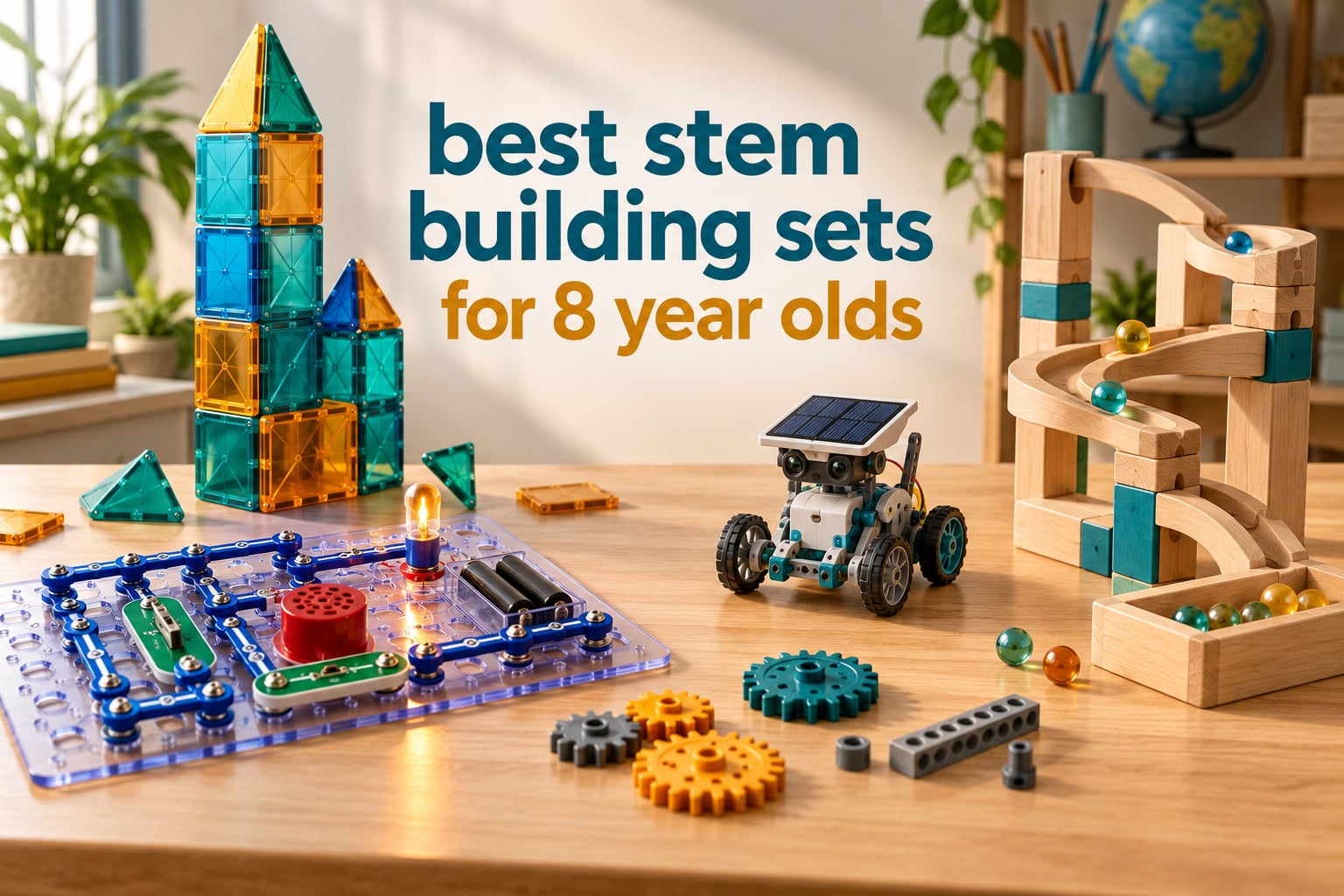
Eight is a good age to start a STEM building set, and also the age where parents get stuck. The kits rated 5+ often demand more force than an 8-year-old has, and the kits rated 10+ assume a reading level they have not reached. We spent weeks with 10 of the strongest options on the market to work out which ones a child at this age will actually finish, keep going with, and pick back up on a wet Saturday afternoon.
A STEM building set is a construction toy whose pieces are designed so that assembling them teaches science, technology, engineering or math. That teaching happens through structural stability, gear ratios, circuit flow or programmable sequences rather than through worksheets. The child snaps, connects or magnetically joins parts into a working model, tests whether it holds, watches it fail, changes one variable and rebuilds. That design-test-fail-adjust loop is the real lesson.
We compared the 10 kits below on piece count, connector force, whether the instructions can be followed without an adult, and whether the finished model does something. Every review carries an honest drawback, because the kits that get abandoned share three causes: too hard on day one, the models run out, or an adult quits before the child does. If you also run a classroom or a homeschool table, our guide to model rocket kits for STEM classrooms covers the launch-based side of the same subject.
Table of Contents
Top 3 STEM Building Sets for 8 Year Olds
These three cover the widest range of interests: circuits, magnetic construction, and kinetic play. Each has a large review base, so the ratings below reflect thousands of households rather than a handful of early buyers.


National Geographic Marble Run
- Glow-in-the-dark marbles
- 80 pieces
- 5 sturdy bases
- storage bag
Best STEM Building Sets for 8 Year Olds in 2026 at a Glance
Every kit in the table below is rated for or near this age band. Piece count matters less than you would think, so the core skill column is the more useful one for narrowing a shortlist.
| Product | Specifications | Action |
|---|---|---|
| Snap Circuits Jr. SC-100 |
|
Check Latest Price |
| MAGBLOCK 176-Pc Magnetic Tiles |
|
Check Latest Price |
| National Geographic Glow Marble Run |
|
Check Latest Price |
 Snap Circuits BRIC Structures Snap Circuits BRIC Structures |
|
Check Latest Price |
 Smartivity Hydraulic Aeroplane Kit Smartivity Hydraulic Aeroplane Kit |
|
Check Latest Price |
 National Geographic Da Vinci Catapult National Geographic Da Vinci Catapult |
|
Check Latest Price |
 Thames and Kosmos Structural Engineering Thames and Kosmos Structural Engineering |
|
Check Latest Price |
 Henoda 468-Pc Programmable Robot Henoda 468-Pc Programmable Robot |
|
Check Latest Price |
 Smartivity DIY Pinball Machine Smartivity DIY Pinball Machine |
|
Check Latest Price |
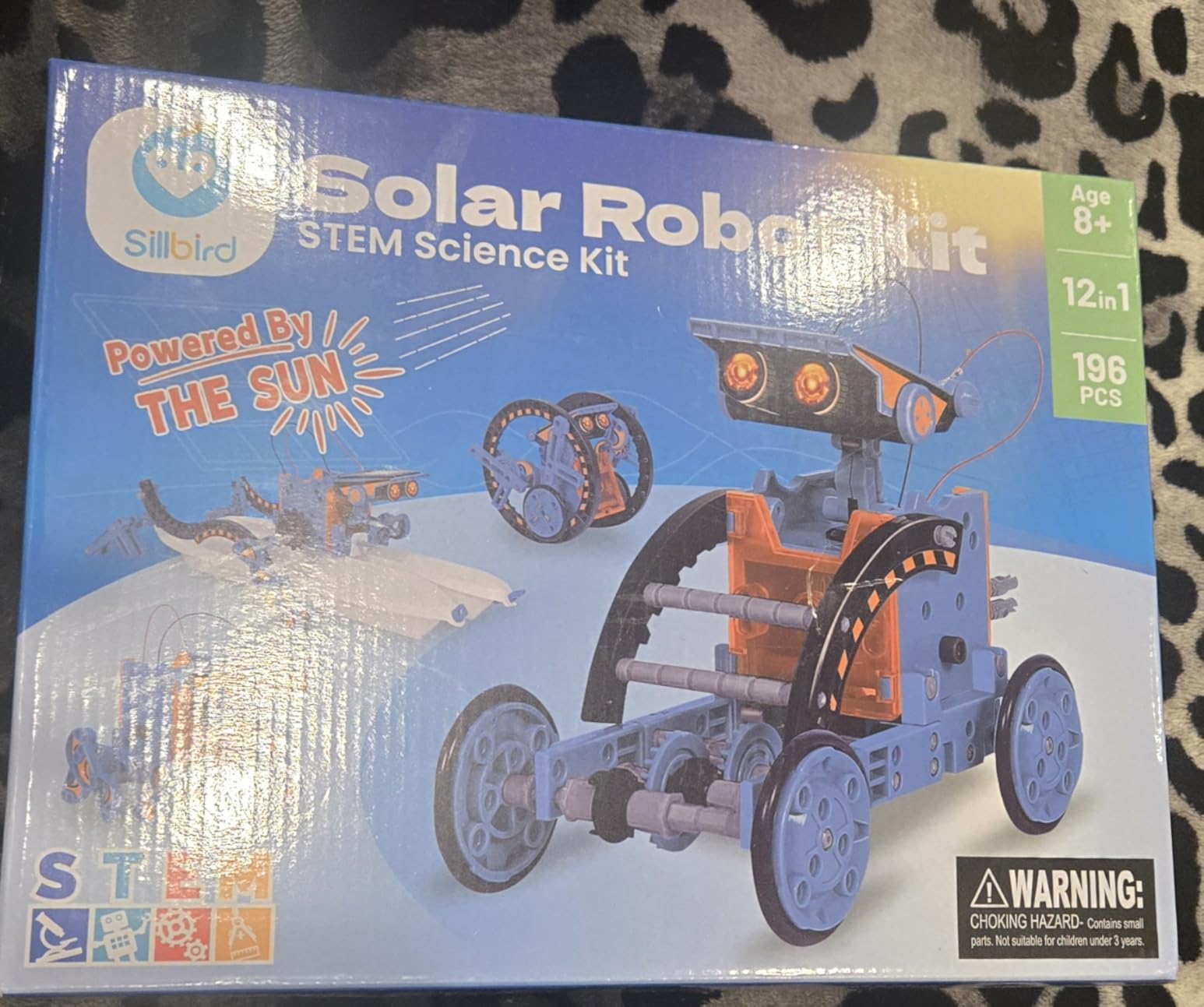
 Sillbird 12-in-1 Solar Robot Sillbird 12-in-1 Solar Robot |
|
Check Latest Price |
1. Snap Circuits Jr. SC-100 – Best All-Round STEM Building Set for 8 Year Olds
SNAP CIRCUITS Jr. SC-100 STEM Electronics Kit, 100+ Projects, Ages 8+
100+ projects
Ages 8 to 108
30+ snap modules
12 x 9.5 x 1.75 inches
Alkaline battery
Pros
- 100+ buildable projects from one box
- Snap-together pieces need no tools or soldering
- Full-color illustrated project manual included
- Color-coded parts suit independent building
Cons
- Only around 29 modules so many projects reuse the same parts
- Some builds look nearly identical
- Manual projects lean toward lights and sounds
Snap Circuits Jr. is the kit we would hand to an 8-year-old first, and the reason is simple: nothing snaps back out. The grid base and the numbered modules are forgiving in a way that rod-and-connector systems are not, which means the frustration curve stays flat for longer. It carries 100+ documented projects, and the finished objects are working circuits rather than shapes on a base.
At age 8, the realistic first builds are the doorbell, the sound-activated light and the flying saucer. Each one needs no force beyond a firm press, and the four-colour manual shows every step in a photo rather than a diagram an adult has to interpret. That photo-driven format is the reason a child can run this one without a parent sitting alongside.
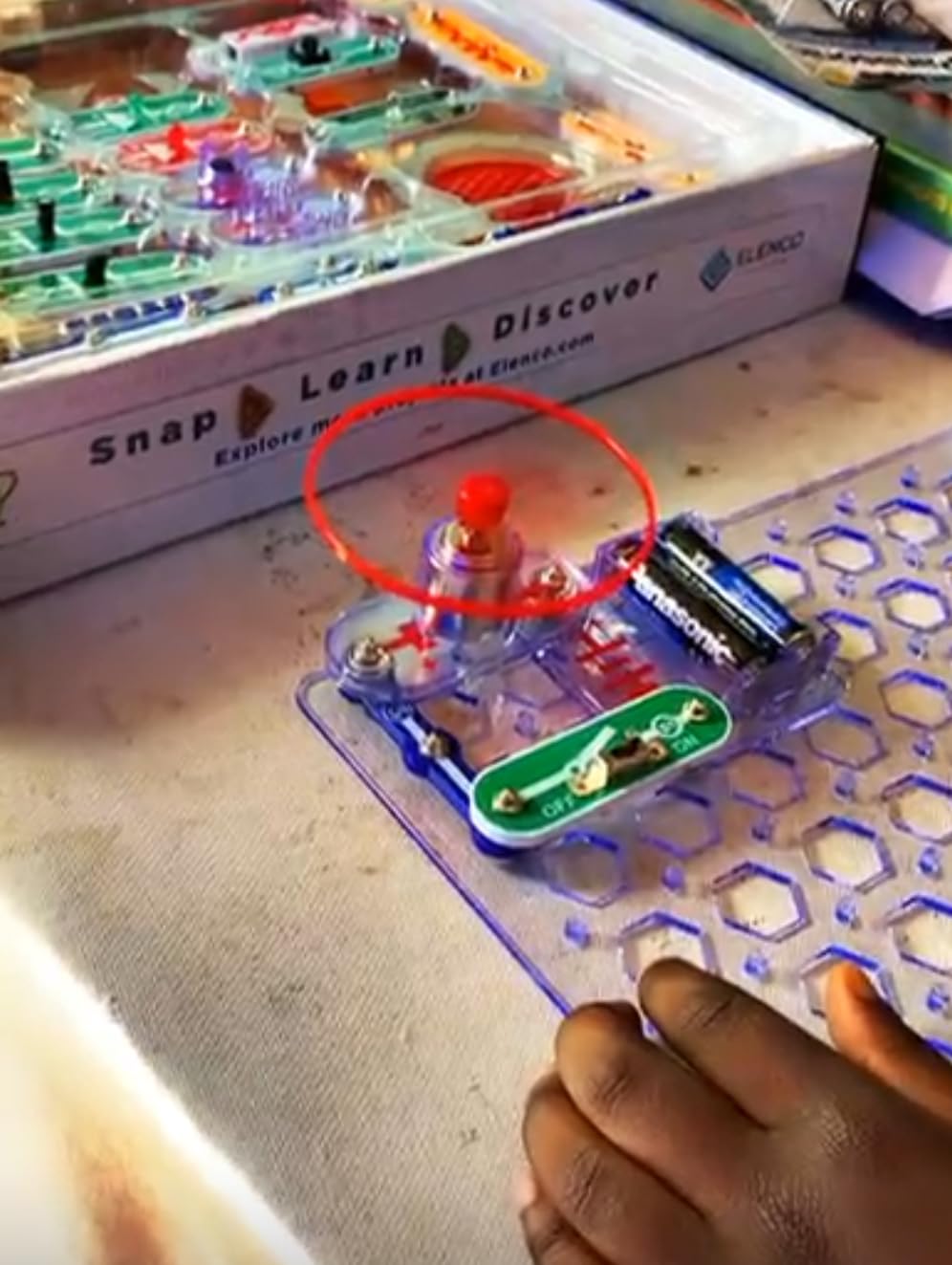
The honest limitation is part count. The box carries around 29 snap modules, so later projects start reusing the same switches and sound components. Builders notice this around the fiftieth build, and a few of the listed projects are near-duplicates of earlier ones in different colours. If your child is the type who wants 20 different mechanisms rather than 100 variations on a light, the piece count will disappoint.
One family we know has had this kit for years and has passed it from a 2-year-old up to a 13-year-old, which is an unusually wide age span for a single kit. Reviewers consistently report that the snap system simply does not break, and it carries a one-year style manufacturer warranty against defects. Our model rocket kit guide is the natural pairing if you want a second kit that moves to the next question, in this case propulsion and gravity.
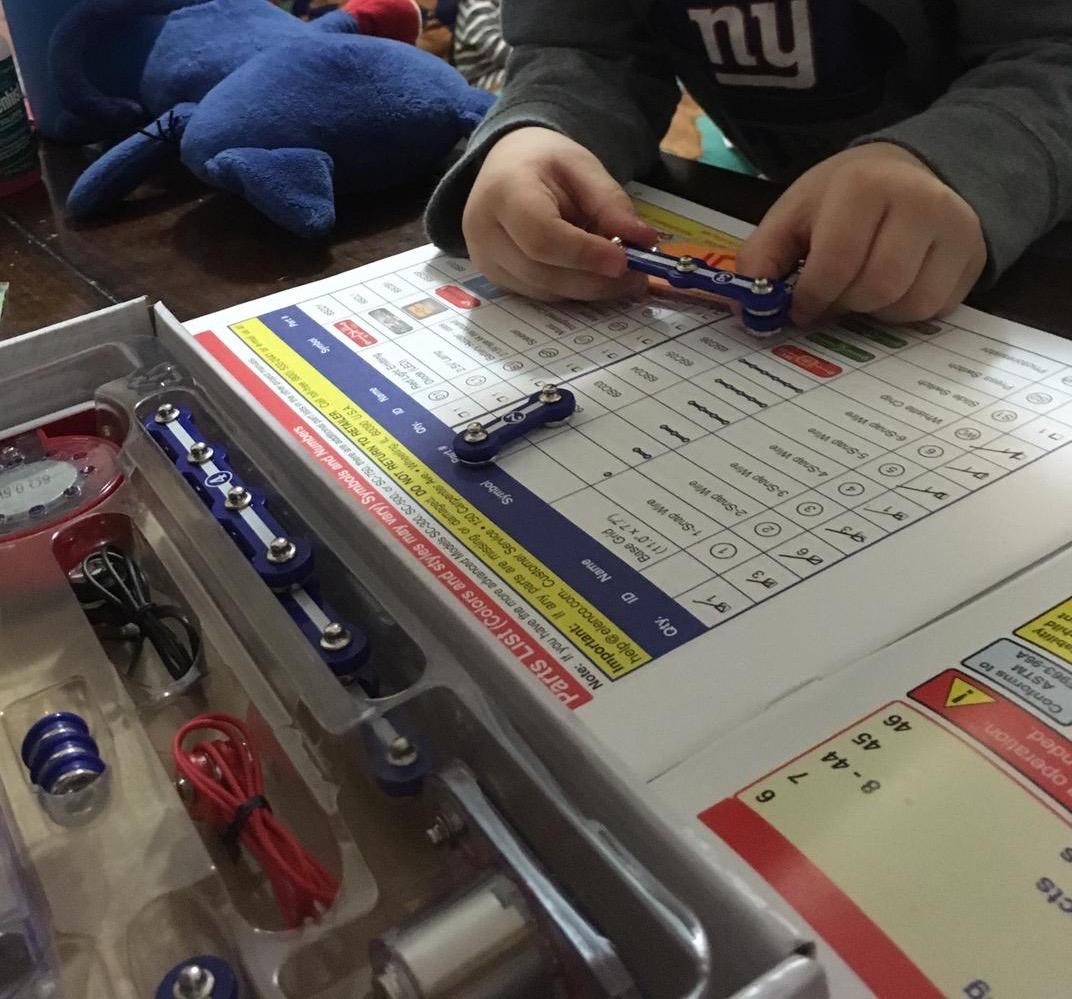
Can an 8-year-old build this without an adult
Yes, and the manual is the reason. Steps are laid out in photographs with the numbered components visible, so a child who cannot yet read fluently can still follow the order. A parent should only step in when a module will not seat, which happens occasionally on the very first build while the child is learning how hard to press.
When this kit stops being enough
It stops being enough when the child wants to build structures as well as circuits, because this set is flat-grid only. It is also the weakest choice for an 8-year-old who already works through circuits quickly and wants motorised mechanisms. In that case the BRIC Structures set in position 4 covers the same brand with a much larger physical build.
2. MAGBLOCK 176-Pc Magnetic Tiles – Best Magnetic STEM Building Set for 8 Year Olds
MAGBLOCK 176PCS Magnetic Tiles Marble Run Set Building Blocks for Ages 8+
176 pieces
Three play modes
Ages 8 and up
3 pounds
ABS plastic
Pros
- Three ways to play in one box
- Strong magnets hold tall multi-layer structures
- Larger-than-expected tiles suit small hands
- Compatible with other major magnetic tile brands
Cons
- Booklet shows ideas rather than step-by-step directions
- Curved tube pieces have small peg connectors
- Included marbles are shooter-sized
MAGBLOCK is the pick for a child who wants to build tall and build fast. Magnets remove the single hardest problem in construction play, which is the force needed to seat a connector. A 5+ rated rod-and-connector set asks an 8-year-old to push hard enough to bend a piece, and that is where most kits get abandoned in week three.
This set runs three separate games rather than one. There is a magnetic building mode, a marble maze mode and a marble race mode, so a child who finishes a structure can immediately switch to a kinetic problem. The 176 pieces break down into 74 magnetic pieces, 56 pipeline accessories, a turntable, a windmill, 24 window cards and 12 glass marbles. Most owners report more than two hours of screen-free play per session.
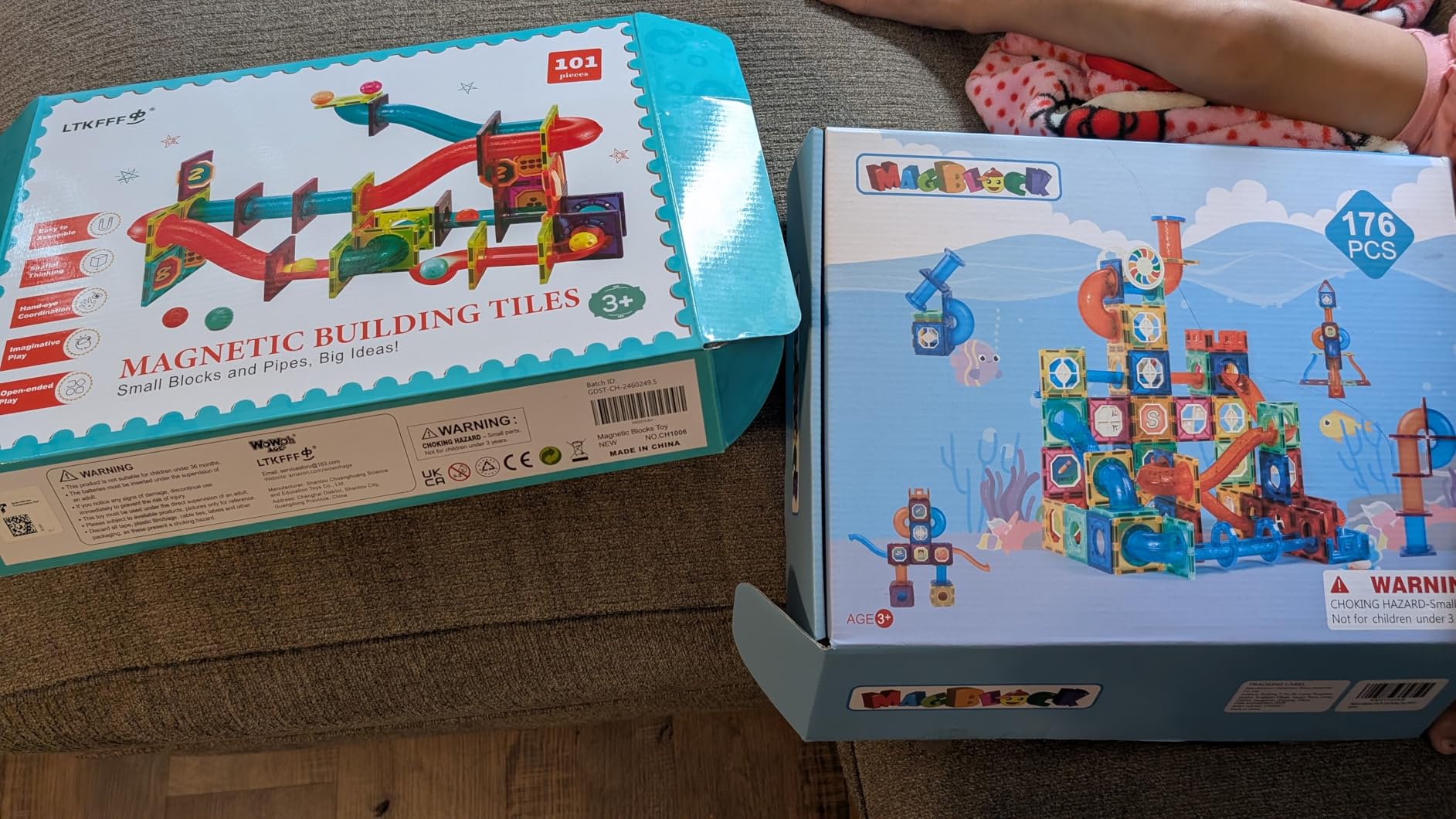
The magnets are the point here. The tiles use permanent magnets joined by ultrasonic welding, and the set is moulded from non-toxic lead-free ABS with rounded edges. That pull is what lets an 8-year-old build a five-layer tower that an equivalent snap-tile set would collapse, and it is also what makes the set compatible with other major magnetic tile brands if you want to combine them later.
The drawbacks are real, though. The booklet lists the pieces used in each pictured build but gives no assembly order, so the child is reverse-engineering the structure, which some enjoy and some find frustrating. The curved tube and bend pieces use small peg connectors that are the hardest part of the set for a younger hand. And the marbles are full shooter size, so a family with a 4-year-old needs to decide in advance whether those stay on the table.
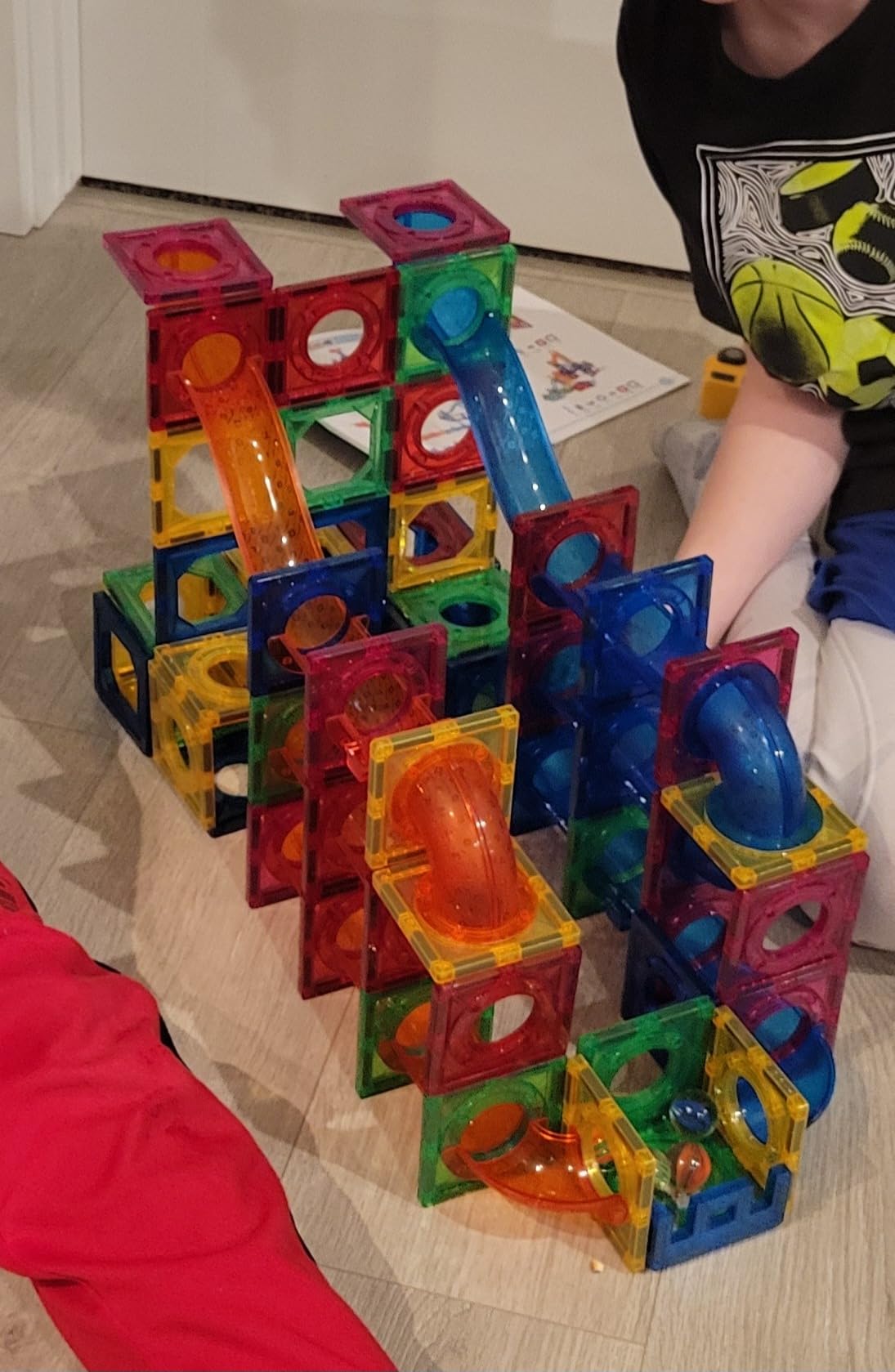
Does this work with a younger sibling on the same set
Better than almost any other kit on this list, and it is the standard answer on parenting forums when one child is four and the other is eight. The larger tile size is easier for small hands to grip, and the magnetic connection means a four-year-old can pull a piece off without breaking anything, which is where most shared sets fail. Hold the marbles back and the rest is genuinely two-player.
Whether the quality holds up to daily use
It does. The welds are the failure point in cheaper magnetic sets, and this one uses ultrasonic welding specifically because glued magnet housings separate first. Expect the structure to be a long-term fixture on a table rather than a one-session toy, though the marbles will end up somewhere you did not plan.
3. National Geographic Glow-in-the-Dark Marble Run – Best Marble Run STEM Kit for 8 Year Olds
NATIONAL GEOGRAPHIC Glowing Marble Run – Construction Set with 15 Glow in the Dark Glass Marbles & Storage Bag, STEM Gifts for Boys and Girls, Building Project Toy (Amazon Exclusive)
80 pieces
Ages 8 and up
15 glow-in-the-dark marbles
2.8 pounds
Storage bag
Pros
- Glow-in-the-dark marbles are the standout feature
- Tubes are thick and smooth with no sharp edges
- Large storage bag makes cleanup easy
- Effectively unlimited configurations
Cons
- Runs wobble and pop apart if not based properly
- Only five bases and they break first
- No included assembly diagrams
- Not enough track for two equal race lanes
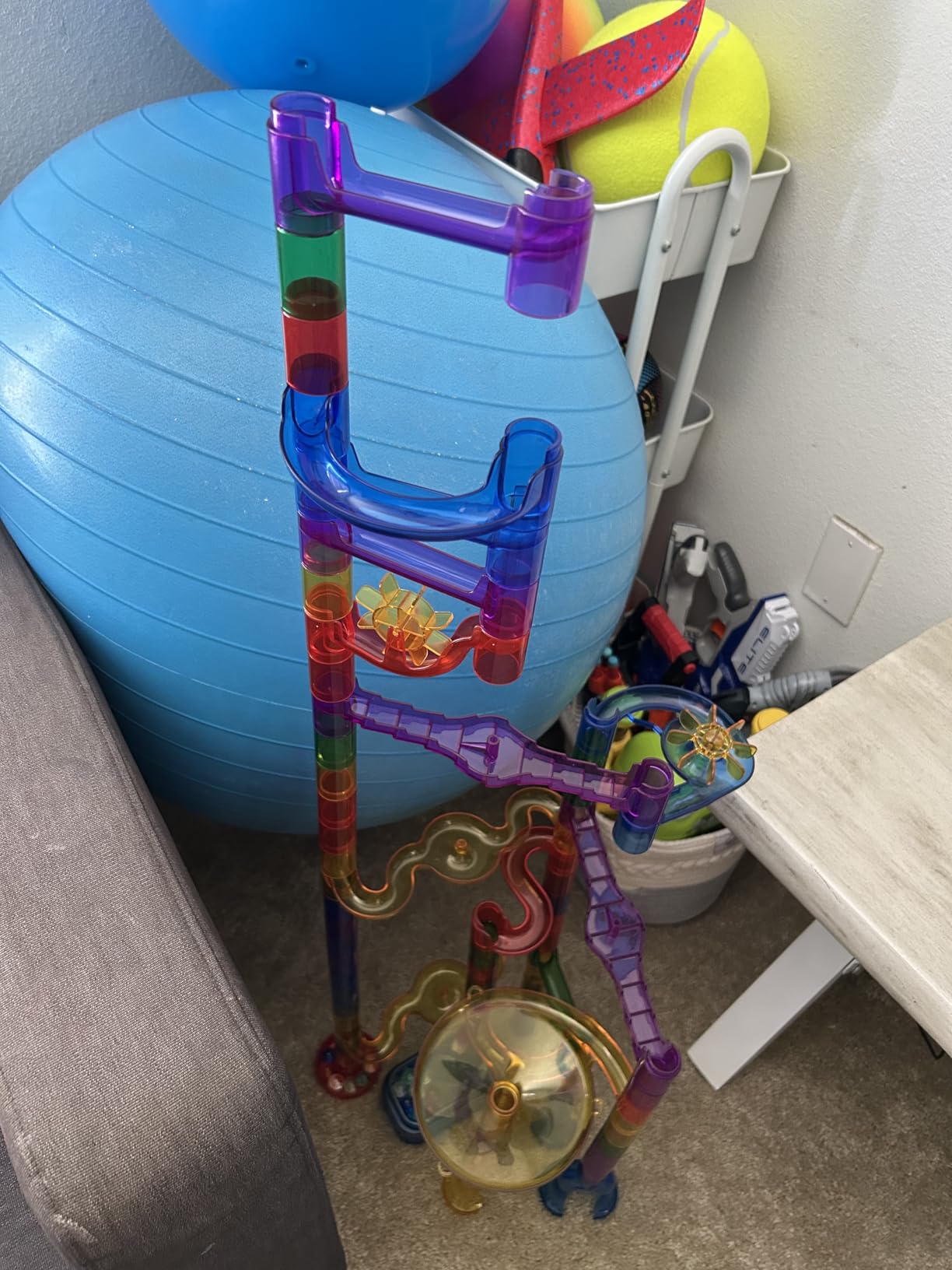
This is the kit that survives a birthday party, which is a category most building sets cannot claim. The glow-in-the-dark marbles charge on the included LED unit and then light up a darkened room, and that effect keeps going long after the track stops being novel. It is rated 4.7 across more than 14,000 reviews, and it ranks in the top three of its Amazon category.
Physically it is 80 pieces split into 5 sturdy bases, 15 action pieces and 45 clear smooth-run track pieces, plus 15 glow-in-the-dark glass marbles in six colours. There is no wrong way to assemble it, so a child who cannot follow a manual can still build something that runs. That is the whole appeal for an 8-year-old who resists being instructed.
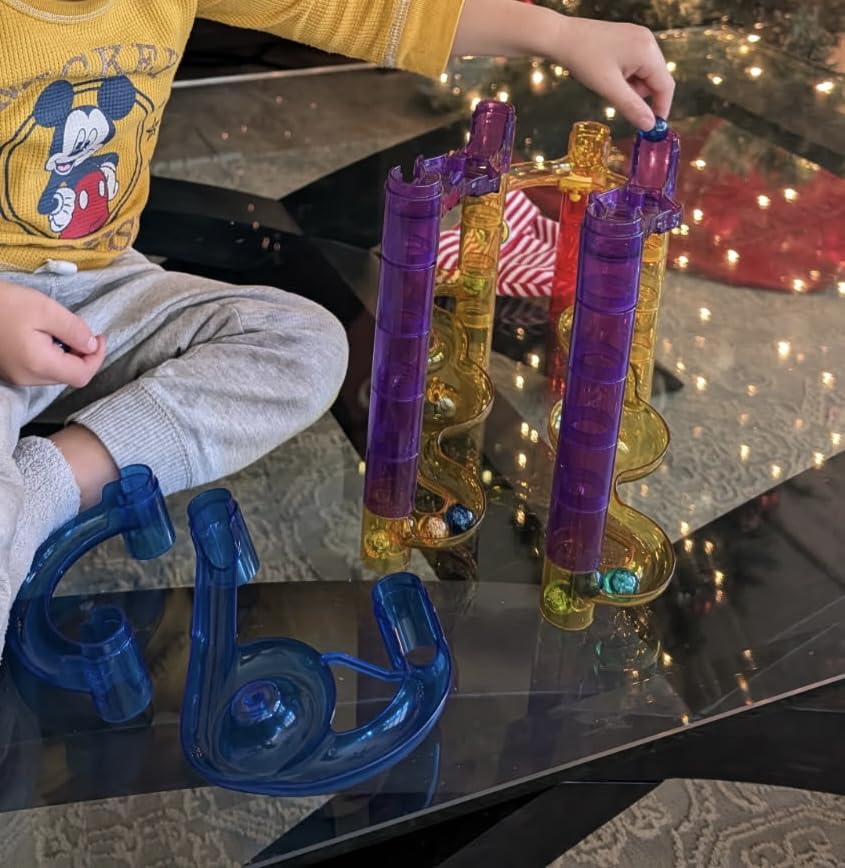
What it teaches is harder to see but real. The learning guide covers the physics of motion, aerodynamics and marble run experiments, and in practice the lesson is structural: children quickly learn that a long unsupported span wobbles and that a run needs a wide base to stay fast. Reviewers report kids redesigning for stability within a few sessions, which is exactly the iteration loop we look for.
The complaint we heard most is structural wobble. Pieces pop apart or tip over if a run is not anchored to a base, and the bases themselves are the first thing to crack under enthusiastic launching. There are only five in the box, and there is not enough track for two equal side-by-side race lanes, so two children racing head-to-head will need a second set. Enthusiasm also sometimes fades after the first few sessions, which is worth planning for.
How long this one keeps working after the first build
Longer than a model-kit style toy, shorter than a magnetic set. Once a child grasps that taller supported runs beat flat ones, they will keep rebuilding for weeks. What ends it is usually two children competing, at which point the track length becomes the limiting factor rather than interest.
Whether this suits a child who needs direction
Not really. There are no assembly diagrams in the box, which most 8-year-olds read as a puzzle and some read as a dead end. If your child asks for step-by-step instructions, choose a kit with photos of each stage, such as the Smartivity pinball machine in position 9.
4. Snap Circuits BRIC Structures – Best Hybrid Brick and Circuit STEM Kit for 8 Year Olds
SNAP CIRCUITS BRIC Structures STEM Building & Electronics Kit, Ages 8+
139 bricks
75 adapters
20 snap modules
Ages 8-15
3 AA batteries
Pros
- Unique hybrid of building bricks and working circuits
- 75 adapters let kids light up their own brick builds
- Full-colour idea booklet with 20+ projects
- Tool-free colour-coded assembly
Cons
- Adapter connections are less intuitive than the pure Snap Circuits grid
- Fewer circuit modules than the standalone Snap Circuits kits
- Needs 3 AA batteries not included
The gap this kit fills is real: a child who has outgrown a flat circuit grid but is not ready for a 287-piece structural set. Bric-2-snap adapters let ordinary building bricks carry lights, sounds and moving parts, so the finished model stands up as a structure instead of lying flat. At age 8 that produces things like a lit-up model building, a working fan on a brick tower, or a sound-triggered alarm box.
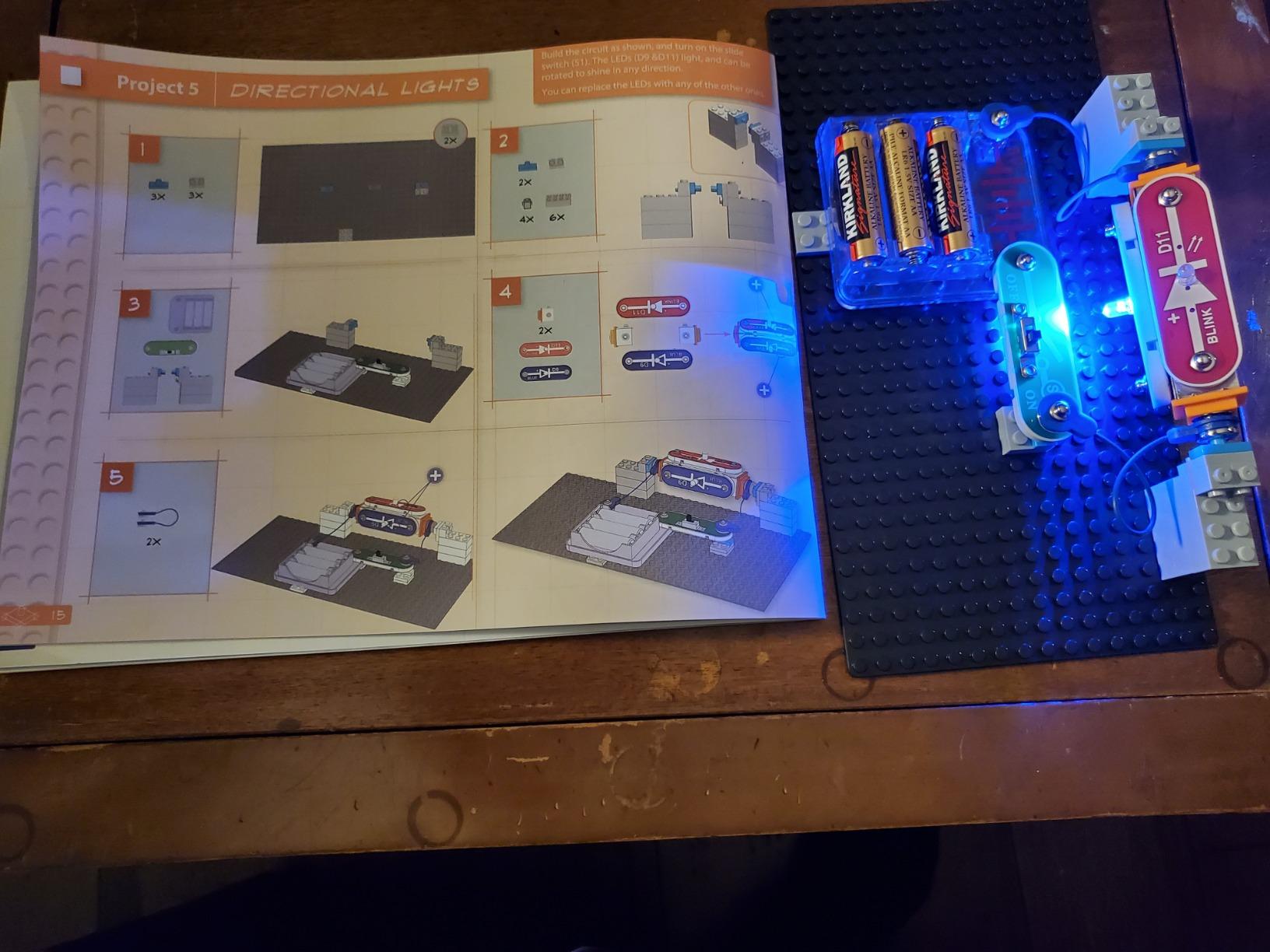
The box carries 139 assorted bricks, 75 Snap-2-Bric adapters, 20 snap modules, a BRIC remover tool and a manual, which is 20+ engineering projects. The parts are numbered and colour-coded, so no tools or soldering are involved, and the manufacturer recommends ages 8 to 15 with a six-month warranty against defects.
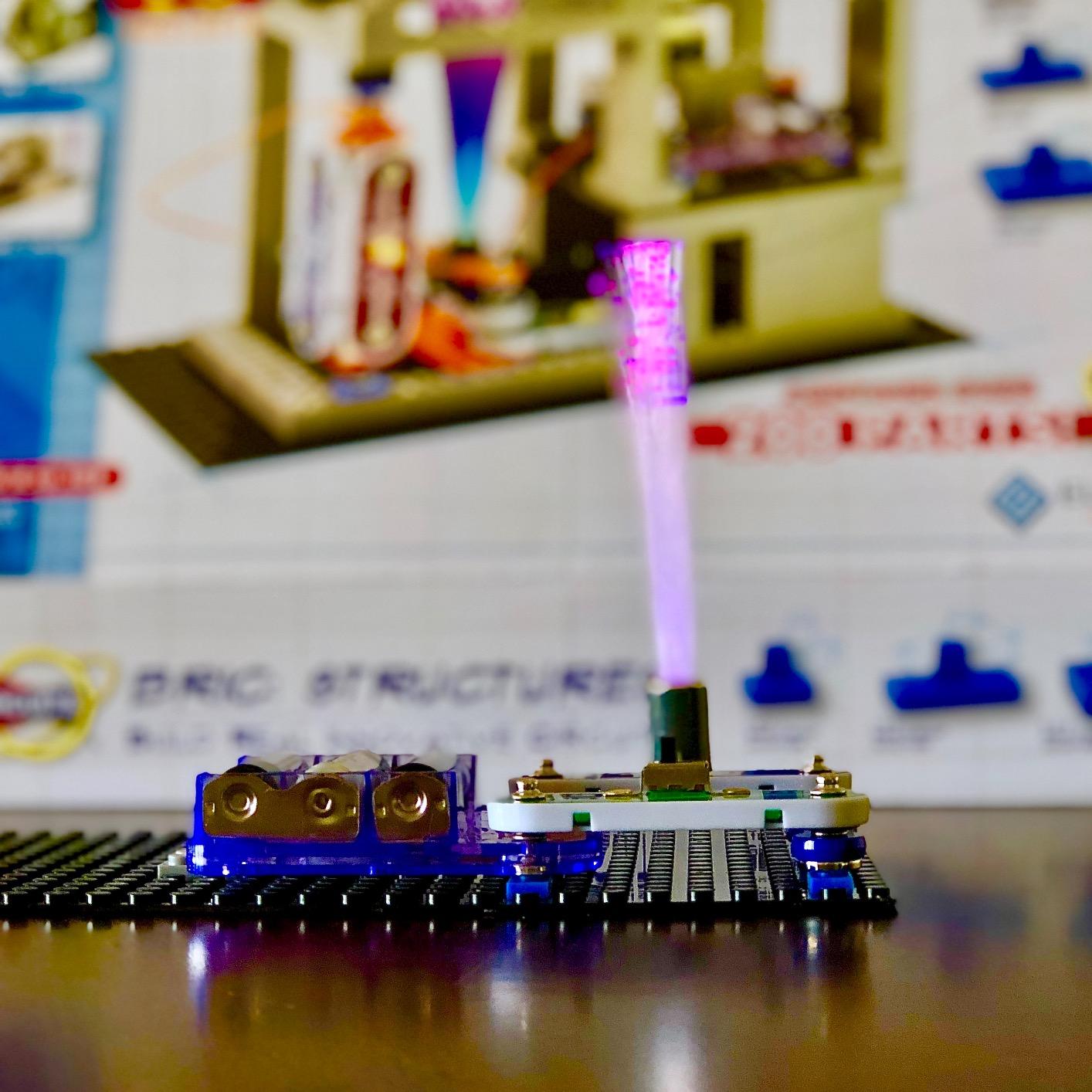
The honest drawback is the adapter system itself. Snapping a module directly onto the grid feels obvious, but seating a brick into an adapter is a two-handed action with an orientation that has to be worked out, and that is where a first-time builder gets stuck. There are also only 20 snap modules here, noticeably fewer than the standalone Snap Circuits kits, so the animated options are narrower.
It runs on 3 AA batteries. For a house that already has Snap Circuits parts in another box, this pairs well, because the modules are cross-compatible. On its own it is a smaller seller with around 2,000 reviews, but it holds a 4.7 rating and reviewers consistently single out the project booklet as well designed.
Whether this is a good first electronics kit
Not as a first one. A child meeting circuits for the first time should start with the flat grid in position 1, where the connection logic is one idea instead of two. This kit rewards a child who already understands that current needs a closed path, and it frustrates one who does not.
When this earns its place on the shelf
When the finished model needs to be stood up and looked at. This is one of the few kits here that produces a displayable object with moving parts, and that is a genuine difference from a flat circuit board that gets taken apart at the end of the session.
5. Smartivity Hydraulic Aeroplane and Dart Launcher – Best Launch-Based STEM Kit for 8 Year Olds
Smartivity 2in1 Hydraulic Aeroplane & Dart Launcher STEM Kit Ages 6-14
58 parts
Ages 6-14
Engineered wood
No batteries
Lifetime replacement parts
Pros
- Two working models in one kit
- Step-by-step manual keeps the build screen-free
- Engineered wood feels durable and safe
- Free replacement parts for life
Cons
- Modest build with shorter replay value
- Hydraulic power is limited compared with spring models
- Only 58 parts
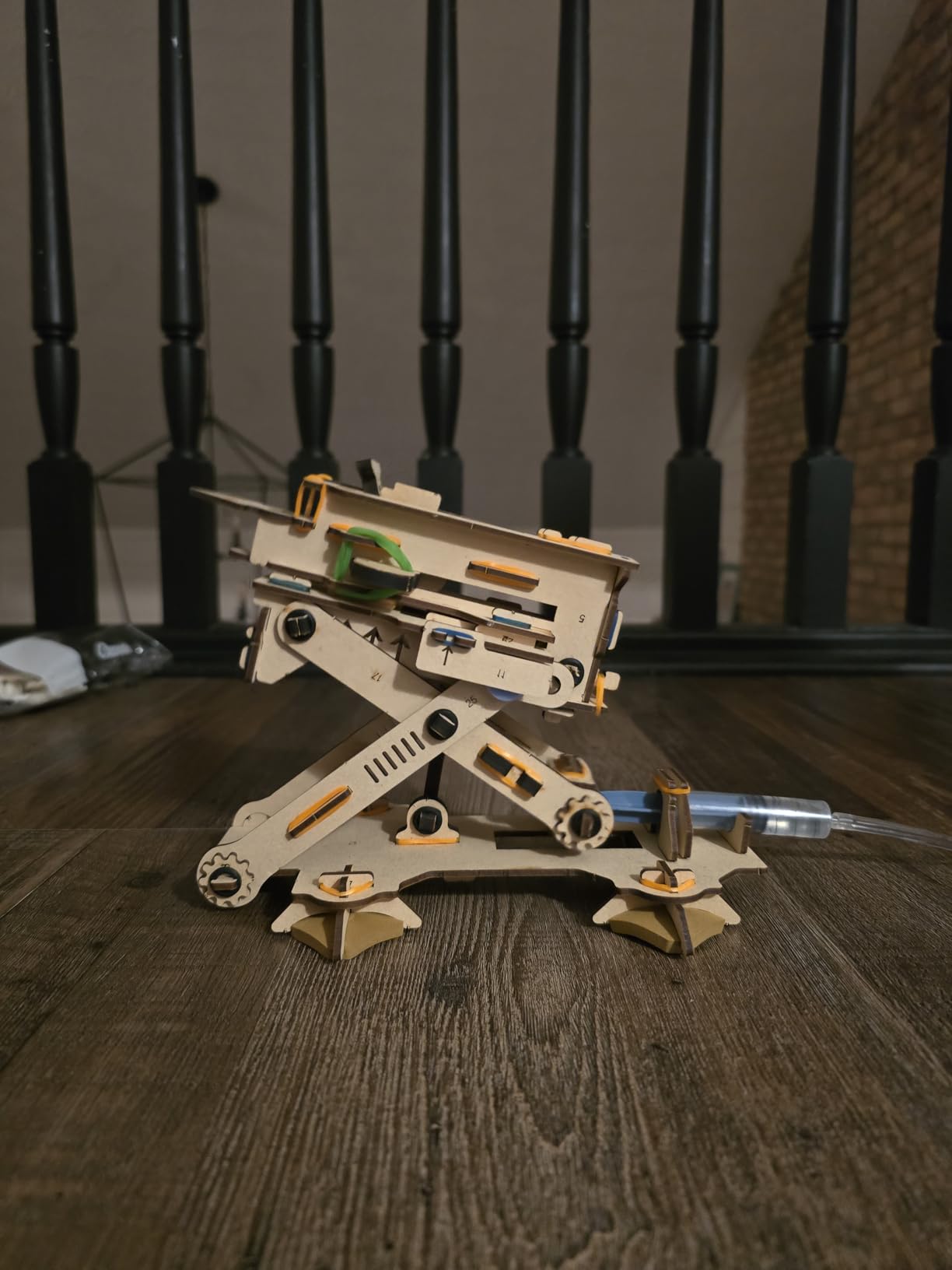
This is the kit for a child whose STEM interest is propulsion rather than circuits or structures. It builds two things from 58 parts: a hydraulic launcher that sends paper aeroplanes down a ramp, and a dart launcher using the same mechanism. The hydraulic force is the lesson, and the manual walks through it step by step in a way an 8-year-old can follow.
There are no batteries and no electronics anywhere in it, which makes it a fully screen-free option with no device and no app involved. It is moulded engineered wood rather than plastic, weighs 172 grams and measures 11.81 x 9.84 x 7.48 inches. Smartivity supplies free replacement parts for the life of the kit, which removes the most common failure worry for wooden models.
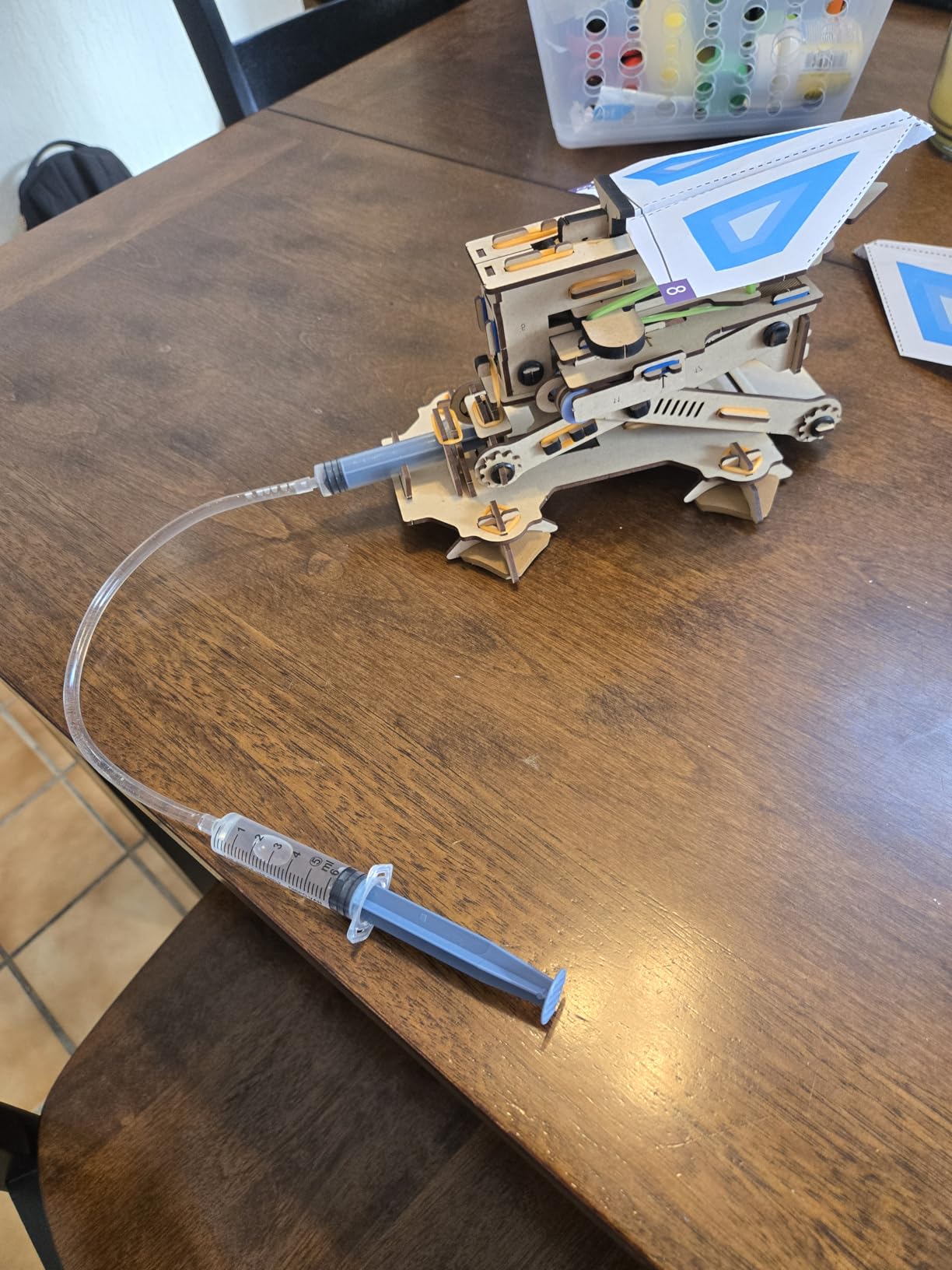
Two things temper the recommendation. The build is on the small side for a 58-part kit, so a child who takes three hours to finish something will lose interest before it launches. And hydraulic power delivers less force than a spring or rubber-band launcher, so the aeroplanes and darts travel a shorter distance. Parents who care more about the launch distance than the mechanism should look at a spring-driven model instead.
It sits in the top tier of its Amazon educational science category and carries a 4.6 rating from more than 5,700 reviews, with 79 percent five-star results. Reviewers credit the clarity of the instructions and the low screen appeal. The manufacturer recommends ages 6 to 14, which makes it one of the few kits here with room to grow on both sides of age 8.
Is this a birthday gift that gets finished on the day
Yes, and that is its main event. A morning build and an afternoon launch fits inside a single birthday, which no kit on this list manages except the solar robot. It also works well as a sibling gift because two children can trade flying paper aeroplanes through the same launcher.
How it pairs with another kit
Pair it with a magnetic tile set. The launcher handles the kinetic side and the tiles handle the structures, and neither kit duplicates the other. If your child leans towards models rather than mechanisms, the Da Vinci catapult in position 6 covers the same ground with more wood and more launch power.
6. National Geographic Da Vinci Catapult – Best Working Wooden Machine Kit for 8 Year Olds
National Geographic Da Vinci Catapult Wood Building STEM Kit for Kids
Three machines
Ages 12 and up
Laser-cut balsa
No batteries
12.8 ounces
Pros
- Three genuinely different working machines
- Laser-cut pieces punch out cleanly
- Models are surprisingly powerful once assembled
- Booklet adds siege history
Cons
- Listed for ages 12 and up so it sits above this age band
- Instructions are ambiguous in places
- Balsa parts can snap if forced
Three finished machines, not one: a ballista, a bombard and a catapult, each taking one to three hours. Having three separate builds in one box is the strongest replay value among the wooden kits in this roundup, and the models genuinely throw things rather than sitting still on a shelf. The components are laser-cut balsa with rubber bands and sandpaper included, and nothing needs a battery or a tool.
We want to be straight about the age rating, because it is the deciding factor here. The manufacturer lists this set at 12 years and up, which puts it above the age-8 band, and it carries a 60-day warranty. A mature 8-year-old with patient hands and a nearby adult can manage it. A typical one will hit the ambiguous diagrams and the fragile wood in the same afternoon.
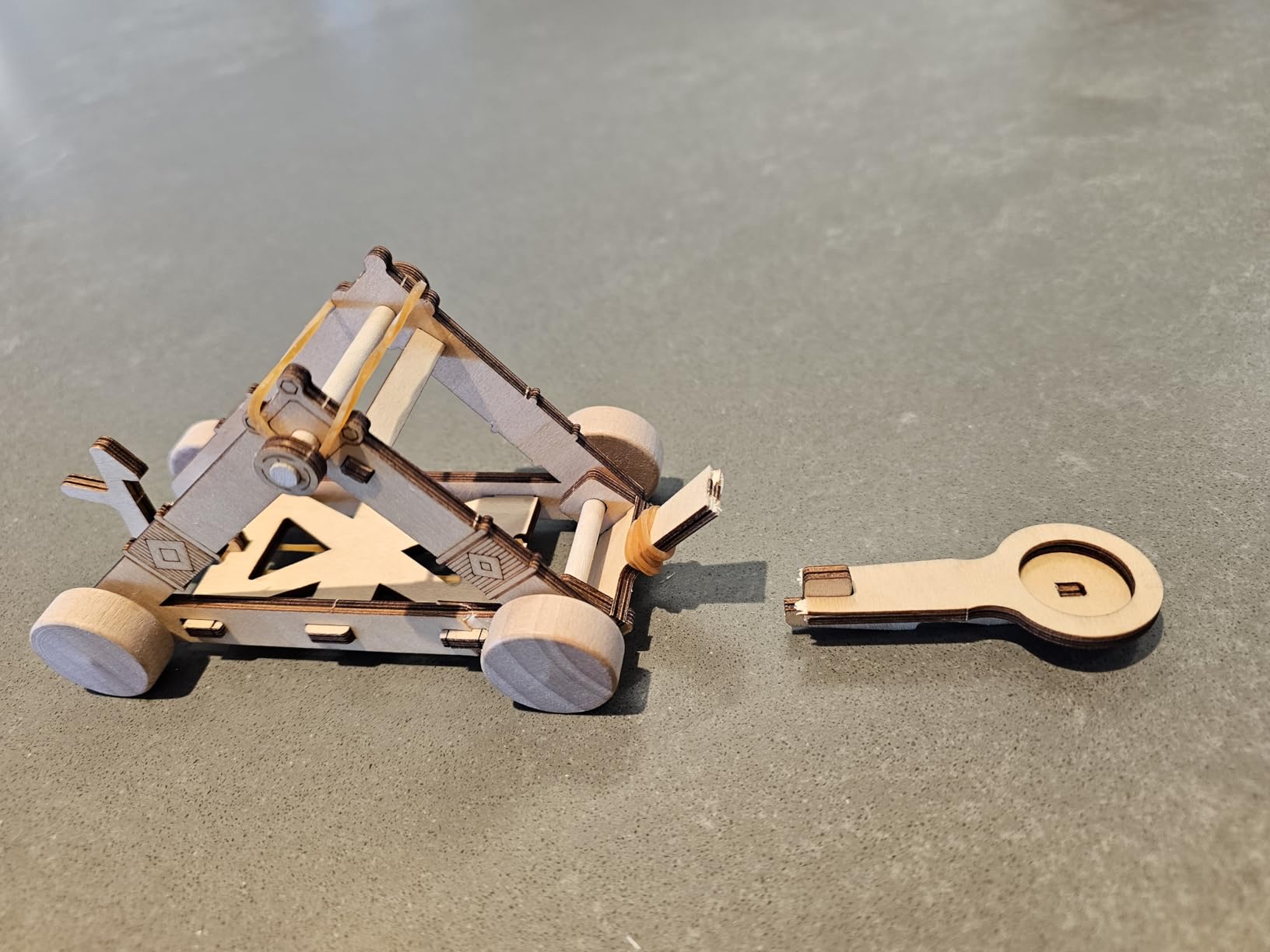
The instruction booklet is the consistent weak point. Several buyers have had to disassemble and reglue a part after following a step that turned out to be ambiguous, and the balsa needs gentle handling because a forced joint snaps rather than bending. The bombard’s trigger is the least functional of the three, though it still fires. What offsets all of this is the finished result: reviewers repeatedly describe the models as impressive to watch.
If you do go ahead with wooden models, understanding what is expected of the hardware beforehand helps. Our notes on hot glue guns for prop building cover gluing technique and low-temp options, and either solves a balsa joint that the manual left ambiguous.

Whether the 12+ rating is a real barrier at age 8
It depends on the child more than the number. The fine-motor demand is low, but the reading demand is real, since the diagrams are the difficult part. A child who is a confident reader of illustrated instructions will get through it. A child who is not should start with a kit that has photos of every stage instead.
How to protect the balsa wood during assembly
Push joints together with a flat surface rather than twisting, keep the sandpaper on hand to clean burrs before fitting, and build one machine at a time so the table is not buried in parts. The pieces punch out cleanly with minimal chipping, so most damage happens at the joint rather than at the cut.
7. Thames and Kosmos Structural Engineering – Best Bridge and Tower STEM Kit for 8 Year Olds
Thames & Kosmos | Structural Engineering: Bridges & Skyscrapers | Science & Engineering Kit | Build 20 Models | Learn about Force, Load, Compression, Tension | Parents’ Choice Gold Award Winner, Blue
287 pieces
20 models
Ages 8-14
36-page manual
Intermediate skill
Pros
- Twenty distinct models each showing a structural principle
- Large interchangeable piece count for open builds
- 36-page manual pairs assembly with load testing
- Established STEM publisher
Cons
- Intermediate skill level with fiddly parts for younger hands
- Small plastic connectors are the usual weak point
- Manual is dense for an 8-year-old to read alone
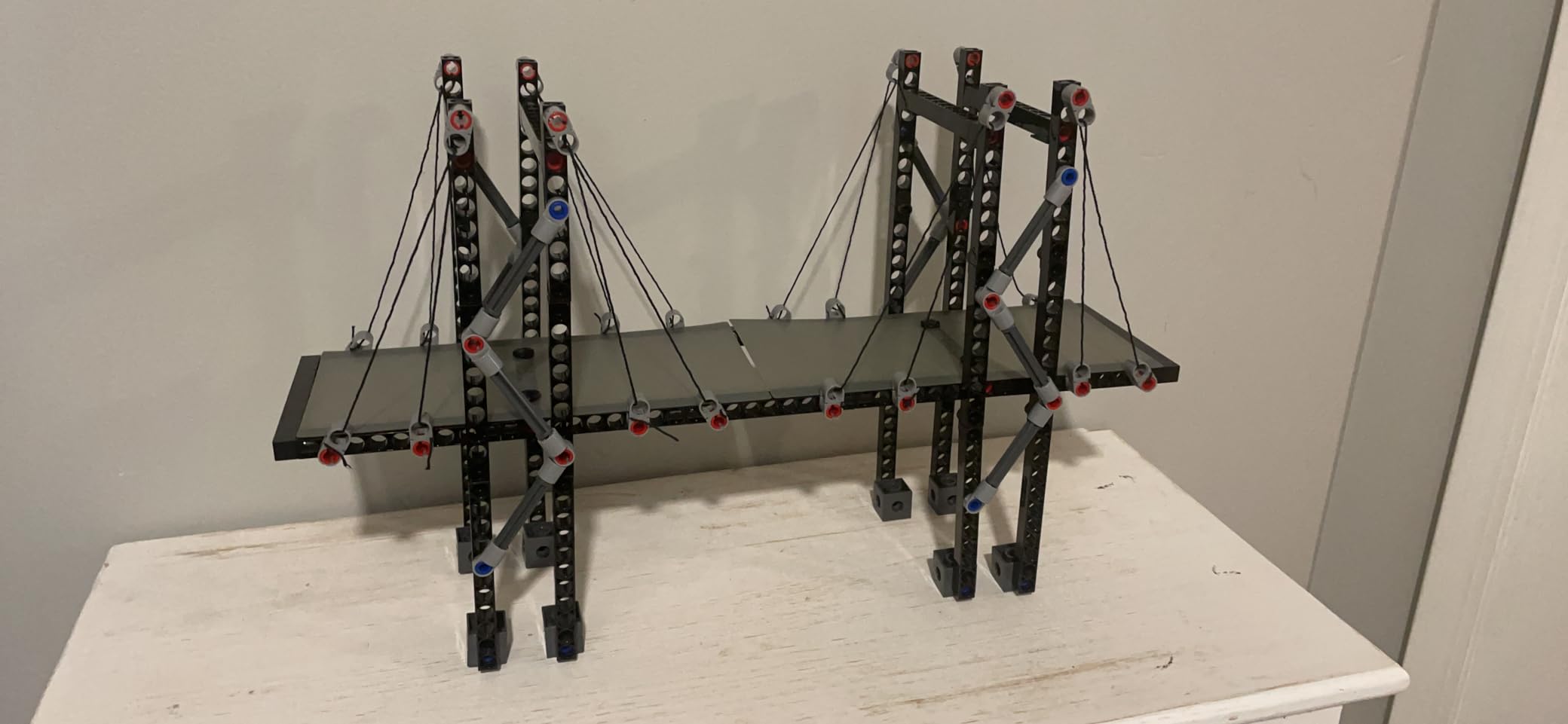
Structural engineering is the most direct way to teach load, compression and tension, and this set does it properly. Twenty models ship with the kit, and each one demonstrates a different structural principle rather than repeating a shape in a new size. At age 8 the first builds are the simpler beam and column structures, and the child quickly gets to the tall tower and long-span designs where failure teaches the lesson.
The manual is 36 pages and illustrated, pairing each assembly with a load test, which turns every build into an experiment. The kit carries over 285 interchangeable plastic pieces, measures 13.1 x 1.8 x 11.6 inches and weighs 16 ounces, and the manufacturer rates it for ages 8 to 14 with a one-year warranty against defects.
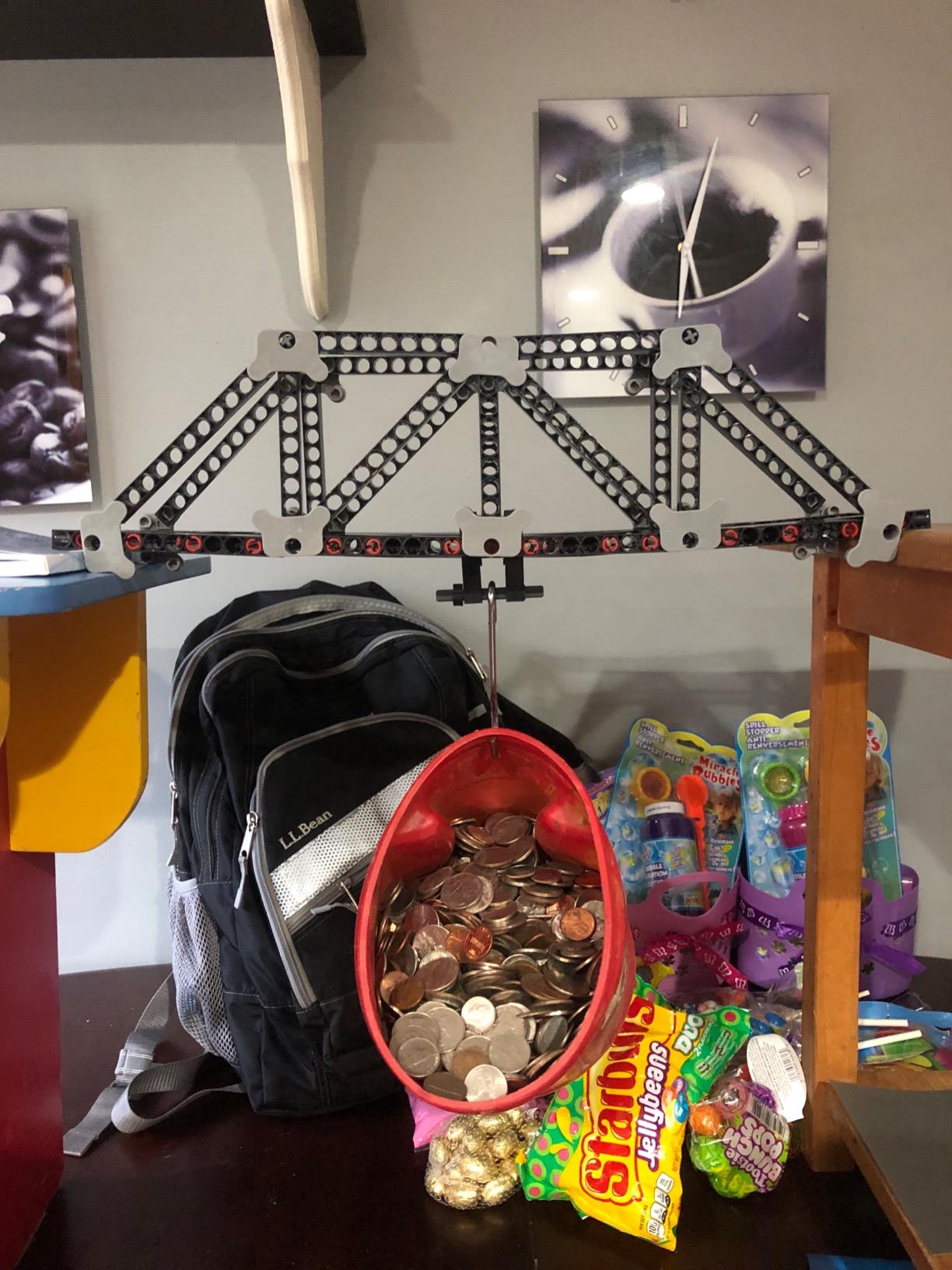
The rated skill level is intermediate, and that is not marketing caution. The pieces are small and the connectors take real force to seat, so an 8-year-old at the younger end of the band will need an adult for the first few builds. It is also a set where small plastic connectors are the usual weak point on completed models, which matters if the child builds a tall tower and then leans on it.
This is a good choice for a family that wants the project to last, because twenty models is more content than most kits at this age offer, and the open-ended piece pool extends well past the manual. It is a weaker choice as a first kit, since a child who abandons a hard build in week one will not return to the remaining eighteen. It holds a 4.6 rating from roughly 1,000 reviews, with 76 percent five-star results.
Whether to buy this instead of a magnetic tile set
Buy the magnetic set first for an 8-year-old. Magnetic tiles build the same intuitive sense of structure with far less force and far more immediate success, and they are easier to share with a younger sibling. Choose this set instead if your child already has tiles and wants a project with a written theory behind it.
What to do about the reading load in the manual
Read the first model together, then hand over the rest. The diagrams are clear once a child has seen one complete build, and the terms used for force and load are worth introducing out loud during that first session. Parents reviewing this kit also flag it as a better fit for a 10-year-old than for a fresh 8-year-old.
8. Henoda 468-Pc Programmable Robot – Best Coding and Robotics STEM Set for 8 Year Olds
Henoda Robot Toys for 8-16 Year Old Boys Girls Kids with APP or Remote Control Science Programmable Building Block Kit, STEM Projects Educational Birthday Gifts
468 pieces
Ages 8-16
Bluetooth app and remote
Lithium battery
1.6 pounds
Pros
- 468 pieces with a colour-coded step-by-step manual
- Works with the included remote and a Bluetooth app
- Glowing eyes and rotating joints add play after the build
- Accessories sorted into separate labelled bags
Cons
- App control needs a compatible phone or tablet
- Programming modes are shallow against dedicated robotics kits
- Bluetooth mode is screen-based
If your child wants a robot that still moves once the build is finished, this is the kit where that matters most. The build uses 468 pieces and produces a transforming robot with glowing eyes and flexible rotating hand joints, and the box includes a remote control, a USB charging cable and a lithium ion battery. Remote range runs past 20 meters, so it works in a garden as well as a lounge.
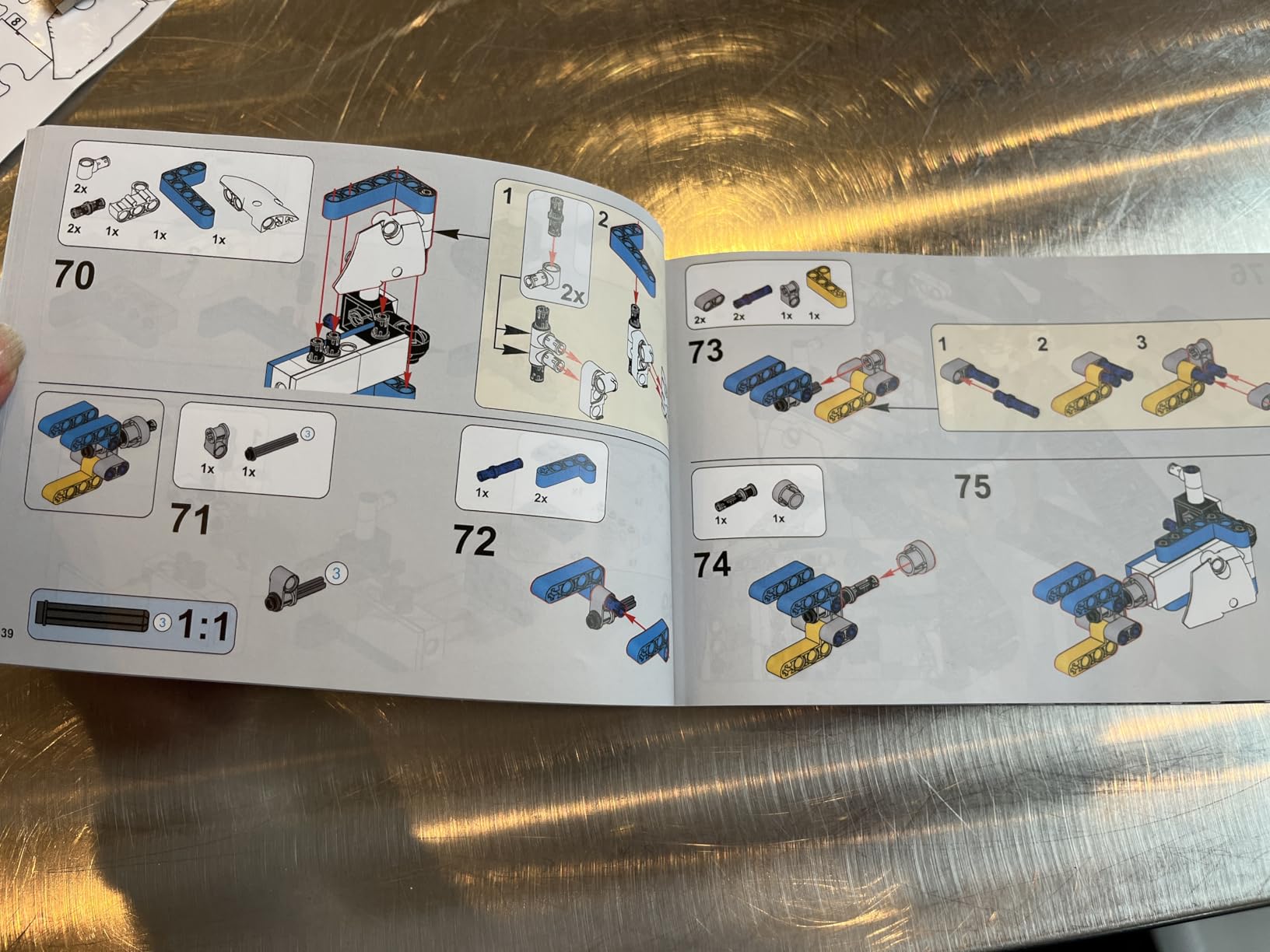
There are four control modes: Bluetooth app, 2.4GHz remote, path and voice control, and gravity sensor and STEM programming. The remote alone keeps the toy fully screen-free, which matters for the parents who told us on forums they bought a coding kit and then wished they had not. The manual uses red boxes and arrows to mark each stage, and the accessories arrive bagged and labelled separately.

The catch is that the programming is shallow. Reviewers consistently note that the programming modes do not match what a dedicated robotics kit offers, so a child who wants to write sequences and debug them will exhaust the options quickly. A 468-piece build also takes real time, and the tiny parts are easy to lose during assembly, so a tray matters more here than with any other kit on the list.
It is built from thick ABS with smooth edges and ships non-toxic, and it carries a 4.6 rating from about 1,900 reviews with 77 percent five-star results. The manufacturer rates it for ages 8 to 16, which is the widest upper range of the robotics kits we looked at and a good sign for a set that will not be outgrown quickly.
Whether this is a screen-free option
Partly. The remote control and path mode both work without any device, and the robot is genuinely fun under remote alone. The Bluetooth app is where the coding lives, so parents who want zero screen time should frame the app mode as a separate optional activity rather than the main event.
Whether it suits two children of different ages
Well. One child can drive it with the remote while the other rebuilds the programming sequences on the app, and because the 468 pieces include a lot of duplicate shapes, a younger sibling can construct separate vehicles alongside the robot. That makes it one of the better shared kits here for an 8 and 11 pairing.
9. Smartivity DIY Pinball Machine – Best STEM Kit That Becomes a Toy for 8 Year Olds
Smartivity DIY Pinball Machine I Global Award Winning Game Ages 8-99 Years
375 parts
Ages 8-14
Spring launcher
No batteries
Engineered wood
Pros
- Becomes a genuinely playable machine rather than a one-time build
- Instructions are the clearest on any kit here
- Sturdy wooden build with padded flipper handles
- Free lifetime replacement parts
Cons
- Build takes several hours so younger children lose interest
- Small pieces are easy to lose during assembly
- Rubber bands deteriorate over time
- No dedicated storage case
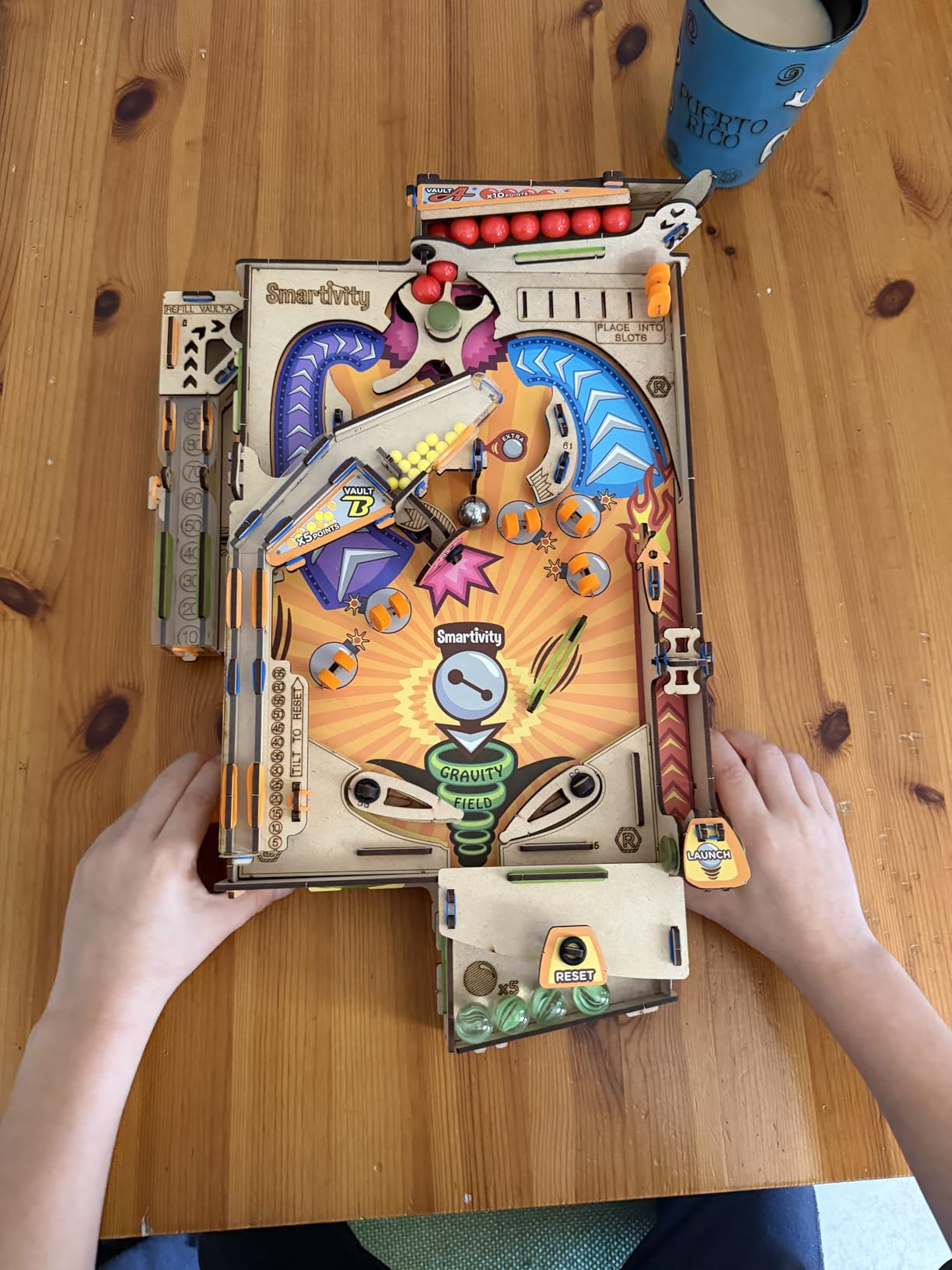
Most building sets are finished the moment they work. This one is finished when the child has spent two hours playing it, and that difference is why it earns a place. The finished machine has a spring launcher, working flippers and scoring targets, powered by rubber bands with no batteries involved, and the levers, springs and ramps are all visible enough that a child can see why the ball does what it does.
The instruction manual is the standout feature and the most-praised thing in reviews. It combines written steps with both front and back view photographs of each part, which removes almost all of the guesswork that spoils wooden kits. Families report children aged 7 and up completing it with supervision, while older children and teens often do the build solo.
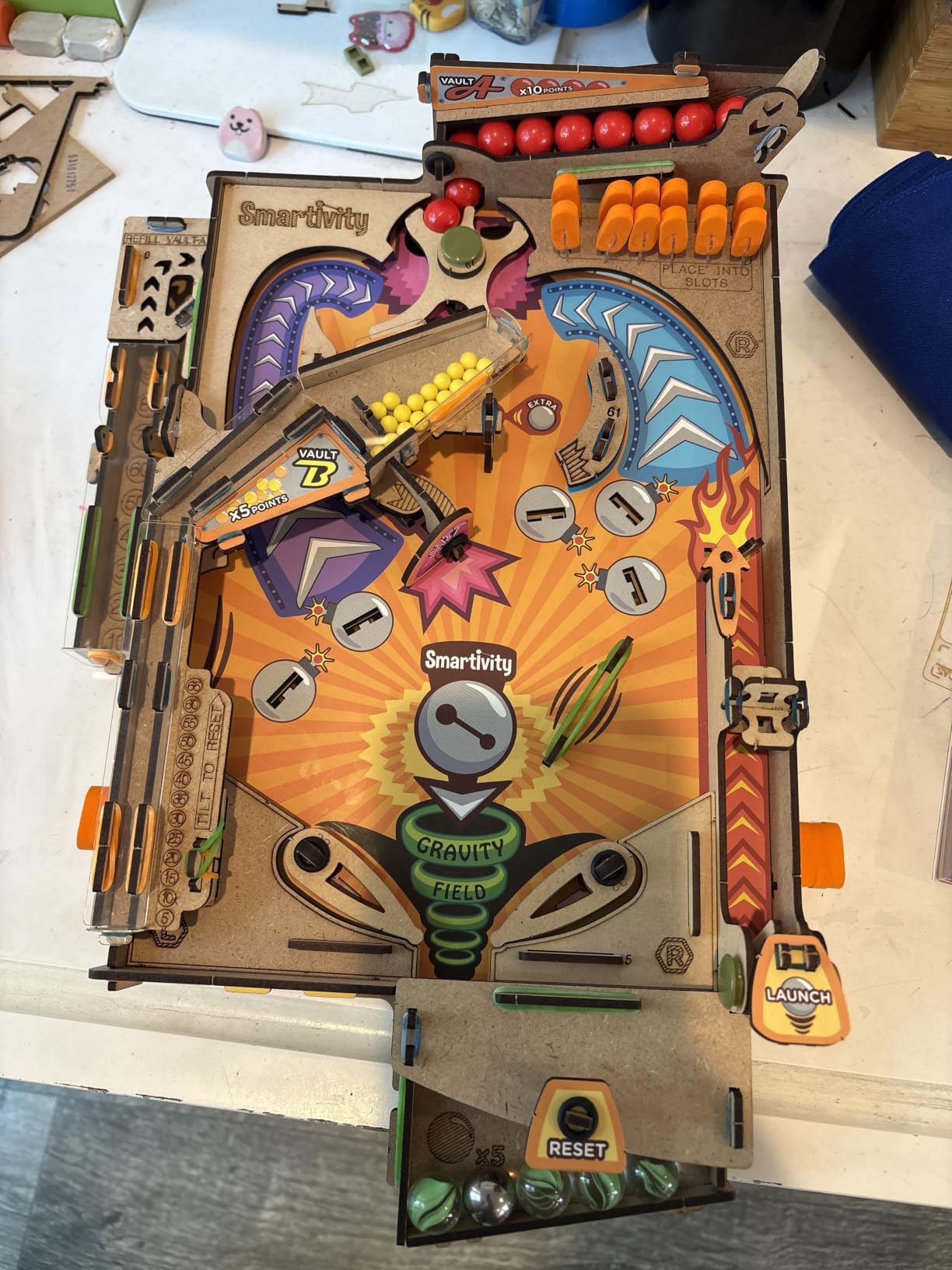
Plan the session properly, because the build runs several hours and the table footprint is 11 x 14.5 x 5.3 inches once complete. Younger children tend to lose interest partway through, so an adult should commit to finishing it with them or hand it to an older sibling. The other practical notes: hundreds of small pieces mean an assembly tray is worth having, rubber bands need replacing eventually, and there is no dedicated case for storage.
It carries a 4.5 rating from more than 3,200 reviews and ranks first in its Amazon miniature pinball category. The manufacturer recommends ages 8 to 14, supplies free replacement parts for life, and the listing extends the range to adults, which we would not read as a claim about the difficulty. The materials are sustainably sourced engineered wood at 529.5 grams.
Whether the build is finishable by an 8-year-old in one sitting
No, and planning for that is the whole trick. Break it into two or three sessions by module rather than by part, keep the built sections on a tray, and save the mechanism assembly for a calm afternoon. Done that way, most 8-year-olds finish it within a week without adult rescue.
Whether this is the best set to buy for a child who finishes things fast
It is the opposite problem, so read it carefully. This kit is built to be a long-term toy rather than a fast-finished challenge, which suits a child who has already worked through simpler kits and wants something that stays on the table. A child who wants a new build every weekend will get more from the Snap Circuits set in position 1.
10. Sillbird 12-in-1 Solar Robot – Best Budget STEM Building Set for 8 Year Olds
Sillbird 12-in-1 Solar Robot Building Kit STEM Gift for Boys Ages 8-13
190 parts
12 models
Solar powered
No batteries
ABS construction
Pros
- 12 models in one box with a large review base
- 12 models of increasing difficulty
- No batteries to buy or replace
- Clear step-by-step instructions for independent building
Cons
- Lowest rating in this group with a 6 percent one-star share
- Solar output drops in dim or indoor conditions
- Thin ABS parts are less durable than wood or metal
- Manufacturer recommends ages 10 and up
At the entry point of this roundup, the Sillbird solar kit does something the others do not: it runs without batteries at all. A larger solar panel converts light into power, so there is nothing to buy, nothing to replace and no charging cable to lose. Outdoors in sun it works properly, and indoors it runs under a strong artificial light such as a flashlight.
That is 190 parts and 12 buildable models arranged in rising difficulty, so the first robot is a two-minute assembly and the last one is a real project. The step-by-step instructions are clear enough that reviewers commonly describe kids building independently. At 10.24 x 7.87 x 2.56 inches it also packs into a smaller box than most kits here, which matters on a tight table.
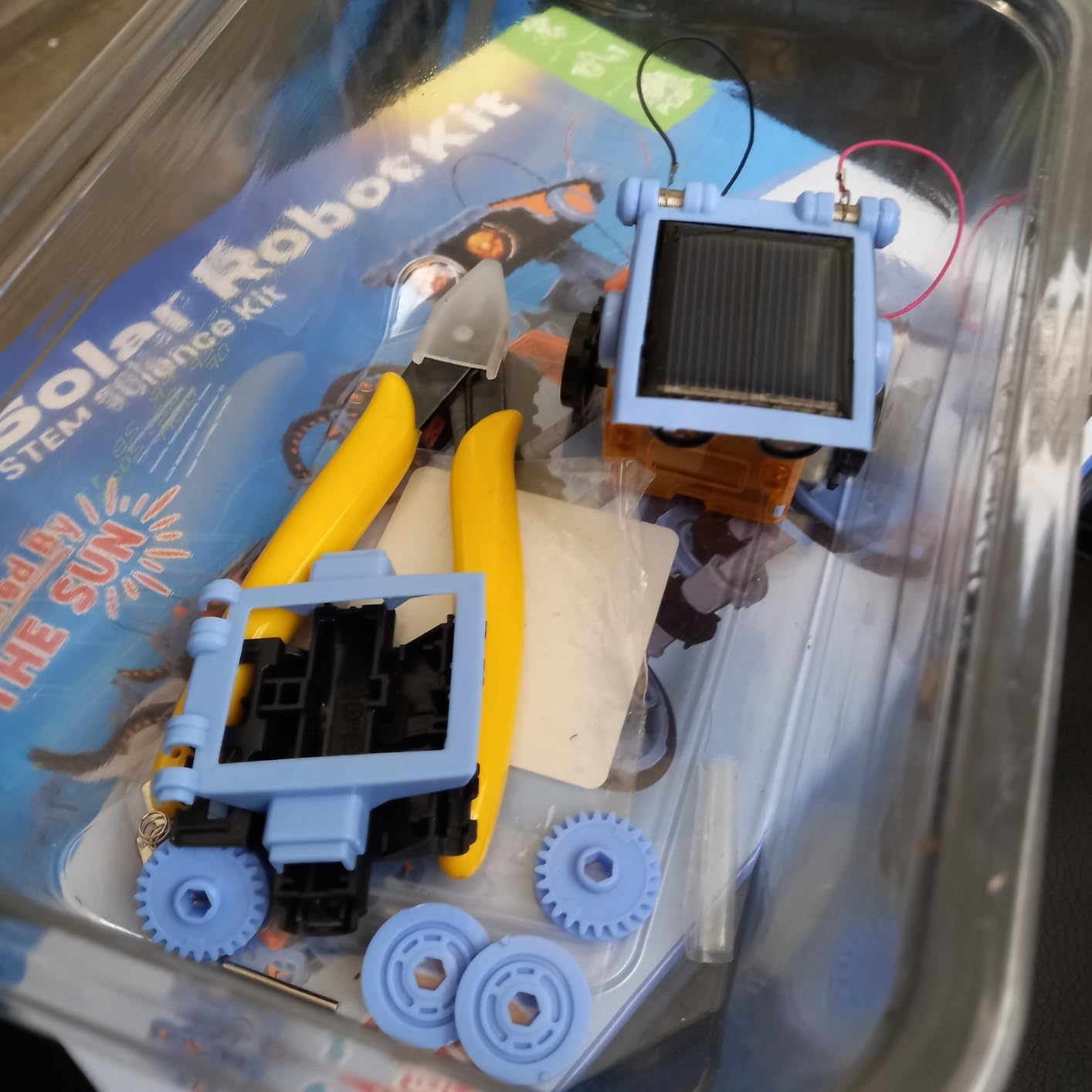
We are rating this one lowest here, and the reasons are consistent across reviews. The rating is 4.3 with a 6 percent one-star share, the only kit in the group below 4.5. Output drops noticeably in dim conditions, so an indoor play session on an overcast afternoon will disappoint. The parts are thin ABS, which wears faster than the wood and heavy plastic in the kits above, and the manufacturer lists it for ages 10 and up even though the box markets younger children.
That last point matters more than the rating does. A ten-year-old will handle the later models comfortably. An 8-year-old will manage the first six or seven and then need help, which is a good deal less generous than the 12 models on the box suggest. Its 15,900 reviews are the second largest count in this roundup, and 67 percent are five-star, so most owners are happy with what they get for the money.
Whether this is a good first robotics kit
It is a good first solar kit, which is a narrower claim. The first models teach the real lesson of a solar toy, which is that energy comes from somewhere and the source matters. Everything past model seven needs more precision than a first-time builder typically has.
How to get more from it than twelve models
Treat the models as a difficulty ladder rather than a checklist, and stop at the last one the child finishes without help. Cross it with the Snap Circuits set in position 1: a solar-driven motor driving a circuit the child wires themselves produces experiments that neither kit offers alone, and costs no extra hardware.
What an 8-Year-Old Can Actually Build Alone
Three questions decide whether a kit works at this age: how much force a connector needs, how small the smallest part is, and whether the manual can be followed without narration. Those three questions predict abandonment better than the age rating printed on the box.
Force is the biggest one. A grid-based system like Snap Circuits needs a firm press and nothing more. A rod-and-connector system, of the kind used by many kits rated 5+ to 7+, asks an 8-year-old to push a rod perpendicularly into a connector, and the same force breaks the piece. Parents describe that step as harder than unscrewing a jar lid, which is a fair way to describe what a 7-year-old is up against. Magnetic tiles avoid the problem completely.
Instruction format is the second. A manual made of photos, like the Smartivity pinball machine or the Snap Circuits Jr. booklet, is followable by a child who is still learning to read fluidly. A manual of line diagrams, like the Da Vinci catapult and the Thames and Kosmos structural set, needs a fluent reader or a nearby adult. A box with no assembly directions at all, like the marble run, suits a child who prefers to invent.
Our rule of thumb for solo play: magnetic tiles, Snap Circuits Jr. and the solar robot can all be handed over unassisted. Marble runs, the hydraulic launcher and the pinball machine work solo after the first build. The bridge set, the brick and circuit hybrid and the wooden catapult all need an adult nearby for the first few sessions, and often for good.
5 STEM Projects an 8-Year-Old Can Actually Finish
Each of these uses a kit from the list, names the finished result, and gives an honest build time. They are ordered by how reliably an 8-year-old completes them.
- A working doorbell circuit using the Snap Circuits Jr. in position 1. Build time is about fifteen minutes, and the result makes a real noise when a child presses the button. This is the ideal first circuit because there is no way to go wrong.
- A five-layer magnetic tower using the MAGBLOCK set in position 2. Twenty to thirty minutes, and the interesting part is discovering which base footprint will not fold. Then knock it over on purpose and rebuild it.
- A glow-in-the-dark race lane using the National Geographic marble run in position 3. Charge the marbles on the LED unit, build a run that finishes in the dark, and time it with a kitchen timer.
- A working catapult that hits a paper target using the Da Vinci set in position 6. Forty-five minutes for the catapult alone, and it is the one to start with rather than the bombard. Expect an adult nearby for the diagrams.
- A robot that walks a taped floor line using the Henoda robot in position 8. Two hours for the build, then five minutes of path-mode programming to get it to follow the line. The debugging is the actual lesson.
Two things these have in common. Each one ends in something the child physically operates, and each one produces a failure that is cheap and fast to correct, which is the condition under which trial and error actually teaches anything.
How to Choose a STEM Building Set for an 8-Year-Old
Start with the category that matches a behaviour you have already seen, not with the most advanced kit available. Parents say the same thing consistently: the best STEM toy is the one the child picks back up unprompted, and buying ahead of the child is the most reliable way to get a kit ignored.
Structural engineering is bridges, towers and load tests. It suits a child who asks why something fell and wants to make it not fall. Structural kits need more force and more patience than the box implies, so they work best as a second or third kit rather than a first.
Electronics and snap circuits are the broadest category and the safest starting point. Pieces seat without force, manuals can be photo-driven, and a hundred projects mean a year of content. The limitation is part count, since most kits in this range carry around 20 to 30 modules and reuse them.
Robotics and coding is where children ask for programmable behaviour. Check whether the kit works with a handheld remote before you commit, because that determines whether it is a screen-free toy or a screen-based one wearing a toy shape. Also check that the programming depth is real, since a shallow app interface wears out fast.
Magnetic tiles give the highest early success rate and the easiest sharing between two ages. They are the best answer when an 8-year-old shares a set with a 4-year-old, and the weakest answer when a child wants a specific finished machine.
Marble runs and chain reactions are kinetic and forgiving, and they teach stability by failure. The limitation is structural wobble, and the fix is always more base pieces rather than more track.
Wooden and paper engineering gives a finished object that looks handmade and often holds a place of honour on a shelf. Expect fragile components, thinner instructions and longer builds. If you build props of your own, our hot glue gun guide covers the low-temperature options that keep balsa and thin ply from splitting.
On the 7+ versus 8+ versus 10+ rating question, buy one notch below the child’s age when they are at the younger end of eight. A kit labelled 10+ is usually pushing reading load and part size rather than concepts, and a kit labelled 7+ usually leaves a year of use on the table. A 7+ kit for a confident 8-year-old is also the cheapest fix for a child who abandons hard things quickly.
On piece count, more is not always more. A 200-piece set that produces two or three finished models can outlast a 600-piece set whose models cannot exist at the same time. Ask whether the child prefers to complete one thing well or keep five things running, because the kits that promise a hundred models often supply enough parts for one 3D and one 2D model at a time.
What to avoid: a kit whose headline claim is a number of models with no photographs of the finished result, and any kit where the smallest part is loose rather than captive. Also avoid the kits marketed to 5-year-olds that need adult force to connect, since the frustration arrives long before the STEM does.
Before you buy, five questions: What skill does this target, and is that skill visible in the finished model? Can an 8-year-old read the instructions without an adult translating them? How much force does a connector need? Are spare parts available if something breaks? And what happens after the last suggested model is finished? A kit that cannot answer the last question is usually a kit that ends up in a cupboard.
Safety Certifications to Check Before You Buy
Look for ASTM F963 in the United States or EN71 in Europe on the packaging or the manufacturer’s own documentation. These are the toy safety standards that cover mechanical and physical properties, flammability and migration of certain elements, and a reputable kit should name its compliance rather than leave you to assume it.
Watch the small-parts warning seriously at this age. Kits that include loose marbles, tiny connectors or batteries are carrying a choking hazard for children under 3, which matters most in a mixed-age household. The MAGBLOCK set in position 2 includes full-size glass marbles for exactly this reason, and the fix is a rule about where those pieces live, not a guess.
Non-toxic materials are worth checking on any wooden or magnetic set. The MAGBLOCK tiles are described as lead-free ABS with smooth rounded edges, and the Henoda robot as non-toxic thick ABS, which are the specific claims to look for rather than a general statement that a product is safe. For kits with electrical components, budget the batteries, and check whether they are included before the first build.
Frequently Asked Questions
What are the best STEM kits for 8-year-olds?
The strongest options at this age are the Snap Circuits Jr. for 100+ circuit projects, the MAGBLOCK 176-piece magnetic set for tower and marble play, and the National Geographic glow-in-the-dark marble run for kinetic builds. Choose Snap Circuits Jr. if your child is new to electronics, magnetic tiles if they share a set with a younger sibling, and a marble run if they would rather invent than follow instructions. All three run screen-free and are rated for this age band.
What are some good STEM projects for 8-year-olds?
A working doorbell circuit, a five-layer magnetic tower, a glow-in-the-dark marble race, a paper-target catapult and a robot that follows a taped floor line are five that reliably get finished at this age. Each ends in something the child physically operates, and each fails cheaply and quickly, which is what makes the correction stick. Build times run from fifteen minutes to about two hours.
What is a good STEM kit for a 10-year-old?
At ten, a child can handle the reading load of a technical manual and the force needed for smaller connectors, which opens up structural and robotics kits. The Thames and Kosmos Structural Engineering set with 20 models and a 36-page experiment manual suits a ten-year-old well, as does a programmable robot with a proper coding app. Both are the natural upgrade from a first circuit kit rather than a replacement for it.
What is a good science experiment kit for an 8-year-old?
An experiment kit teaches by producing a measurable result, while a construction kit teaches by producing a structure that holds or a machine that moves. At eight, most children need the construction route first because the feedback loop is immediate. The marble run set works as a light experiment kit since the learning guide covers motion and aerodynamics, and a solar robot kit lets an 8-year-old test how light intensity changes power output.
How do I know if a building set is age appropriate?
Check three things rather than the age label alone. First, how much force a connector needs, because a kit asking an 8-year-old to push a rod perpendicularly into a socket will get broken and abandoned. Second, whether the manual uses photographs or line diagrams, since a child who cannot yet read fluently can follow photos. Third, whether the smallest part is loose or captive. Buying one notch below the age band is a safe default.
Our Final STEM Building Set Verdicts
The Snap Circuits Jr. SC-100 is our pick for the best STEM building sets for 8 year olds, because it is the one an 8-year-old can finish alone, at 100+ projects, without breaking a single part. Where a child shares a set with a younger sibling, the MAGBLOCK magnetic set is the better tool, and where the finished object matters more than the process, the Smartivity pinball machine is hard to beat.
One honest note before you buy. Check the age rating against the child rather than the year, choose one notch down if they are at the younger end of eight, and pick the kit that produces something the child can operate, not the one with the longest model list. The 2026 roundup changes every year; the pattern of what gets built on a Saturday afternoon does not.