
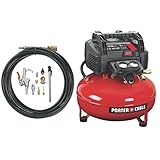
For a typical one or two-car home garage, the best air compressor for the job is the PORTER-CABLE C2002-WK 6-gallon pancake. It delivers 2.6 SCFM at 90 PSI, tops out at 150 PSI, weighs 30 lbs and carries 2,404 owner reviews at a 4.6-star average, which makes it the most proven small-garage machine on this list. If you need more airflow, step up to the Metabo HPT EC914S at 4 CFM and 200 PSI. If noise is the deciding factor because the garage sits under living space, the California Air Tools 8010A runs at 60 dBA.
I spent weeks working through the specs, owner reviews and failure reports for every compressor in this roundup, then sorted them by what actually breaks a weekend project: airflow at working pressure, not peak horsepower, and tank size only second. That is the same order experienced owners on r/Tools insist on, where the advice repeats almost verbatim: get the highest CFM you can afford, because horsepower and tank gallons are marketing numbers next to it.
Everything below is a real unit with published ratings and review counts, and I flag the complaint patterns that appear again and again rather than repeating the marketing line. If you want the wider category covered, our guides to the best air compressors for pneumatic tools and the best air compressors for framing nailers go deeper on airflow sizing.
Table of Contents
Top 3 Picks for Garage Air Compressors in 2026


Every Compressor in This Roundup at a Glance
The table below lists CFM at 90 PSI, tank capacity and the detail that decides each purchase. CFM is cubic feet per minute of free air delivered at 90 PSI, the pressure most pneumatic tools run at.
| Product | Specifications | Action |
|---|---|---|
| PORTER-CABLE C2002-WK Pancake |
|
Check Latest Price |
| Metabo HPT EC914S Pancake |
|
Check Latest Price |
| California Air Tools 8010A |
|
Check Latest Price |
 Klutch 20-Gallon Vertical Klutch 20-Gallon Vertical |
|
Check Latest Price |
 VEVOR 6.3 Gallon VEVOR 6.3 Gallon |
|
Check Latest Price |
 Stealth 20 Gallon SAQ-12018 Stealth 20 Gallon SAQ-12018 |
|
Check Latest Price |
 Craftsman 20 Gallon Oil-Free Craftsman 20 Gallon Oil-Free |
|
Check Latest Price |
 DEWALT 27 Gallon DXCM271 DEWALT 27 Gallon DXCM271 |
|
Check Latest Price |
 Craftsman 6 Gallon Pancake Craftsman 6 Gallon Pancake |
|
Check Latest Price |
 VEVOR 13 Gallon VEVOR 13 Gallon |
|
Check Latest Price |
1. PORTER-CABLE C2002-WK Pancake Compressor – The Most Proven Small-Garage Pick
Black & Decker/dewalt C2002-WK Pancake Compressor
2.6 SCFM at 90 PSI
6 gallon pancake tank
150 PSI max
30 lbs
120V oil-free
Pros
- Most reviewed compressor in this roundup at 2404 ratings
- Light enough to carry one-handed at 30 lbs
- Low-amp 120V motor starts on an extension cord
- Two factory-installed regulated couplers
- 13-piece accessory kit in the box
Cons
- 82 dB is loud for a small machine
- 2.6 SCFM and 150 PSI cap it at trim and finish work
- Six gallons drains fast with a pneumatic tool
This is the compressor I recommend first because the failure rate people report is the lowest I found in the group. With 2,404 ratings averaging 4.6 stars and 78 percent of those at five stars, it has been through enough owners to have a settled reputation rather than a burst of early enthusiasm.
The C2002-WK is a 6-gallon pancake running 150 PSI maximum pressure and 2.6 SCFM at 90 PSI measured to ISO 1217. That flow number is honest for the class. It will run brad and finish nailers, inflate tires, blow dust off bench tools and feed a small orbital sander for short passes.
The pump is oil-free, so there is no oil change and no oil in the airstream, and the low-amperage 120V motor is one of the reasons it starts without tripping a 15A breaker even when run off an extension cord. Two factory-installed regulated couplers mean you can hang two hoses off it without hunting for a splitter.
Reviewers also like that the shroud, handle and console cover feel like they were designed to be carried around, and the 13-piece accessory kit covers inflation and cleaning tasks out of the box. At 30 lbs it moves between the garage and a truck bed easily.
What CFM You Actually Get From This Machine
At 2.6 SCFM, this unit sits in the light-duty band. A finish or brad nailer pulls well under that, so nailing never stalls. An impact wrench wants a sustained 4 CFM, so you will hear the tank pause and the wrench cycle between bursts. A DA sander wants 6 CFM, and this is not the machine for it.
That 1.5x sizing rule matters here. If your loudest continuous tool needs 4 CFM, aim for at least 6 CFM and a bigger tank. The C2002-WK is honest about being the entry tier, and buyers who push past its limits are the ones who return it.
When the 82 dB Rating Will Bother You
The 82 dB figure is the real drawback and it is not subtle. In a detached shop with the door open you can hold a normal conversation nearby. In an attached garage with a bedroom above it, you will hear every cycle, and running it for an hour is genuinely tiring.
Placing it on a rubber isolation mat and pushing it into a far corner cuts the low-end hum noticeably. If the noise itself is a dealbreaker rather than a nuisance, the California Air Tools 8010A at 60 dBA is built for that situation instead.
2. Metabo HPT EC914S Pancake Compressor – Best Flow in a 6-Gallon Body
Metabo HPT Portable Pancake Air Compressor, 6 Gallon 200 PSI, EC914S
4 CFM at 90 PSI
200 PSI max tank pressure
6 gallon tank
73 dB
42 lbs
Pros
- 4 CFM at 90 PSI runs several framing nailers at once
- 200 PSI is the highest ceiling in the pancake class
- Fast recovery keeps nailers cycling without pauses
- Oil-free pump runs at any angle and needs no service
- Built-in handle and 42 lb weight move easily
Cons
- Louder under load than the 73 dB spec suggests
- 6 gallons still means recovery waits on sustained work
- Output drops noticeably at high elevation
If a framing gun is your most-used air tool, this is the pancake that changes the experience. The EC914S delivers 4 CFM at 90 PSI from a 6-gallon tank, which is a 30 percent airflow gain over typical units in the same body size, and it holds 200 PSI where most pancakes stop at 150.
That combination means it can drive two framing nailers, two roofing nailers, two siding nailers, three finish nailers or five brad guns at the same time according to the manufacturer. Even a single gun benefits, because the higher cut-in pressure means fewer motor restarts mid-shot.
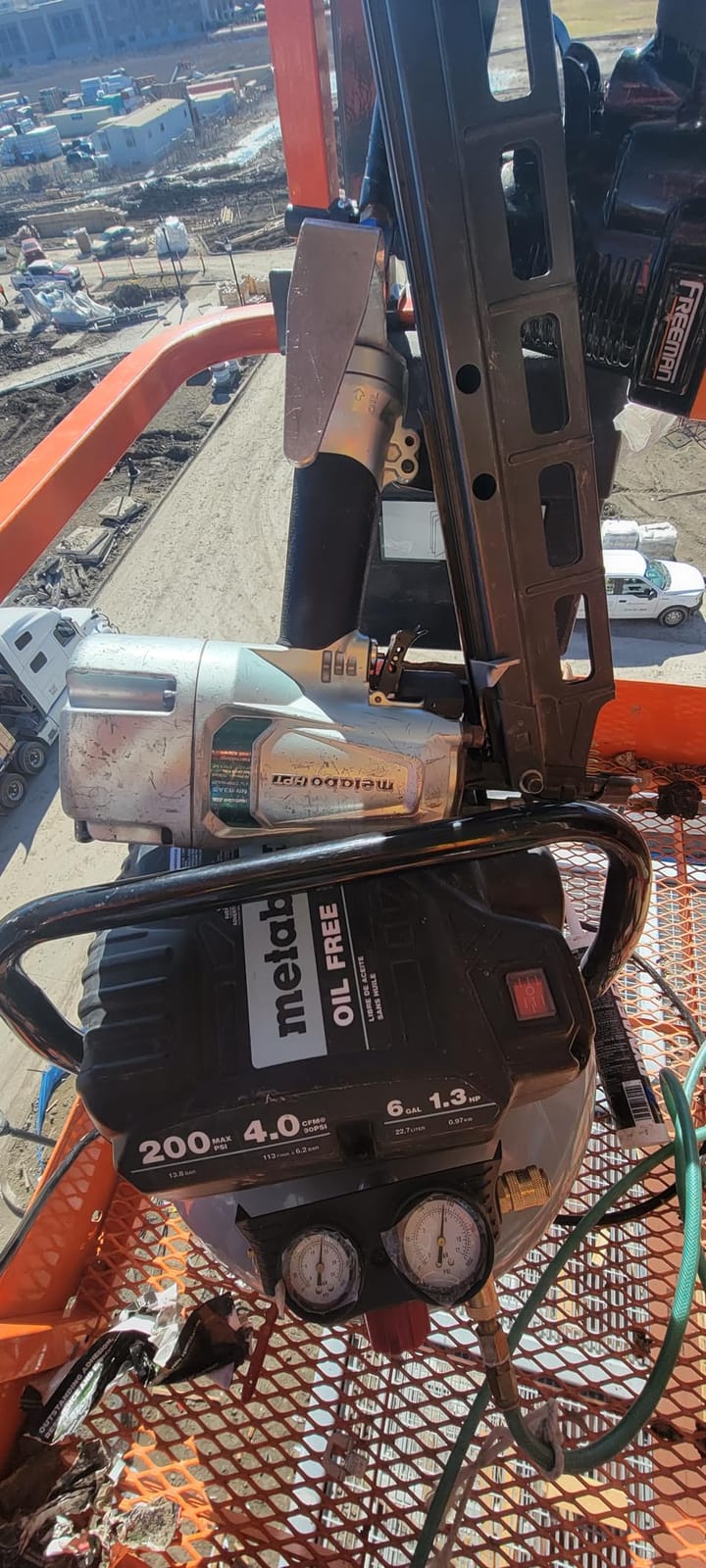
It is a Japanese-engineered unit from Koki Holdings America with a one-year warranty, an oil-free pump, a roll cage and a 42 lb weight that is 22 percent lighter than a comparable twin-stack. Our 10 best air compressors for framing nailers guide goes deeper on how CFM maps to nailer counts if you want the full picture.
The 73 dB specification is quoted as oil-free operation, and owners generally accept it as fair while noting the pump gets audible when it is working hard. If you plan to run framing guns for hours, headphones are worth budgeting for.
Why 200 PSI Reduces Cycling
Pressure is not the same as airflow, but a higher ceiling helps indirectly. With a 200 PSI tank and a 200 PSI cut-out, the usable band between cut-in and cut-out is wider, so the motor starts less often during a burst of nailing.
The flow number still caps what you can do. Four CFM covers framing and finish nailers well. It is thin for a DA sander and inadequate for a spray gun or sandblaster, so this is a nailing-first machine rather than an all-purpose one.
Altitude and Duty Cycle Limits
One owner at 5,300 ft reported tank fill stretching past four minutes, which is normal physics since thinner air means less air pushed per stroke. If you live at real elevation, treat the 4 CFM figure as an optimistic number and size up.
For flat-land homeowners, the EC914S is the strongest airflow-per-pound option here and the single best 6-gallon machine in this roundup.
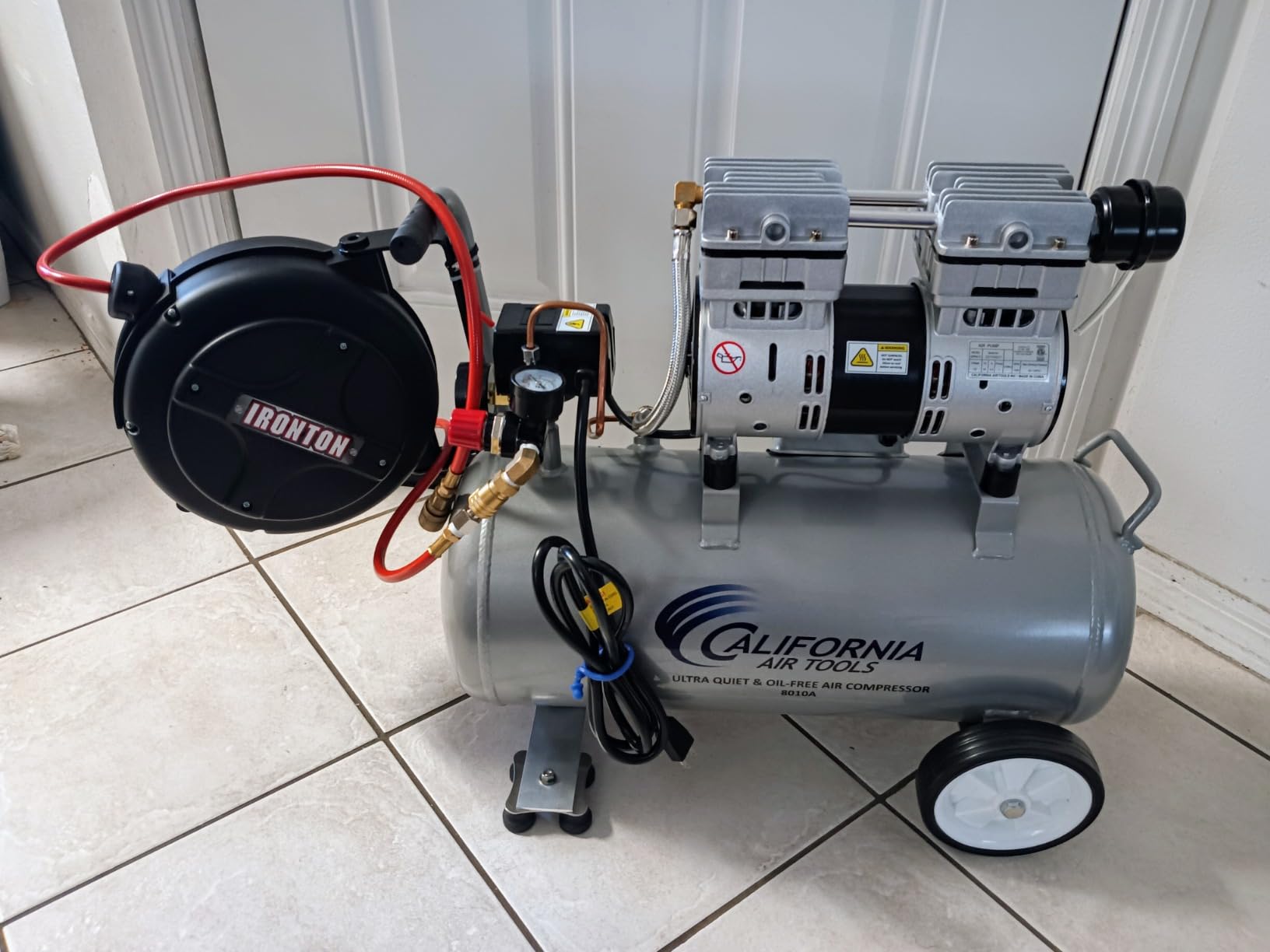
3. California Air Tools 8010A 8-Gallon – The Most Versatile Unit Here
California Air Tools 8010A 1.0 HP Ultra Quiet and Oil-Free Air Compressor, 8 Gallon Aluminum Tank, Lightweight with Wheels, 60 dBA Noise Level
60 dBA noise rating
8 gallon aluminum tank
2.2 CFM at 90 PSI
120 PSI max
37.3 lbs
Pros
- 60 dBA is the quietest rating in this roundup
- Aluminum tank at 37.3 lbs with a wheel kit
- Oil-free dual piston pump rated past 3000 hours
- 165 second fill and 60 second recovery
- Motor turns at 1680 RPM to cut noise and wear
Cons
- 120 PSI ceiling is low next to 175 and 200 PSI rivals
- 2.2 CFM limits it to detail and inflation work
- 8.5 A draw means it cannot share a heavy shop circuit
This is the highest-rated compressor in the roundup at 4.7 stars across 1,115 reviews, with 84 percent of those at five stars. Owners are almost unanimous about why: 60 dBA is low enough to run a compressor in a room without shouting over it, which no other machine here achieves.
The design choices behind that number are sensible. The 1.0 HP motor runs at only 1680 RPM, which reduces both noise and mechanical wear, and the oil-free dual piston pump is rated for more than 3,000 hours before it needs attention. An aluminum tank keeps the whole thing at 37.3 lbs with a wheel kit attached.
It also recovers from 90 PSI back to 120 PSI in 60 seconds and fills an empty tank in 165 seconds, so the small tank is not as limiting in practice as the capacity suggests for intermittent work.
Why the 120 PSI Ceiling Matters Less Than It Sounds
Most finish nailers, brad guns, airbrushing and tire inflators ask for 90 to 100 PSI. The 120 PSI maximum leaves headroom above that, so the low ceiling only becomes a problem if you plan to run a plasma cutter, a HVLP spray gun or sandblasting, all of which want 120 PSI and more.
The bigger limitation is flow. At 2.2 CFM at 90 PSI, this is the lowest airflow in the group, which is the direct trade for the silence. A DA sander at 6 CFM is out of reach.
Where This Machine Fits and Where It Does Not
Attached garages under bedrooms, apartment workshops, indoor hobby rooms and any space where a conversation has to keep going are exactly what this compressor was made for. Detail work, airbrushing, inflating and finish nailing are its natural range.
Skip it if you plan to strip a floor, run framing guns continuously or pressure-wash. The airflow simply is not there, and no amount of tank capacity fixes that. Note also that the 8.5 A draw means it wants a circuit that is not shared with a welder or a table saw.
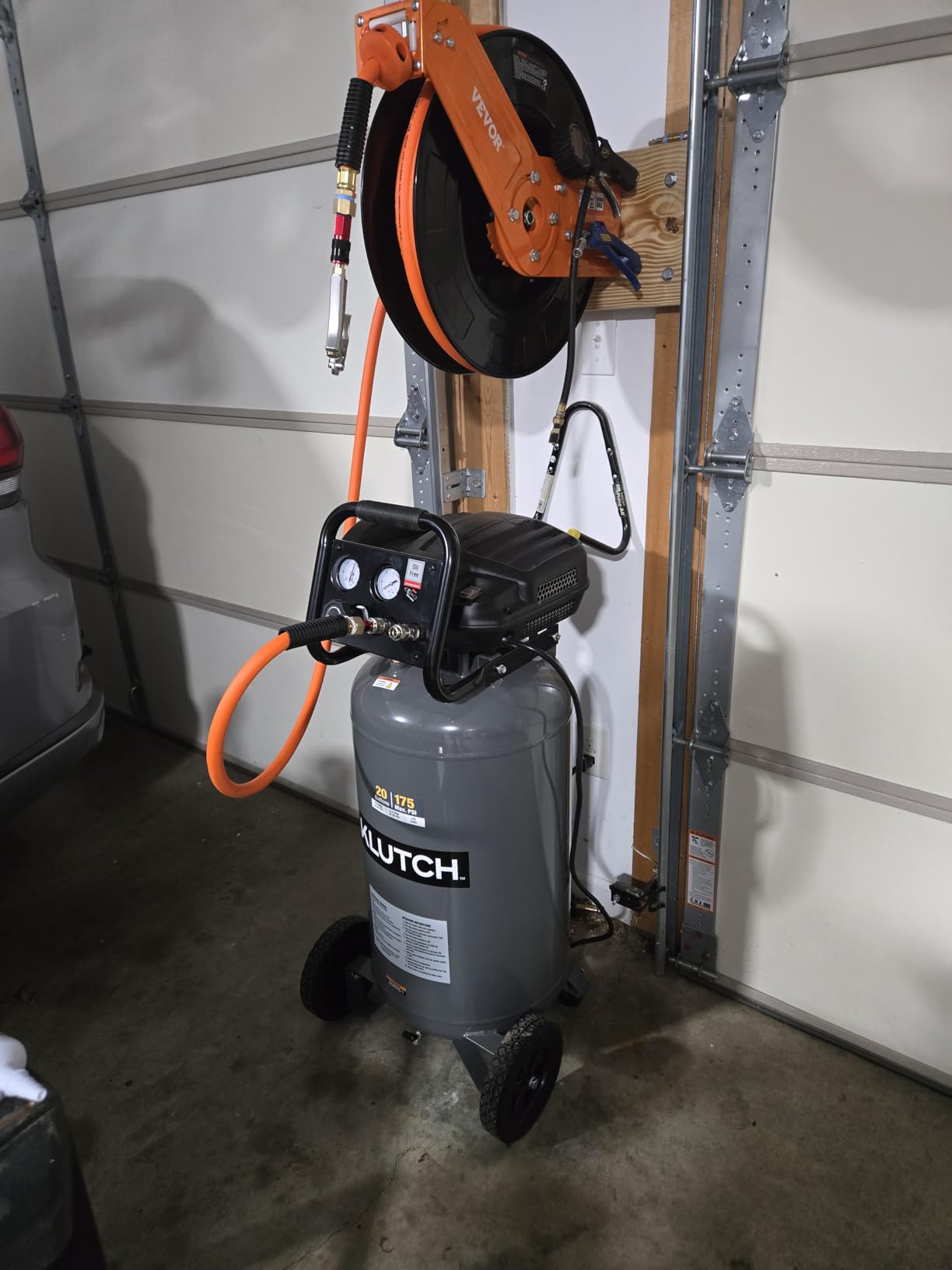
4. Klutch 20-Gallon Vertical Compressor – The 120V Shop Workhorse
Klutch 20-Gallon Air Compressor, 2 HP, 120V, 175 PSI, 4.2 SCFM at 90 PSI
4.2 SCFM at 90 PSI
20 gallon vertical tank
175 PSI max
120V, 75 percent duty cycle
90 lbs
Pros
- 20 gallon vertical tank finishes most jobs without a pause
- Vertical footprint saves floor space in a tight garage
- Runs on a standard 120V outlet with no dedicated circuit
- 75 percent duty cycle with thermal overload protection
- Large wheels and rubber foot stabilizers dampen vibration
Cons
- At 90 lbs it takes two people to move
- One detailed report describes a bypassed internal power switch
- Owners report actual airflow falling short of the rating
- 80 dB during operation
The Klutch is the closest thing here to a shop compressor that still plugs into a normal wall outlet. A 20-gallon vertical tank, 175 PSI maximum, 4.2 SCFM at 90 PSI and a 75 percent duty cycle put it in a class most 20-gallon machines never reach on 120V.
Owners consistently report it holding pressure for days with no measurable leaks, which points to good sealing on the tank and fittings. The vertical layout is a genuine advantage in a one-car garage, since it takes a narrow floor strip rather than a wide shelf.
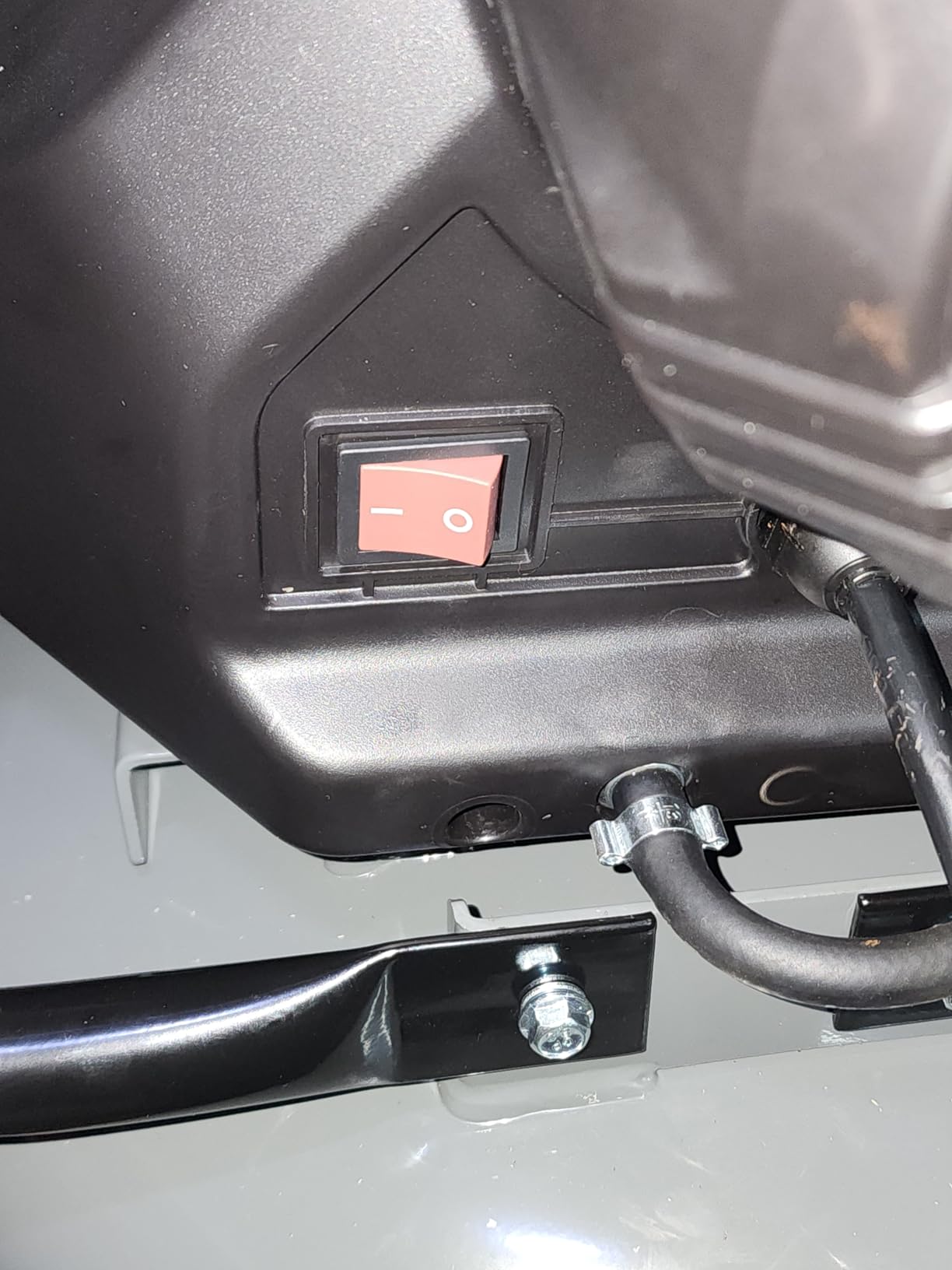
One safety note deserves a line of its own. A single detailed 1-star report describes a power switch that was internally bypassed and produced an arc flash. It is one review among 737, not a pattern, but it is cheap to test any compressor you buy: with the tank empty, confirm the switch actually interrupts power to the motor before you plug a tool into the outlet.
What 4.2 SCFM Will and Will Not Drive
Four CFM covers impact wrenches on half-inch fasteners, most finish and framing nailers, and light sanding. It will keep an impact wrench cycling through lug removal without long stalls because the tank is large enough to buffer the pauses.
It is still short for a DA sander at 6 CFM or a spray gun at 4 to 11 CFM depending on the gun. Several owners also report that real airflow reads lower than the label, which is common in this category and worth expecting.
Handling and Electrical Reality
Ninety pounds is a two-person lift, and the wheels only help on flat concrete. Plan the placement before you fill the tank, because moving a full 20-gallon unit is unpleasant work.
It draws up to 14 A, which is why the manufacturer specifies a standard 120V outlet with no dedicated circuit. That is a genuine advantage over 240V shop units if your electrical panel is where you would rather not run new wiring.
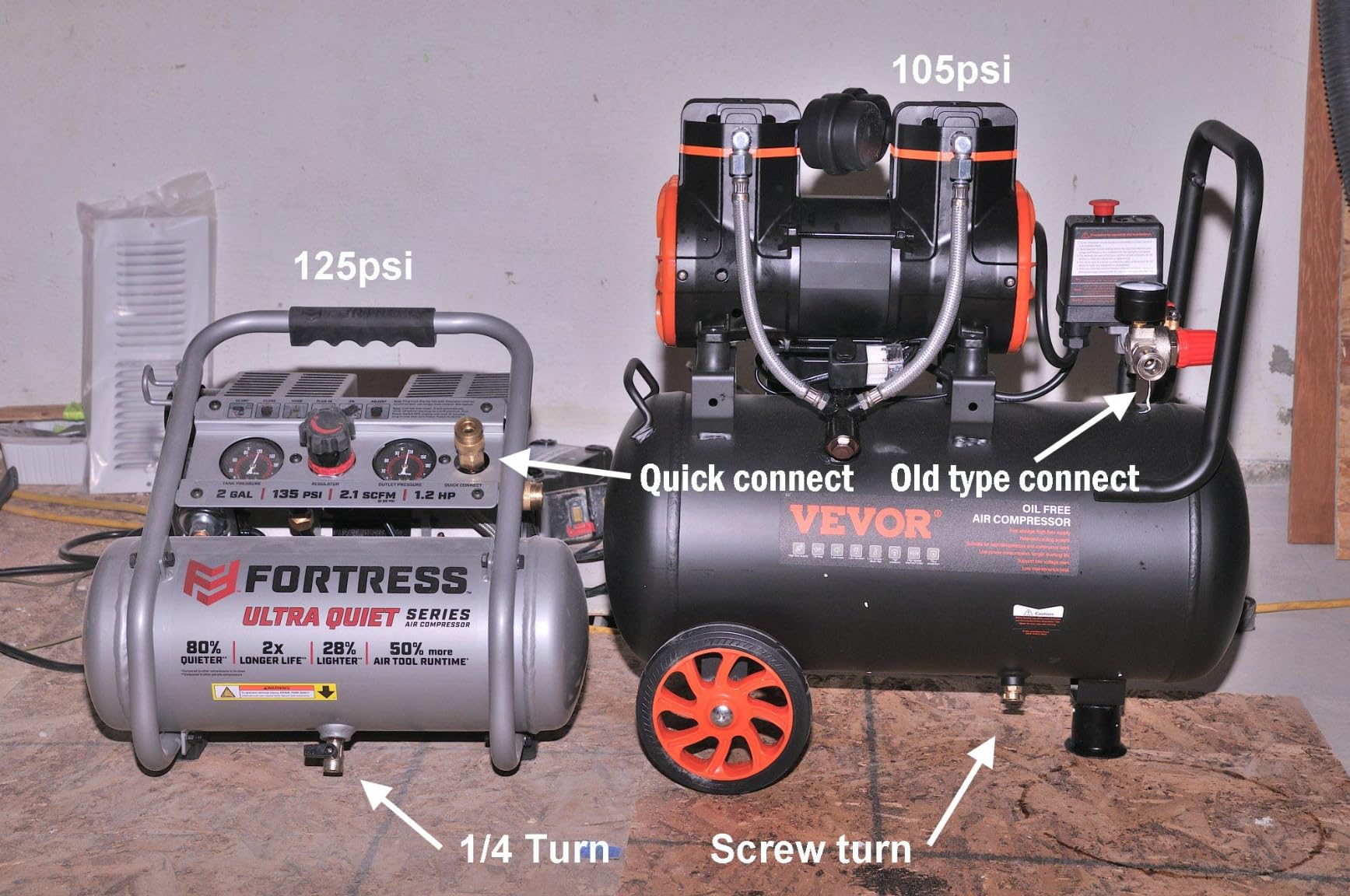
5. VEVOR 6.3-Gallon Compressor – The Budget Pick with Dual Silencers
VEVOR 6.3 Gallon 2 HP Air Compressor, Max 116PSI, Oil Free Compressor Tank
3.35 CFM at 90 PSI
6.3 gallon oil-free tank
116 PSI max
70 dB dual silencers
43 lbs
Pros
- 70 dB is quiet for the class thanks to two silencers
- Fills a near-full tank in about a minute
- Owners report it surviving drops and a tire exploding beside it
- Includes casters
- foot pad and silencers in the box
- Three-layer Q235B steel tank with automatic overheat protection
Cons
- Power cord is only about 40 inches
- Poor tolerance of extension cords and shared circuits
- Small casters let the unit tip when lifted by the handles
- One 1-star owner reported overheat shutdown on long spray work
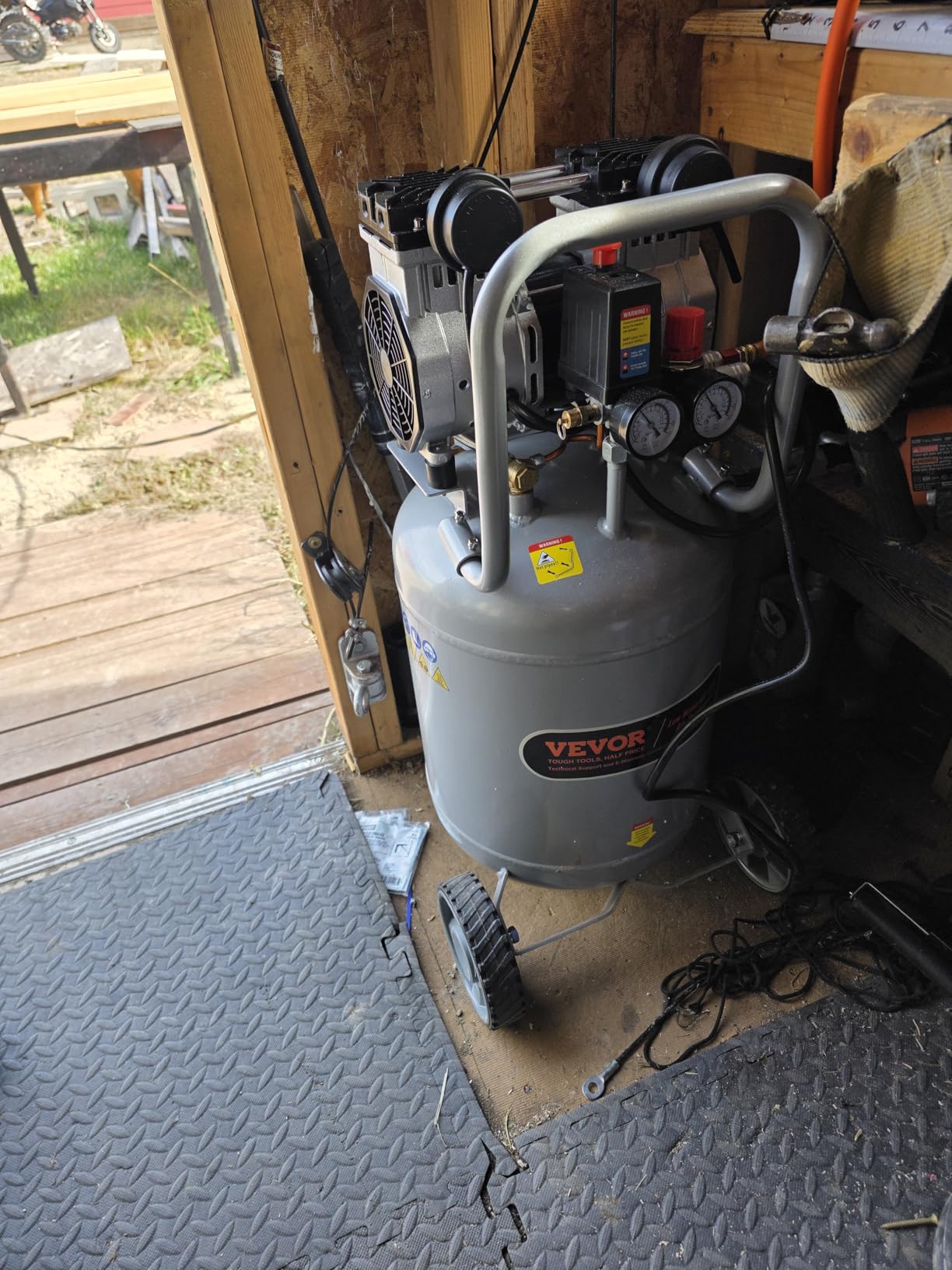
The VEVOR 6.3-gallon is the value pick in this roundup, and the surprise is how much capability sits in it. A 1450W oil-free motor at 3500 RPM delivers 3.35 CFM at 90 PSI, which is higher flow than two of the 6-gallon units above it.
The noise treatment is the standout. Two silencers with a thickened muffler cover, rubber pipe and filter cotton hold it to 70 dB, and reviewers across several countries call out the silence as the first thing they noticed. A 392 degree Fahrenheit silicone intake pipe with stainless steel braided mesh is also a level of detail you rarely see.
Durability reports are surprisingly good. Owners describe the unit surviving drops, impacts and even a tire exploding beside it, and the three-layer tank construction of a wear-resistant layer, powder coat and Q235B structural steel backs that up.
The Cord Is the Real Weakness
At roughly 40 inches, the power cord is far too short to reach a wall outlet from a workbench. That single detail causes most of the complaints in the reviews, along with poor tolerance of extension cords and shared circuits, which push the 14.5 A draw into trouble.
Our advice is to plan the layout around the outlet rather than the bench. If the compressor has to live at the far end of the garage, this is the wrong machine.
Where the Headroom Stops
Maximum pressure is 116 PSI, which is fine for nailing, inflating and cleaning but low for spraying. Three CFM also puts a DA sander and most spray guns out of reach, and one owner reported an overheat shutdown during long spray work.
For a garage that needs brad nailers, tire inflation and cleanup, this is a lot of compressor for the money.
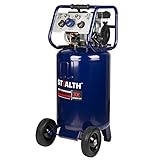
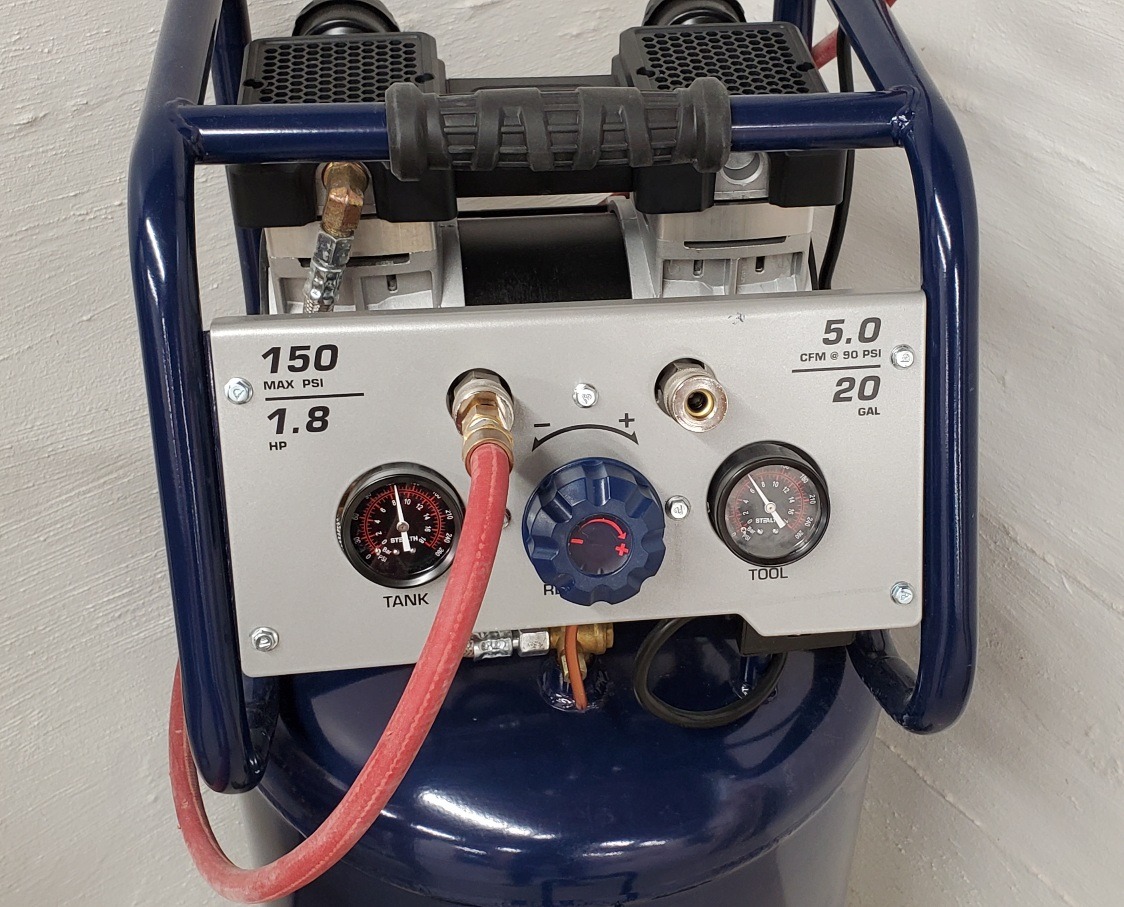
6. Stealth 20-Gallon SAQ-12018 – Quiet 20-Gallon Power
Stealth 20 Gallon Ultra Quiet Air Compressor,1.8 HP Oil-Free Peak 150 PSI 68 Decibel, 5.5 CFM @ 40 PSI 5 CFM @ 90 PSI Silent Long Life Electric Air Compressor W/Wheel for Garage
5 CFM at 90 PSI
20 gallon alloy steel tank
68 dB
1.8 HP oil-free
121.4 lbs
Pros
- 68 dB with 5 CFM at 90 PSI is a rare combination
- Tank is far easier on tools than a 6-gallon pancake
- Owners report a large drop in noise from older compressors
- Backed by a limited lifetime warranty
- Holds air well over long storage periods
Cons
- At 121 lbs it is the heaviest machine in the roundup
- Will not start against a charged tank on undersized wiring
- Sandblasting is not possible on 120V wiring
- One 1-star report of an early breaker-tripping failure
This is the combination I would look at hardest if noise and tank size both matter. Five CFM at 90 PSI from a 20-gallon tank at 68 dB is a pairing that most quiet units cannot reach, and the 1.8 HP oil-free motor gives it real recovery.
Owners comparing it against older compressors describe the change as a soft purr instead of clatter, with measured readings between 65 and 78 dB depending on distance. The build quality, paint finish and rubber tires are consistently called out as feeling solid, and the limited lifetime warranty is the strongest coverage in this group.
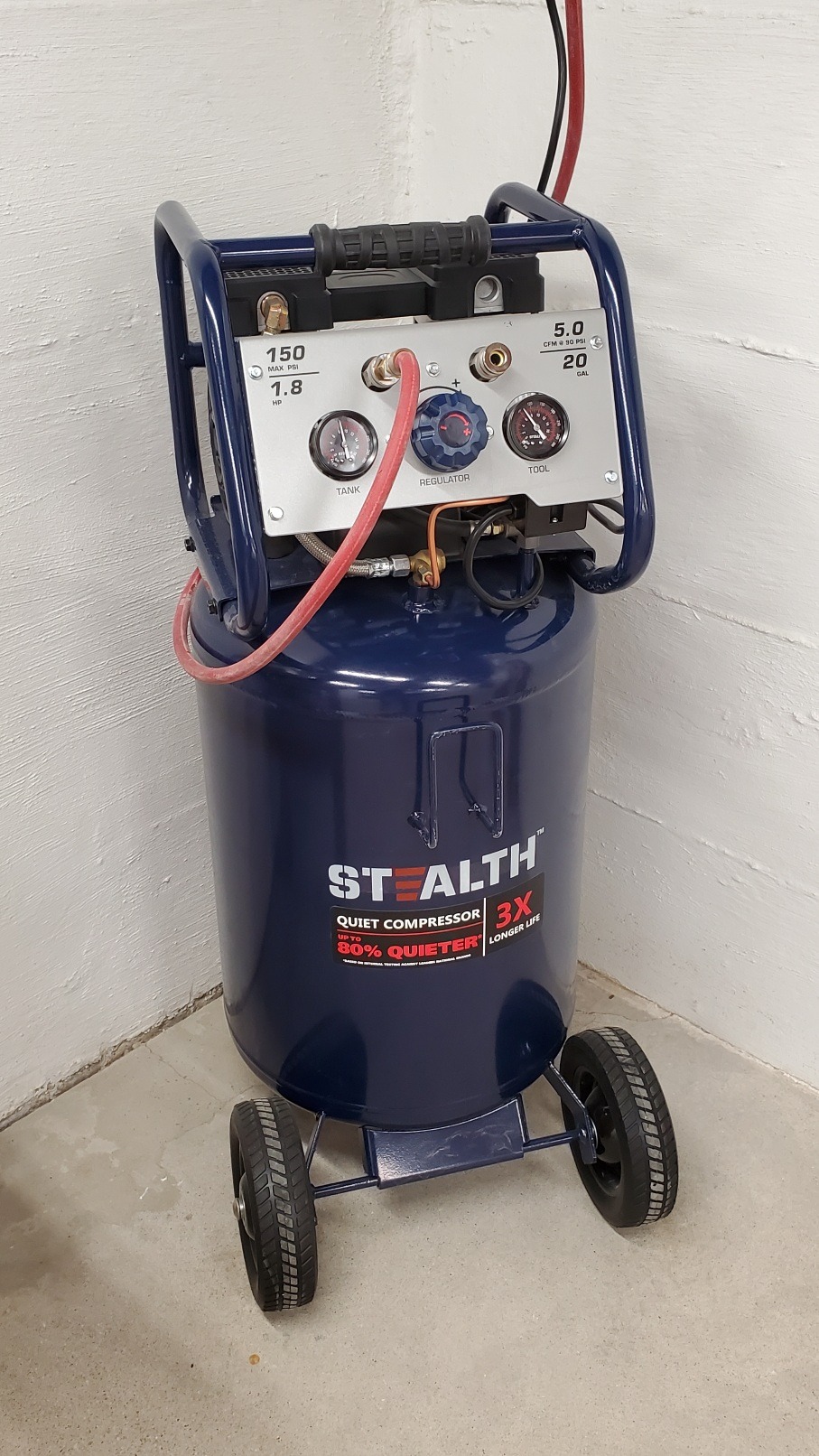
The 20-gallon tank is the second real advantage. A large tank absorbs short bursts of high demand, so a framing gun or impact wrench does not have to wait on recovery the way it would on a 6-gallon pancake.
Weight and Wiring Are the Trade-Offs
At 121.4 lbs this is the heaviest unit here, and getting it into a truck bed is a two-person job. Vertical dimensions of 20 by 18 by 42 inches mean it also has a real footprint once it is full.
The wiring point matters more. Owners report that it will not start against a charged tank on undersized wiring, so the tank has to be emptied first after a power interruption. If your garage has an older 15A circuit with long cable runs, budget for a wiring check before you buy.
When 12 Percent One-Star Reviews Matter
That figure is the highest in this roundup and it is not noise. It clusters around occasional early failure, breaker tripping within the first weeks, and one owner reporting that customer service could not be reached. Treat the warranty as genuinely valuable here rather than boilerplate.
Buy it if 68 dB and a 20-gallon tank are your two hard requirements. Skip it if you need sandblasting capacity, which 120V wiring cannot deliver.
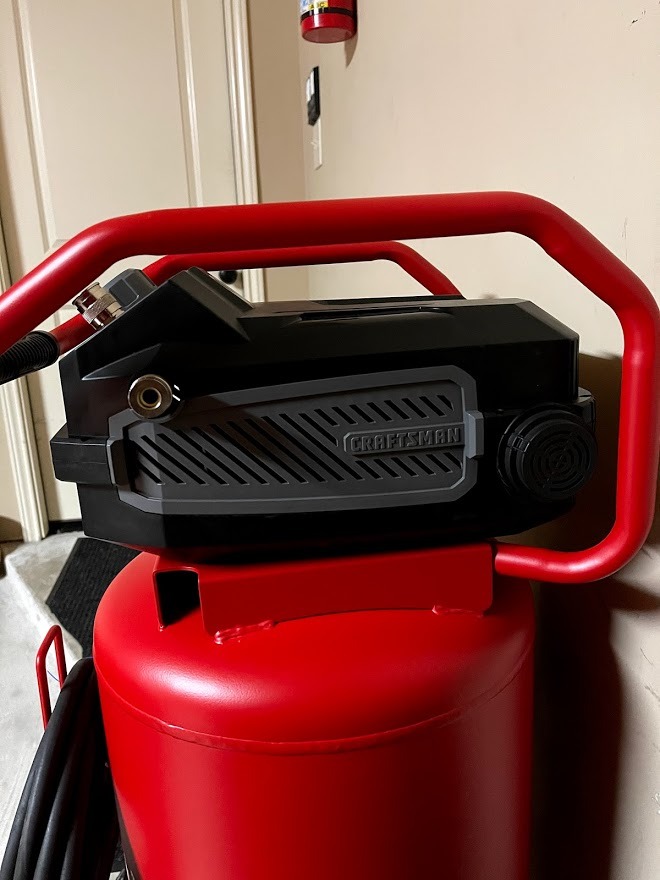
7. Craftsman 20-Gallon Oil-Free Compressor – Big Tank, Two Couplers
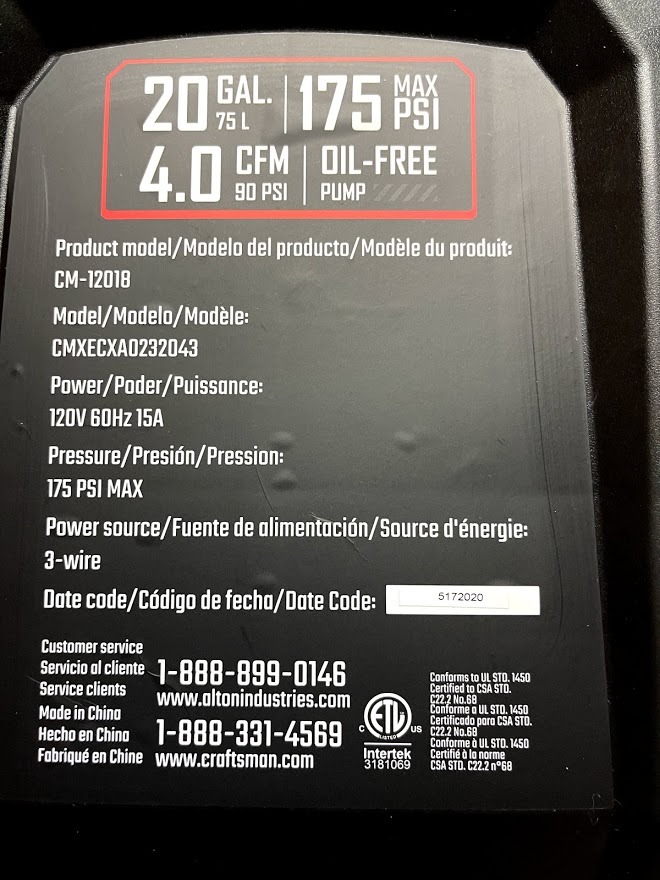
Craftsman Air Compressor, 20 Gallon Oil-Free 1.8 HP Max 175 PSI Pressure Two Quick Couplers Big Capacity, Red- CMXECXA0232043
4 SCFM at 90 PSI
20 gallon stainless steel tank
175 PSI max
1.8 HP oil-free
two couplers
Pros
- 20 gallon stainless steel tank at 175 PSI stores real air
- Two quick couplers let two tools run at once
- Oil-free pump means no maintenance and no oil in the airstream
- Rubber feet reduce vibration and floor wear
- Wheels
- drain valve
- filter and cord all included
Cons
- 80 dB is loud for a garage and indoor workshop machine
- 4 SCFM is modest for a 20-gallon tank and can starve sanders
- Only a 6 foot power cord
- One-year warranty is thin for this tier
The Craftsman 20-gallon is a familiar name in a garage for a reason, and this model is a stainless steel tank with 175 PSI and 4 SCFM at 90 PSI. Two factory quick couplers let two tools run at the same time, which is a small detail that decides whether you are swapping hoses or working.
Owners value the large tank, the stainless construction and the fact that the oil-free pump needs no service and keeps oil out of the airstream, which matters if you are ever spraying or running a pneumatic sander. The package includes a 6 ft cord, ball drain valve, plastic filter, two couplers and two rubber wheels.
Why 4 SCFM Feels Small in a 20-Gallon Tank
This is the mismatch owners complain about most. A 20-gallon tank suggests serious capacity, but the pump only delivers 4 CFM, so the tank refills quickly during sustained work. Sanders and spray guns can starve even though the tank volume looks generous.
Compare it with the Stealth 20-gallon at 5 CFM and 68 dB, which covers the same tank size with more flow and far less noise. If both fit your space, the Stealth is the stronger machine on paper.
Noise, Cords and Warranty Math
Eighty decibels is genuinely loud for something sold for garage and indoor workshop use, and this is the second-loudest compressor in the roundup. Only the two 6-gallon pancake units at 82 dB are worse.
The 6 ft cord is short for most garages and the one-year warranty is the shortest meaningful coverage here. Neither is disqualifying, but they are reasons the machine sits in the middle of the pack rather than the top.
8. DEWALT 27-Gallon DXCM271 – The Longest Run Times
DEWALT 27-Gallon Vertical Portable Air Compressor (DXCM271.COM)
5.1 SCFM at 90 PSI
27 gallon vertical tank
200 PSI max
1.7 HP, 120V / 15A
78 dBA
Pros
- Largest tank in the roundup at 27 gallons for long run times
- Vertical design takes barely more floor space than a pancake
- 5.1 SCFM at 90 PSI is real airflow at working pressure
- 200 PSI at 120V can feed a plasma cutter
- Low-volt easy-start motor handles poor power conditions
Cons
- At 136 lbs it is the heaviest unit here
- Full fill from empty takes roughly 10 to 12 minutes
- Regulator only adjusts to about 160 PSI of the 200 PSI tank
- One owner found leaks at the safety valve fitting and tank hex nut
The DEWALT DXCM271 holds 27 gallons, the largest tank in this roundup, and pairs it with 5.1 SCFM at 90 PSI. Owners upgrading from a 6-gallon pancake describe it as a transformative capacity jump, because tools run for long stretches before anyone waits on a refill.
It is a single-stage, direct-drive, oil-free design with a 1.7 HP motor drawing up to 15 A on 120V. The low-volt easy-start motor is designed for unreliable supply, and 200 PSI at 110V is enough to run a plasma cutter without a 220V circuit, which is unusual in this size class.
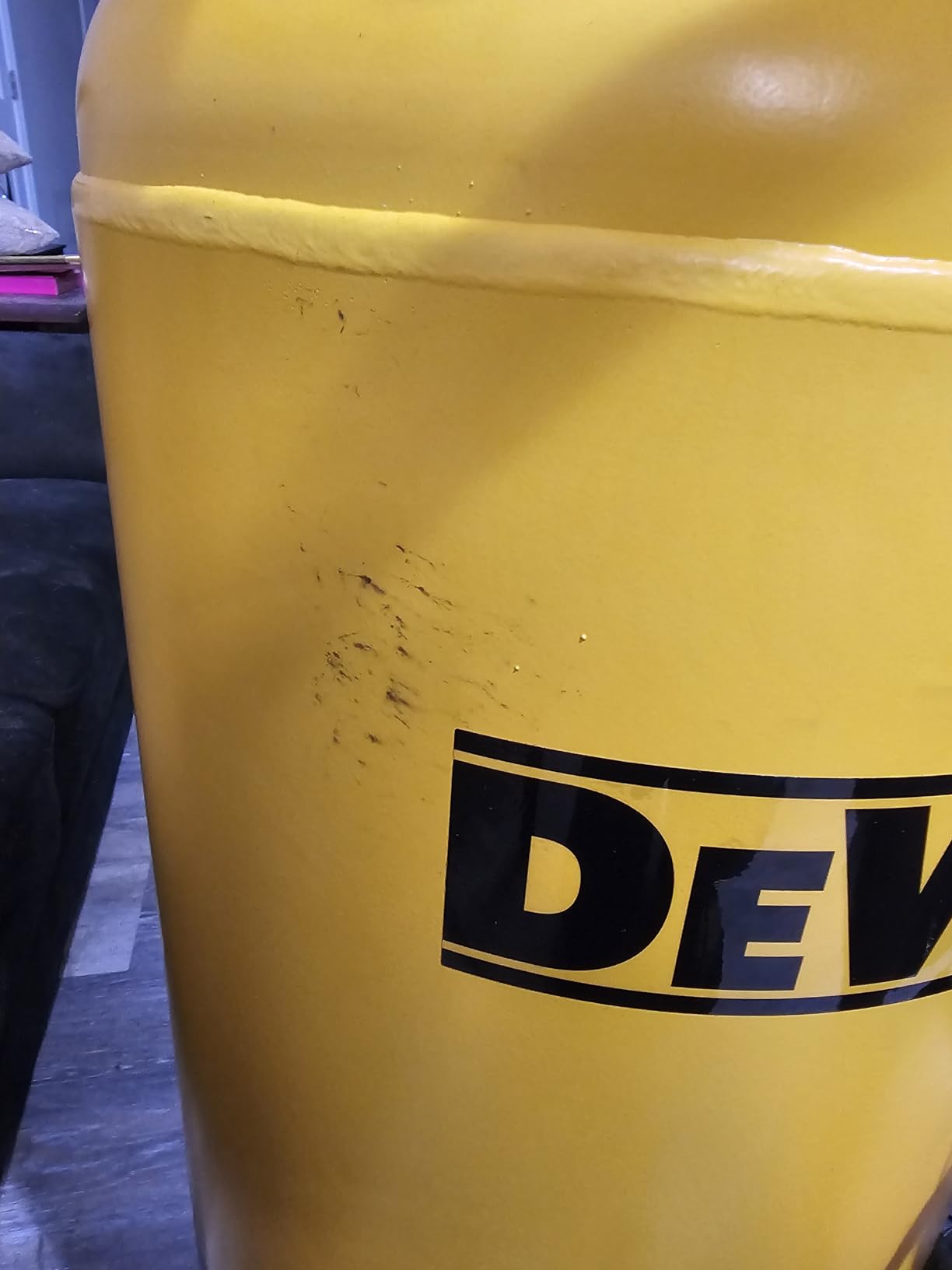
Build quality gets consistent praise. Reviewers compare its valves and knobs favorably to cheaper machines, and 78 dBA is low enough to run inside a shed. The vertical layout at 26.8 by 23.5 by 54.5 inches is space-efficient for the capacity.
Fill Time and the Regulator Ceiling
A full fill from empty takes roughly 10 to 12 minutes, which is the price of a 27-gallon tank on a 120V supply. Plan for it rather than being surprised, and never drain this one mid-project unless you have to.
The more annoying limitation is the regulator, which only adjusts to about 160 PSI even though the tank reaches 200. If your work needs the top of that range through the regulator, this is not the machine.
Weight, Leaks and the Case for It
At 136 lbs this is the heaviest compressor in the roundup, and the big wheels are what make it movable at all. One owner found an air leak at the safety valve fitting and a second at the large tank hex nut, both fixable with teflon tape and replacement parts, and some users report pressure dropping lower than they need for sanding or spraying.
Choose it when tank capacity is your dominant frustration. Our guide to the best shop air compressors for home garages covers the stationary options that go well beyond this size.
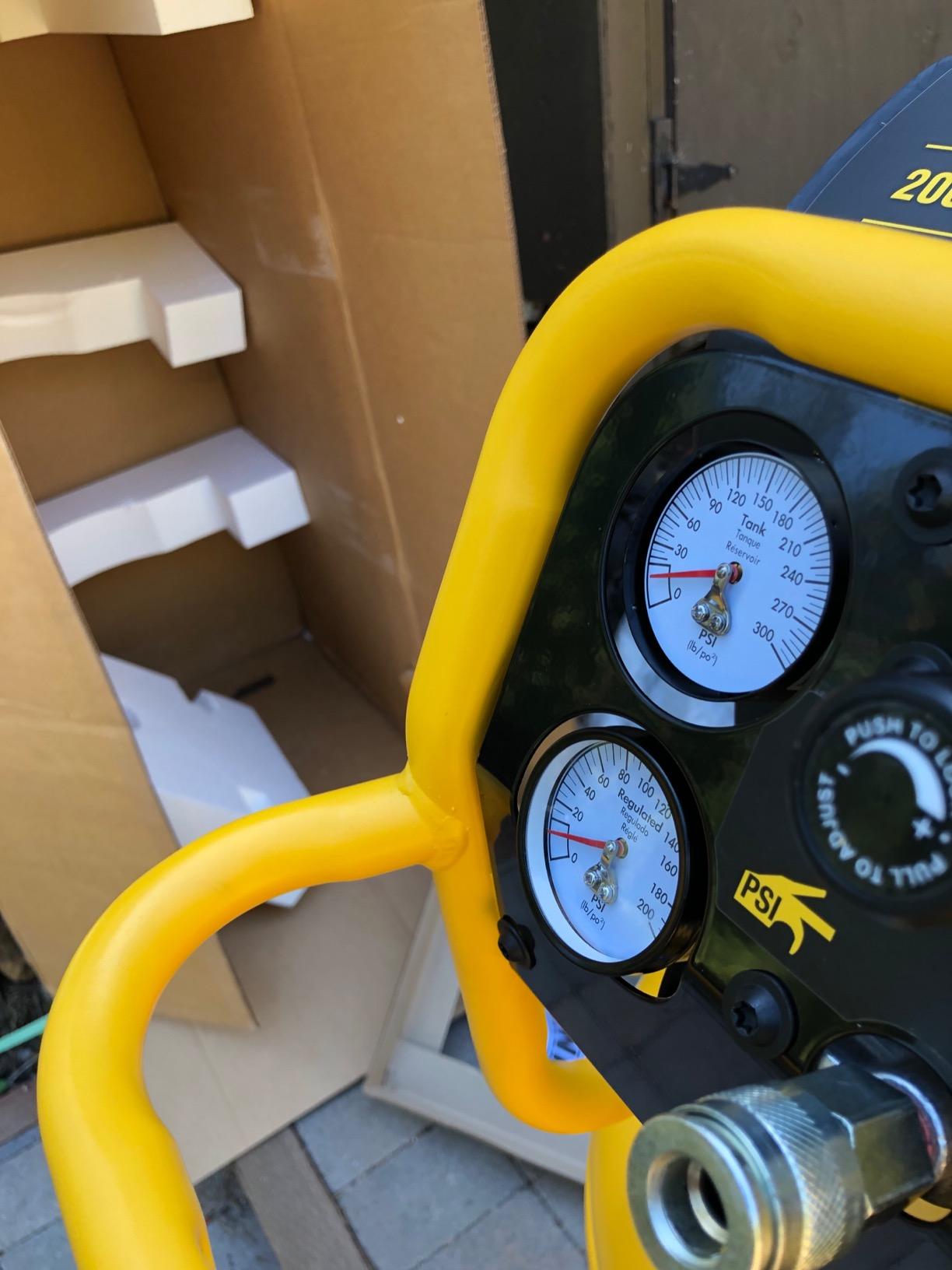
9. Craftsman 6-Gallon Pancake – Smallest Footprint on the List
CRAFTSMAN 6 Gallon 150 PSI Oil-Free Pancake Air Compressor CMXECXA02106410
2.6 SCFM at 90 PSI
6 gallon pancake tank
150 PSI max
30.8 lbs
1.0 HP 120V oil-free
Pros
- Smallest and lightest body here at 15.8 by 16.4 by 17 inches
- Dual quick couplers run two tools at once
- Oil-free pump means no maintenance and clean air
- 1-year warranty backed by a US-based service team
Cons
- 82 dB is loud for its tank size
- Pressure drops immediately on sustained spray or finish work
- Reports of cracked gauge mounting hardware out of the box
- One 1-star review reports a motor that stopped and would not restart
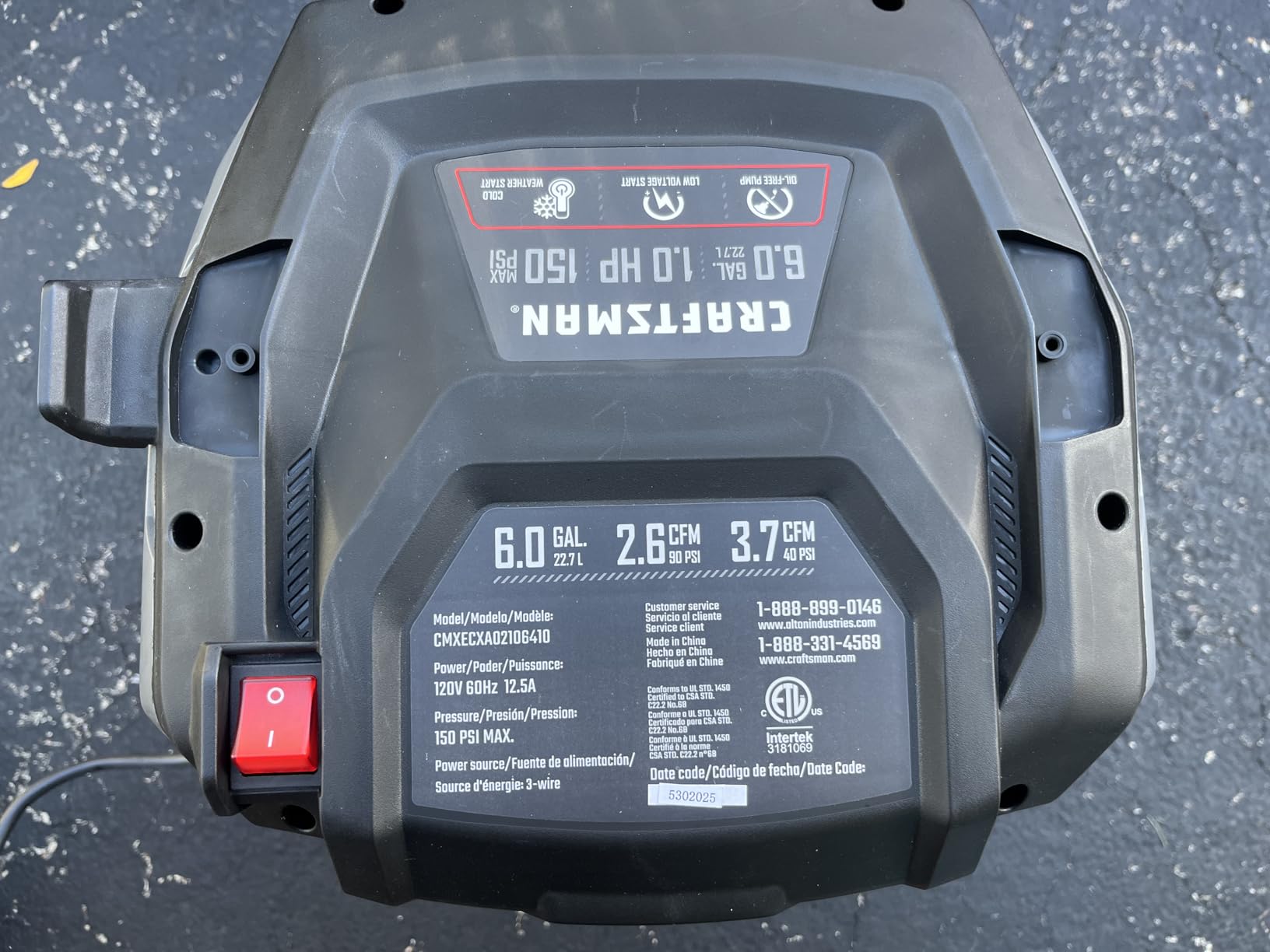
The Craftsman 6-gallon is the most compact machine in this roundup at 15.8 by 16.4 by 17 inches and 30.8 lbs, which matters if your garage workbench is also your storage shelf. Dual quick couplers let two tools run at once from a tank this small.
Owners use it for small household work: inflating tires, brad nailing, blowing dust off surfaces. The oil-free 1.0 HP low-voltage start motor needs no maintenance and produces clean air, and 2.6 SCFM at 90 PSI covers those jobs without strain.
Where the 2.6 SCFM Ceiling Bites
Several owners report pressure dropping immediately on sustained spray or finish work, and that is the expected behavior at this airflow. Anything continuous, including a DA sander, a spray gun or a long run of framing nails, will outrun a 2.6 CFM pump regardless of the tank.
If your garage has a genuine 20-gallon power need, this machine is a step down in capability as well as size. It is a weekend tool, not a shop tool.
Quality Control Reports Worth Knowing
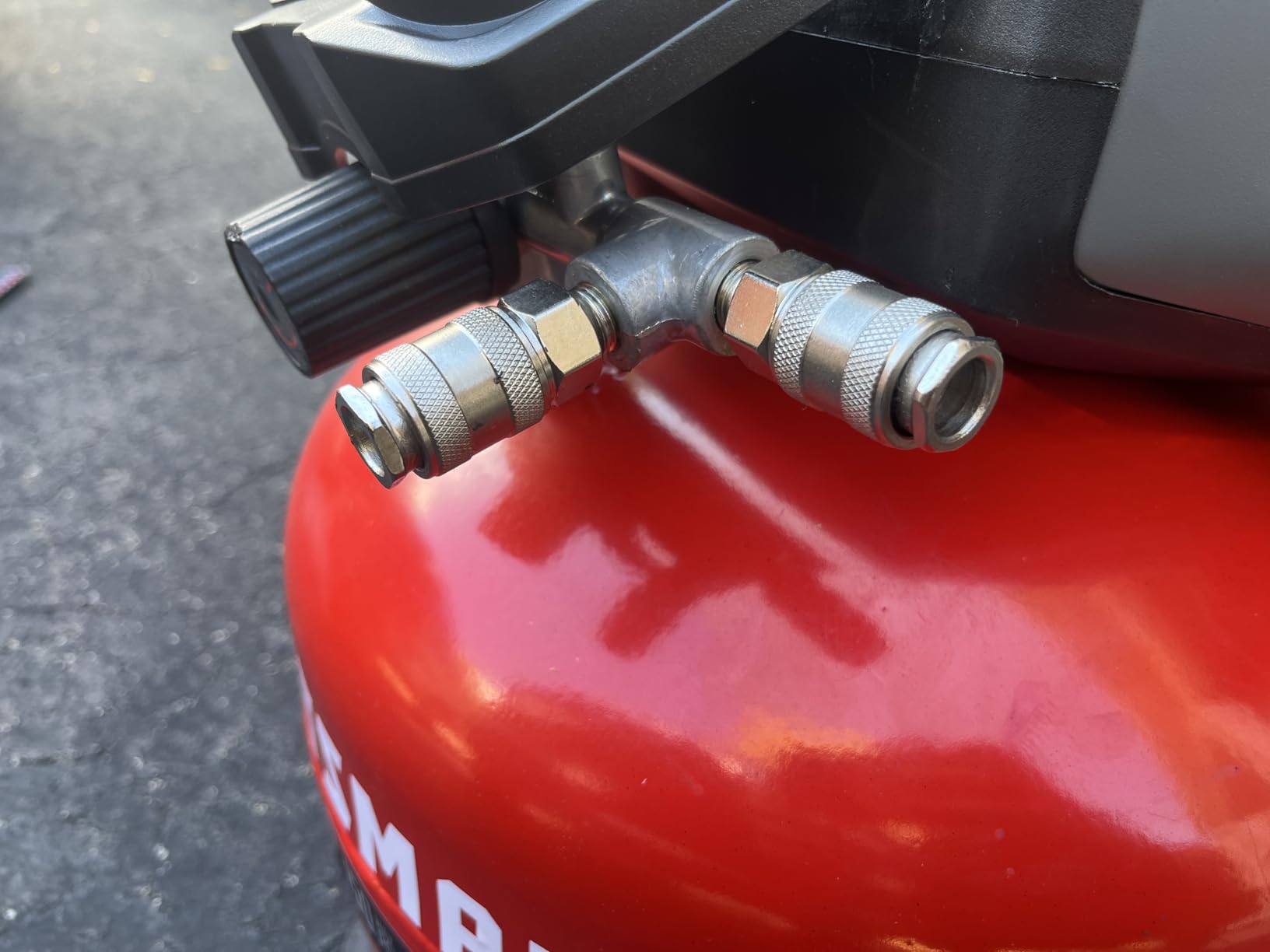
There is a small cluster of reports about units arriving with cracked gauge mounting hardware and one owner who received a unit with a broken handle and could not get a replacement. Another 1-star review reports the motor stopping after about an hour and refusing to restart.
None of these is common, but together they are the reason this sits at 4.5 stars rather than higher. Inspect the gauges and handle before you rely on it.
10. VEVOR 13-Gallon Compressor – Quiet and Cheap for Auto Work
VEVOR 13-Gallon Air Compressor, 2HP, 4.6 SCFM@90PSI, Oil-Free Tank, 66dB Quiet Operation, Ideal for Tire Inflation, Woodworking, Auto Repairs, and Spray Painting (Maximum Pressure 125 PSI)
4.6 SCFM at 90 PSI
13 gallon oil-free tank
125 PSI max
66 dB
71 lbs
Pros
- 66 dB is among the quietest ratings in the roundup
- 13 gallon vertical tank fills in under three minutes
- Two air connections allow simultaneous tool use
- Rolls easily on 7 inch rubber wheels
- Filters
- wheels
- gauges and hardware all in the box
Cons
- One review reports two units failing to repressurize and overheating
- The same review states support admitted about 2.7 CFM actual output
- 125 PSI max is low for heavier pneumatic work
- Units often arrive with bent legs or cracked housings
Thirteen gallons at 66 dB is an unusual pairing, and owners are loud about how quiet it is, with several reporting they no longer need hearing protection. A 2 HP motor fills the vertical oil-free tank in under three minutes, and the reinforced valve system is reported to hold output steady.
It rolls on two 7-inch reinforced rubber wheels and is compact enough to take to a job site. Our guide to portable units for job sites and overlanders covers the smaller form factor if 71 lbs is too much to lift.
The Disputed Airflow Figure
One detailed 1-star review reports two units failing identically, refusing to repressurize after use and overheating until a full power cycle and a 20 to 30 minute thermal reset. The same review states that VEVOR support acknowledged actual output of roughly 2.7 CFM rather than the advertised 4.6 CFM at 90 PSI.
That single account is not proof, but it is a serious caution. At 2.7 CFM a spray gun or sander will starve, so if those are your tools, choose a machine where the flow number is not in dispute. Nine percent one-star reviews in a set of 215 is a meaningful cluster.
Shipping Damage and Pressure Ceiling
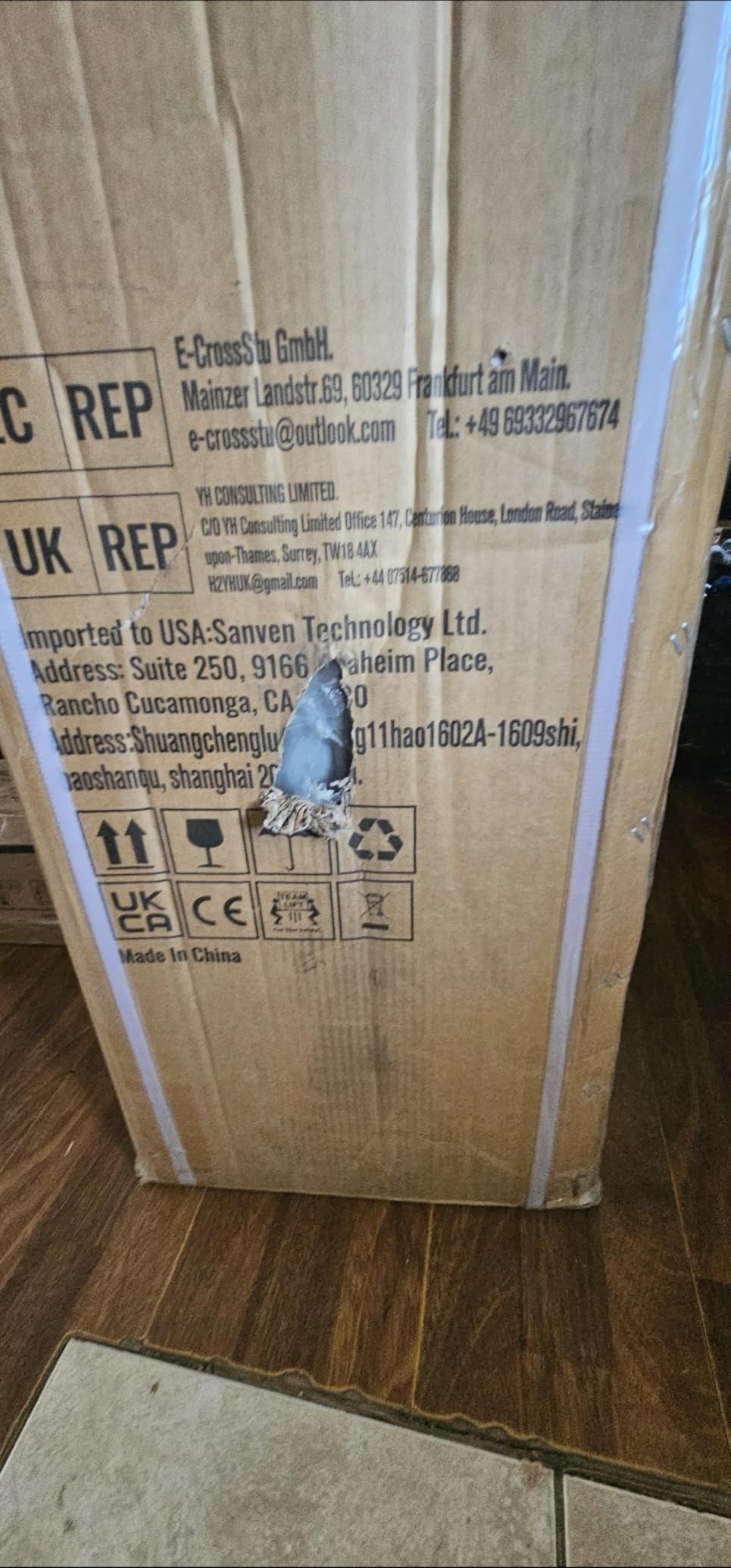
Units frequently arrive with bent legs or cracked plastic housings, which points to a packaging problem rather than a manufacturing one, and it is worth inspecting the frame on arrival.
At 125 PSI maximum, this is fine for tire inflation, impact work and light automotive jobs, but it is low for anything expecting more. At 71 lbs it also takes two people to lift.
How to Choose an Air Compressor for Your Garage
Almost every buyer I have seen go wrong on the same two numbers. They compare peak horsepower and tank gallons, both of which are easy to inflate as marketing claims, and ignore the one figure that decides whether a tool stalls.
CFM at 90 PSI: The Only Number That Decides Whether Tools Stutter
CFM is cubic feet per minute, the volume of free air a pump delivers. SCFM means the same thing measured to the ISO 1217 standard, so treat the two as interchangeable. The number must be quoted at 90 PSI, because air compresses and the same pump delivers far less volume at high pressure.
This is the spec-sheet trap that forum owners complain about most. Some manufacturers quote 6.8 SCFM at 40 PSI and 5.1 SCFM at 90 PSI for the same machine, and only the second number is relevant to a nailer. One owner on r/AutoDetailing put it plainly: the tank size is not the biggest thing, and the compressor needs the correct CFM at working pressure.
The sizing rule is simple. Find the CFM requirement of your most demanding tool, then multiply by 1.5 for headroom, then add a second tool if you will run two at once.
Tool CFM Requirements and the 1.5x Buffer
A brad nailer is the easy end at roughly 0.3 CFM. A finish nailer sits around 1.5 CFM. A framing nailer needs about 2.2 CFM, a 1/2 inch impact wrench around 4 CFM, a DA or random orbital sander about 6 CFM, a spray gun anywhere from 4 to 11 CFM depending on the gun, and a sandblaster needs 10 CFM or more.
Multiply the highest figure on your list by 1.5. If your loudest tool is a framing nailer at 2.2 CFM, you want at least 3.3 CFM, and at least 4.4 CFM if you will run a second nailer alongside it. That calculation is why the Metabo HPT at 4 CFM covers multi-nailer work while the 2.6 CFM pancake units do not.
PSI and Tank Size: Why Bigger Tanks Do Not Add Airflow
PSI is simply pressure. A tank rated at 200 PSI holds more stored air than one rated at 150, but the pump still only pushes what its CFM rating allows. Tank size controls how long you can work between pauses, not how much air arrives per second.
A 27-gallon tank feels enormous until you put a sander on it, which is exactly the complaint owners have with the DEWALT. The pairing that works is a large tank with high CFM, like the Stealth at 20 gallons and 5 CFM, not a large tank with modest flow.
Pancake tanks are short and wide for stability in a vehicle. Twin-stack units are tall and narrow, which saves floor space in a tight corner. Vertical tanks trade width for height, so check the 54-inch height on the DEWALT against your ceiling before buying.
Oil-Free vs Oil-Lubricated Pumps
Every compressor in this roundup uses an oil-free pump. That is the right default for a home garage because there is no oil to change, no oil reaching your tools, and the machine will run at any angle without oil starving the bearings.
The cost is pump longevity. Oil-lubricated cast iron pumps are heavier but far longer-lived, and a rebuild kit extends their life well past ten years. If you plan to run a compressor for a decade of heavy work, a long-cast-iron unit is worth considering, and the shop compressor guide covers that category.
Noise: What Those Decibel Numbers Actually Mean
Decibels are logarithmic, so the difference between 60 and 80 dB is not twice as loud, it is far more disruptive. A 60 dBA compressor is comparable to a refrigerator hum. Seventy dB is a normal conversation level. Eighty dB is where you start wanting hearing protection, and the OSHA permissible exposure limit for 90 dB over eight hours is the number most people eventually ask about.
If your garage is detached, 80 dB is workable. If it is attached with living space above or beside it, anything above 70 dB becomes a family issue, and the 60 dBA California Air Tools is the correct answer.
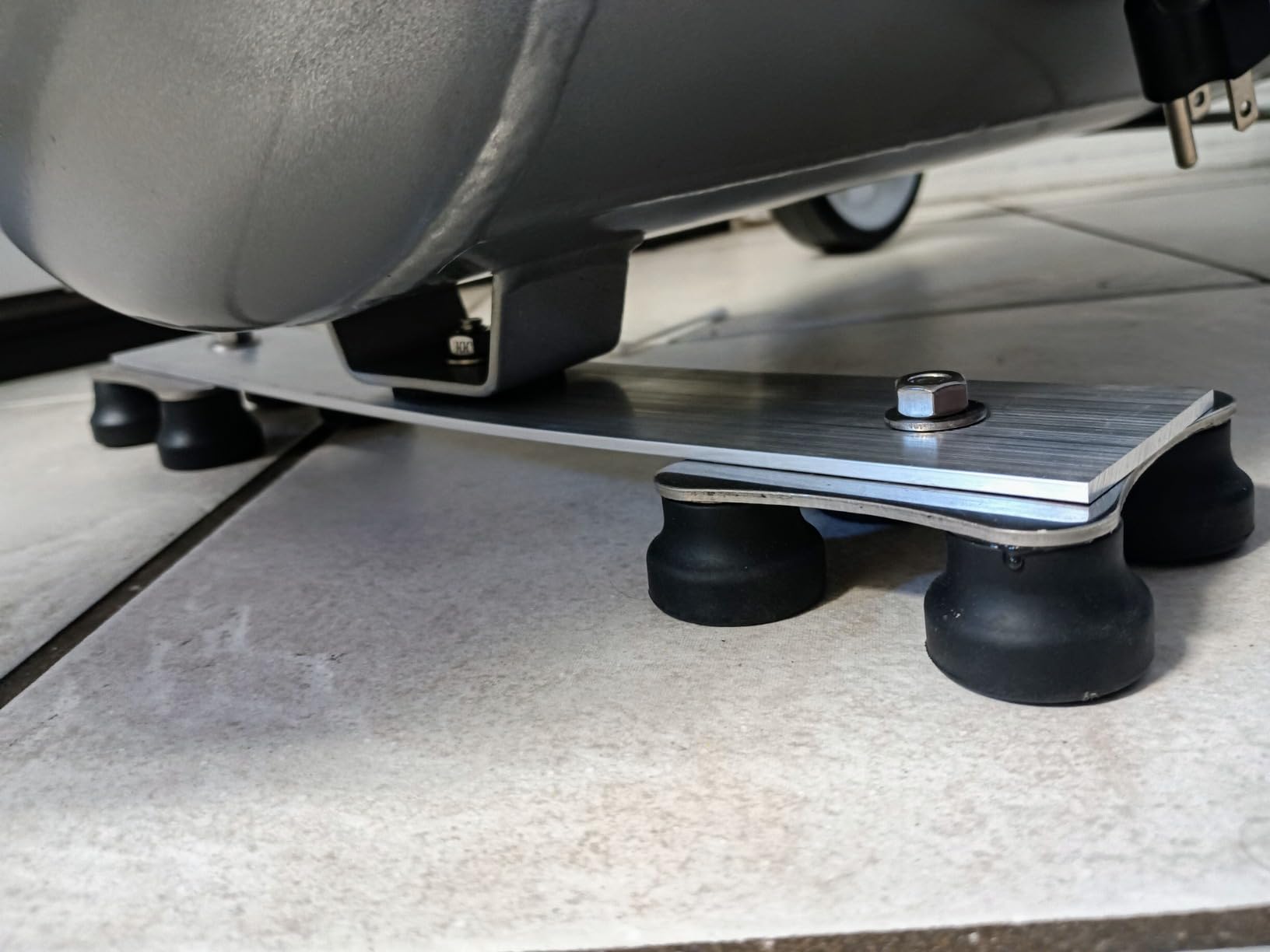
Placement helps more than most buyers expect. Bass loads up in corners, so pull the unit out from the junction of two walls. A rubber isolation pad under the feet cuts structure-borne vibration, and a plywood enclosure lined with foam turns a loud shop compressor into something you can run indoors.
Power Source and Circuit Readiness
Every unit here runs on 120V except none of them needing 240V, which is unusual at the larger sizes. Current draw matters more than people expect: the DEWALT pulls 15 A, the VEVOR 6.3-gallon pulls 14.5 A, the Klutch pulls 14 A and the California Air Tools pulls only 8.5 A.
That means most of these belong on a 20A branch circuit, not a 15A one, and a compressor sharing a circuit with a table saw or welder will trip the breaker. If you are considering a larger stationary unit above 5 CFM, check whether your panel has room for a 240V dedicated circuit before you buy, because that wiring job often costs more than the compressor.
Two of the units here have documented startup problems. The Stealth 20-gallon will not start against a charged tank on undersized wiring, and the VEVOR 6.3-gallon performs poorly through extension cords or on shared circuits.
Air Quality: Separators, Filters and Tank Drains
Any compressor pulls water vapor out of the ambient air, and that water condenses in the tank. Left alone it rusts the tank from the inside and carries moisture into your tools and your paint job.
Four habits keep the air clean. First, drain the tank on the bottom valve every week and fully every month, because a drain valve that never gets opened stops draining. Second, add an in-line moisture separator at the outlet, which catches bulk water cheaply. Third, if you paint or run pneumatic sanders, fit a coalescing filter downstream, since it removes oil aerosols and fine mist that a separator cannot. Fourth, an auto-drain valve removes the weekly chore but needs a trap and a drain line.
Duty Cycle and When to Replace an Old Unit
Duty cycle is the percentage of time a compressor is allowed to run. The Klutch is rated at 75 percent, which is unusually high for a 120V home unit and explains why it can sustain repeated high-draw work.
Ageing compressors have their own signature. A motor that cycles on constantly while pressure barely holds is a low-CFM problem, not a tank problem, and that is the moment to replace rather than repair. On r/Tools, owners describe swapping a 20-year-old 30-gallon Craftsman for exactly that reason. If your old unit still holds pressure but will not deliver airflow, buy on CFM this time.
Frequently Asked Questions
What size air compressor is best for a home garage?
For most one or two-car home garages, a 6 to 8 gallon oil-free compressor delivering at least 2.6 CFM at 90 PSI is the right size. It covers brad and finish nailers, tire inflation and light sanding on a standard 120V outlet. Move up to a 20 gallon vertical unit with 4 CFM or more if you run framing nailers or impact wrenches regularly.
What is the quietest air compressor for a garage?
The California Air Tools 8010A is the quietest compressor in this roundup at 60 dBA, helped by a 1.0 HP motor running at only 1680 RPM. The VEVOR 13-gallon at 66 dB and the Stealth 20-gallon at 68 dB are the next options if you need more tank or airflow.
Is a bigger tank better for an air compressor?
Not by itself. Tank size controls how long you can work between pauses, while CFM controls how much air arrives per second. A 27 gallon tank paired with only 4 CFM will still starve a sander, so match tank size to your highest CFM tool rather than buying capacity on its own.
Does tank size affect CFM?
No. A larger tank holds more stored air but does not change what the pump delivers. CFM is a pump specification quoted at a given pressure, so ask for SCFM at 90 PSI. Some spec sheets inflate the number by quoting airflow at 40 PSI, which is why comparing 90 PSI figures is essential.
Is 4 CFM enough to paint a car?
Four CFM handles light spray guns and detail work, but most HVLP and conventional spray guns need 8 to 11 CFM for a clean finish. A DA sander also wants about 6 CFM. If painting is your main task, size above 4 CFM rather than relying on tank capacity to compensate.
Do I need a dedicated circuit for an air compressor?
It depends on current draw. Units pulling 14 to 15 A, such as the DEWALT 27-gallon at 15 A or the VEVOR 6.3-gallon at 14.5 A, belong on a 20A branch circuit and should not share with a saw or welder. Lower-draw models like the California Air Tools at 8.5 A run fine on a standard outlet.
How long do air compressors last?
Oil-free pumps in home garage use commonly last several years of intermittent duty, and the California Air Tools pump here is rated past 3000 hours. Oil-lubricated cast iron pumps last considerably longer and can be rebuilt with a kit. Tank corrosion from never draining the bottom valve shortens life more than pump wear.
Which Garage Air Compressor Should You Buy?
The default answer for a typical home garage is the PORTER-CABLE C2002-WK. At 2.6 SCFM at 90 PSI, 150 PSI and 30 lbs, with more owner ratings than any other machine in this roundup, it is the lowest-risk purchase for finish nailing, inflation and cleanup.
Two conditional alternatives cover almost everything else. Buy the Metabo HPT EC914S if framing and roofing nailers are your main work, since 4 CFM at 200 PSI is the best airflow-per-pound here. Buy the California Air Tools 8010A if noise decides the outcome, because 60 dBA is the only rating in this group quiet enough for an attached garage.
Step up to a 20 or 27 gallon vertical unit only when a tool is starving your current machine. The 4 CFM threshold for impact wrenches and the 6 CFM threshold for DA sanders are the numbers that tell you it is time for more air, and no tank size substitutes for them.