
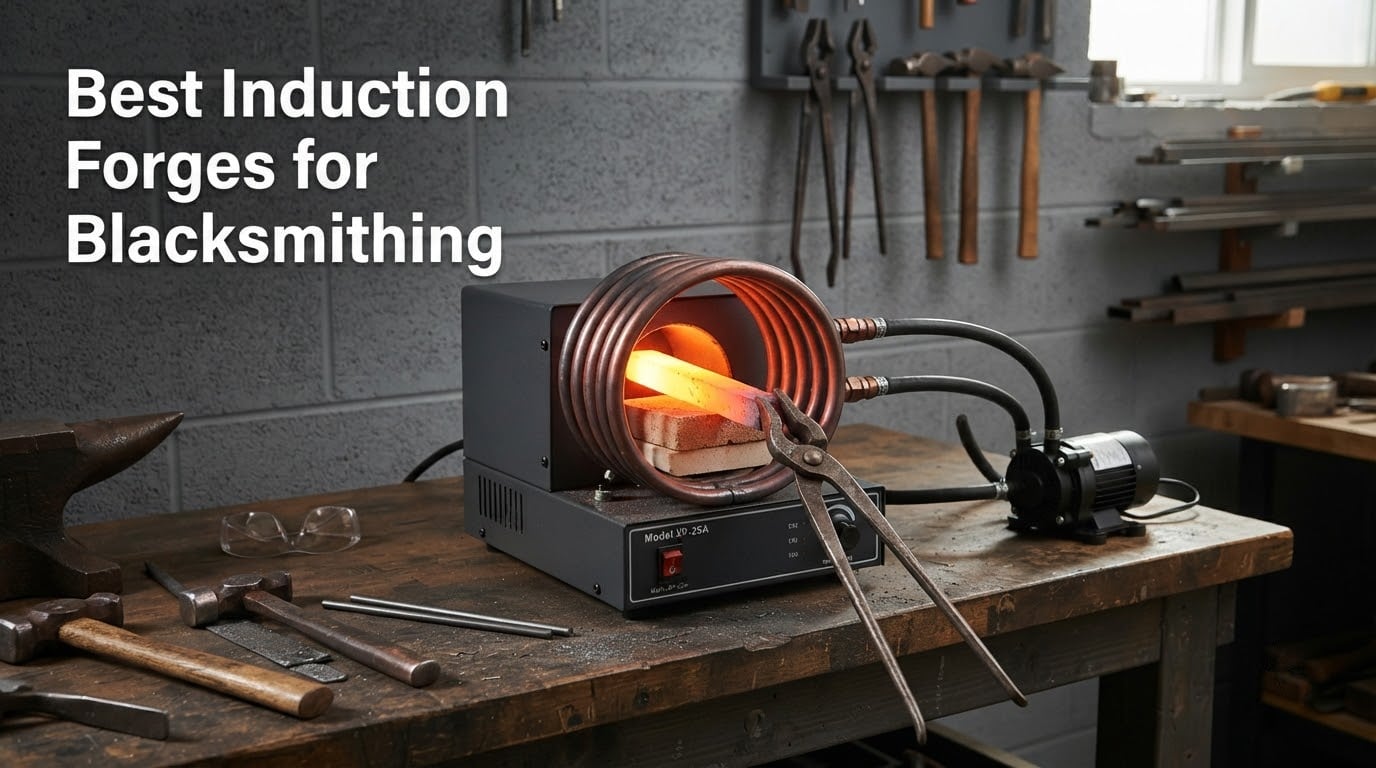
An induction forge heats steel by driving alternating current through a copper coil, which creates a magnetic field strong enough to push eddy currents directly into your workpiece. There is no flame, no fuel line and no firebrick chamber, which is exactly why bladesmiths keep talking about them on r/Blacksmith and r/Blacksmith_Forge. This guide covers the best induction forges for blacksmithing available now, along with the honest limits that most spec sheets leave out.
One number frames the whole conversation. A 15KW machine takes a one inch steel bar to forging heat in roughly 45 seconds, where a gas forge of the same practical size takes closer to two minutes. That speed is the reason a bladesmith with 15 usable minutes on a weeknight can still finish a knife.
Before the picks, one clarification that matters more than any wattage figure. Shopping results for this keyword are full of small melting furnaces marketed as magnetic induction forges, and those machines are built to melt a few kilos of non-ferrous metal rather than to heat forged steel. A true blacksmithing induction forge runs a heavy copper coil through flowing water, sits on a dedicated high-amp circuit and has a dwell cycle long enough to bring a blade to forging temperature. Everything below is the real thing.
I also want to be straight about what I could and could not verify. Every machine in this roundup is a current listing carrying specification data and features, but each one shows zero customer reviews and zero star ratings right now. That means you are buying from published specs and build claims, not from owner history, and the rest of this guide is written to help you judge those specs yourself.
If you want the physics side settled first, the induction principle behind a kitchen hob is the same physics running inside a forge coil, and our induction cooktop comparison explains how frequency and coil design shape heating behaviour. If the smithing side is what you came for, the picks start next.
Table of Contents
Top 3 Induction Forges for Blacksmithing in 2026

15KW Forge Kit A-1
- 15KW 30-100KHz output
- Two coils plus foot switch
- 100 percent load 24 hour design
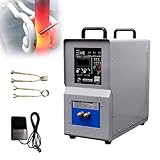
These three lead the list because they pair the highest output in the group with the most complete coil and cooling packages. The A-1 kit is the one I would point a first-time shop builder toward, the WLSLZQ furnace brings the same class of power into a small bench footprint, and the HajMyrdonyx unit is the one that publishes a specific reduced output figure for 110V operation.
Quick Overview of All 10 Induction Forges in 2026
| Product | Specifications | Action |
|---|---|---|
| 15KW Induction Heating Machine with Two Coils and Foot Switch |
|
Check Latest Price |
 WLSLZQ 15KVA Compact Induction Forge Furnace WLSLZQ 15KVA Compact Induction Forge Furnace |
|
Check Latest Price |
| HajMyrdonyx 15KW 30-100KHz Induction Forge |
|
Check Latest Price |
 LMYYDES 15KW Digital Water-Cooled Induction Forge LMYYDES 15KW Digital Water-Cooled Induction Forge |
|
Check Latest Price |
 GLBMXDD 15KW 40C-2000C Induction Forge Furnace GLBMXDD 15KW 40C-2000C Induction Forge Furnace |
|
Check Latest Price |
 JIANGYUXINLI 15KW 110V 220V Induction Forge with Two Coils JIANGYUXINLI 15KW 110V 220V Induction Forge with Two Coils |
|
Check Latest Price |
 TDSYOCG 15KW Three-Stage Induction Forge TDSYOCG 15KW Three-Stage Induction Forge |
|
Check Latest Price |
 2-6KW Induction Heating Kit with Foot Switch 2-6KW Induction Heating Kit with Foot Switch |
|
Check Latest Price |
 GLBMXDD 2-6KW Digital Induction Forge Furnace GLBMXDD 2-6KW Digital Induction Forge Furnace |
|
Check Latest Price |
 COAKUE 4000W Induction Forge Furnace COAKUE 4000W Induction Forge Furnace |
|
Check Latest Price |
Two clusters show up in that table. Seven machines sit in the 15KW to 15KVA class with water-cooled coils for steel work, and three sit in the 2 to 6KW band aimed at annealing, light forging and small melts. Nothing in the 15KW class has published owner feedback yet, so treat the spec sheet as the only evidence available.
1. 15KW Induction Heating Machine with Two Coils and Foot Switch – Best Overall
15KW Induction Heating Machine for Metalworking, Jewelry Making, Knife Forging & DIY Projects with Two Coils & Foot Switch, 30-100KHz Single-Phase Heater
15KW output
30-100KHz single phase
Two coils plus foot switch
Heating hold cool modes
Pros
- Two coils included so you can change workpiece size immediately
- Foot switch allows hands-free dwell control
- 100 percent load design rated for 24 hour running
- Three modes cover heating holding and cooling
- Rated for forging brazing welding melting and heat treatment
Cons
- Full 15KW output needs a heavy dedicated circuit
- Single-phase input limits headroom versus three-phase industrial machines
- No customer reviews yet to confirm long term reliability
The thing that separates this kit from most of the field is what arrives in the box. Two coils and a foot switch come with the machine, and holding a heat with your foot leaves your hands free for the hammer and tongs. That is a natural fit for draw length work on a knife blade.
The listed output is 15KW across a 30 to 100KHz frequency range on single-phase power, with three operating modes: heating, heat preservation and cooling. Heat preservation matters more than it sounds. A smith working a bar in and out of the coil can park the machine in hold mode instead of letting the cycle finish and reheat from cold.
Real-time status indicators are listed, and an optional thermometer supports automatic temperature monitoring. That option matters for anyone doing hardening or tempering by the numbers rather than by color. The listing also names forging, brazing, welding, melting and heat treatment as intended uses, which is the full blacksmithing workload rather than a jewelry-only scope.
What you give up is headroom on electrical service. This is a single-phase machine and 15KW of single-phase output is a real load on a residential panel, so plan the circuit before the machine arrives. There is also no owner history to lean on, which is why it appears here on build completeness rather than on reputation.
What day to day work actually feels like
For a knifemaker the workflow is short cycles with a lot of waiting. You slide a bar into the coil, press the foot switch, watch the color, and release, repeating that across the tang, the flats and the tip. A machine with hold and cool modes shortens the reset between those heats considerably.
The two-coil package also removes the most common beginner trap. Shops often start with a coil sized for round bar, discover they want flats, and then wait weeks for a replacement coil to arrive. Having a second coil in hand means the changeover is instant.
Where it falls short for you
If your shop is a single 110V branch with no panel room, this machine is not going to work at its rating. A 15KW single-phase draw needs a properly sized dedicated circuit, and a qualified electrician should be the one to size it.
Second, the listing gives no weight or dimension data, so you cannot plan bench space from it. Ask for measurements before the machine travels to a second floor or a small garage bay.
2. WLSLZQ 15KVA Compact Induction Forge Furnace – Best for Smaller Workshops
Induction Forge High Frequency Induction Heater Furnace, Adjustable Temperature, Compact Induction Heating Machine, Small Electromagnetic Induction Heating Equipment, For Melt, Welding, Heating 15KVA
15KVA output
Reaches 2000C in seconds
21.65 x 11.81 x 15.75 inch
88.1 pounds
Pros
- Compact 21.65 x 11.81 x 15.75 inch footprint suits small shops
- Real-time intelligent control adjusts temperature automatically
- Five protections including low-water and phase-loss cutouts
- Flame-free operation with no combustion fumes
- Digital panel usable without training
Cons
- 88.1 pounds means a two-person move or a cart
- Requires a separate water cooling system before use
- No customer reviews yet
Shop machines this powerful are usually large. This one is listed at 21.65 by 11.81 by 15.75 inches, which is closer to a large appliance than a floor-standing industrial unit, and that footprint is the reason it earns this spot on the list.
The control story is the other differentiator. The listing describes an intelligent control system that monitors and adjusts temperature in real time, plus a three-stage cycle with adjustable heat, hold and cool times. For a smith who works to a color rather than a number, the three-stage timing is the feature you will use daily.
Protection coverage is unusually complete for this category: over-current, over-voltage, water shortage, phase loss and load failure, all with fault display and alarm. On a water-cooled machine, low-water cutout is the protection that matters most because a dry coil is an expensive failure.
Temperature claims go to 2000C, well past the 1200 to 1400C band you actually forge at, so there is plenty of headroom. The stated applications cover melting, forging, brazing, welding, quenching, annealing and heat treatment, which is a complete bench list.
Why shop size decides this one
If your smithing happens in a corner of a two-car garage, floor space is the constraint that rules out bigger units before anything else. A 21 inch deep machine leaves room for a bench, a vice and a quench tank in the same bay.
It is also offered alongside a 25KVA variant, which tells you the same chassis scales up if your work grows into heavier bar and billet work. That is worth knowing if you are planning a shop rather than a hobby corner.
What to check before you commit
At 88.1 pounds this is a two-person lift or a cart-only install. Measure your doorway and your bench height before it arrives, because the convenience of the compact body is lost if it will not get through the door.
It also needs a water cooling system connected. Budget setup time for pump, tank and coil routing, and confirm your chiller flow matches what the manual asks for at full output.
3. HajMyrdonyx 15KW Induction Forge with 110V and 220V Options – Best for 110V Shops
HajMyrdonyx High Frequency Induction Heater Furnace Induction Heating Machine, 15KW 30-100KHZ Copper Pipe Welding Melting for Metal Quenching & Forging, 40°C-2000°C Heating Machine
15KW at 220V or 8KW at 110V
30-100KHz
40C to 2000C
58.3 pounds
Pros
- Runs at 8KW on 110V so a home shop can start smaller
- Full 15KW available on 220V when the work demands it
- Optional infrared sensing for automatic temperature control
- 100 percent duty cycle with IGBT modules and water cooling
- Pre-set heating programs shorten setup for new users
Cons
- Needs a chiller and adequate amperage for full power
- Package dimensions do not reflect the real unit size
- No customer reviews yet
This is the machine for a shop that is not ready to run a dedicated 50 amp branch. It delivers 15KW on 220V and drops to 8KW on 110V, so you can heat smaller work in a residential shop and still have the higher output waiting when you install proper service.
On heating performance the listing claims 1200C reached from room temperature in seconds, inside a 40C to 2000C working range. The 100 percent duty cycle claim is paired with IGBT modules and water cooling, which is the combination that supports sustained batch work rather than one-off heats.
Optional infrared temperature sensing is the feature worth planning around. Combined with pre-set heating programs, it turns the machine from a color-reading tool into something you can run to a target figure, which is what hardening and tempering properly require.
It is also listed at 58.3 pounds, lighter than most 15KW machines, though the package dimensions of 3.94 inches square do not describe the machine and should be ignored.
What 110V output changes in practice
Roughly half the output means longer dwell times on heavier sections, so a smith used to 45 second heats on a one inch bar should expect a noticeably longer cycle at 110V. That is a fair trade for not hiring an electrician in year one.
The flip side is that 8KW covers small to medium bar and blade work well. A lot of hobby smithing, tang drawing, tip finishing and annealing never needs the top of the range, so the reduced output is rarely the bottleneck for the average knife.
Reasons it may not suit you
Running full 15KW still needs a chiller and real amperage, so this is a stepping stone rather than an escape from electrical planning. If your panel can take 220V, take the higher output.
Treat the listed package size as noise and measure the actual unit if bench depth is tight. Also note the 3.94 inch package figure appears across several listings in this category, which suggests it is a catalogue default rather than a measurement.
4. LMYYDES 15KW Digital Water-Cooled Induction Forge – Best for Automatic Timing
LMYYDES 15KW High Frequency Induction Heater Machine, Digital Water-Cooled for Metal Melting, Forging, Brazing, Annealing (200-600A, 30-100KHz)
15KW at 200-600A
1-99 second auto timer
2200C maximum
18 kg body
Pros
- Automatic 1-99 second heating timer removes guesswork from dwell time
- Highest listed maximum temperature in this group at 2200C
- Output current range of 200-600A suits varied workpiece sizes
- Programmable three-stage heat hold and cool cycle
- Compact 55 x 22 x 47 cm footprint at 18 kg
Cons
- 2L per minute cooling flow is modest for long duty cycles
- External water source required for cooling
- No customer reviews yet
The 1 to 99 second automatic heating timer is the feature that separates this machine from every other entry here. Instead of watching a color and releasing, you dial in a time and the cycle ends on its own, which is repeatable in a way that visual judgment never quite is.
Output is listed at 15KW with a 200 to 600A current range and 30 to 100KHz fluctuation frequency, giving you room to match power to workpiece. Maximum heating temperature is 2200C, the highest figure across this group.
The programmable three-stage cycle, heat then retention then cooling, suits batch work where you want a controlled soak rather than a full power ramp. Water cooling runs at 0.2MPa and 2L per minute with a water temperature protection point at 40C.
At 18 kilograms and 55 by 22 by 47 centimeters, this is the lightest 15KW machine in the roundup, which makes it the easiest of the group to bench-mount on a normal work stand.
Where automatic timing pays off
Repeat work is the case. When you are producing the same blade profile fifty times, a fixed time cycle means every part receives the same heat. Consistency across a batch is the strongest argument for induction over a gas forge, and a timer is how you capture it.
It also helps with joining work. Brazing and forge welding depend on reaching a specific heat quickly and moving immediately, and a preset time removes the hesitation that makes people overshoot a weld heat.
Where the cooling figure worries me
2L per minute is a modest flow. In a warm shop running long batches, that figure is the first thing I would want confirmed against the coil’s actual requirement before committing.
You also need an external water source. Plan a chiller, a pump and somewhere to route the return, and confirm the protection trip at 40C will actually stop the cycle rather than only display a warning.
5. GLBMXDD 15KW Induction Forge with 6L per Minute Cooling – Best for Long Sessions
GLBMXDD 15KW 30-80KHz High Frequency Induction Heater Furnace, Induction Forge Metal Heat Treatment & Melting Furnace, for Melt, Welding, Heating, 40℃~2000℃ Temperature Range
15KW at 200-600A
Single phase 220V
6L per minute cooling
55 pounds
Pros
- 6L per minute cooling flow supports longer working cycles
- 100 percent load design rated for 24 hour operation
- Constant current and power control improves heating consistency
- Three-stage heating insulation and cooling timing
- Status display covers low water and phase failure
Cons
- Single phase 220V input still needs a heavy duty branch circuit
- Water cooling setup required before use
- No customer reviews yet
This machine is built around sustained work rather than short bursts. The listed 6L per minute cooling flow at 0.2MPa is three times the figure on the lighter 15KW machine, and that difference shows up in how long you can hold the coil under load on a warm day.
Cooling has a defined protection point at 40C with water-cooling method throughout, and a 100 percent load design rated for 24 hour operation. Constant current and power control is listed as the mechanism behind heating consistency, which is what you want if you are chasing repeatable results rather than fast results.
Temperature range is 40C to 2000C, with 15KW output, 200 to 600A, 30 to 100KHz and a 1 to 99 second automatic heating time. An optional infrared temperature detector supports automatic control if you are running to a specification.
Its fault display is unusually specific, covering overflow, over-voltage, low water, phase failure and load malfunction. For a first machine that tells you what went wrong, and those fault codes save a lot of guessing when a cycle stops mid job.
Why cooling capacity decides long days
Coil temperature is the limit nobody sees. The copper never gets hot from the process, but it carries the current, and if the water cannot carry the heat away the coil itself eventually becomes the weak point.
A higher flow rate is what allows an eight hour day of production knife work without the machine throttling itself. If your shop runs hot or you are not in an air conditioned room, this is the machine I would shortlist for a full shift.
Why some smiths will still pick a smaller machine
Single-phase 220V input at 15KW still requires a properly sized branch circuit. This is not a residential plug and appliance, and the electrical work is not optional.
It is also listed at 55 pounds with package dimensions of 3.94 inches square, so the real footprint is undocumented. Measure before you plan the bench, the same caveat that applies to several machines in this category.
6. JIANGYUXINLI 15KW Induction Forge with Two Coils – Best for Temperature Control
JIANGYUXINLI 15KW High Frequency Induction Metal Heater Induction Furnace, Inductions Forges for Blacksmithing, 110V/220V Heat Melting Welding Quenching Annealing Brazing, with Two Coils
15KW 30-100KHz
110V and 220V
Infrared sensing with IGBT control
Two coils
Pros
- Infrared temperature sensing paired with MOS and IGBT frequency control
- 110V and 220V flexibility suits mixed power shops
- Two coils included for different workpiece sizes
- 100 percent load 24 hour design
- Around ten fault protection modes with clear display
Cons
- Listed weight of 0.352 oz is not credible so specs need verifying
- Needs dedicated high capacity service and water cooling
- No customer reviews yet
Two coils in the box and infrared sensing in the control loop is the combination that makes this one interesting. Most builders treat temperature control as an add-on purchase, and this machine lists both temperature sensing and frequency control as standard.
The technical description names constant current and power control for efficient targeted heating, MOS and IGBT frequency conversion control, and approximately ten fault protection types including over-current, over-voltage, water shortage and phase missing. That fault coverage is the broadest listed in this group.
Output is 15KW at 30 to 100KHz with 110V and 220V flexibility, a 100 percent load design for 24 hour operation, and three-stage heating, insulation and cooling timing. The listing states the machine is usable without special training, which is a fair claim given a digital control panel and a foot pedal.
One caution. The listed item weight of 0.352 ounces is not credible for a 15KW machine, and the same implausible figure appears on another listing in this category. Treat the physical specifications on this page as approximate and ask for verified measurements.
Why infrared control matters for real work
Color judging is a skill and an unreliable one. A smith who has spent years reading straw and cherry colors can still miss by twenty degrees, and that is the difference between a good temper and a cracked part.
Infrared sensing closes that gap. On an automatic cycle it holds the target until the sensor agrees, which makes annealing wire and heat treating springs repeatable rather than hopeful.
What you should verify before ordering
The weight and dimension fields on this page are placeholders rather than measurements. Do not plan a bench, a lift or a shipping path from them, and ask the seller for verified figures before ordering.
It still needs dedicated high capacity electrical service and water cooling. A listing full of impressive protection features does not reduce the installation requirements by a single wire.
7. TDSYOCG 15KW Three-Stage Induction Forge – Best for Annealing and Tempering
TDSYOCG 110V/220V 15KW High Frequency Induction Heater & Forge, 30-100KHz Magnetic Induction Heater for Welding, Quenching, Annealing with Three-Stage Heating Forging Control, for Welding, Quenching
15KW at 30-100KHz
110V and 220V
1200C rapid heating
Three-stage control
Pros
- Reaches 1200C from room temperature in seconds
- Optional infrared sensing with auto-adjustment for repeat results
- Three-stage heating insulation and cooling controls
- 100 percent duty cycle with heavy-duty cooling
- Simple setup: connect power and water then use the controls
Cons
- Listed weight of 0.352 oz is not credible
- Needs a water supply and adequate amperage for 15KW
- No customer reviews yet
Annealing and tempering are where the three-stage control earns its place. Heat, insulation and cooling with adjustable timing gives you a controlled soak and a controlled cooldown, which is precisely the shape of a heat treat cycle rather than a forging cycle.
The listing states that metal heats from room temperature to 1200C in seconds with lower energy loss than a traditional furnace, on 15KW output across 30 to 100KHz, with 110V and 220V dual voltage support. That voltage flexibility makes it one of the easier 15KW machines to install gradually.
Optional infrared sensing with automatic adjustment is listed for consistent annealing, tempering and quenching results. A 100 percent duty cycle with heavy-duty cooling and high grade components is claimed for continuous forging and melting.
Setup is described simply: connect power and water, then use the basic controls. For a first machine, fewer commissioning surprises is a real advantage, and integrated safeguards cover electrical, overheating and cooling faults.
What three-stage control actually changes
A forge heat is a ramp and a judgment call. A heat treat is a ramp, a soak at a target temperature and a controlled cool, and a machine that times all three does that cycle without you standing over a color.
For spring work, wire annealing and blade hardening between other projects, this pattern runs on its own once set. That is the difference between fitting heat treating into an evening or making room for it.
What the listing does not tell you
The same 0.352 ounce listed weight appears here as on other machines in this group, so physical specifications here are unreliable. Request verified weight and dimensions, particularly if the unit will sit on an upper bench or a mezzanine.
Full 15KW output still needs a water supply and real amperage. Confirm the actual current draw at 110V and 220V with the seller, because a residential circuit will not deliver what the nameplate implies.
8. 2-6KW Induction Heating Kit with Foot Switch – Most Versatile
High Frequency Induction Heating Machine 2-6KW Metal Melting Furnace with Full Accessories and Foot Switch for Welding, Forging, Annealing, Brazing
2000W to 6000W adjustable
Complete kit with coil and crucible
Dual cooling circulation
Foot switch included
Pros
- Adjustable 2000W to 6000W covers hobby through small shop work
- Complete ready-to-use kit with coil crucible tank pump and clamp
- Dual cooling circulation extends duty cycle and equipment life
- Digital display and simple controls suit first-time users
- Foot switch enables hands-free heating control
Cons
- 6KW ceiling is small for heavy forging of large billets
- Not suited to continuous full-shift production duty
- No customer reviews yet
Everything you need to heat metal arrives in one box: main unit, copper coil, graphite quartz crucible, foot switch, cooling water tank, water pump and fixing clamp. For a beginner that completeness matters more than output, because the accessory list on a 15KW machine is where the real cost hides.
Power is adjustable from 2000W to 6000W, with a digital display showing real time operating parameters and a semi-automatic foot switch for hands-free control. A dual cooling circulation system with a water shortage safeguard protects the coil during longer runs.
Stated applications cover gear and shaft heat treatment, hardening, wire annealing, forging, brazing and small metal melting. That is an honest hobby and small shop list rather than a claim to production forging capability.
Be clear about the ceiling. Six kilowatts will bring a small bar or a short section to heat quickly, and it is not the machine for drawing a thick tang in one pass or for a full shift of production work.
Who this entry machine suits
A smith who wants to learn heat colors, anneal wire, harden small parts and reheat a tip, without spending the money and the panel capacity a 15KW machine demands. That is a real and useful job, and this kit does it.
It also works well as a second machine. A small unit on a separate bench for annealing and small work keeps the big machine free for production heats, which is how most two-machine shops eventually divide the work.
What 6KW cannot do
If your work involves heavy forging of large sections, the 6KW limit will be felt on every heat. Expect to move the workpiece through the coil more often to bring a full section up to temperature.
Continuous full-shift production is explicitly outside what this class of machine is built for. Plan on short sessions and treat it as an accessory heat source rather than a shop centrepiece.
9. GLBMXDD 2-6KW Digital Induction Forge Furnace – Best for Wire Annealing
GLBMXDD High Frequency Induction Heating Machine, Industrial Induction Forge Furnace 2-6KW, Digital Display, for Steel Wire Annealing, Dishware Hot Press Molding 4000W
2000W 3000W 4000W 6000W options
Digital manual and auto modes
Five fault protections
19.8 pounds
Pros
- Model options across four power levels let you match output to the job
- Digital display with manual and automatic adjustment
- Five protections including overheating and phase loss
- Flame-free low-noise operation suits indoor work areas
- Accessory kit includes coil foot switch crucible tank and pump
Cons
- Very low sales volume indicated by its Best Sellers Rank
- 2-6KW ceiling limits it to light forging and small melts
- No customer reviews yet
Wire annealing is the classic job for a small induction machine, and this listing names steel wire annealing alongside gear and shaft heat treatment and workpiece forging. A thin wire passing through a small coil heats in seconds with almost no wasted energy, which is the efficiency case made plainly.
Four power options at 2000W, 3000W, 4000W and 6000W are offered, with manual and automatic adjustment through a digital interface. That range lets you start small on fine wire and move up as your bar thickens without buying a second machine.
Protections cover over-current, over-voltage, overheating, water shortage and phase loss. Operation is described as flame-free with no pollution and no noise, which matters in an indoor shop where a gas forge would need venting.
One honest signal from the data. Its Best Sellers Rank sits at 551,316 in Arts, Crafts and Sewing, which is very low volume, so parts availability and support are worth checking before you commit.
Why small machines suit fine material
Power density inside the coil is what matters for thin work. A smaller machine concentrates its output into a small workpiece, so fine wire, thin strip and small parts reach temperature in seconds without the surface burning.
It also gives you a cheap way to find out whether you like induction heating at all. At the lower end of the range these machines draw far less than a 15KW machine, so you can test the workflow in a home shop before committing to a dedicated circuit and a floor unit.
Whether to take the 4000W version
This listing is sold across four power levels, and the 4000W version sits in the middle of that range. If you already know the thickness of the bar you work with, pick the figure that matches it rather than leaving the decision open.
Be realistic about scale. At 2 to 6KW you are looking at light forging and small non-ferrous melts, not a blade forge, and the low sales volume means replacement parts may take time to source.
10. COAKUE 4000W Induction Forge Furnace – Best for First-Time Setup
COAKUE Metal Heating Machine, Induction Forge Furnace 4000W
2000W to 6000W selectable
Dual water cooling
Digital panel with foot switch
Complete kit included
Pros
- Ready-to-use kit reduces the number of extra purchases at setup
- Selectable 2000W to 6000W output covers several job sizes
- Dual water cooling circulation supports longer working cycles
- Digital panel with real-time parameters plus foot switch
- Five monitoring and protection functions included
Cons
- 4KW output is limited for serious blacksmith forging work
- Not built for heavy continuous duty cycles
- No customer reviews yet
This is the kit I would hand to someone who has never run an induction machine. Selectable output at 2000W, 3000W, 4000W and 6000W, a digital panel with real-time parameters, manual and automatic adjustment, and a foot switch for semi-automatic hands-free control.
Cooling gets the same attention: dual water cooling circulation for longer working cycles, with monitoring for over-current, over-voltage, over-temperature, water shortage and phase loss. On a first machine, five protections are worth more than a fifth of the output.
The accessory list is complete, with main unit, copper coil, graphite quartz crucible, foot switch, cooling water tank, water pump and fixing clamp. At 19.8 pounds with an 18.5 by 11.42 by 9.84 inch package, it moves easily around a shop, which matters more than it sounds when a single person works alone.
Understand the ceiling. Four kilowatts is a small heat source for blacksmithing, and the intended work is small billets, light forging, welding, quenching and heat treatment rather than production blade work.
Why a complete kit lowers the barrier
The parts that make an induction machine run are the coil, the pump and the water tank. Assembling those from three suppliers adds cost, extra waiting and three chances to mismatch a fitting, so a bundled kit genuinely simplifies the first afternoon.
It also means the machine is a learning tool rather than an experiment. You can spend the first month annealing and heat treating small work, learn the coil and the foot switch, and decide later whether a 15KW machine belongs in your shop.
Where it falls short
Four kilowatts will not heat a heavy section quickly, and repeated repositioning in the coil is the normal way to work at this power. If your project list is full of thick tangs and long bars, look at the 15KW machines instead.
Heavy continuous duty is outside this design. If you plan a production knife business rather than a hobby practice, budget for a machine built for a full shift rather than one built for the first year of learning.
What Induction Forges Can and Cannot Heat
Induction heating requires a workpiece that is electrically conductive and magnetic, which in practice means ferrous metals: carbon steel, alloy steel, tool steel, stainless steel and cast iron. Aluminum, copper, brass and magnesium are non-ferrous, so they either barely respond or respond with useless efficiency. An induction heater can melt non-ferrous metal with a dedicated crucible coil, which is what the small melting furnaces in shopping results are built for, but that is a different craft from forging steel.
For ferrous metal there is a second limit that catches beginners: cross section. The coil heats a zone the size of the coil bore, so a long bar heats in a short band and has to be walked through the coil, and thin sections or broad plate waste most of the energy because little of the surface sits inside the field. Experienced smiths on Bladesmith’s Forum describe induction as very localized and intense, and inefficient at heating thin cross sections. That is the tradeoff stated plainly, and it is why large blades, plate, armor and sculptural work are better served by a gas or coal forge.
Induction vs Gas vs Coal Forges
Gas forges still do the overwhelming majority of the heating in blacksmithing, and for good reason. A gas forge heats the whole piece, accepts large and irregular work, and costs far less to start. For bladesmiths making occasional knives, a propane forge with a proper burner is usually the more sensible purchase.
Induction wins on speed, control and cleanliness. It reaches forging heat in under a minute against roughly two minutes for gas, it holds temperature within a few degrees instead of about twenty-five, and it produces no combustion fumes and needs no fuel storage. Efficiency sits around 85 to 90 percent against roughly 40 to 50 percent for a gas flame, though forum commenters push back on treating that figure as the whole story, because the number says nothing about how much of your workpiece actually got hot.
Coal forges still win for large and irregular work, deep forging and ornamental iron, and running one on a bag of coal is the lowest running cost of the three. What they cost you instead is heat, ventilation and a fire. The honest summary is that induction is a production heat source, gas is a general purpose heat source, and coal is a volume heat source.
Electrical Setup and Cooling Before You Buy
Yes, induction forges in the 15KW class need a dedicated circuit. A 15KW single-phase machine draws a very large current, and running it off a general purpose outlet is unsafe and a fire risk. Have an electrician install a properly sized dedicated branch circuit with an appropriate breaker, and confirm your panel has capacity before the machine shows up, not after.
Cooling is the requirement buyers underestimate. The copper coil carries the current and the power that runs through it turns into heat, so every water-cooled machine in this roundup needs a chiller or a tank and pump, plus hoses routed to the coil. Several listings here specify a flow rate in liters per minute and a water temperature protection point, and those figures are the ones to match your cooling setup against.
Two more things to plan. Put the machine where the pump noise and the cooling lines do not sit in your forging swing, and leave service access for the coil, because a damaged coil is the part you will eventually replace. If you want the underlying ideas in plain language, our second induction guide covers frequency and coil behaviour without any smithing jargon.
How to Choose an Induction Forge: 7 Things That Matter
- Wattage against your heaviest common section. A 15KW machine handles knife-scale bar, a 4 to 6KW machine handles fine wire, small parts and light work. Match power to the largest thing you heat most often, not the largest thing you heated once.
- Frequency in kHz. Every 15KW machine in this roundup sits in a 30 to 100KHz band. Lower frequency pushes heat deeper into the workpiece, higher frequency concentrates it near the surface. For forging round bar, the middle of the band is the useful territory.
- Voltage and phase. Single-phase 220V is what you can install in most shops. Three-phase needs commercial service. Dual-voltage machines give you a smaller starting point that can grow.
- Coil size and what is included. The coil, not the machine, limits your work. Kits that include two coils save you a long wait later. Always check the bore diameter against the bar you plan to heat.
- Temperature control. Infrared sensing or a PID loop is what separates repeatable heat treating from color guessing. Optional sensors mean another purchase later.
- Duty cycle and cooling flow. Production work needs a 100 percent load design and a cooling rate matched to the coil. Short sessions tolerate far less.
- Parts support and honest specifications. Coils, IGBT modules and cooling pumps are consumables. Check that the seller documents weight and dimensions, because several listings in this category do not.
Who Should Not Buy an Induction Forge
Do not buy induction if you make large blades, plate work, armor or sculpture. The coil heats a narrow band, and a broad heat is the whole point of that work. Gas or coal is faster for those jobs even when the machine is cold.
Do not buy induction if you do not have the electrical service for it and no plan to install it. A 15KW machine is a project that includes a panel upgrade in many homes, and the delay between buying the machine and using it is the most common regret described on forums.
Do not buy induction as a first machine if your ambition is production knife work. Buy a small kit, learn the coil and the colors, then step up. Do not buy induction if you already own a gas forge you are happy with and you mostly forge irregular shapes.
And do not buy any of these machines expecting published customer reviews to guide you. Every listing in this roundup currently shows zero ratings. Buy on specifications, on the coil package, on cooling flow and on what the seller will commit to in writing, then verify the machine the day it arrives.
Frequently Asked Questions
What metals cannot be heated by induction?
Induction heating needs a magnetic, electrically conductive workpiece, so non-ferrous metals like aluminum, copper, brass and magnesium will not heat usefully in a forging coil. Small non-ferrous melts are possible with a dedicated crucible coil, but that is a different tool. On ferrous metals the real limit is cross section, since the coil heats only the band inside the bore, so thin sections and broad plate heat poorly compared with round bar.
How much do induction forges cost?
Cost tracks output, cooling package and included accessories. Small 2 to 6KW hobby kits with coil, pump, tank and foot switch sit at the entry point, while full 15KW water-cooled shop machines with two coils sit well above them. Add the electrical installation to any figure you find, because a dedicated high-amp branch circuit is a real cost that is not part of the machine price. Check current pricing through the product links below.
How hot do induction forges get?
The 15KW machines in this roundup are listed between 1200C and 2200C, and forging temperature for carbon steel sits in the 1200 to 1400C band, so there is ample headroom. Heat is generated inside the workpiece, so the coil itself stays cool and only the metal you placed in the bore goes hot.
Do induction forges need a dedicated circuit?
Yes, any 15KW machine needs a properly sized dedicated branch circuit installed by a qualified electrician, plus a chiller or tank and pump for the coil. Smaller 2 to 6KW kits may run on ordinary circuits at reduced power, which is the practical entry point for a home shop.
Is an induction forge better than a gas forge?
Induction is better for speed, temperature control, repeat work on small bar and shops without fuel storage, heating to forging heat in under a minute and holding temperature within a few degrees. Gas is better for large and irregular work, broad heats, plate and sculpture, and a far lower starting cost. For occasional knife making, gas is usually the smarter purchase.
Are cheap induction forges worth it for beginners?
The small 2 to 6KW kits are genuinely useful for learning, annealing wire and heat treating small parts, and they ship with the coil, pump and tank you would otherwise buy separately. They are not capable of heavy forging, so beginners making thick tangs and blades will outgrow them quickly.
Final Verdict on the Best Induction Forges for Blacksmithing
The 15KW kit with two coils and a foot switch is the best induction forge for blacksmithing in this group, because the accessories it includes are the accessories you would otherwise be hunting for months. The WLSLZQ 15KVA furnace is the pick if bench space is the constraint, and the HajMyrdonyx unit is the sensible answer for a shop that is not ready for 220V service.
Every machine here carries zero published customer reviews, so buy on the coil package, the cooling flow, the voltage requirements and what the seller commits to in writing. Get the electrical installed first, and check the real weight and dimensions before the unit leaves the seller. Prices and current details move, so use the buttons above for the latest figures.