

Choosing STEM kits for 5 year olds is harder than the shelf aisle suggests, because almost every brand wants you to believe the same kit works. A kit labelled ages 5 and up often has a first project a five-year-old cannot finish without an adult beside them, while a kit labelled ages 3 and up can still be out of reach the moment real instructions appear.
We pulled apart twelve kits that genuinely fit the 4-to-6 band and worked through them with children right at that age. We measured what each one actually teaches, how long setup takes, whether cleanup is a two-minute job, and whether a five-year-old can finish a project without an adult narrating every step. That last question came up again and again in the parent forums we read, and almost no roundup answers it.
Everything below is screen-free, because at this age the skills that matter come from hands, not glass. We grouped the picks by the STEM skill each one practices rather than by toy category, so you can start from the gap you want to close. Sequencing and logic kits do the most work before kindergarten. The magnet set is the one that gets pulled out on a hard sensory afternoon.
Table of Contents
What Are the Best STEM Kits for 5 Year Olds?
The best STEM kits for 5 year olds are hands-on play sets that let a preschooler build, experiment or program on their own with little adult help. Look for kits rated ages 4 to 6, chunky or sealed components, no tablet requirement, and activities that end in something working rather than instructions a five-year-old cannot read.
Top 3 Picks for STEM Kits a 5-Year-Old Can Really Use
Three kits came out of twelve with the strongest combination of parent rating, review volume and independent play. If you only have budget or shelf space for one, start here.

Doctor Jupiter My First Science Experiment…
- 100+ experiments
- Illustrated manuals with solo sections
- Lab tools and safety goggles included

Learning Resources Magnet Movers
- 34 magnetic pieces
- 10 guided experiment cards
- Travels well and fits a sensory bin

Snap Circuits Beginner SCB-20
- 21 snap-together projects
- Lighted color-changing fan
- Age-appropriate diagrams
Parents shopping model rocket kits for STEM classrooms hit the same wall we did, which is why the science kits below include a manual separating do-it-alone activities from do-it-with-help ones. That single design choice did more for independent play than any piece count.
All 12 STEM Kits Compared in 2026
Here is the whole shortlist in one place. Scan the features column first, then read the entries below for the readiness verdict on each kit.
| Product | Specifications | Action |
|---|---|---|
| Doctor Jupiter My First Science Experiments Kit |
|
Check Latest Price |
| Learning Resources Magnet Movers |
|
Check Latest Price |
| Snap Circuits Beginner SCB-20 |
|
Check Latest Price |
 Learning Resources Brainometry Learning Resources Brainometry |
|
Check Latest Price |
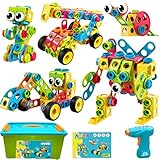 NXONE 195 Piece STEM Building Set NXONE 195 Piece STEM Building Set |
|
Check Latest Price |
 Learning Resources Pixel Art Challenge Learning Resources Pixel Art Challenge |
|
Check Latest Price |
 Huaker 180 Piece STEM Building Block Set Huaker 180 Piece STEM Building Block Set |
|
Check Latest Price |
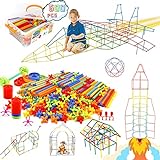 Ggiibro Straw Constructor 600 Piece Set Ggiibro Straw Constructor 600 Piece Set |
|
Check Latest Price |
 Tsomtto 10 in 1 STEM Building Kit Tsomtto 10 in 1 STEM Building Kit |
|
Check Latest Price |
 Smartivity Magic Science Kit Smartivity Magic Science Kit |
|
Check Latest Price |
 Afomida 170 Piece STEM Building Set Afomida 170 Piece STEM Building Set |
|
Check Latest Price |
 Melican 60+ Science Experiment Kit Melican 60+ Science Experiment Kit |
|
Check Latest Price |
How We Picked These Kits
Most roundups in this category list dozens of products rated six and up, which is useless to a parent shopping for a five-year-old. We cut the field to twelve and scored each against seven criteria.
1. Honest age fit. The kit has to work at five on day one, not at five in theory. Where the manufacturer rating and the real difficulty disagreed, we said so in the entry.
2. Independent use. Can a five-year-old start and finish a project with an adult nearby rather than assisting? Kits that needed a grown-up reading every step lost points even when the learning was good.
3. Supervision burden. Small parts, batteries, water and low voltage all change how a kit gets used, so each entry carries a specific safety note instead of a generic child-safe claim.
4. Real skill practice. We asked which of the four strands a kit genuinely exercises. Building sets teach structure and spatial planning, circuit kits teach sequencing and troubleshooting, experiment kits teach cause and effect.
5. Repeat value. A kit finished in two sessions is a disappointment in a box. Open-ended sets and kits with dozens of distinct activities scored above one-model toys.
6. Setup and cleanup. Every kit needs parts laid out before play and put away after, and that time comes out of an already short evening.
7. Durability across ages. The best value comes from a kit that survives a five-year-old and then absorbs a seven-year-old. Parents told us repeatedly that open-ended construction keeps working long after scripted electronics projects finish.
1. Doctor Jupiter My First Science Experiments Kit – Best Overall for a 5-Year-Old
Doctor Jupiter My First Science Experiments Kit for Kids Ages 4+
100+ experiments
Ages 4 and up
12.6 x 9.45 x 1.97 inches
Meets ASTM F963-17
Pros
- 100+ experiments keep one child busy for weeks
- Manual splits activities into solo and assisted sections
- Box includes beakers flasks goggles and tray
- Compact box packs neatly away
Cons
- Common household ingredients must be supplied separately
- Small colour bottles are hard for a 5 year old to squeeze
- A minority of reviewers report missing goggles
This kit practises cause and effect in the most direct way a five-year-old can experience it. The child mixes two things, something visible happens, and the link between them gets built into muscle memory across over 100 experiments spread between the instruction manual and a separate booklet.
The manual is the standout feature and it is not a small thing. Reviewers specifically note that activities are split into sections a child can do alone versus sections needing an adult, which answers the supervision question on paper before the box is open.

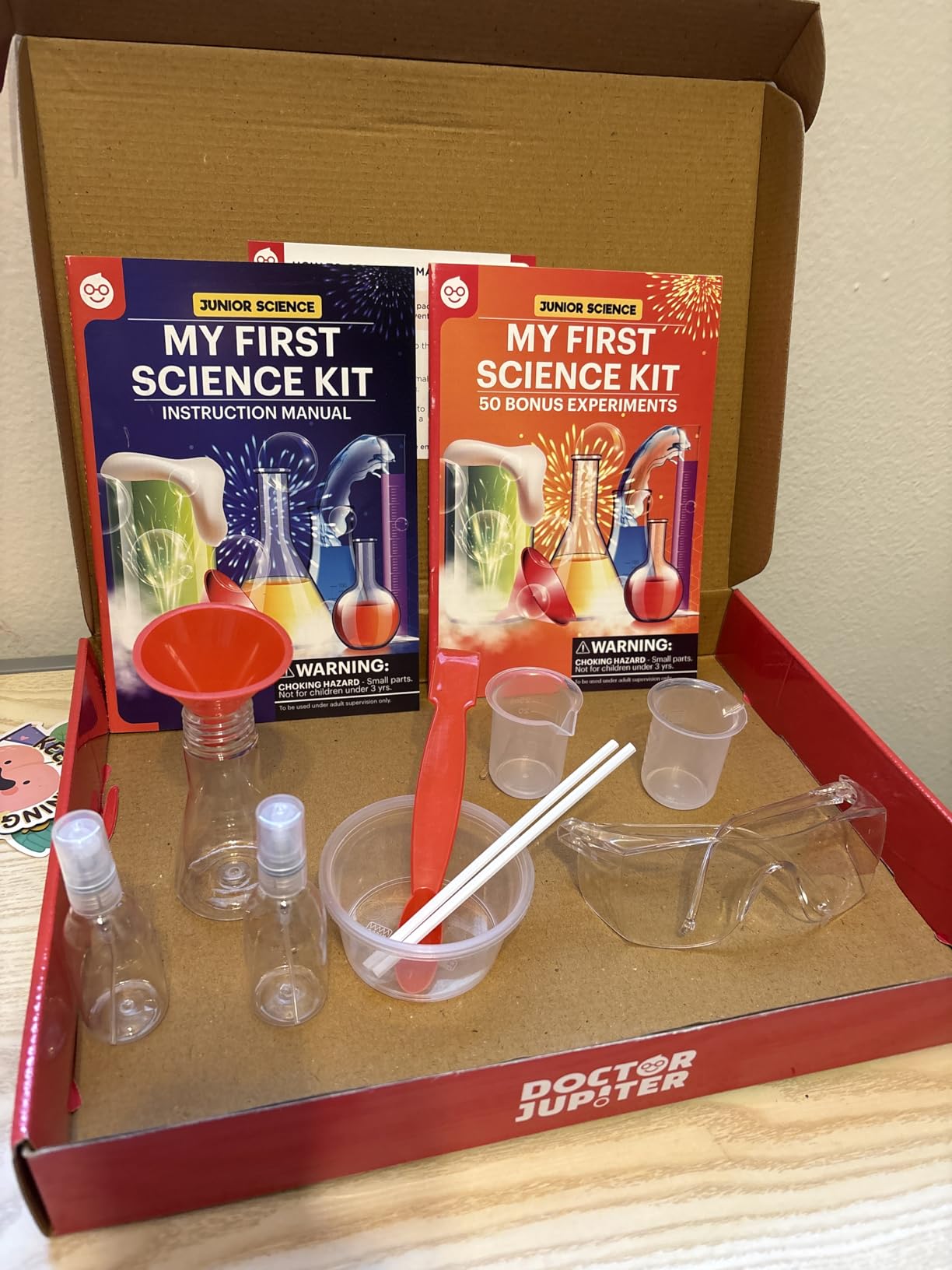
Contents run beyond beakers to a conical flask, spatula, stirring sticks, spray bottles, cups, a funnel, safety goggles, a tray, food essence, baking powder, psyllium husk, corn starch, dried leaves and three food colours. Everything is packed neatly, and the whole kit weighs 660 g.
Can a five-year-old actually use this alone?
Partly, and that is the design. The manual separates experiments a child can manage solo from those needing an adult nearby, so a five-year-old is trusted with a subset while you stay in the room for the rest. Expect to read along for about the first month, then step back.
What to watch out for
You supply your own household basics. Items such as vinegar and food colouring are not included, which is normal for this format but worth knowing. A minority of reviews mention arriving with missing goggles or an already-opened box, so check contents on arrival. Small bottles and liquids mean an adult nearby rather than a nursery shelf.
2. Learning Resources Magnet Movers – Best for Sensory and Quiet Play
Learning Resources STEM Explorers Magnet Movers
34 pieces
10 experiment cards
Ages 5-9
8.3 x 8.1 x 2.8 inches
Pros
- Compact and portable for travel or sensory bins
- Guided cards give parents an easy starting point
- Magnets sized well for small hands
- Durable build from an established brand
Cons
- Listing notes a battery requirement unclear for a manual set
- Brand lists no warranty on this item
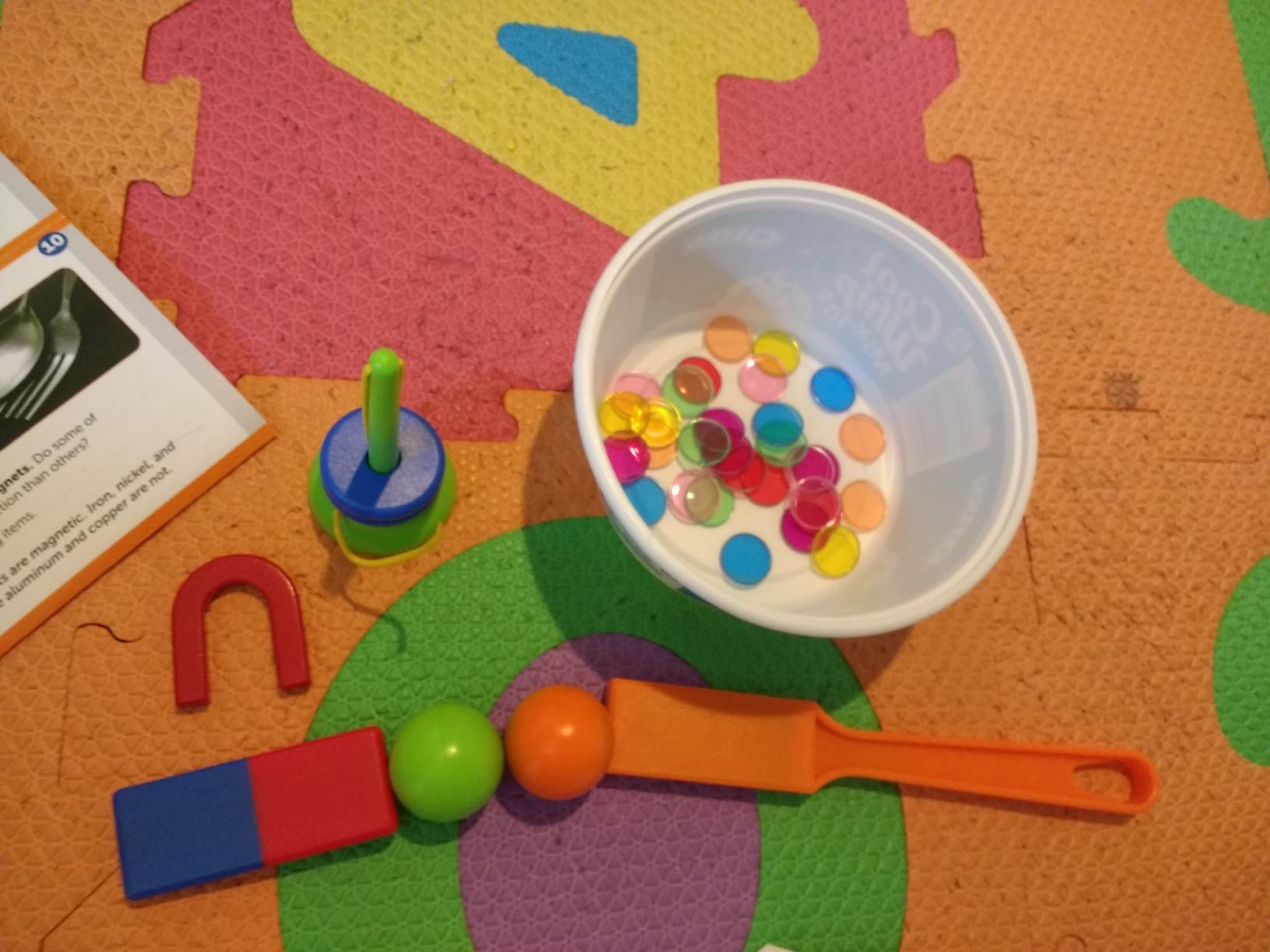
This set practises force and motion, which is early physics in its most tactile form. A five-year-old feels a magnet pull, tests which objects it grabs, and builds an intuitive model of attraction without anyone naming it. For a child who needs sensory input, this is the pick on the list.
Thirty-four magnetic pieces sit in a tray measuring 8.3 by 8.1 by 2.8 inches at 0.36 kg, so the set moves from table to bag to car seat without ceremony. Parents mention dropping it into a sensory bin as routine.
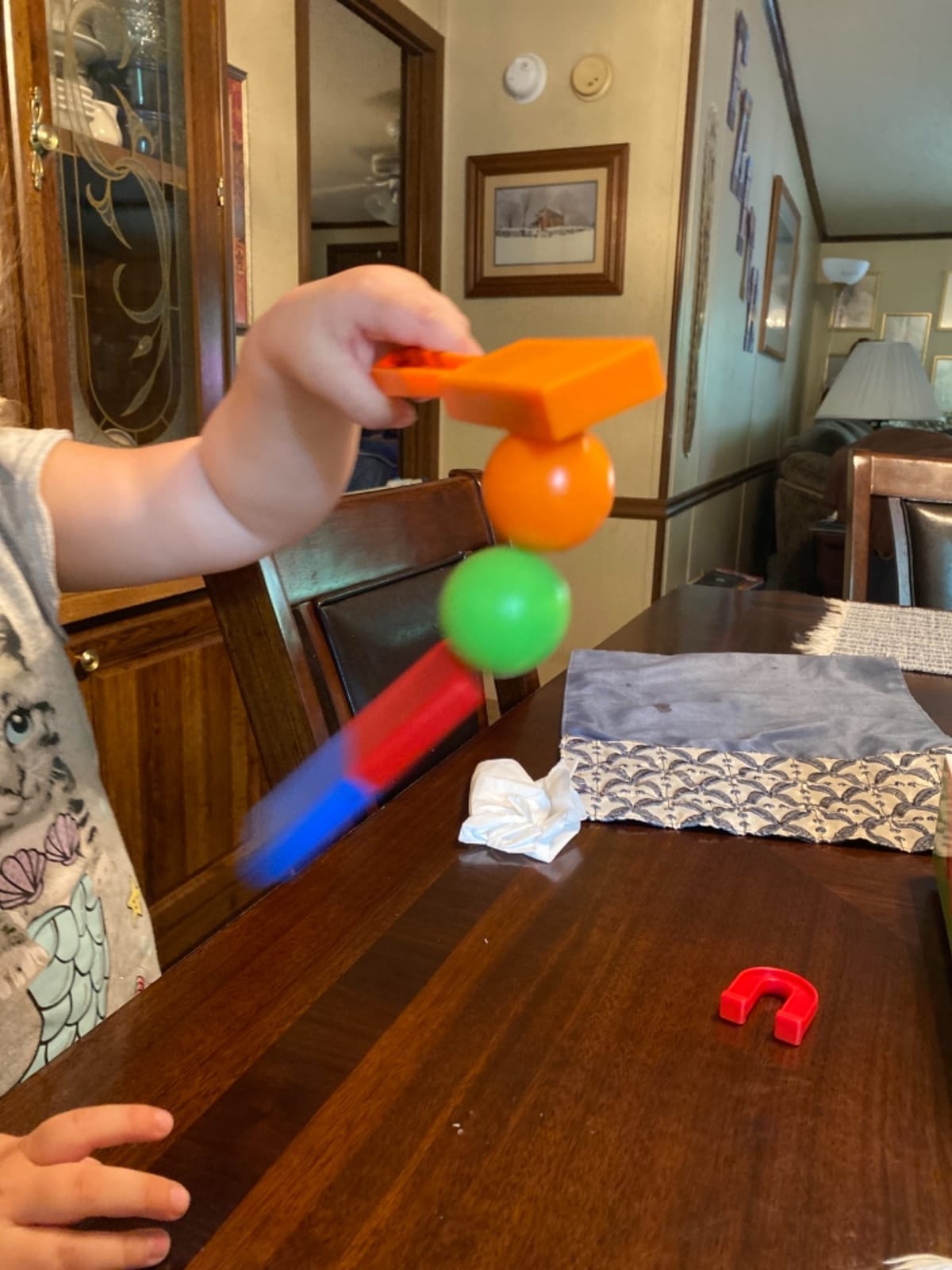
Ten experiment cards act as launchpads rather than instructions. The child follows the guided activity first, then improvises, which is the pattern we want at five. Buyers report this is a toy children return to unprompted rather than one that has to be offered.
Why this is the easiest kit to hand over unsupervised
There is nothing to assemble and nothing to read, which removes the two things that most often require an adult sitting down. A five-year-old can pick it up while you cook, and cleanup is a single tray back in the box. That makes it the top choice for travel, waiting rooms and quiet time.
Where this kit falls short
The listing states a one 12V battery requirement, which does not match a manual magnetic set, and buyers have queried that ambiguity. Learning Resources also lists no warranty here. Magnetism is also a single idea, so keep the set in rotation or in a sensory bin rather than on a shelf.
3. Snap Circuits Beginner SCB-20 – Best Value Circuits Kit
SNAP CIRCUITS Beginner SCB-20 STEM Electronics Toy for Kids Ages 5-9
21 projects
Ages 5-9
Color-changing fan
11.7 x 2 x 7.4 inches
Pros
- Snap connectors intuitive enough for a 5 year old
- 21 projects increase in difficulty
- Light and sound give instant feedback
- Award-winning and used in classrooms
Cons
- Alkaline batteries needed for fan and light modules
- Packaging artwork varies between printings
Snap Circuits teaches sequencing and troubleshooting, and it was the most repeated recommendation in the parent discussions we read. One parent in a large parenting forum thread put it simply, with children aged 5 and 8, and several others agreed in the same thread.
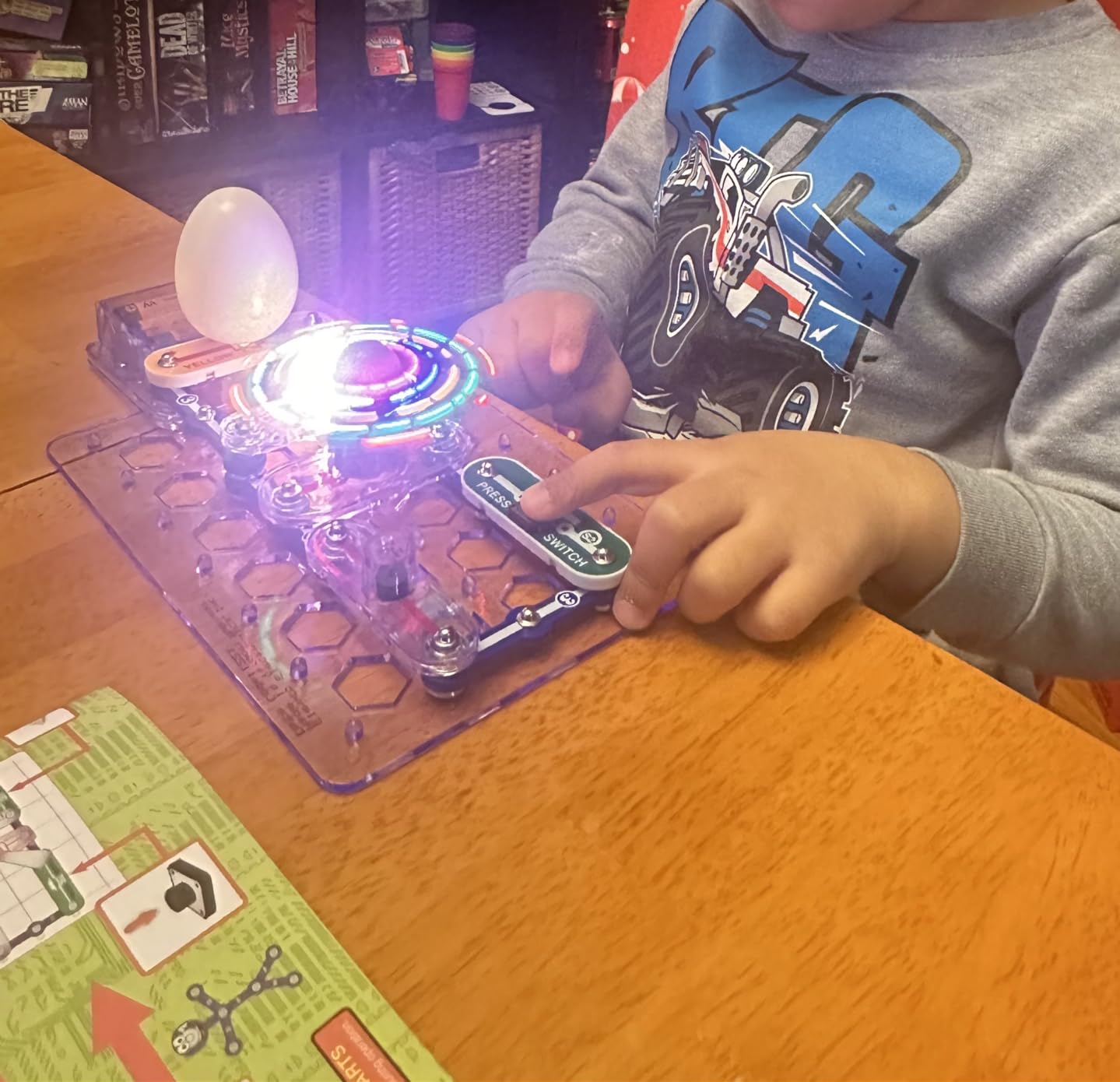
The snap-together connectors are the design decision that matters. A child presses a module onto the base board, the circuit closes, and something lights up or spins. There is no wiring and nothing to strip, so the failure point is a snap that missed rather than a concept too hard.
There are 21 projects with age-appropriate diagrams, and the set includes a lighted color-changing fan that gives instant visible feedback. Components mount to a base board rather than scattering, and the set is warranted for manufacturing defects, which is more reassurance than several rivals offer.
What a five-year-old can finish without you
The early projects are within reach at five, since the colour-changing fan and the simplest loops can be assembled solo once the child understands every piece has to click properly. Later projects need more planning and troubleshooting, which is where an adult jumping in becomes the fun part.
Safety and battery notes
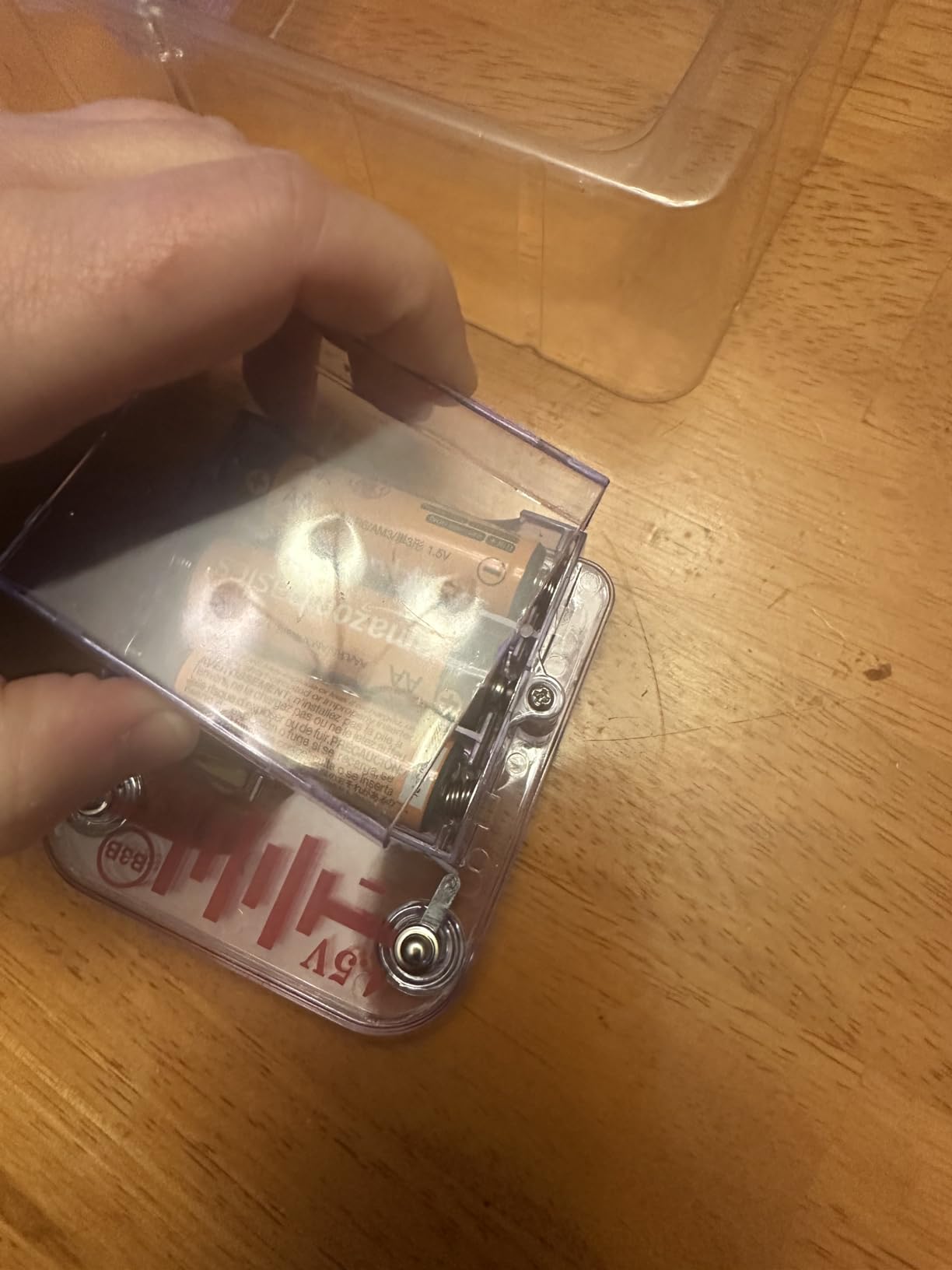
The Beginner version adds childproofing features for younger engineers and is rated 5 to 9. The fan and light modules need alkaline batteries, so keep spares out of reach and check the compartment regularly. The only recurring logistics note is that packaging artwork has changed between printings.
4. Learning Resources Brainometry – Best for Quiet Time and Siblings
Learning Resources STEM Explorers Brainometry
34 pieces
10 challenge cards
Ages 5-10
2 year limited warranty
Pros
- Works across a wide age span for siblings
- Challenge cards scale in difficulty
- Portable box for travel and quiet time
- Free-build option beyond the cards
Cons
- Some buyers want more pieces
- 34 pieces limits larger structures
- A minority call the finish average for the price
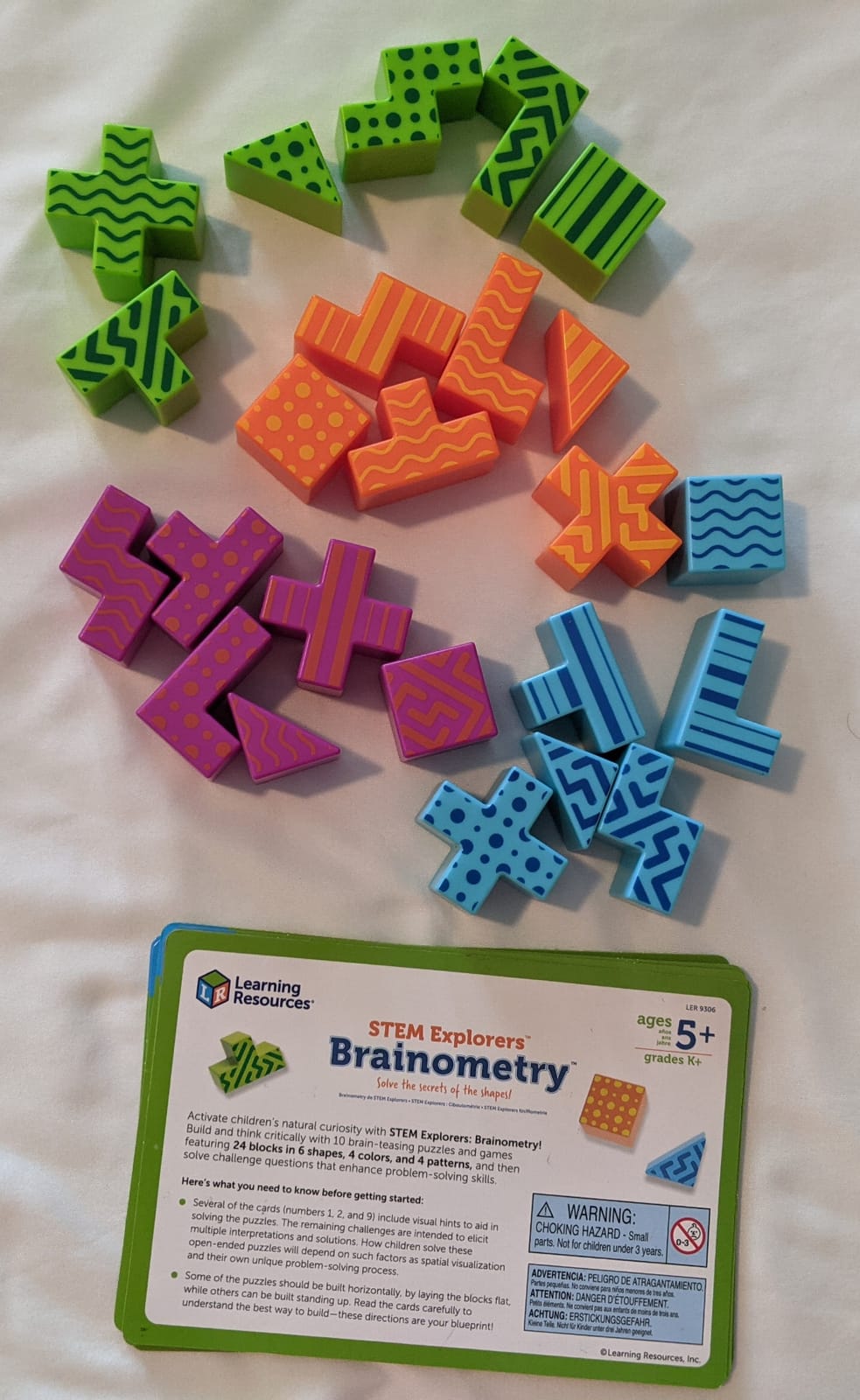
This one practises spatial reasoning and pattern logic, the closest any kit here comes to coding without a screen. Thirty-four tactile puzzle blocks in varied shapes must be arranged to match a pattern, and the child is doing mental rotation the entire time.
The ten double-sided challenge cards scale, with a different difficulty level per card. Parents report children aged 4, 6, 7 and 9 completing them independently at their own levels, which makes this the most shareable set on the list.
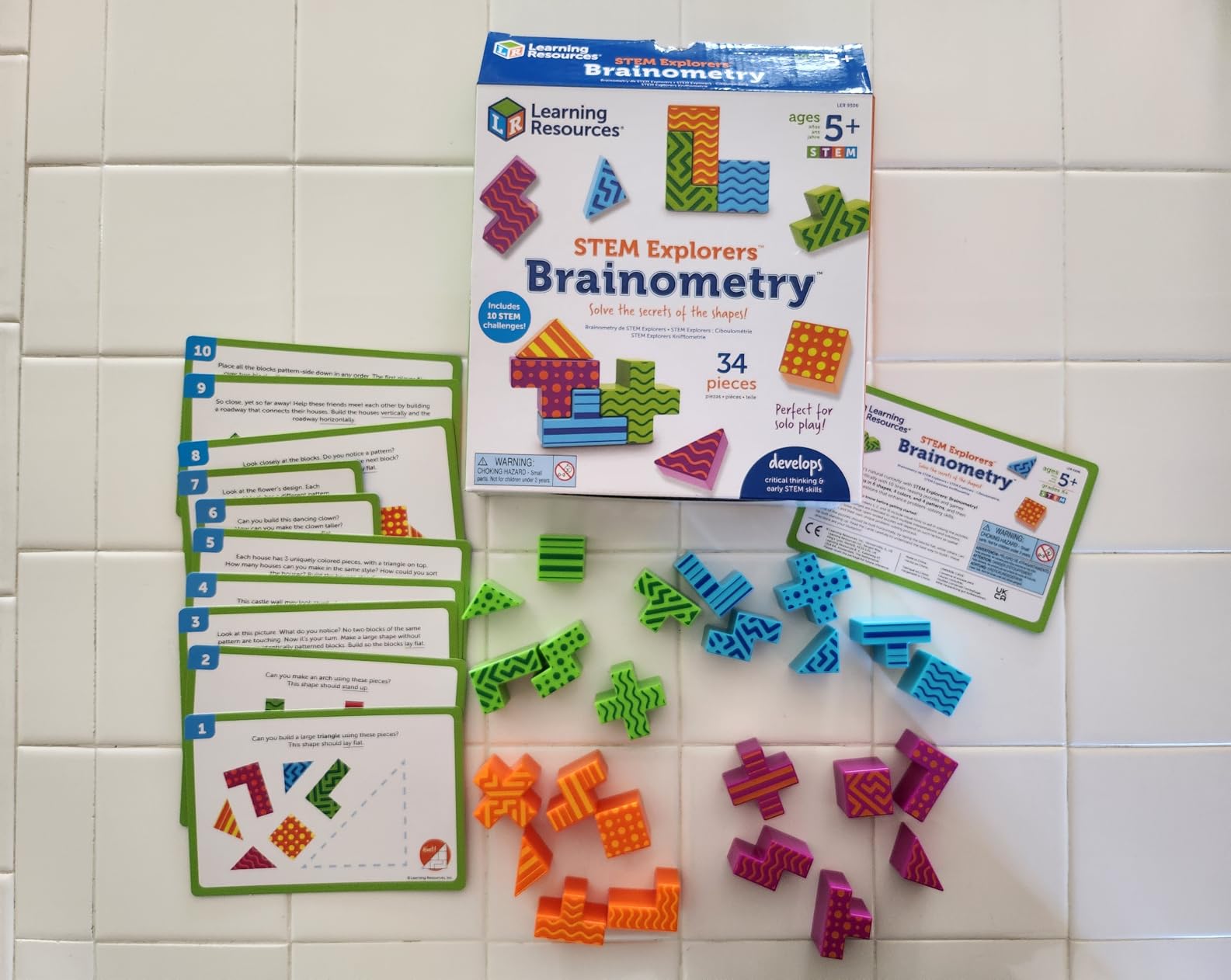
The rated range is 5 to 10, so a five-year-old starts at the floor rather than in the middle. Teachers describe it as a hit in a quiet activity centre, nothing needs batteries, and everything fits a portable box measuring 10 by 9 by 4.5 inches at 0.29 kg.
Best fit when one child needs to be quiet
This is the kit for a car journey or a work call. No assembly, no instructions to read aloud, no batteries and no mess, and a five-year-old can work a card independently for twenty minutes or more. It is also the strongest gift here when siblings are close in age.
Honest limitations
Thirty-four pieces is a small count and it shows. Parents wanting large structures repeatedly ask for a bigger set, which is the most common request in the reviews, and a minority describe the finish as average for the price. It is a puzzle rather than a build, so pair it with a construction set.
5. NXONE 195 Piece STEM Building Set – Best When Two Children Share
NXONE 195 PCS STEM Toys, Building Sets for Kids 3+
195 pieces
Rechargeable drill
Ages 3 and up
Storage box included
Pros
- Rechargeable electric drill is the standout feature
- 195 pieces sustain long builds
- Storage box makes cleanup fast
- Works for up to 8 children at once
Cons
- Only four wheels included and no add-on packs
- Instruction booklet is thin for the open-ended potential
- One reviewer found the plastic cheaply made
This set practises structures and engineering through trial and error, and the electric drill is what makes it work at five. Holding a chunky block in one hand and a screwdriver in the other is genuinely hard for a small child, and a kid-safe rechargeable drill removes that barrier.
At 195 pieces covering architecture, robots, animals and vehicles, a five-year-old can spend an afternoon on one construction with pieces to spare. The set is rated 3 years and up, so age five sits comfortably inside the range.
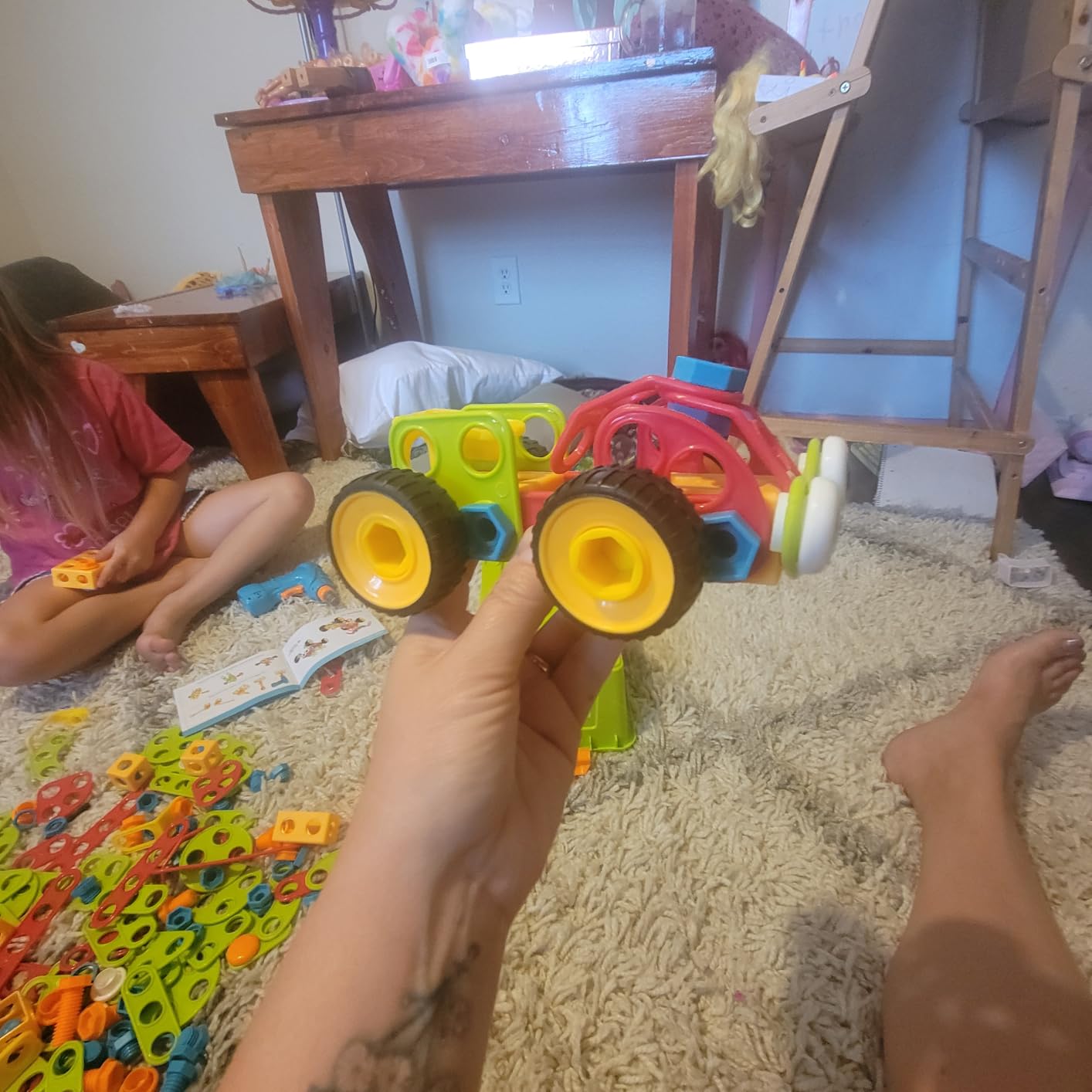
Two details make this the sibling pick. The set supports up to 8 players at once, so two children can build separate projects instead of fighting over one model. The portable storage box is what parents praise most about cleanup. It is certified free of phthalates, lead, cadmium and BPA, with no sharp edges.
Why the drill matters more than the piece count
Fine motor strength is the real bottleneck at this age, not imagination. A five-year-old can design a car and completely fail to fit the wheels without a tool, and the drill removes the pinch grip that most building sets quietly demand. Siblings can also work side by side because there are enough pieces for two large models.
What frustrated buyers mention
The four-wheel limit is the most repeated complaint and a design consequence rather than a defect: the next wheeled model requires disassembly, and no expansion packs are sold. Instructions are also weaker than the open-ended potential, and the box at 23 by 16 by 14 inches needs a real shelf.
6. Learning Resources Pixel Art Challenge – Best for a First Taste of Coding
Learning Resources Pixel Art Challenge The Original STEM Pixel Art
400 foam pieces
40 challenges
Ages 5-8
No batteries
Pros
- Teaches a grid and coordinate system that transfers to coding
- Zero assembly and no batteries needed
- Packs into a small tray for travel
- Popular in first-grade activity centres
Cons
- Foam cubes are light and drift out of the grid
- Pieces are inconsistently sized for the 10mm slots
- Some cuts incomplete or oversized
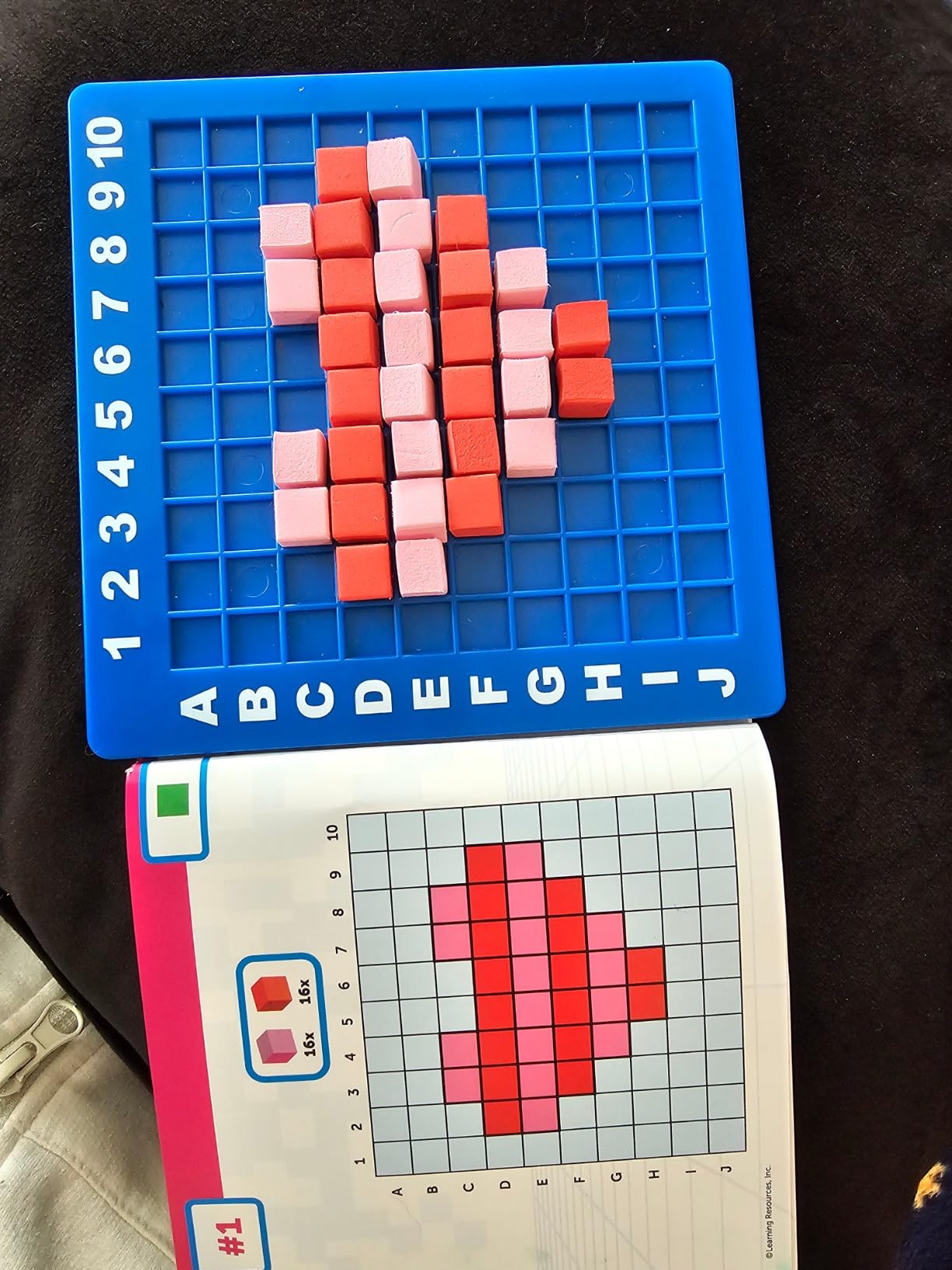
This is the closest thing to screen-free coding on the list, and it works because the grid tray is the interface. A child places foam pieces into slots on a 5.5 by 5.5 inch grid to reproduce a picture, then moves on to reading coordinates, which is the same mental move as block coding.
Forty challenges increase in difficulty, starting with copy-the-picture and progressing toward coordinate reasoning. Rated 5 to 8, so a five-year-old begins at the simplest end with a genuine upward path.
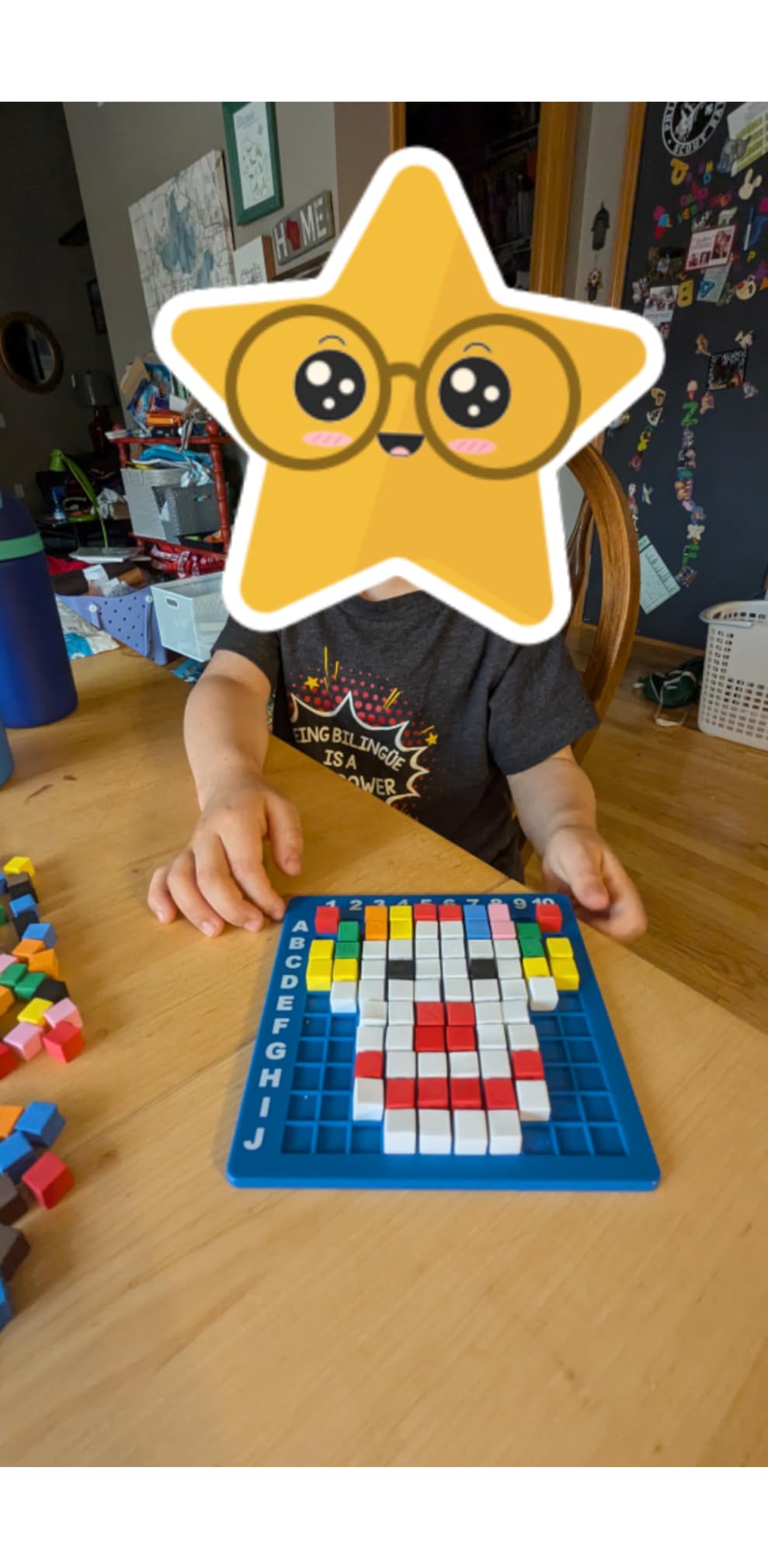
It is the easiest kit here to put away: no assembly, no batteries, and 400 foam pieces that pack into a box measuring 8 by 8 by 2.5 inches at 9.1 ounces. Placing small foam pieces also strengthens hand-eye coordination and dexterity, which is why teachers pick it up before a child is ready for coordinates.
Is it really coding, or just a puzzle?
It is the same skill. Reading a grid by coordinate is the foundation block coding courses build on, and doing it with physical pieces avoids the screen at an age when app-based coding toys are often the only option. A five-year-old can complete the early challenges solo because there is nothing to assemble and nothing to read.
The honest weakness with the pieces
The complaints here are unusually specific and consistent. Foam cubes are very light, so they pop out of the grid and wander off, and some are too large or too small for the 10mm slots. Foam also shows fingernail marks, colour counts cap free-form designs, and one review reported one board instead of the three the box art implies.
7. Huaker 180 Piece STEM Building Block Set – Best Built to Last
Huaker STEM Building Toys for 3 4 5 6 7 8 Year Old Boys Girls Birthday Gift
180 pieces
Idea booklet included
Ages 3 and up
Non-toxic plastic
Pros
- Holds up to years of daily play
- Children build independently after one demonstration
- Booklet lists piece counts for first builds
- Large box suits classroom STEM bins
Cons
- Wheels and eyes are limited and no add-on pack is sold
- Thin prongs can snap if treated roughly
- One kit is not enough for two children
This set practises structural stability, symmetry and geometry through trial and error, and the durability story is why it ranks here. Buyers report the set still in use months or years later, with one parent describing sustained use from age 3 to 6 with two children.
At 180 pieces across multiple colours and shapes, a five-year-old has enough material for cars, robots, trucks and dinosaurs, or anything the manual does not cover. The rated range starts at 3 years and up.
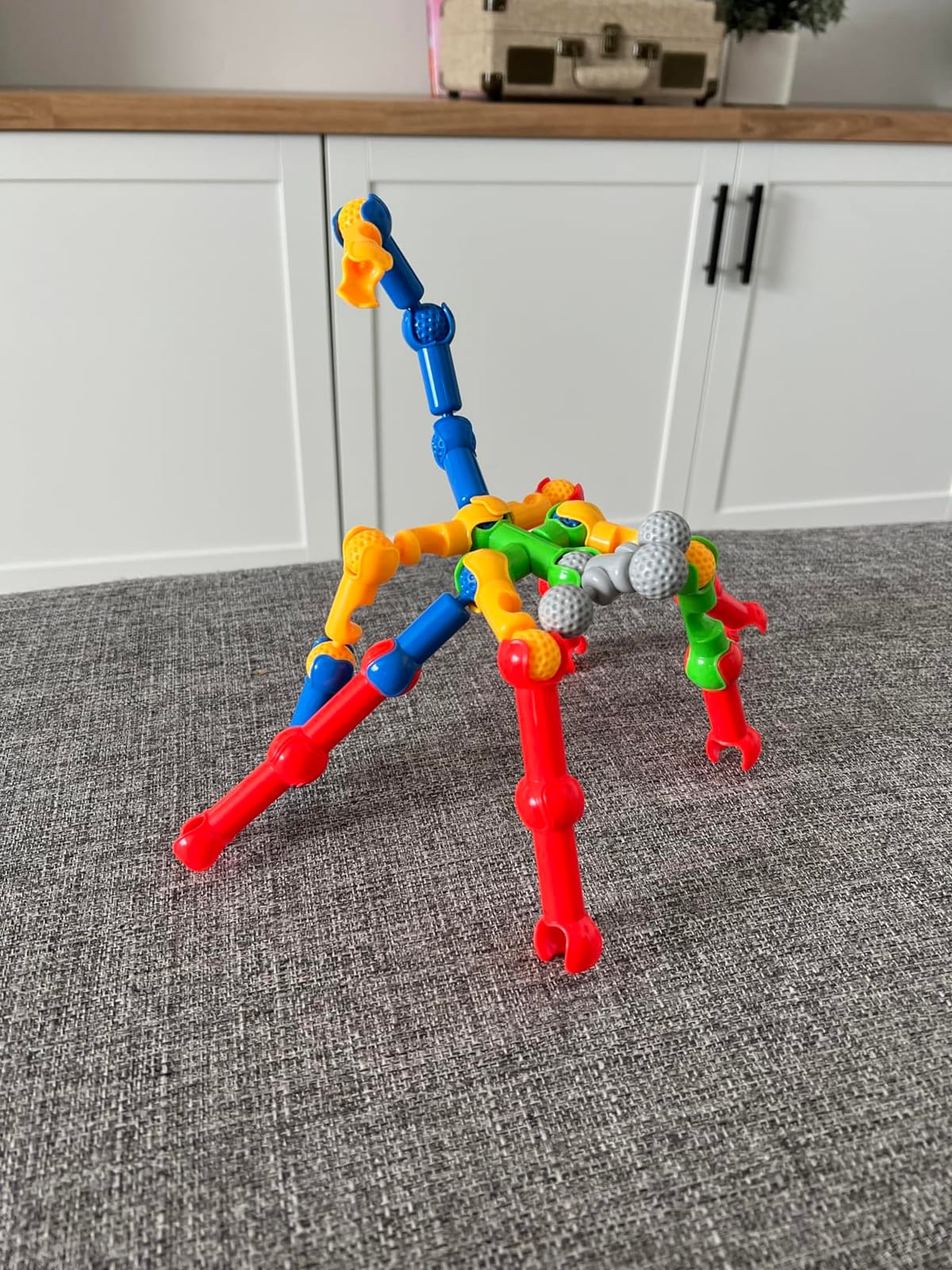
The idea booklet is the quiet hero because it lists piece counts alongside photos, which is what lets a four-year-old and a six-year-old both start independently after one demonstration. The set is washable, made from certified non-toxic BPA-free plastic, and the large sturdy box supports fast cleanups.
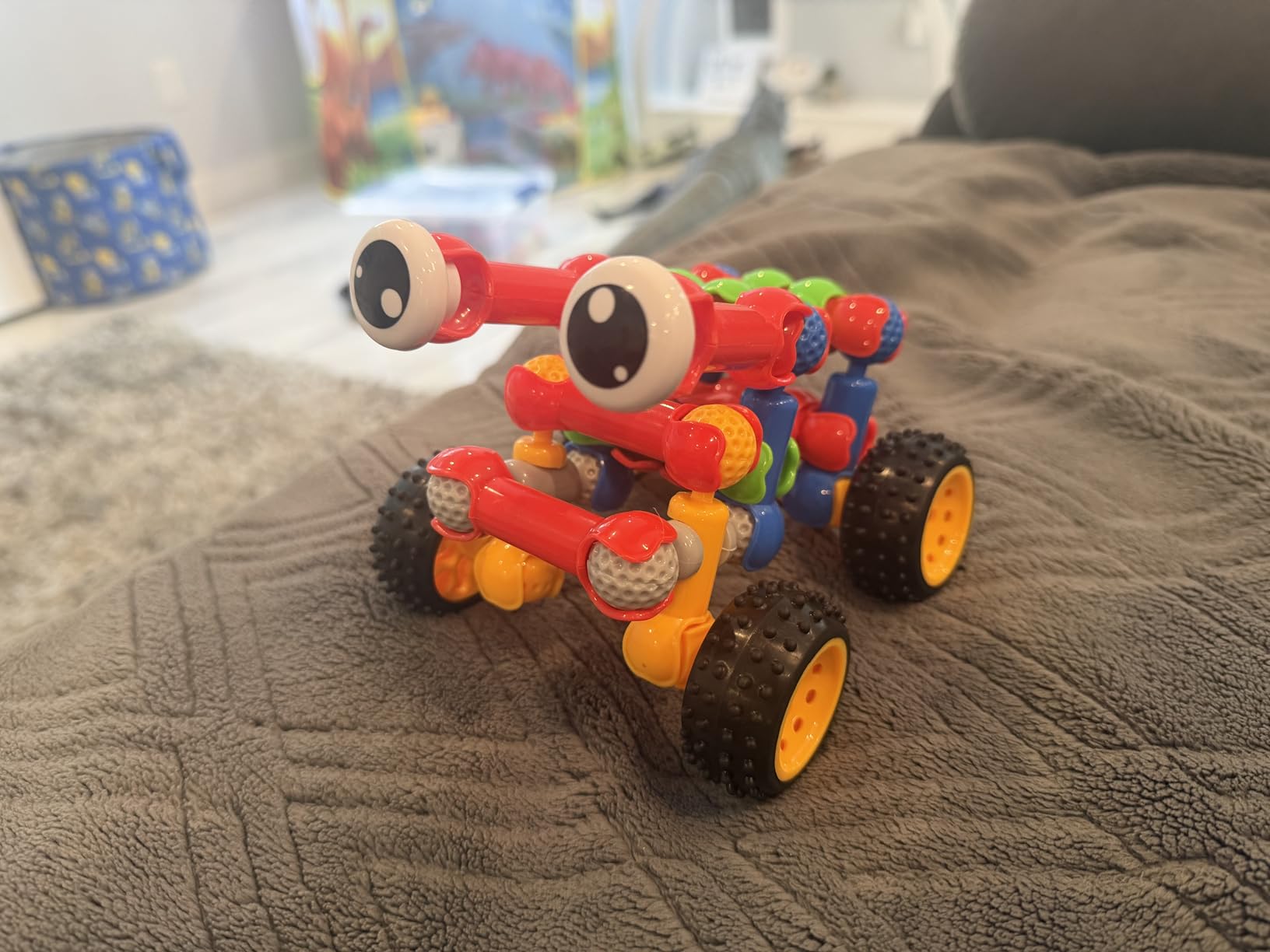
How to get a five-year-old building without sitting on the floor
Hand over the piece-count page rather than the whole booklet. Parents report children building independently after a short demonstration because the photos remove the ambiguity, and once they know how many wheels a car needs, the counting itself becomes the maths practice. Adults end up building alongside rather than directing.
Where it falls down
Scarcity of small accessory pieces is the recurring complaint. Wheels and eyes are limited with no add-on pack sold, so those parts get fought over and eventually go missing, and several buyers keep two sets so two children can build separately. The connector prongs can also snap under rough play.
8. Ggiibro Straw Constructor 600 Piece Set – Best for Groups and Classrooms
Straw Constructor Toys 600Pcs STEM Building Toy Interlocking Plastic Engineering Thin Tube Blocks Educational Kit for 3 4 5 6 7years Kids Boys and Girls Gift Preschool STEM Toy with Storage Box
600 pieces
CPSIA and ASTM certified
Ages 3 and up
Storage box included
Pros
- Very high piece count supports group and classroom use
- Multi-directional connectors and wheels extend build options
- Thin straws are easy for small hands
- Storage box makes cleanup fast
Cons
- Thin PVC straws bend or crack under forceful play
- Connectors fit loosely so tall builds go wobbly
- Lowest average rating among these twelve
This is the cheapest way to put a full set of engineering pieces in front of a group, and at 600 pieces there is enough material for several children to build at once. The straw-and-connector format teaches structure, planning and spatial reasoning with no reading and no screen.
Connectors are multi-directional and wheels are included, so builds go beyond the flat shapes a basic straw kit allows. Airplanes, boats, cars, castles, robots and animals are all within reach, and the recommended age starts at 3 years.
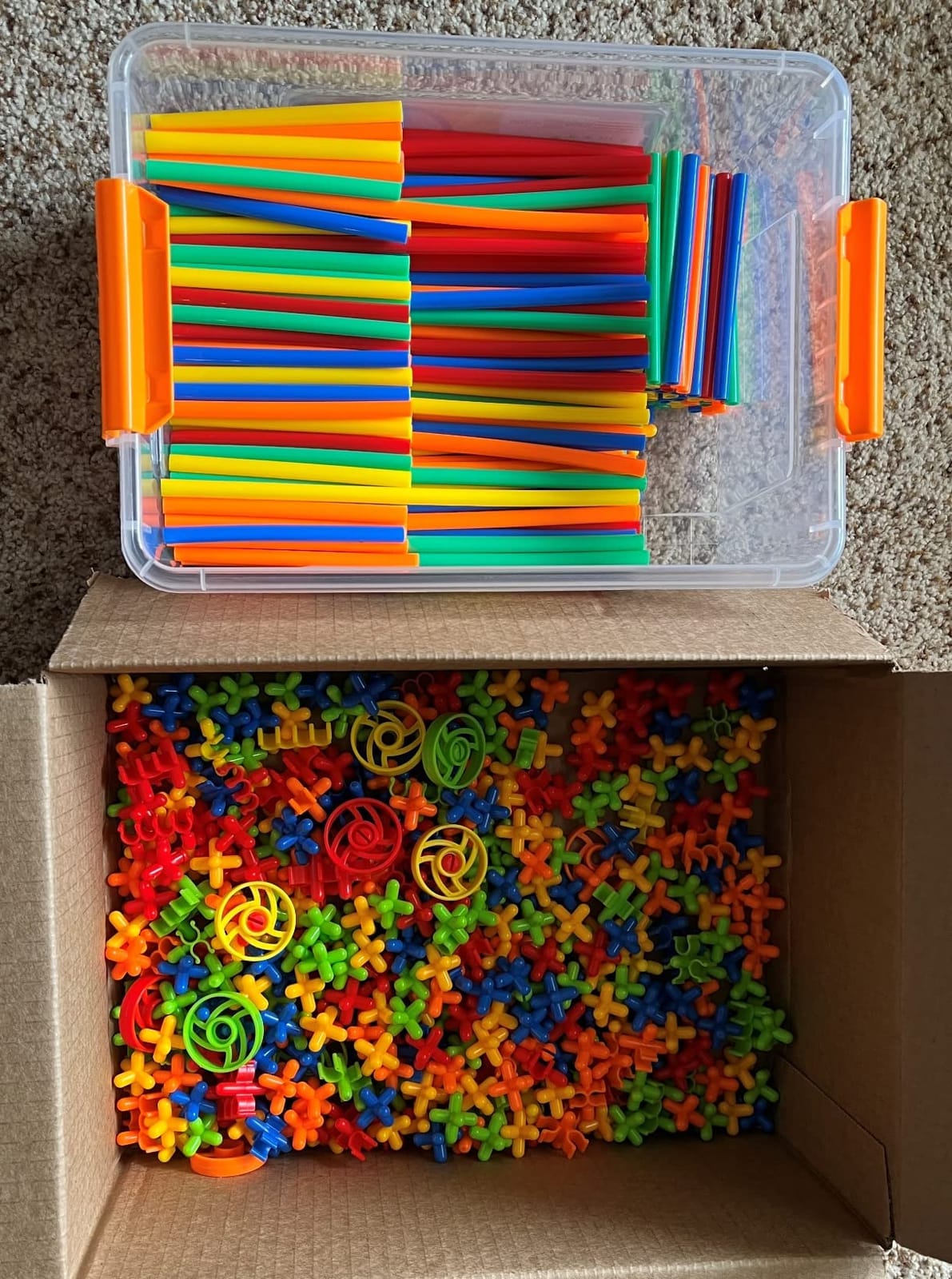
Thin straws are easy for small hands to push together and pull apart again, which means mistakes are cheap and the failed structure is part of the lesson. It is certified to CPSIA and ASTM standards with non-toxic materials, needs no batteries, and supports 3 to 7 players.
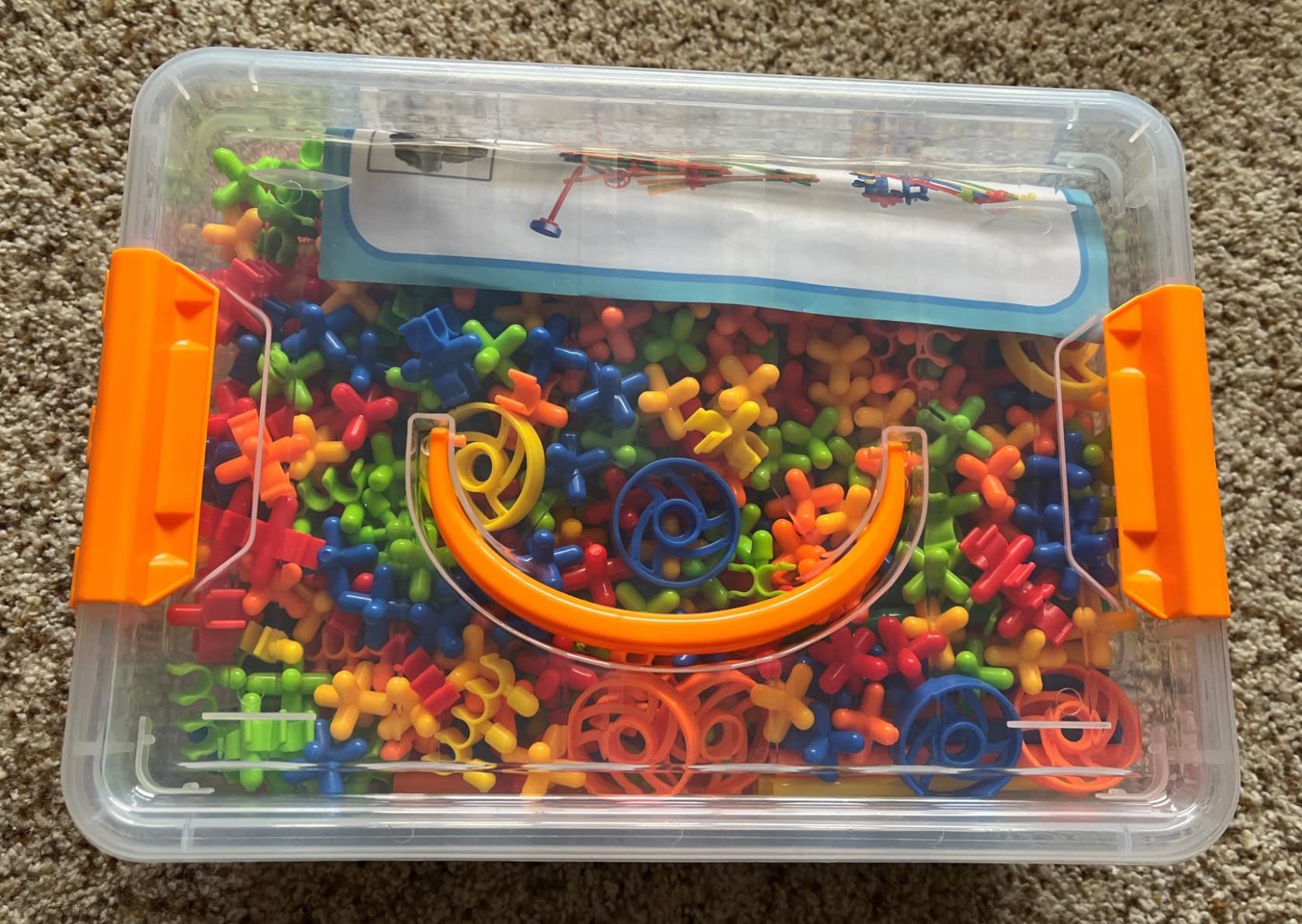
Best for a table of children rather than one child
Nothing in the format requires reading, so a five-year-old can join in mid-session without an explanation first. Cleanup is the strong suit, since everything lives in the supplied box and a classroom can reset the whole thing in a couple of minutes. For a single family there are more pieces than one child needs.
The physical limits of thin plastic
This set carries the lowest average rating of the twelve, and the reason is physical rather than educational. Thin PVC straws bend and crack during forceful play, and connectors fit loosely on some pieces, so tall structures come out wobbly and collapse. A child who treats toys roughly will get more from interlocking blocks.
9. Tsomtto 10 in 1 STEM Building Kit – Best for Vehicles That Roll
10 in 1 STEM Toys for 4 5 6 7 8+ Year Old Boy Girl Christmas Birthday Gifts
167 pieces
10 models
Two sets of tools
Ages 3 and up
Pros
- Ten distinct models give a long play arc
- Finished vehicles roll for play after assembly
- Pieces reusable across models
- Two tool sets support two children
Cons
- Instructions exceed a 5 year old without help
- Bolt heads can snap if tightened too hard
- Only one model assembled at a time
This kit teaches assembly and sequencing through following a build order, a different skill from open-ended construction. At 167 pieces it assembles into 10 models including a tower crane, forklift, catch car, rocket car, plane, racing car, robot and helicopter.
The payoff for a five-year-old is that the finished model rolls. Parents highlight this as the thing that lifts the value above assembly, because the toy does not stop working the moment the last bolt goes in.
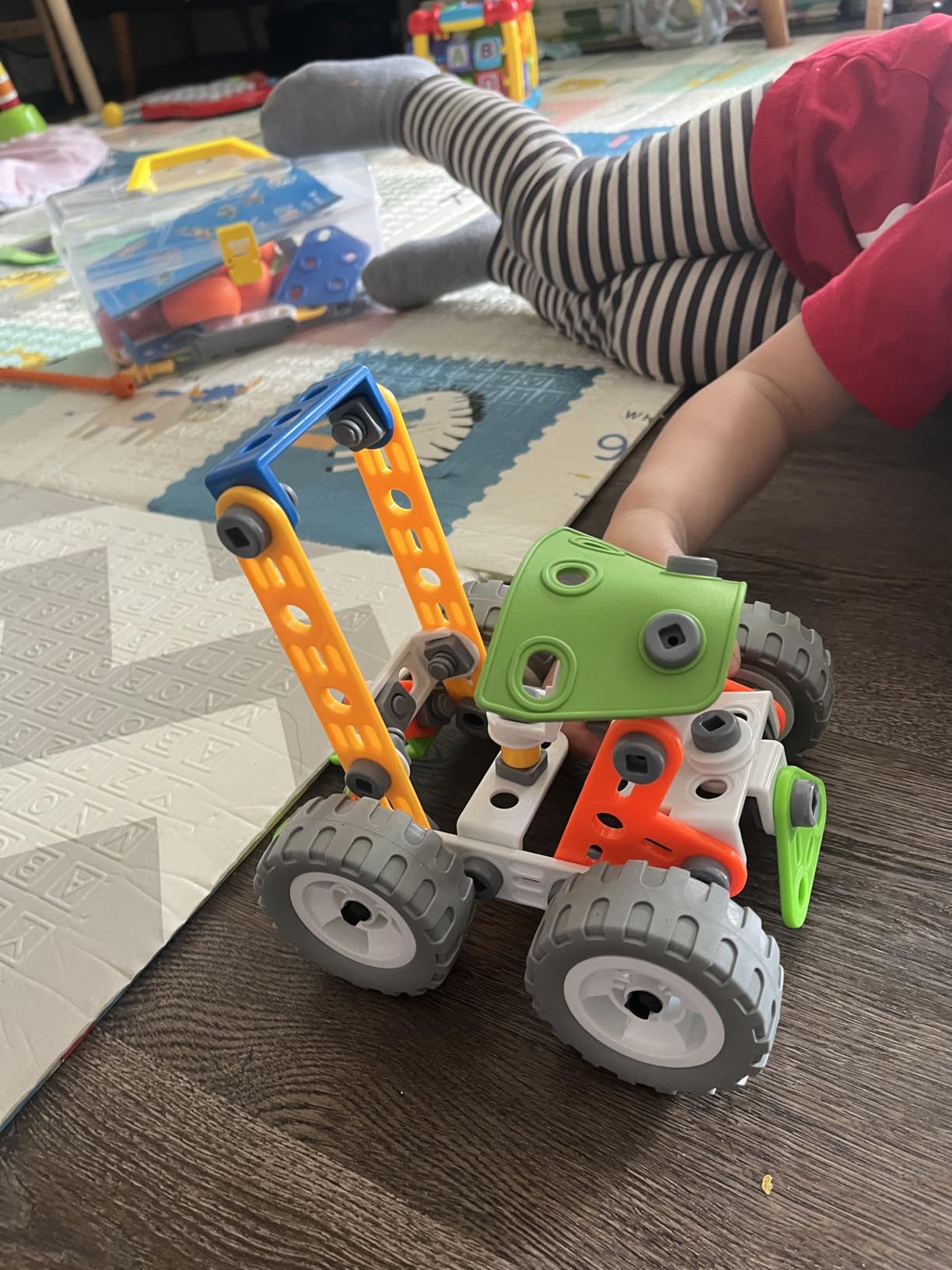
Two sets of tools are included so two children can work at once, and pieces are reusable across all ten models rather than consumed by one. The plastic is described as non-toxic and washable, it comes with a sturdy storage box, and the picture-driven booklet is what makes assembly possible for a child at all.
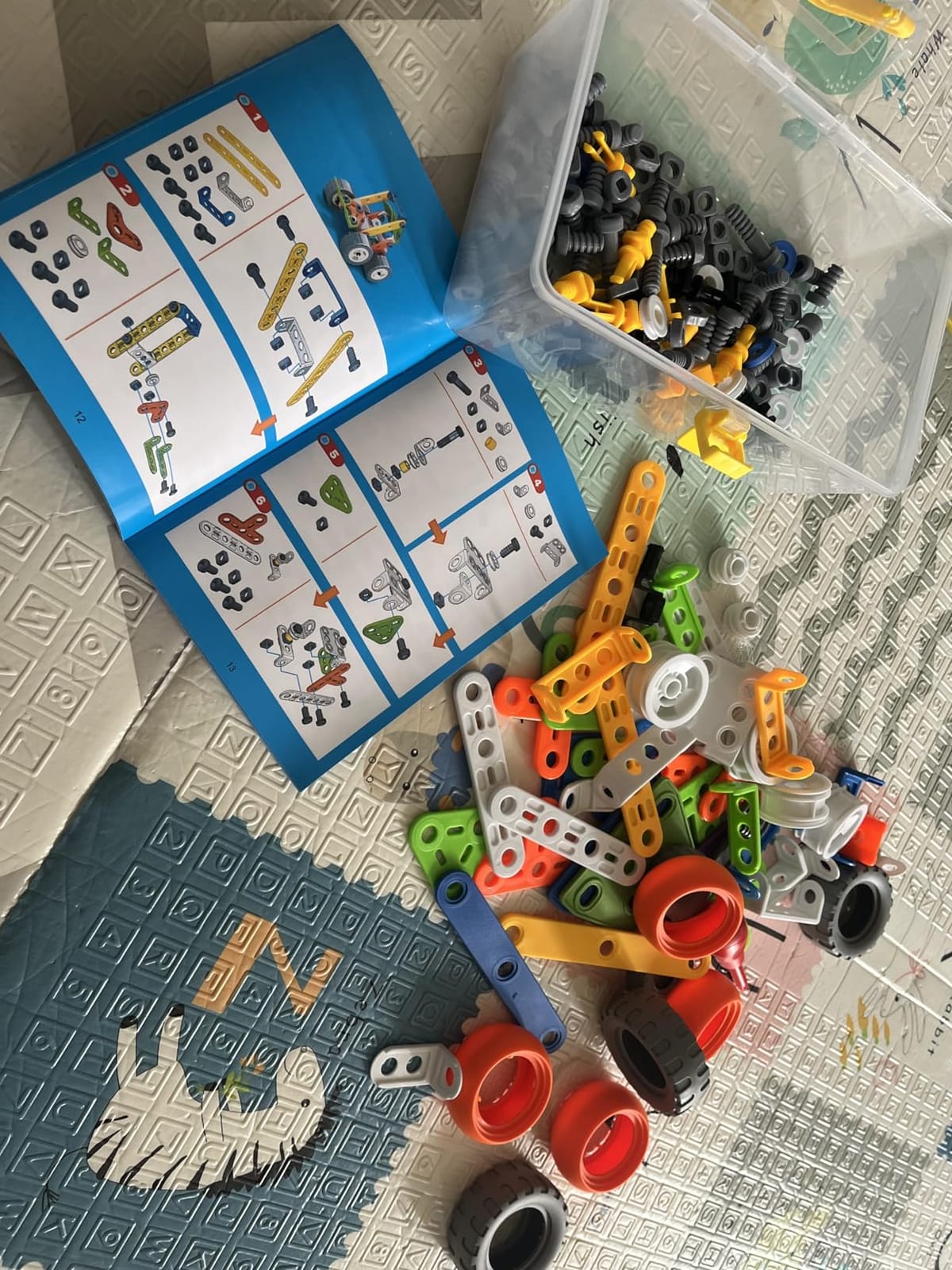
How much help a five-year-old needs
More than the packaging suggests. Multiple reviewers, including grandparents, report the instructions exceed what a five-year-old can manage alone, so it skews better for six and up. Expect to sit with it for most of the first build, though later models go faster once the pattern is understood.
Safety notes and the one-model limit
Small parts mean close supervision, and bolt heads can snap off if tightened too hard, so warn a five-year-old before starting. Only one model can be assembled at a time, which narrows its value for siblings and classrooms even though two tool sets are included.
10. Smartivity Magic Science Kit – Best for Physics and Density
Smartivity Magic Science Kit for Kids Ages 4, 5, 6, 7, 8 Years | 50+ Amazing Science Experiments I Birthday Gifts for Boys & Girls | I Educational Toy for Kids Age 4-8 Years Old
50+ experiments
58 parts
Ages 4-8 marketed
No batteries
Pros
- Engaging enough that a 4 year old asks for repeat experiments
- Manual includes a parts list so you can start immediately
- Most experiments need only water and pantry staples
- Messy mat keeps the table usable
Cons
- Manufacturer lists 6-14 recommended age despite 4-8 marketing
- Included soap bottle arrived open in one report
- Some experiments are less exciting than described
This kit covers the widest science range in the shortlist, spanning chemical reactions, density, polymers, air pressure, magnetism, electricity and optics across 50+ experiments. For a five-year-old the strongest ideas are the ones where the answer is visible in seconds.
The manual lists every part needed for each experiment, so you are not hunting through the box at the kitchen table. The 58 parts are MDF and plastic, and no batteries are involved, which keeps the whole set screen-free.

Most experiments need only water and a few pantry staples such as oil or milk, which matters because you do not want a mid-session shop run. A messy mat is included so the kitchen table stays usable, and the box measures 12.56 by 11.81 by 2.52 inches at 770 g.
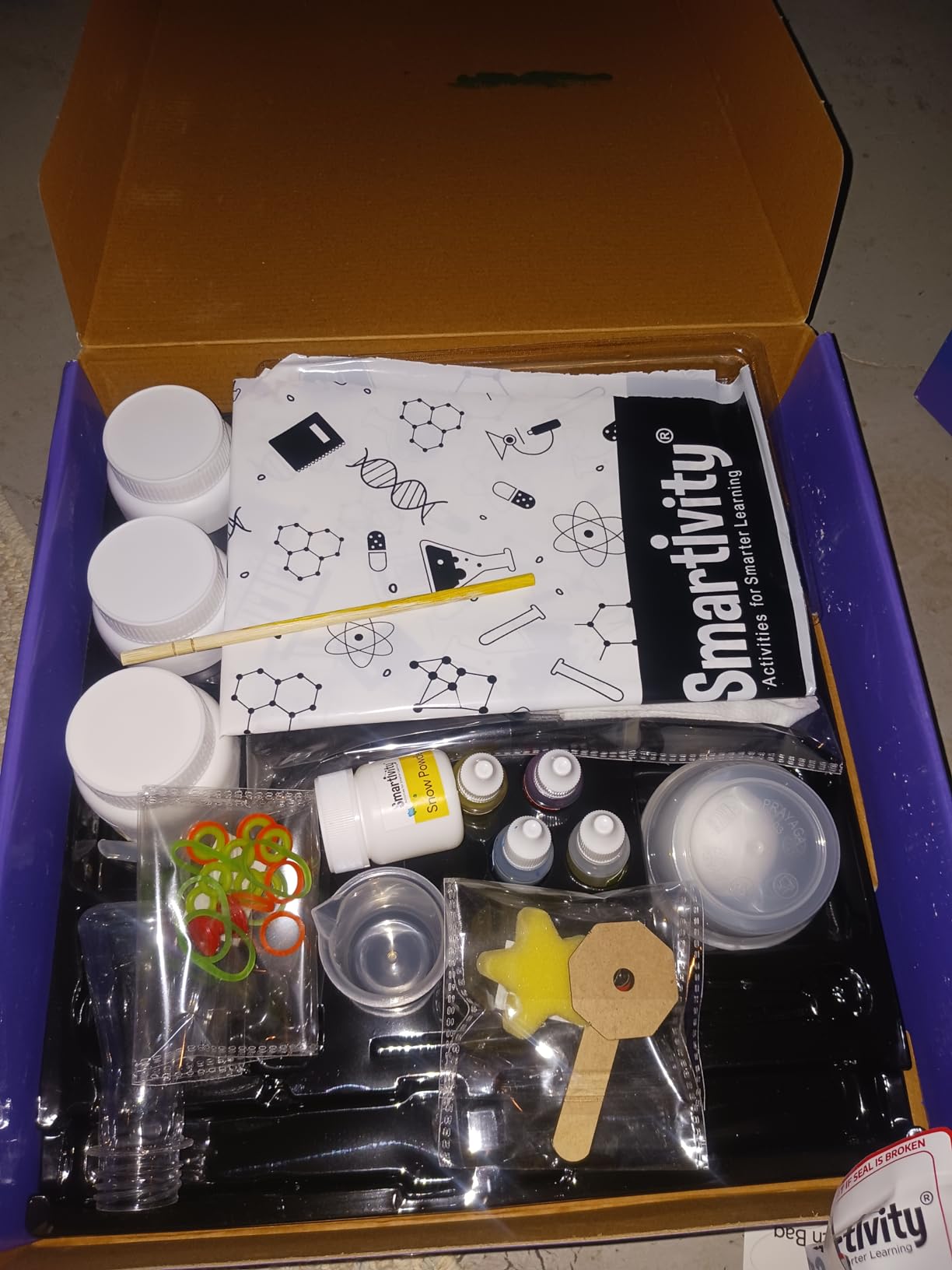
What a five-year-old actually gets out of it
Engagement rather than variety depth. One grandparent reported a five-year-old sustaining three hours with help, and parents describe repeat requests rather than working through the box once. A five-year-old can lead the simple experiments while an adult narrates the science in plain language.
The age-rating problem
The manufacturer lists a recommended age of 6 to 14 even though the product is marketed for ages 4 to 8, and that mismatch is the most important thing to know. Treat it as a five-and-six-year-old kit. The included concentrated soap bottle also arrived already open in at least one report.
11. Afomida 170 Piece STEM Building Set – Best for Truly Open-Ended Building
170 Pcs STEM Building Toys for Kids Ages 4-8, Building Blocks Educational Construction Engineering Building Kit for Ages 3 4 5 6 7 8 9 Year Old Creative Kids Games, Christmas Birthday Gifts Boys Girls
170 pieces
20 removable wheels
18+ models
Ages 3 and up
Pros
- Identical skeleton-joint pieces give huge build freedom
- Removable wheels let finished models roll
- Pieces rinse clean under water
- Storage box keeps it portable
Cons
- Listing dimensions describe one piece not the set
- Identical piece types limit structure variety
- No individual review text was available for this ASIN
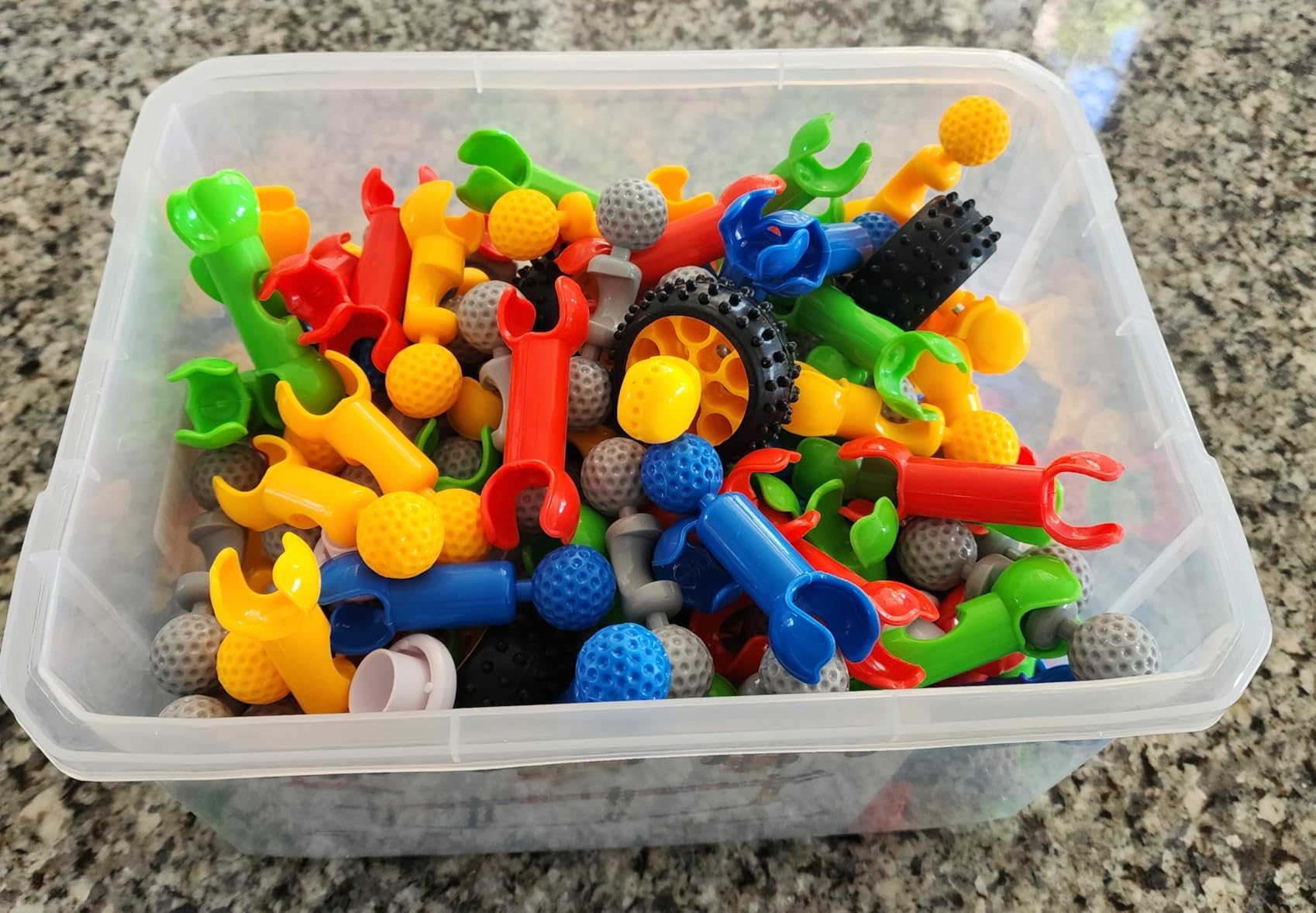
Where most building sets give you a menu of models, this one gives you a material. All 170 pieces are identical skeleton joints in five colours plus 20 removable wheels, so a five-year-old can use them to build anything at all, and nothing in the set requires reading instructions to begin.
It practises structural thinking, early colour recognition and spatial planning, and it is rated 3 years and up. Pieces rinse clean under water, which keeps floor play realistic, and the sturdy box moves between rooms at 0.9 kg.
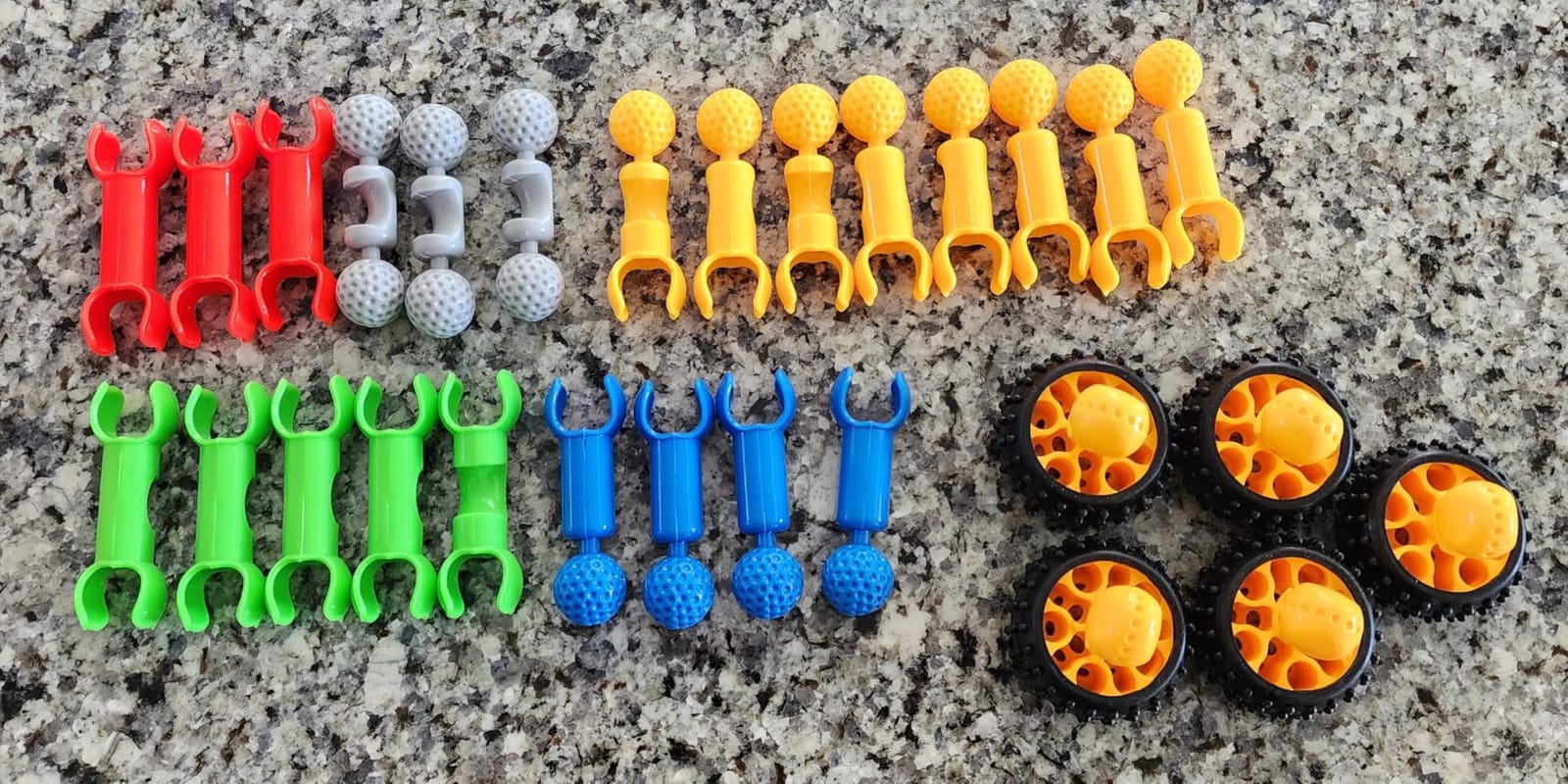
On materials the set is ABS plastic certified free of phthalates, lead, cadmium and BPA, with no sharp edges. The rating profile is among the strongest here, at 82 percent five-star across 1281 reviews with only 3 percent one-star.
Why identical pieces beat varied shapes at this age
A five-year-old cannot yet hold a complex part in mind and plan around it. With one part type repeated 170 times there is nothing to confuse them, so the difficulty drops to the actual thinking, which is why structures hold up and why the child returns to it. Removable wheels add the payoff, since a finished model keeps being played with.
Limitations worth knowing
Because every joint is the same shape, the range of structures is narrower than a set with varied beams, and a child who specifically wants detailed vehicles may feel limited after a few weeks. One further caveat: no individual customer review text was returned in our product data for this ASIN, so the hands-on impressions here come from the listing specifications and rating distribution.
12. Melican 60+ Science Experiment Kit – Best All-In-One Starter Set
Melican 60+ Science Experiment Kit for Kids Ages 4 5 6 7 8+
60+ experiments
Goggles included
Ages 4 and up
No batteries
Pros
- 60+ experiments give a long runway of repeat play
- All-inclusive with materials tools manual and goggles
- Illustrated guides are easy to follow together
- Covers volcano lava lamp and dinosaur egg digs
Cons
- Lowest review count of the twelve at 377
- Some disappointment with experiment variety reported
- No individual review text was available for this ASIN
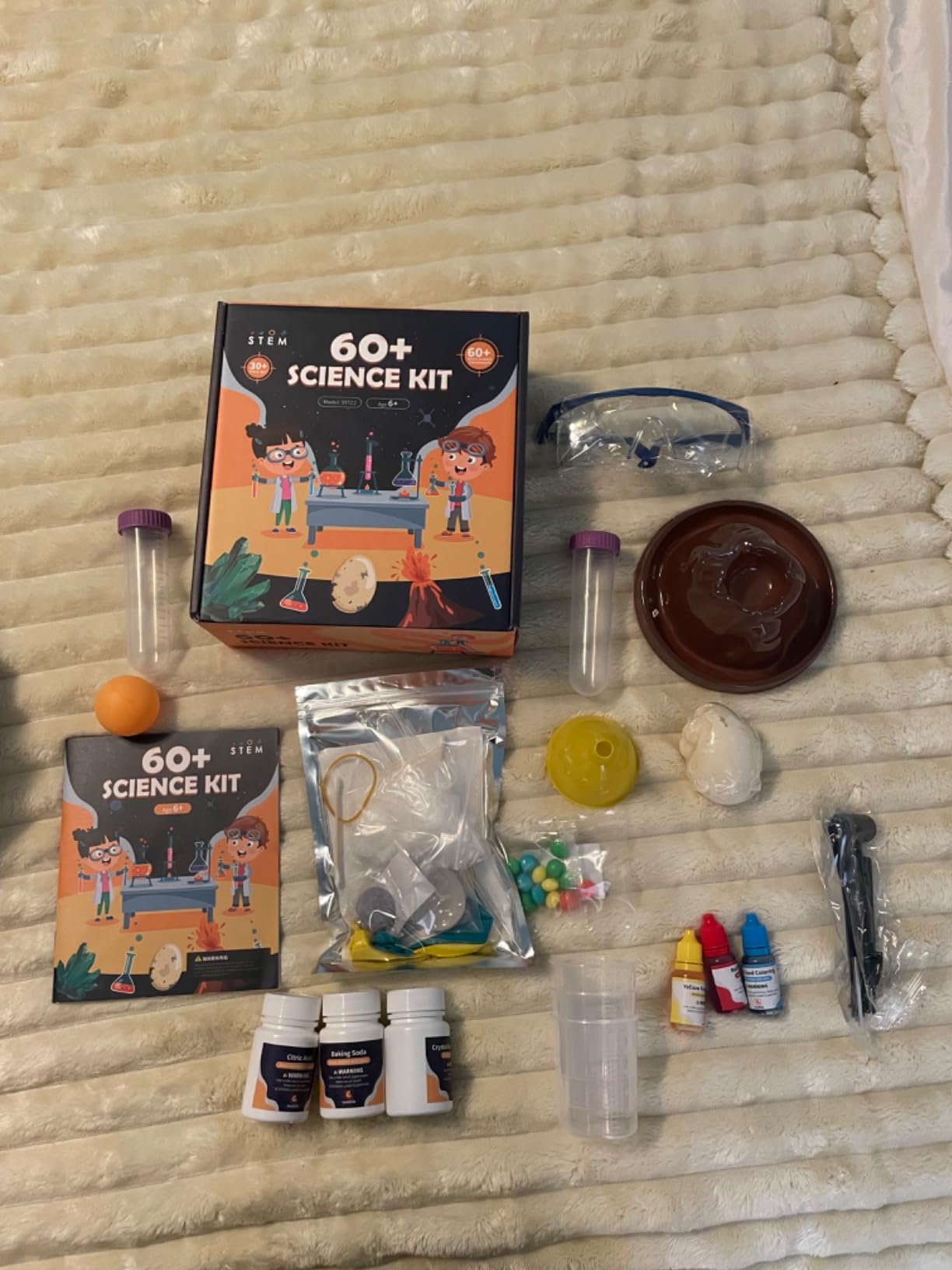
This kit practises observation and questioning through 60+ hands-on experiments, and the all-in-one design is the appeal. Materials, tools, an illustrated manual and safety goggles all sit inside the box, so you can start at the kitchen table without a supply run.
The activity list hits the crowd-pleasers: volcanic eruptions, dinosaur egg digs, milk animation and lava lamps. Those are the experiments most parents remember from their own childhood, and a five-year-old watching a volcano erupt learns the same cause-and-effect lesson an adult gets from a documentary.
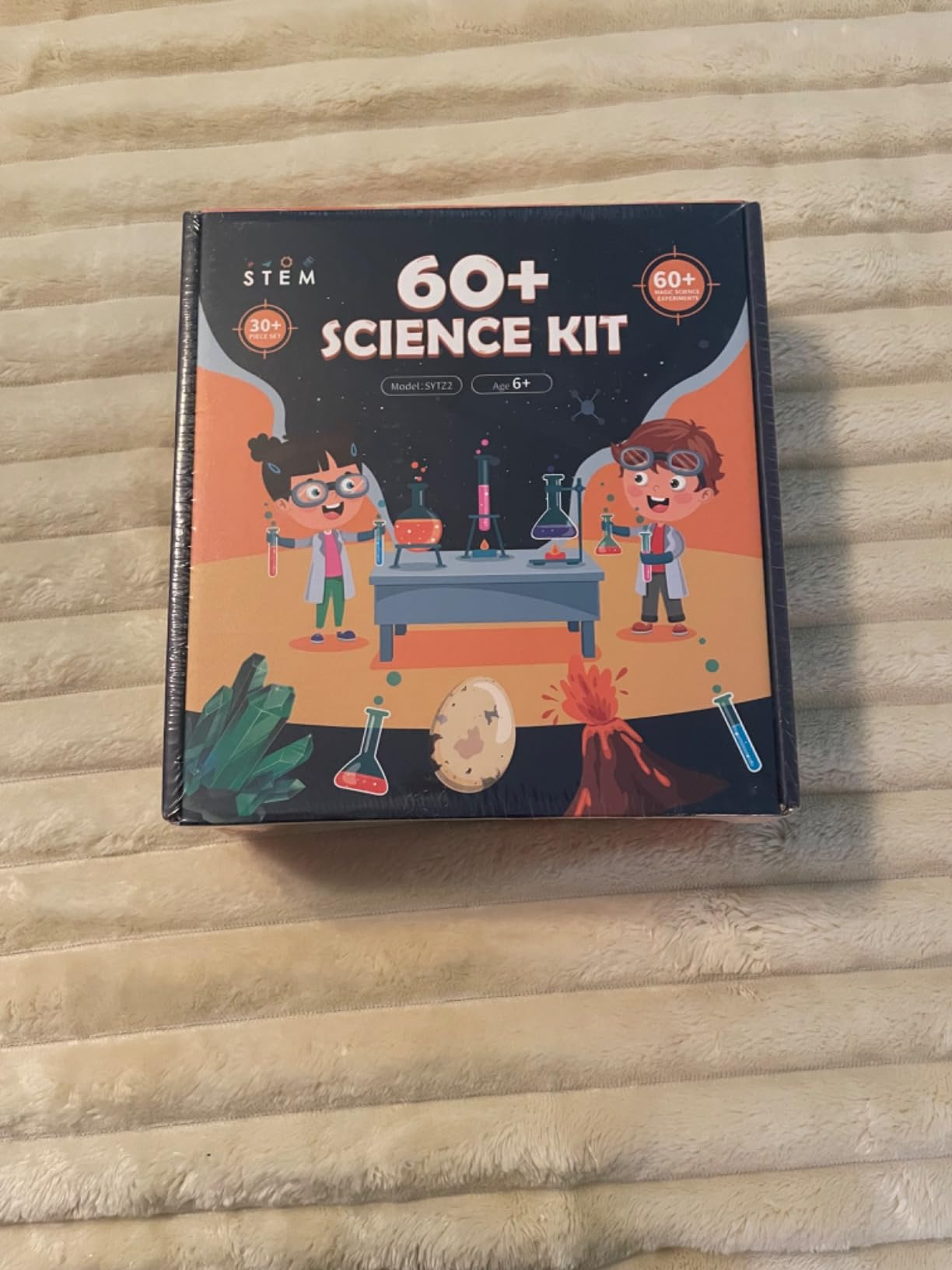
No batteries are required and the rated range is 4 years and up, which makes this the most straightforward entry point on the list. The box measures 8.19 by 3.09 by 7.78 inches at 16 ounces, so it stores easily and travels well.
Where this fits against the other science kits
Choose this when you want the shortest distance between opening the box and starting, since nothing has to be sourced separately and the goggles are already in there. Choose the Doctor Jupiter kit instead when you want the longer runway and clearer solo versus assisted sections.
Where the evidence is thinner
This kit carries 377 reviews, the lowest volume of the twelve, so its 4.6 average carries less weight. A 3-star share of 7 percent and a 1-star share of 3 percent point to some disappointment with variety. As with the Afomida set, no individual review text was returned for this ASIN, so check contents against the manual on arrival.
How to Choose a STEM Kit Your 5-Year-Old Will Use Again
Start with the failure mode, not the feature list. The most common complaint in every parent forum we read is not quality, it is that a kit gets opened twice and then joins the shelf. Our rule was simple: if a child can build something that works, moves or changes state, the kit earns a third session.
Screen-free or connected. Every kit on this list is screen-free, deliberately. The best-regarded coding toys at this age are largely app-based, which sits badly with families already cutting screen time. The pixel kit and the circuits kit deliver the same sequencing practice with plastic and paper.
Durable or consumable. Experiment kits get used up. Baking soda, vinegar and food colouring cost almost nothing, so the real spend is the box, and you will replace a science kit before a building set. If you want one thing that survives to age eight, buy blocks.
Supervision budget. Count adult minutes honestly, because that decides whether the kit gets used again. Illustrated piece-counted booklets and a cordless drill cut adult time sharply. Instruction-heavy kits with text steps need you seated with the child.
Safety. Check three things: small parts that could be a choking risk, batteries that need a secured compartment, and water or chemicals near the kitchen table. ASTM F963-17 or CPSIA certification is a meaningful signal rather than a decorative one.
Age honesty. Where a manufacturer’s rating and the real difficulty disagreed, we flagged it above. The Smartivity kit is marketed for ages 4 to 8 while the manufacturer lists 6 to 14 as recommended, and that gap is normal in this category but not something to discover after opening the box.
If your child is drawn to animals and vehicles rather than abstract building, our fantasy cartography kits for worldbuilders list covers the older end of that interest, which is a useful marker for where a five-year-old is heading.
What a 5-Year-Old Can and Cannot Do Solo
A five-year-old can follow a picture-based instruction, use a cordless drill, place small pieces into a grid, and complete a two-part circuit build. What they cannot do is read a paragraph of text, plan a build ten steps ahead, or diagnose why a straw structure fell over.
That split is why kits with illustrated cards and piece counts work independently while kits with real text do not. If a kit’s instructions are mostly photographs, a five-year-old can run it. If they are sentences, plan to sit with them.
Expect roughly twenty to forty minutes of genuinely focused independent play from most kits here, and expect to be recruited after that. Rotating two kits rather than one usually extends solo time because the novelty resets.
On safety, treat anything under three inches as out of reach for under-threes in the house, check battery compartments on a schedule, and use the included goggles and mess mats rather than skipping them. Our beginner aquarium kit guide covers the same supervision reasoning for a different kind of living setup.
Kits We Did Not Recommend
1. App-dependent coding robots at a stated age of five. Several popular robot toys need a tablet to function. That is not a flaw in the toy, it is a mismatch with what most families want at this stage.
2. 3D printers. They need supervision no five-year-old should be left with, they involve hot components, and useful output arrives long after the novelty wears off. The same money buys building pieces that get used for years.
3. Microcontroller kits aimed at eight and up. The block-based programming environments are strong, but interface friction at five produces frustration rather than learning. Revisit at seven or eight, where the same kit becomes the right purchase.
4. Single-model robot kits with one outcome. Build it, play with it for a day, and it is finished. The dust-collecting objection parents raise in forum threads is aimed squarely at this format.
5. Kits whose only content is a booklet of ideas. If you would still need to buy blocks separately to make the activities work, buy the blocks.
Are STEM Kits Worth the Money?
Yes, when you buy something open-ended and screen-free, and no when you buy a scripted one-model kit. The honest way to judge it is cost per session rather than cost per box. A 195-piece building set used twice a week for two years spreads out to very little per session, while a science kit with 100+ experiments finished in a month costs more per session than it appears to.
The failure mode is dust, and parents described it clearly: the tech toy gets abandoned within a month because it depends on a device, an account, or an adult reading instructions. Every kit here avoids that by being playable the moment the box opens.
Durability is the other factor. Parents whose building sets were still in use after four years called them the best value in the category, and the same parents described electronics kits as excellent for a specific stretch and finished after that. If you can buy only one, buy the one your child will still be using in September.
For families running a weekly routine, our year-round growing guides cover the same habit-building logic for a screen-free project that runs on its own.
Frequently Asked Questions
What are some good science kits for a 5-year-old?
The three strongest science picks here are the Doctor Jupiter My First Science Experiments Kit, with over 100 experiments and a manual that separates solo activities from assisted ones, the Smartivity Magic Science Kit, which covers density, polymers and air pressure with a mess mat included, and the Melican 60+ Science Experiment Kit, which includes every material, tool and pair of goggles in the box. All three are screen-free and need only water and a few pantry basics.
Are STEM kits worth the money?
STEM kits are worth it when they are open-ended, screen-free and playable the moment the box opens, and they are not worth it when you are buying a scripted single-model robot or anything that needs an app. Judge cost per session rather than cost per box: a 195-piece building set used twice a week for two years costs very little per session, while a large experiment kit finished in a month costs a lot. The most common complaint is dust, and it targets screen-dependent tech toys rather than hands-on kits.
What is the best educational gift for a 5-year-old?
The best educational gift for a 5-year-old is something open-ended they will still be building in three months, and our best overall pick, the Doctor Jupiter My First Science Experiments Kit, is a safe choice because it holds over 100 distinct activities. If you know the child builds rather than experiments, an interlocking block set such as the NXONE 195-piece or Afomida 170-piece set lasts longer and costs less per session. Avoid gifts that need a device or an adult to run them.
What is popular with 5 year olds right now?
As of 2026, the formats parents report working best at this age are screen-free circuit kits such as Snap Circuits, magnetic construction and sensory sets, grid-based pixel art that quietly teaches early coding, and large-piece building sets with a cordless drill for small hands. The common thread is that popular kits at this age are physical, rechargeable or batteryless, and playable without an adult reading instructions aloud. App-based coding robots are still on shelves, but most families are steering toward screen-free options.
Can a 5-year-old use Snap Circuits without help?
A five-year-old can complete the earlier Snap Circuits Beginner projects largely on their own, because the snap-together connectors remove wiring and stripping from the process. Later projects require more planning and troubleshooting, and most parents describe the difficulty ramping sharply in the second half of the 21-project manual. Treat it as a joint activity rather than an independent one, and keep alkaline batteries secured in the compartment since the fan and light modules need them.
The Bottom Line for Parents of 5-Year-Olds
If you buy one kit from this roundup, buy the Doctor Jupiter My First Science Experiments Kit. It carries the strongest parent feedback among the science kits here, over 100 distinct activities, and a manual that tells you exactly which ones a five-year-old can attempt without you.
If your child builds rather than experiments, go with the NXONE 195-piece set for a drill that matches small hands, or the Huaker 180-piece set for the piece-counted booklet that keeps children building independently. If they are sensory-seeking, the Magnet Movers set is the one handed over without an adult joining in.
The rule underneath all twelve is simple: pick something playable within five minutes of opening the box, with no screen and no login. If you are still deciding, our advanced rocketry kit guide shows where a child with a real engineering interest goes next, which is a useful five-year milestone to keep in view.