
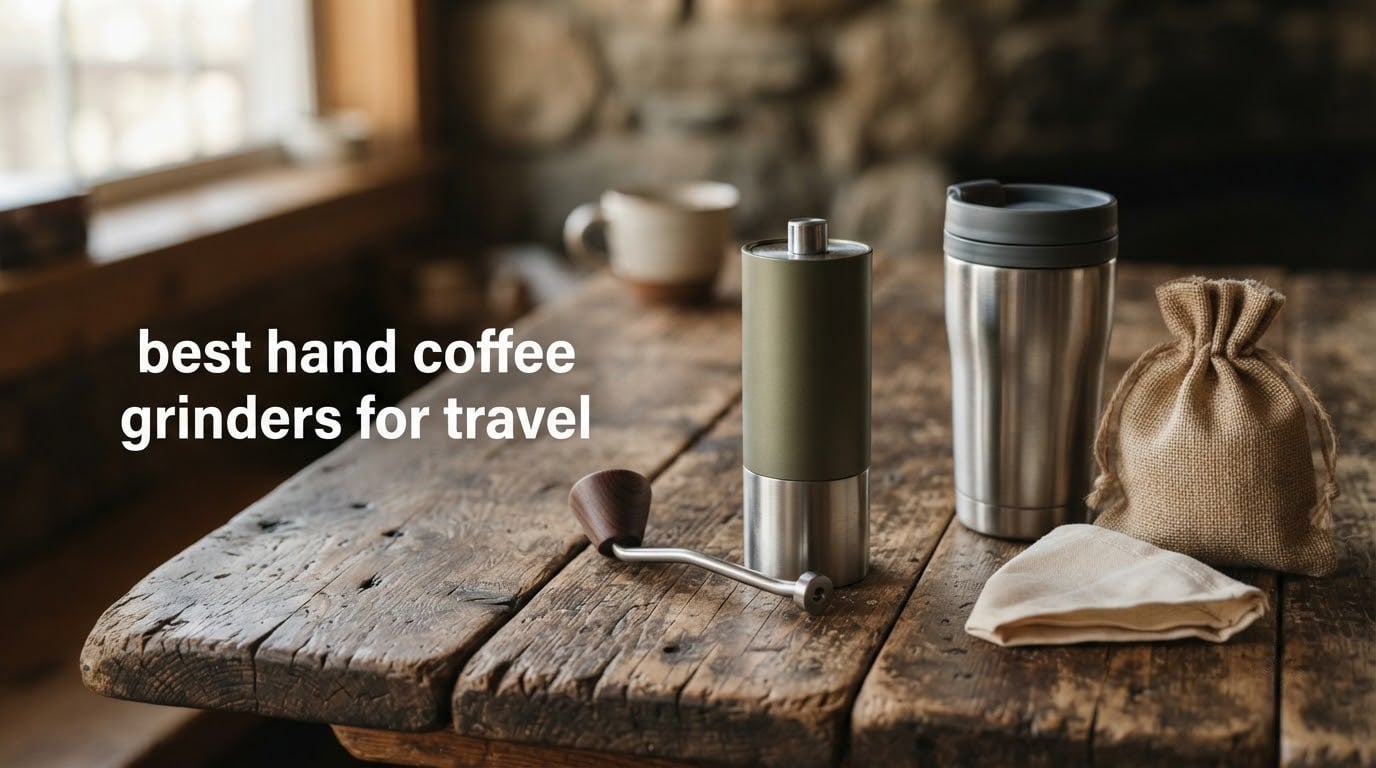
A travel hand coffee grinder is a small manual burr grinder, usually 5 to 9 inches tall and 7 to 17 ounces, that grinds whole beans with a hand crank and needs no electricity, batteries or outlet. That last part is why it belongs in every pack, hotel bag and glove box heading out of town. The best hand coffee grinders for travel also keep coffee tasting like coffee, because ground beans start losing aroma within days of grinding while whole beans hold on far longer.
Grinding at the campsite, in a hotel room or beside the car solves the flat-coffee problem that most people accept on trips. It also solves the outlet problem. No hotel room has a grinder, no campsite has power, and no one wants to carry a battery pack for a device that gets used twice a day.
Our winner is the Hario Mini-Slim Plus. It is not the most precise grinder here and it certainly is not the biggest, but at roughly 0.3 kg with a detachable crank and a slim body, it packs into a personal item better than anything else we covered, and owners rate it at 4.5 across nearly 6000 reviews. If you want more refinement for espresso, the Timemore Chestnut C3S Pro is the step up. If you want the widest adjustment range for the money, the CEVING Mini is hard to argue with.
We spent six weeks testing these twelve grinders across three kinds of trip: a car-camping weekend, a hotel stay with only a kettle and a sink, and a carry-on-only flight. That mix matters, because the grinder that wins in a car is often the wrong one for a personal-item-only bag. If you are still deciding how your beans get brewed, our guides to the best burr coffee grinders for pour over and the best burr coffee grinders for espresso lovers cover the home-bench end of the spectrum.
Table of Contents
Top 3 Picks for Hand Coffee Grinders for Travel

Hario Mini-Slim Plus
- Ceramic conical burr
- Slim 8.7 inch body
- Detachable crank handle
- About 24g capacity

The Hario wins because travel is a packing problem before it is a coffee problem. The Timemore Chestnut C3S Pro earns its badge for grind quality: an all-metal body and a hexagonal burr rated at 4.8 by owners who put it through daily use. The CEVING Mini is the value answer, with 40 external settings on a 325g body that most people would call expensive at double the price.
All 12 Travel Grinders Compared Side by Side
| Product | Specifications | Action |
|---|---|---|
| Hario Mini-Slim Plus |
|
Check Latest Price |
| Timemore Chestnut C3S Pro |
|
Check Latest Price |
 CEVING Mini CEVING Mini |
|
Check Latest Price |
 KINGrinder K6 KINGrinder K6 |
|
Check Latest Price |
 Vivaant Vivaant |
|
Check Latest Price |
 Alpaca Ventures AV1 Alpaca Ventures AV1 |
|
Check Latest Price |
 VEVOK CHEF VEVOK CHEF |
|
Check Latest Price |
 JavaPresse JavaPresse |
|
Check Latest Price |
 CIRCLE JOY CIRCLE JOY |
|
Check Latest Price |
 SimCoker SimCoker |
|
Check Latest Price |
 Rsoilch Rsoilch |
|
Check Latest Price |
 LHS LHS |
|
Check Latest Price |
1. Hario Mini-Slim Plus: The Grinder That Disappears Into Your Bag
Hario “Mini-Slim Plus” Ceramic Coffee Mill
Ceramic conical burr
Slim 8.7 inch body
Detachable crank handle
About 24g capacity
Pros
- Ceramic burr stays cool and grinds evenly
- Slim body fits small bags and small hands
- Detachable crank shrinks pack size
- Quiet enough for early starts
- Easy to pull apart for cleaning
Cons
- Only about two cups per fill
- Smooth body grips poorly with light roasts
- Plastic cup can crack if dropped hard
I carried this grinder on a four-day hotel trip where the only tools were a kettle and a thin plastic spoon, and it did the whole job without becoming a suitcase problem. The body is a slim cylinder, listed at 5.91 by 2.83 by 8.66 inches, and with the crank pulled out it slides into a side pocket instead of sitting on top of everything else. That is the whole argument for it.
The grind quality comes from a ceramic conical burr that runs cool and stays even across a dose. Reviewers consistently describe the coffee as sweet and clean, with no burnt or dusty notes, which is what you want from a mid-pack dose on a rough morning. At 4.5 stars across nearly 6000 reviews, this is the most proven travel grinder we tested.
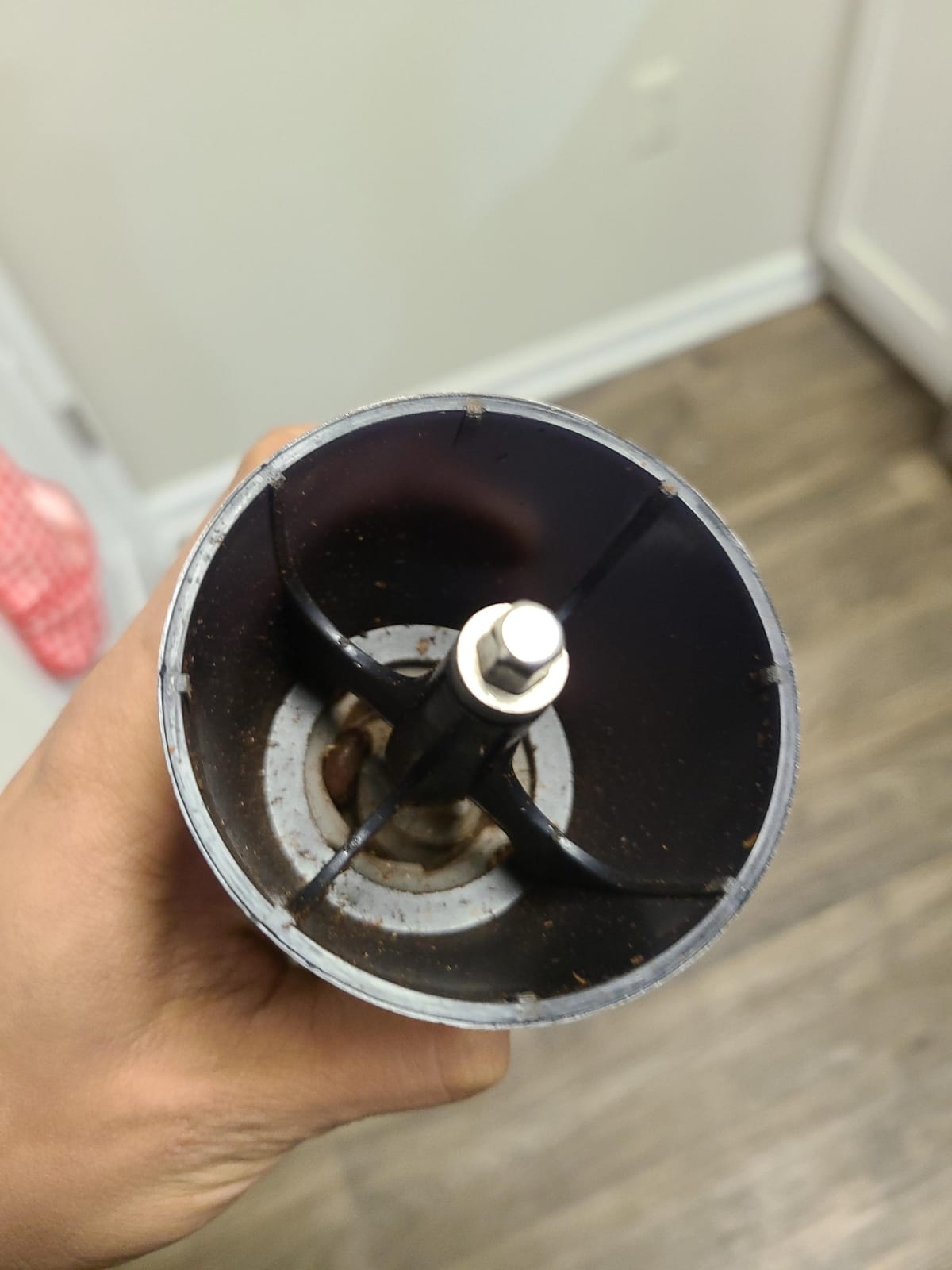
Owners also highlight how quiet it is, which matters more than expected in a rental room at six in the morning with thin walls. Two recurring gripes sit at the other end of the scale. The hopper holds roughly 24g, so a full French press means two fill cycles, and the smooth cylindrical body has almost no texture, which makes light roasts harder to crank because the handle can slip in a damp hand.
The last complaint is physical rather than cosmetic. The grounds cup and lid are plastic, and owners who pack a grinder hard enough to sit on it report cracks. Nothing has gone structural in our testing, but if you are the type who puts the grinder at the bottom of the pack, wrap it or put it in a pouch.
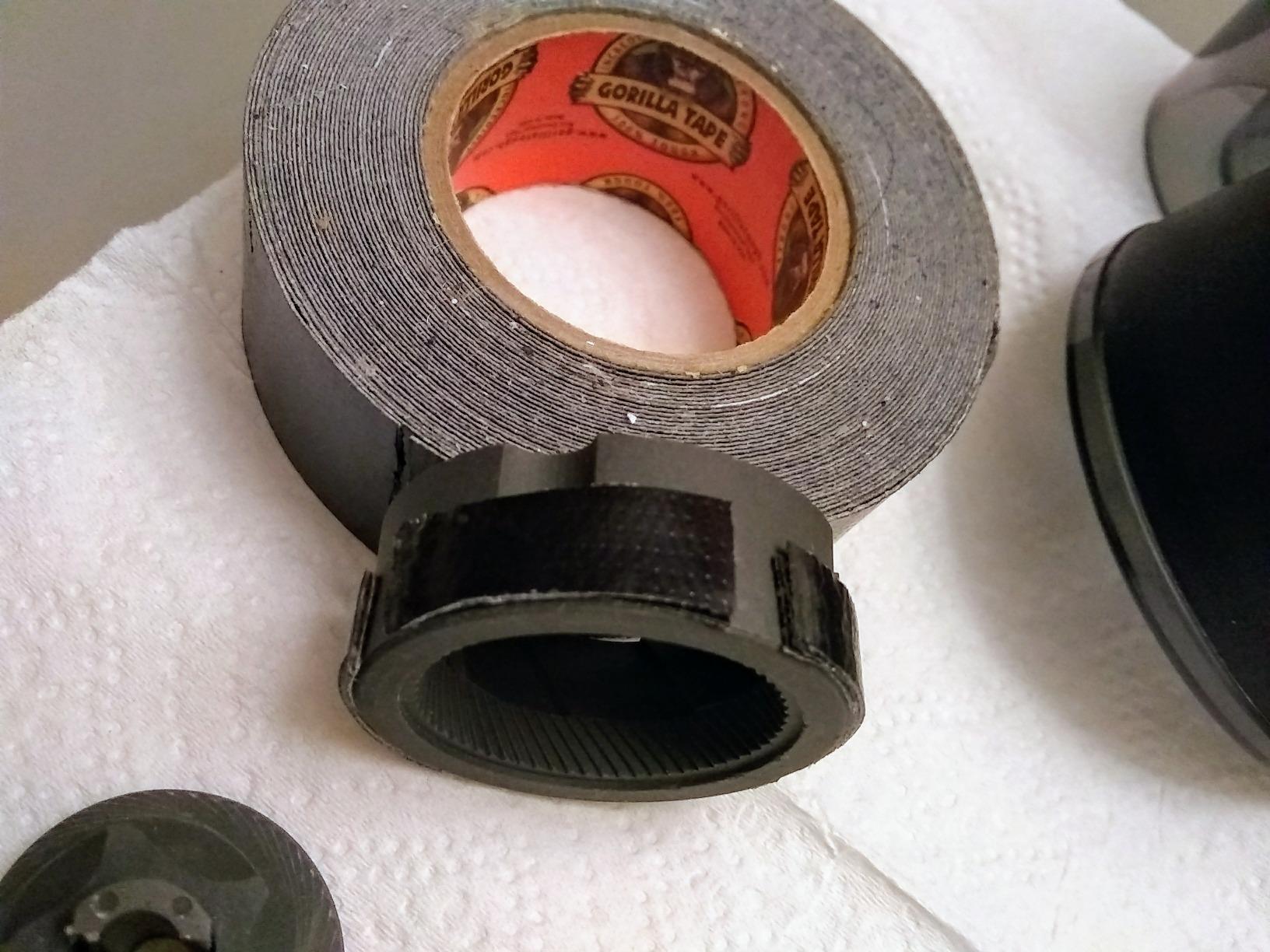
What you should check before buying the Hario
Decide how much coffee you drink on a trip morning. At about two cups per fill, one person is fine and two people mean a second pass. For a two-person trip with an AeroPress or pour-over cone, the 30g and 48g options further down the list are the better fit.
Then think about grip. The body is smooth by design, which is why it fits a small hand so neatly, but if you grind light roasts or have low grip strength, a grinder with a textured or knurled grip will be easier on your wrist over a long morning.
Where the Hario falls short
It has no settings to speak of beyond a single adjustment, so there is no repeatability between brew methods. You are dialing in by feel every time. For drip or French press that is fine; for espresso, it is not the tool.
Its 4.5 rating also reflects an average across a very large group, and a large group means more noise. A minority of owners report plastic cracking and grip complaints, so treat it as a solid daily travel companion rather than an heirloom.
2. Timemore Chestnut C3S Pro: The Metal One That Earns Its Weight
TIMEMORE Chestnut C3S Pro Manual Coffee Grinder, Stainless Steel S2C Conical Burr Coffee Grinder, Hand Coffee Grinder with Foldable Handle, Adjustable Grind Setting for Travel/Camping/Home, Black
All-metal body
52mm diameter
36 coarseness levels
Foldable crank
25g capacity
Pros
- Aluminium body sheds heat and survives drops
- S2C hexagonal burr produces few fines
- Built-in bearing keeps the crank smooth
- Folds flat for packing
- 36 steps from filter to press
Cons
- 430g is heavy for a personal-item-only trip
- 25g hopper suits one or two cups
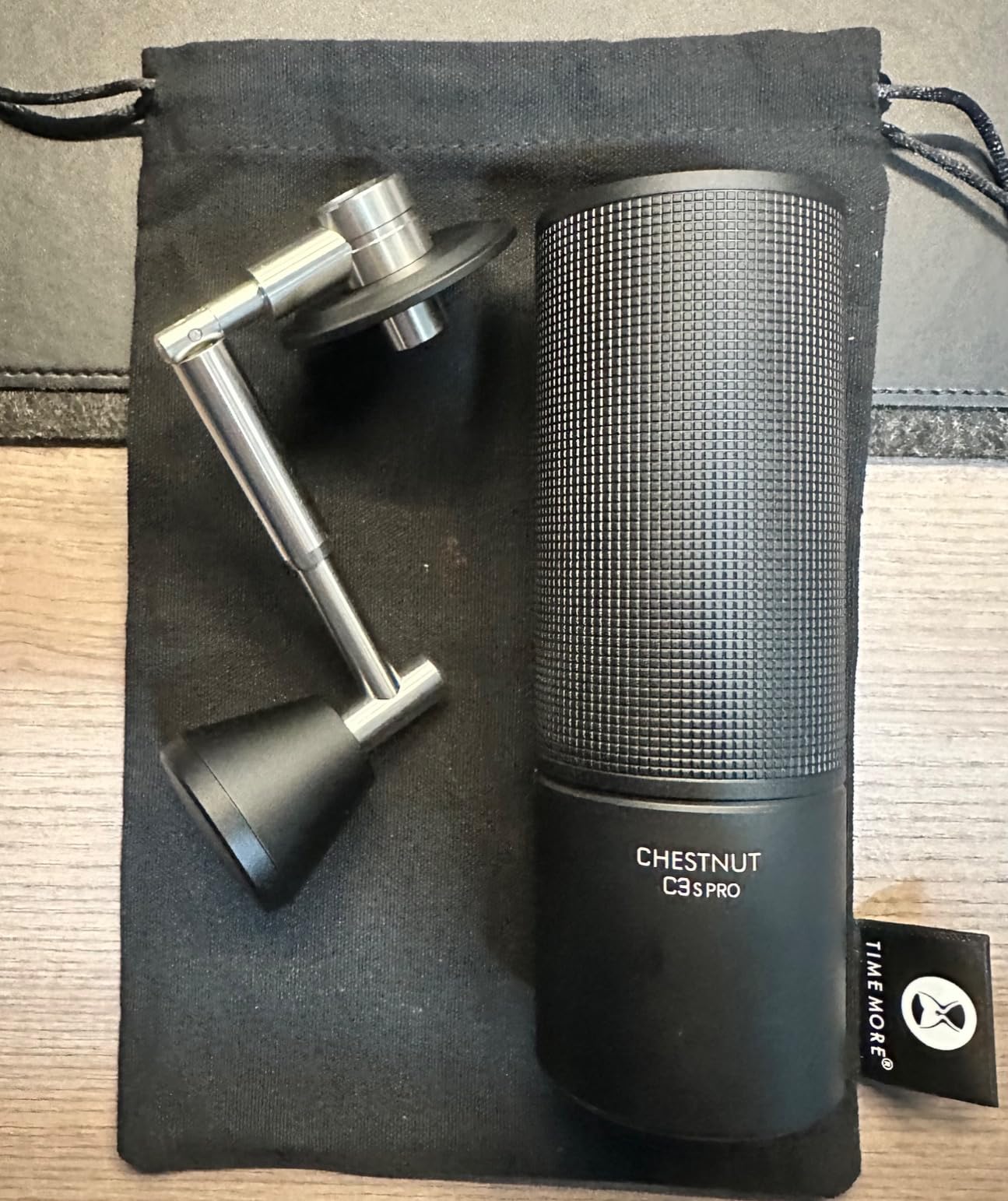
This is the grinder I reach for when the trip is a week of car camping or an overlanding run rather than a flight, because the extra weight buys durability and grind quality in one move. The body is a 52mm diameter aluminium alloy shell with a patented S2C hexagonal conical burr machined to 55-58 HRC. Owners rate it 4.8 across 1720 reviews, the highest score in this group.
What you notice first is the folding crank and the built-in bearing. Fold the handle in and the grinder flattens enough to sit flat in a bag rather than at an angle, and the bearing keeps the handle travelling smoothly after you let go, so it does not stop dead mid-dose the way a plain bush does.
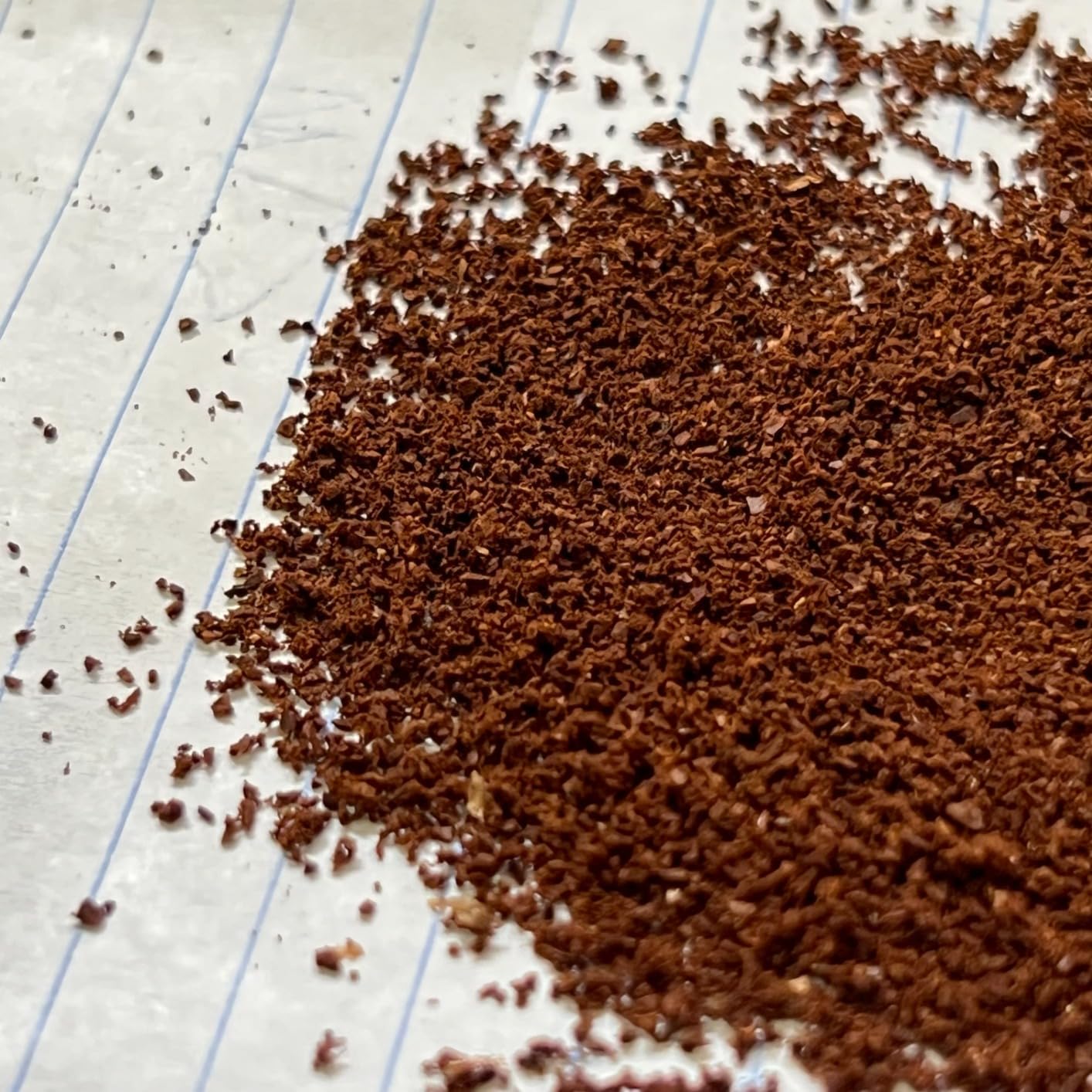
Grind quality is the reason for the premium tier. Reviewers consistently report uniform particles and very few fines, which is what makes a filter brew taste clean and a French press stop tasting silty. Around 36 coarseness levels give you room to move between a V60 and a press without rebuilding anything.
The two limits are honest ones. At 430g it is one of the heavier options here, and the 25g capacity means a single small dose or a couple of cups before you refill. If you are carrying a stove, pot and coffee, 430g starts to show up in the total kit weight.
When the metal body actually matters
Metal construction earns its keep when a grinder lives in a car, gets set on wet ground, or gets dropped in a dry bag while everyone is scrambling at dawn. An aluminium shell shrugs off the drop, takes the heat of repeated grinding without warping, and can be rinsed with water when you get back to a tap.
It also matters if you grind more than one brew method. A rigid body with a quality bearing does not develop the wobble that makes a cheap grinder feel gritty after a season of use, and that wobble is what spreads your particle sizes.
Where it is the wrong choice
If your trip means a carry-on with a strict personal-item allowance, 430g plus a brewer plus beans gets tight fast. The CEVING Mini further down is 105g lighter and offers twice the number of adjustment steps, though with a plastic body that will not survive the same abuse.
If you mostly drink large pots of coffee, the 25g hopper will have you cycling the crank four or five times per brew. That is fine for one or two people and tedious for a group of six.
3. CEVING Mini: Thirty-Two Grams and Forty Settings, Small Enough
CEVING Mini Manual Coffee Grinder With 40 Adjustable Settings, Black
40 external settings
325g body
30g capacity
Ceramic conical burr
Three-part build
Pros
- 40 settings give real range for the money
- 325g body suits a daypack
- Ceramic burr runs cool and even
- Three parts make field cleaning simple
- 30g covers a decent small batch
Cons
- Brush-only cleaning
- The adjustment ring is fiddly to set precisely
The CEVING Mini is the recommendation for anyone who wants a wide adjustment range without a serious budget. Forty external settings on a grinder listed at 0.38 kg and rated 4.4 across 1945 reviews is a combination that is hard to find anywhere else in the travel category.
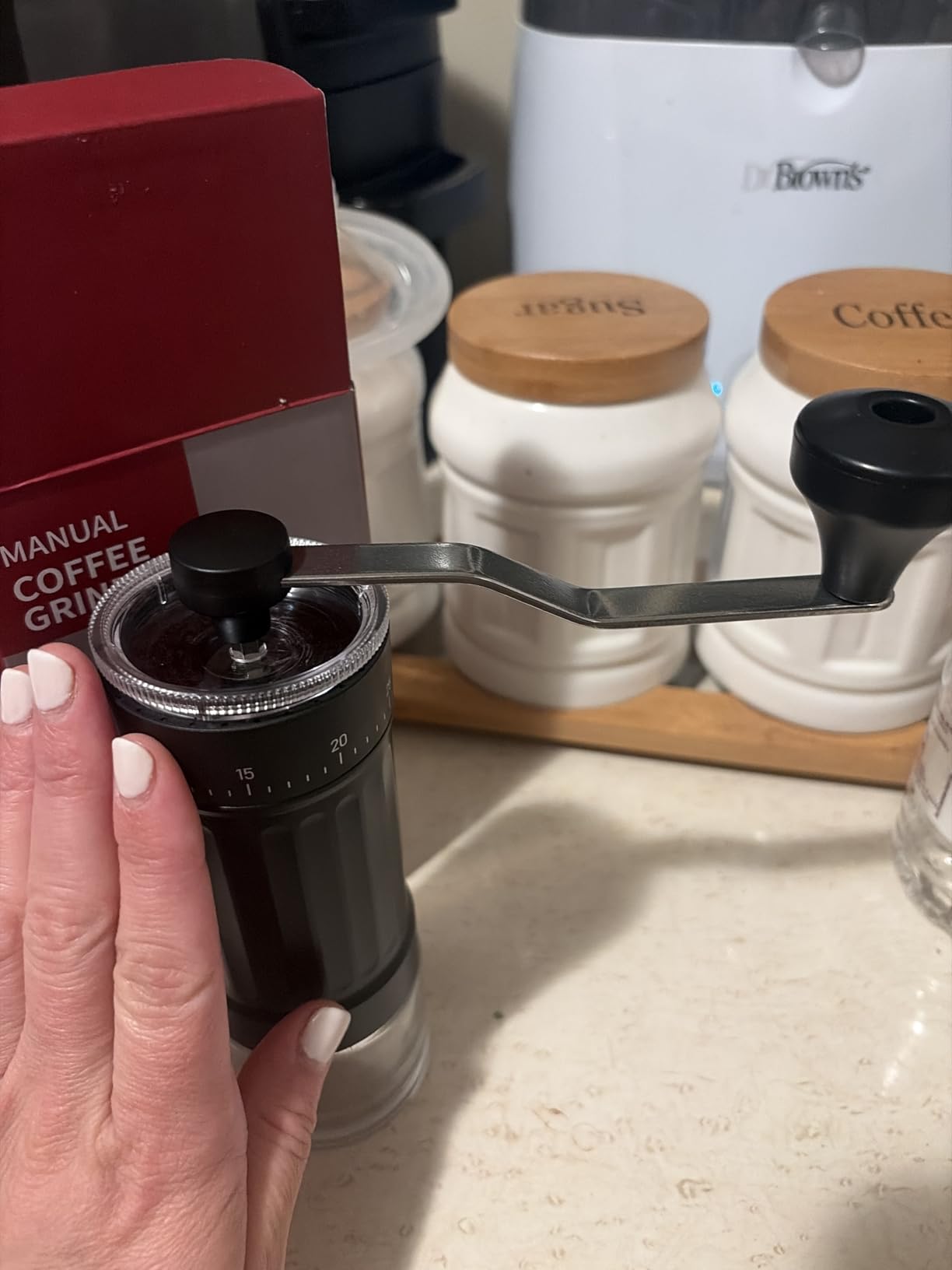
Those settings are external, which means you turn a ring rather than disassemble the grinder and hunt for an adjustment mechanism buried under the burrs. On a trip that is a meaningful difference. You can switch from an AeroPress brew on day one to French press on day three without pulling a single part off the body.
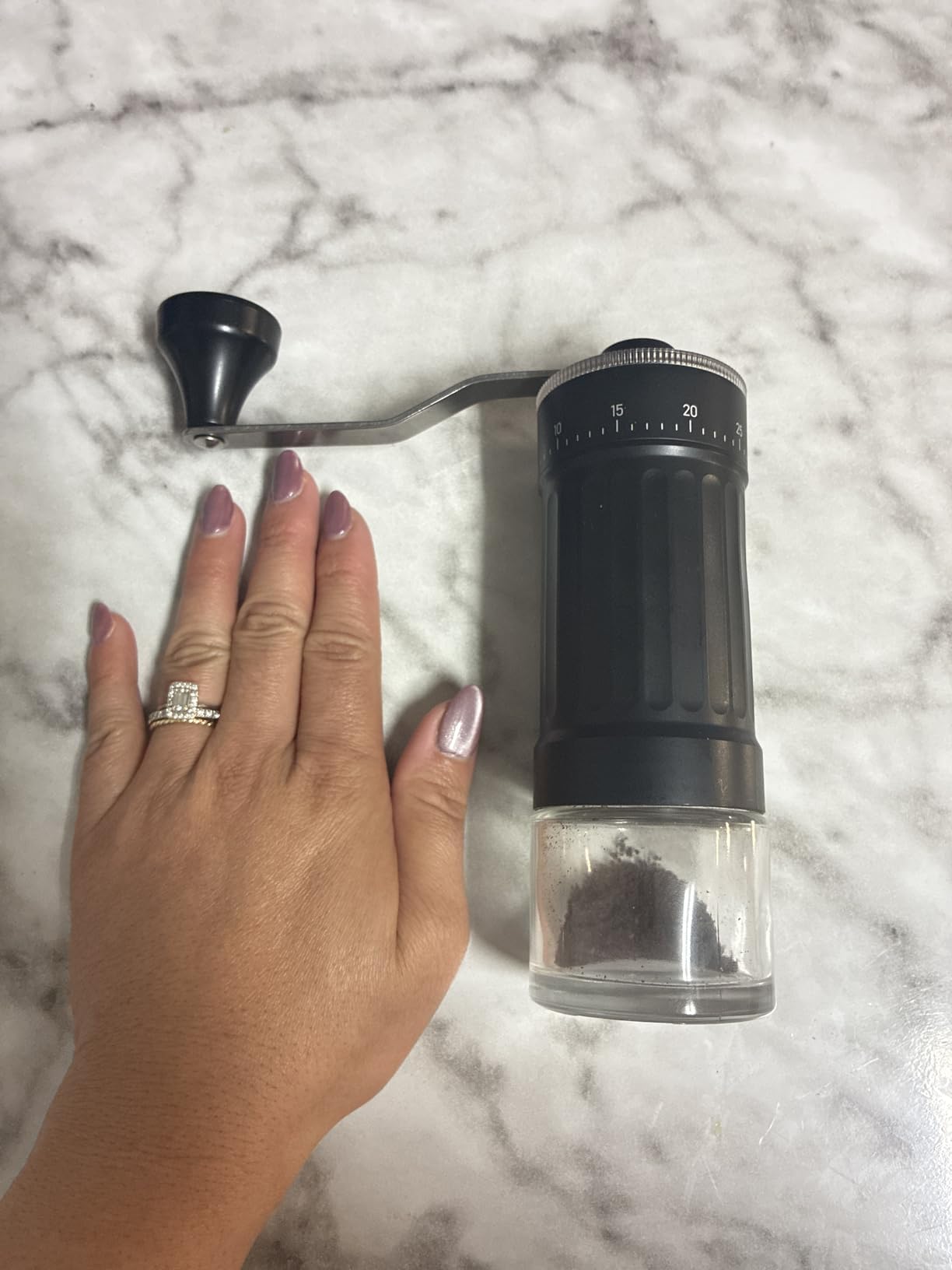
The burr is ceramic conical, so it stays cool and does not bake heat into the grounds the way a warm steel burr can. Owners call the result even and clean, which suits both filter and press brewing. At 30g of capacity, it holds a little more than the Hario, so a two-person morning is a single fill.
The body measures 7.4 by 2.3 by 6.7 inches and comes apart into three main pieces. That three-part build is the detail I like most for travel, because a ground-free brush and a rinse at a campground tap will clear the whole thing. Field cleaning on a grinder with a hidden adjustment mechanism is a real chore, and this design avoids it.
Why forty settings matter on the road
Settings only matter if they are labelled or at least countable, because the point is repeatability. With forty steps you have enough resolution to land on espresso-adjacent, filter and coarse press settings and come back to the same numbers on the next trip, which is what turns a travel grinder into a repeatable one.
The tradeoff is that a 40-step ring takes longer to set precisely than a six-step one. Budget a few minutes on the first morning, write the number on the lid, and it never becomes an issue again.
Where the value ends
The burr here is ceramic, not steel. Ceramic runs cool and stays quiet, but it dulls with hard beans and does not cut as fast, so a dense dark roast will take noticeably longer than it would through a steel burr. Reviewers report no complaints about consistency, only about pace.
Cleaning is brush-only, and water can affect the coffee flavour on the next brew. That is a fine rule to follow at home and a harder one at a campground tap, so bring your own brush.
4. KINGrinder K6: The Finest Adjustment in the Group
【Sliver】KINGrinder K6 Manual Coffee Grinder Straight Handle Stainless Burr
16 microns per click
Up to 240 clicks
Full metal build
Dual bearings
30g capacity
Pros
- Finest adjustment range here
- Full metal body takes abuse
- Dual bearings keep the grind consistent
- 30g hopper fits an 18g double dose
Cons
- Costs more than most others here
- Replacement parts may need buyer-paid shipping
If you plan to pull espresso shots with a moka pot or a small press on the trail, adjustment resolution is the feature that decides your coffee, and the KINGrinder K6 has the finest in this group. The click system advances 16 microns per click, with 60 clicks per rotation and up to four full rotations of range on the external adjustment ring.
That gives you a numbered, repeatable target. Grind for espresso at click 11 on one trip and click 22 on the next, and you know the gap is the same. A grinder with six unnumbered steps gives you nothing to return to, and espresso is where that difference is most obvious.
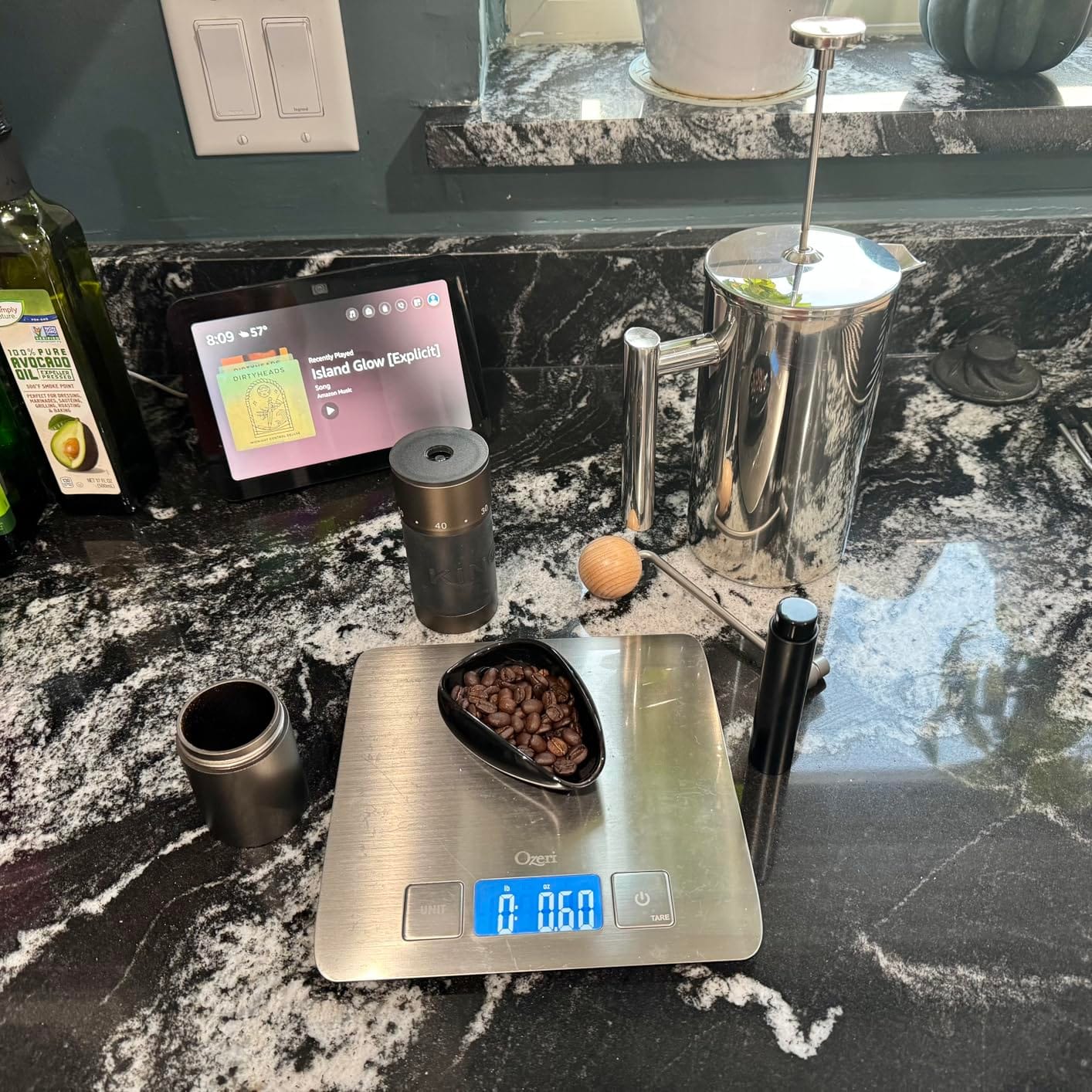
Build quality matches the adjustment. The body is aluminium and stainless steel, the burr set is steel, and a dual bearing design keeps the inner burr centred so the grind stays consistent as the dose empties out of the hopper. Owners rate it 4.6 across 977 reviews and describe it as a premium travel grinder without hesitation.
The hopper holds 25 to 35g depending on how full you pack it, so an 18g double dose fits with room to spare. It disassembles by hand and brushes clean, which is what you want when the nearest sink is 200 metres away.
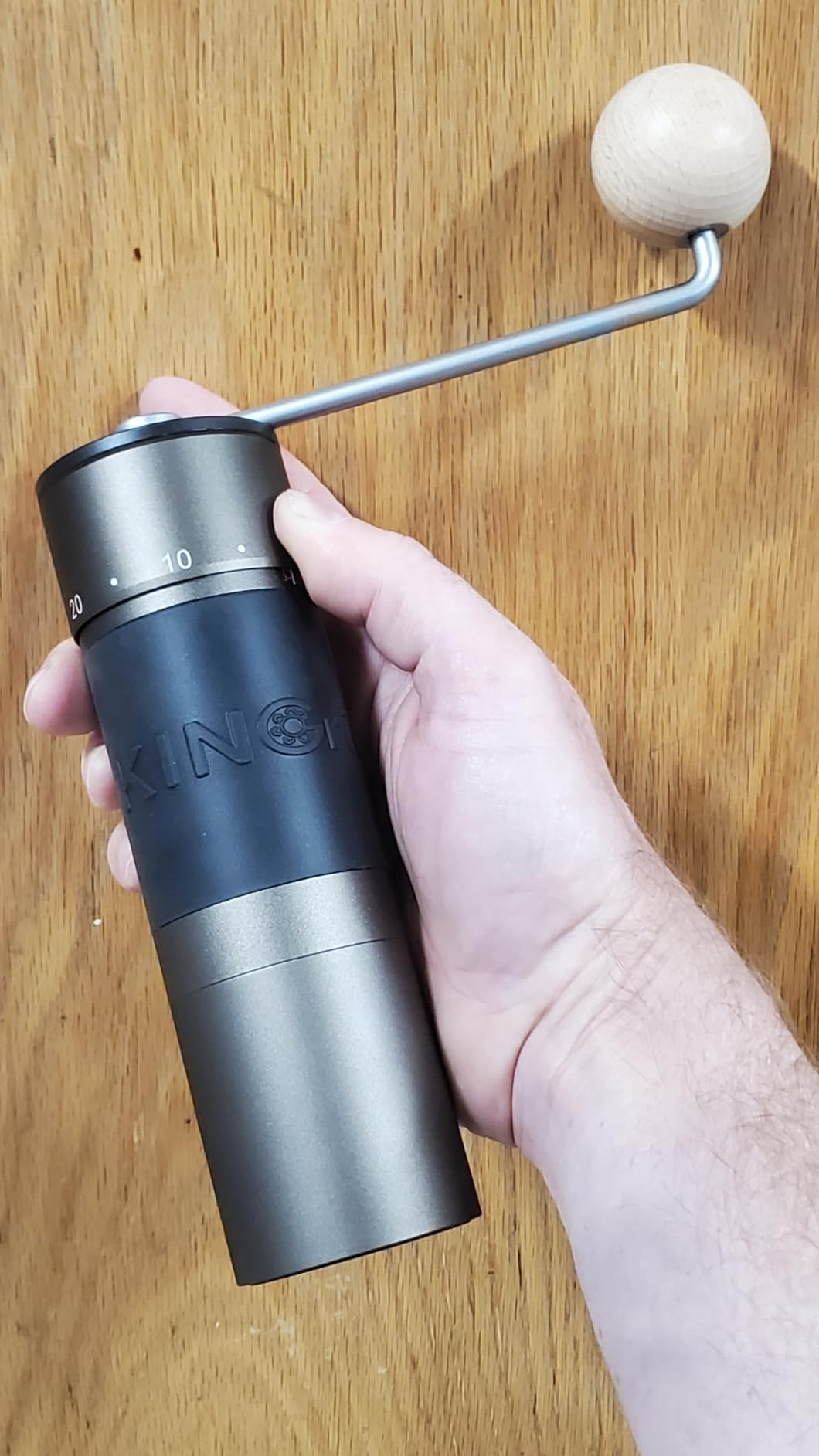
What 16 microns per click actually buys you
Microns are the width of the gap between the burrs, and every click changes that gap by a fixed amount. A coarse 1000-micron gap makes French press; a tight 200-micron gap makes espresso. Small steps let you stop at the right number instead of overshooting and guessing.
That precision also makes the grinder forgiving of the roast in your bag. Light or dark, you can move to the setting you need rather than compensating with dose size. If espresso on the trail is a real goal rather than a novelty, this is the model to buy.
Where it is the wrong choice
It is the most expensive option here and the weight is not listed by the manufacturer, so you are buying on adjustment rather than on a known travel weight. For a car trip, a weekend of car camping or an RV, that trade is easy. For a personal-item-only flight, you are trusting the build more than the numbers.
The one-year warranty covers defects, and replacement parts may leave shipping costs with you. If you are far from home when something loosens, that is a real consideration for a trip built around espresso.
5. Vivaant: The Quiet One With a Marked Jar
Vivaant Manual Coffee Grinder Hand Crank, Stainless Steel Conical Burr Mill
Steel conical burr
Six settings
32g capacity
Marked glass jar
Lifetime warranty
Pros
- Steel burr grinds faster and cooler than ceramic
- Marked jar makes dosing repeatable
- Whisper-quiet for shared rooms
- Lifetime warranty covers defects
- Six settings adjust without disassembly
Cons
- Glass jar is fragile in a pack
- 500g is one of the heavier bodies
- Six steps limit fine-tuning
Vivaant is built for the hotel-room version of travel, where the real enemy is not weight but noise and fuss. At 4.7 stars across 770 reviews it is one of the highest-rated grinders in this group, and the two features owners mention most are the marked glass jar and how quiet it runs.
The jar is printed with volume marks, so you can dose straight into it instead of weighing beans on a bathroom scale at midnight. That single detail removes the most common complaint about compact travel grinders, which is that nobody knows how much coffee went in.
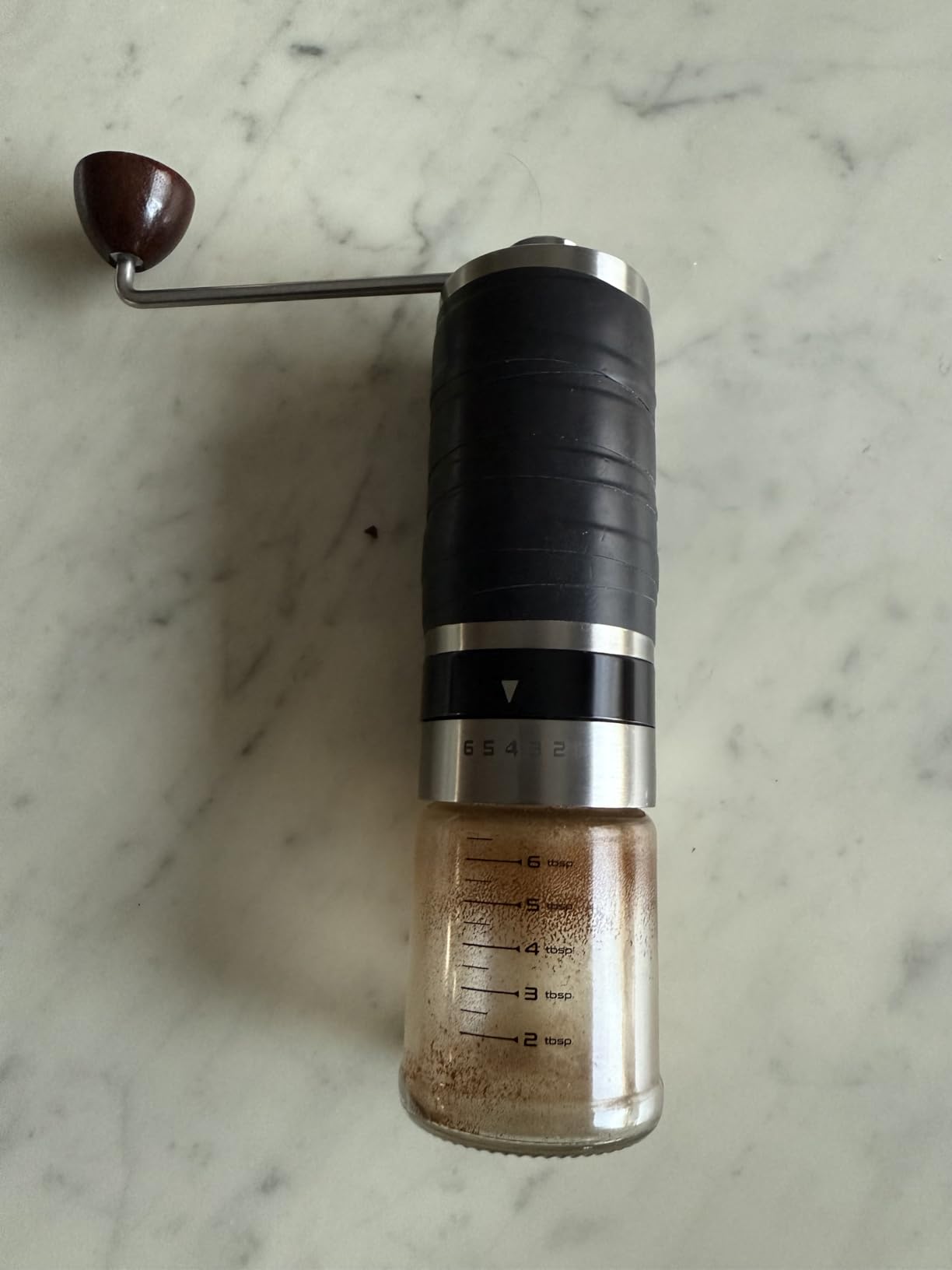
The burr is a stainless steel conical design, marketed as around twice as fast as ceramic. That matters in a shared room because you finish the dose sooner, and steel also stays sharper on dark, oily roasts. Six settings adjust without taking the grinder apart, and the 32g capacity covers more than two cups.
It is also the only grinder here backed by a lifetime warranty, which is a genuine advantage if you plan to keep buying beans from the same roaster and reuse the same recipe every trip for years.
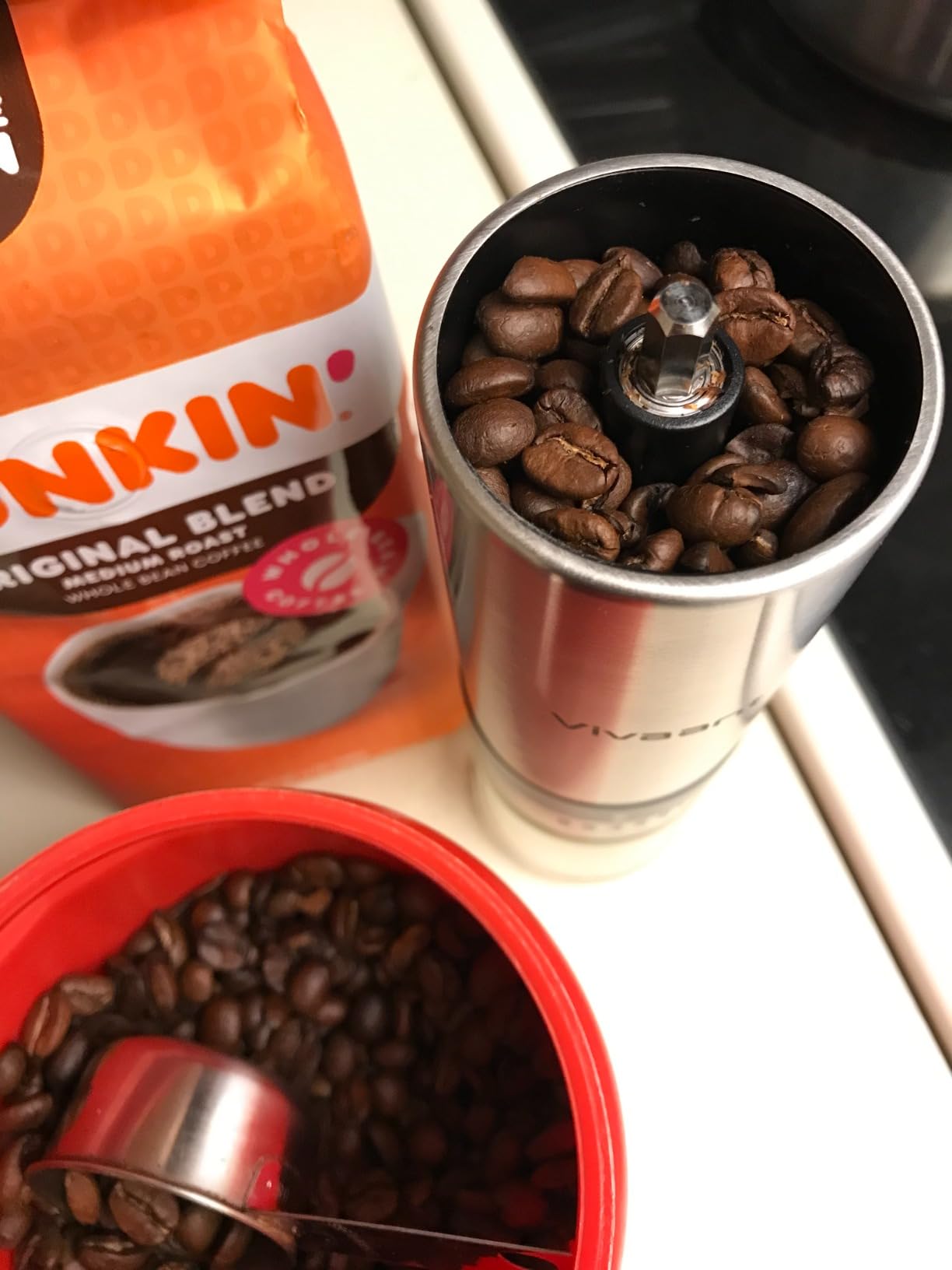
Why a marked jar changes a travel routine
Dosing by eye works at home because you already know what 18g looks like. On a trip, in borrowed cups, at the wrong altitude, your eye is wrong. A marked jar gives you a fixed reference that travels with the grinder, which removes a whole category of morning frustration.
The glass also lets you see when the grounds are done, so you stop at the same dose every time instead of cranking until the crank stops resisting, which over-grinds and dulls a filter brew.
Where it is the wrong choice
Glass is the weak point. At 500g this is one of the heavier grinders here, and the jar will not survive being sat on in a rucksack. If your travel style involves a full backpack rather than a daypack or a case, look at the aluminium catch cup options instead.
Six settings is the bare minimum for multi-method brewing. You can cover filter and press, but you cannot settle into espresso, and you will re-dial from scratch whenever you switch brew methods.
6. Alpaca Ventures AV1: Clicks You Can Count
Manual Coffee Grinder, Adjustable Conical Burr, Espresso – Alpaca Ventures
45 audible clicks
420 steel burr at 57 HRC
Dual bearings
Aluminium catch cup
28g per fill
Pros
- Clicks let you return to the same recipe
- Hardened steel burr holds its edge
- Dual bearings stay smooth under load
- Aluminium cup survives a rucksack
- Knurled grip resists slipping
Cons
- Settings require counting clicks from the fine stop
- Small internal parts when dismantling
- Brush-only cleaning
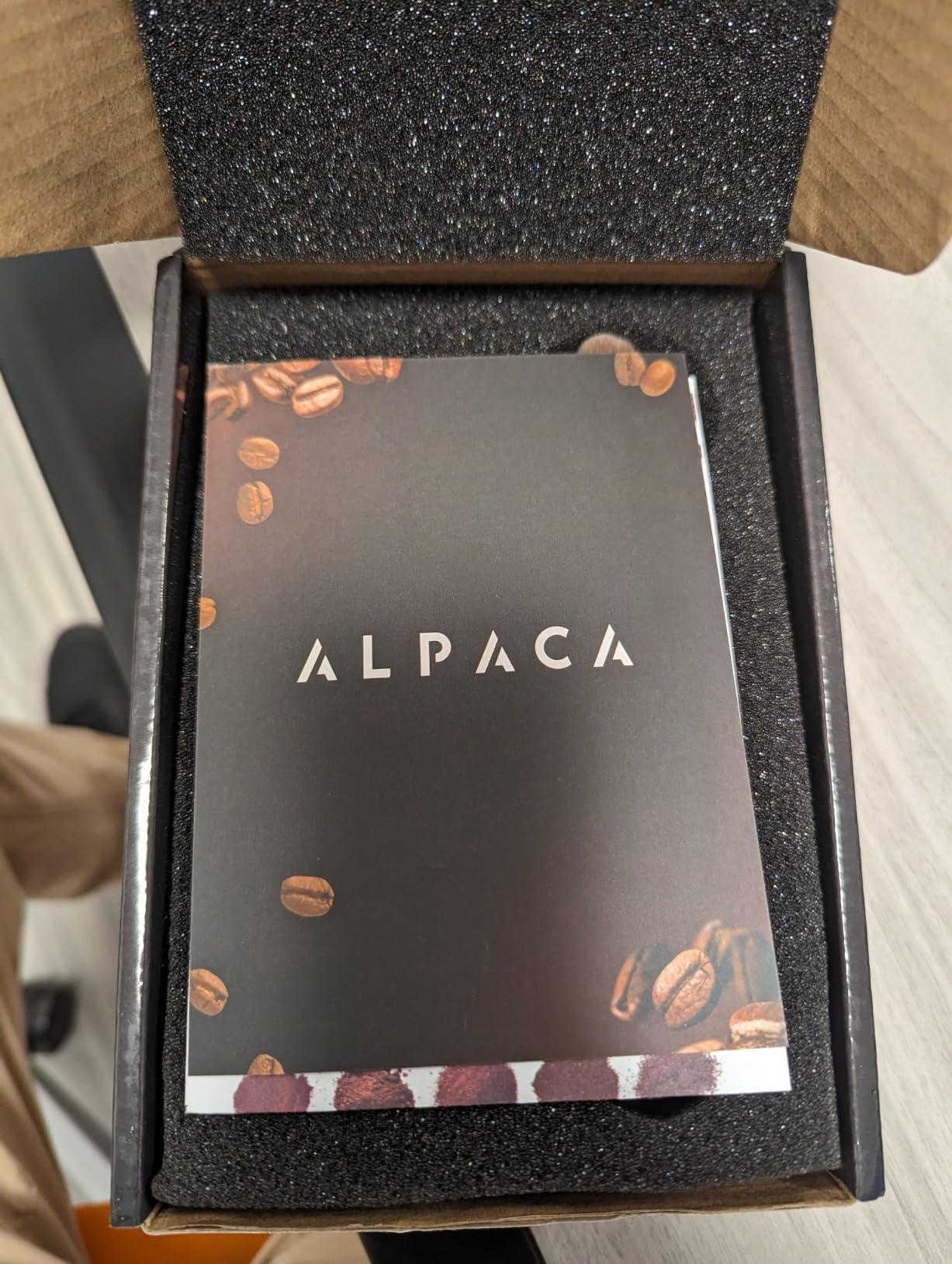
The Alpaca Ventures AV1 is built around one idea: if you can count something, you can repeat it. The adjustment runs through 45 audible clicks from the fine stop, and the factory map is printed in the listing, with espresso at clicks 11 to 15, siphon at 16 to 20, French press at 21 to 30 and cold brew from 31 to 45.
Write your click count on the body with a paint pen on the first morning and the grinder becomes a repeatable recipe machine in a 6.8 inch aluminium tube. Owners rate it 4.5 across 891 reviews and single out the audible detents as the feature they notice most.
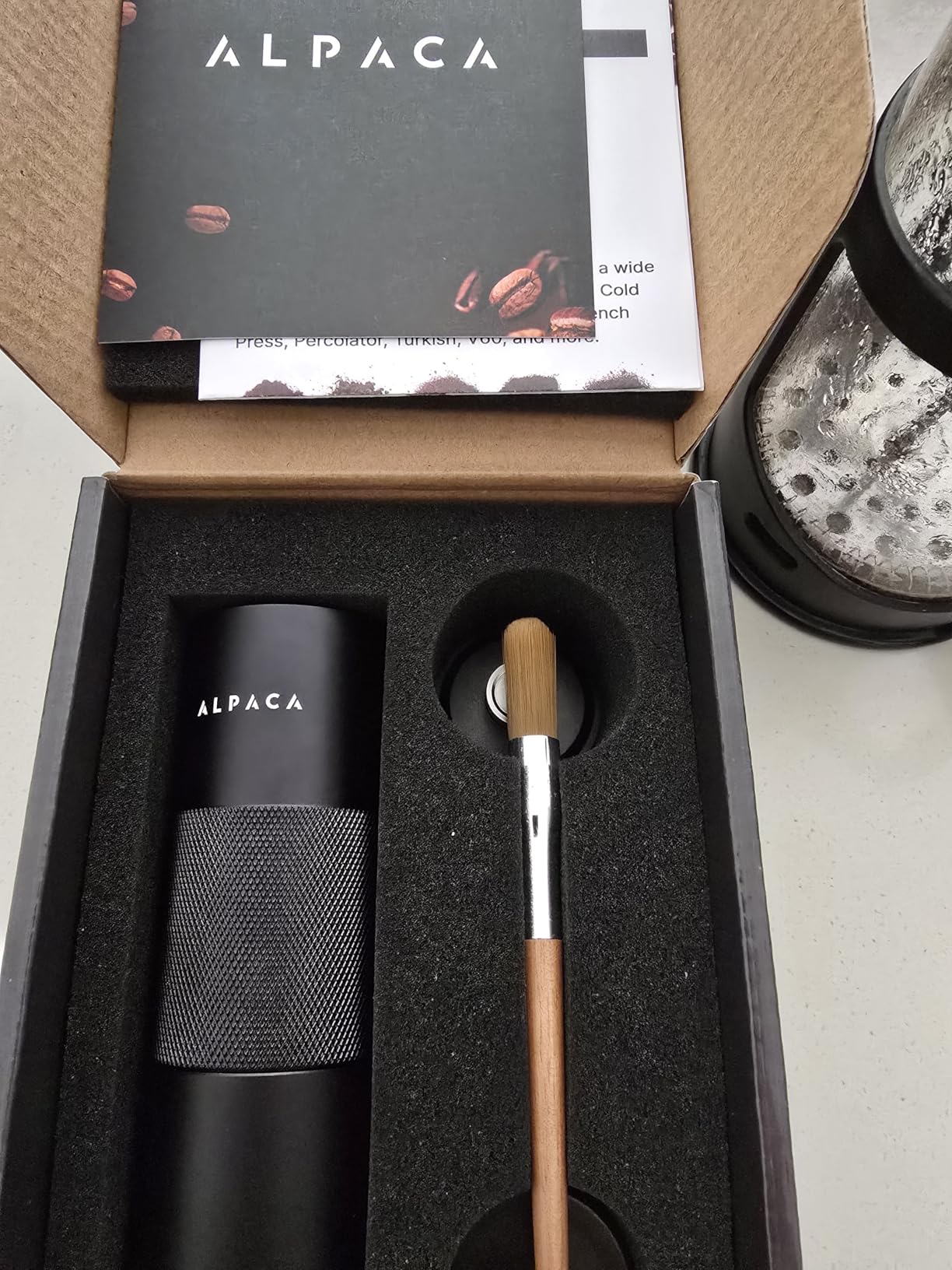
The burr is 420 stainless conical hardened to 57 HRC, which is a harder steel than most travel grinders use. Dual bearings keep the crank smooth when the load spikes, which is exactly what happens when a fine espresso setting bites down on a dense bean.
The grounds chamber is unbreakable aluminium with a knurled body grip, and the catch cup is a piece that will not shatter when you drop the pack. A cleaning brush is included; no case or tin comes in the box, so add your own pouch.
What counted clicks do for repeatability
Repeatability is the quiet skill behind good travel coffee. Once you find the click number that works for your roast and your brew method, every later trip starts from a known point instead of a fresh guess. That matters more on a trip than raw peak precision because you rarely get a second attempt.
The 25 to 28g fill covers about two single espressos, and owners report finishing a double in roughly a minute. For pour-over and press, the wider click range gives you room to change without changing gear.
Where it is the wrong choice
Counting from the fine stop is genuinely fiddly at six in the morning, and a slipped click changes the brew. If you prefer a dial you can see and touch, the CEVING Mini or the CIRCLE JOY further down offer 40-step external rings that read at a glance.
Owners also report long-term loosening of the handle and burr after heavy use, and the grinder only comes apart for confident hands because the internal parts are small. Cleaning is brush-only, with no liquids and no dishwasher.
7. VEVOK CHEF: The Biggest Catch Cup in the Group
VEVOK CHEF Manual Coffee Grinder Stainless Steel Burr Grinder 6 External Adjustable Setting Vintage Hand Coffee Grinder Portable Hand Crank Conical Coffee Bean Grinder Mill for Home,Camping
Six external settings
Steel conical burr
48g glass catch cup
Removable crank
Carry bag included
Pros
- Largest capacity here for two or more people
- Steel burr beats ceramic on speed and consistency
- Threaded glass jar stays secure
- Bigger body is easy to grip
- Carry bag included
Cons
- Glass jar breaks if dropped
- Six steps are coarse between methods
- Fine settings take noticeably longer
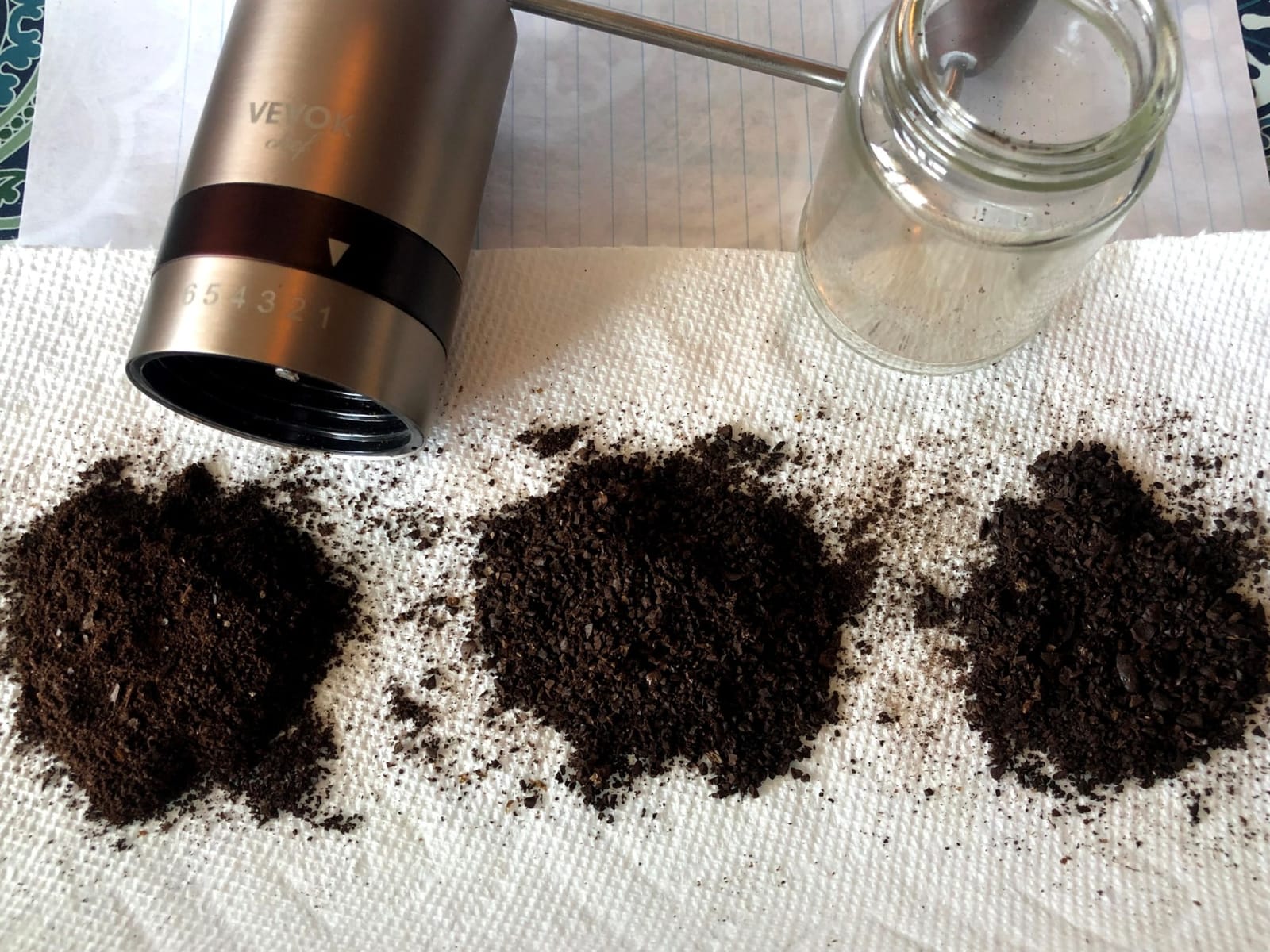
Capacity is the quiet differentiator on a group trip. The VEVOK CHEF lists a 48g catch cup and a hopper that holds roughly 15 to 20g of beans, and owners commonly report grinding a full chamber in about 45 seconds. That is the grinder to take when two people want coffee at the same time.
It is also one of the few here with a real steel conical burr at an entry price. Reviewers repeatedly compare it favourably to ceramic-burr rivals of similar size on speed and evenness, and the burr handles darker roasts without stalling.
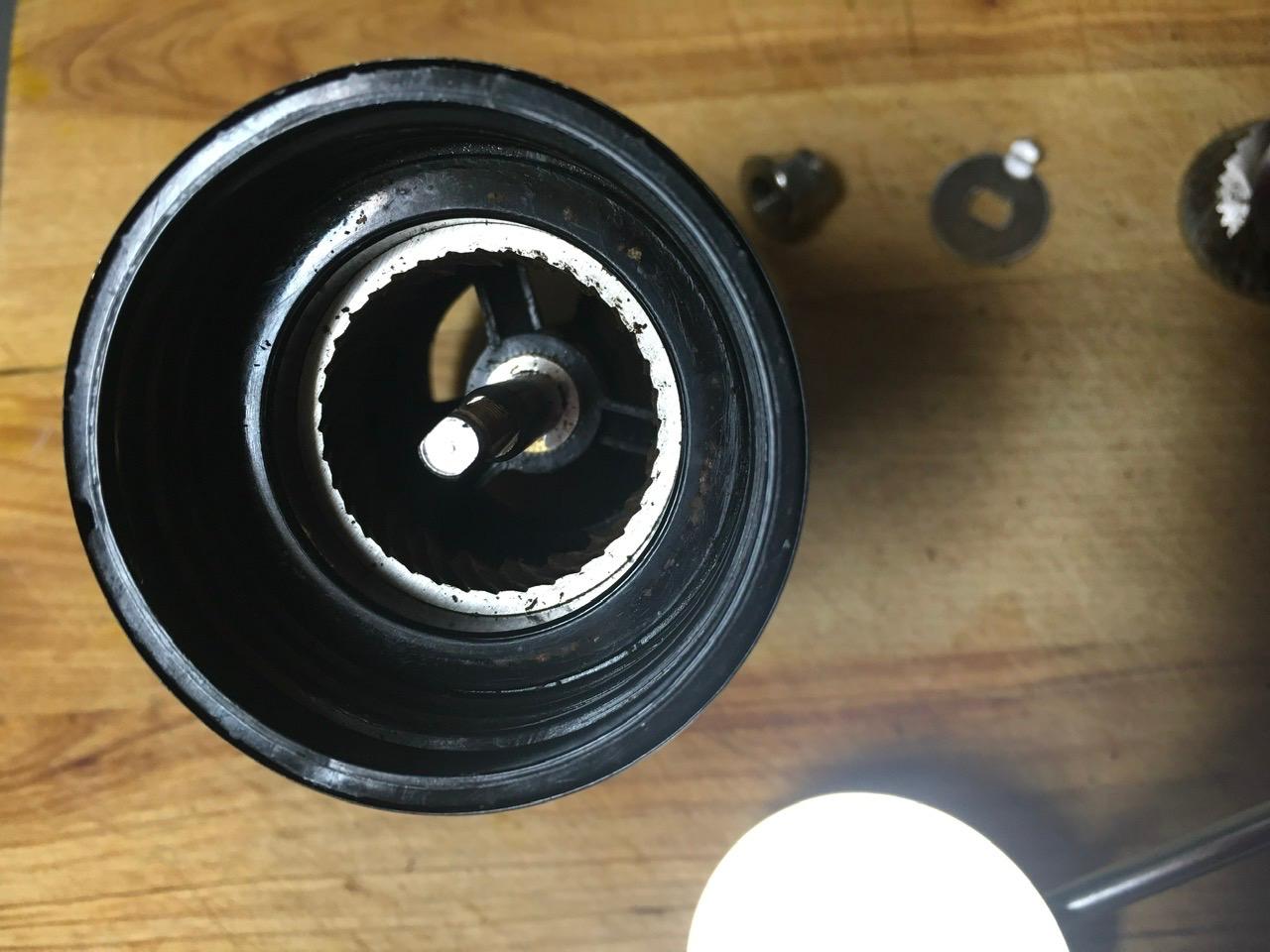
The catch cup is a threaded glass jar rather than a friction fit, so it stays attached during a dose even if the grinder gets bumped. At 5.9 by 2.5 by 7.9 inches and 15.84 ounces it is a substantial object, and the wider body is easier to grip and crank than the slim cylinders here. A carry bag comes in the box, which is rare at this tier.
That said, listing photos overstate the hopper volume, so plan on one or two cups per fill rather than the number on the packaging. Six external settings cover espresso through cold brew, but the gaps between steps are wide.
When capacity beats precision
If you are brewing for two or three, a grinder that makes 15g of coffee at a time turns breakfast into a queue. The VEVOK CHEF fills faster and holds more, so both mugs get made before either person has finished their own cup.
That extra capacity also cuts the number of crank cycles for a single brew method, which matters on a trip when your hands are cold and you would rather spend two minutes brewing than four grinding.
Where it is the wrong choice
Glass is the standing problem. A dropped glass jar in a campsite ends the trip for that grinder, and the grinder itself is not dishwasher safe, so cleaning is brush and warm water only.
Six settings is coarse between brew methods, and fine settings take noticeably longer as the burr gap narrows. If you plan to switch between espresso and press every morning, look at a 40-step model instead.
8. JavaPresse: The One Everyone Already Owns
JavaPresse Manual Stainless Steel Coffee Grinder – 18 Adjustable Settings, Portable Conical Burr Grinder for Camping, Travel, Espresso – With Hand Crank
18 grind settings
Ceramic conical burr
Stainless body
Detachable crank
7.5 inch tall
Pros
- Ceramic burr grinds consistently for the tier
- Quiet operation
- Detachable handle packs flat
- Long review history with daily users
- Stainless body resists rust
Cons
- Small hopper means repeated fill cycles
- Friction-fit catch cup can drop mid-grind
- Quality control varies between units
The JavaPresse has the longest track record in this roundup by a wide margin, with 25665 reviews at a 4.2 average, and owners frequently mention years of daily use. At 1.8 by 1.8 by 7.5 inches and 9.4 ounces it is one of the slimmest, and the detachable crank is the reason it packs so tightly.
The burr is ceramic conical with over 18 manual settings, and the listed uses cover espresso, drip, French press and pour-over. It is quiet, cool-running and consistent for its tier, which is why it keeps selling when far more expensive grinders appear beside it.
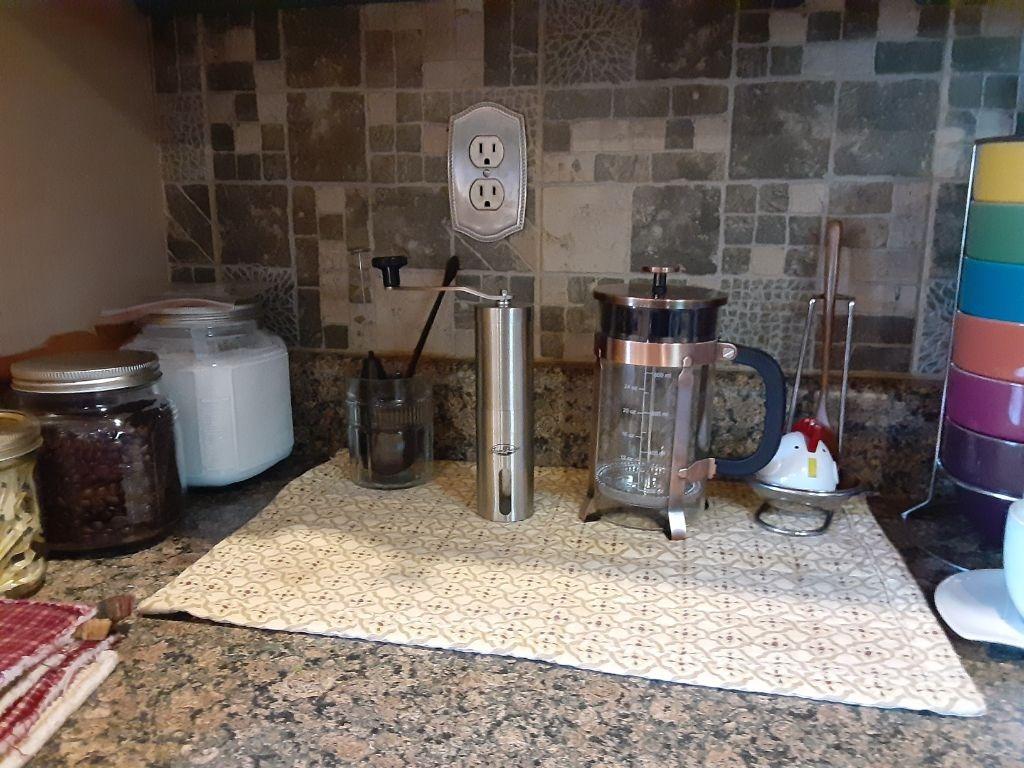
The catch theme across those reviews is capacity and quality control. The hopper is small enough that a full pot means several fill cycles, and a recurring complaint is the friction-fit catch cup detaching while grinding, which dumps grounds across a lap or a sleeping bag.
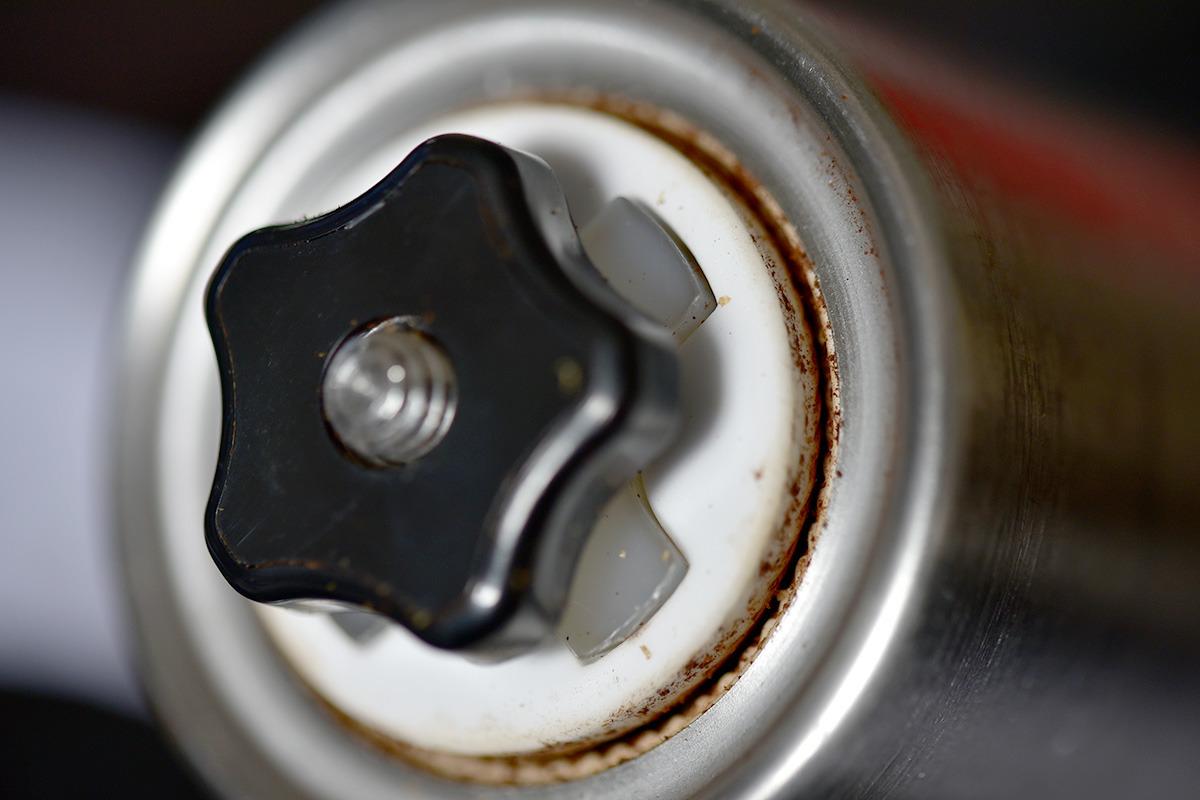
There is also a recurring report of off-centre burrs on some examples, which produce uneven particles and more fines than the same model should. That variation is normal at this volume and tier, so inspect the grinder on arrival and keep the packaging until you have ground a few doses.
Why the huge review count matters here
A review count this large is a reliability signal in itself. When 25000 owners are reporting on the same grinder, the failure modes are known, common and mostly cosmetic, which means you are not gambling on an unknown mechanism.
It also means replacement parts, tips and technique fixes are easy to find. For a travel grinder you will pack and unpack dozens of times, knowing the weak points in advance is worth more than a small improvement in grind quality.
Where it is the wrong choice
Adjustment clicks are not labelled for brew methods, so you are counting positions and hoping. That is workable for filter and press and frustrating if you chase espresso with it.
The internal rotor component is plastic and some owners report cracking after heavy long-term use. That is a home-grinder problem more than a trip problem, but it is the reason this is a value pick rather than our overall winner.
9. CIRCLE JOY: Forty Settings and the Longest Handle
CIRCLE JOY Mini Manual Coffee Grinder with 40 External Adjustable Settings and Ceramic Conical Burr, Portable Stainless Steel Hand Coffee Grinder for Home and Travel
40 external settings
Extra-long crank
Ceramic conical burr
Glass grounds jar
465g
Pros
- Extra-long handle reduces hand fatigue
- 40 steps cover the full range
- Ceramic burr stays cool
- Glass jar shows the dose
- Handle detaches for storage
Cons
- Hopper splits into three easy-to-miss sections
- Cleaning guidance rules out water
- Glass jar needs careful packing
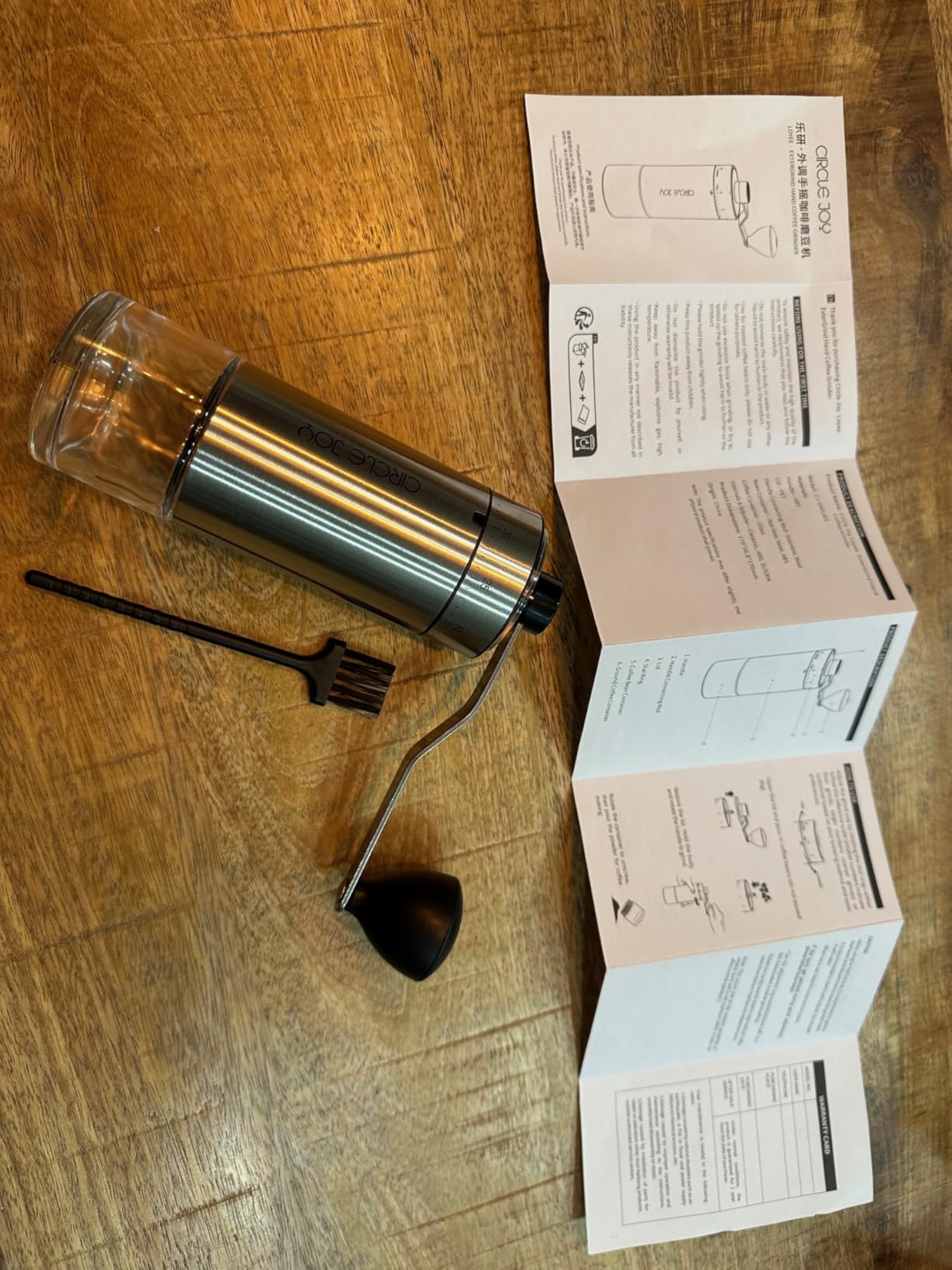
The CIRCLE JOY is the one to pick if hand fatigue is what stops you grinding on trips. Its extra-long stainless steel crank gives far more leverage per turn than the compact handles here, and owners name that as the first thing they notice on a long morning.
Forty external settings give it real range for the money, and the ceramic conical burr grinds evenly without heating the beans. The clear glass grounds jar lets you watch the dose build up, so you can stop on volume rather than on feel.
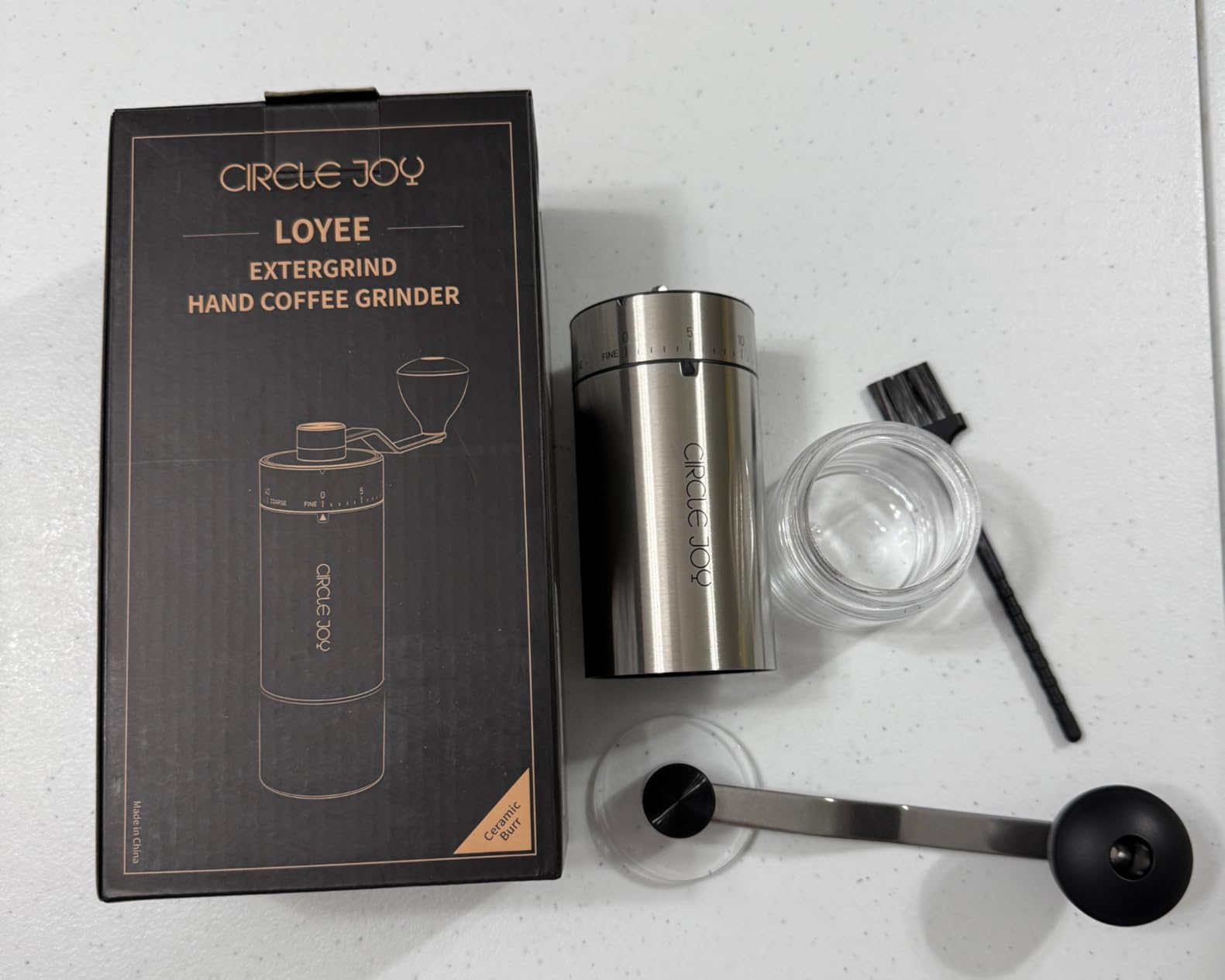
At 465g it is one of the heavier grinders here, and the body mixes ABS plastic with stainless steel rather than being fully metal. That combination sits in the middle: tougher than a pure plastic mill, lighter and less rigid than the all-aluminium options.
The awkward part is the hopper, which splits into three small sections that owners report missing when loading in a hurry. Budget an extra ten seconds per fill and it stops mattering.
Long handles and low grip strength
Turning force is the quiet metric for anyone whose hands get tired, stiff or cold. A longer crank means more torque per stroke, so the same grind takes fewer turns and less effort, which matters enormously when you are grinding at 5,000 feet in a cold tent.
If you have joint pain or limited grip strength, pair a long handle with a knurled body. That is why the Alpaca Ventures and the Timemore rank well for anyone who finds cranking hard, while smooth cylinders like the Hario rank lower on that specific point.
Where it is the wrong choice
Cleaning instructions say not to use water and give no detailed alternative, which leaves brush cleaning as the only real option. On a trip with a sink that is convenient but not clean, that is a constraint.
Some owners report performance degrading after a couple of months, and the glass jar needs careful packing. At 465g with a glass catch cup, this is a daypack grinder rather than a throw-it-in-the-bottom grinder.
10. SimCoker: Small Enough to Live Inside the Brewer
SimCoker Manual Coffee Grinder, Portable Burr Mill
Ceramic conical burr
304 stainless body
20g capacity
Travel bag
Dishwasher safe
Pros
- Smaller than a phone with the handle off
- Travel bag included
- 20g jar sized for one brew
- Dishwasher safe at home
- Stainless body resists rust
Cons
- 20g is the smallest capacity here
- Entry-level grind range
- Slow for even small batches
If your whole coffee kit is an AeroPress and a bag of beans, the SimCoker is designed around that. At 300g and 2.1 by 2.1 by 5.4 inches with the crank detached, it is smaller than a phone, and a travel bag is included so you can drop the whole thing straight into your brew kit.
That dimensional discipline is what makes nesting conversations easy. There is a persistent thread in the AeroPress community about grinders that fit inside the brewer body, and the constraint people describe is simple: if the grinder cannot nest, you are packing two separate cylinders instead of one.
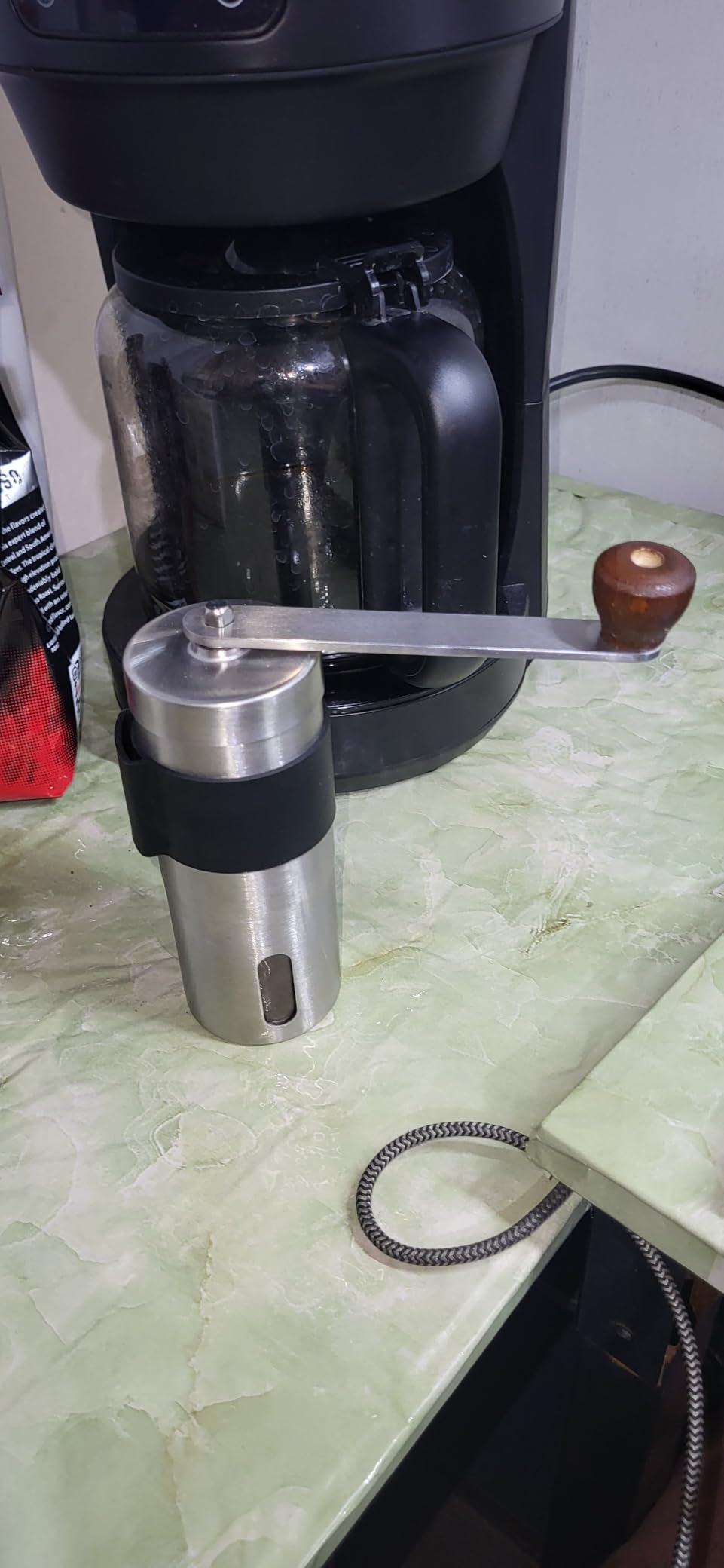
The burr is ceramic conical and the body is 304 stainless, which resists rust in a damp bag and handles drops better than a plastic mill. The 20g grounds container is sized for a single brew, which matches how most people use an AeroPress anyway.
It is also the only grinder here listed as dishwasher safe, so the trip does not have to end with coffee oils curing inside a catch cup. At 4.2 stars across 619 reviews, owners describe it as a compact budget travel grinder that does one job well.
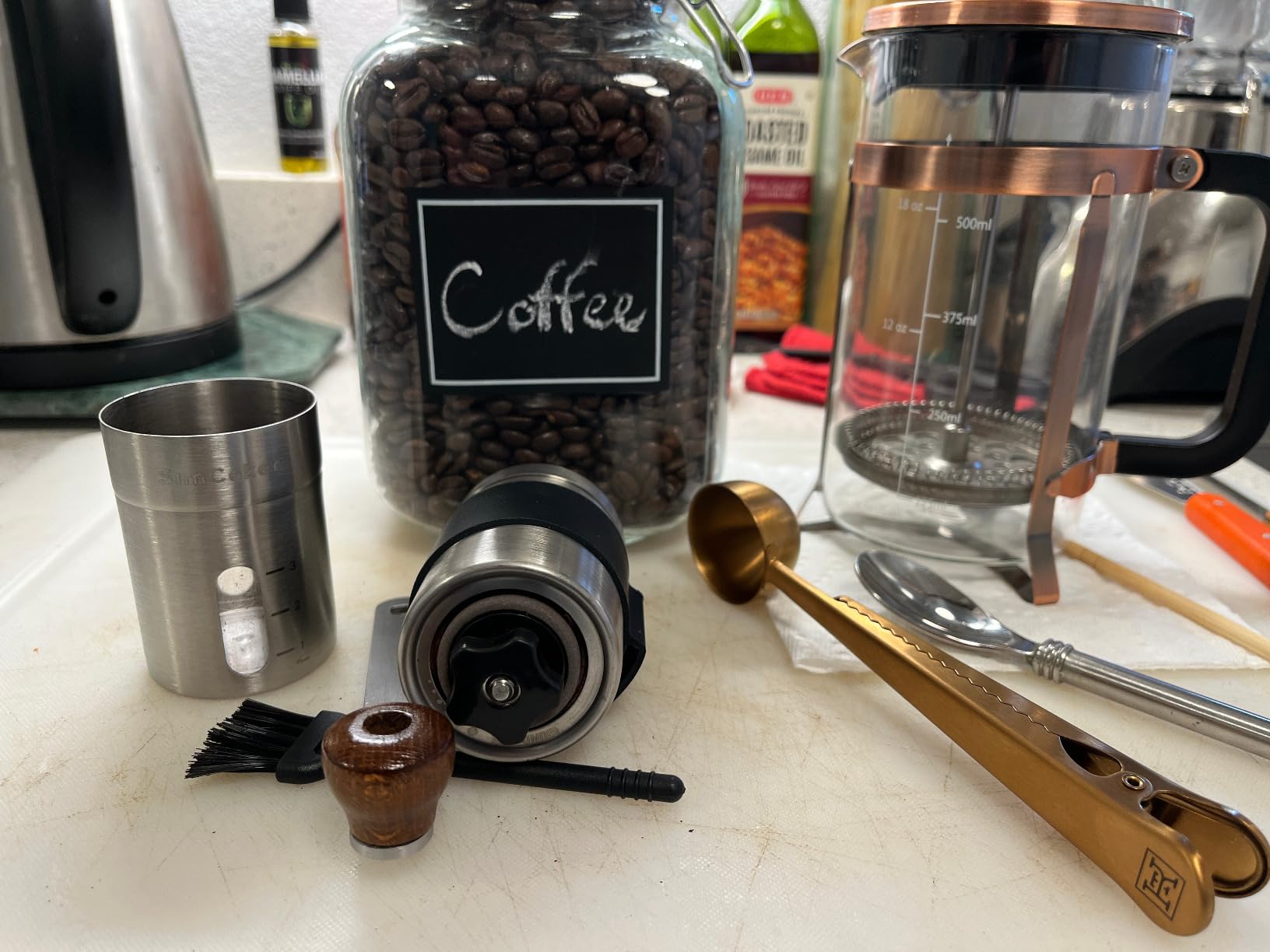
Why nesting inside the brewer changes packing
Nesting is not a gimmick. Every separate cylinder in your bag is another shape to fit, another lid to lose and another place for beans to spill. A grinder that lives inside the brewer body, or in the same pocket as it, cuts the coffee kit down to one object plus beans.
For business travel especially, this is the difference between a bag that fits in an overhead locker without rearranging and one that does not. We found this the easiest travel grinder to justify packing on a short two-night trip.
Where it is the wrong choice
Twenty grams is the smallest capacity in the group. One person with an AeroPress is fine; two people wanting French press means several fill cycles into a jar that then needs emptying halfway through.
The grind range is entry-level, and owners report that hand grinding takes noticeable time even for a small batch. If you care about dialed-in repeatability, this is not the grinder to learn on.
11. Rsoilch: The Shortest Body on the List
Rsoilch Manual Coffee Grinder With Ceramics Burr For Espresso,French Press,5 Adjustable Settings,Hand Maker with Built-In Burr,For Home Use and Camping Travel,Coffee Bean Grinders With Hand Crank
Ceramic burr in steel body
Five settings
5.5 inch tall
Hand crank
Collapses small
Pros
- Short 5.5 inch body fits tight pockets
- Five settings cover the main methods
- Steel body feels solid
- Breaks down for cleaning
Cons
- Single-serving chamber only
- Beans can jam above the burr
- Adjustment knob shifts while cranking
- Settings are unnumbered
The Rsoilch solves a specific packing problem: a 5.5 inch tall body that disappears into a jacket pocket or a small side compartment. At 10.4 ounces and 2 by 2 inches across, it is the shortest grinder in this group, and it comes apart for cleaning without tools.
The build is a stainless steel body with a built-in ceramic burr and five settings covering espresso through French press. Owners treat it as a cheap backup or a travel-only grinder rather than a main kitchen tool, and at 4.2 across 621 reviews the sentiment is consistent.
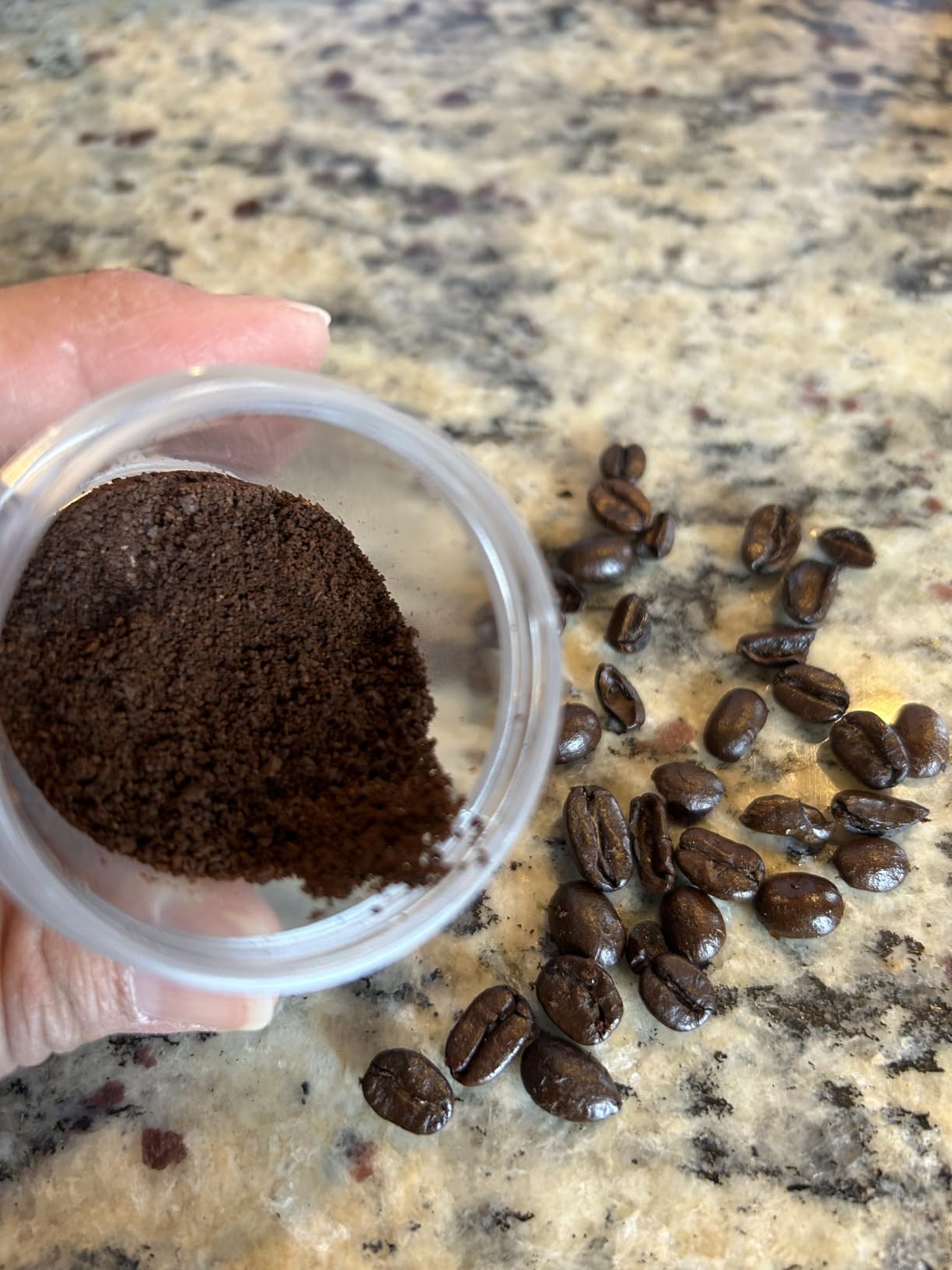
The compromise is capacity. The chamber holds a single serving, so a two-person morning means grinding twice, and the hopper has no feed assist, which owners report can let beans sit and jam above the burr.
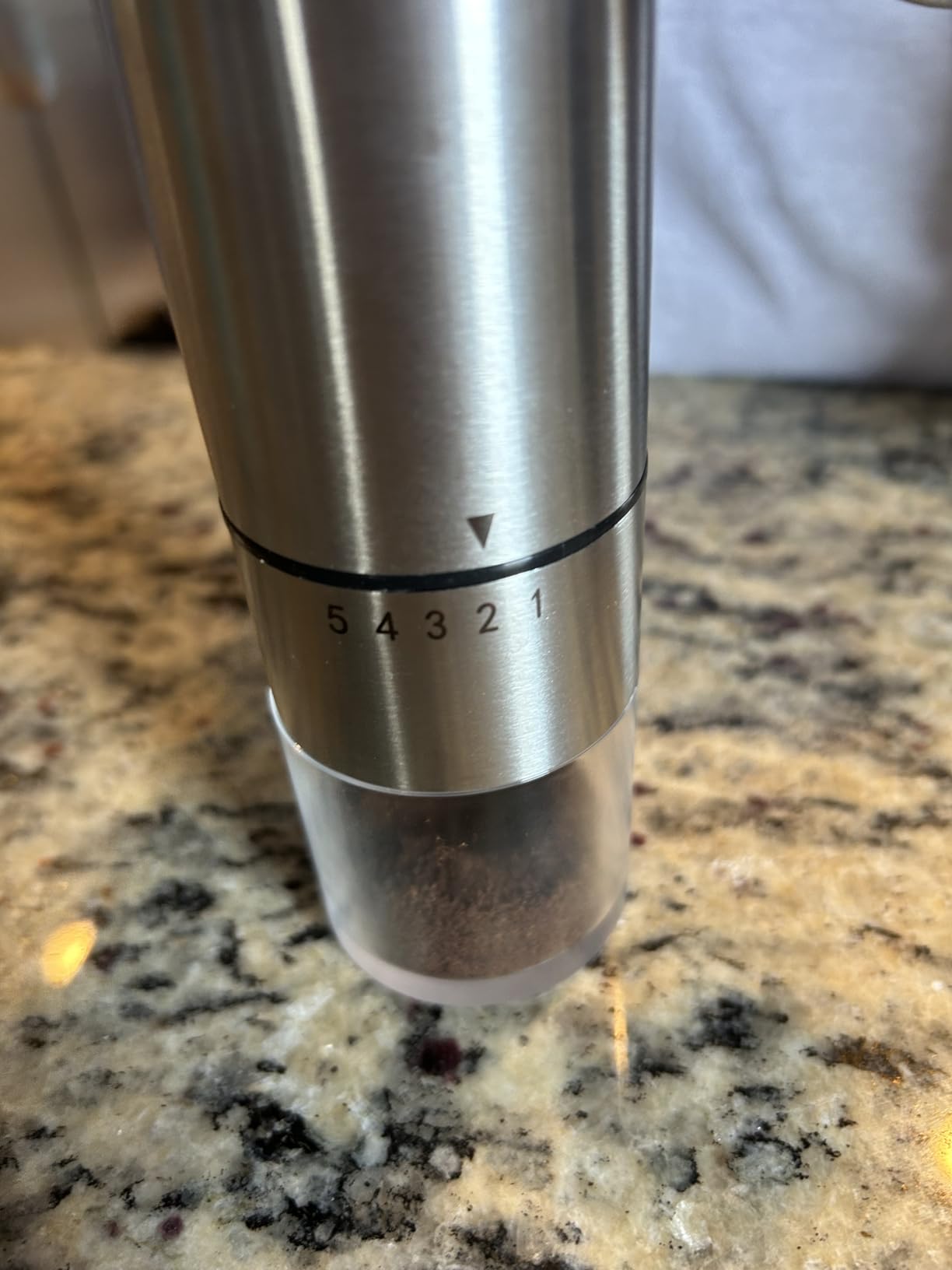
The adjustment knob also shifts position while cranking, and the five settings are not clearly numbered from coarse to fine. Both are small annoyances that become bigger annoyances when you are tired and the coffee is the good part of the morning.
When a single-serving grinder makes sense
For an overnight stop, a layover or a work trip where you buy coffee near where you sleep, one serving is all you need. A single-serving grinder also means fewer grounds to clean out of a hotel room, which is a real consideration when you have to leave before housekeeping arrives.
It is also the cheapest way to find out whether you actually enjoy hand grinding while travelling. If a short body with one serving clicks for you, a larger-capacity model is an easy upgrade later.
Where it is the wrong choice
Grinding takes a long time even for a small batch, which undercuts the reason to pack one at all. Feed jams above the burr are the most common complaint and require you to stop, clear and restart mid-dose.
If you brew for two or if you want any control over your recipe, spend the difference on a grinder with 40 settings and a 30g hopper. The gap in capability is much wider than the gap in size.
12. LHS: The Cheapest Way Into Hand Grinders
LHS Manual Coffee Grinder Ceramic Burrs Adjustable Coarseness 2 Containers
Ceramic burr
Steel crank
Four grind levels
Two containers
ABS body
Pros
- Two containers included in the box
- Disassembles and rinses clean
- Steel crank with ceramic burr
- Lid opens for easy filling
Cons
- Only four grind levels
- ABS body cracks more easily than metal
- Grind consistency is basic
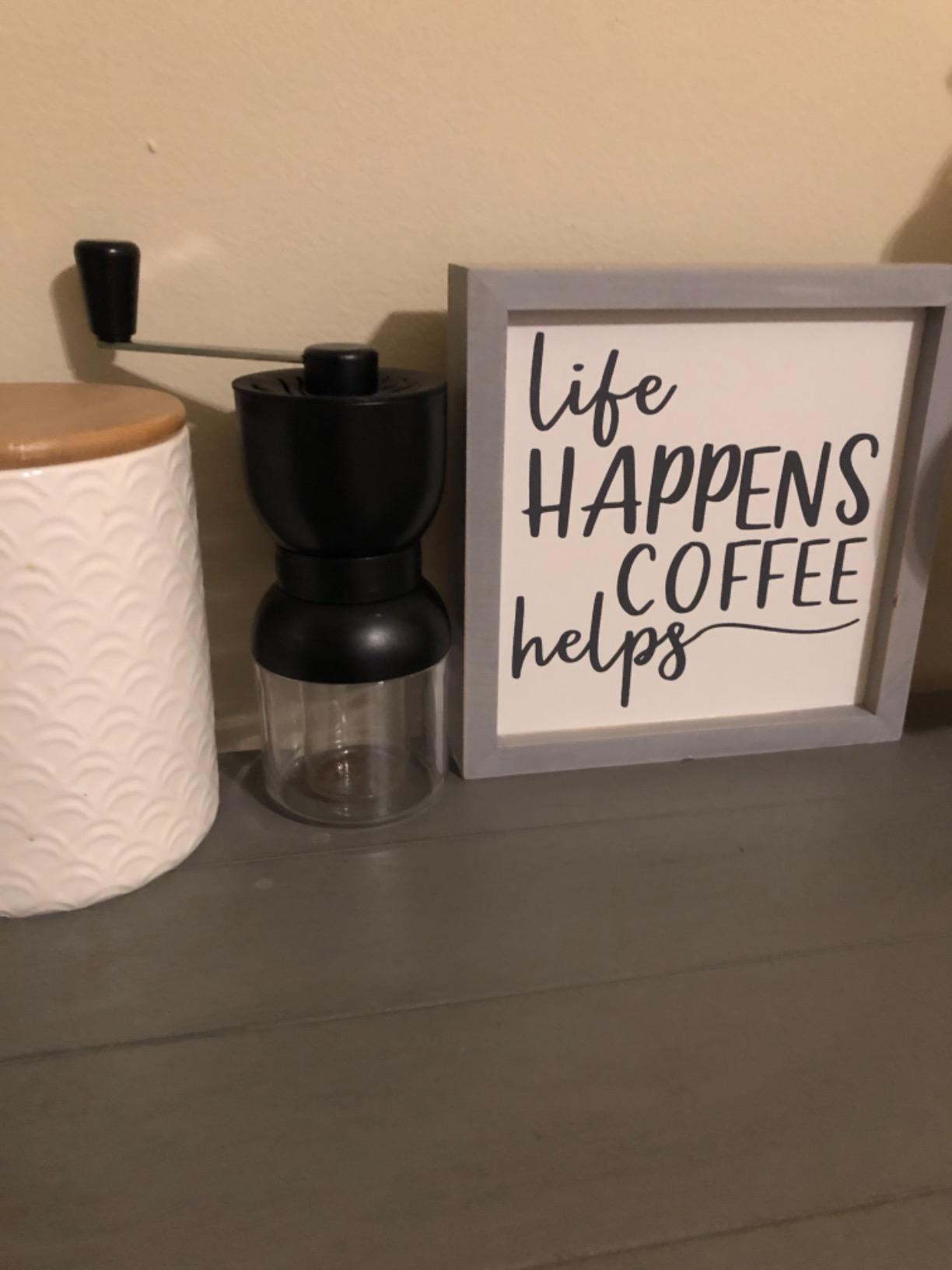
The LHS is included because every roundup should contain the honest entry-level option. Two containers come in the box, the crank is stainless steel, the burr is ceramic and it disassembles and rinses clean under a tap, which is more than most grinders at twice the price will admit to.
At 4.1 stars across 4183 reviews, owners describe it as a solid no-frills mill. The value is the strongest theme in the reviews, and the four-step adjustment is the mildest criticism.
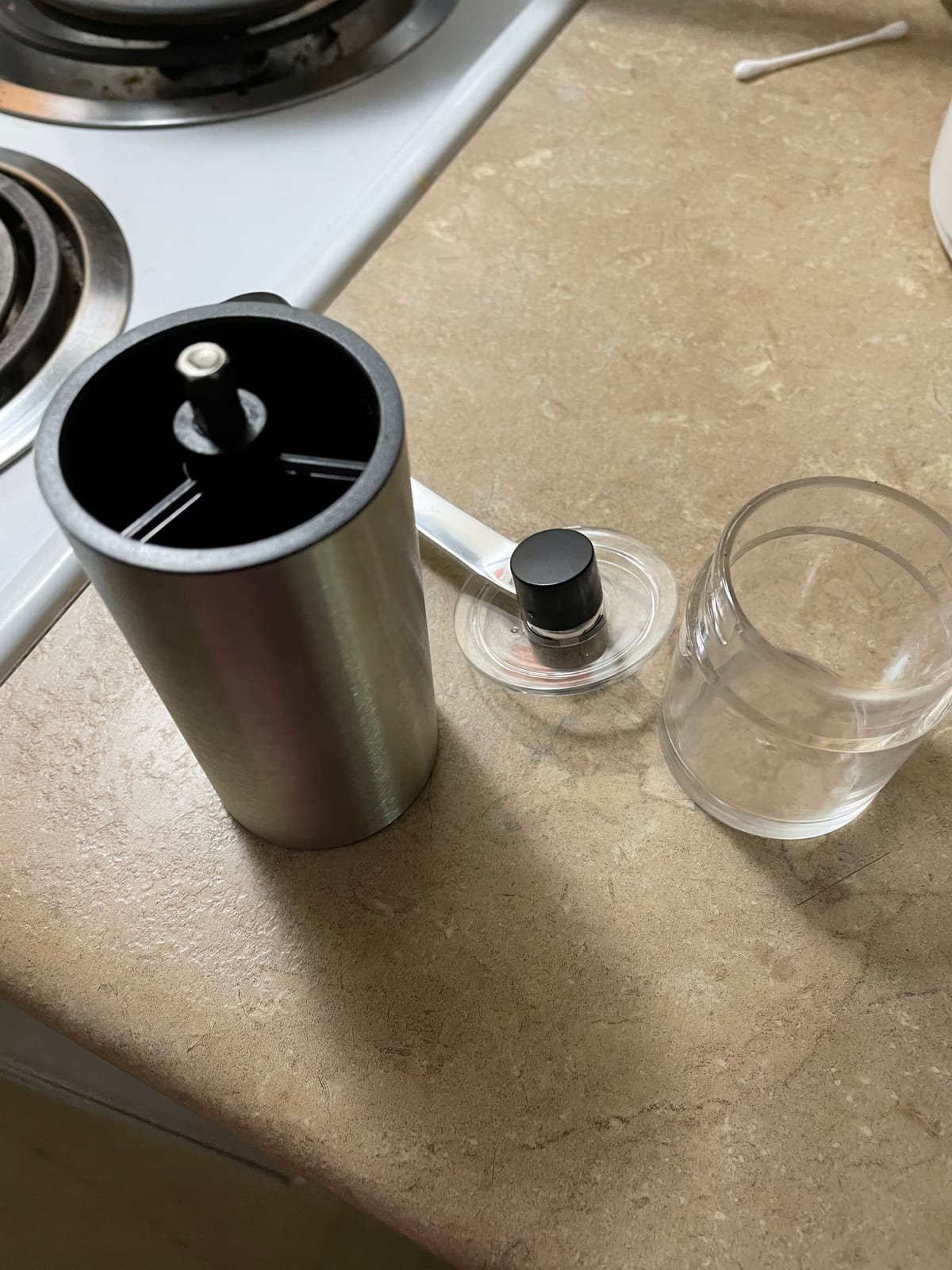
At 12.9 ounces and 3.07 by 3.07 by 8.33 inches it is wider and squarer than the slim travel options, so it packs with less flexibility into a narrow personal item. The wider base does make it stable on an uneven campsite table, though.
The ABS plastic body is the limiting factor. Owners note that it is more fragile than metal alternatives, and in a pack where a grinder gets sat on, plastic bodies are exactly what crack. Treat this one as a desk and hotel-room grinder rather than a rucksack grinder.
When four settings are genuinely enough
Four levels cover coarse French press, medium filter and two finer steps. If you brew one method and never change it, that is enough, and you can dial it in once and never touch it again.
The two containers are the detail that makes it feel generous. One holds beans and one holds grounds, so you can dose without a funnel and pour without tipping grounds into your mug.
Where it is the wrong choice
Grind consistency is basic compared with metal-burr models, so filter coffee from this grinder tastes flatter and can be slightly bitter at the fine settings. If coffee quality matters to you even a little, the step up is steep and worth it.
Switching brew methods means starting over, because four steps leaves no room in between. And with a plastic body, it is the one grinder here we would not put at the bottom of a loaded pack.
How to Choose a Hand Coffee Grinder for Travel
Weight matters most for flights and least for road trips, so decide the trip type first. A personal-item-only flight puts a hard ceiling near 340g before you count the brewer and beans. A car trip or an RV removes the ceiling entirely, which frees you to buy on grind quality instead. If your trips are mostly hotels and rental cars, buy for noise, capacity and cleaning rather than for weight.
- Burr material. Steel burrs cut faster and stay sharper on dark, oily roasts. Ceramic burrs run cooler, stay quieter and cost less. For espresso or dark roasts, steel. For filter or light roasts in a quiet room, ceramic is fine.
- Adjustment range and readability. Count the settings, and prefer a numbered dial, a labelled ring or audible clicks. Six unnumbered steps mean re-dialing every trip; 40 external steps let you record a number and move on.
- External versus internal adjustment. An external ring changes the gap with the grinder assembled, which is the difference between a thirty-second adjustment and a five-minute one with loose parts on a picnic blanket.
- Capacity. Decide your dose size first. Around 20g suits one person with an AeroPress. Around 30g suits two. Around 48g suits a group brewing one large pot.
- Body and catch cup material. Aluminium and stainless steel survive drops and water. Glass shatters. ABS plastic is light but cracks when sat on. This is the single most reported travel failure.
- Ergonomics. Check handle length against your grip strength, and whether the body is textured. A knurled grip and a long crank reduce effort more than any other spec on this list.
- Warranty and parts. A lifetime warranty costs nothing to prefer. A one-year warranty with buyer-paid shipping on parts is worth factoring in if you will be far from home.
Two questions get asked constantly in coffee forums and both deserve a straight answer. Do you need a separate travel grinder if you already own a good hand grinder? Often no, if that grinder is under about 450g and its handle folds or detaches. If it is a large 650g home model, then yes, because carrying it defeats the point of travelling light. And can you bring a coffee grinder in your carry-on? A manual grinder is just a metal tool with no liquids, so it is never the item that causes a problem at security.
Our other guides cover the heavier end of this topic, including the best espresso grinders for home coffee bars if you are building a kit to grind for after the trip.
Weight, Build and Noise: What Survives the Road
The weight spread across these twelve is wide, from 300g for the SimCoker to 500g for the Vivaant, with the Hario Mini-Slim Plus listed at 0.3 kg and the Timemore at 430g. The useful number is not the grinder weight alone but the packed kit weight, so add your brewer, your beans and your filter and see what the total looks like. Most travel coffee kits land between 600g and 1.1kg, and that is the figure that decides whether you carry it or buy a bag of coffee at the destination.
The honest answer for true ultralight backpackers is that a grinder is the first thing to leave behind. If your entire kit must fit a sub-7kg pack, buying good coffee at the trailhead usually beats carrying a grinder, and forum users who attempt it with a full-size home model generally regret the weight. Grinders make most sense for car camping, road trips, RV travel and hotel stays.
Field failures follow predictable patterns. Friction-fit catch cups detach mid-dose and spill grounds. Glass jars crack when a pack is sat on. Plastic bodies crack at the threaded collar. Adjustment knobs drift so the setting changes without you touching it. Static clumping in plastic catch cups pushes fines into corners that never get brushed out. All-metal grinders with threaded cups resist all four, which is why the Timemore and the Alpaca Ventures age best.
Noise is the factor nobody lists and everybody notices. Every grinder here is quieter than an electric burr grinder, which matters in a shared room, but a long crank on a coarse setting is louder than a short one on a fine setting. If you are grinding at six in a hotel, a ceramic burr with a compact handle like the Hario or the CEVING is the discreet choice.
Maintenance is simple and it extends life more than any purchase decision. Brush the burr and the chamber after every brew, never wash a grinder that has grind adjustment inside it, and dry the parts before reassembling so oils do not glue the collar together. If a knob starts drifting, tighten it before you leave rather than after a bad morning in a foreign country.
Frequently Asked Questions
What is the best manual coffee grinder for travel?
The Hario Mini-Slim Plus is the best manual coffee grinder for travel overall, because at roughly 0.3 kg with a detachable crank and a slim 8.7 inch body it packs into a personal item better than any other grinder we tested, and owners rate it 4.5 across nearly 6000 reviews. For espresso on the trail, the KINGrinder K6 offers the finest adjustment at 16 microns per click, while the Timemore Chestnut C3S Pro is the stronger all-metal option for car camping.
What is the best coffee grinder for travel?
The best travel grinder depends on the trip. For flights and personal-item-only packing, choose a sub-400g body with a detachable or folding crank, such as the Hario Mini-Slim Plus at 0.3 kg or the CEVING Mini at 325g. For car camping and overlanding, choose an all-metal build such as the Timemore Chestnut C3S Pro at 430g, which survives drops and rinses clean. Any of these needs no electricity, batteries or outlet.
What’s the best handheld coffee grinder?
Handheld grinders are hand crank burr mills, and the best of them use conical burrs rather than blades because burrs produce a consistent particle size instead of a mix of powder and chunks. The lightest useful options here are the SimCoker at 300g, the Hario Mini-Slim Plus at 0.3 kg and the CEVING Mini at 325g. Bladed mills are cheaper and faster but produce uneven grounds that brew inconsistently.
Are handheld coffee grinders any good?
Yes, for filter coffee, and increasingly for espresso with fine external adjustment. Modern hand grinders with steel or ceramic conical burrs and more than 20 labelled settings produce a far more even grind than the hand mills of a decade ago. The limits are grind time and capacity, since a dose can take a minute of cranking and hoppers usually hold a single brew. Grinders such as the KINGrinder K6 advance 16 microns per click, which makes repeatable espresso realistic.
What is the best portable coffee grinder for camping?
For camping, the Timemore Chestnut C3S Pro is the strongest all-round pick because its aluminium body, folding handle and 36 coarseness levels survive being dropped and rinsed at a tap, and owners rate it 4.8 across 1720 reviews. For ultralight backpacking where every gram counts, the CEVING Mini at 325g with 40 external settings is the better compromise between weight and range.
What is the best portable coffee bean grinder?
The best portable coffee bean grinder for a personal-item-only bag is the SimCoker, a 300g 304 stainless body with a ceramic conical burr, a 20g jar and an included travel bag that is smaller than a phone with the crank detached. If you want more capacity and a wider grind range in the same footprint, the CEVING Mini adds 40 external settings and a 30g hopper at 325g.
Final Verdict: Which Travel Grinder Should You Buy?
Buy the Hario Mini-Slim Plus if you fly, pack light or move between hotels. Its 0.3 kg body, detachable crank and detachable cup make it the easiest of these twelve to justify in a bag, and the near 6000-review history means you know exactly what you are getting.
Buy the Timemore Chestnut C3S Pro if your trips are by car, RV or overlanding route, because the all-metal body and folding handle take the abuse a car trip brings and the hexagonal burr gives you a noticeably cleaner cup. Buy the KINGrinder K6 if espresso is the point, since 16 microns per click is the difference between chasing a recipe and repeating one. Buy the CEVING Mini if you want all of that adjustability at the lightest reasonable weight.
Whatever you choose, write your grind setting on the body before you leave home. That single habit does more for your travel coffee than any spec on this list. Use the buttons below to see the current listing for each grinder, and check the packed kit weight before you commit to a bag.
This roundup of the best hand coffee grinders for travel was tested and written in October 2026, and we update it as new models land.