
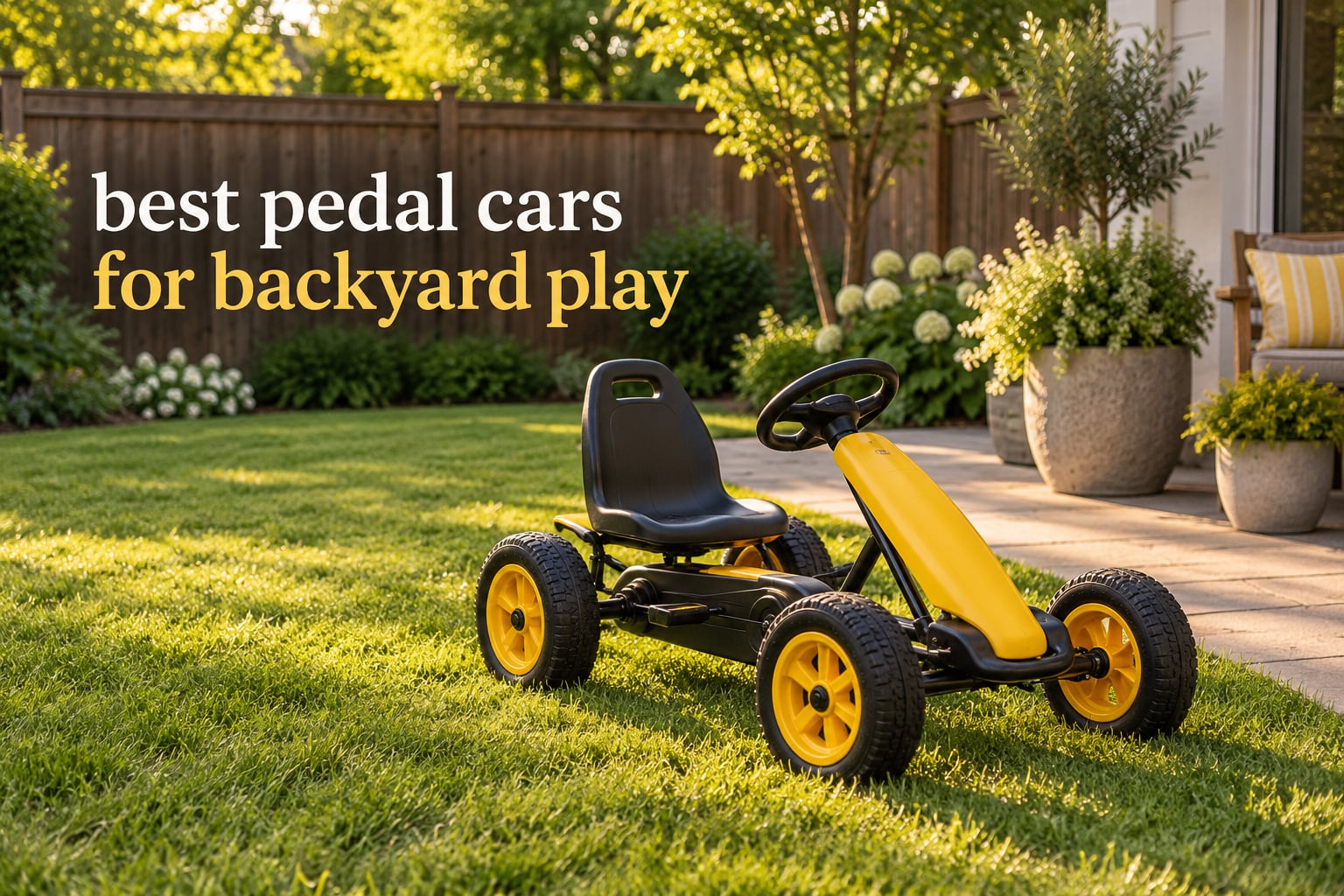
A pedal car is a child-sized ride-on toy that a child powers entirely with their legs, with no battery, motor or remote control anywhere in the package. If you are searching for the best pedal cars for backyard play, the short version is this: the hauck Lightning is the overall pick, the Costzon 36 Inch is the budget pick, and the YBIKE Explorer is the one to buy when your child is already too big for anything labeled age five. We spent weeks comparing twelve of the highest-rated pedal karts and pedal cars on the market, checking the details that actually decide whether a cart survives a real yard: the frame material, the wheel compound, the stated weight capacity and how much adjustment the seat gives you.
Two product families get sold under the same search term, and that trips up a lot of first-time buyers. A pedal car is car-shaped, with a bonnet, a grille and sometimes opening doors, sitting close to the ground like a miniature classic automobile. A pedal go-kart is a low, open, flat kart with a steering wheel, a chain guard and a pedal deck, closer in spirit to a soapbox racer. Both are pedal-powered. They differ almost completely in styling, seating posture and the age bands they suit, and we have kept both in this roundup because both turn up in backyard searches.
Backyard play also adds a requirement the retail category pages never mention: the surface underneath. Smooth plastic wheels roll beautifully on a driveway and dig straight into lawn. Grass, gravel and slopes punish the light karts and reward the heavy steel ones with real tread. Every pick below gets a surface verdict, along with a note on assembly time and how much of your garage it eats when it is not being ridden.
Over on our sister site we have put together a broader look at pedal go-karts for kids if you want the age-band breakdown first, and our guide to castle-themed outdoor playsets if you are building out the rest of the yard at the same time.
Table of Contents
Top 3 Pedal Carts for Backyard Play in 2026
hauck Lightning Pedal Go Kart
- Alloy steel frame with rubber-profile wheels
- 110 lb max weight
- Two-position adjustable bucket seat

hauck Batmobile Pedal Go Kart
- Adjustable bucket seat
- 77 lb max weight
- Themed superhero body on a steel frame

hauck Hurricane Pedal Go Kart
- Long 47.6 inch frame
- Three seat positions
- Rubber wheels with dual bearings
The Lightning takes the top slot on the strength of its steel frame, its two-position seat and the largest body of owner feedback in the group. The Batmobile is the same proven chassis in a themed shell that most four-year-olds consider the whole point. The Hurricane is one of the longest and most solidly framed karts here, which makes it the most stable choice for an older child with a heavier foot.
Pedal Car vs Pedal Go-Kart: The Difference 2026 Buyers Miss
A pedal car is modelled on an automobile, so the child sits low and forward with a wheel in front of them and a shaped body around their legs. A pedal go-kart sits in an open tray with the pedals and steering wheel laid out in front, closer to a go-kart frame than a car. Both are driven by rear-wheel drive through a chain, and on decent models that chain sits behind a guard.
The practical differences matter more than the styling. Pedal cars such as the Kid Trax Classic have heavier steel bodies and lower weight limits, because the shell and the low seating position constrain how large a child can grow into them. Pedal go-karts are longer and wider, take an adjustable seat that slides along the frame, and are far easier to size for a child who is big for their age. If your child is a toddler, a car shape sells it. If your child is five or older, the kart geometry is easier to ride and easier to grow into.
One more distinction worth making: neither of these is an electric ride-on. A pedal cart develops leg strength and balance because the power comes from the rider, and there is no charging, no motor to service and no runtime limit. Parents weighing a pedal kart against a battery-powered ride-on usually find the pedal kart wins for a child who has outgrown a push toy but is not yet ready for a bicycle.
Quick Comparison: All 12 Pedal Carts in 2026
| Product | Specifications | Action |
|---|---|---|
| hauck Lightning Pedal Go Kart |
|
Check Latest Price |
| hauck Batmobile Pedal Go Kart |
|
Check Latest Price |
| hauck Hurricane Pedal Go Kart |
|
Check Latest Price |
 Costzon 40 Inch Off-Road Pedal Go Kart Costzon 40 Inch Off-Road Pedal Go Kart |
|
Check Latest Price |
 Little Tikes Jett Car Racer Little Tikes Jett Car Racer |
|
Check Latest Price |
 Costzon 36 Inch Pedal Go Kart Costzon 36 Inch Pedal Go Kart |
|
Check Latest Price |
 HONEY JOY Pedal Go Kart HONEY JOY Pedal Go Kart |
|
Check Latest Price |
 YBIKE Explorer Pedal Car YBIKE Explorer Pedal Car |
|
Check Latest Price |
 Kid Trax Classic Pink Pedal Car Kid Trax Classic Pink Pedal Car |
|
Check Latest Price |
 Aosom Pedal Go Kart Ages 5-12 Aosom Pedal Go Kart Ages 5-12 |
|
Check Latest Price |
 HOMGX Pedal Go Kart HOMGX Pedal Go Kart |
|
Check Latest Price |
 Aosom Swing Axle Pedal Go Kart Aosom Swing Axle Pedal Go Kart |
|
Check Latest Price |
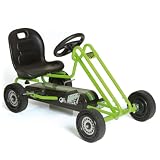
1. hauck Lightning Pedal Go Kart: Best Overall Pedal Go-Kart
hauck Kids Pedal Go Kart, 4 Wheel Bike Cart, Ride for Ages 4-8, Green
Alloy steel frame
Rubber-profile wheels
110 lb max weight
38.19 x 20.86 x 22.05 inch
Pros
- Steel frame that holds up to heavy abuse
- Rubber-profile tires with strong braking
- Two-position seat that grows with the child
- Arrives mostly assembled
- No batteries to charge
Cons
- Low gearing limits speed and legroom
- Struggles in grass and dirt
- One rear wheel is chain-driven
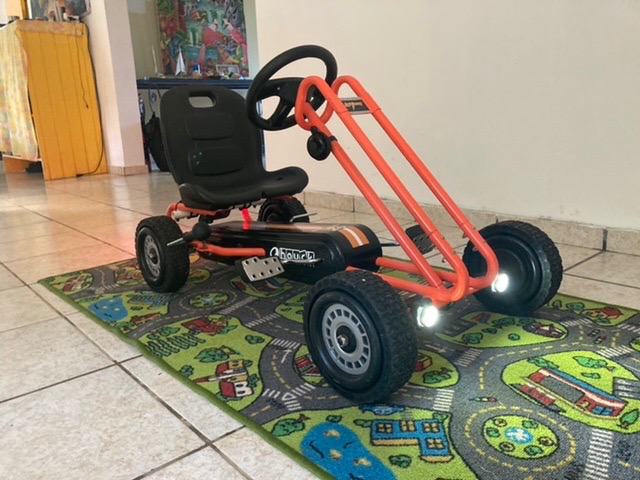
This is the kart we keep coming back to. It has the highest owner rating in this group and the largest volume of written feedback by a wide margin, which matters when you are trusting a stranger’s judgment about how a frame holds up after a summer of being jumped off curbs. The build is alloy steel with rubber, and it arrives close to complete, so the assembly job in your garage is short.
The seat is the piece that does the most work here. It moves between two positions, 44 cm and 51 cm from seat to pedal, which covers a surprising age range for a kart this small. The handbrake pulls on both rear wheels rather than one, and the rubber-profile tires give a short, controlled stop that plastic wheels on the same chassis never manage.
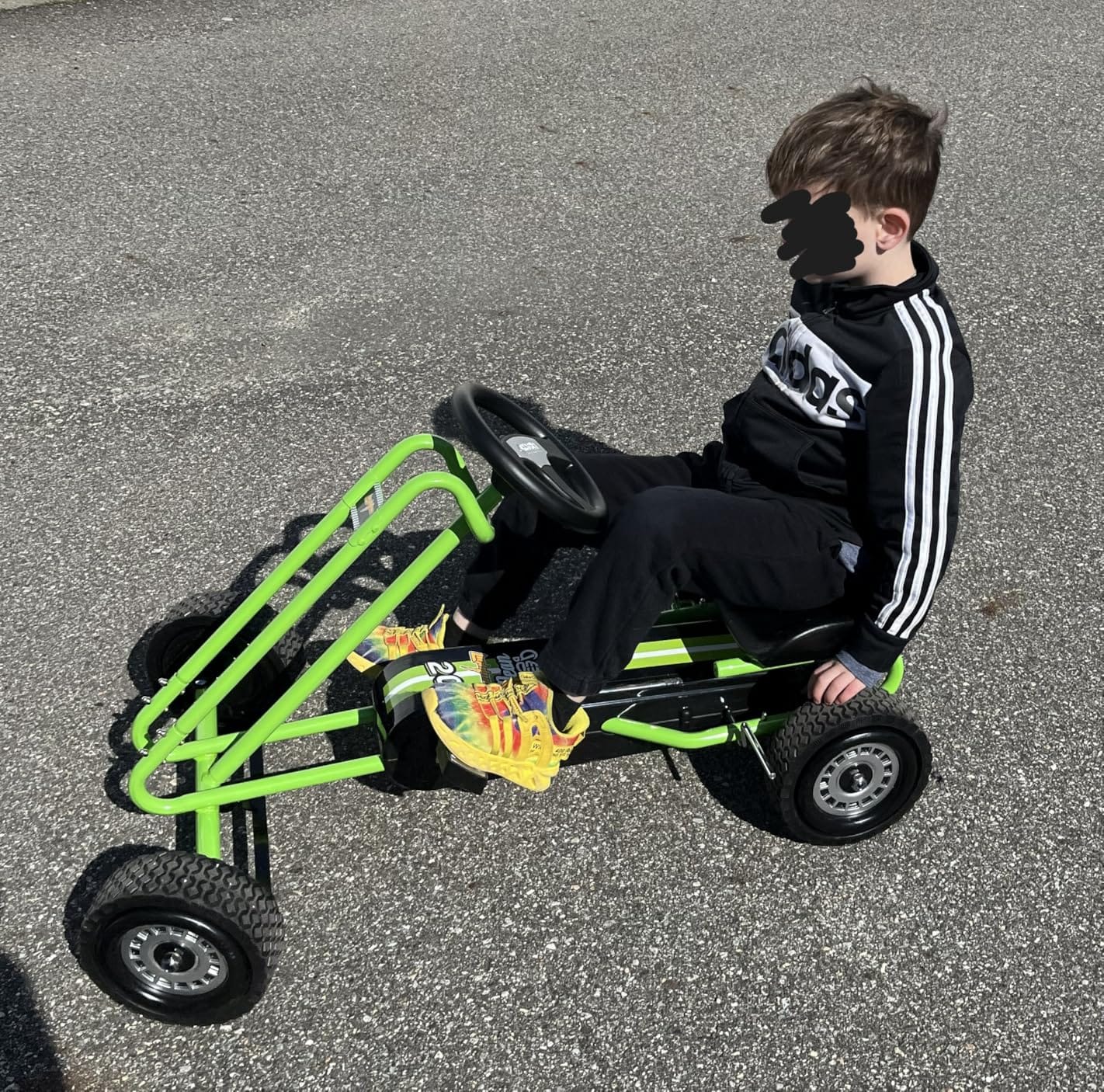
Where it earns its rating is build quality and simplicity. There is no battery, no wiring and nothing to charge, so the only thing that wears out is what the child puts into it. Assembly takes under an hour for most families, and the compact 38 by 21 by 22 inch footprint means it fits along a garage wall without taking a car space.
The limitation worth naming is gearing. Only one rear wheel is driven by the chain, and the pedal crank is short, so a taller child runs out of legroom and speed before the cart feels like it is really moving. It is a kart for pavement, brick patios and smooth concrete, not a vehicle for a lawn.
Who the hauck Lightning fits best
This suits a child roughly four to seven years old, which matches the 90 to 110 cm height band and the 110 lb ceiling the manufacturer states. That 110 lb ceiling leaves real growth room if your child is on the taller side for their age, and it is the highest weight rating among the four-wheel karts in this group that we could confirm from the listed specifications.
It is also the pick for a household with one rider, since the frame is narrow and the turning radius is wide. Plan the driving area accordingly: a driveway or a long paved path gives a much better experience than a small square of concrete.
Where the hauck Lightning falls short
If your backyard is lawn rather than paving, this is the wrong kart. Owners consistently report that it stalls in grass and dirt, and the hollow plastic steering column that flexes at the center does not inspire confidence on broken ground. A wide turning circle also makes tight indoor maneuvering frustrating.
For a child who is already nine or ten, the short pedal stroke will feel limiting long before the 110 lb rating is reached. Look at the YBIKE Explorer or the Aosom 5-12 kart instead, both of which are dimensioned for bigger riders.
2. hauck Batmobile Pedal Go Kart: Best Themed Pedal Go-Kart
hauck Batmobile Pedal Go Kart, Superhero Ride-On Car for Kids, Black
44 x 21 x 22 inch steel frame
Rubber wheels
77 lb max weight
Ages 4-8
Pros
- Sturdy frame that handles heavy play
- All bolts and wrenches included
- Curved adjustable seat
- Responsive steering
- Themed styling kids latch onto
Cons
- Snap-on front panel pops off in crashes
- 77 lb limit is below most rivals
- Rattles on pavement
Styling does more work than most buyers expect. A four-year-old who refuses a bicycle will often pedal a superhero kart for an hour straight, and that hour is worth more than any spec on the list. This kart puts the theme on a proven steel chassis with an adjustable bucket seat, so the appeal is not just decoration.
Construction is the same family as the Lightning, with alloy steel, rubber wheels and race-styled pedals. The curved seat supports a small back properly, and the steering is light enough for a four-year-old to turn at walking pace without getting stuck. Hardware for assembly arrives in the box, including the tools.
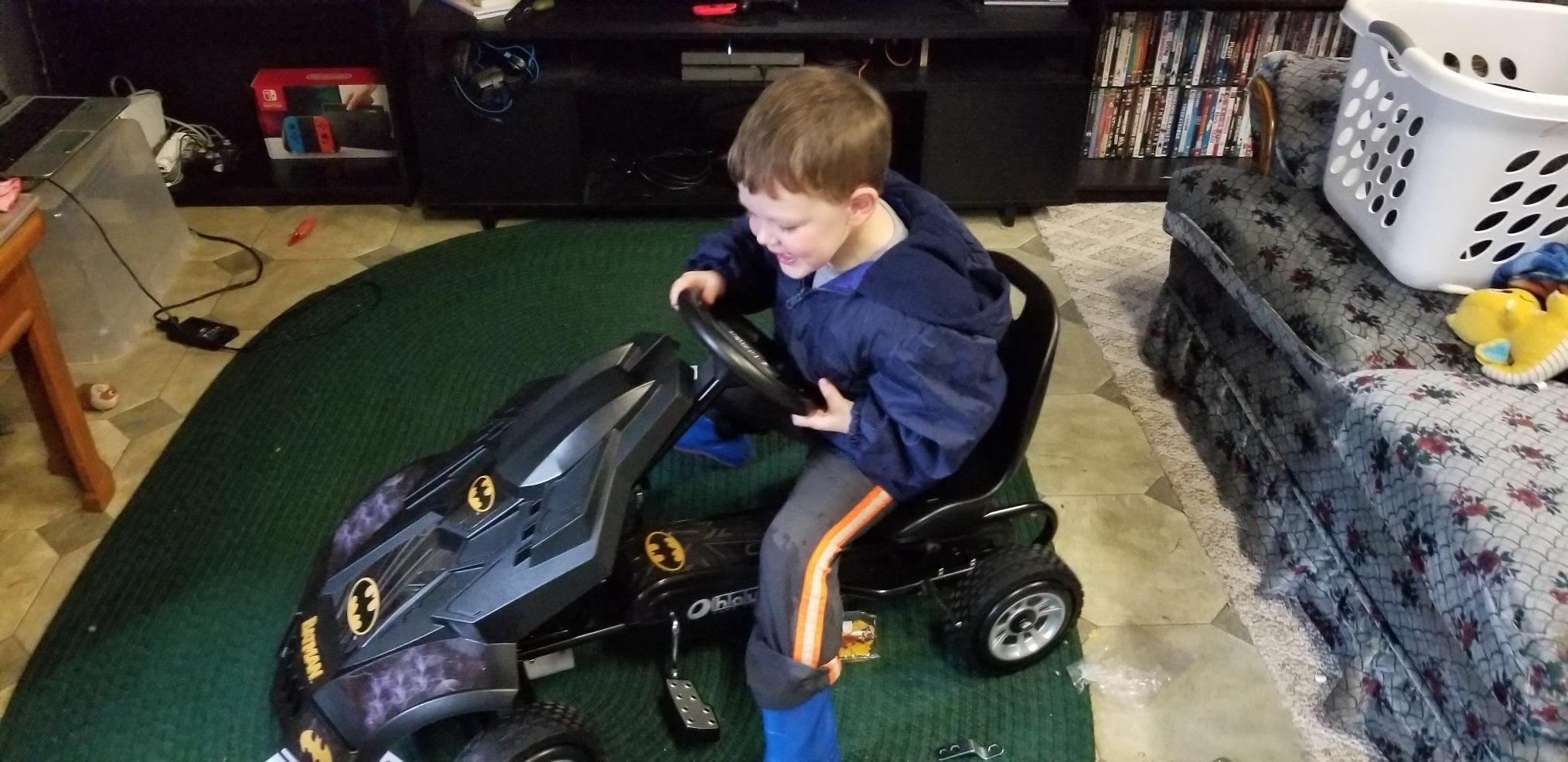
It measures 44 by 21 by 22 inches, which is a longer footprint than the Lightning and worth measuring before you buy. It carries a one-year warranty against manufacturer defects. On smooth surfaces the ride is quiet and controlled, and parents frequently describe it as the step that moved a child on from a tricycle toward a bicycle.
Repeated rough play is where it struggles. The front body panel is a snap-fit piece and it detaches on bumps and collisions, which means loose plastic panels rattling around a garage until you find the screws. On pavement the kart is also noticeably noisier than an open-frame kart.
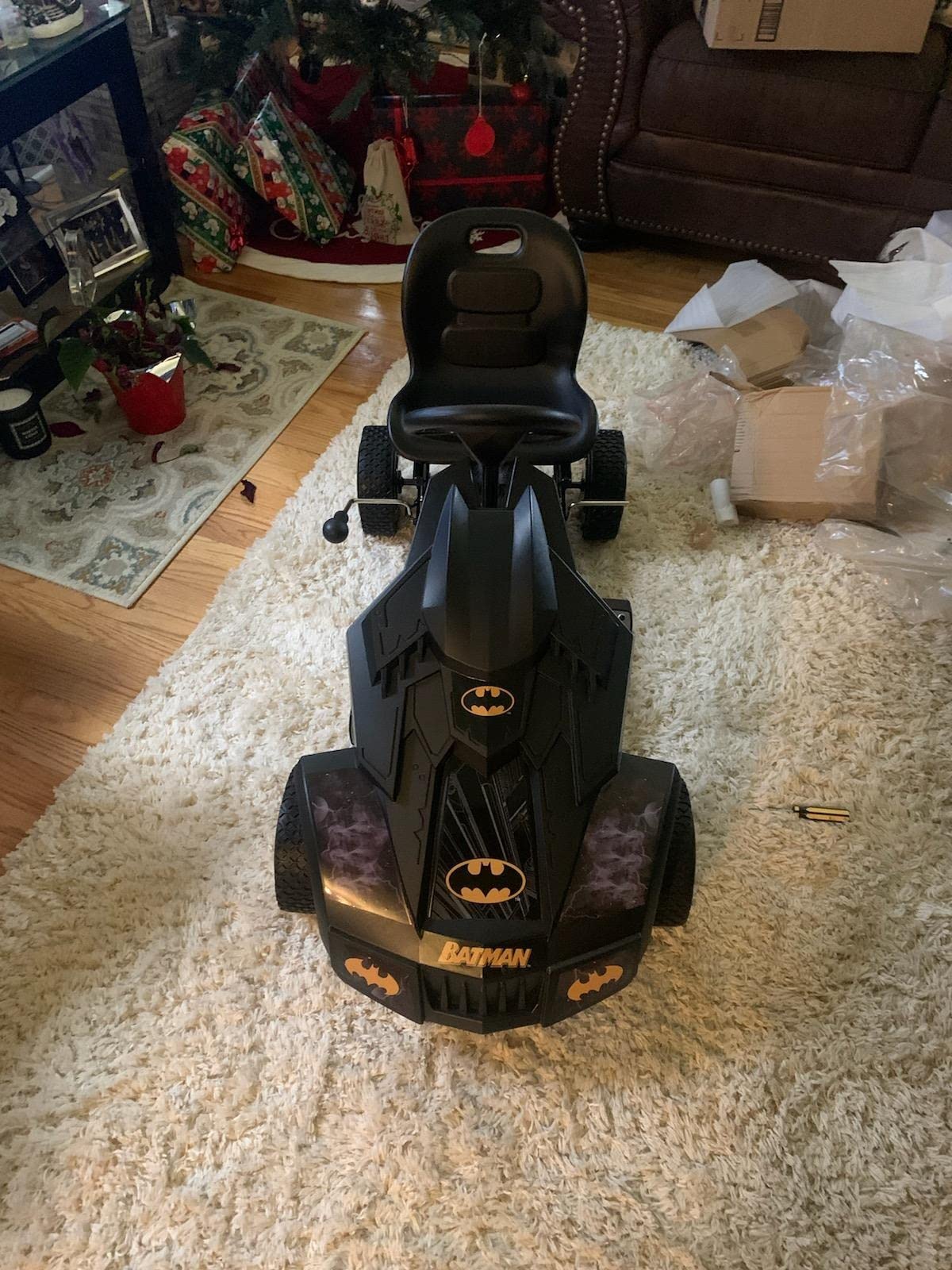
Who the hauck Batmobile suits
The stated range is 48 to 96 months, and the 77 lb weight limit lines up with that. It is a good birthday gift for a child aged four to six who is ready for a proper pedal kart but still wants the ride to feel like a character vehicle rather than a piece of sporting equipment.
It also works well as a sibling-to-younger-child handover, since the adjustable seat moves up as the first child grows out of it. Keep an eye on the snap-fit front panel if the kart is driven on anything rougher than a driveway.
Who should skip the hauck Batmobile
At 77 lb, the capacity is lower than the Lightning and several other karts here, so a big seven-year-old may outgrow the seat before the weight becomes an issue. Parents buying for a child who is already tall for their age should measure the seat-to-pedal distance first.
It is also not the kart for a lawn. The narrow track and light frame are tuned for pavement and patio, and a themed kart in the grass mostly collects clippings in the footwell. Consider a swing-axle model for mixed surfaces.
3. hauck Hurricane Pedal Go Kart: Best for Stable, Confident Riding
hauck Kids Pedal Go Kart, Hurricane 4 Wheel Bike Cart, Ages 4-10, Red
47.6 x 21.9 x 28.3 inch frame
Three seat positions
Rubber wheels
28 lb weight
Pros
- Solid and stable at speed
- Low centre of gravity aids balance
- Rubber wheels grip and wear slowly
- Three seat positions
- Pedal power means no play-time limit
Cons
- Rear axle drives only the right wheel
- Seat range may not suit a small 3-year-old
- Unclear instructions
- 40 minute assembly
This is one of the longest and heaviest karts in the group and it feels that way from the moment you lift it. At nearly 48 inches long and 28 lb, the Hurricane sits low and wide, and the resulting centre of gravity is noticeably calmer than anything else in this roundup. For a child who is cautious on a bicycle, that stability is the entire selling point.
Rubber wheels grip well and, according to owners, wear slowly, which matters if the kart lives outside. The rims carry two bearings each, a small detail that shows up as a smoother, quieter roll a year later. Three seat positions give more growth room than the two-position karts at the same age.
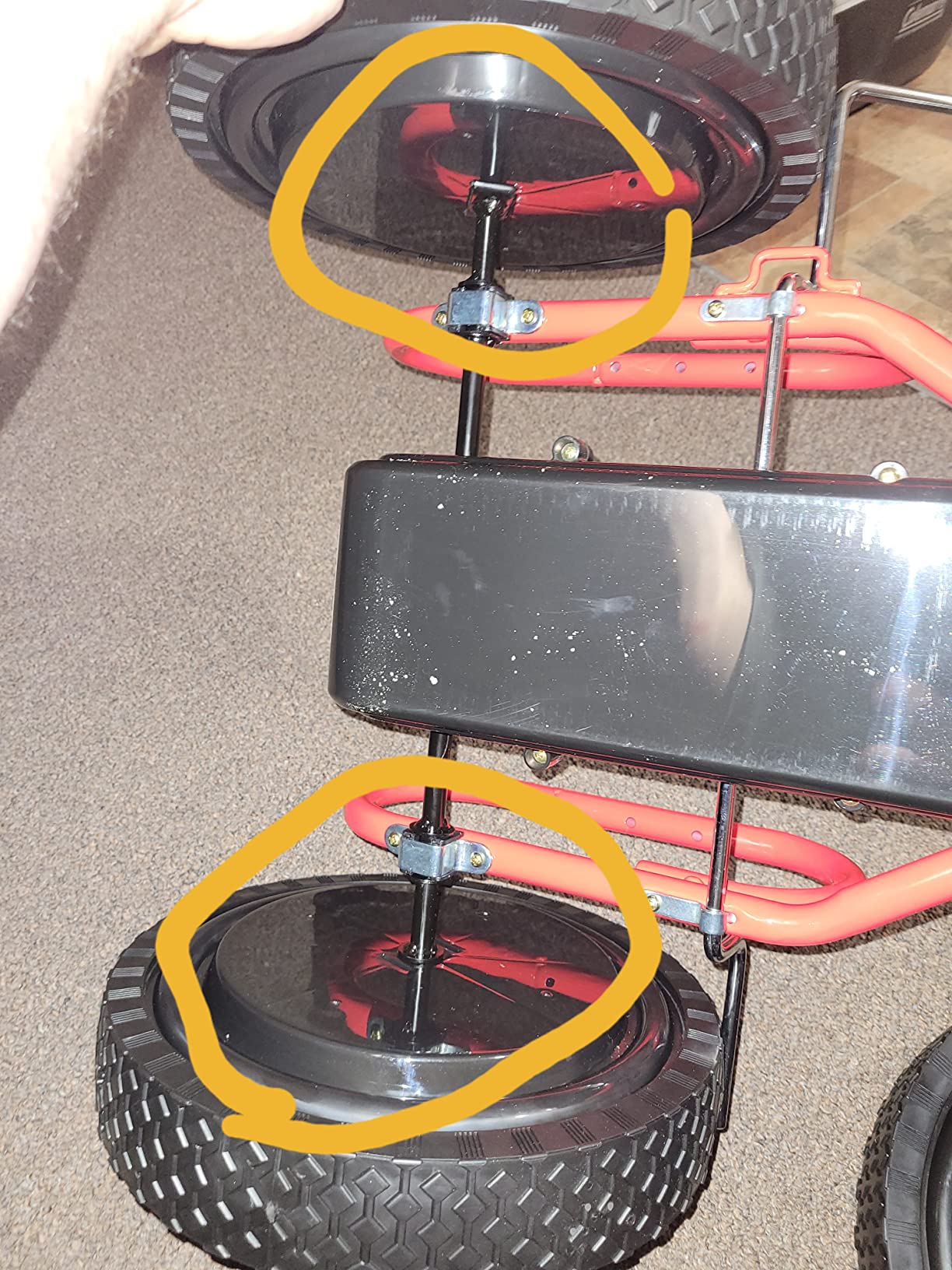
Because it is pedal-powered, there is no runtime ceiling and no charging cable, and the whole family understands the controls in about five minutes. The advanced handbrake system is easy for small hands to reach from the seat. The instructions are the weak point; budget closer to 40 minutes for the build rather than 20.
The trade-off for all that size is a one-wheel drive rear axle. The chain moves only the right rear wheel, which is fine on a flat driveway and frustrating over cracks, expansion joints or uneven paving where a one-wheel-drive kart tries to veer. The front seat position also does not extend far enough forward for the smallest riders.
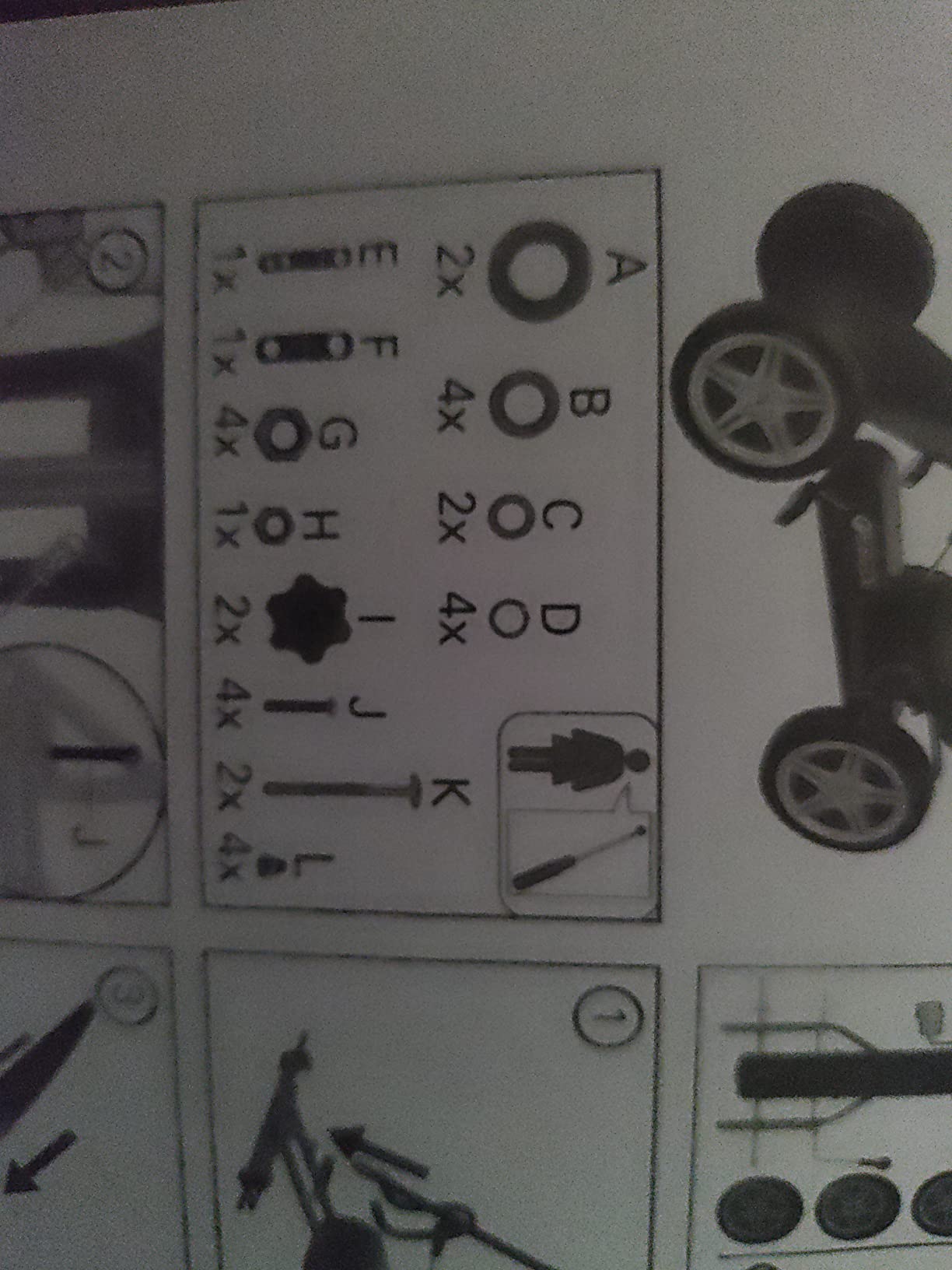
Why the hauck Hurricane earns its place
Parents gravitate here when the child is heavy-footed, cautious or slightly uncoordinated, and a wider, heavier frame settles the nerves. The three seat positions cover roughly ages four to eight, matching the 48 to 96 month range the manufacturer lists, and the 28 lb weight means it will not tip when a child leans hard into a turn.
It is also a good match for a family with several children taking turns, because the seat resets quickly between riders. Rubber tires and a steel frame are the combination most likely to still be running several years from now.
Where the Hurricane will disappoint
Storage is the first real drawback. At 47.6 by 21.9 by 28.3 inches this is one of the bulkiest karts here, and it needs a genuine corner of a garage rather than a space beside the recycling bins. Parents in small garages should measure before committing.
The one-wheel-drive axle and the limited front seat position are the other two. If your surface is a patched driveway with weeds in the cracks, or your child is a very small four-year-old, this kart will ask more patience than the Lightning or the Aosom swing-axle model.
4. Costzon 40 Inch Off-Road Pedal Go Kart: Best for Driveway Racing
Costzon Go Kart for Kids, 4 Wheel Off-Road Pedal Go Cart w/Adjustable Seat, 2 Safety Brakes, EVA Rubber Tires, Ride-On Toys for Boys Girls, Outdoor Racer Pedal Car (Red, 40″ L x 24”W x 24.5”H)
40 x 24 x 24.5 inch metal frame
66 lb max weight
Ages 3-8
Two safety brakes
Pros
- Roughly 30 minute assembly
- Metal frame with ergonomic backrest
- Two-position seat covers ages 3-8
- Decals pre-applied
- Drives smoothly on pavement
Cons
- Advertised rubber tires are mostly plastic
- Poor on grass and gravel
- Instructions have mismatched holes
This is the mainstream middle of the market: a 40 inch long metal-frame kart with a wide two-position seat, sold on the promise of off-road capability. On a driveway it delivers. It is stable, the pedals feel solid under an older child, and the hand brake beside the seat stops it quickly on hard surfaces.
The gear lever on the chain guard is a genuinely useful detail. It switches between forward drive and neutral, and neutral is what you use for a stationary play session or for coasting down a gentle slope without the chain grabbing. That single feature is worth more than most of the styling accessories on carts at twice the size.
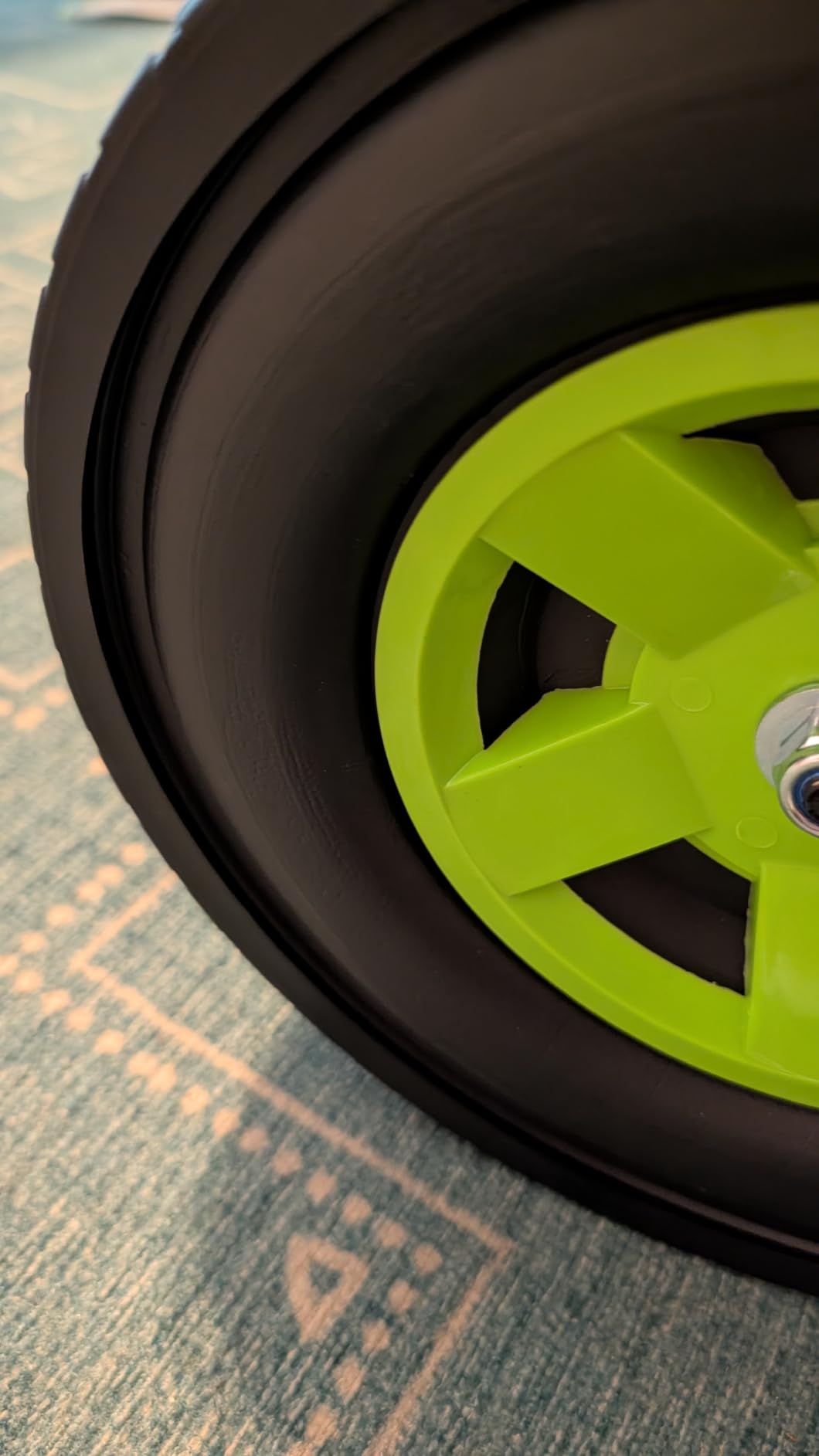
Assembly is quick, most owners putting it together in about half an hour, and the decals are pre-applied so there is no paint step. The frame is metal with polypropylene body panels, and the two-position seat with a backrest is more comfortable for a three-year-old than the flat benches on cheaper carts. At 20 lb it is still light enough for one parent to move.
The word off-road is doing too much work in this product’s marketing. The wheels are largely plastic with a thin rubber strip, and owners report the kart performs poorly on grass, dirt and gravel. Short pedal arms and limited gearing also make any slope a struggle. Treat it as a paved-surface kart.
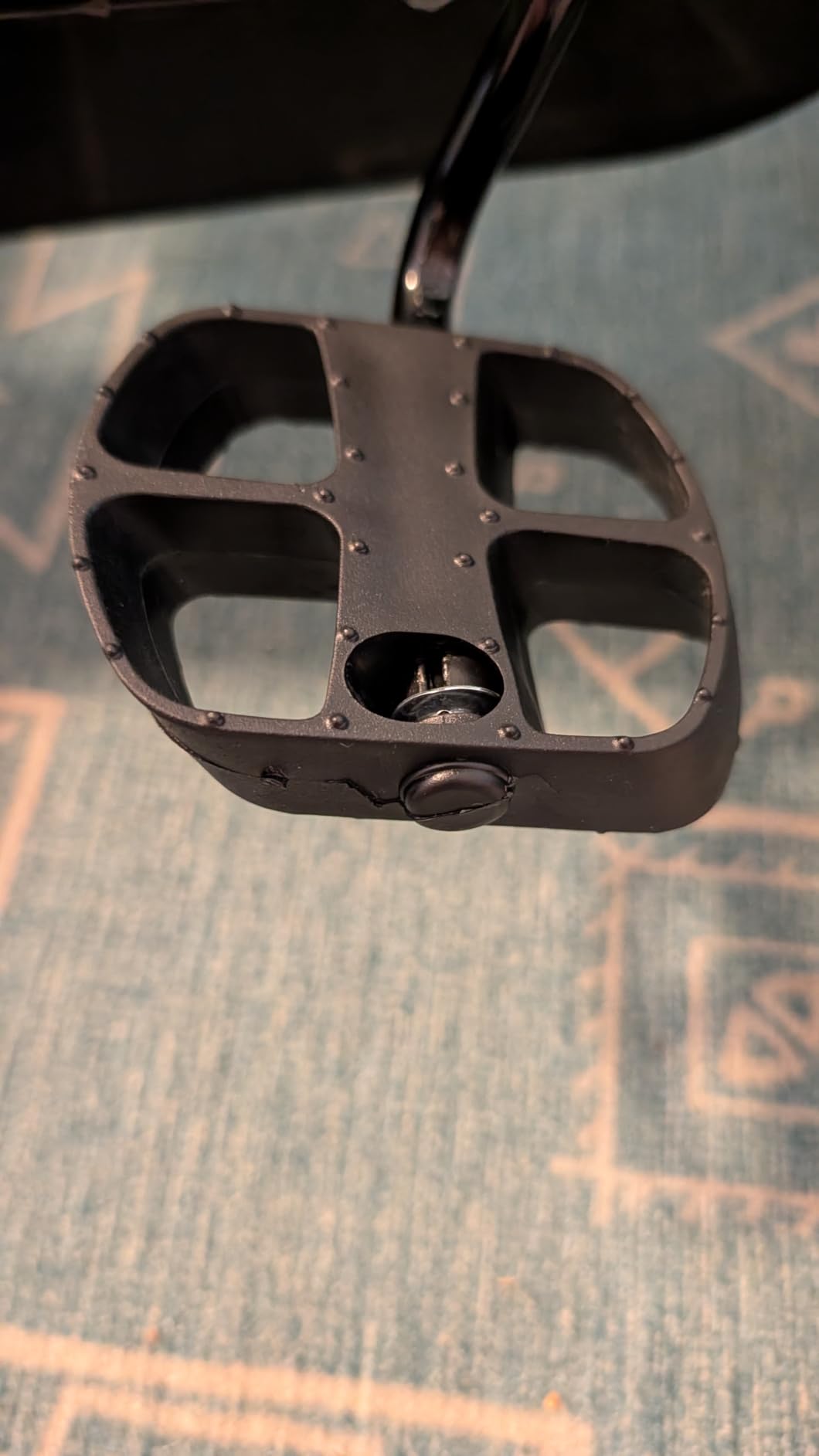
Best for ages 3 to 8 on hard surfaces
The stated range runs 36 months to 8 years with a 66 lb ceiling, and the two-position seat is what makes that range honest. It suits a family that uses the driveway as a race circuit, or a paved patio behind a house, where a long straight line and a hand brake are all a child needs to feel fast.
It is also one of the few carts here that moves both forward and backward, which saves a lot of frustration for a three-year-old who gets wedged against a wall. No batteries means no charging ritual before outdoor play.
Not for rough ground or bigger children
If your idea of backyard play involves lawn, gravel or a slope, skip this one. The plastic-dominant wheels and short pedal arms make anything but a hard surface a struggle, and 66 lb is a modest ceiling for an eight-year-old.
Owners also flag the assembly instructions, where several holes in the diagrams do not line up with the frame. Budget extra time, and if your child is a larger five-year-old, the 40 inch length is short enough that knees may start hitting the deck. The YBIKE Explorer covers a much wider age span.
5. Little Tikes Jett Car Racer: Best Steering for Small Hands
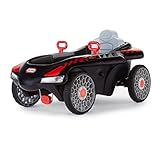
Little Tikes Jett Car Racer Black, Ride On Car with Adjustable Seat Back, Dual Handle Rear Wheel Steering, Racing Control, Kid Powered Fun, Great Gift for Kids, Toys for Girls Boys Ages 3-10 Years
39.5 x 25.75 x 13.75 inch
Molded plastic body
69 lb max weight
Ages 3-10
Pros
- Dual-handle rear-wheel steering
- Seat back adjusts for ages 3-10
- No batteries
- Off-road style tires
- Recognizable mainline brand
Cons
- All-plastic build lacks metal durability
- 10 percent one-star review share
- Seat adjusts on one axis only
Almost every kart on the market steers through a wheel or handlebar at the front. This one steers the rear wheel with two handles, one either side of the child’s hands, and that single design decision is why it earns a place on this list. Two small hands have far less leverage on a narrow steering column than one pair on a wide handlebar.
The seat back adjusts rather than the whole seat, extending the useful range from 3 to 10 years. That is a wider age span than most of the karts here, and it is a plastic body rather than steel, so it is lighter to move and cheaper to live with when a wheel finally cracks.
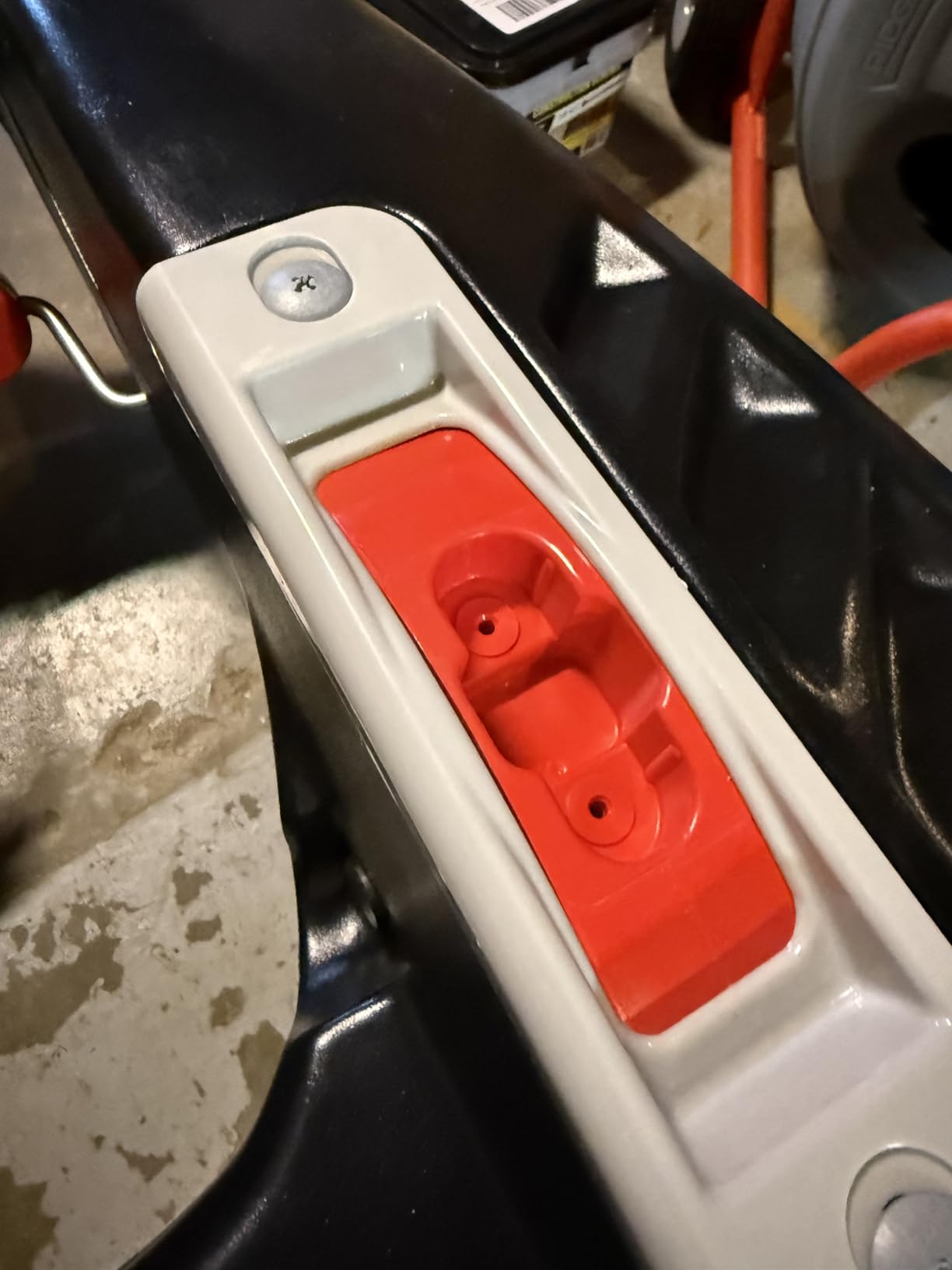
The tires are moulded in a rugged off-road profile, which handles a patio edge or a boardwalk better than smooth plastic wheels. Kids control the speed entirely themselves, there is no chain to oil, and the whole thing stores against a wall in a footprint of 39.5 by 25.75 inches.
Durability is the reservation, and it is a real one. This is a plastic kart in a category where metal frames are the norm, and the listing shows 10 percent one-star reviews, with durability the main theme among them. The rear-wheel steering also behaves unlike a front-steer kart and needs a few sessions of practice before a child stops over-correcting.
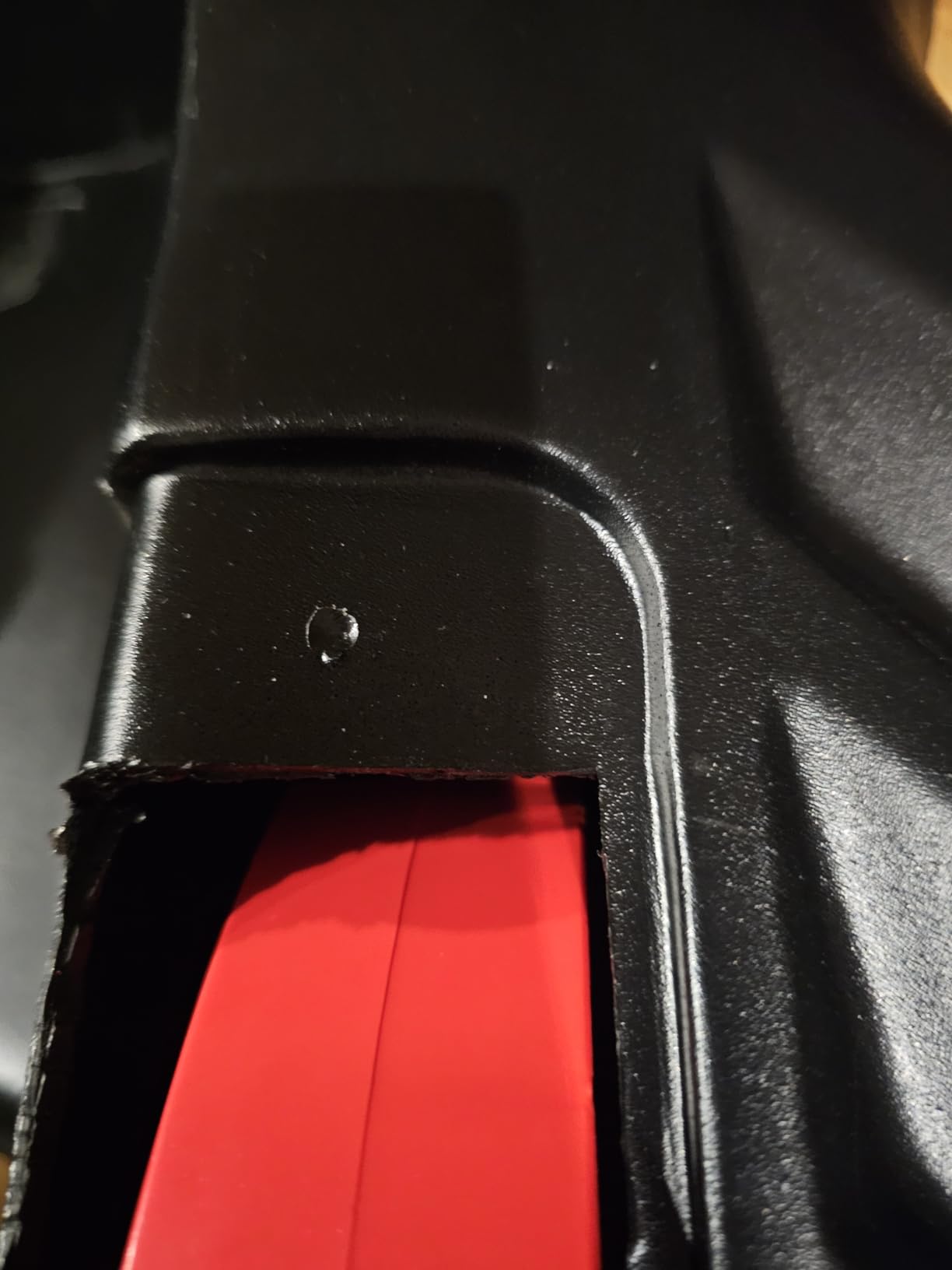
Where the Jett Car Racer works well
It is a good fit for a child aged three to six in a small space, where the tight steering radius of rear-wheel steering is an advantage. A narrow side path, a balcony terrace or a patch of concrete behind a garage will all be navigable in a way a full-size kart is not.
Parents of children who tire quickly of one toy also report well here, because the racer styling and the two-handle cockpit hold attention. The three to 10 year seat adjustment means it can follow a child from a first ride up to early school years.
When to buy a metal kart instead
If the cart will live outdoors through a full season of hard use, or if a sibling is likely to inherit it, a steel frame is the safer long-term bet. Plastic bodies on this style of racer can crack around the mounting points after repeated bumps, and the 69 lb weight limit is modest for an older child.
The one-dimensional seat adjustment also means you cannot compensate for a child with a long torso the way you can on a sliding-seat kart. Measure before you commit, and if the child is already near the top of the age range, choose a kart with a proper capacity rating.
6. Costzon 36 Inch Pedal Go Kart: Best Budget Pedal Cart
Costzon Go Kart for Kids, 4 Wheel Pedal Powered Go Cart with Adjustable Seat, Handbrake & Non-Slip Wheels, Outdoor Racer Ride On Pedal Car, Gift for Boys Girls (Red)
36 x 20 x 21 inch
13 lb frame
66 lb max weight
Ages 3-8
Pros
- Only 13 lb
- the lightest frame here
- Two-position seat with backrest
- Handbrake stops predictably
- Anti-slip strips grip asphalt and cement
- Fully enclosed chain box
Cons
- 4.0 rating with 11 percent one-star reviews
- Non-inflatable plastic wheels
- Thin-gauge iron frame
- 66 lb suits younger children only
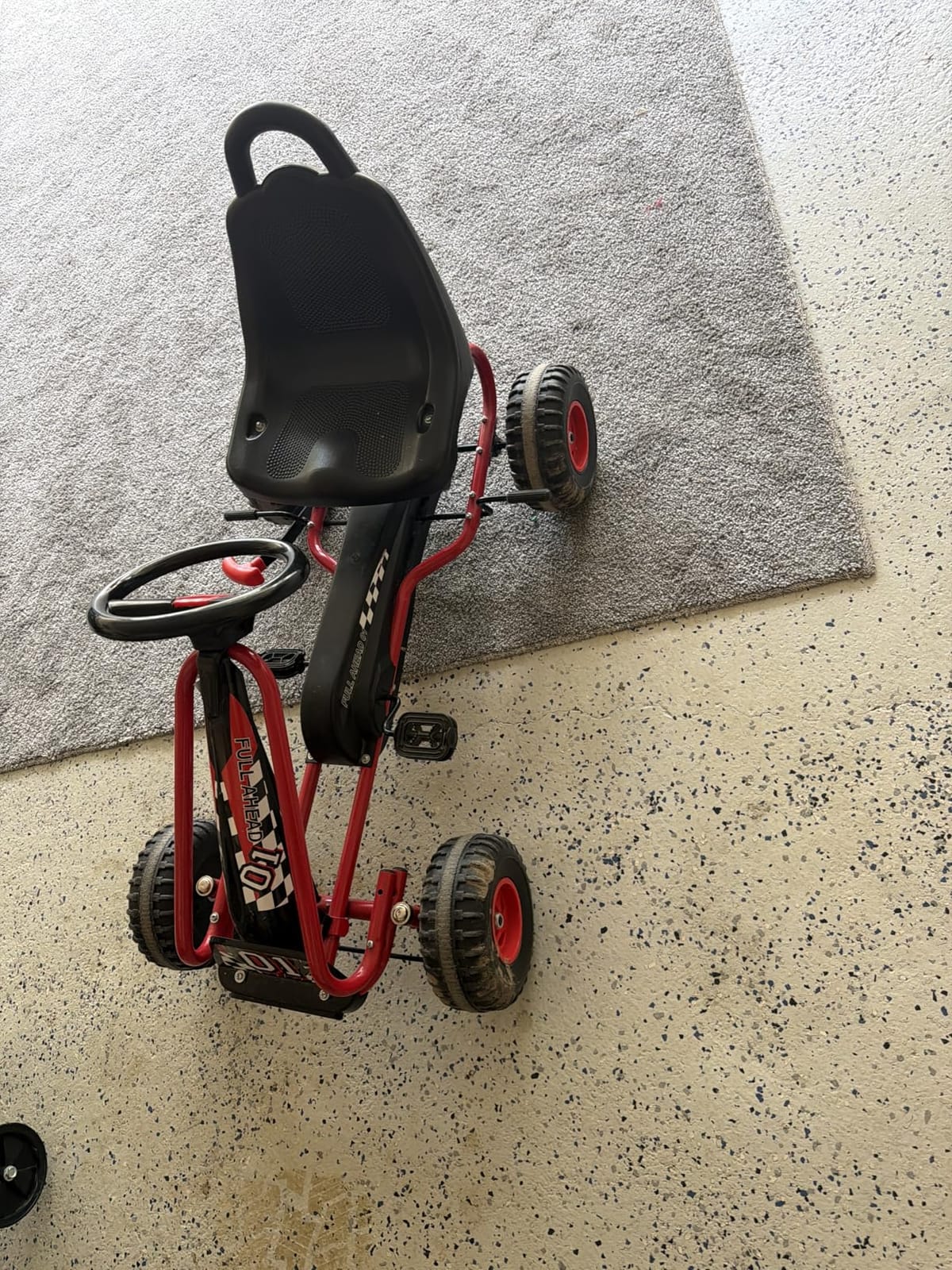
At 13 lb this is the cart a parent can carry up a flight of stairs or reposition across a lawn single-handed, and that changes what you will actually use it for. The smaller the cart, the more often it gets used, and the other 20 lb to 30 lb metal karts tend to end up in the garage after the first week.
The engineering priorities are sensible. The chain sits inside a fully enclosed box that protects small fingers without a separate guard, the handbrake pulls cleanly, and the anti-slip strips molded into the non-inflation wheels give real grip on asphalt, cement and boardwalk. No battery, no wiring, nothing to charge.
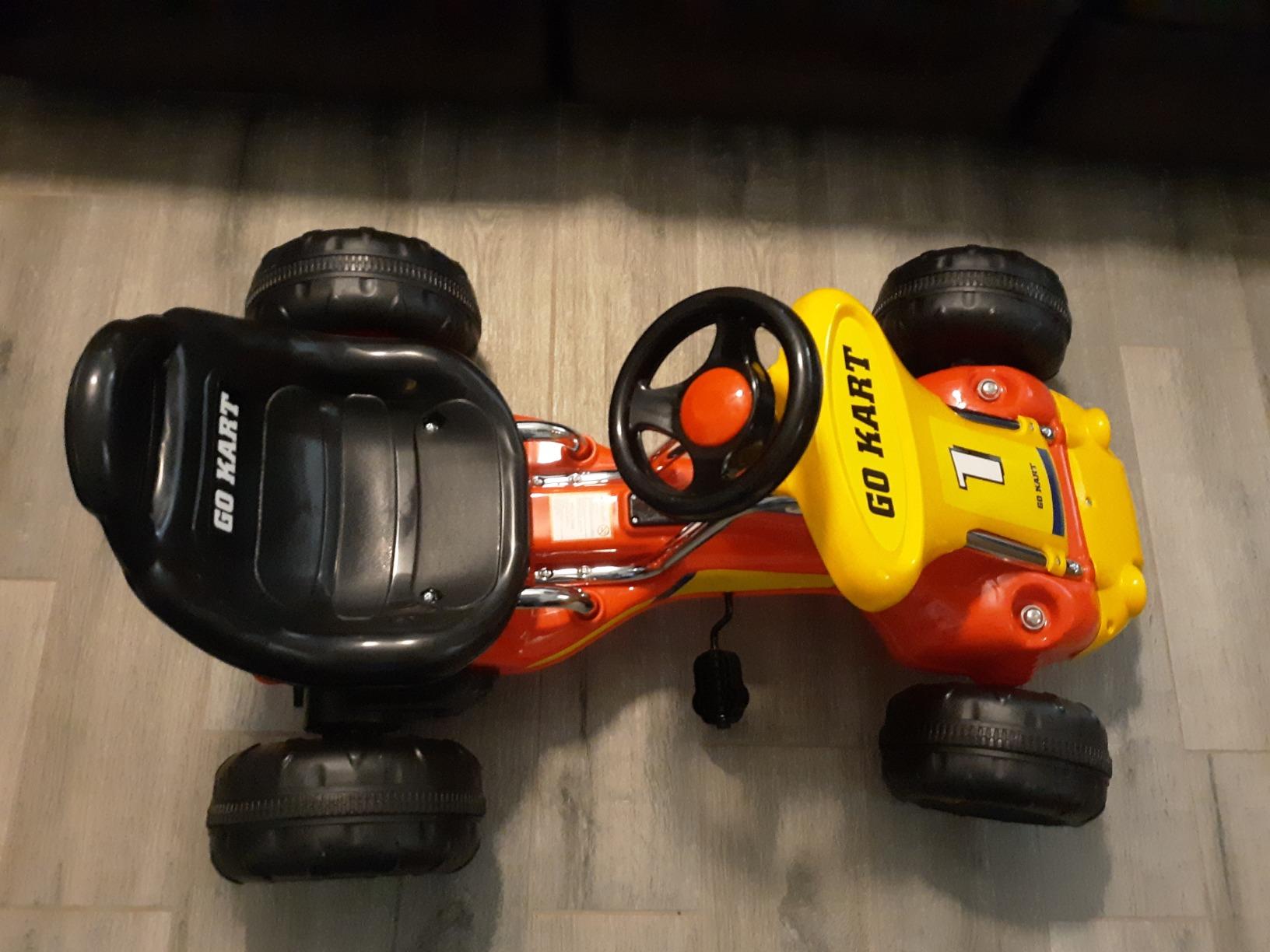
The two-position adjustable seat has a proper backrest, which is rare at this level and stops a small child sliding out under acceleration. Assembly is straightforward, and the compact 36 by 20 by 21 inch footprint means it disappears into a garage corner between trips out.
Ratings here cluster tightly, with several karts sitting at 4.0 stars, and this one carries about 11 percent one-star feedback. The honest weaknesses are a thin-gauge iron frame, polypropylene body and rigid plastic wheels that give no cushioning over bumps. Some buyers also report inconsistent finish and hardware quality between units.
Who gets the most out of the budget cart
A child aged three to six, riding on a driveway, patio or pavement, with a parent who wants something they can move without help. At 66 lb the ceiling is fine for that age group and low enough that you will not have to worry about a heavier sibling overloading the frame.
It also suits a flat-pack-friendly household. The enclosed chain box means there is no exposed mechanism to check, and a toddler cannot get fingers into the drive train. For a first pedal cart, it does the basics well.
When it is the wrong choice
If the kart will spend its life on grass, the non-inflation wheels will not grip and the light frame will bog down in the first soft patch. Rigid wheels also transmit every expansion joint and paving stone straight into the child’s spine.
For a child who is going to keep this for years, a heavier steel kart with rubber wheels will survive longer even though it costs more and weighs more. Treat this one as a first season purchase rather than a hand-me-down.
7. HONEY JOY Pedal Go Kart: Best Safety Features for Ages 3-8
HONEY JOY Pedal Go Kart, 4 Wheeler Toddler Racing Ride On Pedal Car Toy, Forward/Backward, Ergonomic Seat, Handbrake, Steering Wheel, Outdoor Off-Road Go Cart for Kids, Boys Girls Gift (Pink)
37.4 x 26 x 25.5 inch
77 lb max weight
Ages 3-8
ASTM and CPSIA compliant
Pros
- Two control modes including a freewheel clutch
- Low centre of gravity and safety angle limit
- Enclosed chain guard
- Two-position seat with backrest
- Certified to ASTM and CPSIA
Cons
- Off-road claims overstate capability
- Seat position hard to change after assembly
- Short pedal crank
- Wheels are thin rubber over plastic
This kart is built around two ideas that rarely appear together: a clutch that changes how the pedals behave, and a frame geometry designed to be hard to tip. The handbrake is responsive, and the low centre of gravity with a safety angle limit is easy to see in the way the kart stays planted when a child leans into a turn.
The control modes are the standout. One is a normal pedal clutch for driving. The other is a freewheel clutch that locks the pedals so the cart can be coasted or used as a stationary play object, which means a child can sit on it in a garage or on a patio without the pedals turning under their feet.
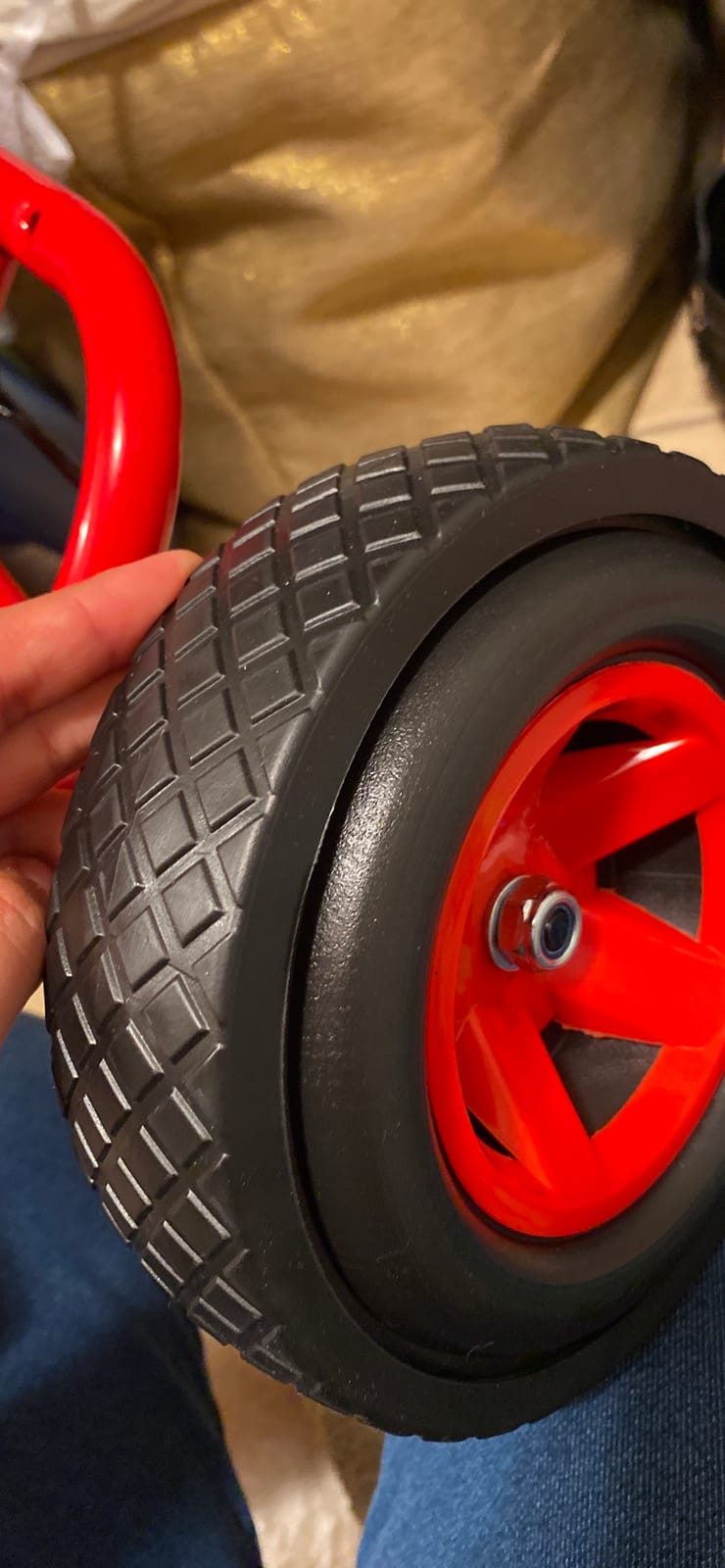
The chain is fully enclosed behind a guard, the seat is a two-position unit with a supportive backrest, and the product is listed as complying with ASTM and CPSIA standards. At 37.4 by 26 by 25.5 inches it is a compact footprint, and the wear-resistant wheels are specified for asphalt, brick, wooden floors and short grass.
As with most karts at this level, the wheel reality is a thin rubber strip over moulded plastic, and the off-road language in the listing overstates what it does. The short pedal crank limits leverage for taller children, and one practical snag is that the seat position is easiest to set correctly at assembly and awkward to change afterwards.
Best for a cautious or younger rider
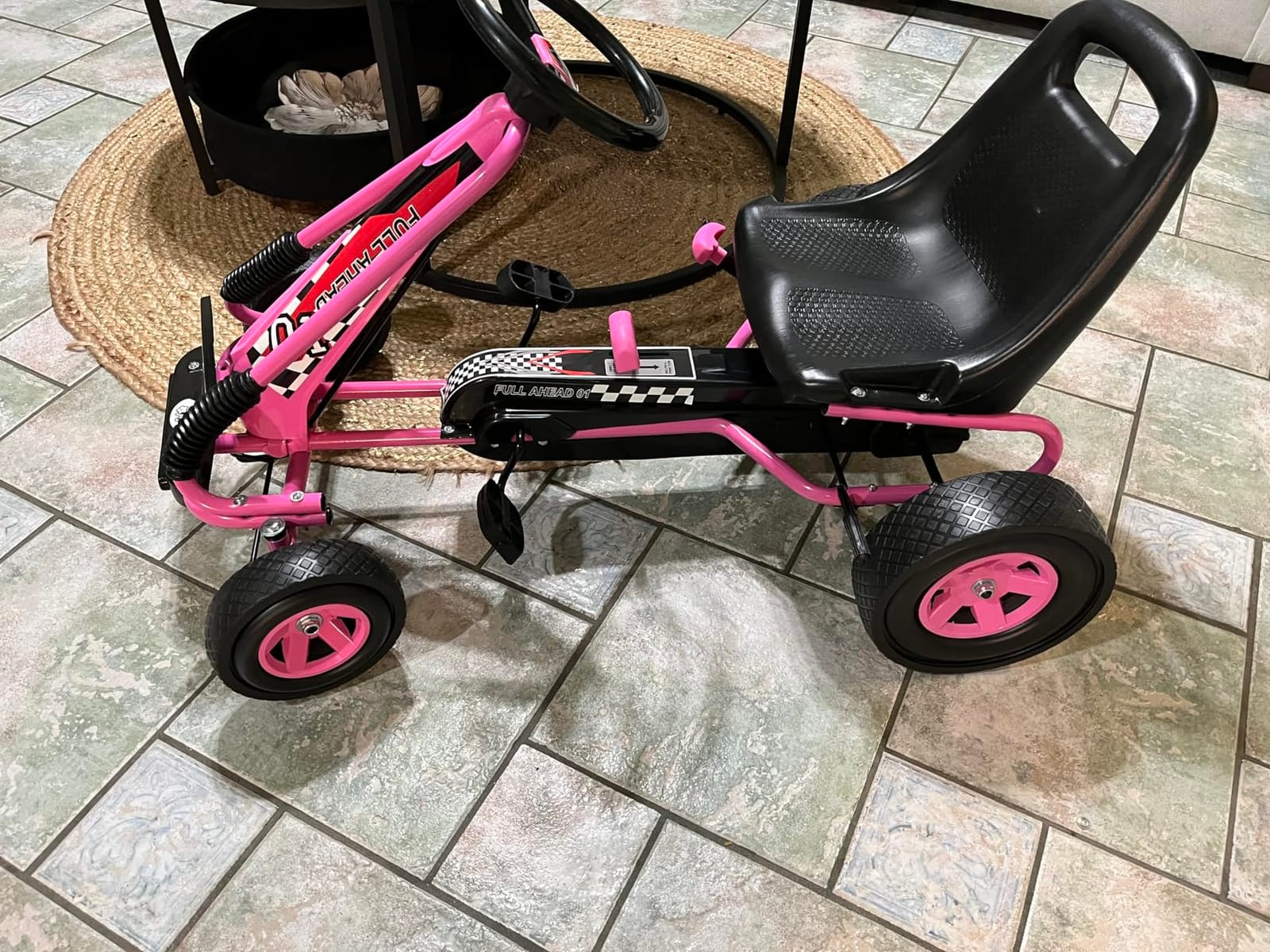
The 77 lb limit suits a child from three up to about eight, and the stability geometry is a genuine benefit for a rider who is still building balance. Parents who ask about safety hardware first tend to land here, because the enclosed chain guard, the handbrake and the certification marks are all present rather than implied.
It is also a good indoor or semi-indoor option, since the freewheel mode lets a child ride on a wooden floor or in a garage without the pedals spinning. The declared surfaces include brick and asphalt, which covers most suburban driveways.
Where the two-mode clutch is not enough
If your child is eight or older, the short pedal crank will feel cramped before the 77 lb rating is reached. For that age range, a kart with a longer frame and a multi-position seat gives more room to grow.
On grass and gravel, the thin wheels are the limit, not the frame. Keep it on hard surfaces and it will hold up well; put it on a lawn and the drive will bog down in the first few rotations.
8. YBIKE Explorer Pedal Car: Best for Bigger Riders
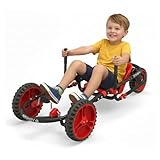
YBIKE Explorer Pedal Car – 3-Wheel Go Kart for Kids, Ride On Toys for Girls and Boys, Ages 4 & Up, Steer with Handles, Adjustable Frame & Seat, Up to 155 lbs, Red & Black
51.6 x 24.4 x 17.7 inch aluminum frame
155 lb max weight
Ages 5-12
Pros
- Rated up to 155 lb
- Adjustable frame and seat span ages 4-12
- 20 lb aluminum frame is light for a parent
- Puncture-proof tires
- Three-wheel stability
Cons
- Wide turning circle
- Front pedal shaft bushings can be tight
- Plastic seat can crack in prolonged sun
- Tires not readily replaced
This is the answer to the most common version of the question parents ask after the search results fail them: what do you buy for a child who is too big for a toddler kart but nowhere near ready to stop riding. The 155 lb rating is more than double what most four-wheel pedal karts in this roundup support, and nothing else here comes close.
It is also the only three-wheeler. Three wheels mean a very low centre of gravity and a wide stance, which is why it appeals to parents of children with balance or coordination challenges who find a two-wheeler difficult. Steering is handled by two rear wheels under lever control, and the whole frame extends as the child grows.
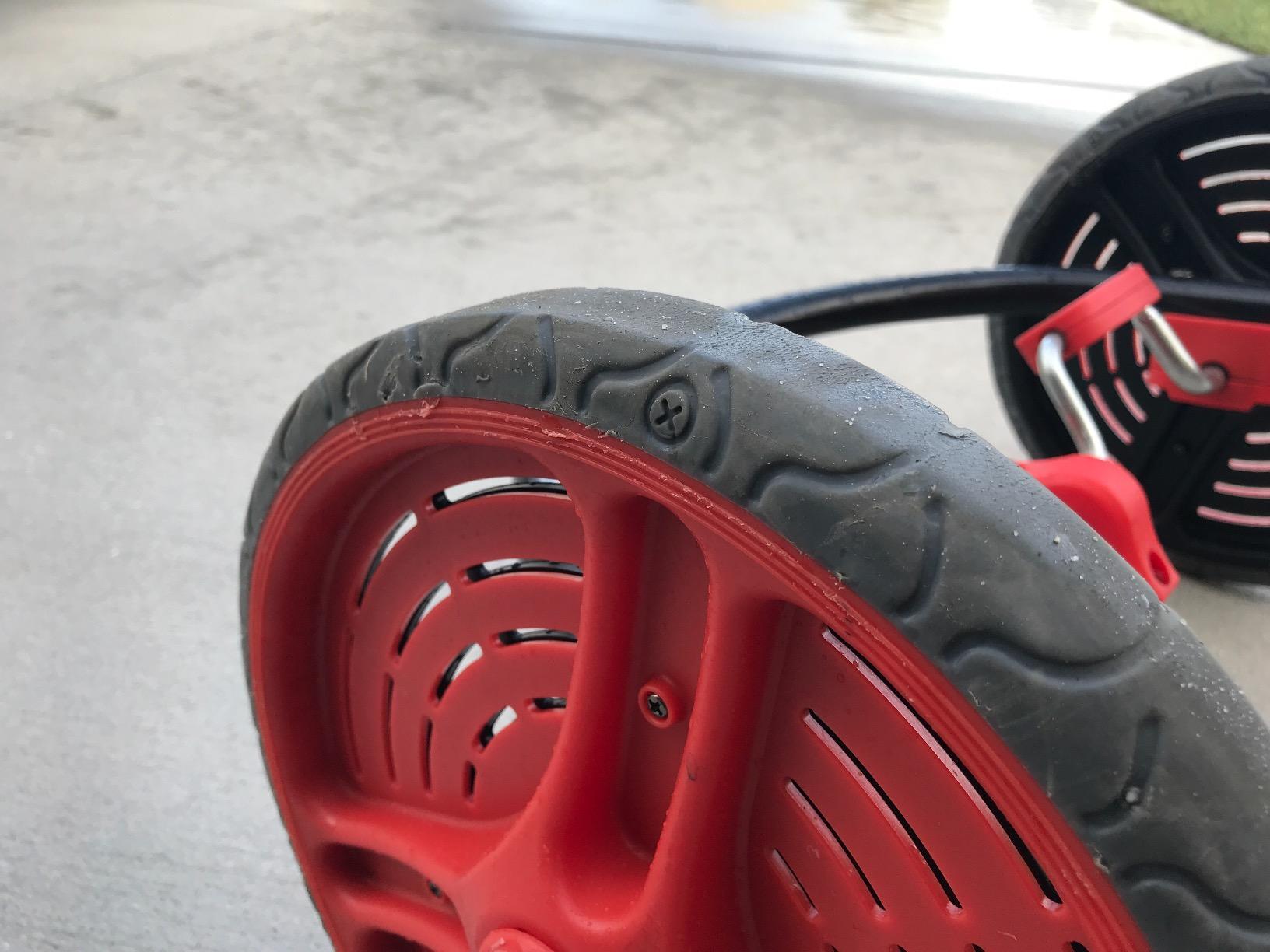
Adjustable seat and frame extension bars let a single cart span roughly ages 4 to 12, which is a genuine hand-me-down candidate. The aluminum frame weighs 20 lb, so a parent can still reposition it, and the TPR tires are puncture-proof, removing the flat tyre problem entirely. No batteries are involved at any point.
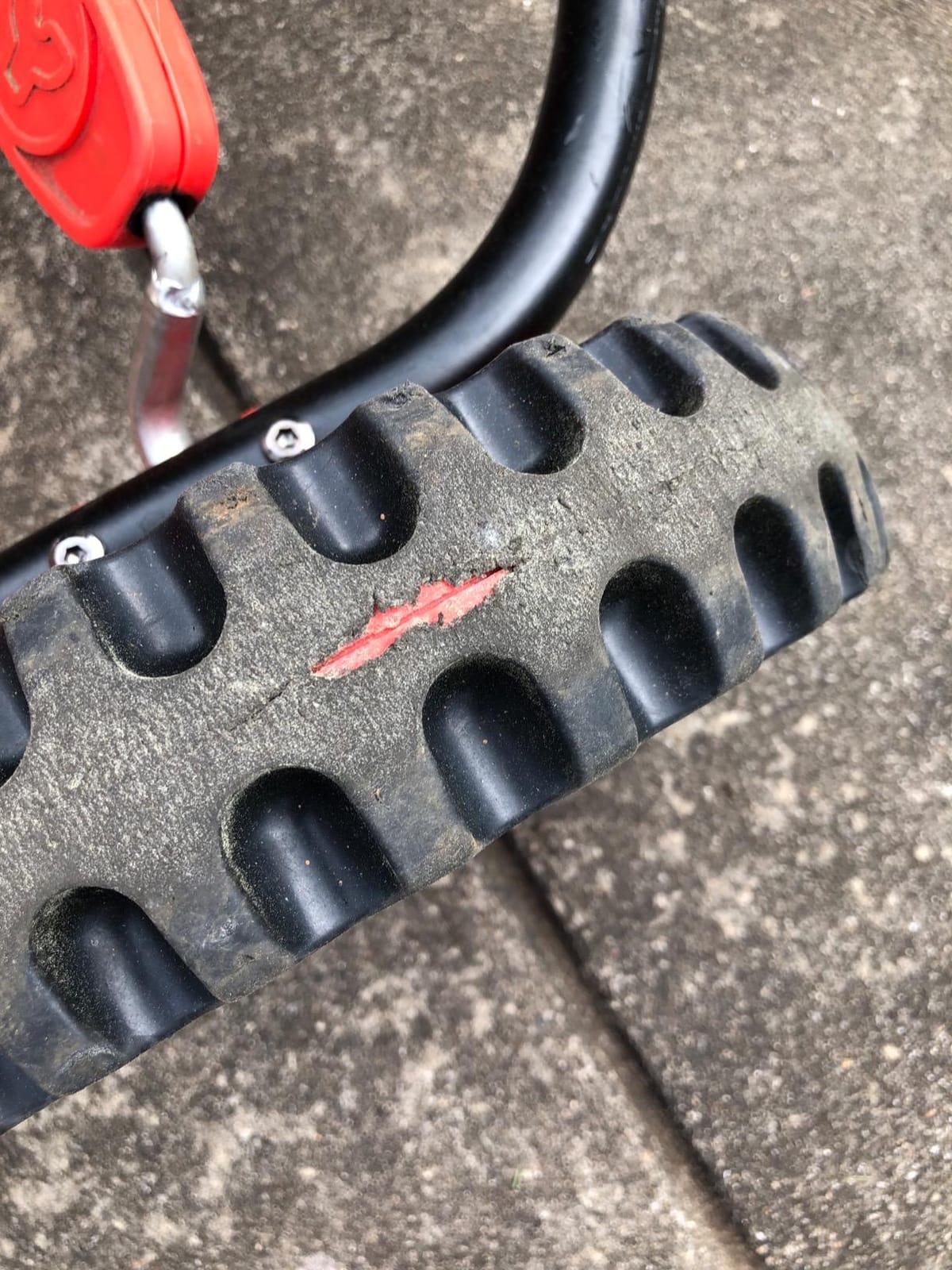
The trade-offs are real. At 51.6 inches long, the turning circle is poor, and in tight spaces a child may need to lift the car to turn it. The plastic seat can become brittle after prolonged sun exposure, and replacement tires are not easy to source if a wheel eventually splits.
Why the 155 lb rating changes the decision
Most pedal karts top out between 60 and 80 lb, which a child reaches somewhere around age seven or eight. This one is built to carry an older child, a teenager or an adult on the same machine, and the adjustable frame is what makes that credible rather than theoretical.
It is the pick for a family with a wide age gap in riders, for a child who is big for their age, or for anyone who wants one cart to last a decade. The three-wheel layout also gives a nervous rider a stable base that no four-wheel kart matches.
Where the Explorer falls short
The width is the issue in a normal suburban driveway that doubles as parking. A 51.6 inch turning circle means U-turns are wide and parking requires a bit of planning, and the front pedal shaft bushings can feel tight for a small child adding leverage.
Material longevity is also mixed compared to a solid steel kart. A sun-exposed plastic seat and a reported metal wheel mount failure are worth weighing against the 155 lb advantage. Park it in the shade if you can.
9. Kid Trax Classic Pink Pedal Car: Best Pedal Car for Ages 3-5
Kid Trax Classic Pink Pedal Car for Girls, Ages 3-5, Durable Steel, 60lbs Max, Easy Assemble, Indoor/Outdoor Ride-On Toy, Toddler Ride-On, Vintage Style, Rubber Tires, Functional Steering
34.65 x 15.75 x 20.87 inch
Alloy steel body
60 lb max weight
Ages 3-5
Pros
- Durable steel construction
- Premium rubber tires with chrome hubcaps
- Functional responsive steering
- Vintage styling for role play
- Rated for ages 3-5
Cons
- Limited to the youngest riders
- Assembly required
- Low 60 lb weight limit
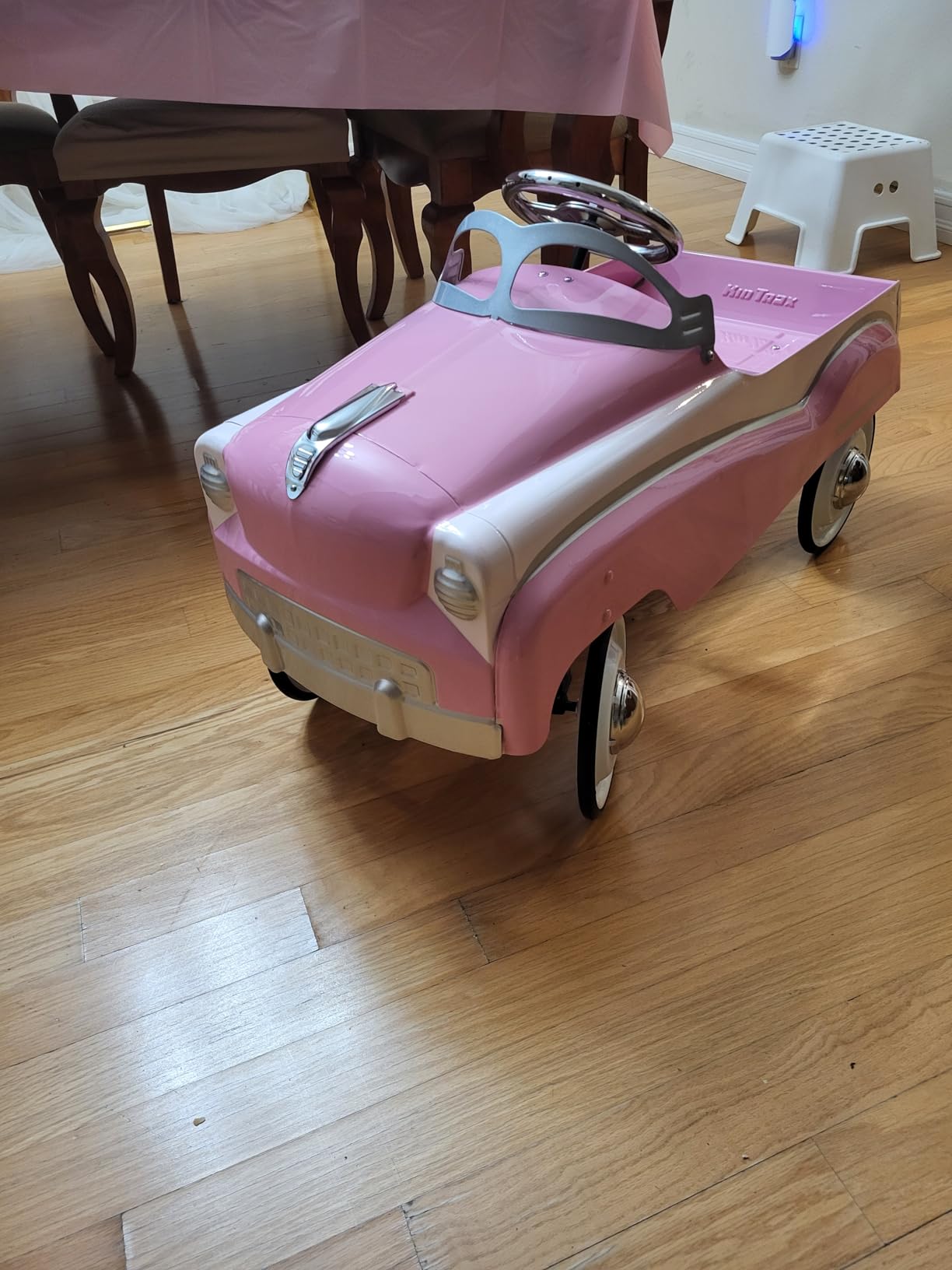
It is a pedal car proper, in the sense most of this roundup is not. It is a car-shaped steel body with a bonnet, chrome hubcaps and a vintage profile, and for a three-year-old that silhouette does more work than any specification. It is the shape most children picture when they hear pedal car.
The steel body is the reason to choose it over a plastic racer at this age. It weighs 30 lb, which is heavy for the age group but stable on a driveway and tough enough to survive being climbed on. Rubber tires with chrome hubcaps give a smooth ride rather than a rattle, and the steering is genuinely responsive rather than decorative.
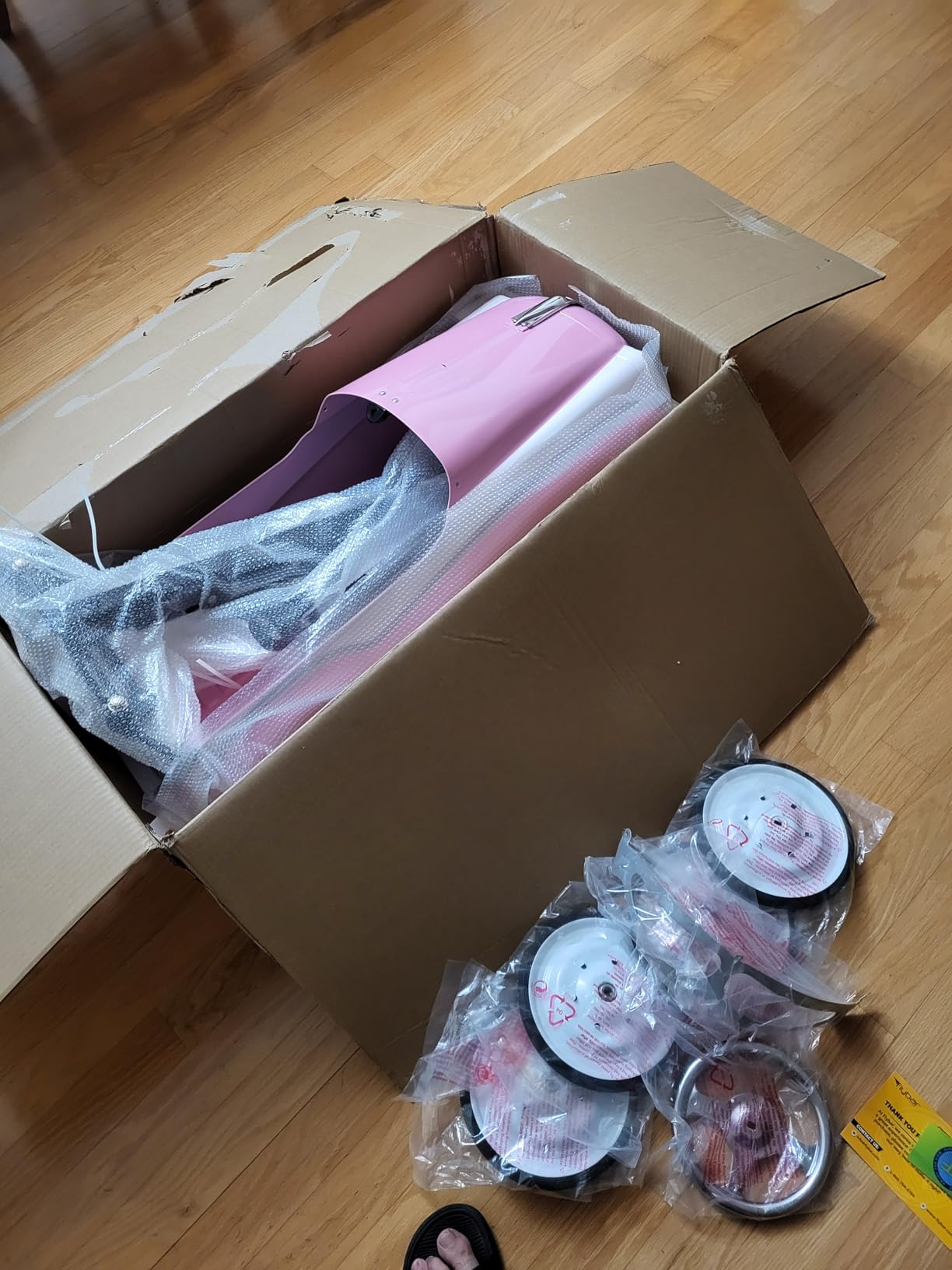
Assembly is required and straightforward, which suits a parent who expects to spend twenty minutes with a screwdriver on a Saturday morning. The footprint is compact at under 35 inches long and 16 inches wide, so it stores easily and can even go on a balcony or a small patio.
The ceiling is the tradeoff. A 60 lb limit and an age range that stops at five mean this is a three-season toy, not a hand-me-down, and the vintage coupe shape is not for every child. Parents on parenting forums note that some children simply dislike enclosed car shapes and prefer an open kart where their feet and knees are free.
Best for a first pedal car at three to five
The steel construction, the rubber tires and the low 60 lb limit line up exactly with the age range, which makes this a coherent package for a young child who can reach the pedals and grip the wheel. Parents buying a first pedal car often buy too big and the child cannot reach the pedals, so matching the size here matters.
It also works well as a birthday or holiday gift, because the vintage styling supports role play with a stuffed animal passenger rather than purely solo riding. No batteries means it is ready the moment the wrapping paper is off.
When to move up to a pedal go-kart
Outgrow it quickly. Once a child passes 60 lb or turns five, the frame and seat stop making sense, and forcing an older child into a car-shaped pedal car produces exactly the complaints the buyer’s guides warn about.
It is also narrower and more enclosed than the karts here, which makes it harder to ride for a child who likes to stride rather than sit. A swing-axle or adjustable-seat kart is the natural upgrade, and it keeps the vintage appeal alive longer.
10. Aosom Pedal Go Kart for Ages 5-12: Suspension and Reverse
Aosom Kids Pedal Go Kart Ride-on Toy Ergonomic Comfort Ages 5-12 Green
47.75 x 22.75 x 24 inch
Metal and plastic
Three-position seat
Ages 5-12
Pros
- Three-position seat spans ages 5-12
- Rubber wheels with shock-absorbing suspension
- Handbrake plus freewheel and reverse
- ASTM F963 CPSIA and SOR certified
- Pre-installed hardware speeds assembly
Cons
- Handbrake reported as weak by some owners
- Decals fade in sunlight
- Single-wheel drive
- One report of front wheel arms bending
Everything about this kart is dimensioned for a child who will grow, and the 47.75 inch frame is nearly as long as the Hurricane while carrying less weight. The three-position ergonomic seat is the main event, and it is the reason a single purchase can cover a child from five to twelve rather than two or three seasons.
The wheel and suspension package is unusual at this level. Rubber tires with a shock-absorbing suspension system smooth out seams in pavement far better than a rigid plastic wheel, and that difference is most of what a rider notices about comfort over a long session.
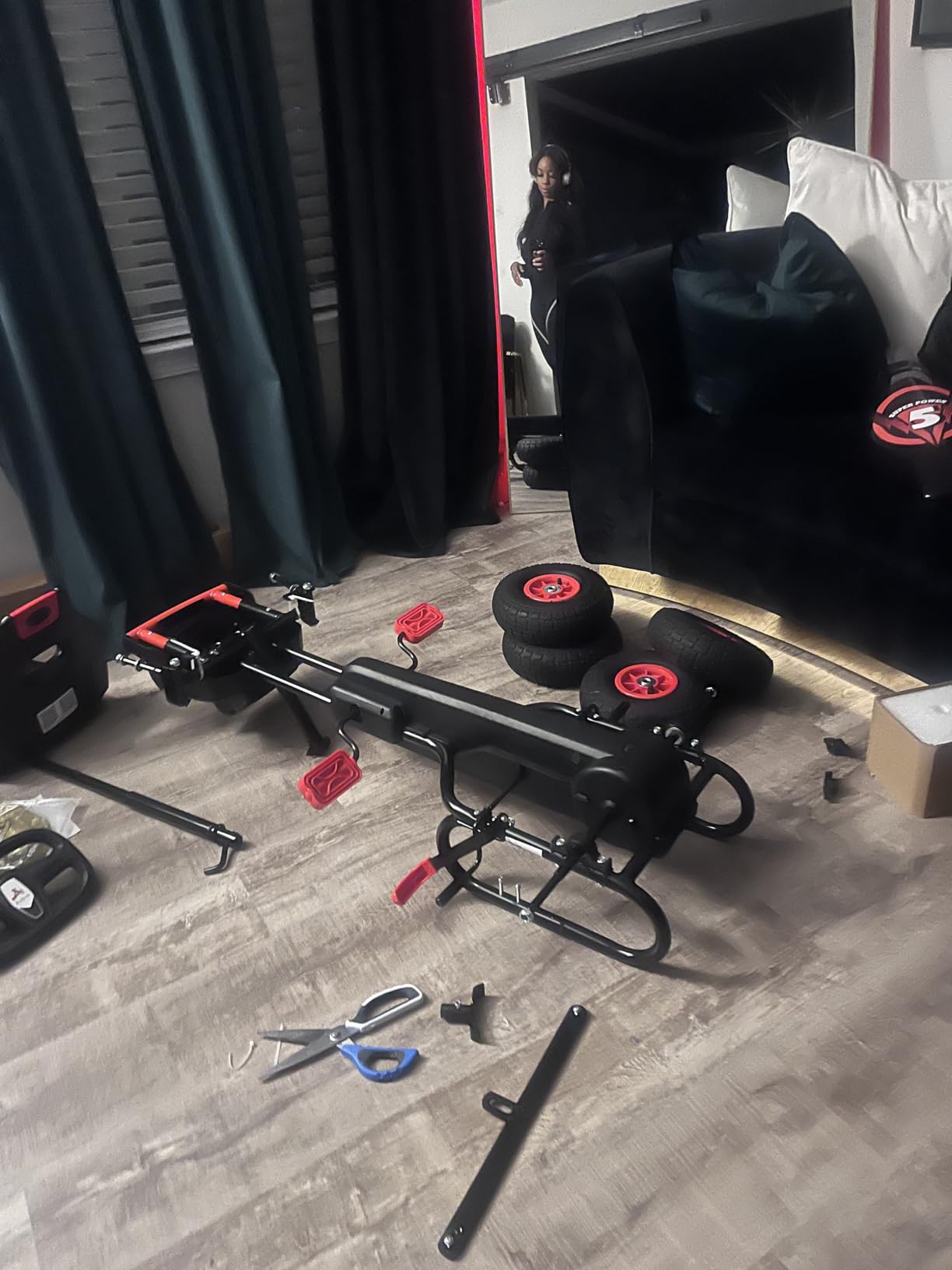
There is also a reverse function alongside the handbrake and freewheel, so a child who noses into a wall or a hedge can back out without a parent’s help. Assembly uses pre-installed hardware, which owners consistently rate as easy, and the listing cites ASTM F963, CPSIA and SOR compliance. Pedal power, no batteries.
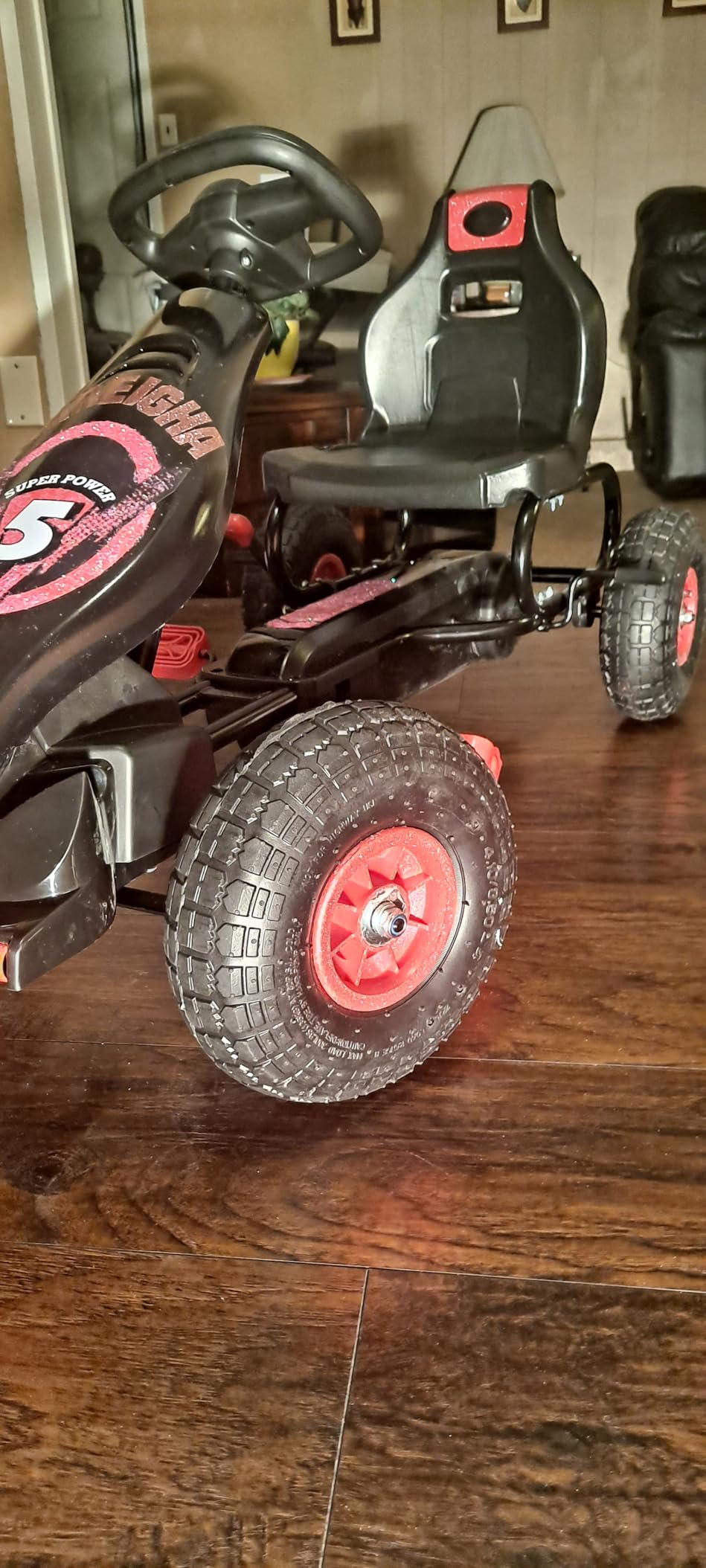
The handbrake is the soft spot. Some owners report it as weak for a heavier child, which matters more here than on a lighter kart. Decals fade in prolonged sun, the drive is single-wheel, and there is at least one report of the front wheel arms bending when a curb is hit hard. Check the handbrake before the first solo ride.
Best for a child who will grow quickly
At 29.7 lb it is a solid, long kart that a two-year span fits, and the age range is the selling point. If a child is five today and thinking about a bicycle at eight, a shorter kart means buying twice. This one is designed to be the answer across that whole stretch.
The suspension and rubber tires also make it a comfortable choice on a driveway with expansion joints or a paved path with a curve. Parents of children who get carsick on long journeys tend to appreciate the difference.
Where the Aosom 5-12 needs checking
Test the handbrake first, particularly if the child is at the upper end of the size range. A weak brake on a 29.7 lb kart is a different proposition from a weak brake on a 13 lb cart, and the reverse gear is not a substitute for a working one.
It is a paved-surface kart despite the marketing language. Single-wheel drive plus a stiff front end means lawn, gravel and curbs will produce complaints rather than fun, so pair it with a clear paved play area.
11. HOMGX Pedal Go Kart: Best Dual Braking for Ages 3-5
HOMGX Pedal Go Kart, Outdoor Kids Off-Road Go Kart with 2-Position Adjustable Bucket Seat, 2 Safety Brakes, EVA Rubber Tires, Pedal Powered Ride On Kart for Boys & Girls 3-5 (Blue)
40 x 24 x 24.5 inch
Iron frame with anti-rust paint
Ages 3-5
19 lb weight
Pros
- Handbrake plus clutch gives dual braking
- Iron frame with anti-rust coating
- Rubber-wrapped wheels
- Curved adjustable seat
- Light at 19 lb for transport
Cons
- Some owners find it hard to pedal
- Seat may not reach forward for taller children
- Listed 19 lb capacity looks like a spec error
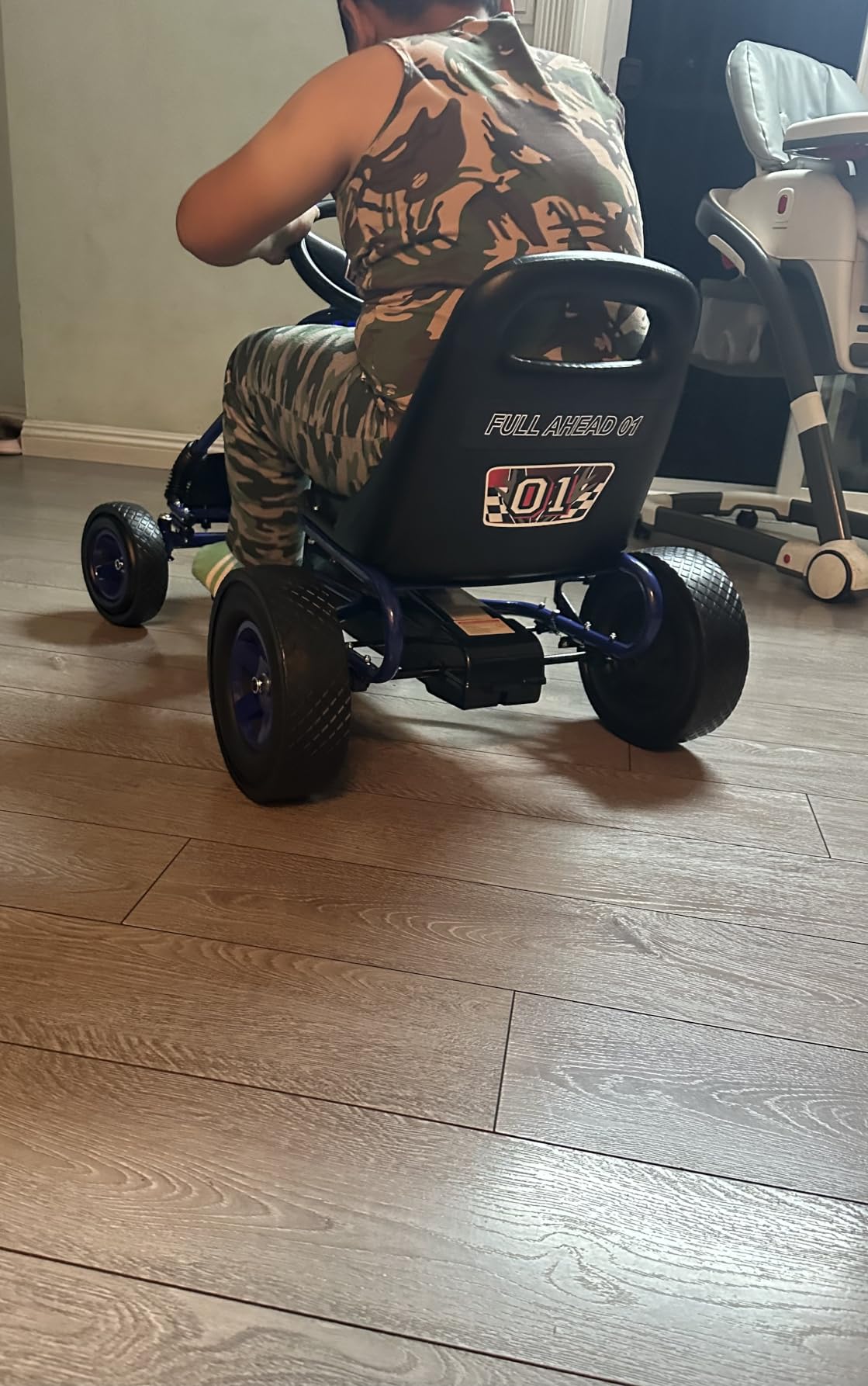
Dual braking is a sensible answer to the most common complaint about pedal karts. A handbrake beside the seat gives active stopping, and a clutch design handles the forward and backward movement, so a child has two ways to control the kart rather than one. For a three-year-old learning to stop, that redundancy is genuinely useful.
The frame is iron with an anti-rust, waterproof paint coating, and the four wheels are rubber-wrapped for grip on asphalt, cement, sand and lawn. At 19 lb it sits at the light end of the group, light enough for one parent to carry and solid enough not to tip. The curved seat supports a small back properly.
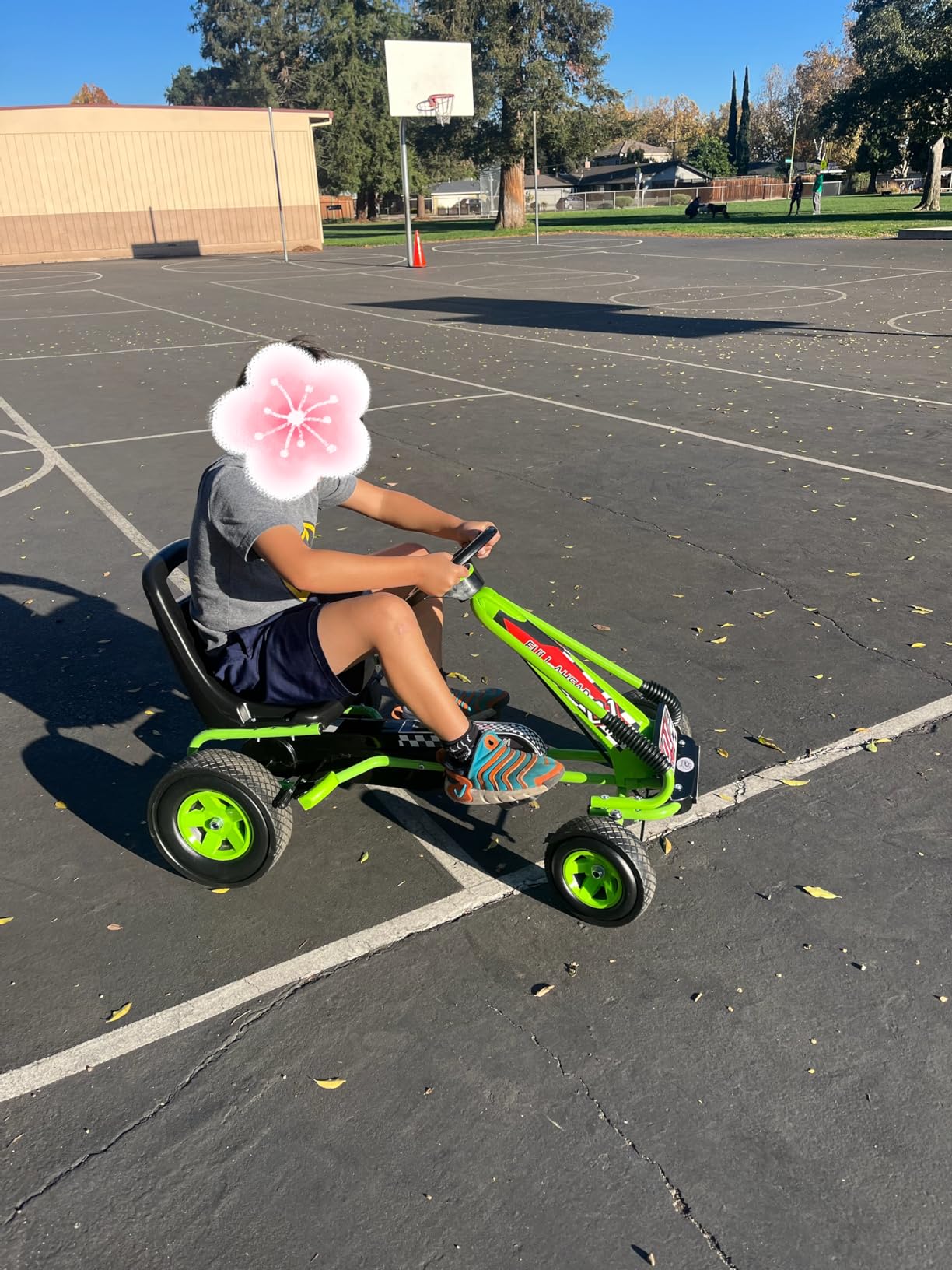
No batteries are involved, and the clutch also gives reverse movement, which saves a great deal of frustration when a small child gets stuck facing a fence. The stated range is 36 months to 5 years, which is a narrow band but an honest one for a kart this size.
Two caveats stand out. Some owners find it hard to pedal, and the seat does not adjust far enough forward for taller children inside the stated range. The listed weight capacity of 19 lb also looks like a listing error, since owner reviews describe children well above that riding it comfortably. Treat the age range as the more reliable guide.
Best for a three-year-old learning to stop
The dual braking system is the reason to pick this over a cheaper single-brake cart. Combined with reverse movement and a rubber-wrapped wheel set, it gives a young rider more ways to control speed on a driveway, which is where most three-year-olds will use it.
The iron frame is a genuine step up from polypropylene at a similar weight, and the anti-rust coating is the detail that decides how it looks after a year outdoors. For a family wanting one kart to hand between two children aged three and five, the fit is reasonable.
Where it will let you down
Pedalling effort is the recurring complaint. A child who is small for their age may find the pedals heavy, and the tight seat range means the fit is less forgiving than a multi-position seat on a longer kart.
Check the published weight figure before purchase. If your child is anywhere near five, a longer kart with a 66 lb or higher rating will serve better, and if your surface is grass, the rubber-wrapped wheels are better than most but still not a substitute for real tread.
12. Aosom Swing Axle Pedal Go Kart: Best Seat Adjustment and Smooth Ride
Aosom Kids Pedal Go Kart with Swing Axle Adjustable Seat for Ages 3-8 Blue
39.25 x 22.75 x 23 inch
Four-position seat
66 lb max weight
Ages 3-8
Pros
- Four-position seat with 5.5 inch of adjustment
- Swing axle with shock-absorbing EVA wheels
- Forward and reverse with handbrake
- ASTM F963 and CPSIA certified
- Fits children 47.2 to 59.1 inches tall
Cons
- Assembly required
- Swing axle needs maintenance over time
- EVA tires wear faster than rubber on rough ground
Four seat positions with up to 5.5 inches of travel is the most measured adjustment in this roundup, and it is the reason this kart is worth the effort to sit near the back of the age band. The manufacturer specifies a fit for children between 47.2 and 59.1 inches tall, which is a concrete number you can measure your child against rather than guessing from a label.
The swing axle is the other feature to understand. Instead of a fixed rear axle, the rear wheels pivot slightly to follow the surface, so cracks, gravel and uneven paving cause far less of a jolt than they do on a fixed-axle kart. Paired with silent shock-absorbing EVA wheels, it takes the sting out of the seams that bother a fixed-axle kart most.
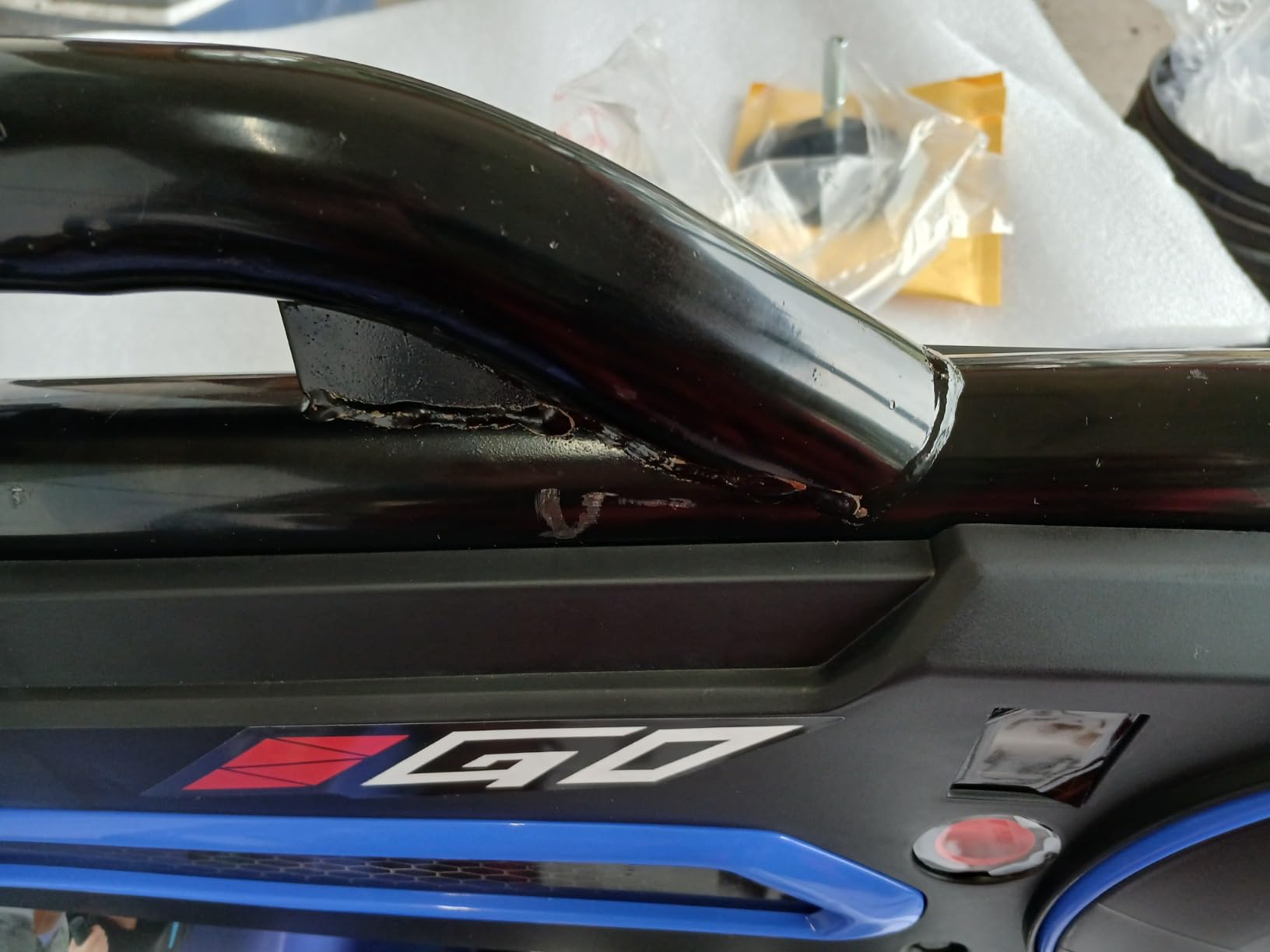
Forward and reverse drive with a handbrake gives good control, and the kart is certified to ASTM F963 and CPSIA standards with a 66 lb capacity. The listed surfaces are cement, brick, gravel and asphalt, which is an honest set for a swing-axle design. It is pedal-powered throughout, with no battery anywhere.
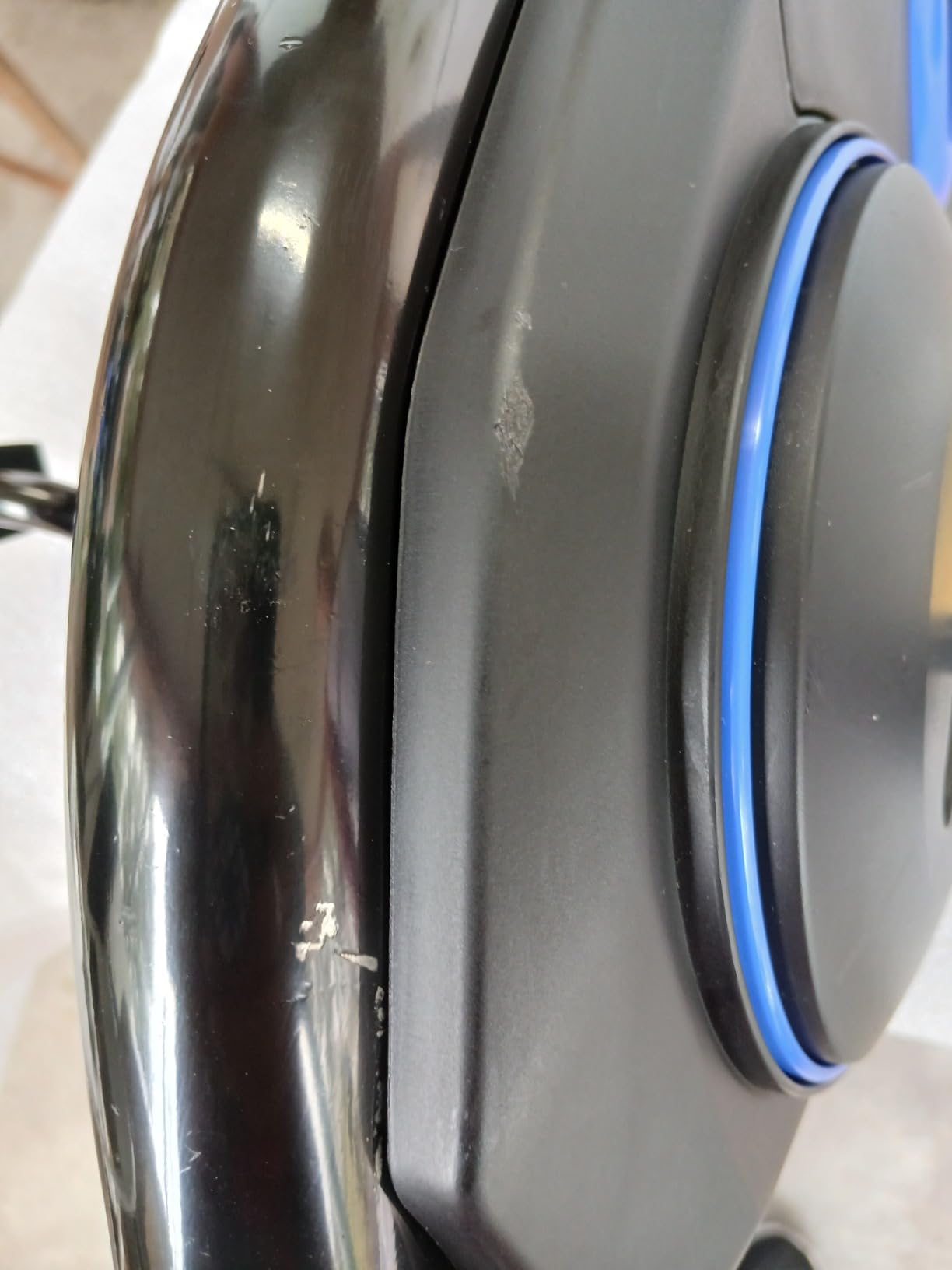
Two things to weigh. Assembly is required, and the swing axle is a moving part that benefits from an occasional check, so this is not a zero-maintenance toy. EVA foam tires also wear faster than rubber when driven on rough surfaces repeatedly, so keep it on the surfaces it was designed for.
Best for uneven paving and a tight fit problem
The swing axle shines on a driveway with expansion joints, cracked sealant lines or a brick path, where a fixed axle would jolt the child on every seam. If your outdoor play area is paved but imperfect, this handles it better than anything else in the roundup and does it silently.
The four-position seat solves the most common sizing complaint. Parents of children who are small for their age can slide the seat all the way forward, and parents of tall eight-year-olds can slide it back, which is a bigger range than the two-position karts offer at the same price level.
When to choose something simpler
If you want the lowest-maintenance cart in the group and your surface is smooth, a fixed-axle kart with rubber tires will be simpler and longer-lasting. The swing mechanism is an advantage on rough paving and a small liability everywhere else.
At 66 lb the capacity suits ages three to eight rather than older children. For a child approaching ten, the YBIKE Explorer or the Aosom 5-12 kart stretches much further before the frame becomes the limiting factor.
Matching the Cart to Your Backyard Surface
The single biggest reason a pedal kart disappoints is not the kart. It is the surface underneath it. A kart that feels fast and solid on a smooth driveway can bog down within a few strides on grass, and the same weight that makes a kart stable on paving makes it hard to turn in sand.
Level grass is the hardest common surface. Nearly every cart here is specified for asphalt, cement, brick or gravel, and most owners confirm that grass causes a stall, particularly on the lighter frames. The workable approach is to designate a paved strip for the kart and treat the lawn as a place to push the cart, not ride it.
Gravel is the most deceptive. Small karts with rigid plastic wheels bog down almost immediately, while a heavier steel frame with rubber tires can plough through short gravel, though it will be slow and noisy. Nothing in this roundup is a genuine trail vehicle, and if rough ground is the priority you are looking at a different category of ride-on.
Pavement and concrete is where all twelve excel, and the difference between them comes down to wheel type and suspension. Rigid plastic wheels transmit every joint and stone straight up through the frame, rubber wheels damp most of it, and the swing-axle models smooth out what remains. Slopes are the last variable: low gearing and short pedal cranks on the lighter karts make an incline genuinely hard work.
One final surface note. Wide, heavy karts such as the Hurricane and the Aosom 5-12 are stable but need real room to turn, while narrow carts like the Kid Trax Classic and the Little Tikes racer fit into tighter spaces and are easier to reposition. Measure your actual play area before choosing, not the lawn in general.
How to Choose a Pedal Car: 7 Criteria That Matter
First, check the weight capacity before the age label. Age ranges on these products are approximate and frequently optimistic, while the weight rating is a hard structural number. A child who is tall for their age may exceed the stated range while still being within the weight limit, and the reverse is also true. Where the two disagree, the weight rating wins.
Second, look at frame material. Parents consistently treat steel as the durability signal, and the data backs that up: the carts in this roundup built around alloy steel or iron hold their ratings better than moulded plastic racers, which attract more durability complaints. If a kart is meant to be handed to a sibling or kept for three or four years, pay for metal.
Third, match the wheels to the surface. Rubber-profile and rubber tires grip and damp, rigid non-inflation wheels are fine on smooth paving and poor everywhere else, and a swing axle absorbs uneven surfaces in a way a fixed axle cannot. Read the wheel specification the same way you read the frame material.
Fourth, count the safety hardware. A working handbrake, a chain guard or enclosed chain box, and a steering column that does not flex are the baseline. Skip any kart with an exposed chain. A dual-brake system like the HOMGX offers is a step up for younger riders, and certification marks such as ASTM F963 and CPSIA are worth checking on a newer model.
Fifth, measure the seat adjustment rather than trusting the age range. Two-position seats cover a narrow band, while three or four positions with several inches of travel can double the useful life of a purchase. The Aosom swing-axle kart with 5.5 inches of adjustment and the YBIKE Explorer with extending frame bars are the two strongest examples.
Sixth, plan for assembly and storage. Expect 30 to 40 minutes for most of these carts, and longer where instructions are poor, as with the Hurricane and the Costzon 40 Inch. Footprints run from under 35 inches for the Kid Trax Classic to over 51 inches for the YBIKE Explorer, and a 30 lb kart is a two-person job to move across a lawn.
Seventh, be honest about the electric alternative. Parents on parenting forums ask this constantly: pedal kart or battery-powered ride-on? A pedal kart develops leg strength, needs no charging, has no motor to fail and costs less to maintain, but it stops working on a child’s birthday. A battery ride-on keeps a three-year-old delighted for years, at the cost of charging and a heavier machine. Most families use the pedal kart as the bridge between a push toy and a bicycle, which is the gap electric ride-ons tend to fill later.
On durability expectations, there is a heritage worth acknowledging. One parent on a karting forum reports a Sachs pedal go-kart that survived seven children over 35 years and was still rolling. No cart in this roundup carries that pedigree, but the anecdote explains why steel frames and replaceable parts matter more to experienced buyers than the feature list does.
Safety Gear and First-Ride Checklist
Any child riding a pedal cart in an area shared with traffic, driveways or slopes benefits from a properly fitted helmet, even though most pedal karts top out at speeds that feel slow to an adult. The risk on a pedal kart is usually not speed but a fall onto a hard surface or a collision with an obstacle.
Before the first ride, check the handbrake holds, the chain guard or chain box is fully closed, the steering column is tight, and the seat is locked in position. Set the seat position before the child climbs in rather than after, since some designs make it awkward to reach once a rider is on board.
Then check the surface. Clear the play area of stones, sticks, sprinkler heads and garden hoses, and keep the first rides on level ground away from steps, kerbs and slopes. Supervise the first few sessions, particularly if the kart has reverse or a clutch, so the child learns the stopping behaviour before riding alone.
One last practical point from the forums: some children dislike coupe-style pedal cars and simply prefer an open kart where they can move their legs freely. Before buying a car-shaped model, borrow or rent a kart for an afternoon if you can. A style mismatch is the most common reason a pedal car ends up unused in a garage.
Frequently Asked Questions
What is a good pedal car for a 12-year-old?
Most pedal karts top out around 60 to 80 pounds, which a 12-year-old exceeds. The YBIKE Explorer is the standout option here, rated to 155 pounds, with an adjustable frame and seat that span roughly ages 4 to 12 and a stable three-wheel layout. Its wide turning circle is the main drawback, so measure your driveway before buying.
What are the best pedal cart brands?
The best-documented brand in this category is hauck, which supplied three of the highest-rated carts we tested, including the Lightning at 4.7 stars across more than 3600 reviews. Little Tikes is the better-known name but builds in moulded plastic, which attracts more durability complaints. Aosom and YBIKE cover the bigger-rider and three-wheel ends of the market.
What is a good pedal car for a 5-year-old?
For a five-year-old, the hauck Lightning is the strongest all-round choice, with a 110 pound weight limit, a two-position seat and rubber-profile wheels that brake well. If your child is small for their age and needs the seat right at the front, the Aosom swing-axle kart with four seat positions fits better. Both suit a paved driveway best.
Are pedal cars worth the money?
Yes, when the frame is steel and the wheels suit your surface. Metal-framed karts in this roundup hold up far better than moulded plastic racers, and rubber wheels damp pavement seams that rigid plastic wheels transmit straight to the child. The value case weakens on grass, where most of these carts struggle regardless of what you spend.
How fast does a kids go-kart go?
A child-powered pedal kart is limited by leg strength and gearing rather than any motor, so speeds vary enormously between a four-year-old and a ten-year-old on the same cart. Lightweight karts with short pedal cranks feel noticeably slower because of low gearing. A child typically reaches an adult jog over flat ground on a well-geared kart, which is fast enough to require a helmet.
What is the difference between a pedal car and a pedal go kart?
A pedal car is car-shaped, with a bonnet, body panels and a vintage profile, and it usually carries a lower weight limit because of the shell. A pedal go-kart is a low, open kart with a steering wheel, a chain guard and a sliding adjustable seat, which suits older children and grows further. Both are powered entirely by the rider with no battery or motor.
The Best Pedal Cars for Backyard Play in 2026
After working through all twelve, the hauck Lightning Pedal Go Kart is our pick when you are searching for the best pedal cars for backyard play, because it combines a steel frame, a 110 lb weight limit and a two-position seat with the deepest body of owner feedback we found. Its one weakness is grass, so give it a paved driveway and it will hold up for years.
Match the pick to the child rather than the budget. For a three-year-old on a patio, the Kid Trax Classic gives a vintage steel pedal car with a 60 lb limit. For a five to eight year old on hard surfaces, the Lightning, the Costzon 40 Inch and the Aosom swing-axle kart cover the main options, with the Aosom offering the widest seat adjustment. For a child past eight or one who is big for their age, the YBIKE Explorer at 155 lb is the only cart here that will not be outgrown quickly.
Two things decide the purchase before any brand does: check the weight capacity against your child today, and check the wheel type against your surface. Get those right and the rest is preference. If you are furnishing the rest of the yard at the same time, our guides to kids playhouses for outdoor play and pedal go-karts by age band cover the surrounding setup.