
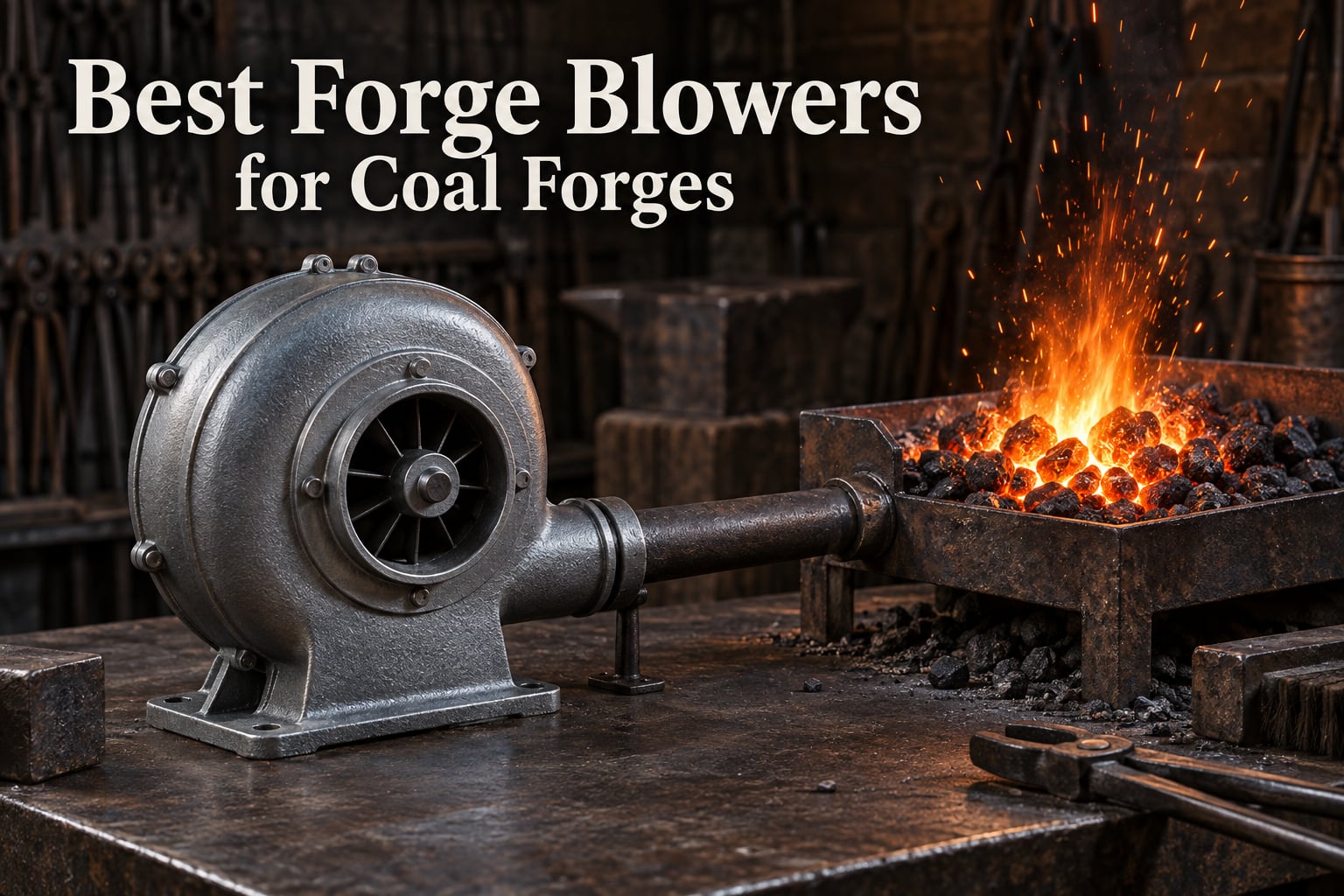
A coal forge is only as good as the air under the fuel bed, so picking the right blower decides whether you spend your afternoon chasing a fire or actually forging. After reading through published specifications, owner review patterns and years of forum thread history on coal forges, the best forge blowers for coal forges split into three clear groups: the Sunlar 110V 250W electric blower is the best overall pick because it carries the largest review base in the category and moves enough air to hold anthracite at welding heat; the LINJIN hand crank blower is the best value if you want a no-power-needed blower for a small firepot; and the BSTJXDZ 780 Pa high pressure unit is the one to buy when a restrictive tuyere is starving your fire.
One thing to say plainly before the picks: we did not bench test these eight units against each other. Every judgement below comes from manufacturers’ published specifications, from the patterns in hundreds of owner reviews, and from what smiths report on forums like r/Blacksmith, I Forge Iron and Smokstak. Where a maker does not publish a figure, we say so rather than guess, which is why you will see more honest gaps in this roundup than in most.
That matters on this topic more than it does on most shopping topics. A forge blower is a machine whose usefulness is entirely a function of how much air it can push through a tuyere and a bed of coal, and the number on the box is rarely the number that matters. Buy a leaf blower, an 80 dollar electric fan and a production blower and you will find all three quoted in the same CFM range while behaving nothing alike at the fire.
If you are still building out a workshop, start with the forge itself — our guide to the best knife making forge kits for hobbyists covers the fire side, and everything below assumes you have one.
Table of Contents
Top 3 Forge Blowers for Coal Forges in 2026

Sunlar 110V 250W Electric Blower
- 220W 110V corded motor
- 3000 rpm centrifugal
- 115.95 cfm listed spec
- 2.5 inch outlet
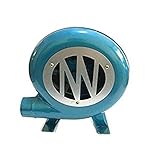
LINJIN 1:36 Hand Crank Blower
- No power required
- 1.97 inch outlet with telescopic pipe
- Stamped steel and welded iron

230CFM 250W Centrifugal Blower
- 230 cfm from 250W
- 6 adjustable blades
- Cast aluminium housing
- 69 dB rated
Best Forge Blowers for Coal Forges at a Glance
All eight blowers below are real, currently listed forge blowers spanning hand crank and electric, budget through production class. Where a manufacturer omits a number the table simply leaves it out rather than substituting an estimate.
| Product | Specifications | Action |
|---|---|---|
| Sunlar 110V 250W Electric Forge Blower |
|
Check Latest Price |
| LINJIN 1:36 Hand Crank Forge Blower |
|
Check Latest Price |
| 230CFM 250W Electric Forge Blower |
|
Check Latest Price |
 Simond Store HB-18 6 Inch Hand Blower Simond Store HB-18 6 Inch Hand Blower |
|
Check Latest Price |
 BSTJXDZ 300CFM 780 Pa High Pressure Blower BSTJXDZ 300CFM 780 Pa High Pressure Blower |
|
Check Latest Price |
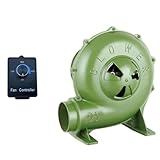 BSTJXDZ 240CFM Variable Speed Blower BSTJXDZ 240CFM Variable Speed Blower |
|
Check Latest Price |
 Simond Store HB-25 8 Inch Hand Blower Simond Store HB-25 8 Inch Hand Blower |
|
Check Latest Price |
 Pinelicorn 141CFM 250W Electric Blower Pinelicorn 141CFM 250W Electric Blower |
|
Check Latest Price |
How Much Air Does a Coal Forge Need?
Direct answer: a typical shop forge wants on the order of 100 to 150 CFM at up to 5 inches of static pressure, and that figure is quoted almost identically in the classic reference material and in modern forum threads. One Smokstak poster put it exactly this way — a shop forge wants up to 150 CFM at up to 5 inches of static pressure, and too much air will actually make the fire cool off and go out.
That single line contains the two ideas beginners most often miss. The first is that CFM alone is not a real specification. Air delivery is always a curve: a fan moves its maximum volume at zero restriction, and the moment you plumb that air through a tuyere, a bed of coal and a firepot grate, you are working against back pressure and the delivered volume falls.
The second is that static pressure — the resistance the fan can push against, measured in inches of water column (in. w.c.) or pascals (Pa) — matters more to a coal fire than raw CFM. A blower that delivers 300 free-air CFM but stalls at 2 in. w.c. will do less for a deep coal fire than one delivering 140 CFM steadily at 5 in. w.c.
For sizing, match the blower to the fire rather than to a spec sheet. A small firepot with a light bed of charcoal or shavings needs almost nothing — a shop vac or a hair dryer will light and hold it, and a modest blower covers everything after that. A medium firepot holding four to six inches of coal wants real volume. A deep fire soaking billets for a forge weld wants both volume and pressure, which is where the high pressure electric units earn their place.
One caution that forum veterans repeat constantly: over-air is a real failure mode, not a theoretical one. Force a hot coal fire hard enough and you will blow the fire out of the firepot and cool your steel at the same time. That is why air control — a gate valve, intake shutters or a speed controller — matters as much as CFM on any real coal forge.
Hand Crank vs Electric Forge Blower: Which Should You Buy?
The short version: hand crank buys you silence, immediacy and independence from the grid; electric buys you back your working hand and a fire that stays hot while you are not cranking. On Bladesmith’s Forum the electric argument is put bluntly — it noticeably improves your time to forge because the fire stays hot while you are forging. That is a productivity purchase, not a luxury.
Smiths who run both report the same pattern. A crank gives finer, more immediate air control because your hand is the throttle, it makes no meaningful noise, and it works during a power outage or in an off-grid shop with no generator. The cost is one hand occupied while you work, and the fact that the fire cools within seconds of stopping.
There is also a durability case for the crank that has little to do with nostalgia. Vintage American blowers such as the Champion 400 and the Buffalo ran cast iron gears in an oil bath, and on forums they are treated as the gold standard hand crank blowers — a Reddit r/Blacksmith owner described an antique Champion 400 as a 10/10 machine before eventually replacing it with a new cast crank unit. A cast iron gear running in an oil bath outlasts a plastic worm gear in a sealed case; every owner report in this category points the same way.
Where the crank loses is sustained work. Wrist and arthritis problems make sustained cranking impractical for older hobby smiths, and nobody with sore hands cranks a deep fire for a three hour welding session. If your forging is mostly bits and pieces with pauses to think, crank. If you are doing production work or forge welding, electric pays for itself in the first month.
One more variable is the fire itself. A propane forge has a fixed burner and needs no blower at all, so if your fuel is propane this entire roundup does not apply to you.
1. Sunlar 110V 250W Electric Blower — Best Overall Coal Forge Blower
110V 250W US Style Electric Blacksmith Forge Blower Blacksmithing Coal Forge Fan air Blower Tools with 125CFM
220W 110V corded motor
3000 rpm centrifugal impeller
115.95 cfm listed spec
5.9 lb, 2.5 inch outlet
Pros
- Largest review base in the category at 367 reviews
- Strong airflow owners report holding welding heat on anthracite
- Works with a variable speed controller or air gate
- Cast aluminium body with a balanced aluminium blade
- Compact and comparatively quiet for the volume of air
Cons
- Overpowered on a small firepot without an air gate
- Thin build quality and a cheap push-button switch
- The 2.5 inch outlet is an unusual diameter needing an adapter
- Airflow control can be inconsistent on some units
This is the blower that came up most often when we read through owner reviews, and it earned that on evidence rather than marketing. Across 367 reviews averaging 4.5 stars, the recurring theme is raw airflow: owners run it on anthracite, bituminous coal and charcoal and report reaching welding heat without drama. That matters because a blower that merely reaches forging heat and cannot push past it is a frustrating tool.
The specifications are honest shop equipment. A 220 watt 110 volt corded motor turning a three-blade centrifugal impeller at 3000 rpm, housed in cast aluminium, at 5.9 pounds and 8.27 by 4.72 by 11 inches. The plug is a standard NEMA 1-15P, which means it goes into an ordinary outlet, and it carries a single push-button speed with button control.
Here is where I would be careful, and it is worth being upfront about it. The airflow figure is inconsistent on the listing: the specification block says 115.95 cfm while the feature bullets advertise 230 CFM, and some buyers question the number outright. Treat both as unverified. What you can verify is that it moves a lot of air in practice, and that is the number that decides whether your fire holds heat.
That leads to the single most common complaint in the review set, which is not a defect but a mismatch: on full power this blower can blow coals straight out of a small fire pot. Nearly every owner solves the same way, with a gate valve or a speed controller to dial back from full blast. Budget for that accessory as part of the purchase, not as an afterthought.
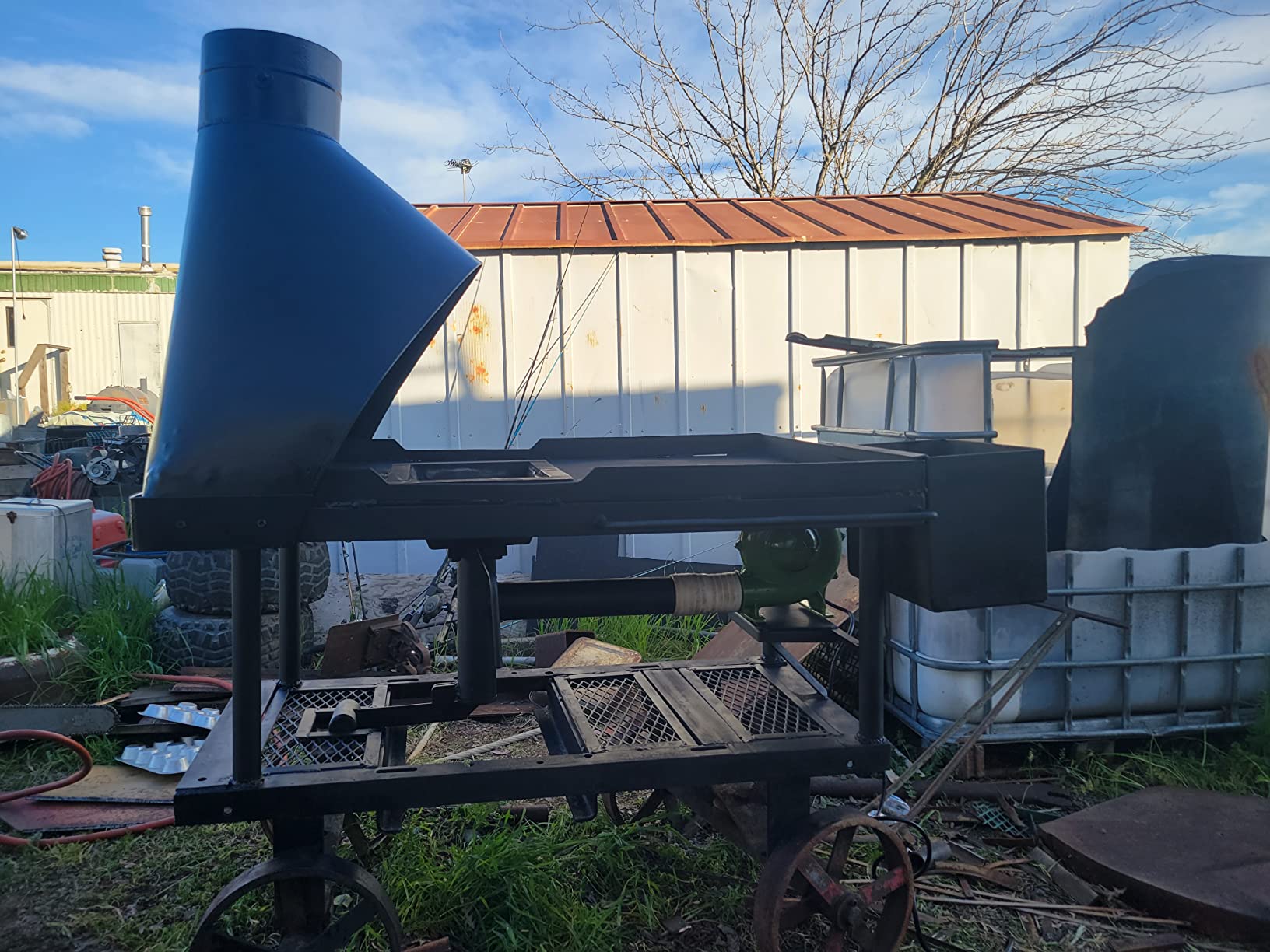
It is also quieter than you would expect. Owners put it around 45 to 50 dB, comparing it favourably to a microwave fan on high, which is unusual for a fan in this output class and a genuine advantage in a small shop you share with a household.
Beyond forging, the same motor gets used for ribbon burners, foundry work and maple syrup arches, which tells you something about the headroom in the design. A dual-use shop tool that also works as your forge blower is a good deal of value from a single machine.
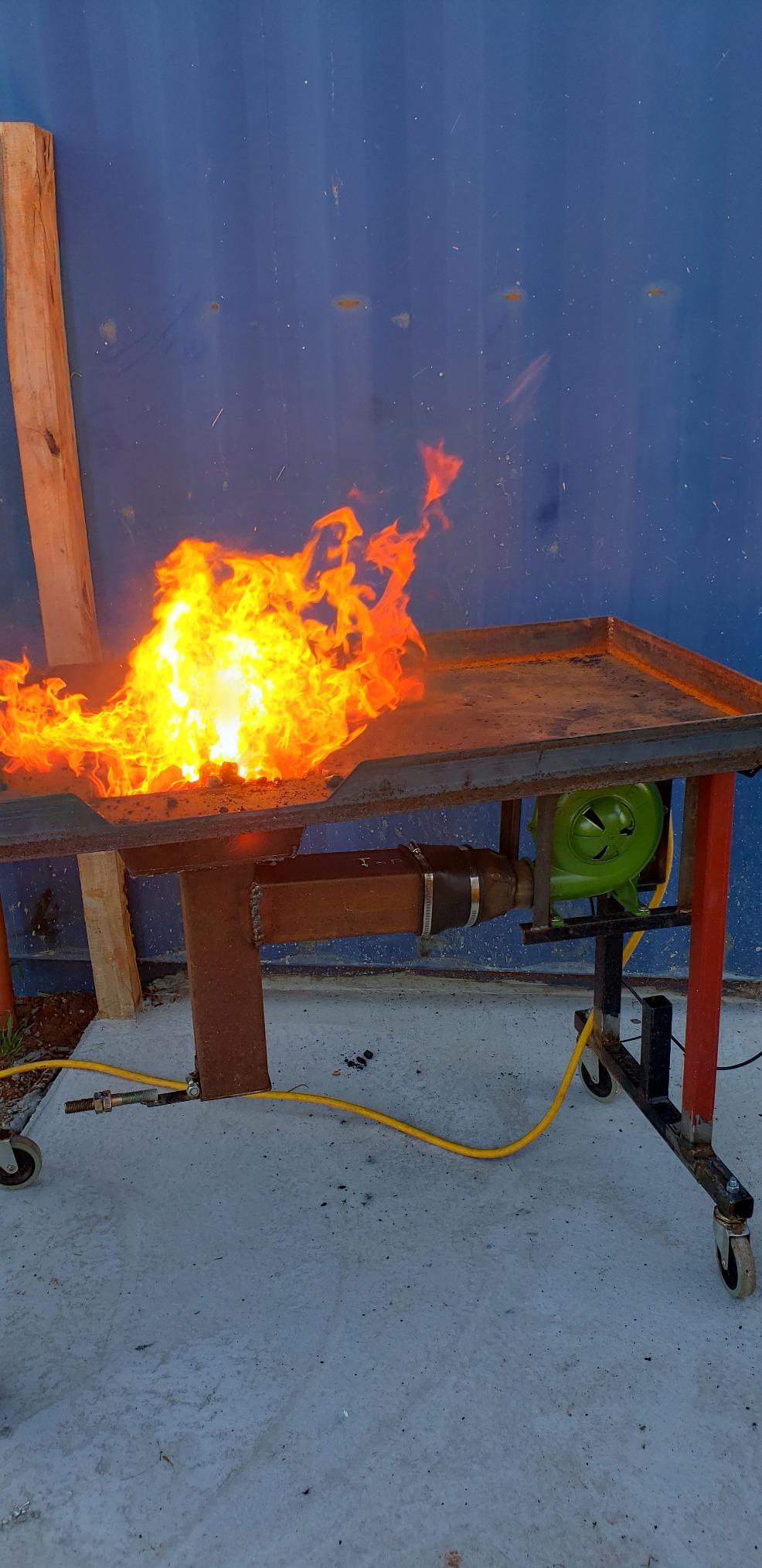
Whether the outlet size will fit your tuyere
The outlet is 2.5 inches, which is not a standard plumbing size and is the most common practical snag with this blower. If your tuyere is fed by 2 inch pipe, you will need an adapter or a short transition, and several owners describe improvising the seal. Buy the proper adapter before you light your first fire rather than discovering the gap at the firepot.
Conversely, if you are still designing the forge, this is a reason to pick a 2 inch tuyere and standard 2 inch pipe, because a 2.5 inch outlet adapts to it far more gracefully than the reverse.
Who should buy it and who should not
Buy it if you are running a real coal fire, if you want a blower that does not need a speed controller to be usable, and if having one machine handle both forging and general shop air movement appeals to you. It is the most thoroughly reviewed blower in this roundup by a wide margin, and that volume of owner data is itself part of the value.
Skip it if your firepot is small enough that a serious breeze threatens to blow the coal out, or if you work somewhere noise matters more than airflow. In those cases the quieter hand crank options further down this list are a better fit.
2. LINJIN 1:36 Hand Crank Blower — Best Value Hand Crank for a Small Firepot
LINJIN Hand Crank Blacksmith Forge Blower Iron Gear Popcorn Fan Manual Fan, Cooking Manual BBQ Air Blower (as shown)
1:36 gear ratio
Stamped sheet metal and welded iron
1.97 inch outlet with 14.17 inch telescopic pipe
Floor stand form factor
Pros
- Fully manual so it works anywhere with no power
- Lowest cost entry into hand crank forge blowers
- Telescopic pipe extends to 14.17 inches for reach
- Simple stamped and welded construction
Cons
- The 1.97 inch outlet limits total air volume
- Listed as a fire starting and small stove blower rather than sustained forge duty
- Single-speed crank with no airflow throttling
- Unfinished finish and thin sheet metal
Hand crank blowers have a reputation problem they largely earn, and this one is the honest low end of it. Across 120 reviews at a 4.0 average, buyers describe it as an inexpensive manual blower suited to fire starting, small stoves and casual barbecue rather than hard forge work. That framing is correct, and if you buy it for a small firepot you will be satisfied.
The mechanism is straightforward. A 1:36 gear ratio, which is a relatively high reduction and means the crank turns slowly for a fast impeller, driving a stamped sheet metal and welded iron body. It is listed at 200 watts and includes a telescopic air pipe that extends to 14.17 inches, so you can position the outlet where the fire needs it without improvising ducting.
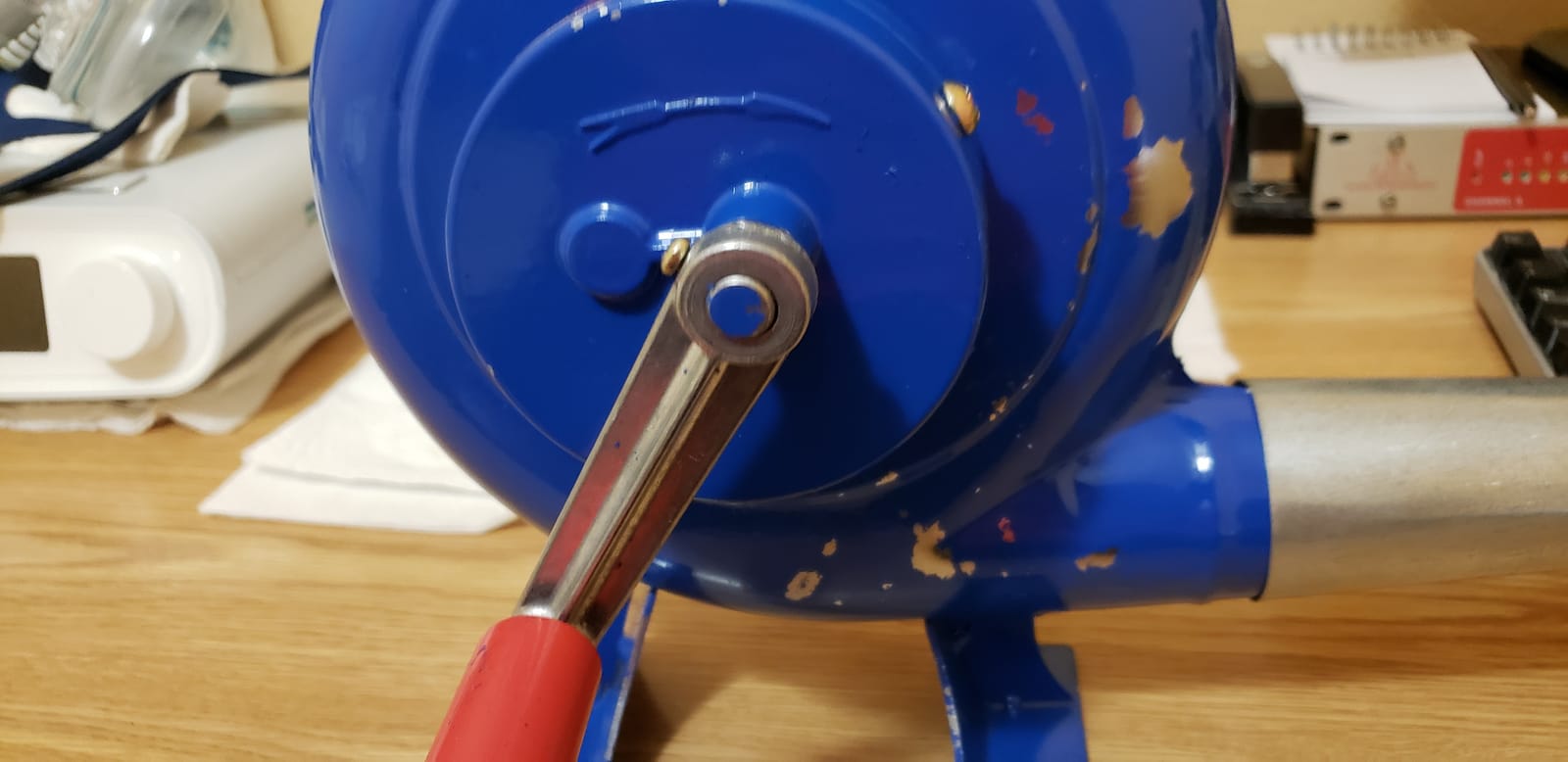
The floor stand form factor is worth noting. It stands on the ground or a bench, so you are not holding the whole machine one-handed while trying to shape steel with the other. At 9.25 by 4.72 by 23.5 inches it is a tall, narrow object, so plan the footprint accordingly.
What you give up is volume and control. A 1.97 inch outlet moves less air than anything else on this list, and with a single-speed crank your only throttle is how fast your hand turns. That is fine for lighting and holding a light fire, and it is a real constraint the moment you want to drive a deep coal bed hard.
Where it genuinely earns its place
Off-grid and outdoor work is the strongest case. A demonstration at a fair, a camp forge, a teaching session away from mains power — nothing on this list is easier to deploy, and nothing is quieter, because there is no motor running at all.
It is also the cheapest way to find out whether you actually enjoy cranking. Many hobby smiths try a hand crank blower first precisely to feel the air control before committing, and for that purpose a simple stamped unit is the right instrument.
The limits you should accept up front
Do not expect this to run a deep coal fire. The outlet diameter is the binding constraint, and no amount of cranking effort compensates for a narrow outlet when you are trying to push air through clinker and a full firepot grate.
It is also a light duty machine by design. If you already know you want sustained hand cranking, spend the extra money on a cast aluminium blower with a proper 2 inch outlet further down this list and you will be happier long term.
3. Generic 230CFM 250W Centrifugal Blower — Best Electric With Adjustable Inlet Blades
250W Blower Fan, 230CFM Electric Forge Blower, Blacksmith Forge Charcoal Chimney Starter, Air Mover Blower BBQ Fan, Centrifugal Blower 110V 2-1/2” Outlet
230 cfm from a 250W 110V motor
3000 rpm centrifugal, 6 adjustable blades
69 dB rated noise level
Cast aluminium housing, 2.5 inch outlet
Pros
- High 230 cfm output for a 250 watt motor
- Adjustable inlet blades let you tune airflow
- Cast aluminium housing rated for demanding use
- 2.5 inch outlet is a common forge blower size
- Works with an external variable speed controller
Cons
- Rated 69 dB makes it one of the louder options
- Speed controller is supported but not included
- 13 percent of reviews are 1 star on quality inconsistency
- Single-speed out of the box with unverified CFM
This is the blower to buy when you want a genuine centrifugal forge fan at a modest outlay and you are willing to buy an air control accessory separately. Model 5106B, it is a 250 watt 110 volt centrifugal blower turning six blades at 3000 rpm inside a cast aluminium housing, rated by the manufacturer at 230 cfm.
The adjustable blades are the feature that separates it from a plain fan. Because the six fan blades can be adjusted to control the air inlet, you have a second means of tuning airflow even before you add a controller. On a coal fire that matters, because the difference between a sympathetic blast and a fire that blows itself out is often just a few percent of inlet.
The 2.5 inch outlet is a common forge blower size and accepts 2 inch pipe, which solves the adapter problem that trips up some cheaper blowers. If your tuyere is plumbed with standard 2 inch pipe, this is a clean fit.
The honest weak spot is noise. A rated 69 dB is the loudest figure published anywhere in this roundup, and it is a published rating rather than an owner impression. In a shared workshop or a garage you work in at night, that will matter.
What to buy alongside it
A variable speed controller, because the listing supports one but does not include it. Without a controller this is a single-speed machine, and a single-speed machine driving a coal fire is a rough instrument — you will be feathering an air gate constantly.
Budget for a simple gate valve as well. With adjustable inlet blades and a gate valve you have two independent air controls, which is genuinely more usable than either one alone.
The quality control question
With 44 reviews at 4.1, the rating distribution has a pronounced tail: 61 percent five star but 13 percent one star, and no two-star ratings at all. That pattern usually means some blowers are fine and some are not, rather than that everyone is disappointed.
So inspect on arrival. Listen for bearing noise, check the blade spins true, and confirm the outlet is round and unwarped. If anything rattles or the motor hums unevenly, deal with it before you rely on it at the firepot.
4. Simond Store HB-18 6 Inch Hand Blower — Best Cast Aluminium Hand Blower for Fireplaces and Fire Pits
SIMOND STORE Hand Crank Blacksmithing Forge Blower, Cast Aluminum Manual
6 inch cast aluminium casing and impeller
1:28 gear ratio
Two oil ports
1-4/5 inch outlet, 11 lb, tabletop mount
Pros
- Cast aluminium casing and impeller with steel handle pipe and stand
- Two oil ports make lubrication straightforward
- Good airflow for its size in fireplaces and fire pits
- Mounts on the ground or a table for stability
Cons
- Airflow reported as insufficient for a coal forge
- Oil leaks from casting seams on some blowers
- The supplied open-ended wrench does not fit the fasteners
- Stand is flimsy and the blower can walk off it
Model HB-18 is a proper cast aluminium hand blower, and cast aluminium in an impeller and casing is the right material for a machine that will sit next to a fire for a decade. The handle, pipe and stand are heavy duty steel. It weighs 11 pounds, which is real mass rather than sheet metal, and at 15 by 6 by 8.25 inches it is a compact tabletop unit.
Two oil ports is the detail that matters most on a gear-driven hand blower, and this one has them. A dry gearbox is the number one killer of long-lived hand crank blowers, including vintage ones, so a twin-port design with visible access is a genuine quality signal rather than a cosmetic one.
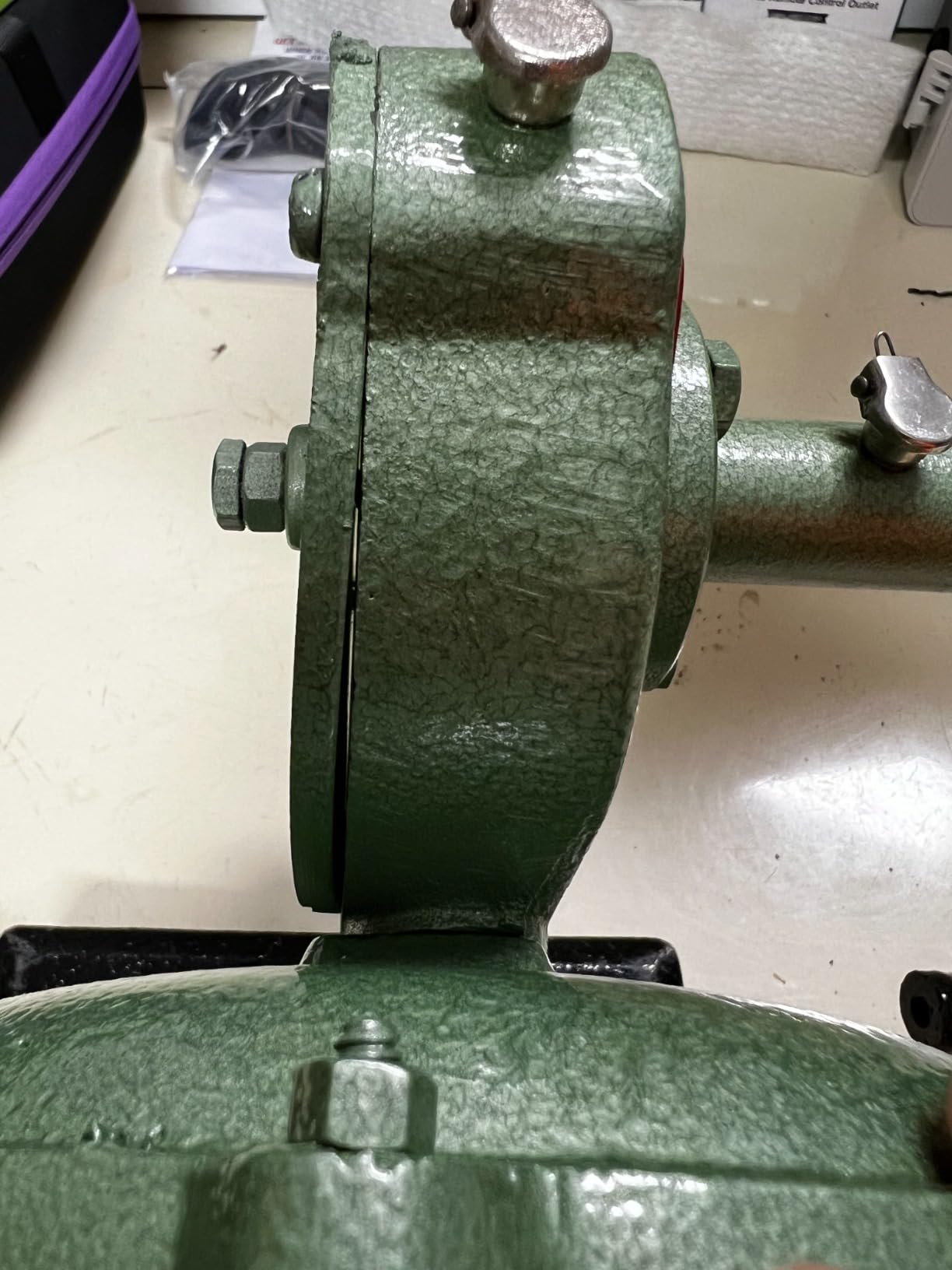
The 1:28 gear ratio sits in the range that most hand crank blower buyers treat as the sweet spot — enough reduction that the crank turns at a comfortable cadence while the impeller spins fast. The casing measures 6 inches with a 1-4/5 inch air outlet, and it is an eight-blade impeller in cast aluminium.
But the honest finding in the reviews, and the reason this is not higher in the list, is that several owners report the airflow is insufficient for a coal forge. It is praised repeatedly for fireplaces, fire pits and light forge work. A coal bed is a far more demanding air path than a fire pit.
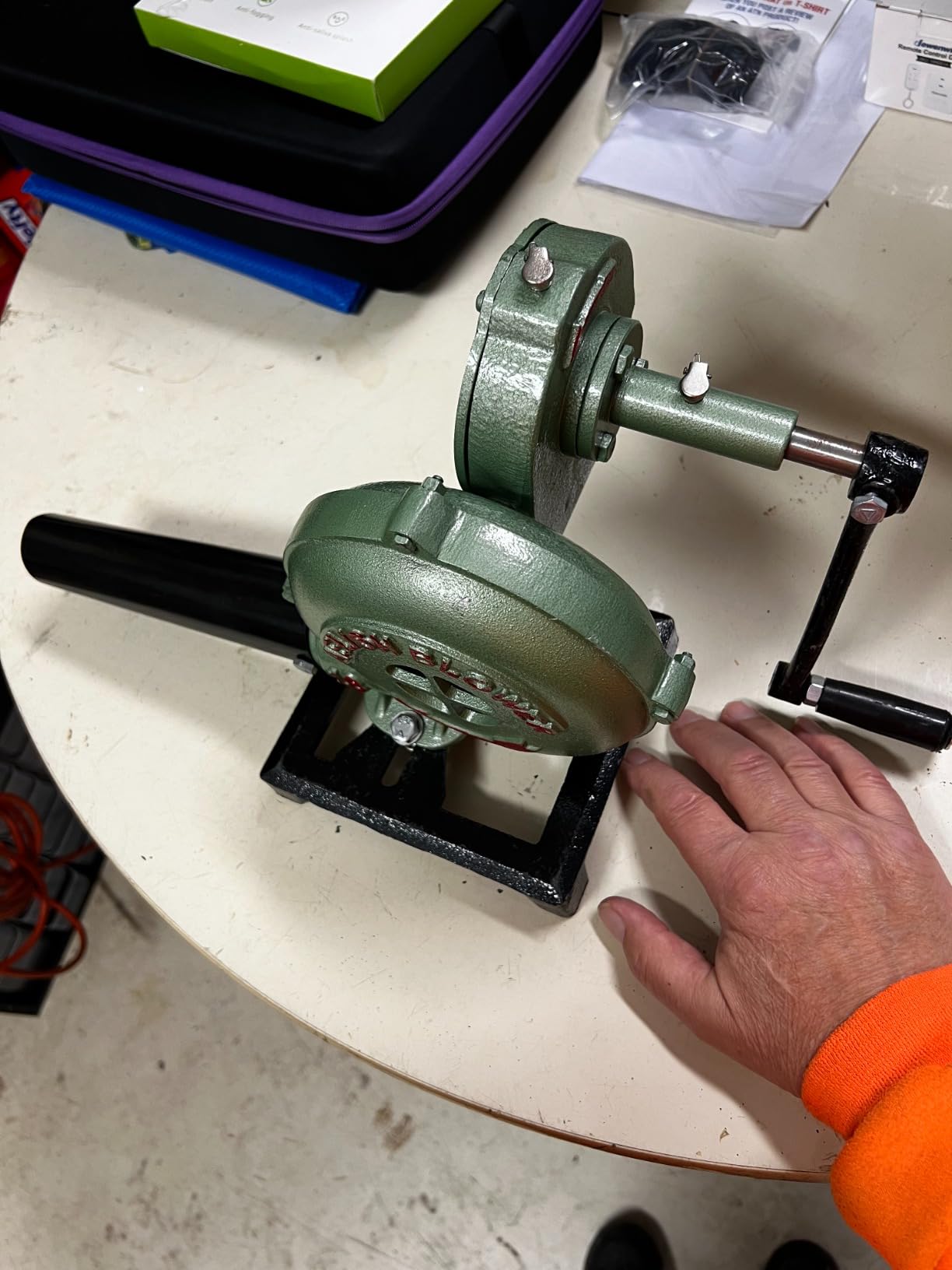
Assembly quality is the real variable
Three recurring complaints point at the same issue: fit and finish. Owners report cast parts that do not always mate tightly and let oil leak from the gear case seams, and a supplied open-ended wrench that does not fit the bolts or nuts. The stand is described as flimsy, with the blower able to walk away from it during cranking.
All of that is manageable if you check it on day one. Run the gearbox by hand for free smooth rotation, tighten the casing fasteners properly, and fix the blower to your bench or floor rather than trusting the stand alone. Budget an hour with a wrench you trust.
Who it suits and who it does not
This suits a smith whose coal work is occasional, whose firepot is small, and who wants a cast aluminium hand blower with a real gearbox at a sensible outlay. It also works well as a fireplace and fire pit blower, which is how most owners use it.
Skip it if coal is your primary fuel and you want sustained output — the complaint about insufficient airflow is consistent rather than occasional. In that case, either move up to the 8 inch casing with the 2 inch outlet later in this list, or go electric.
5. BSTJXDZ 300CFM 780 Pa Blower — Best for Restrictive Tuyeres and Static Pressure
300CFM Blower Fan, 780 Pa High Pressure 110V Electric Blacksmith Coal Forge Blower
Advertised 300 cfm at 780 Pa
370W 110V motor
Aluminium construction
3 inch outlet, adjustable speed
Pros
- High 780 Pa pressure figure aimed at holding a coal fire
- Variable speed adjustment to match airflow to the workpiece
- Metal construction rated for sustained use near a hot forge
- Compact and easy to install relative to its output
Cons
- Advertised 300 CFM conflicts with the 180 cfm listed spec
- Only 12 reviews so durability is largely unverified
- Variable speed depends on a controller that may not be included
- 4.7 kg blower is heavy for a compact shop
Model JX001 is a 370 watt 110 volt blower advertised at 300 CFM and 780 Pa.
Why pressure matters more than volume here: a tuyere is a restriction. Air has to be pushed through a narrow pipe, through a grate, and up into a bed of coal that gets progressively more blocked as clinker builds on the firepot floor. A high pressure fan keeps pushing air through that restriction while a high volume low pressure fan simply stalls.
There is adjustable speed on this blower, so you can match airflow to the workpiece rather than running flat out, and aluminium construction is specified for sustained use near a hot forge. It weighs 4.7 kg, so it is a substantial machine that you will want positioned once rather than carried around.
Now the caveat, and it is a significant one. The advertised 300 CFM conflicts with the listed airflow specification of 180 cfm on the same listing. The 780 Pa figure is consistent with the high-volume claim and inconsistent with the low-volume one, so the pressure capability is the specification you can lean on and the volume figure you should not quote to anyone.
Why 3 inch outlet matters for a deep fire
The 3 inch outlet is larger than anything else in this roundup, and for a deep firepot that is an advantage rather than a nuisance. A 3 inch outlet can be reduced to 2 inch with a short reducer, and a larger outlet before the reduction means less pressure loss on the way in.
It also means adapters. If you are running a 2 inch tuyere, buy a 3 to 2 inch reducer and a length of 2 inch pipe to reach the firepot, and seal the joint properly so you do not lose pressure at the connection.
Is 12 reviews enough to trust it?
It is enough to know there is no widespread failure mode, and not enough to know how it behaves after a thousand hours. The distribution shows zero one star and zero two star ratings, which is a good sign, but twelve data points is twelve data points.
Given that, treat it as a shop tool you will inspect rather than a lifetime purchase. Check the speed control works, confirm the outlet is round, and give it a proper mounting spot where airflow is not restricted on the intake side.
6. BSTJXDZ 240CFM Variable Speed Blower — Best When You Want Air Control in the Box
110V 240CFM Variable Speed Electric Forge Blower Fan for Blacksmith Coal Forge
240 cfm maximum airflow
Included 110V fan speed controller
Adjustable intake restrictors
2.5 inch outlet that accepts 2 inch pipe
Pros
- Speed controller is included
- which no other blower here includes
- Adjustable intake restrictors add a second layer of air control
- Reaches welding heat on a medium coal forge at full speed
- Substantial heavy housing rather than a lightweight plastic fan
- Usable for ducting and shop ventilation beyond forging
Cons
- Not quiet for a fan of this output
- Speed control is not linear with most change in the top fifth of the range
- Only 8 reviews to judge durability by
- 2.5 inch outlet may need an adapter depending on your setup
Air control is the thing that separates a blower you can run a coal fire with from one you fight, and this one ships with the control built into the box. You get a 240 CFM maximum airflow blower, a 110V fan speed controller, and adjustable intake restrictors as standard. Nothing else in this roundup includes its controller.
Those restrictors are the part owners single out. Instead of only varying the motor speed, you can physically restrict the intake, which changes airflow behaviour in a way a dimmer alone does not. Two independent controls on a coal fire is the difference between holding a heat and losing it.
At full speed, owners report it can blow coals out of a firepot and that combined with the intake shutters it reaches welding heat easily on a medium coal forge. That is the correct operating envelope for a blower of this class, and it is exactly why the included control matters.
The 2.5 inch outlet accepts a 2 inch pipe internally, which is a nicer arrangement than a reducer. You can push 2 inch pipe straight into the outlet and seal it, losing less pressure than stepping down through a fitting, and that is a real advantage when you are fighting a restrictive tuyere downstream.
Construction is the other selling point. Owners describe a substantial, heavy housing that feels like shop equipment rather than a lightweight plastic fan, and the listing specifies a heat resistant housing and sealed bearings for dusty, high heat environments. It also works for ducting and general shop air moving, so it is not a single-purpose tool.
The speed control is not linear, and you need to know that
This is the one substantive complaint, and it is worth planning around. Most of the RPM change happens in the upper fifth of the controller range, so the first half of the dial barely does anything perceptible. Dialling in a light air is therefore harder than the dial suggests.
Work around it by using the intake restrictors for fine control at the bottom of the range and the speed control for the top end. Owners who get good results treat the controller as a coarse adjustment rather than a continuous throttle.
How much evidence sits behind the 5 star rating
Eight reviews, all five star. That is a genuinely enthusiastic but very thin sample, and a perfect distribution this small tells you more about the first buyers than about the long term.
Because the control hardware is included, this is a blower whose main risk is mechanical rather than electrical. Check the controller feels smooth across its travel, confirm the restrictors move freely, and confirm the impeller spins true before you rely on it.
7. Simond Store HB-25 8 Inch Hand Blower — Best 2 Inch Outlet Hand Crank for a Bigger Firepot
SIMOND STORE Hand Crank Blacksmithing Forge Blower, 8 Inch Casing
8 inch cast aluminium casing with 2 inch outlet
1:28 gear ratio
Eight-blade cast aluminium impeller
40 dB listed noise level
Pros
- 8 inch cast aluminium casing moves more air per crank than the 6 inch model
- Eight-blade cast aluminium impeller on a 1:28 gear ratio
- Heavy duty steel handle pipe and stand
- Very low listed 40 dB noise for a manual blower
Cons
- Only 5 reviews so durability is largely unverified
- Single oil port means frequent re-oiling in long sessions
- Hand cranking a large casing is harder work than a small one
- Lightweight feel at the handle in some reports
The 8 inch casing is the whole argument for this one. A larger casing with a 2 inch outlet moves more air per crank revolution than a 6 inch casing, and the 2 inch outlet means it connects directly to standard 2 inch pipe and a normal tuyere without an adapter. That outlet mismatch is the single most common complaint forum users raise about budget hand blowers, and this one simply does not have the problem.
Internally it is a serious hand blower: an eight-blade cast aluminium impeller in an 8 inch cast aluminium casing driven through a 1:28 gear ratio, with a heavy duty steel handle, pipe and stand. The dimensions are 17 by 6 by 11 inches, so plan a larger footprint than the 6 inch model, and expect more cranking effort per revolution.
The listed noise level of 40 dB is the lowest published figure in this roundup. For a hand blower that is plausible, because there is no motor and no impeller whine — just gearing and rushing air. If noise is a real constraint in your space, this is the quietest thing here.
It ranks as a tabletop mount and is intended for farrier, blacksmith and coal forge firepot work as well as fireplaces, fire pits and outdoor cooking. The material entry is cast aluminium for the impeller and casing, and the finish is oil rubbed.
One oil port is provided, and that is the practical weakness. On the 6 inch model you get two ports; here you get one, so lubrication is less convenient and you will need to re-oil more often during extended cranking sessions. A hand blower that is under-oiled is exactly how gearboxes fail, so this is not a trivial difference.
How the 1:28 ratio feels under load
A 1:28 reduction is in the comfortable range for sustained cranking: the handle turns at a cadence you can hold for minutes rather than a few seconds, while the impeller still spins fast enough to move real volume. The cost is that an 8 inch casing presents more resistance than a 6 inch one, so a full blast takes deliberate effort.
Smiths who move from a small hand blower to a large one describe the first few sessions as a genuine adjustment. Set the stand at a height that lets you crank with your arm hanging rather than your shoulder raised, and you will get through it quickly.
Where it fits against the electric blowers
With only five reviews and no one-star or two-star ratings, the signal is positive but thin. That is a fair summary of buying a hand blower on secondhand knowledge, and it is why the used vintage route below is worth considering.
Choose this over an electric blower if you want no power dependency and near silence. Choose an electric blower instead if you are doing long sessions or forge welding, because no hand blower, at any casing size, keeps the fire hot while you are not cranking.
8. Pinelicorn 141CFM 250W Electric Blower — Best Electric for a Small Firepot
Pinelicorn 110V 250W Electric Forge Blower, Blacksmith Forge Charcoal Chimney Starter, Air Mover Blower BBQ Fan Centrifugal Fan with 140CFM
250W pure copper motor
141.26 cfm at 500 Pa
Cast aluminium cage housing with rotatable shell
5.86 lb, 9.41 by 7.68 by 10.42 inches
Pros
- Cast aluminium cage housing described as sturdy and wear resistant
- Six fan blades with an adjustable inlet for airflow control
- Rotating outer shell opens for heat dissipation and safety
- Compact 5.86 lb body that is easy to carry between the shop and a club forge
- Usable for shop ventilation and ducting beyond forging
Cons
- Modest 141 cfm output suits a small or medium firepot only
- Only one review on record so reliability is unverified
- Speed controller supported but not included
- Below the air needed for a deep coal fire
At 5.86 pounds and 9.41 by 7.68 by 10.42 inches, this is the blower you can carry to a shared club forge or an outdoor session without thinking about it. The motor is a 250 watt pure copper unit driving a centrifugal cage blower with six fan blades behind a cast aluminium housing.
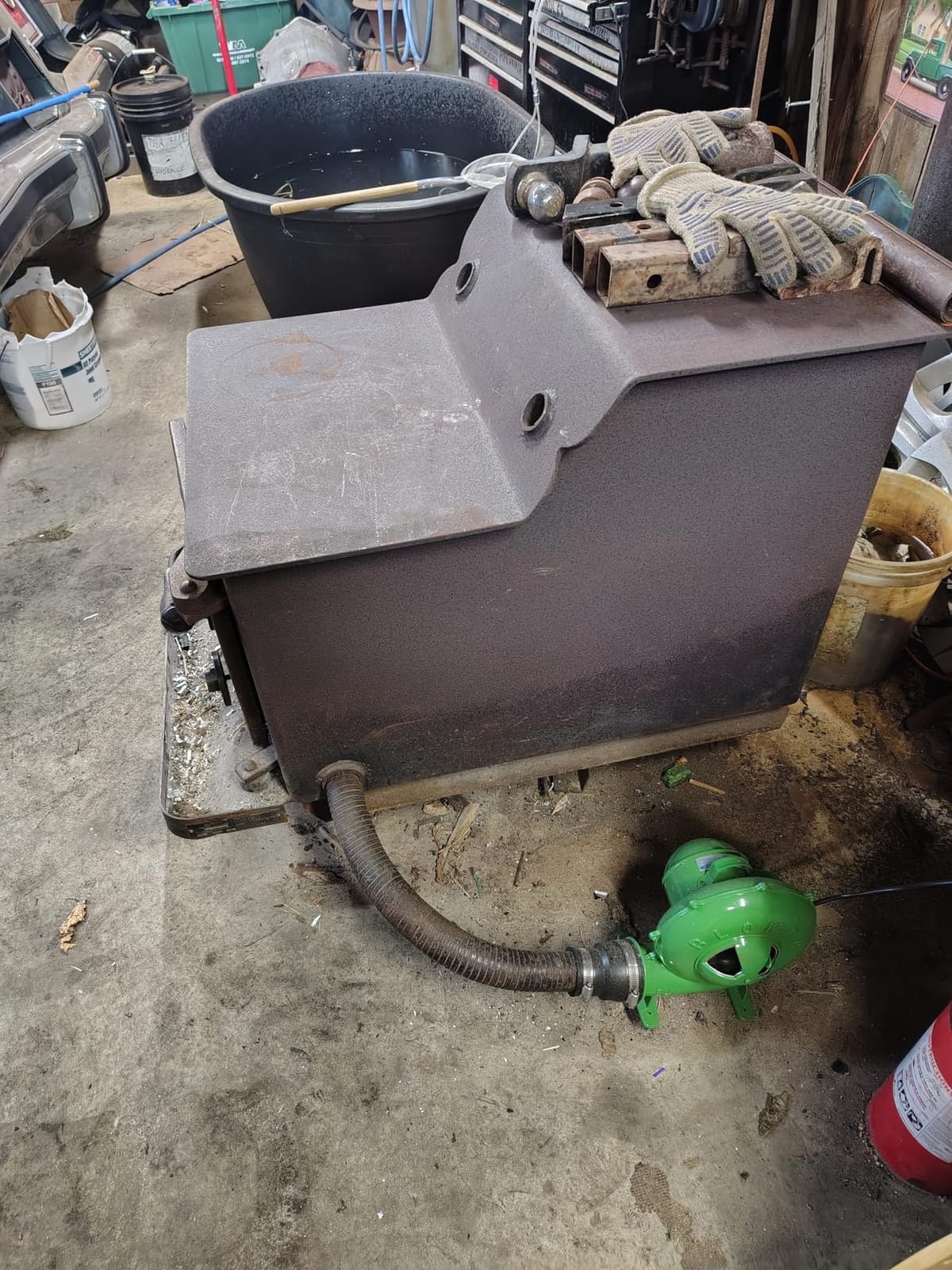
It publishes the most complete pressure figure of any budget blower here: 500 Pa at 141.26 CFM. That is an honest pairing rather than a headline number, and 500 Pa is a usable working pressure for a small or medium firepot where the air path is not fighting much restriction.
The adjustable inlet on the six blades gives you a second airflow control, and a variable speed controller is supported if you buy one. The rotatable outer shell is a nice practical touch — it opens for heat dissipation, which matters when the blower is sitting close to a forge all afternoon.
This is the right blower when your coal fire is a small to medium firepot, when you need something portable, or when you want an air mover that also handles ducting and ventilation jobs around the shop. The 141 CFM figure is well matched to a light fire that you want to hold at forging heat rather than drive to welding heat.
Be clear-eyed about the one review. A single rating of 5.0 carries almost no statistical weight, so everything above is based on the published specification rather than on owner experience. The listing itself notes the low airflow figure as its main limitation, and that is accurate for deep fires.
When this one is the wrong call
If you run a deep coal fire or do forge welding, 141 CFM is simply not enough air. The blowers earlier in this list are in a different class, and the difference shows up immediately when you try to soak a billet.
It is also the wrong pick if you want air control out of the box, because the controller is supported but not supplied. Budget for that, or choose a blower that includes one.
Why portability is more valuable than it sounds
For a hobby smith, weight is a real constraint rather than a spec. A blower you can move with one hand goes to the club forge, to the outdoor demo, and back to the garage bench. A 10 pound cast blower stays where you put it.
At 5.86 pounds with a cast aluminium cage housing, this blower gets you most of the durability story of a heavier blower at a fraction of the handling weight, which is a reasonable trade for light duty work.
How to Choose a Forge Blower for a Coal Fire
CFM and static pressure are both required
Never buy on CFM alone. A fan quoted at 300 CFM delivers that number into open air with no restriction, and delivers considerably less once it is pushing through a tuyere, a grate and a bed of coal. Ask what pressure the blower is rated at, and if the maker does not publish it, assume the low end of its capability.
Work in one system and be able to convert mentally. 1 inch of water column is roughly 249 pascals, so the 780 Pa blower in this roundup is about 3.1 in. w.c. and the 500 Pa blower is about 2 in. w.c. The 5 in. w.c. figure that shop forges are commonly specified at is well above both, which tells you something useful about what a deep tuyere demands.
The general rule of thumb: match the blower to the fire, not to a spec sheet. A small firepot needs far less than a deep coal fire, and over-airing a fire is as common a mistake as under-airing it.
Gear ratio and gearbox type on hand crank blowers
For a hand crank blower, the ratio tells you the reduction between crank and impeller, with common figures running from 1:25 to 1:36. A higher number means a slower, more comfortable crank cadence with a faster impeller. The 1:28 on both Simond blowers and the 1:36 on the LINJIN blower all sit comfortably in that working range.
The material matters more than the number. Cast iron gears running in an oil bath, as on the vintage Champion 400 and Buffalo blowers, are treated in forums as the gold standard. Plastic worm gears in a sealed case will do the job but they do not have the same service life, and a dry gearbox is the number one killer of hand crank blowers including vintage blowers.
The seven signals of a quality hand crank gearbox are simple: cast iron rather than plastic gearing, an oil bath or visible oil ports, smooth free rotation when you turn it by hand, no gritty feeling as the gears mesh, no oil weeping from casing seams, a solid stand or mounting provision, and a handle that does not wobble on the shaft.
Outlet size and tuyere match
Match the blower outlet to your tuyere before you buy, not after. A 1 inch or 1-4/5 inch outlet on a small hand blower means a bag of adapters to reach a normal tuyere, and that mismatch is one of the most repeated frustrations in forum threads. A 2 inch outlet is the most convenient size because it accepts standard 2 inch pipe directly.
For reference, most hobby shop forges are fed through 1 inch or 1.5 inch tuyere fed by 1.5 inch or 2 inch pipe. Buying a blower with a 2.5 inch or 3 inch outlet and a reducer gives you the most flexibility, and provided the reducer is sealed well, the pressure loss is manageable.
Impeller and casing material
Cast aluminium is the sweet spot for a hand crank blower: light enough to carry, stiff enough not to flex at speed, and it will not rust the way sheet steel does. Cast iron is heavier and tougher. Stamped sheet metal is the budget option and it flexes, which is not ideal near sustained heat.
For electric blowers, cast aluminium housing is again the standard and it is what you want. Impeller blade material is more of a mixed picture, with plastic blades appearing on several blowers here; they run fine but a metal impeller is preferable if you are running long sessions and dealing with coal dust ingestion.
Air control is the feature you will use most
Ask what air control the blower gives you on day one, before any accessories. A gate valve, intake shutters, an included speed controller and a variable-speed motor are four different approaches, and more than one of them at once is best.
On a coal fire you will use control constantly. The common complaint pattern across this whole category is that a fixed-speed blower either cannot hold a fire or blows it out of the firepot, and the fix in nearly every case is the same: add a control.
Weight, noise and storage
Weight decides whether you will move the blower between the garage, the club forge and a demonstration. The range here runs from 5.86 pounds to 11 pounds, and that difference is very obvious when you are carrying it across a yard.
Noise matters more than most people expect. Published figures here range from 40 dB for a hand blower to 69 dB for a centrifugal electric fan, and if you share a building with a household that difference is a quality of life issue. Hand crank blowers are the quiet option by a wide margin.
Who should skip a blower entirely
If your forge runs on propane, you do not need any of this. A propane forge has a fixed burner with its own air supply, so the entire roundup is irrelevant to you.
If you run only a charcoal chimney or a small firepit for warming, a shop vac, a hair dryer or a leaf blower will light and hold the fire. That is a genuinely common first step among beginners, and it costs almost nothing. Our guides to the best leaf blowers for fall cleanup and the best commercial leaf blowers for landscapers cover the blowers hobby smiths most often repurpose for exactly this.
The limits are worth being precise about, because this is where buyers go wrong. A leaf blower, shop vac or hair dryer can move enough air to light and hold a light coal or charcoal fire, but a deep coal fire needs a purpose-built blower that can deliver air against static pressure. A 400 CFM free-air figure from a leaf blower may fall well short once that air is pulled through a tuyere and a bed of coal. Match the source to the fire, not to the headline number.
Whichever air mover you settle on, a second pass is worth it before you commit. Our roundups of the best cordless snow blowers for small driveways and the best battery snow blowers for suburban homes apply the same airflow-versus-pressure reasoning, and it transfers directly to a fire that fights back.
Buying a Used or Vintage Forge Blower Without Regretting It
Neither Champion nor Buffalo is manufactured any more, so if you want a cast iron gear in an oil bath the secondhand market is the only route. On forums those vintage American blowers are treated as the gold standard and close to a buy of a lifetime, and the secondhand search is worth doing before buying anything new.
The most common regret in a used vintage blower purchase is not a broken part, it is a seized or dry gearbox that nobody tested before the sale. Work through this checklist in the order below, and walk away from the first two without hesitating.
First, turn the crank. The gearbox should spin freely and smoothly with no gritty sensation as the gears mesh. A blower that only turns in short bursts, or that you can feel binding at one point in the revolution, has a problem and it will get worse fast.
Second, check the oil. Vintage blowers run an oil bath or at minimum a heavily oiled gearbox, and a dry gearbox is the leading cause of failure on blowers of this age. Ask the seller when it was last serviced and look for fresh oil at the sight glass or port. If the seller cannot say, assume it has been dry.
Third, look at the casing. Dents and flat spots in a cast iron or cast aluminium casing distort the impeller clearance, which makes the blower noisy and reduces output. Run a hand along the inlet and outlet for flat spots.
Fourth, listen to the bearings. Spin the impeller by hand and listen for rumble, scraping or a rough sound. A noisy blower is a blower with bearing wear, and bearings are the expensive part to replace.
Fifth, check the shaft and handle for wobble. Play in the handle or a crank that feels loose at the shaft means worn bearings or a stretched shaft. This is a common failure on blowers that have been dropped or hauled hard.
Finally, ask about parts. On a discontinued blower the deciding factor is whether impellers, shafts and gear parts are findable. If the seller cannot tell you and the seller seems not to care, walk away, because you will need those parts eventually.
There is also a well-trodden middle path. Smiths who love a vintage blower and want electric freedom have discussed retrofitting a motor onto an old crank blower, and you will see the RPM question worked out in detail on enthusiast forums. It is a satisfying project for a mechanically minded hobbyist, and it is not a weekend job for a first forge.
Coal Forge Blower Safety and Maintenance
Coal is harder on a blower than propane or charcoal, and the maintenance is specific. Practical Machinist thread participants describe forges and their blowers winding up caked with a mixture of coal dust, fly ash, soot and oil leaked from the equipment, and that caking degrades performance in a way that is easy to overlook because the fire gets a little lazy rather than obviously failing.
So make impeller cleaning part of your routine rather than an emergency. With the blower off, unplugged if electric, open the housing where the design allows and wipe the impeller and casing down. Do it every few fires on a coal setup and the difference in delivered air is immediate.
Watch for clinker specifically. Clinker is the fused ash and slag that builds on a coal firepot floor, and it blocks the air path before it ever reaches the blower. A tuyere that has been fully crusted over will starve the fire and force you to crank harder for less air, which accelerates the wear you were trying to avoid.
On the electric side, cord management around an open coal fire deserves more attention than it gets. Run the blower on a GFCI-protected outlet, route the cord well clear of the firepot and away from anywhere sparks travel, and never leave it on a damp floor or where a hose can get run over. Keep the intake clear of combustibles, because a centrifugal fan pulls air in from all sides.
For personal protection, wear ANSI Z87.1 rated eye protection and a face shield when opening clinker, because it can burst off a hot firepot floor without warning. Skip synthetic clothing near the fire; it melts into skin faster than cotton or leather. And open a window: a coal fire in a small shop produces carbon monoxide regardless of how good your ventilation looks.
One more habit worth forming early is a written record of which gearbox oil you use and when you last serviced each blower. On hand crank blowers especially, a few drops on the scheduled basis keeps the gearbox alive for decades instead of months.
Frequently Asked Questions
How much air does a coal forge need?
A typical shop forge wants on the order of 100 to 150 CFM at up to 5 inches of static pressure, which is the figure most commonly cited in reference material and in blacksmithing forums. Match the blower to the fire rather than to a spec sheet: a small firepot needs far less than a deep coal fire, and forcing too much air into a hot fire will blow the fire out of the firepot and cool the steel.
What is the strongest blower on the market?
For coal forges, the strongest blowers in practical use are the high pressure electric blowers, which publish figures in the 240 to 300 CFM range paired with 780 Pa of pressure. That pairing matters more than volume alone, because a deep tuyere and a coal bed create serious back pressure and a high volume low pressure fan will simply stall.
Can you use a leaf blower for a forge?
Yes, for a small firepot. A leaf blower, shop vacuum or hair dryer can move enough air to light and hold a light coal or charcoal fire. A deep coal fire needs a purpose-built blower that delivers air against static pressure, because the air has to be pushed through a tuyere, a grate and a bed of coal that resists flow.
Is 400 CFM enough for a leaf blower?
The number that matters is delivered CFM at your static pressure, not the free air rating. A 400 CFM free air figure from a leaf blower can fall well short once air is pulled through a tuyere and a bed of coal, so treat the box figure as an upper bound and size the fire to what the blower can still push through the restriction.
Which is better for blacksmithing, coke or coal?
Coke burns hotter and cleaner, while coal is cheaper and far more available. A coke bed generally demands more air than a coal bed, so if you switch fuels expect to open up your air control. Neither fuel fixes a poorly drafted fire: airflow, not fuel choice, is the limiting factor for reaching forging heat.
The Verdict: Which Forge Blower Should You Buy in 2026?
If you want one answer for most people building a coal forge in 2026, the Sunlar 110V 250W electric blower is the pick. It has the largest body of owner evidence behind it, it moves enough air to hold anthracite at welding heat, and at 5.9 pounds it is easy to move. Add a gate valve or speed controller, because the one consistent complaint is that it is overpowered on a small firepot.
Choose the LINJIN 1:36 hand crank blower if you are working off-grid or outdoors on a small firepot and want zero noise and zero power dependency. Choose the Simond Store HB-25 with its 8 inch casing and 2 inch outlet if you want a hand crank with real air volume and a direct fit to standard 2 inch pipe.
For a deep fire with a restrictive tuyere, buy on pressure rather than volume, which points to the BSTJXDZ 780 Pa blower. For a medium fire where you want usable air control out of the box, the BSTJXDZ 240CFM blower is the one that ships with its speed controller and intake restrictors. And the Pinelicorn blower is the pick when portability matters more than air volume.
Whichever you choose, buy the air control alongside it, keep the impeller clean of coal dust and clinker, and run the electric options on a GFCI outlet well clear of the fire.