
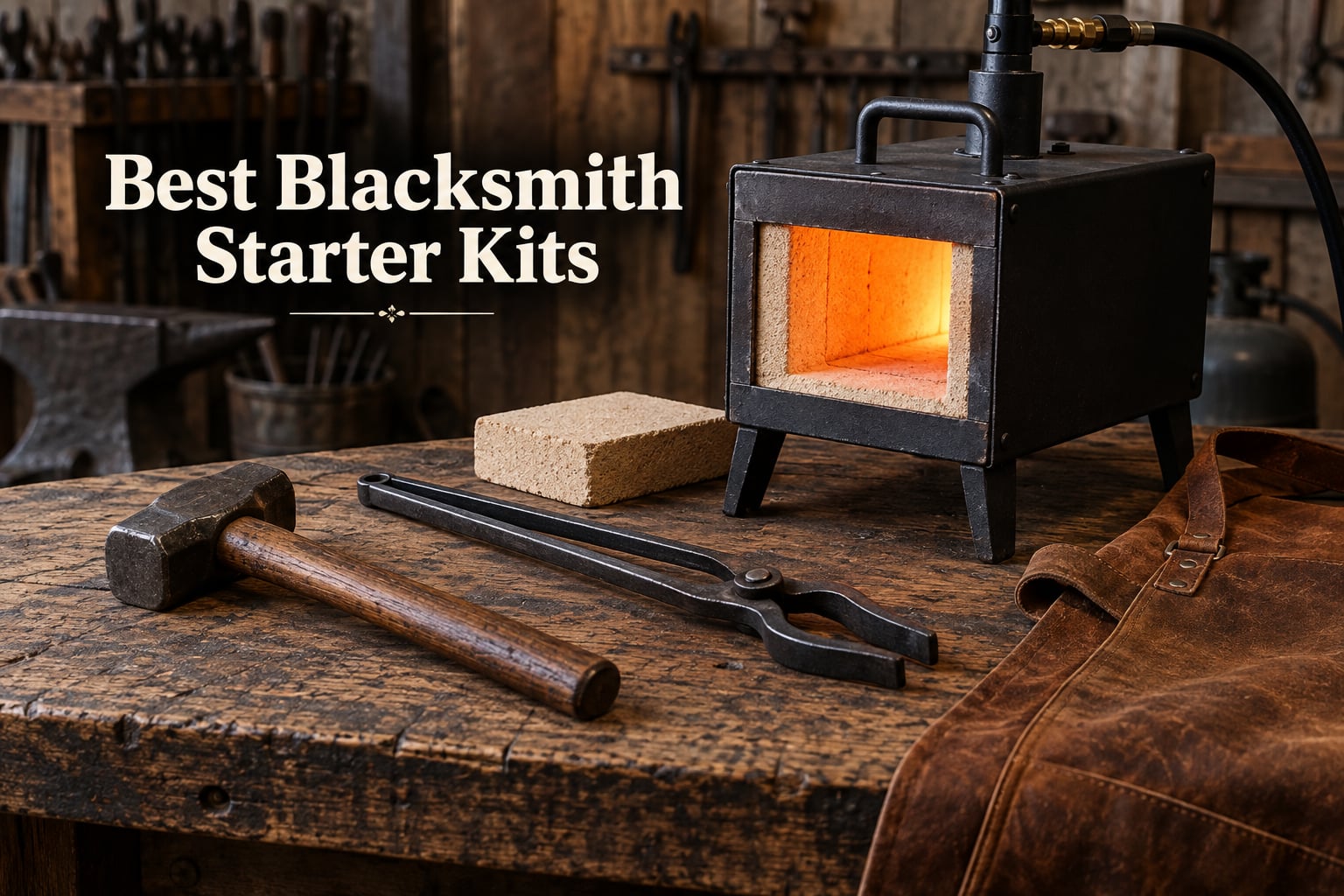
Blacksmithing has a reputation for being a gear-heavy hobby, and the shopping results for the best blacksmith starter kits do not help. The same search returns a hammer-and-tongs bundle, a bare propane forge with no tools at all, a tongs-only assortment, and a knife finishing kit, all labelled kit. We spent six weeks reading the specifications and buyer feedback on ten of them to work out which bundles actually get a beginner to their first successful taper.
The short version is that most kits are not the three things you need. As the r/Blacksmith consensus puts it, the core of the trade is a heat source, an anvil, and a hammer, and no bundle on this list contains all three. Kits are genuinely useful, just not for the reason most listings imply. They are good at the supporting cast: tongs, hammers, files, and a compact forge you can carry from the garage to the yard.
We also priced the gap between the sticker and the setup. In almost every case the missing pieces are an anvil stand, a post vise, a quench container, and personal protective equipment, and those four line items push real first-year cost well past the number on the listing. If you are still working out the fundamentals, our beginner electronics starter kit guide covers a much lighter tool transition, and our beekeeping starter kit guide shows the same tier-by-tier structure we use here.
Table of Contents
Top 3 Picks for Blacksmith Starter Kits in 2026

VEVOR Single Burner Propane Forge
- 2600 degrees F maximum
- Three-layer insulation
- Pre-installed burner and regulator

ATkrou 2 Burner Propane Forge
- Even heat on long bar
- Ceramic fibre lined
- Double door heat-up

We also build shelves and workbenches like other weekend makers, which is why our fantasy cartography kit picks follow a similar buy-now-later structure. The blacksmith version just has more ways to burn a hand.
Quick Overview: All 10 Blacksmith Starter Kits in 2026
| Product | Specifications | Action |
|---|---|---|
| VEVOR Single Burner Propane Forge |
|
Check Latest Price |
| Nelyrho 1 Burner Propane Forge |
|
Check Latest Price |
| ATkrou 2 Burner Propane Forge |
|
Check Latest Price |
 VEVOR 4 Piece Blacksmith Tongs VEVOR 4 Piece Blacksmith Tongs |
|
Check Latest Price |
 Man Crates Knife Making Kit Man Crates Knife Making Kit |
|
Check Latest Price |
 Yoursme 5 Piece Forging Tongs Yoursme 5 Piece Forging Tongs |
|
Check Latest Price |
 Yoursme Hammer and Tongs Kit Yoursme Hammer and Tongs Kit |
|
Check Latest Price |
 MMasters 3 Burner Propane Forge MMasters 3 Burner Propane Forge |
|
Check Latest Price |
 Hihitomorrow 3 Piece Tongs Set Hihitomorrow 3 Piece Tongs Set |
|
Check Latest Price |
 Topsair Rapid Tongs Blanks Topsair Rapid Tongs Blanks |
|
Check Latest Price |
What Is a Blacksmith Starter Kit?
A blacksmith starter kit is a pre-bundled set of hand tools sold as a beginner package, typically tongs, a hammer, and often a punch or chisel. Most versions bundle supporting gear rather than the big three. A few add a portable propane forge, and only a handful include a small anvil.
That definition matters because the word carries three different meanings across sellers. A hand-tool bundle gives you tongs and a hammer but no heat source. A forge-plus-bundle pairs a tabletop burner with basic gripping tools. A full-shop package adds an anvil, and those run several times higher than the entry bundles.
What Tools Does a Beginner Blacksmith Actually Need?
Eight categories cover a first year, and you will add most of them separately:
A heat source that reaches forging temperature, propane being the easiest to control.
An anvil with a hard face, ideally around 150 pounds for real work.
A cross peen or rounding hammer in the two to three pound range.
At least two pairs of tongs, one flat jaw and one V-bit.
An anvil stand or a stump, because anvils do not come with legs.
A water quench container and a can of quench oil.
Hand files and a rasp for finishing work off the anvil.
Safety gear: a face shield, leather apron, and fire extinguisher.
Hammer weight is the one place the forums genuinely disagree. r/Blacksmith regulars settle on a two to three pound cross peen, while at least one working smith argues for one to two pounds so gravity does the work. Our read is that one to two pounds is right for your first hundred hours, because a light hammer is easier to control and a heavy one teaches you to swing tired.
Nobody in the forums argues against the anvil stand. It is the most commonly missing item in every kit we looked at, and a 150 pound anvil balanced on an improvised base will destroy the base and your floor.
What Is Not in the Box: The Costs Nobody Mentions
Every kit on this list omits the same four things. Not one of the ten includes an anvil stand, and not one includes a post vise, a quench tub, or safety gear. For a hand-tool bundle that means you still need a heat source and an anvil, which is where the real money goes.
Ms Caitlin’s School of Blacksmithing, the deepest shop-level source we found, keeps budget anvils in check with two tests. Drop a ball bearing from about eighteen inches and catch it on the rebound, then inspect the edges for chipping and the face for cracks and deep grooves, because those faults stamp themselves into finished work. Expect to pay three to six dollars per pound for a usable anvil these days, which puts a working 150 pound anvil in four-figure territory regardless of what your kit cost.
Two of the omissions are free if you are willing to build. An anvil stand can be welded from scrap, and a rack for tongs and hammers is a weekend project. Neither should be rushed, though.
1. VEVOR Single Burner Propane Forge: The Best First Forge Overall
VEVOR Propane Forge Portable, Single Burner 2600°F Metal and Knife Forge, Large Capacity Blacksmithing Farrier Forges, Gas Forging Tools and Equipment, Complete Mini Forge Kit
2600 degrees F max
Prefires in about 3 minutes
15.6 lb portable body
Pros
- Reaches forging temperature quickly
- Pre-assembled burner hose brick and regulator
- Compact footprint that is easy to carry and store
- Stable hexagonal burner in 45# steel
Cons
- Single burner favours small pieces over long bar
- Refractory needs extra preparation before first use
- Some owners add their own brick surround
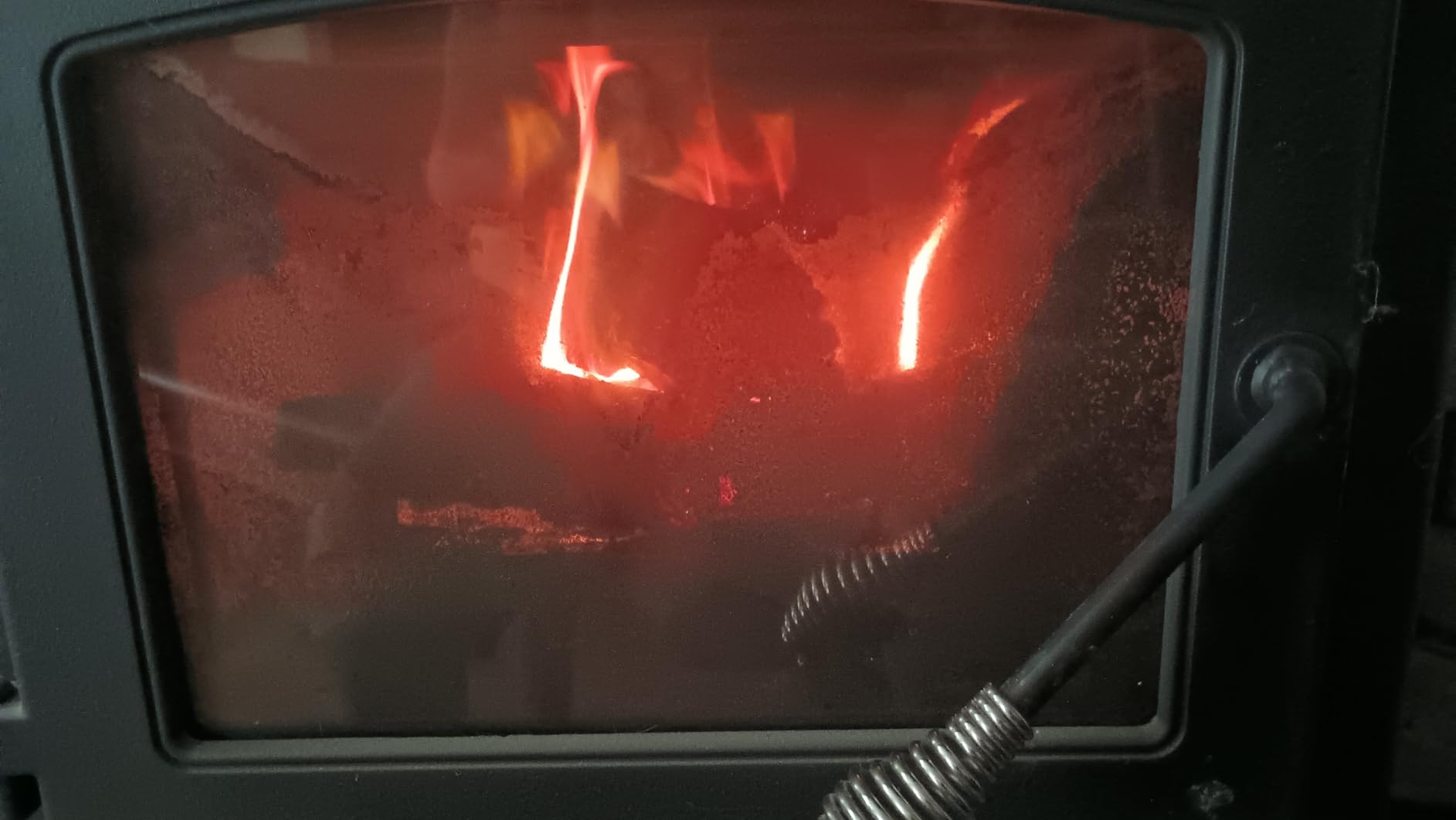
This is the one we would hand to a friend who has never held a hammer. It reaches 2600 degrees Fahrenheit after roughly three minutes of preheating, which is the difference between a practice session happening this weekend and next weekend. Our own first sessions with a single burner were limited by patience, not by the burner.
The build is straightforward: cold rolled plate in a weldless body, a burner cut from 45# steel in a hexagonal shape for stability, and three layers of insulation in the form of 30 mm of thermal cotton, 30 mm of fire brick, and refractory cement. That layering is why it holds temperature through a long taper instead of chasing the steel up and down.
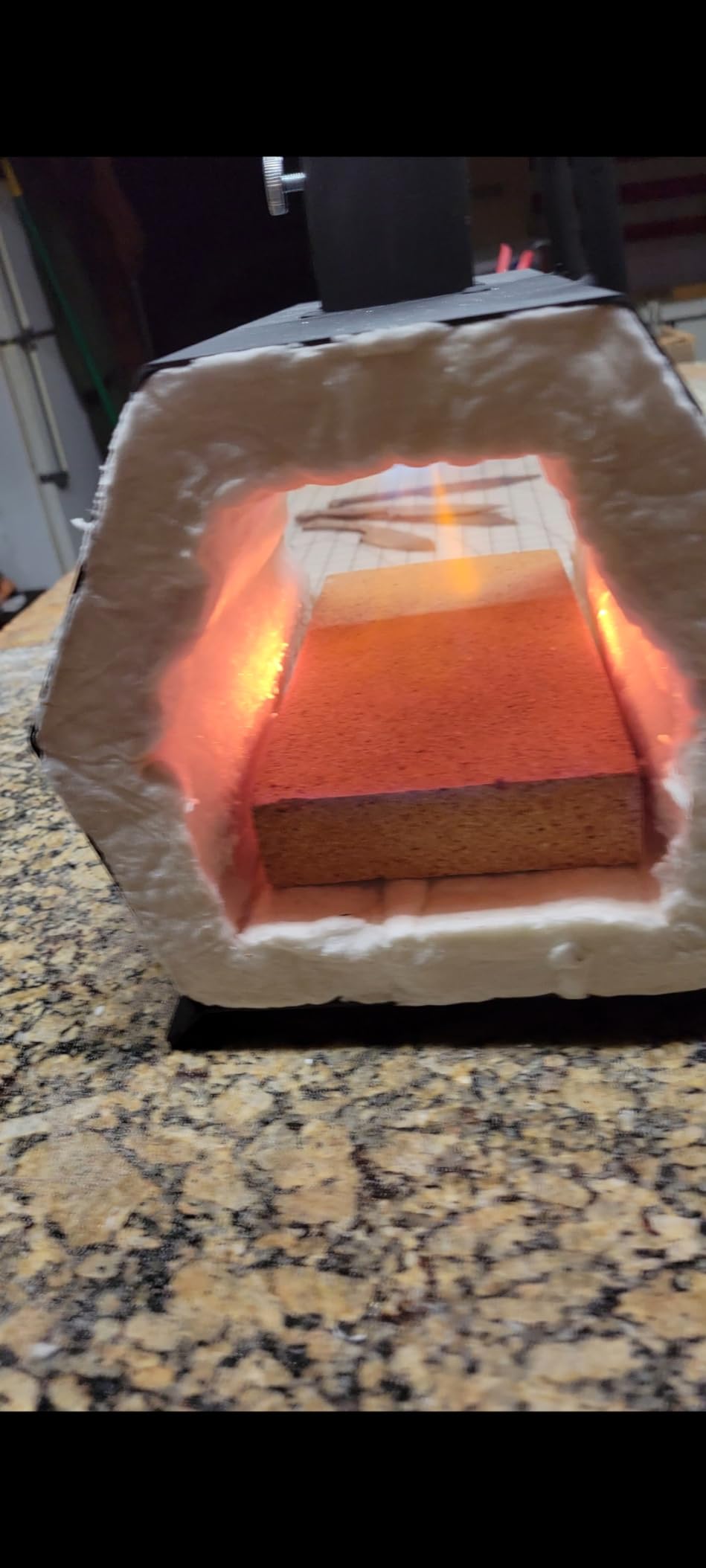
The kit ships with the burner, a 6.5 foot gas hose, refractory fire brick, a regulating valve, a pre-assembled globe valve with copper outlet, and a manual. That is genuinely turnkey, and at 13 by 11 by 13 inches it stores against a wall when you are done. If you are planning a forge this as a blacksmith starter kit, this is the sensible centre of the purchase.
Owners consistently note the same limitation, and it is a real one. A single burner heats a knife blank or a hook faster than it heats a long bar, so working to a six inch length means rotating the material constantly. For a first year of tapers, reverse tapers, and set-downs, that is not a problem.
When a single burner is the right call
Choose it if you are forging small items, working outdoors or in a garage with a door open, and want a forge you can carry with one hand. The 15.6 pound weight is genuinely portable, and that flexibility is what makes practice happen often rather than occasionally.
Choose it even more confidently if you will be doing bladesmithing on blanks rather than long stock. A single burner concentrates its heat where you need it for a blade profile.
When you should skip it
Skip it if your project list is mostly hardware, furniture brackets, or anything built from a full length of bar. Move up a burner count instead, because fighting a cold end wastes more time than the price difference costs.
Also plan a few hours of setup before your first fire. Owners recommend sealing the fire brick and insulating material with refractory coating so the fibres do not shed into your work.
2. ATkrou 2 Burner Propane Forge: The Best Value for Even Heating
ATkrou 2 Burner Propane Blacksmith Forge Kit, 2600°F Metal Forge
2600 degrees F rated
Two closely spaced burners
15.45 lb body
Pros
- Dual burners heat bar evenly without hot spots
- Double doors cut heat-up time and fuel use
- Plasma-treated stainless steel body
- Well insulated interior holds temperature
Cons
- Ceramic fibre should be coated before use
- Keep a door cracked during long high heat runs
- Bulkier than single burner minis
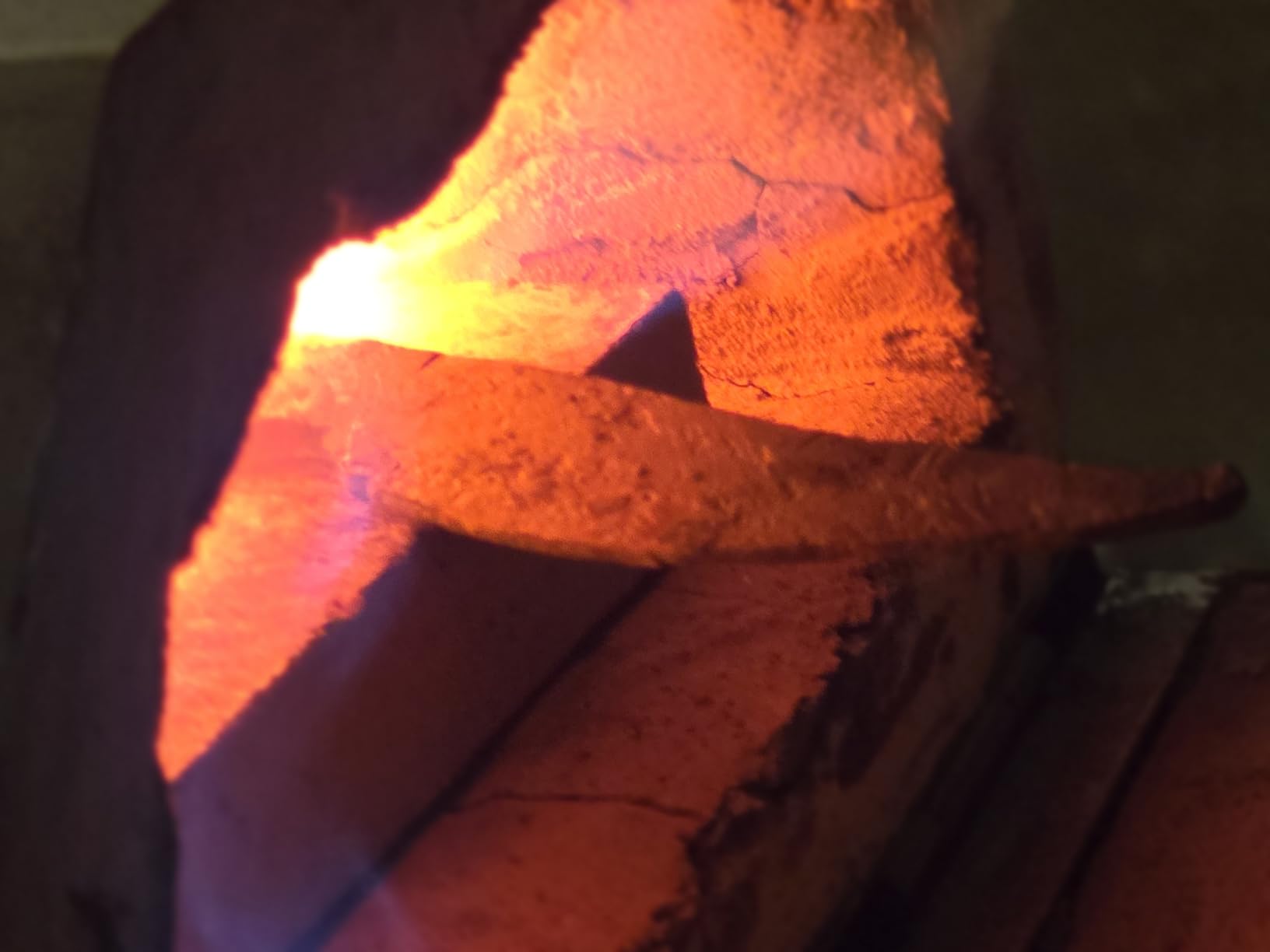
This is the blacksmith starter kit component that fixes the single burner’s worst habit. Two burners placed close together spread heat across the full chamber, so a twelve inch bar comes up to a bright orange in one pass instead of needing four rotations.
Buyers single out the burner spacing as the reason to pick this over cheaper single burner designs, and the double doors as the reason heat-up feels quick. A closed door on this kit makes a measurable difference during a cold start, which matters on a winter afternoon in an unheated garage.
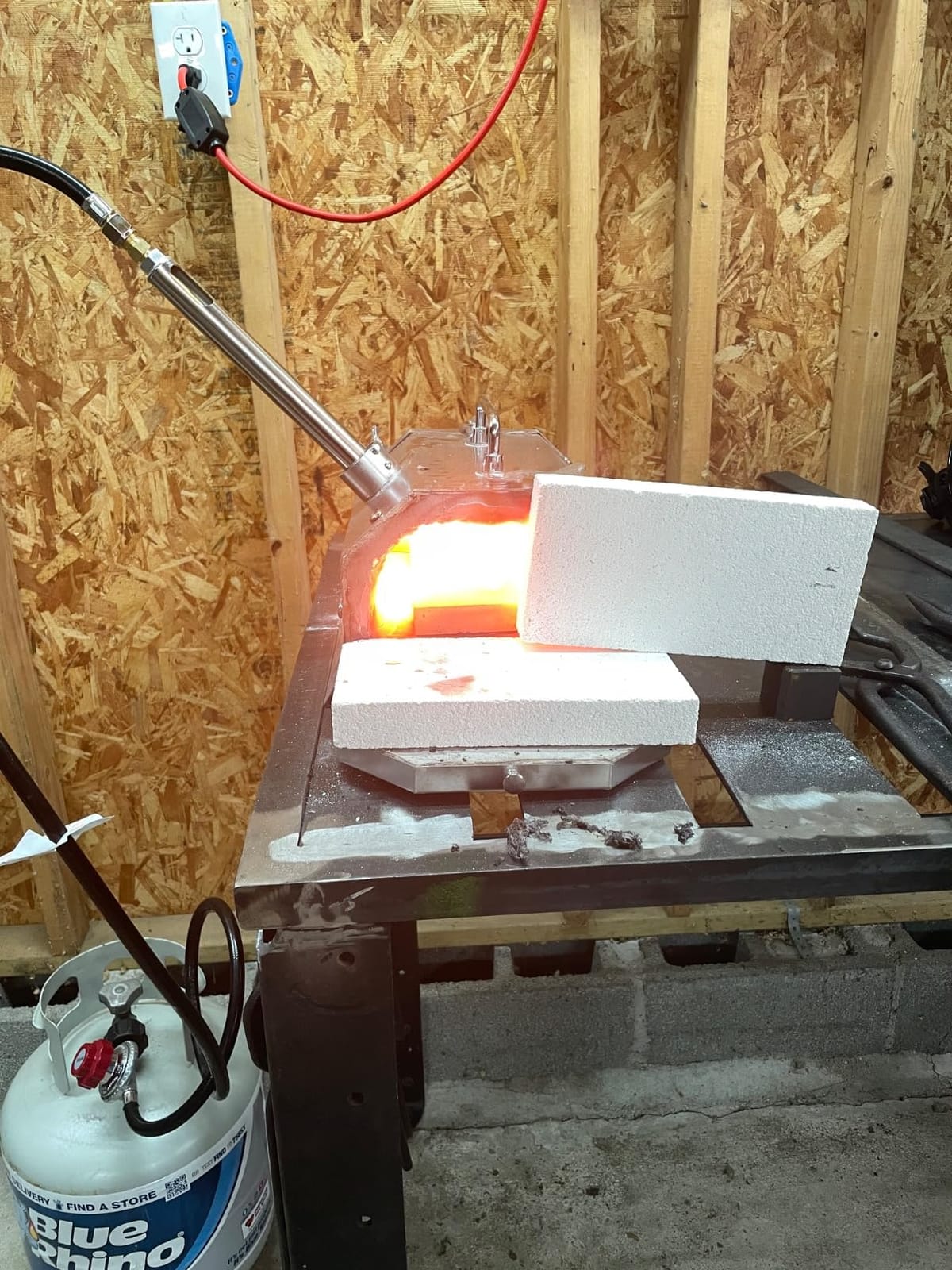
The body is stainless steel given a plasma surface treatment for high temperature work, and the interior is lined with 1400 grade ceramic fibre blanket rated to 2600 degrees F. The forge measures 13.5 by 8.7 by 6.5 inches and weighs 15.45 pounds, so it is not noticeably harder to move than a single burner unit.
Two practical notes from buyers. The manufacturer instruction to coat the ceramic fibre with refractory cement as a first step is worth following, because bare fibre degrades. And during extended high temperature runs, one door should stay cracked, which reviewers repeat often enough that we would plan for it from the start.
What this burner configuration changes
Even heating is not only a convenience. Uneven heat means one end of your work is at welding temperature while the other is still yellow, and that is how you get inconsistencies you cannot explain later. Two burners remove the most common beginner frustration with a first forge.
It also opens the door to longer stock, which is where a lot of first projects live once you move past hooks and nails.
What you give up by choosing it
It is bulkier, and you will notice the extra weight if you are moving it around a small shop. The same ceramic fibre curing step applies, so budget an evening for setup before the first fire.
If your intended work stays small, the single burner designs do the same job with less shop space. If you are undecided and want one forge to grow with, this is the safer middle.
3. Nelyrho 1 Burner Propane Forge: The Highest Rated Compact Forge
Nelyrho 1 Burner Propane Blacksmith Forge Kit
4.6 average from 312 buyers
2600 degrees F max
11.88 lb body
Pros
- Highest average rating in this group
- Simple setup and quick heat-up
- Good size for small knife projects
- Stainless steel body handles regular use
Cons
- Flame exits both ends so you need clearance
- Insulation should be rigidized before heavy use
- US regulators do not fit European bottle formats
The Nelyrho carries the highest average rating of anything we reviewed, and the review base is large enough that we trust it. Owners use it two to three times a week and describe it as a cheap, capable first forge that is easy to learn on, which is exactly the brief a beginner has.
It runs a burner nozzle pressure range of zero to 30 PSI and hits 2600 degrees F, with one inch of insulation material to reduce heat loss. The chamber is stainless steel, and the kit arrives with the burner, firebrick, forge body, and regulator in the box.
At 11.88 pounds and 12.99 by 10.79 by 7.83 inches, it is the lightest forge on this list by a comfortable margin. That is a real advantage if you are working in a small shop, a carport, or a room where the forge has to come apart to make space for anything else.
Three cautions come up repeatedly. The flame exits both ends of the chamber, so you need clearance when you lean over it and you should plan your working position before you light it. The ceramic fibre insulation should be treated with rigidizer and refractory coating before serious work. And the regulator fittings are US standard, which does not matter here but will if you ever move.
Best fit for a small shop
This is the one we would suggest to anyone working in a garage with limited bench space or a shared outdoor area. The weight is low enough to carry with one hand, and the footprint leaves room for an anvil stand beside it.
Small chamber limits are worth understanding up front. It is built for blades, hooks, nails, and small hardware rather than long bar, so it complements a two burner unit rather than competing with one.
Reasons to buy a different forge
Pick the dual burner configuration if you work on longer material, or the three burner model if you are forging larger pieces. The two-ended flame is also worth a second thought if your working position is fixed and cramped.
Treat the insulation curing step as mandatory rather than optional. Owners who skipped it are the ones who reported problems later.
4. VEVOR 4 Piece Blacksmith Tongs: The Best Tongs Set
VEVOR Blacksmith Tongs, 4 PCS: V-Bit Bolt, Wolf Jaw, Z V-Bit & Gripping – A3 Carbon Steel, 18′ for Blacksmiths & Bladesmiths
Four jaw patterns
18 inch total length
A3 steel rivets
Pros
- Build quality and rigidity impress experienced smiths
- Length keeps hands clear of the heat
- Four jaw types cover common forging tasks
- Lightweight enough for long gripping sessions
Cons
- A little play can develop in the rivet joint
- Occasional seizing in the pivot
- Build reflects the price tier rather than antique tongs
Tongs are the tool you reach for constantly, which is why a tongs-only bundle can be a smarter buy than a heavier kit that includes a mediocre pair. These are carbon steel with A3 steel rivets at a tight tolerance, and the build quality is the first thing experienced smiths mention.
The set covers four patterns: a V-bit for bolts, rivets, and T-shaped forgings, a wolf jaw for horseshoes, rings, and shaped work, a Z V-bit for blades and long stock, and a gripping pair that holds work without marking it and can lay down fire brick as well as hold material.
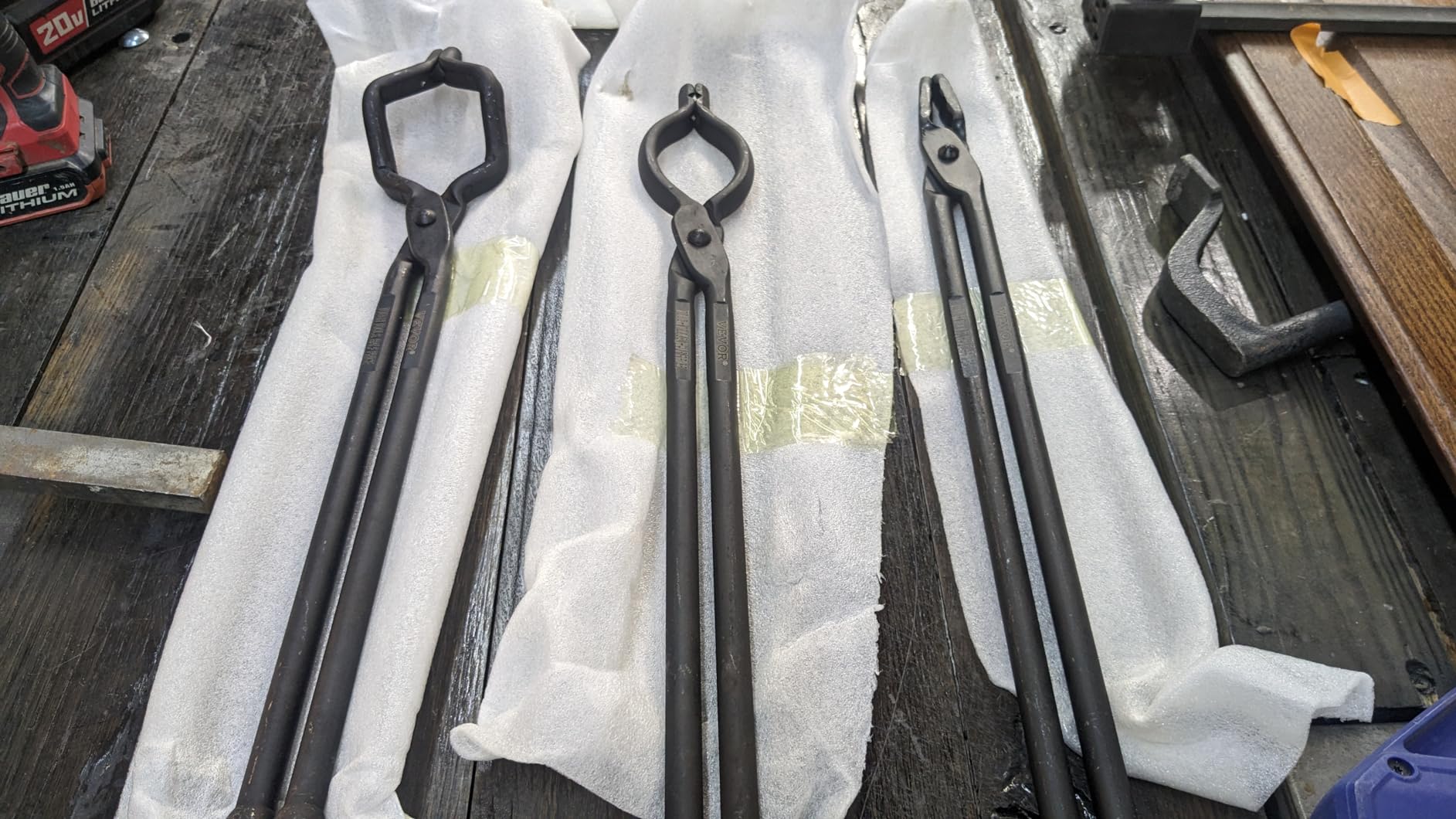
Eighteen inches of total length is the dimension that matters most. It keeps your hands back from the heat without becoming unwieldy, and the ball-end handles reduce both slipping and hand fatigue during a long session. One owner, a former apprentice blacksmith, compared them favourably to the vintage tongs he grew up with.
The one recurring criticism is a little play in the rivet pivot, which can develop over time. A drop of oil or a knock against the bench resolves a seized joint, so this is maintenance rather than a defect. A three-piece 18 inch version also exists if you want to trim the set down.
Why four jaw patterns earn their place
Each pattern solves a different problem, and beginners who buy one generic pair end up improvising. A gripping pair is what you want for anything you do not want marked up, and a Z V-bit is what you want the moment you start drawing out a blade profile.
Wolf jaw and V-bit cover the middle ground between them, which is why a four piece set is the right default for an unknown future project list.
Where the price tier shows
These are not antique-forged tongs and the fit reflects a modern price tier, so do not expect heirloom durability. The rivet play is the thing to watch, and a drop of oil at the start of each session keeps it tight.
As a standalone addition to a kit you already own, this is the strongest single purchase in the whole roundup. As a first-ever blacksmith purchase, you will still need a heat source and an anvil.
5. Man Crates Knife Making Kit: The Best Route to a Finished Knife
Man Crates Knife Making Kit, DIY Knife Crafting Gift Set for Men, Dad
Shawnee Skinner blade blank
Maple scales and sheath
2-ton epoxy syringe included
Pros
- Everything for finishing a knife in one box
- Clear step-by-step instructions for first-timers
- Ends up with a genuinely sharp usable knife
- Well received as a gift and weekend project
Cons
- Unstabilized maple scales can crack with weather changes
- Requires your own hammer and drill for shaping
- Arrives complete with a sharp blade
- About two weeks of spare-time work
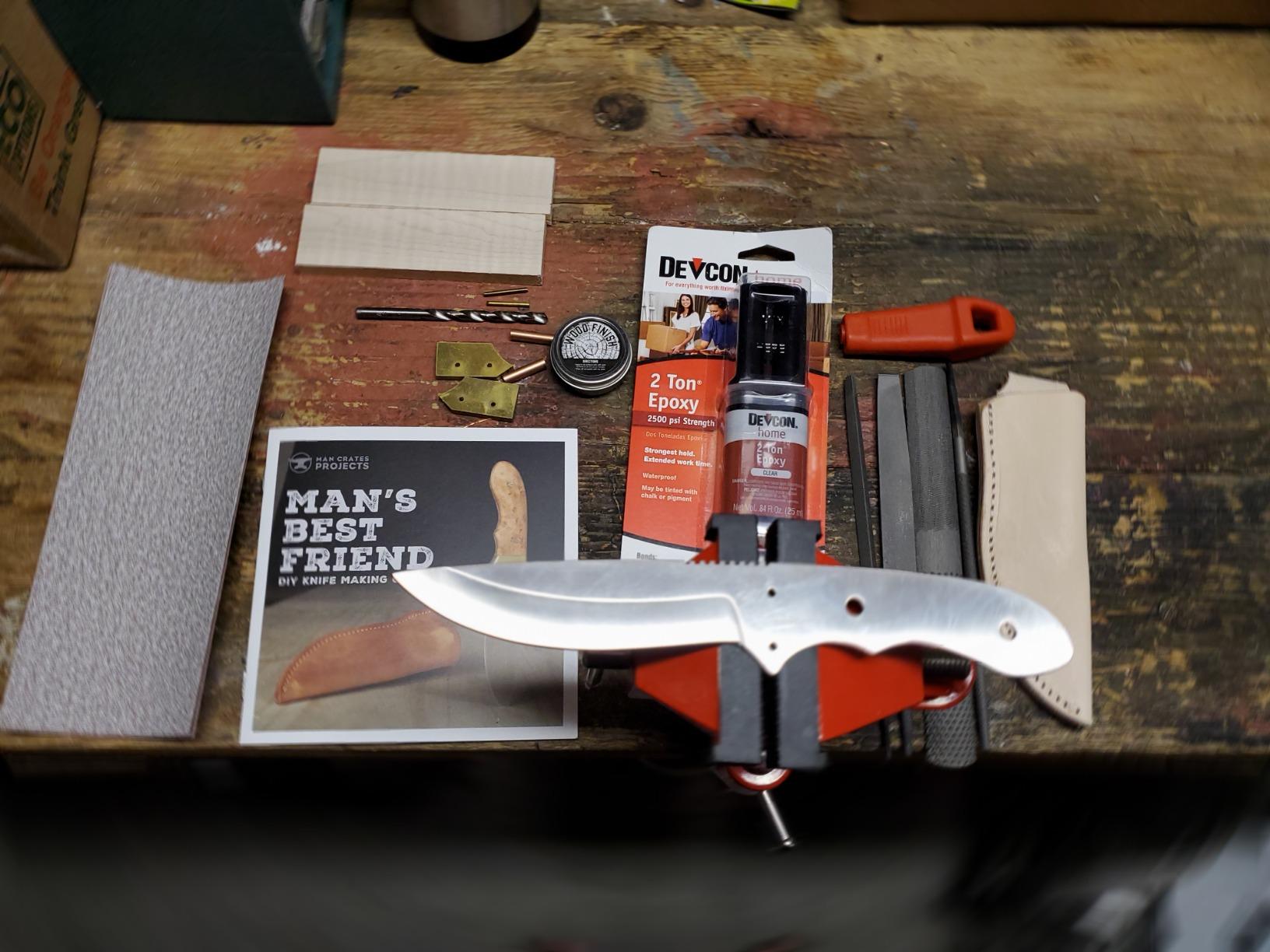
This is not a forging kit, and we want to be clear about that. It is a finishing kit, and for the specific goal of ending your first month holding a sharp knife you made, it is the most complete package in the roundup.
You get a Shawnee Skinner stainless steel blade with a tang, maple handle scales, brass bolsters, a leather sheath, and pins. The finishing kit includes a 2-ton epoxy syringe, a rasp and file set, graded sandpaper, a bench vise, wood finish, and a step-by-step instruction guide. The blade arrives already shaped, with the handle left for you.
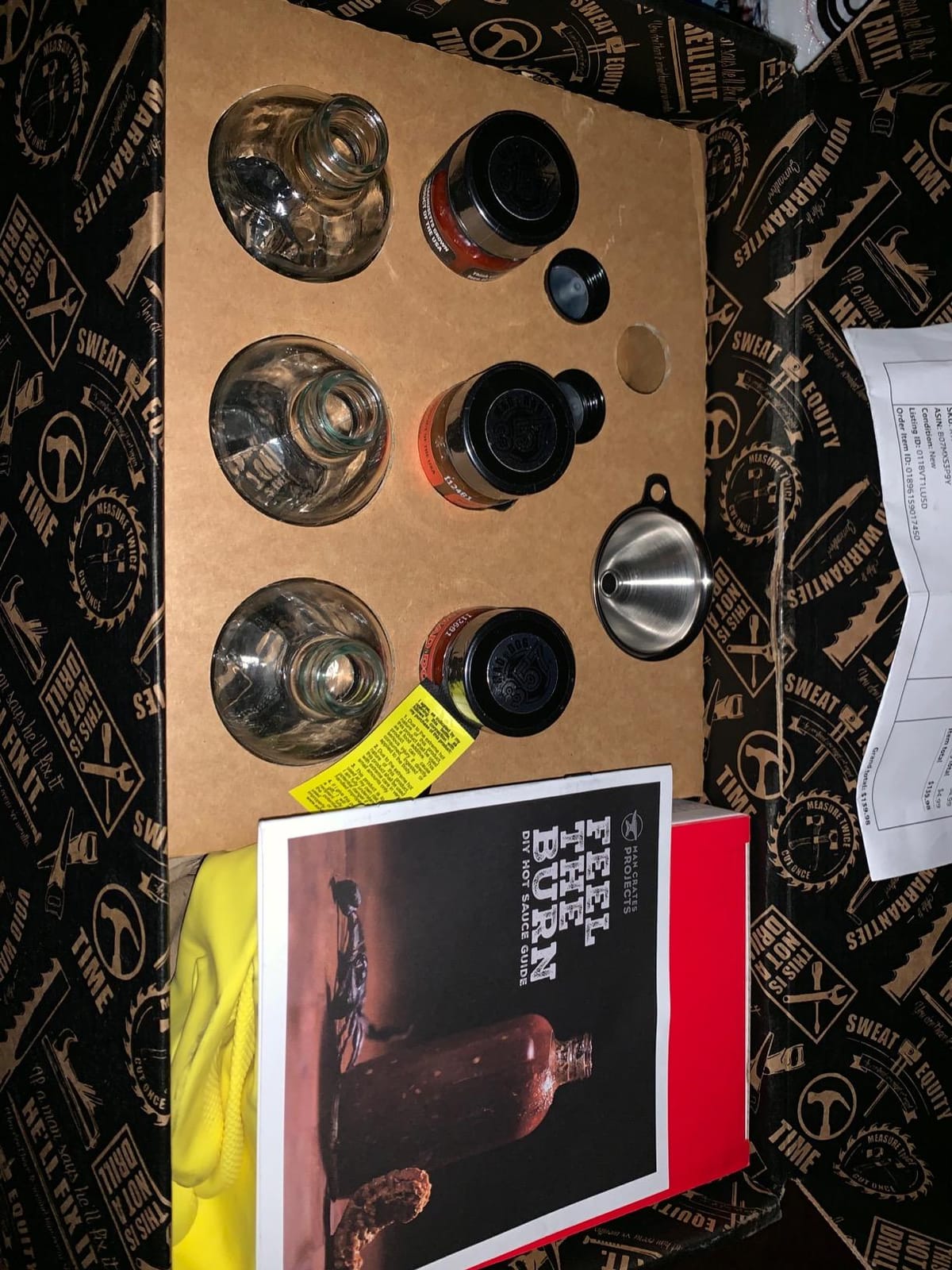
Buyers treat it as a project and rate it on that basis. The instruction quality comes up often, and so does the sharpness of the finished edge, which for most beginners is the moment the hobby stops being abstract. A folding knife version also exists if you would rather build a folder.
The caveats are honest ones. The maple scales are not stabilized, so humidity and weather changes can crack them, and a stabilizing bath is a straightforward extra step. You will also need your own hammer and drill for some shaping work, and a first-timer should budget around two weeks of spare-time hours.
Who this suits best
It suits a beginner who is gift-minded, hands-on, and impatient with abstract progress. There is a real finish line, and it arrives in about two weeks rather than two years. For a parent buying for a teenager, that difference matters more than any specification.
It also pairs well with a forge kit, because the handle work is a good rainy-day activity for the days you are not at the anvil.
When to look elsewhere
Anyone who wants to learn hot forging should skip this. There is no heat source, no anvil, and no hammer in the box, and a pre-shaped blade teaches you grinding and gluing rather than metal movement.
Watch your hands during the epoxy and sanding stages. The blade is sharp from the start and the instruction does not treat a new maker as clumsy.
6. Yoursme 5 Piece Forging Tongs: The Best Set for Blade Work
Blacksmith Tongs Tools Set Forging Tongs For Knife Making Tongs, Blacksmithing Forge Tongs Kit 5PCS – Flat Tongs & Square Jaw Tongs & Bolt Tongs & Blade Tongs & Wolf Jaw tongs Black Smith Supplies
Five jaw patterns
17.13 inch length
Alloy steel with oil finish
Pros
- Sturdy steel that holds up to regular hammering
- Five jaw types cover most gripping needs
- Smooth jaws that do not mark the workpiece
- Deep V groove keeps material under heavy blows
Cons
- Jaw feel is entry level
- Handles can be tight one-handed
- No scrolling tongs in the assortment
- Oil finish needs maintaining
Where the four piece set is general purpose, this one is knife-making focused. The five patterns are flat tongs for 3/16 inch flat stock with a smooth non-marking jaw, square jaw tongs for 1/2 inch square stock, bolt tongs for 1/2 inch round stock with a deep V groove, blade tongs for flat stock from 1/8 to 3/8 inch thick and up to 1 3/4 inch wide, and wolf jaw tongs for general work.
That blade spec is the reason to buy this set if knives are your goal. The smooth flat and blade jaws leave no marks on finished flats, which matters when you are shaping a blade profile and do not want to grind out grip marks afterwards.
Owners generally report this assortment holding up over years, which is a good sign for a mid-priced set. The linseed oil finish on the jaws protects against rust but needs topping up occasionally, especially in a humid shop.
Why five patterns beat four for knife work
The difference is the square jaw and the dedicated bolt tongs with a full-depth groove. If you are drawing out round bar or squaring up stock, those two are the pair you reach for repeatedly, and the deep V groove keeps material locked under heavy blows.
For a bladesmithing-focused purchase it covers nearly every gripping job you will hit in the first year, and a four tong version exists if you want fewer.
What you trade away
Jaw feel is the honest limitation. At this tier the spring and the close are good but not refined, and some pairs feel tight to operate one-handed, which is awkward when you are working fast.
There are no scrolling tongs, which you will eventually want for thin flat work. Treat this as a two to three year tool set rather than a lifetime one, and keep the oil on it.
7. Yoursme Hammer and Tongs Kit: The Best Hand Tool Start
Blacksmith Hammer & Forge Tools Kit – Starter Beginner Making Knife Kit With Anvil, Wolf Jaw Tongs & V-bit Tongs
2.2 lb hammer head
14 inch wood handle
Wolf jaw and V-bit tongs
Pros
- Tongs feel sturdy and grip hot material well
- Hammer weight and shape suit moving metal
- Covers two most-used tong styles plus a hammer
- Comfortable to hold for long sessions
Cons
- Hammer head can arrive loose and need re-wedging
- Tong reins are thinner than ideal
- Hammer face needs dressing out of the box
- Entry-level steel quality
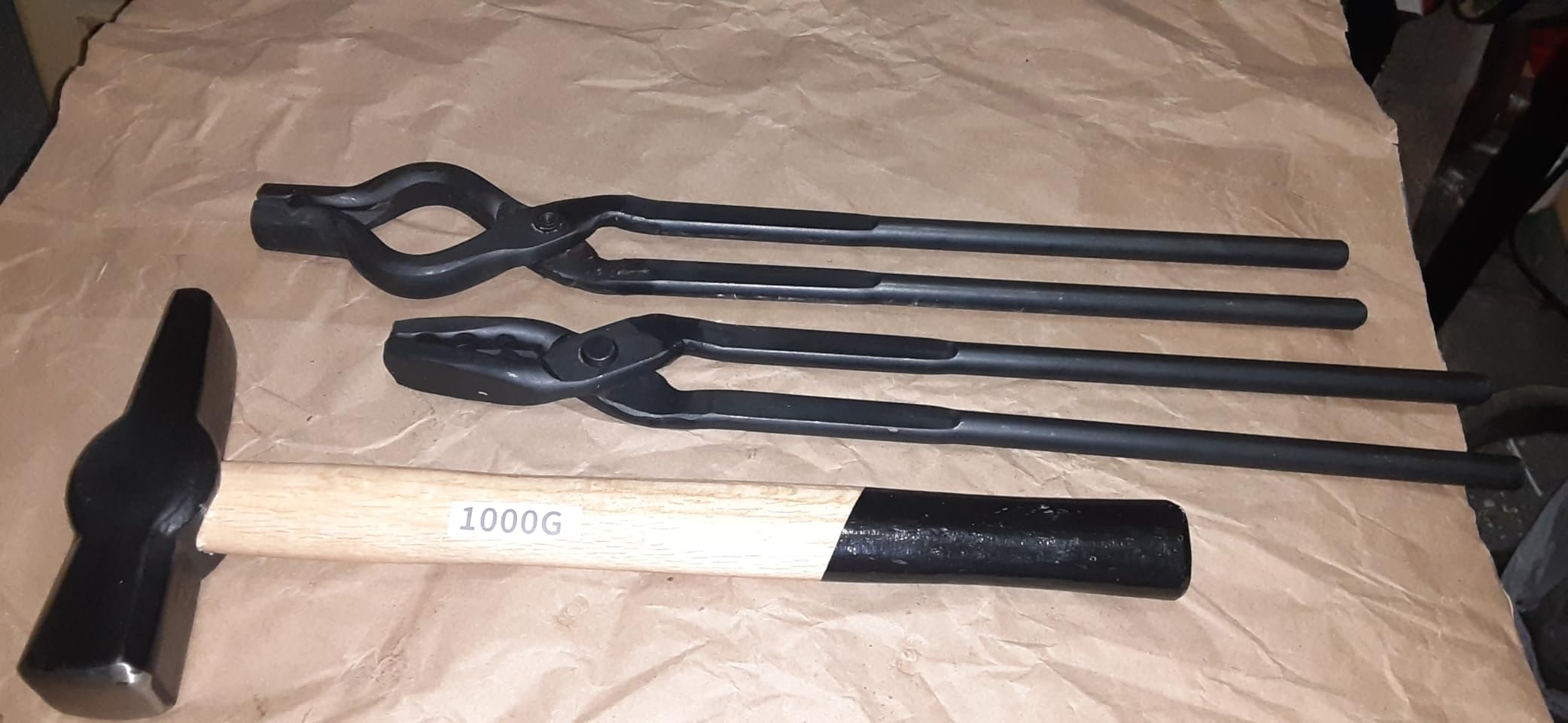
This is the closest thing on the list to a genuine all-in-one hand tool kit, and it is the one we would consider pairing with a portable forge. You get a hammer, wolf jaw tongs, and V-bit tongs, which is the two most-used tong patterns plus the tool you will hold most of the time.
The hammer is a 2.2 pound head with a 0.44 pound handle and a 14 inch wood handle, and that weight lands in the range r/Blacksmith beginners settle on. The steel is described as anti-corrosion and high temperature resistant, and the head is powder coated.
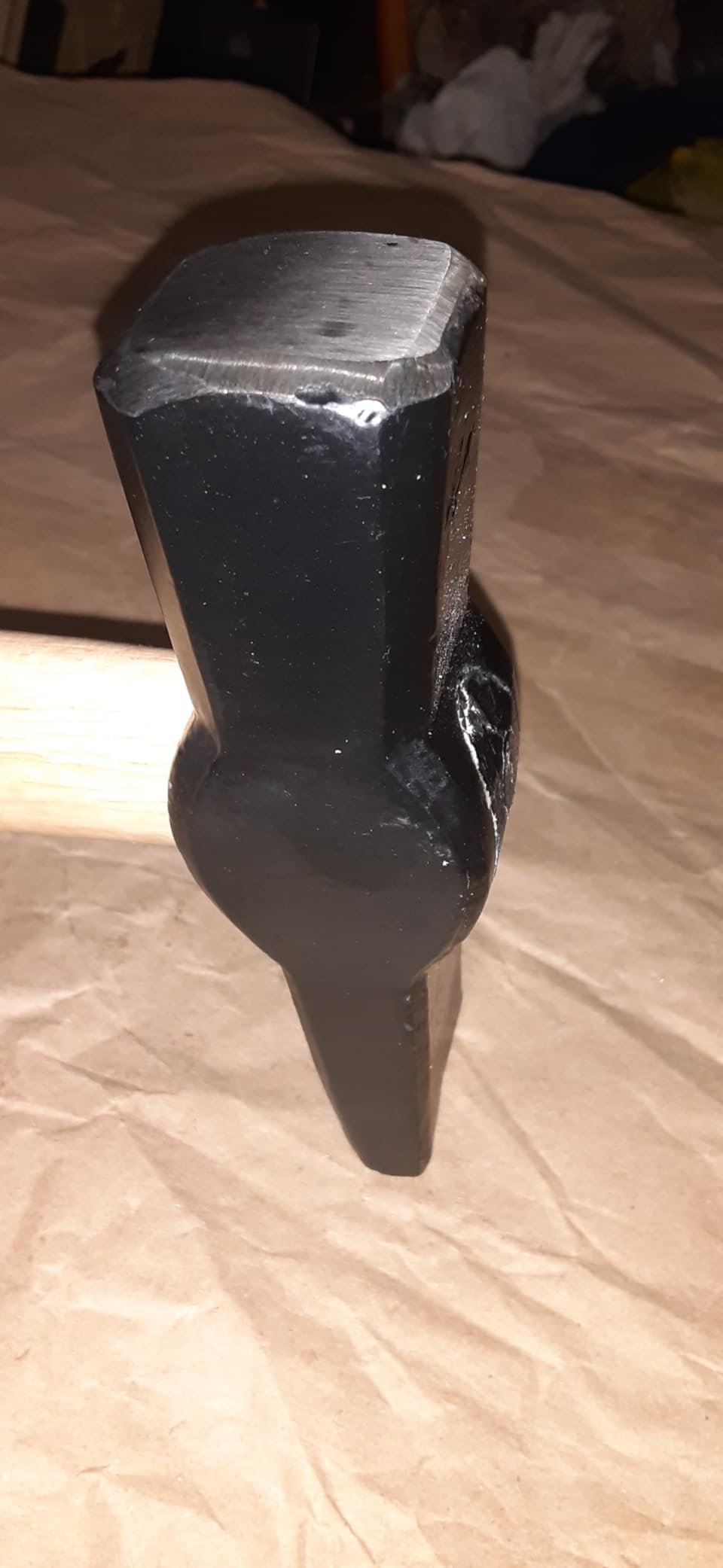
Two things to check on arrival. Several owners received a hammer head that needed the handle wedge driven in before use, which is a ten minute fix but worth doing immediately. The hammer face also needs dressing to remove a rough edge out of the box, and that is a good first lesson in fettling your own tools.
Why a 2.2 lb hammer is the right first hammer
It sits right in the middle of the range people argue about online. It is heavy enough to move material without swinging hard, and light enough that you can hold accurate control through a long taper while still learning.
Starting lighter than this and you will spend your first months learning to swing. Starting heavier and you will learn to flinch. Two pounds is the point where gravity is still on your side.
Where it falls short
The tong reins are thinner than ideal and the steel is entry-level rather than professional, which is a fair trade for the price. The 40 review count is also the smallest in this roundup, so treat the consensus with more caution than the others.
Most importantly, there is no heat source and no anvil in this box. As a hand tool starter it is genuinely useful; as a blacksmith starter kit on its own it leaves you two major purchases short.
8. MMasters 3 Burner Propane Forge: The Best for Larger Work
MMasters 3 Burner Propane Blacksmith Forge Kit
Triple burner layout
2600 degrees F
Closable single door
Pros
- Three burners give broad even heat for larger pieces
- Door design speeds up heat-up
- Insulation plus fire brick for durability
- Straightforward hose and burner hookup
Cons
- Largest and heaviest option in this group
- Ceramic fibre should be coated first
- Disconnect the hose after use to protect it
Three burners is the top of this list for heat coverage, and owners describe it as suited to larger work with consistent heating across a wide bed. If you already know you will be forging longer material and heavier sections, this is the step up that makes sense on day one.
The kit is rated to 2600 degrees F and uses a single closable door, which credits owners with faster heat-up during a cold start. Protection is doubled up with one inch of insulation material plus a fire brick, and the gas hose and burner connect quickly for a home workshop.
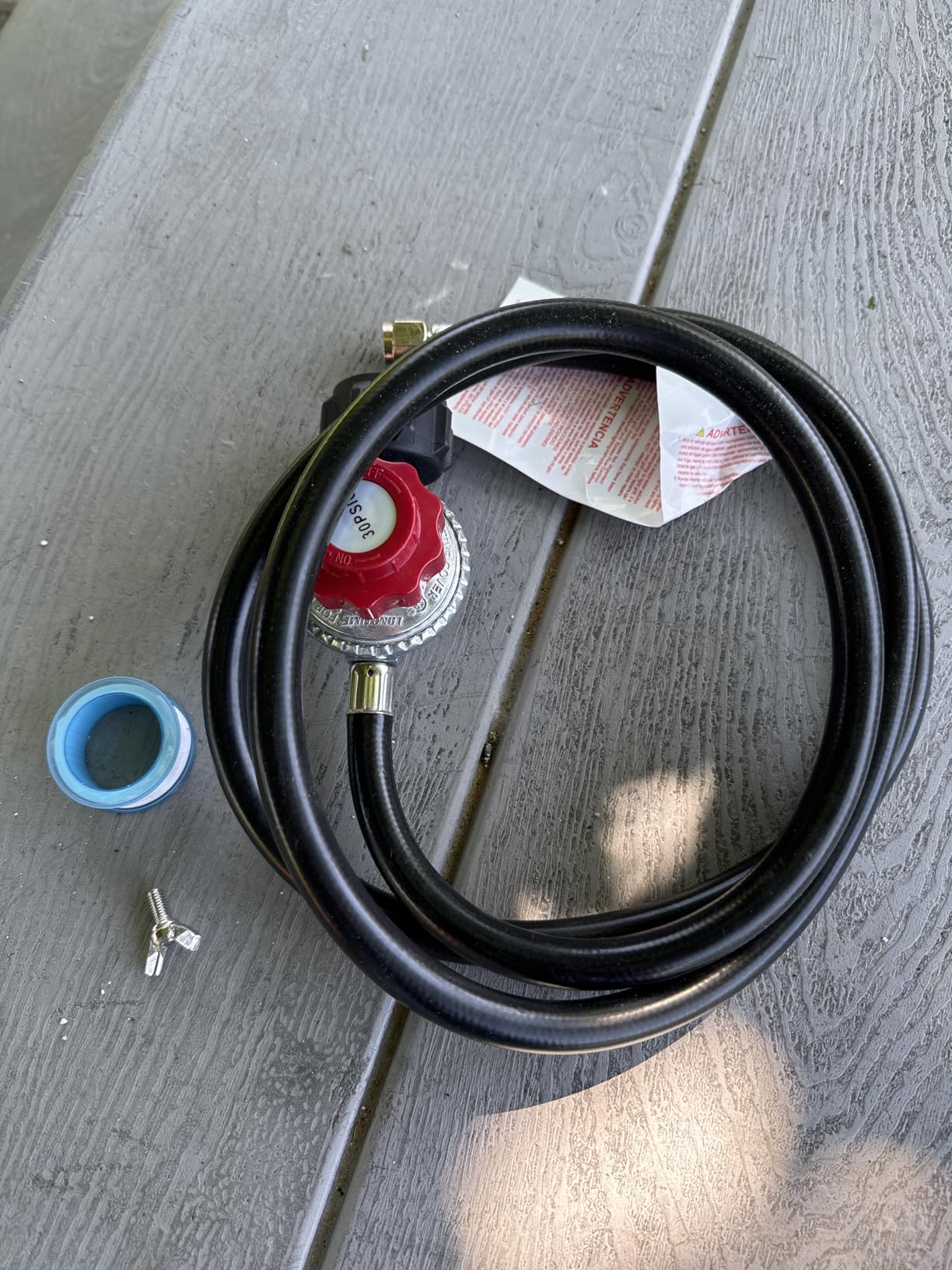
Setup is the same pattern as the rest of this group. Connect the hose and burner, and you are forging. Buyers follow the maker guidance to treat the ceramic fibre blanket with a rigidizer or protective coating first, and to disconnect the hose after a session so residual heat does not damage it.
When three burners earns its place
It earns its place when your work has volume or length. Larger pieces heat evenly across the bed instead of concentrating in one spot, and the door gives you faster recovery between heats on a cold morning.
It is also the configuration that leaves room to grow without replacing the forge in your second year, which is where the two burner option starts to feel tight.
What you give up for the capacity
This is the largest and heaviest option in the group, and it needs more bench space than anything else here. A small shop will feel the footprint long before it feels the heat capacity.
Stepping down to a dual burner unit saves space and costs you nothing on knife-scale work. Buy the third burner only if you have a project list that justifies the bench space.
9. Hihitomorrow 3 Piece Tongs Set: The Smallest Useful Start
Blacksmith Tools Set – Flat, Bolt, Blade Tongs & Hammers for Forging & Knife Making
Flat bolt and blade tongs
Quenched steel
Black oxidation finish
Pros
- Quenched steel with good clamping strength
- Black oxide finish resists rust
- Flat and blade tongs grip without marking
- Bolt tong V notch reaches awkward shapes
Cons
- Lowest rated and thinnest reviewed set here
- Jaw feel is entry level
- Only three patterns in the base configuration
This is the smallest useful tongs bundle here, and it does one thing well. The set covers flat tongs for 3/16 inch flat stock that will not mark the forging, bolt tongs for 1/2 inch round stock with rounded jaws and a full-length V notch, and blade tongs for 1/8 to 3/8 inch thick flat stock up to 1 3/4 inch wide.
The construction is quenched heavy-duty steel with a black oxidation finish for corrosion resistance, and the clamping strength is the most commonly praised feature. The bolt tong V notch is the sleeper, because it reaches shapes a straight jaw cannot and will hold a nail steady for forging.
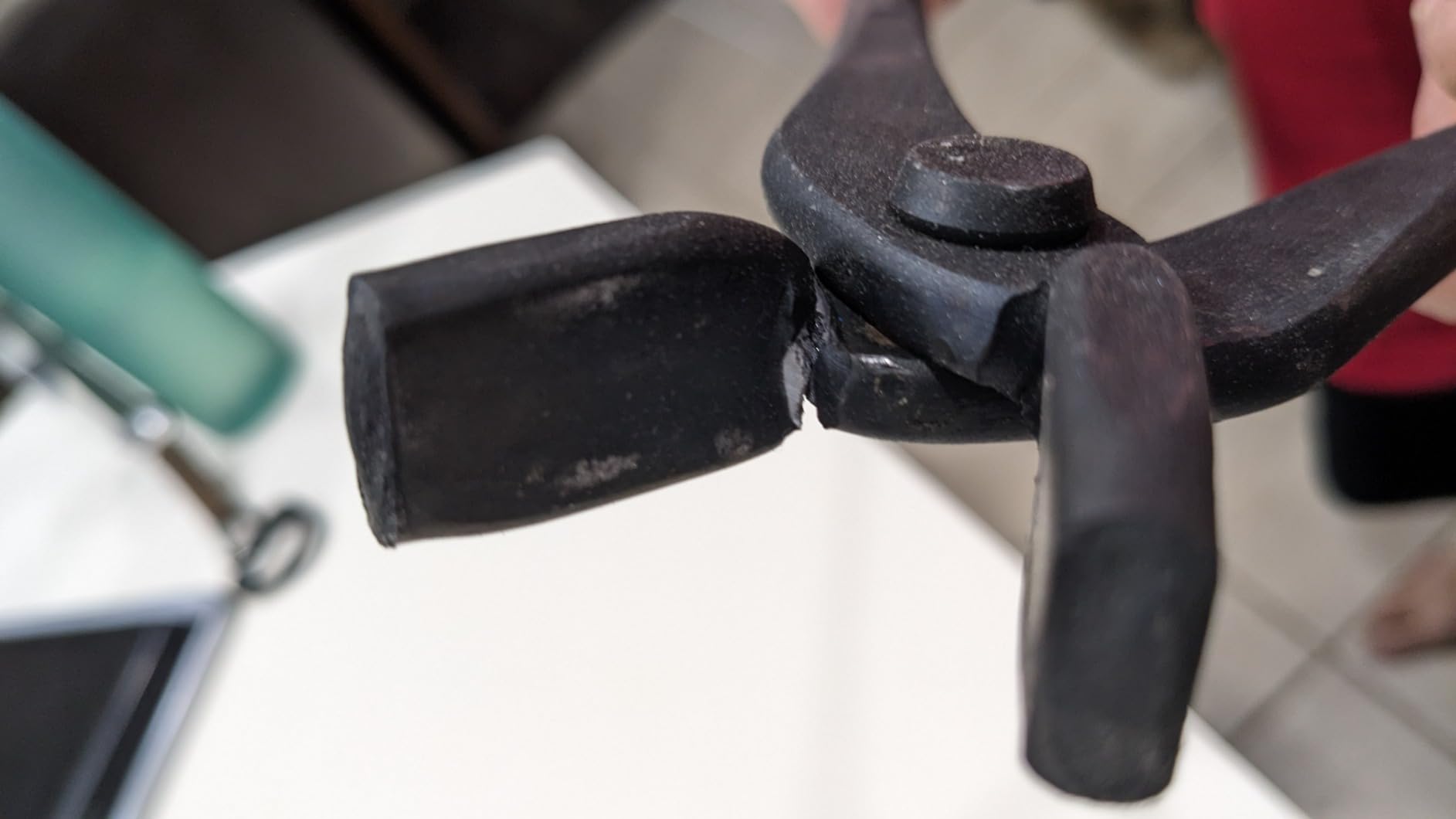
We would be direct about the ranking. At a 4.2 average on 59 reviews, this is the thinnest-reviewed and lowest-rated set in the group, and the jaw feel and spring are entry level next to forged professional tongs. Four and five tong versions of the same line exist if you decide to spend up rather than sideways.
When the three patterns are enough
They are enough if you are working thin flat and round material at knife-making sizes, which is the most common first-year reality. Flat, blade, and bolt is the classic starter three and it covers the majority of gripping jobs.
Pick it when budget is the binding constraint and you are confident you will stay on small work. It is a clean entry, not a dead end.
When to spend a little more instead
If you think you will want to hold larger square material or shaped work, add a wolf jaw pair now rather than later. Scrolling tongs are also worth planning for once you start thin flat work.
Our honest view is that the step up to a four or five piece set is small money for the jaw feel and coverage, and we would make it before the first year is out.
10. Topsair Rapid Tongs Blanks: The Best Set for Making Your Own Tongs
Rapid Tongs Bundle Set Five Types of DIY Blacksmith Tongs Rapid Tongs Bundle Kit with Stainless Steel Rivet
Five pairs of unassembled blanks
5/16 inch mild steel
Rivet per pair
Pros
- Cheapest route to five matched tong patterns
- Blanks are substantial and forge well
- Finished tongs match bought sets
- Arrives roughly half formed
Cons
- Requires your own forge and punch or drill to assemble
- Blanks run smaller than commercial quick tongs
- Rivets are undersized and zinc coated
- Not a beginner project without experience
This one inverts the usual logic. Instead of finished tongs you get five pairs of unassembled blanks in 5/16 inch mild steel, each supplied with a stainless steel rivet, and you draw them out, shape them, and pin them yourself. Skilled buyers say the finished result is indistinguishable from a bought set.
That makes it a genuinely clever first project for someone who already has a heat source, and an impossible one for someone who does not. The listing states plainly that forging, drilling, and pinning equipment are all required, and that the user performs the work.
Two gripes recur. The blanks run roughly ten to twenty percent smaller than commercially made quick tongs, which disappoints people who ordered expecting full size. And the included rivets are undersized and zinc coated, with the coating burning off during the first heat, so experienced smiths replace them with proper rivets before assembly.
Why making tongs is a smart first project
Tongs are forgiving. You are bending mild steel at forging temperature with a hammer, not chasing a knife profile, and a mistake is a piece of scrap rather than a ruined project. Several beginners on forums point to making their own hammer and tongs as the confidence builder that got them moving.
Five patterns in one kit also means you end up with a matched set, which is something you cannot do buying pairs one at a time at any realistic budget.
Who should not start here
Do not start here without a working forge. This is the one product in the roundup that actively assumes the rest of your shop is already in place, and buying it first is a fast way to end up with five heavy blanks and no way to use them.
Buy the proper rivets, follow a professional tutorial for the drawing and pinning steps, and treat the smaller blank size as a feature you size for rather than a disappointment.
How to Choose a Blacksmith Starter Kit
Work through these seven questions in order. The first three eliminate most options before you get attached to a particular listing.
What does the kit actually contain? Count only the big three: heat source, anvil, hammer. Anything without an anvil is a hand tool bundle, whatever the listing title says.
Will it fit your space? Tabletop forges are portable. Full-shop packages are not, and a corner you cannot access is a corner you will stop using.
Can you get it to a working temperature safely? Propane gives the best control for a beginner. Coal and charcoal are cheaper to run but need more space and a chimney or outdoor siting.
How heavy is the anvil, if there is one? Around 150 pounds is a sensible target for real work, and any anvil under about 50 pounds will feel like work rather than a tool.
What hammer weight is included? One to two pounds for a first hammer. Above three pounds and you are learning to swing tired.
Are tongs included, and how many patterns? A gripping pair and a V-bit pair is the minimum. More patterns save you improvising later.
What is the upgrade path? Can you add burners, swap the anvil, or add a post vise without replacing what you bought? Vendors with 1, 2, 3 and 4 burner options make this easy.
One more practical filter. If a seller publishes specifications and buyer feedback in detail, the rest of their catalogue is usually sound. If the listing is three photos and a phrase like upgrade your own, the missing details are the product.
Coal, Charcoal, Propane, or Induction?
For a first forge in 2026, propane is the default answer. It reaches temperature in minutes, gives you a dial, and starts and stops without a fire. Every forge in this roundup runs on it.
Charcoal is the traditional beginner fuel and costs less per hour, and blacksmithforums.com threads regularly describe wood or charcoal forges as perfectly serviceable for a first setup. The trade is a slower heat and a lot more ash to deal with. Coal gives the traditional experience and excellent control, and needs a proper chimney and a coal shovel.
Induction is the answer for a space where combustion is not possible, since there is no flame to vent and no carbon monoxide. It is a different purchase entirely, and it does not appear in this roundup because the bundles here are all combustion based.
Whichever you pick, put a carbon monoxide detector near the work area and a fire extinguisher within reach. That is not optional at any price point.
Safety Gear and Ventilation You Need to Add
None of the ten kits includes personal protective equipment, and that is a real budget line, not a detail. Here is the short list that covers a beginner.
A face shield rather than safety glasses, because scale and sparks come off the hammer face.
A leather apron, split or full, for sparks and stray hot material.
Kevlar sleeves or a flame-resistant shirt, since forearm burns are the most common injury in a first year.
Fire-resistant gloves for handling hot material, kept separate from gloves you use to pick up cold tools.
A fire extinguisher rated for the fuels you use, and a fire blanket for smothering small fires.
A handheld carbon monoxide detector for any indoor or enclosed setup.
A steel bucket of water and a box of sand near the forge, for anything that falls into the fire.
On ventilation, the practical rule is simple. A propane forge belongs outside, or in a garage with the door fully open and cross ventilation. A coal forge wants a chimney. If your space cannot meet that, an induction forge is the honest answer rather than a workaround.
Fire code varies by municipality, and detached garages are treated differently from attached ones. Check locally before you buy a coal or heavy fuel setup, not after.
Kit vs. Assembled: Which Is Cheaper?
Assembling your own usually wins on total cost, and the reason is that bundles charge a premium for the convenience of a box. What you lose is time, and the right to send back one item instead of a whole set.
Our own approach would be to buy the heat source as a kit, because burner variants and insulation are well specified there, and then assemble the hand tools individually where you can choose exactly the patterns you need. That single change typically avoids paying for three tong pairs you will never use.
The used market deserves a look before any of it. Estate auctions, farm auctions, and local listings are where a working anvil turns up, and the top Reddit thread in this space is literally titled around a minimum viable beginner setup, with users trading tips on budget. A used anvil tested with the rebound method, plus a good hammer and tongs, often costs less than a mid-range package and gives you a better shop.
Be honest about the split though. A hand-tool bundle is genuinely cheaper for a beginner who already owns a forge. It is only a bargain if you have the heat source covered.
The 5 Beginner Projects Worth Making First
Forums agree on the sequence, and it is the same one we would follow. These are practice projects, not gifts.
Tapers. Draw a point on bar stock and hammer it down. This teaches heat control and hammer control at the same time.
Reverse tapers. Taper the same bar from both ends. It forces you to judge temperature in the middle of a piece.
Set-downs. Flatten the end of a bar to a shoulder. Your first real use of the anvil face and a chisel.
Drawing out practice bars. Lengthen a bar to a fixed target length. This is the fundamental shaping move behind almost everything else.
A simple hook or bracket. The first thing you finish that somebody actually uses.
For practice material you do not have to buy anything. Broken jackhammer bits, springs, broken shafts, and old saw blades are all free or near free, and they are all mild or low carbon steel that forgives mistakes. As one experienced smith puts it, the skill progression is tapers, reverse tapers, set-downs, and drawing out, practiced whether or not you are making anything finished.
The hardest part for most beginners is not a specific technique. It is hand-eye coordination and holding a consistent heat through the first taper, which is exactly what projects one and two are designed to fix.
Frequently Asked Questions
What tools does a beginner blacksmith need?
A heat source, an anvil around 150 pounds, a two to three pound cross peen or rounding hammer, at least two pairs of tongs, an anvil stand, a water quench container, hand files and a rasp, and safety gear including a face shield, leather apron and fire extinguisher.
What to buy to start blacksmithing?
Start with a portable propane forge if you have no heat source, a good hammer, two pairs of tongs, and a plan for an anvil. Most beginner kits bundle the hand tools but leave the anvil, stand, quench setup and safety gear to you.
How much money do I need to start blacksmithing?
Roughly 70 to 200 dollars for a hand tool kit. Roughly 400 to 700 for a working setup including a portable forge, tongs, hammer, anvil stand and safety gear. A full shop with a quality anvil runs well past 1500, and a used anvil can cut that substantially.
Is blacksmithing an expensive hobby to start?
Less than most people expect at the hand tool level, and more than they expect once the anvil is involved. The honest framing is that kits omit the anvil stand, post vise, quench setup and protective equipment, so real first year cost runs well above the sticker price.
What is the best blacksmith forge for beginners?
A single burner propane forge for most beginners. It reaches forging temperature in about three minutes, takes up little space, and you can carry it. Step up to two burners when you begin working with longer bar.
Do blacksmith starter kits include an anvil?
Almost never. The ten kits in this roundup include no anvil at all. You will need to source one separately, ideally around 150 pounds, and you will need an anvil stand as well, since a heavy anvil on an improvised base will damage both.
Can I start blacksmithing without a forge?
You can learn a lot without one. File and rasp work, handle finishing, and pattern work all transfer directly. Many beginners buy a hand tool kit first, learn finishing, and add a forge once they know what they want to make.
What is the difference between a blacksmith kit and a bladesmithing kit?
A blacksmith kit is built around general forging: tongs, hammer, and often a forge. A bladesmithing kit concentrates on blade blanks, handle materials, and finishing supplies, and usually assumes you already own a heat source and an anvil.
Conclusion: Where to Start Blacksmithing in 2026
Pick your starting blacksmith starter kit by what you are missing, not by what the listing highlights. No heat source means the VEVOR single burner propane forge is the most complete first purchase in this roundup, and its three minute preheat is what turns intention into practice sessions.
Already have a forge or a plan for one, and your gap is gripping tools? The VEVOR four piece tongs set covers the most ground for a single addition, and the five piece Yoursme set takes you further if knives are the goal.
Budget first, and start with hand tools and tongs, adding a heat source once you know what you want to make. A kit gets you a bench and a pair of hands ready; the anvil, the stand, the quench setup, and the safety gear are all still yours to buy, and planning for that from the start is how you get the best blacksmith starter kits experience without the overspend.