
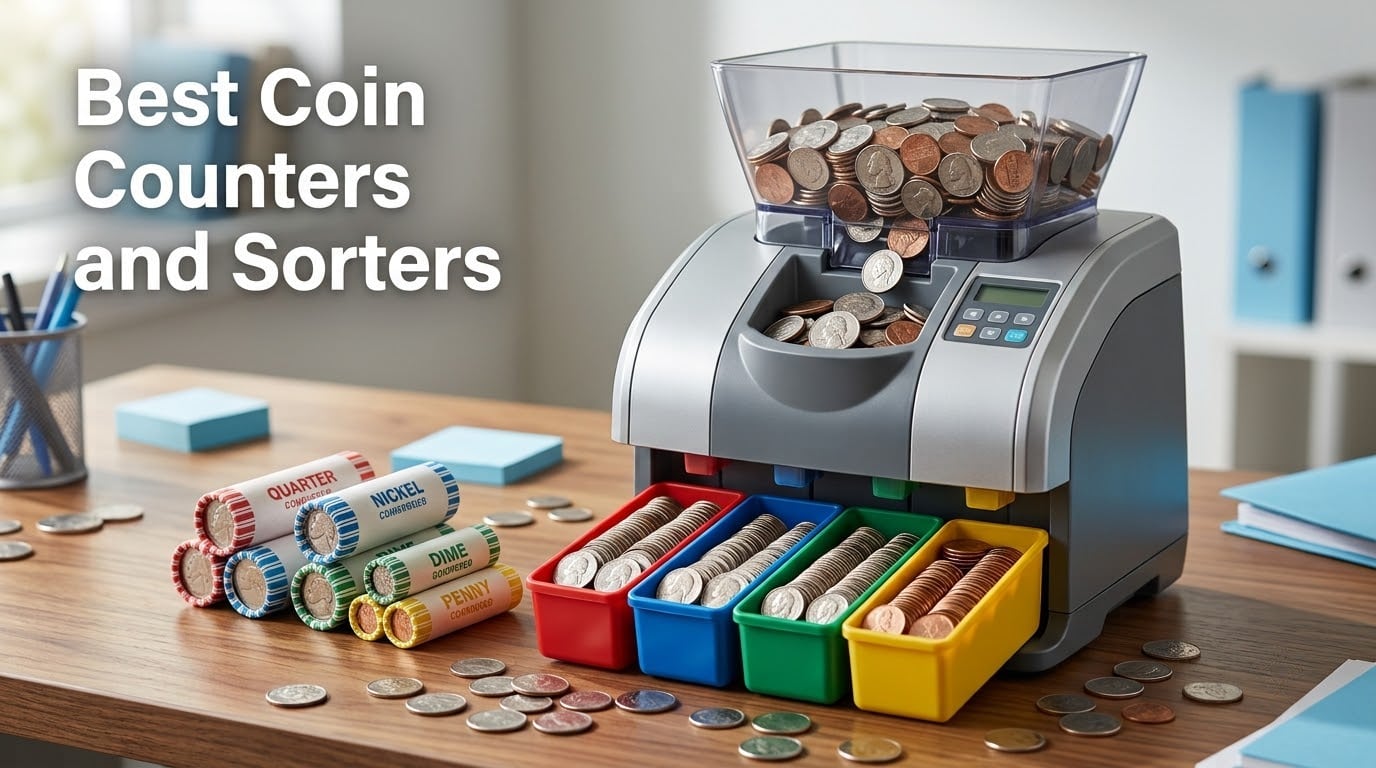
A coin counter totals the number and value of the coins you feed into it, a coin sorter separates them by denomination into bins or tubes, and a coin counter sorter and wrapper does both and then packs them into the paper rolls most US banks require for coin deposits. That is the whole market in three sentences, and it is also where most buying guides go wrong: they treat a hand-held plastic tube and a 300-coins-per-minute floor machine as the same category of product.
They are not. This roundup covers the best coin counters and sorters in 2026 across that full range, from manual rollers that sort a household coin jar to electric sorters built for laundromats, car washes and small retail counters. We looked at hopper capacity, throughput in coins per minute, which denominations each machine actually accepts, whether it fills wrappers or only bins, how it behaves when coins are dirty or bent, and whether replacement parts and support are easy to find.
One product earned our Editor’s Choice. The rest are here because they win a specific job better than anything else in the group, and because the right answer for a jar of pocket change looks nothing like the right answer for a change machine in a car wash bay. If you collect coins rather than count them, our challenge coin display case guide covers the storage side instead.
Table of Contents
Top 3 Coin Counter and Sorter Picks for 2026


Every Coin Counter and Sorter in This Roundup in 2026
| Product | Specifications | Action |
|---|---|---|
 Cassida C300 Cassida C300 |
|
Check Latest Price |
| Nadex S540 Pro |
|
Check Latest Price |
 Kolibri KCS-2000 Kolibri KCS-2000 |
|
Check Latest Price |
 VEVOR 5-Denomination Sorter VEVOR 5-Denomination Sorter |
|
Check Latest Price |
 VEVOR 300 CPM LCD Sorter VEVOR 300 CPM LCD Sorter |
|
Check Latest Price |
 Aneken AL-121 Aneken AL-121 |
|
Check Latest Price |
| Byteen8 5-in-1 Tube |
|
Check Latest Price |
 CO5IN1 5-in-1 Sorter Tube CO5IN1 5-in-1 Sorter Tube |
|
Check Latest Price |
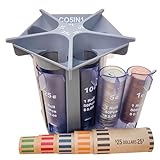 CO5IN1 Manual Change Roller CO5IN1 Manual Change Roller |
|
Check Latest Price |
 ESSENTIAL Trays and Tubes Set ESSENTIAL Trays and Tubes Set |
|
Check Latest Price |
 CO5IN1 11-Slot Change Counter CO5IN1 11-Slot Change Counter |
|
Check Latest Price |
 Sumrftn Trays, Tubes and Wrappers Sumrftn Trays, Tubes and Wrappers |
|
Check Latest Price |
1. Cassida C300 – the Best Coin Counter Overall
Cassida C300 Professional USD Coin Counter, Sorter and Wrapper/Roller, 300 Coins/min, with Quickload and Printing-Compatible, Gray
300 coins per minute
2000-coin hopper
Quick Load coin tubes
1-year warranty
Pros
- 2000-coin hopper handles large batches without refilling
- 300 coins per minute throughput for heavy volumes
- Quick Load tubes speed up roll changes
- Optional thermal printer for count receipts
- Only 12.4 pounds
Cons
- Thermal printer sold separately
- Sorting accuracy can vary with worn or damaged coins
The C300 is the machine we kept coming back to while working through this list. It is not the fastest machine here and it is not an entry-level purchase either, but it is the one with the best balance of throughput, hopper size and build quality, and it sits in the top tier of the Coin Counters and Coin Sorters category with thousands of reviews behind it. The 2000-coin hopper means you are not topping it up every two minutes, which is the difference between a machine you use and a machine you avoid.
The feature that separates it from the other 300 coins per minute machines is the Quick Load coin tube system. On a standard counter you pull the tube out, dump the full roll, slip a new wrapper in and push it back. On the C300 you swap the roll from the bottom of the tube without removing the tube, so a long wrapping session loses far less time to setup. Reviewers single this out more than any other convenience feature.
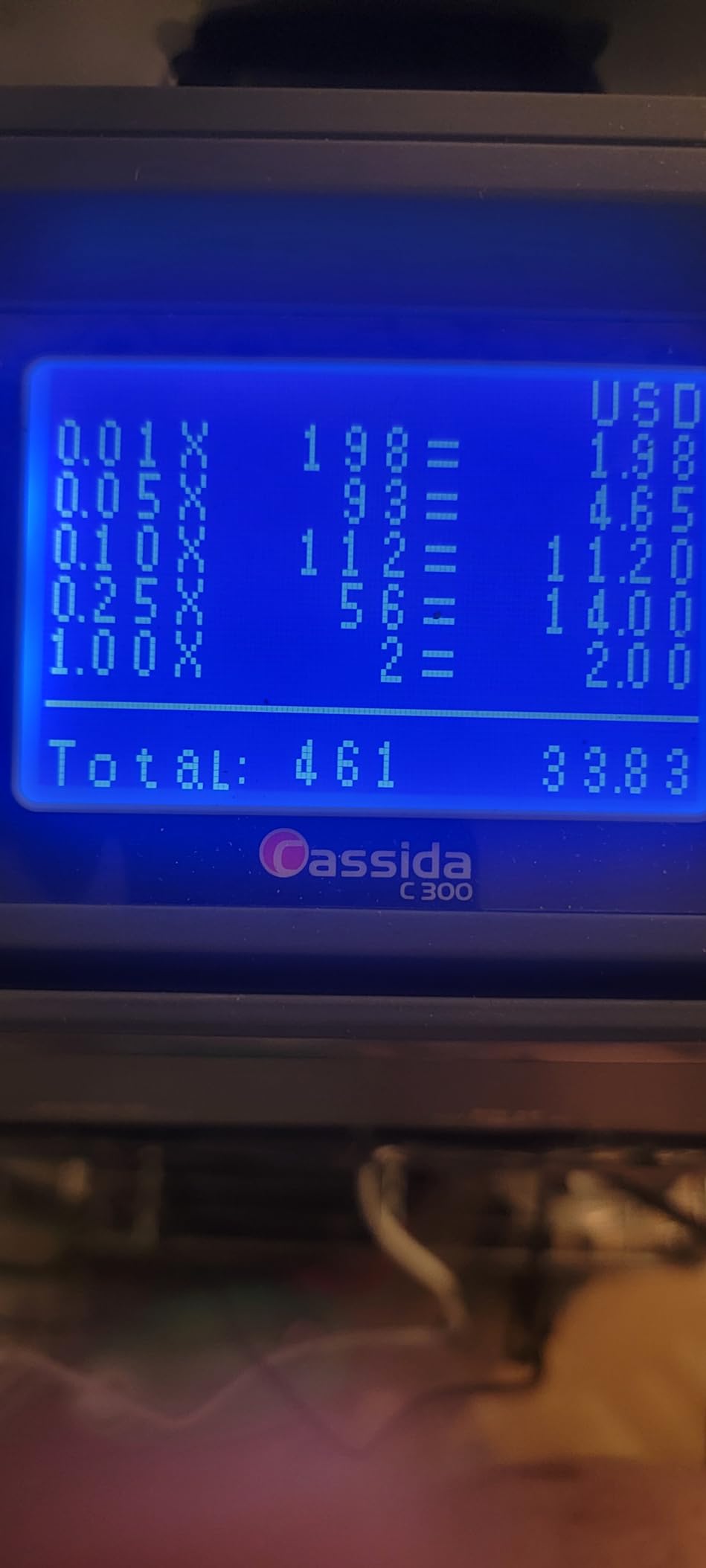
At 12.4 pounds and 11 by 11 by 10 inches, this is a machine you can lift between a counter and a back room rather than bolting down. You can also pair it with a Cassida thermal printer for a printed count receipt, and that receipt is genuinely useful at deposit time. The printer is a separate purchase, so factor it into your budget if you want paper records.
Sorting accuracy holds up well on normal circulation. Where it gets interesting is worn or damaged coin: bent, flattened or partially cleaned coins are the ones most likely to be mis-sorted, because the sensor reads diameter and thickness. The warranty runs one year. If your volume is steady enough to justify a receipt trail, this is the pick.
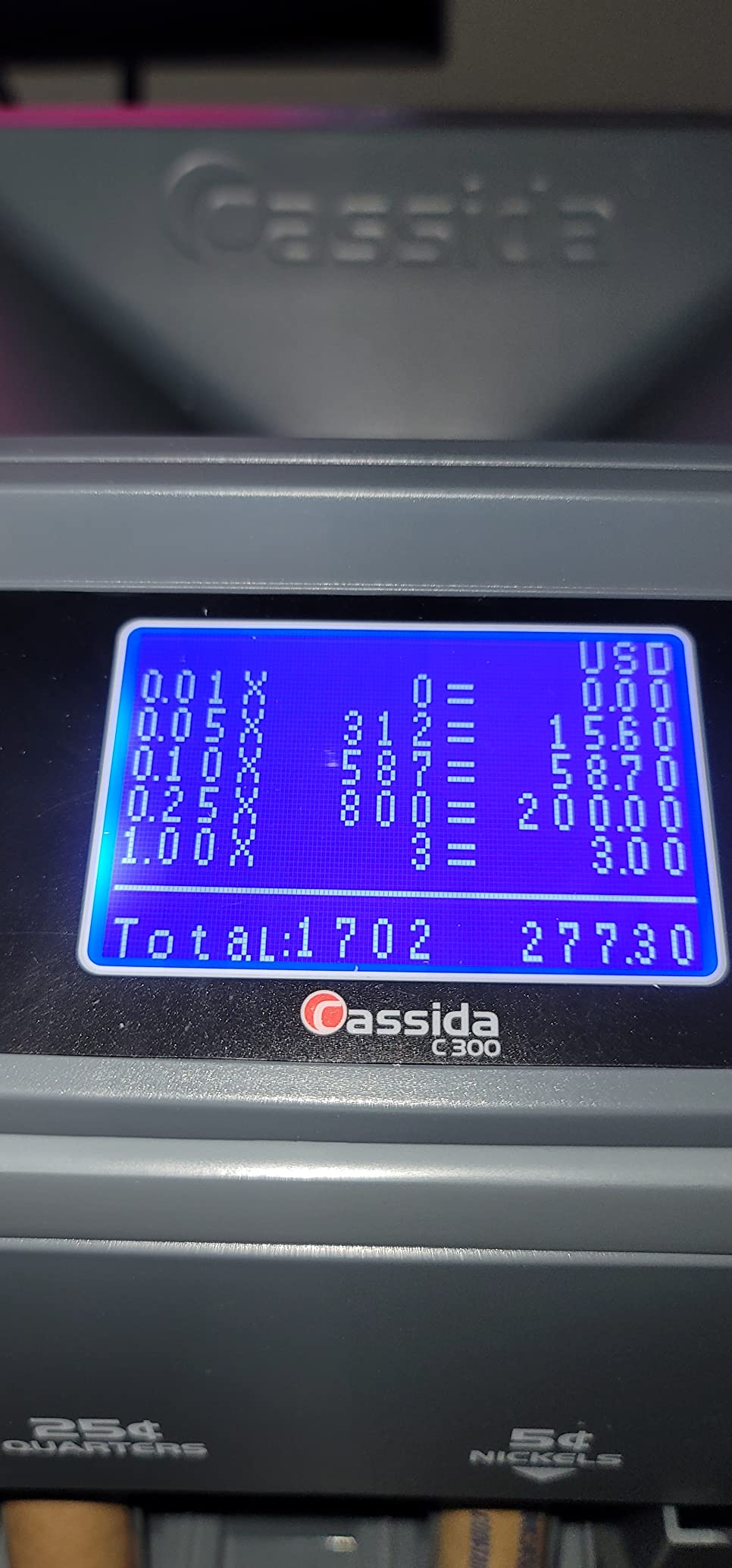
How the C300 handles a long run of mixed change
Pour, press start, walk away. At 300 coins per minute a 2000-coin hopper empties in under seven minutes, so the bottleneck shifts from counting to how fast you can strip finished rolls. The denomination readout shows count and value per coin type, which is what you need for reconciliation at the end of a shift.
Half dollars are worth planning around here. The C300 is built around the five common circulating denominations, so anything off-size or foreign is a manual problem. Pull them before the run rather than letting the machine fight them.
Where the C300 is the wrong buy
If your volume is modest, this is overkill and a manual tube will serve you better. It is also more than you need if you never print a receipt, since the thermal printer is an add-on rather than a standard feature. For a laundromat or car wash running quarters and dollar coins all day, it earns its place.
2. Nadex S540 Pro – Best Coin Counter for a Small Business
Nadex S540 Pro | Coin Counter, Sorter, and Wrapper | Sorts up to 300 Coins Per Minute | Comes with 48 Preformed Wrappers (Gray)
300 coins per minute
2000-coin hopper
Sorts into trays or wrappers
48 wrappers included
Pros
- Runs long batches without jams
- Counting accuracy holds per tube and total
- One-button batch setup with auto-stop
- Build quality avoids cheap deforming plastic
- Responsive support for sensor faults
Cons
- Half dollars and foreign coins need manual removal
- Grand total resets to zero after power cycling
- Flat bank-supplied wrappers do not seat properly
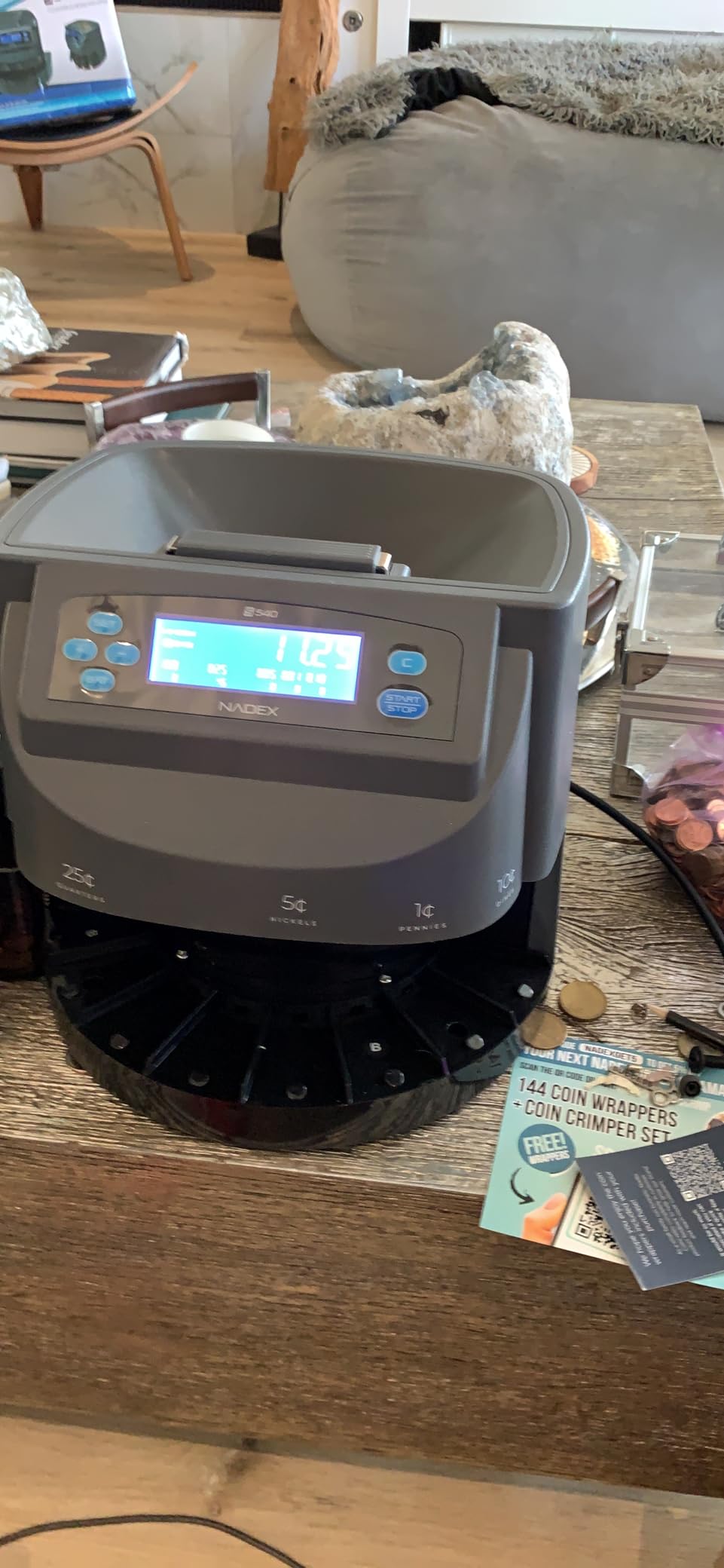
The S540 Pro is the recommendation we give most often to a small business that has outgrown manual rolling but is not ready to buy a dedicated counting department. It runs at 300 coins per minute with a hopper rated at 2000 dimes, and it ships with 48 preformed wrappers, which means you can sort and roll on day one.
What makes it unusually flexible is batch mode. One touch sets a target count and the machine stops on its own, so a roll fills to exactly the right quantity and stops. You can also run custom batch settings that send some denominations into trays and others into wrapper tubes at the same time, which is the workflow a shop with both a coin drawer and a deposit routine actually needs.
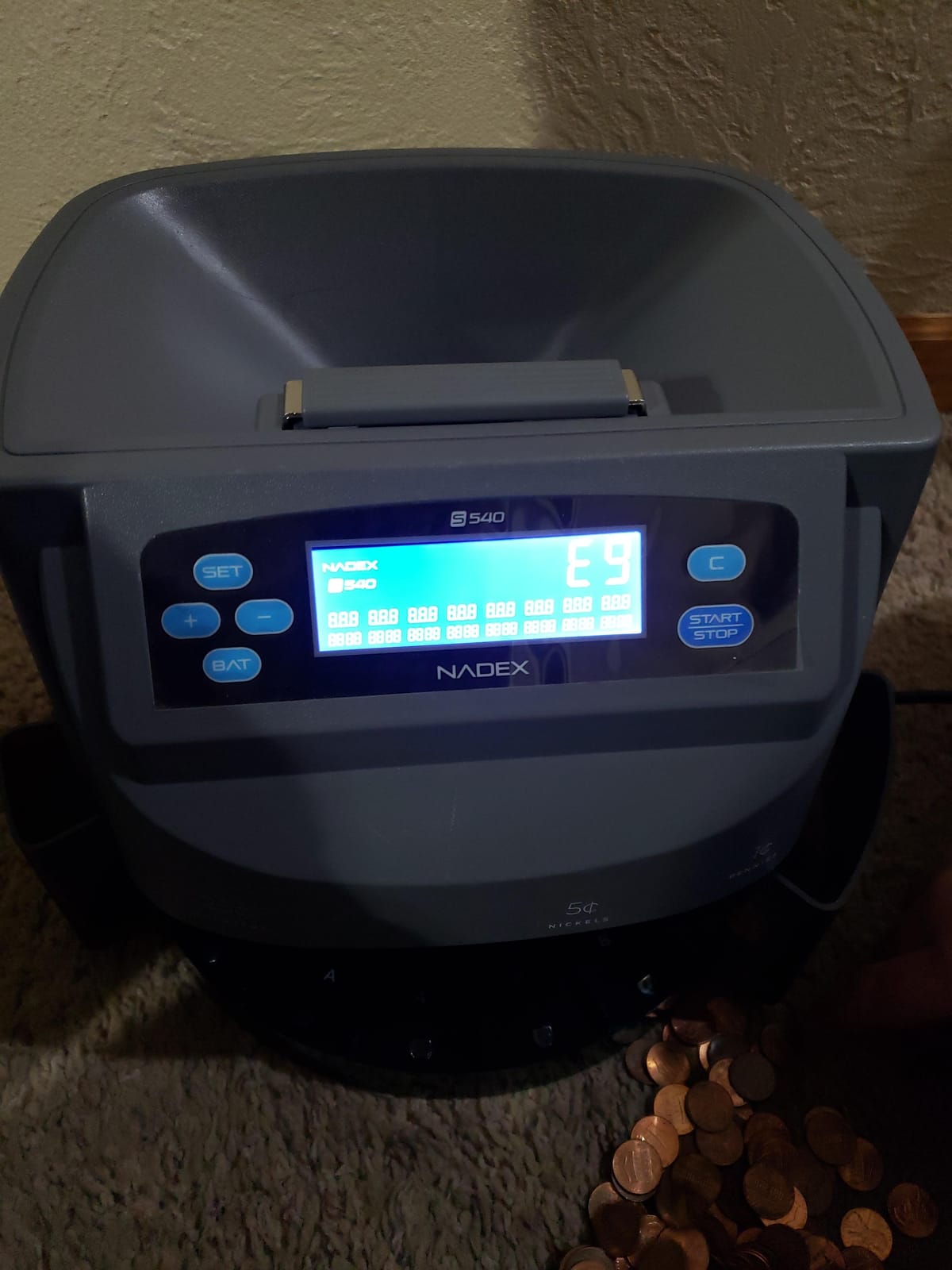
The build quality comes up constantly in reviews, specifically as a contrast with cheaper sorters whose plastic housings deform. Buyers running multi-hour sessions report stable accuracy, and support has been responsive when sensors have needed attention. The bin capacities are listed as dimes 900, nickels 450, quarters 350, pennies 300 and dollars 130.
Two practical notes from actual use. The grand total counter resets to zero after a power cycle, so write your running total down if you plan to count in sessions. And flat bank-supplied wrappers do not seat well in the tubes; rounded wrappers are reported to fit properly, so plan on buying your own.
Sorting coins for a bank deposit versus a coin drawer
Point the tubes at wrappers when the goal is a deposit slip, and point the bins at trays when you are breaking a drawer down at close. Switching between the two is a button press, and the per-denomination readout on screen tells you what each tray is worth as it fills.
For scale, a manual tube on this design handles a mixed batch in roughly an hour, based on buyer reports. An electric sorter at 300 coins per minute cuts a much larger mixed batch down to minutes.
When it frustrates owners
Half dollars and foreign coins are the recurring complaint: they lock up in the mechanism and have to be removed through the rear access door. Some users also report the coin chute becoming less reliable after many runs. If your stream of change includes half dollars regularly, check that before you commit.
3. Kolibri KCS-2000 – Best All-in-One Counter, Sorter and Roller
Kolibri KCS-2000 Professional USD Coin Counter Machine, Coin Sorter, Wrapper/Roller | 300 Coins/min, LED Display, Batch Feature | USD Change Counter (USA Tech Support)
220 coins per minute
2000-coin hopper
LED denomination report
Lifetime technical support
Pros
- Counter
- sorter and roller in one unit
- Large LED display makes the report easy to read
- One-touch batch settings for bins and wrappers
- Coin tube attachments fill preformed wrappers
Cons
- 220 coins per minute is slower than 300 coins per minute machines
- Coin wrappers are not included
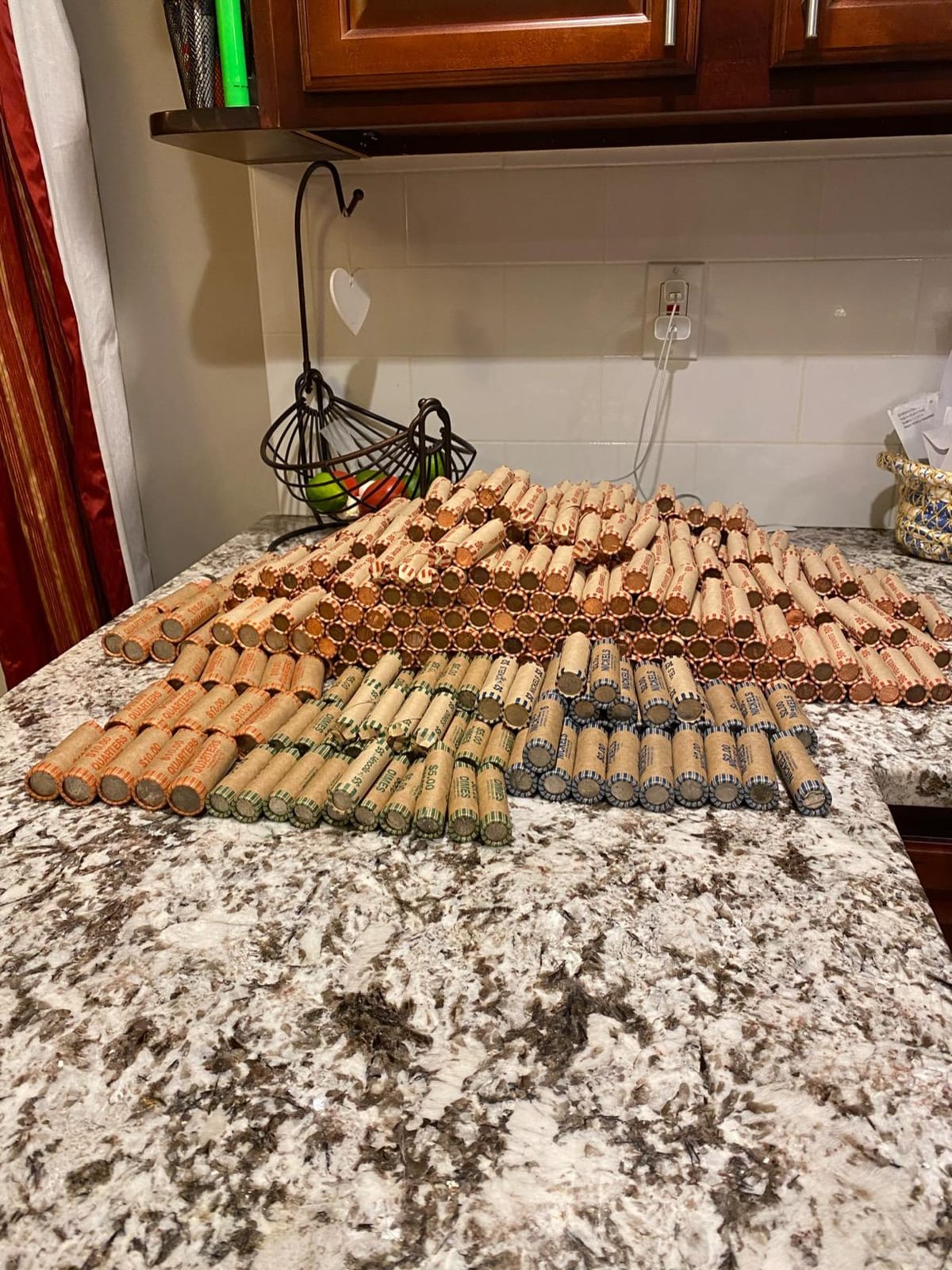
The KCS-2000 does the same core job as the machines above it but at 220 coins per minute rather than 300. Owners accept that trade in exchange for a straightforward unit with a large LED display that shows the full on-screen report by denomination, which is easier to read at a glance than smaller panels.
It handles dollars, quarters, nickels, dimes and pennies into either the included trays or the coin tubes. The one-touch batch setting applies to both bins and wrappers, with auto-stop so nothing overfills, and custom batch settings let you run trays and tubes simultaneously.
Support is the quiet strength here. Kolibri is a USA-based cash handling company and buyers get a one-year warranty plus free lifetime technical support, which matters more than it sounds when a machine lives in a back room and nobody on staff knows how it works. At 8 pounds it is also one of the lightest electric units here, which matters on a counter where it gets moved around.
The listed bin capacities are 900 dimes, 450 nickels, 350 quarters, 300 pennies and 130 dollar coins, and the unit measures 13.58 by 10.03 by 11.61 inches, so it needs a modest counter footprint.
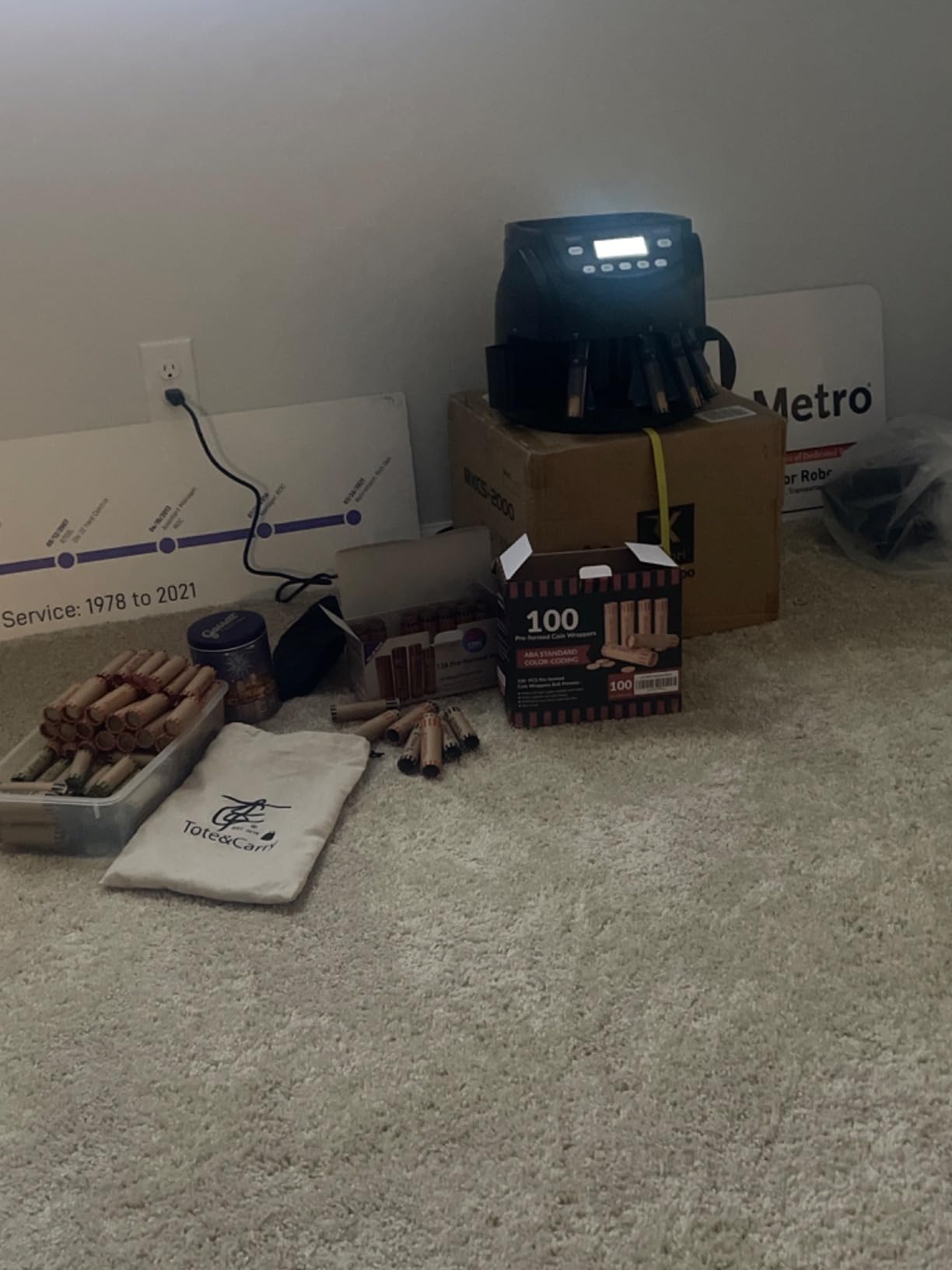
Reading the denomination report on a busy counter
The LED panel is large enough to read from a step back, and the report breaks out each coin type rather than showing a single running number. That matters when you are reconciling against a till: you can see at a glance whether the shortfall is in dimes or quarters.
Pressing stop mid-run gives you a final tally on demand, which is useful when the last customer walks in halfway through a sort.
What you give up compared with faster models
At 220 coins per minute a full hopper takes noticeably longer to clear than on a 300 coins per minute machine. For a business that counts coins once or twice a day that difference disappears. For a laundromat clearing quarters continuously, it does not. Wrappers are also not included, so add those to your first order.
4. VEVOR 5-Denomination Sorter – Best for Simple Small Counters
VEVOR USD Coin Counter Sorter and Wrapper Machine for 5 Coin Denominations
225 coins per minute
1500-coin hopper
Upgraded recognition sensor
Button controls
Pros
- Mixed change goes straight in with no manual pre-sorting
- Upgraded recognition sensor aimed at fewer mis-sorts
- 1500-coin hopper cuts down on refills
- Controls need no training
- Weighs 9.48 pounds
Cons
- 225 coins per minute is slower than the 300 coins per minute leaders
- 1500-coin hopper is smaller than several rivals
This is the machine to point at when someone says they want a coin sorter that a new employee can run on day one. The controls are plain buttons with no menus to learn, and mixed change can go straight into the hopper without any pre-sorting. The manufacturer lists an upgraded coin recognition sensor and claims it lifts identification accuracy meaningfully.
It processes 225 coins per minute with a 1500-coin hopper, and it sorts all five US denominations. Reviews describe dependable denomination recognition and simple controls suited to a small business counter, supermarkets, convenience shops, laundromats, banks and community centers.
Because it only arrived in recent memory, the review pool is smaller than the established models, and that is worth weighing. Reviewers broadly accept the speed and hopper size as adequate rather than class-leading, which is an honest description of where it sits.
How it handles a supermarket or convenience counter
Dumping mixed change straight in and letting the machine separate it is the whole appeal. There is no tray, no tube swap and no batch programming to remember, so a busy counter with rotating staff can run it without supervision. At 9.48 pounds it is easy to reposition.
The 1500-coin hopper means you refill more often than on a 2000-coin machine, but at 225 coins per minute that is a short pause rather than a bottleneck.
Where you will notice the limits
Mis-sorts increase when coins are fed faster than the sensor can read them, so a steady pour beats dumping. It has no wrapper-filling tubes described in the listing, which makes it a counter and bin machine rather than a roll maker. If you need bank-ready rolls, look at a model with tubes.
5. VEVOR 300 CPM LCD Sorter – Best Value 300-Coins-Per-Minute Machine
VEVOR USD Coin Counter with LCD Display, Precise Coin Counting and Sorter Machine – Sorts up to 300 Coins/min into Coin Wrappers, Compact Digital Change Counter Included 5 Coin Bins & 5 Tubes
300 coins per minute
2000-coin hopper
5 bins and 5 tubes
LCD progress display
Pros
- 300 coins per minute paired with a 2000-coin hopper
- LCD screen shows real-time counting progress
- Five bins and five tubes give flexible destinations
- Automatically fills wrappers placed on the roller tubes
Cons
- Coin wrappers are not included
- Compact build has less margin for error when overloaded
This machine pairs specs that normally belong to a higher tier: 300 coins per minute, a hopper rated at 2000 coins, and roller tubes that fill wrappers automatically. Buyers keep pointing out that combination as the reason to buy it. For a business moving mixed change through a counter, you get genuine business-grade throughput without the premium brand price.
It counts and sorts pennies, nickels, dimes, quarters and dollars into five bins, and the LCD interface shows counting progress in real time so you can judge when to top up the hopper. The package includes five coin bins and five tubes.
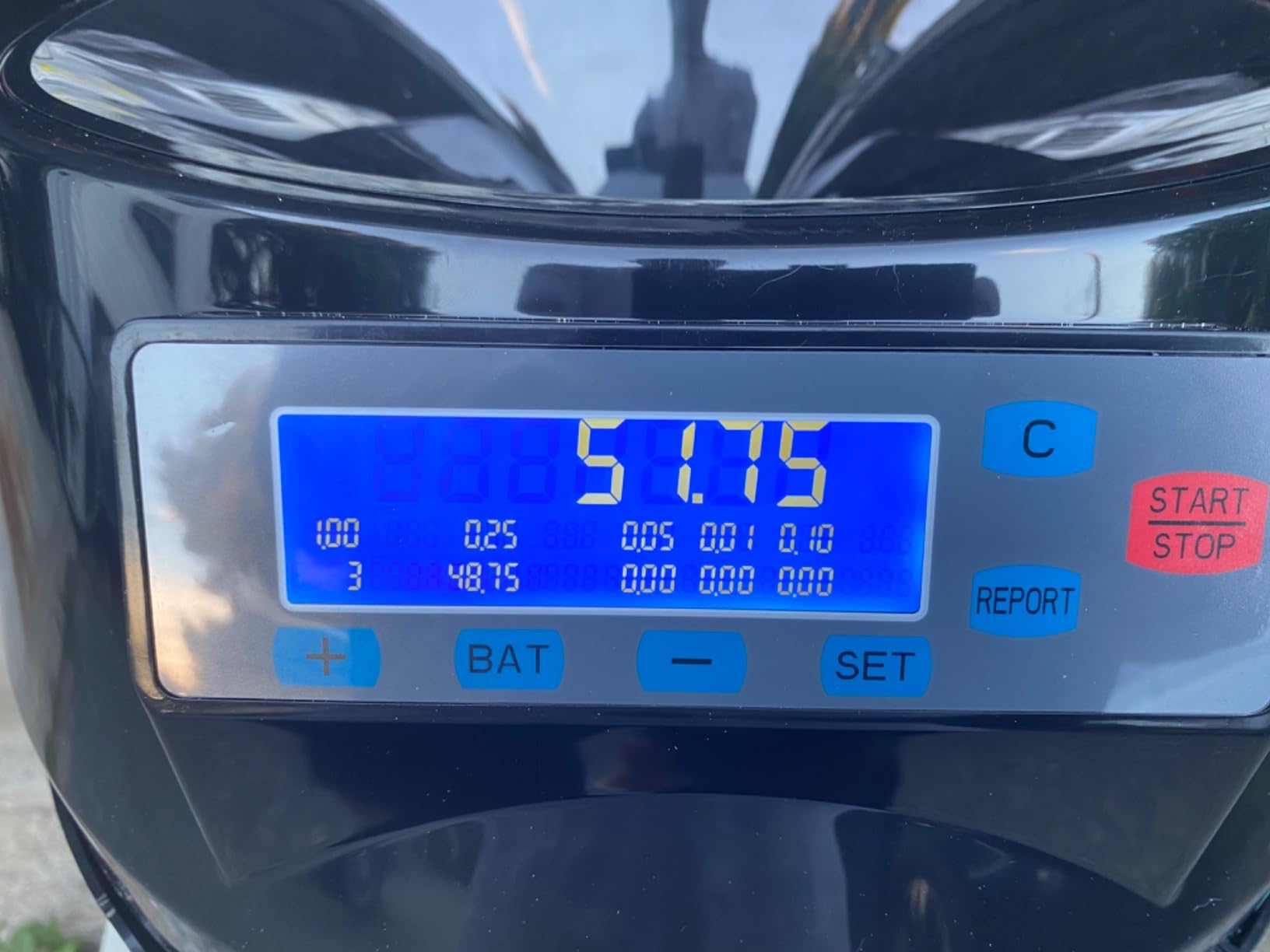
Wrappers are sold separately, and that is the single most repeated caveat in the reviews. It is a small line item, but plan for it before your first run so you are not stopping halfway through. Sorting technology is described as newly upgraded for efficiency, and the control buttons are kept simple.
Reviewers also note the compact build leaves less margin for error when coins are overloaded, so feeding in a controlled pour rather than a full shovel of change gives you the best accuracy.
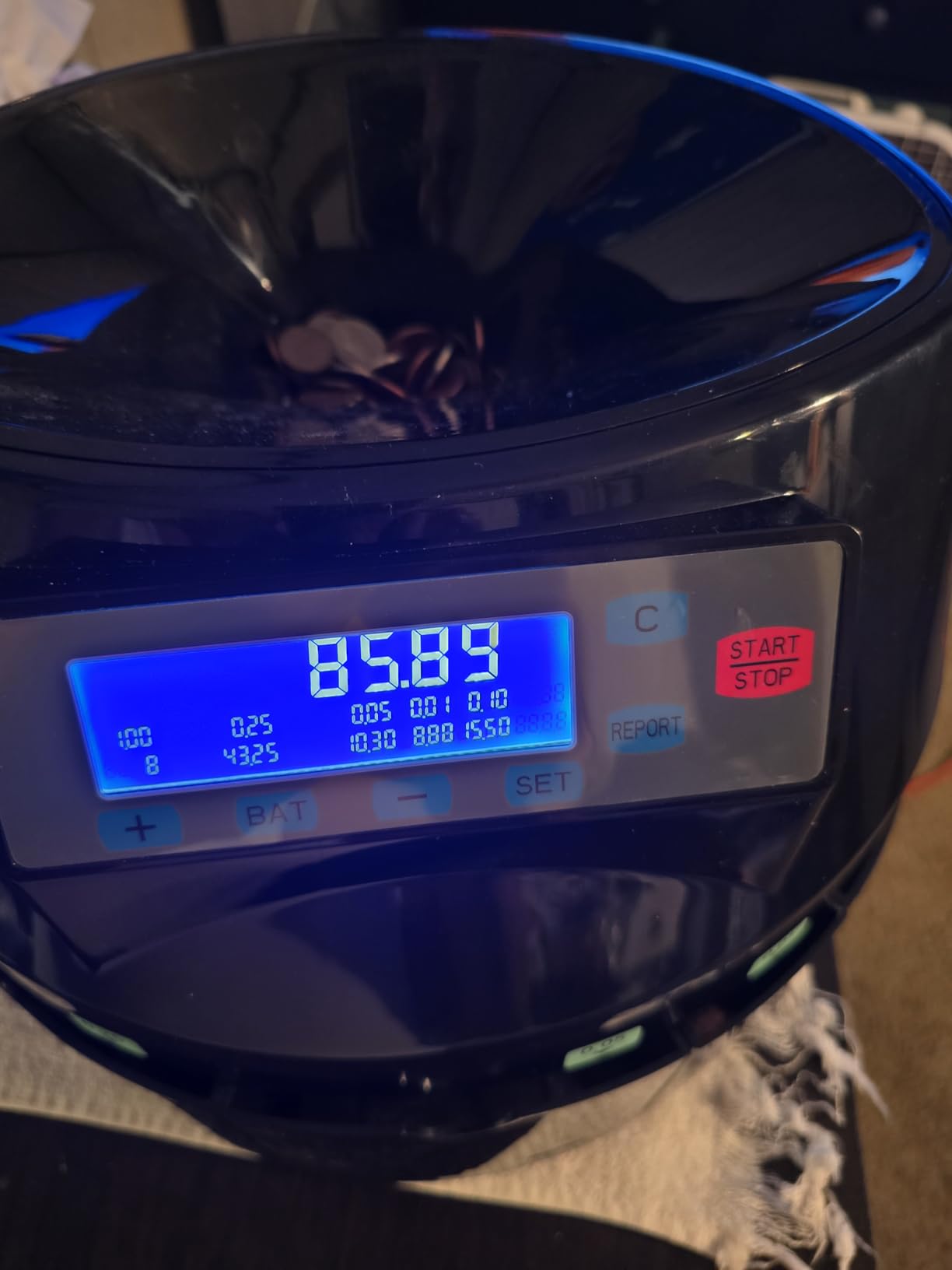
Setting up tubes and bins for a two-denomination workflow
The five tubes are what make this useful for a laundromat or car wash where you mainly care about one coin while still needing to know what the rest is worth. Put wrappers on the tubes for the denomination you deposit, and leave the rest running into bins. The LCD progress view keeps you from overloading a tube.
Because the machine auto-fills, the wrapping step drops from a separate chore to something the machine does while you are handling the next batch.
Where it falls short of the premium models
Support and parts availability are the real differences against a Cassida or Nadex, and the reported review base is much smaller. Dimensions and weight are not published for this model, so measure your counter space before ordering. Overloading the hopper is the fastest way to provoke a mis-sort.
6. Aneken AL-121 – Fastest Throughput With the Clearest Screen
Aneken Coin Counter & Sorter for U.S. Coins, 3.5-Inch TFT Display
350 coins per minute
2000-coin hopper
3.5 inch TFT color screen
Batch counting 0-999
Pros
- 350 coins per minute is the fastest rated throughput here
- 3.5-inch TFT color screen beats monochrome panels
- Batch counting from 0 to 999 with auto-stop
- External display and accessories included
- 2-year support coverage
Cons
- Instructions are unclear for programming each coin type
- Overloading sends coins behind the sorting tubes
- No half dollar support
The AL-121 sorts at 350 coins per minute with a hopper rated at 2000 coins, which makes it the fastest throughput figure in this roundup. The 3.5-inch TFT color screen is the other headline: it shows the quantity and total value of each denomination in real time, and owners consistently rate it clearer and more intuitive than the monochrome displays on cheaper sorters.
Batch counting runs from 0 to 999 and the machine stops on its own when it hits the number, and it powers down after 20 seconds of inactivity so it is not drawing power through a long idle period. It runs on standard AC 110V-120V.
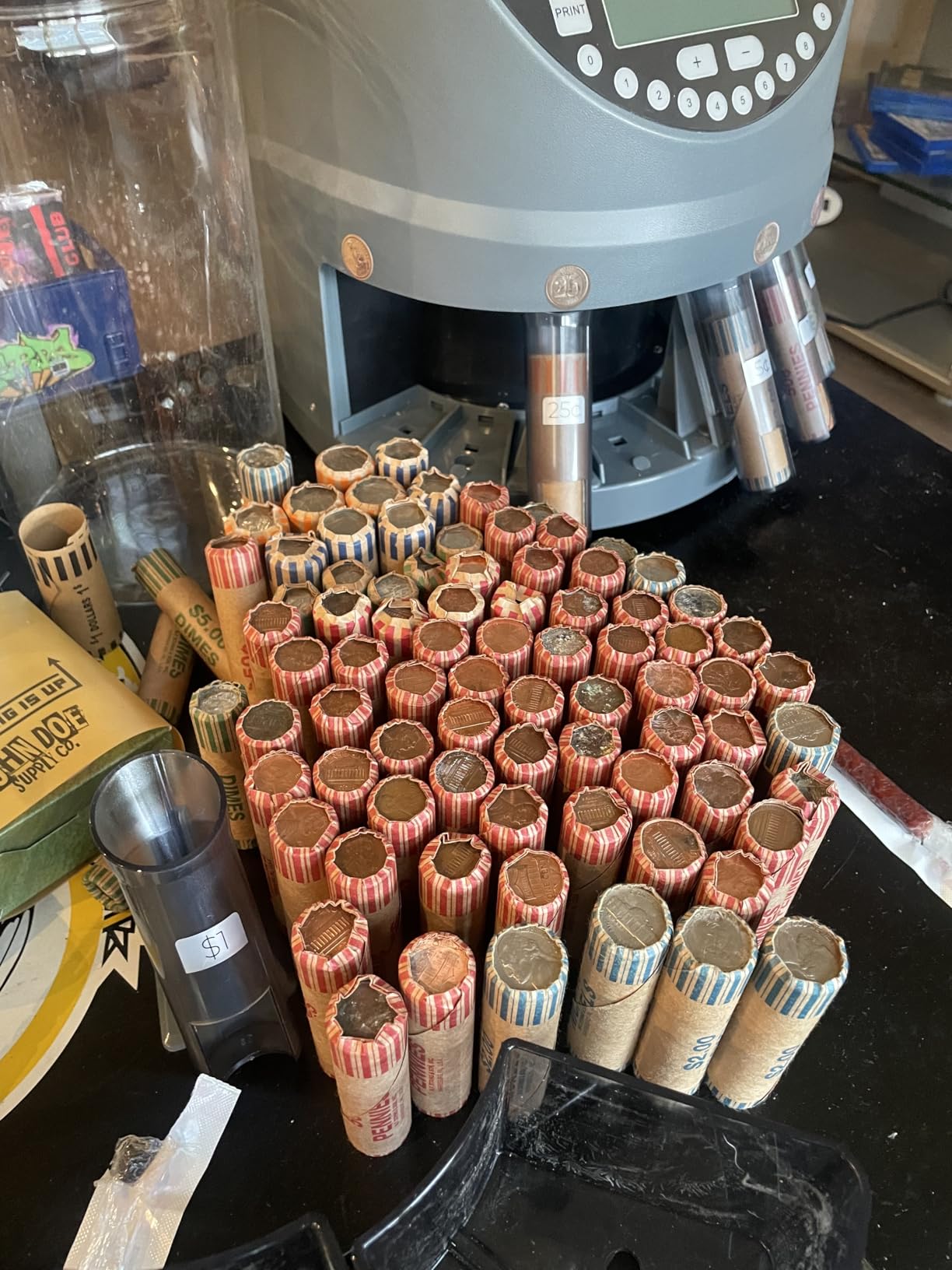
The box is unusually well packed for this category. You get an external display, five coin wrappers, a cleaning brush, a spare fuse, a power cord and a user manual, plus two-year support coverage. That spare fuse alone saves a trip after a jam.
It handles the five common circulating denominations: dollar coins, quarters, dimes, nickels and pennies. Half dollars are explicitly not supported, and foreign coin is not a target.
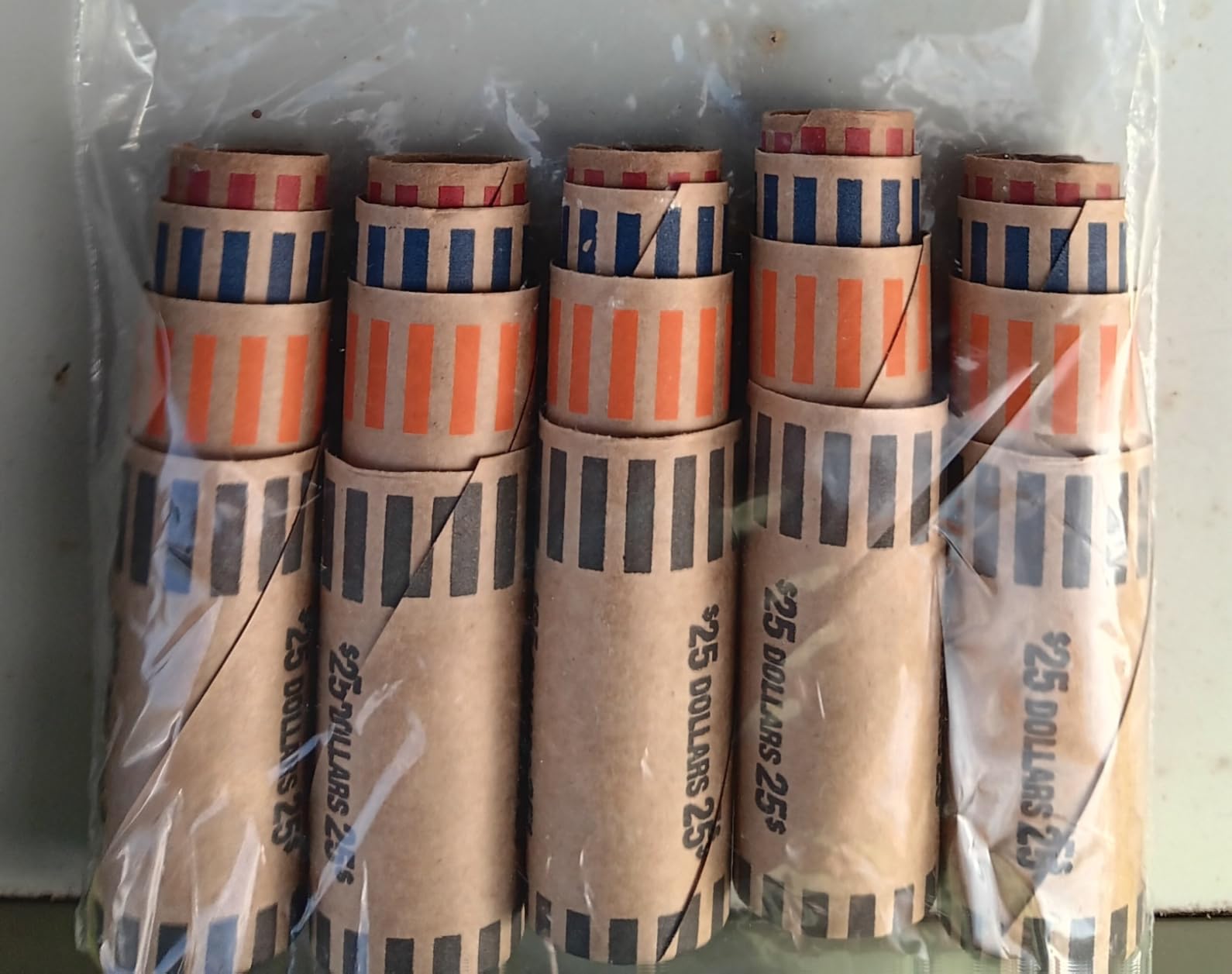
Why the display matters more than the speed number
A color panel that separates denominations by color and value cuts the sorting work out of the job. You can read the dime total without squinting across a counter, and the per-denomination view is what you check before a deposit rather than a single number you have to trust.
Reviewers who feed coins in small handfuls at a steady rate report no jams and no coins landing in the wrong bin. That feeding habit is the single biggest accuracy lever on this machine.
What the reviews warn about
Documentation is the most common complaint. Owners report unclear instructions, especially for programming each coin type, so budget time for a first session. Overloading the hopper causes coins to fall behind the sorting tubes and tubes to overflow, and a few buyers report occasional mis-sorts such as pennies landing in the dime tube. One review also mentioned loose unidentified parts inside the unit on arrival.
7. Byteen8 5-in-1 Coin Tube – Best Value for Home Coin Jars
Byteen8 Coin Counter Coin Sorter with Coin Wrappers, Change Roller Machine
5-in-1 sorter tube
Each tube holds one roll
Wrappers included
Manual and battery free
Pros
- One 5-in-1 unit replaces five separate tubes
- Each tube is sized to exactly one roll
- Coin wrappers included so nothing extra to buy
- No batteries and no motor noise
Cons
- Coins must be pre-sorted on a flat surface first
- Penny rolls occasionally come up one coin short
- Plastic clicks in and out and may crack over time
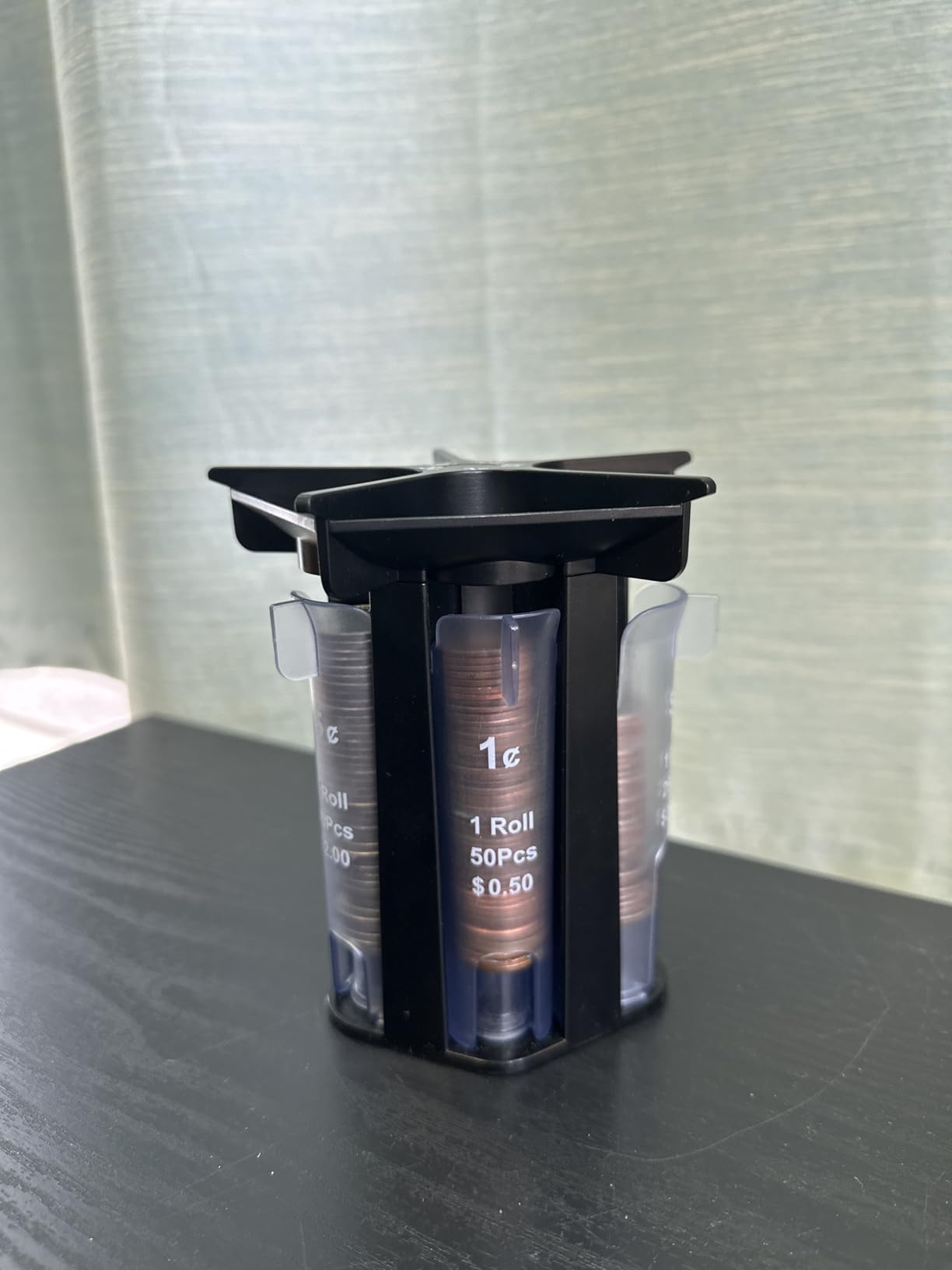
This is the answer to the most common question in this category: what do I do with a jar of mixed change now that my bank no longer has a coin machine. The Byteen8 is a single 5-in-1 unit covering pennies through dollar coins, so there is nothing to lose and nothing to keep track of, and coin wrappers are included in the box.
The clever part is calibration. Each tube is sized to hold exactly one roll, so when the tube is full you slide the excess off and wrap. There is no counting step at all, which is the single biggest time saver in manual sorting. Owners consistently report it replacing a trip to a self-service coin counter at a tiny fraction of the cost.
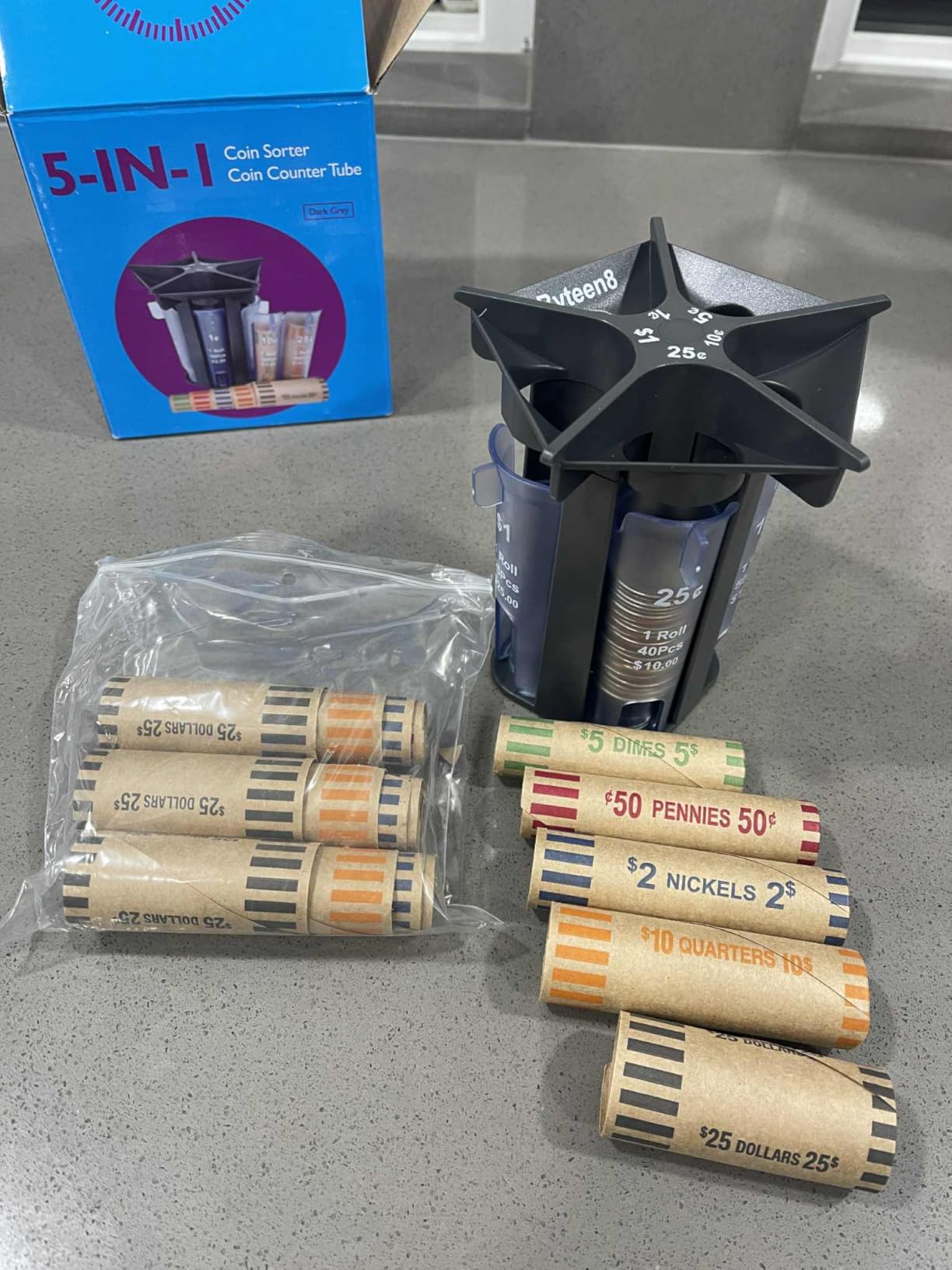
Operation is genuinely simple. Put coins in, slip the wrapper over the top of the column, and roll. There is no power, no noise, and at 4.72 by 4.45 by 5.12 inches it holds in one hand and stores in a drawer. Owners also use it as a teaching aid for children learning to identify coins.
Upward of 1,800 reviews sit against it, and the rating holds steady, which is a useful signal for a product with no moving parts to fail. It is the least expensive way to turn a jar of mixed change into something your bank will actually accept.
Sorting change with kids versus banking it yourself
The upright design and clear full-slot markings make it workable for a child: the fill line is visible, and finishing a roll gives a concrete endpoint. For an adult doing a bigger jar, the manual pre-sort on a flat surface is the bottleneck and the honest cost of this approach.
Manual counting of a large amount of loose change takes hours. Even an hour of tube time replaces a much longer evening at a table, and the sorted result is bankable instead of loose.
Where the manual approach loses
You still do the separating by hand, so the time saving is in counting and rolling rather than in sorting. Accuracy can be off depending on the age of the pennies, occasionally needing an extra coin to reach 50, and some owners are concerned the plastic tube may crack over time. If you have more than a few hundred dollars a month, an electric machine pays back faster.
8. CO5IN1 5-in-1 Sorter Tube – Best for Detailed Home Counting
CO5IN1 Coin Sorter Tube Coin Counter with Coin Wrappers Change Sort Machine
5-in-1 sorter tube
One roll per tube
Printed value markings
Wrappers included
Pros
- Roll counts check out when buyers verify each tube
- Removable tubes are easy to fill and carry
- Overfill slides off when the tube is tilted
- Detailed printed markings on tube and lid
- Works with round tube-style wrappers
Cons
- Coins can fall into the wrong slot if the source pile is not pre-sorted
- Flat paper coin wrappers do not work with the tube; round tube-style wrappers are required
- Roll amounts are not accurate for Canadian coinage because of thickness differences
This tube does the same job as the Byteen8 with a different emphasis: verification. Detailed printing on the tube and the lid shows the coin type, value and quantity, so you can confirm what you are filling and what a full roll is supposed to contain. Buyers who counted each tube afterward report the roll amounts are accurate for US coins.
Removable tubes make it easy to fill, carry and empty, and one buyer reported getting through a large mixed batch of change in about an hour with this design. Overfill simply slides out when the tube is tilted, so there is no recounting step. Simple enough that an 80-year-old user can operate it, which is worth more than it sounds.
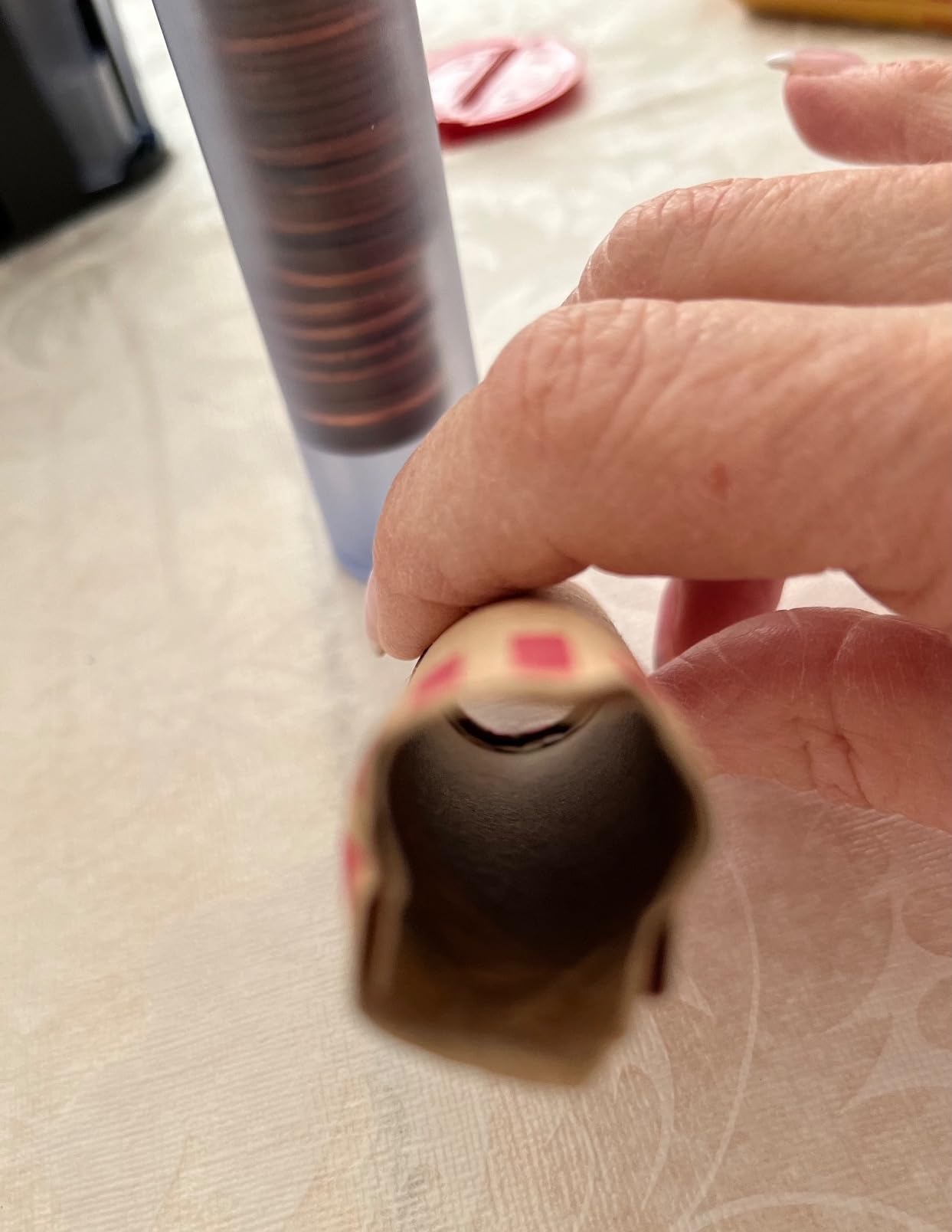
Wrappers are included. Be aware of the type though: this works with round tube-style wrappers and not with flat paper wrappers, so keep an eye on what you buy as replacements. At 8.8 ounces and 4.8 by 4.4 by 5.5 inches it disappears into a cabinet when the job is done.
It is a manual device with no motor, so there is no accuracy rating to speak of beyond the roll calibration itself.
Rolling as you go instead of in one long session
Because the tube holds one roll, you can work denomination by denomination and stop whenever a roll is finished. That suits households that would rather do fifteen minutes than sit down for an evening, and it suits anyone whose bank supply of wrappers runs out mid-project.
Keep the source pile sorted as you go. Coins that land in the wrong slot come from feeding an unsorted pile, not from a faulty tube.
Where it will not work
Roll amounts do not hold up for Canadian coinage because of thickness differences, so this is a US-only tool. It is also clearly slower than an electric counter for anything above a jar-sized amount. Treat it as a bridge between loose change and a machine, not a replacement for one.
9. CO5IN1 Manual Change Roller – Best Compact Portable Roller
CO5IN1 Manual Change Sorter Roller Coin Counter Machine with Coin Wrappers
5-in-1 sorter tube
One roll per tube
Printed quantity markings
Battery free
Pros
- Each tube calibrated to exactly one roll
- Five denominations in one compact unit
- Clear printed markings for type and quantity
- Simple enough for children to use
- No power required
Cons
- Coins must be pre-sorted by denomination
- Calibrated to US coin sizes only
This is the same core design as the previous tube, in a light grey package, and it earns its place as a second set for a second table. At 9.9 ounces it is easy to move between rooms, offices or a kitchen, and it needs no outlet and no setup. The listing gives its package footprint as 5.47 by 4.8 by 4.57 inches, so measure your shelf before ordering.
The printing on the tube shows the coin type, value and quantity, and each tube is again sized to exactly one roll so overage rolls back out rather than creating a recount. Buyers find it effective for rolling household loose change and simple enough for a child to handle.
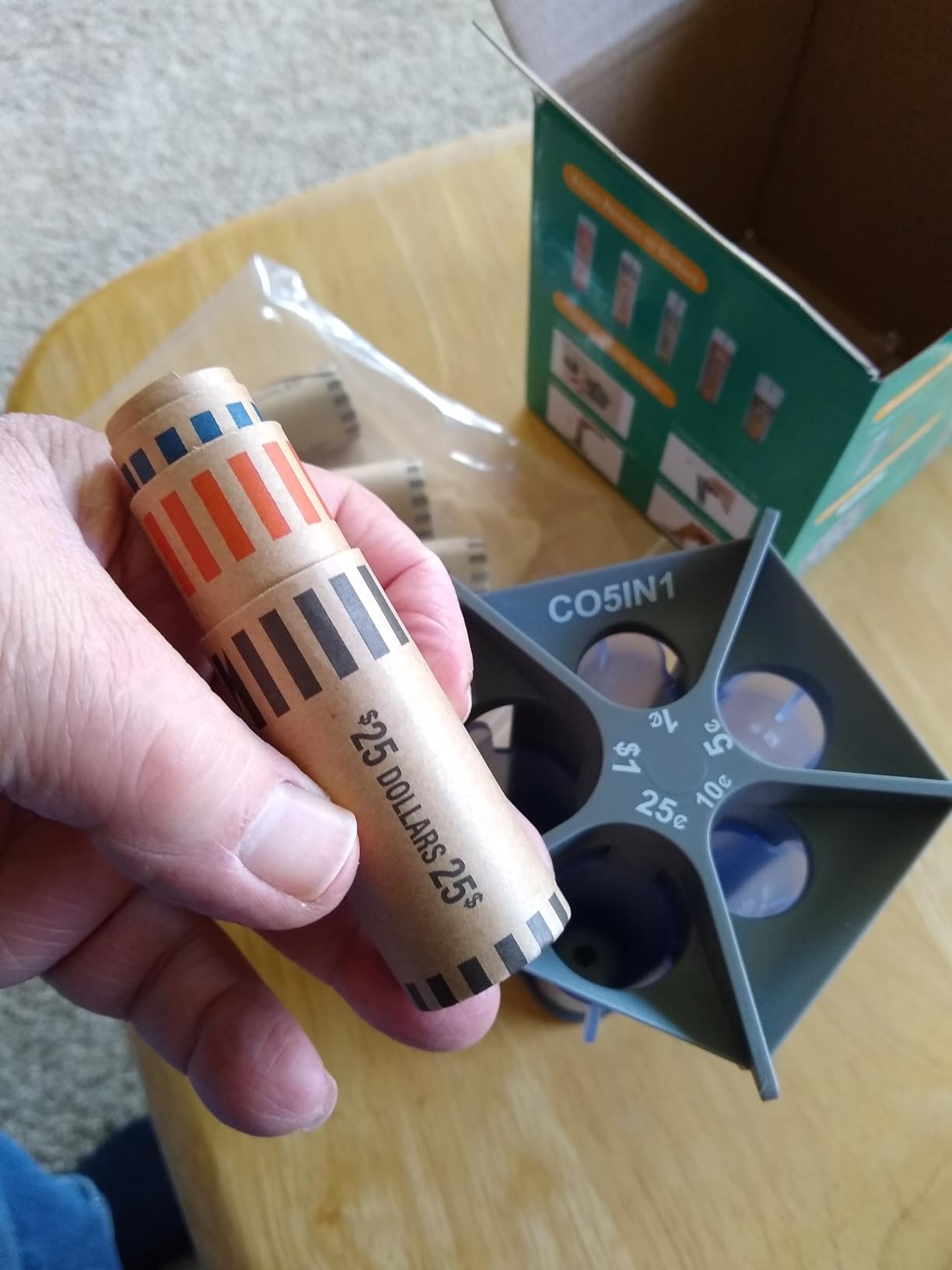
Because there is no motor, there is nothing to plug in and nothing to service. The tubes lift out for filling and empty by tipping, which is the whole operating cycle: fill, tip off the excess, slide a wrapper over the column and roll. For a classroom, church group or small office, that simplicity is the entire appeal.
The light grey housing is easy to tell apart from a black set on a shared table, which matters more than it sounds when several identical tubes are in rotation and you need to know which one belongs to which pile.
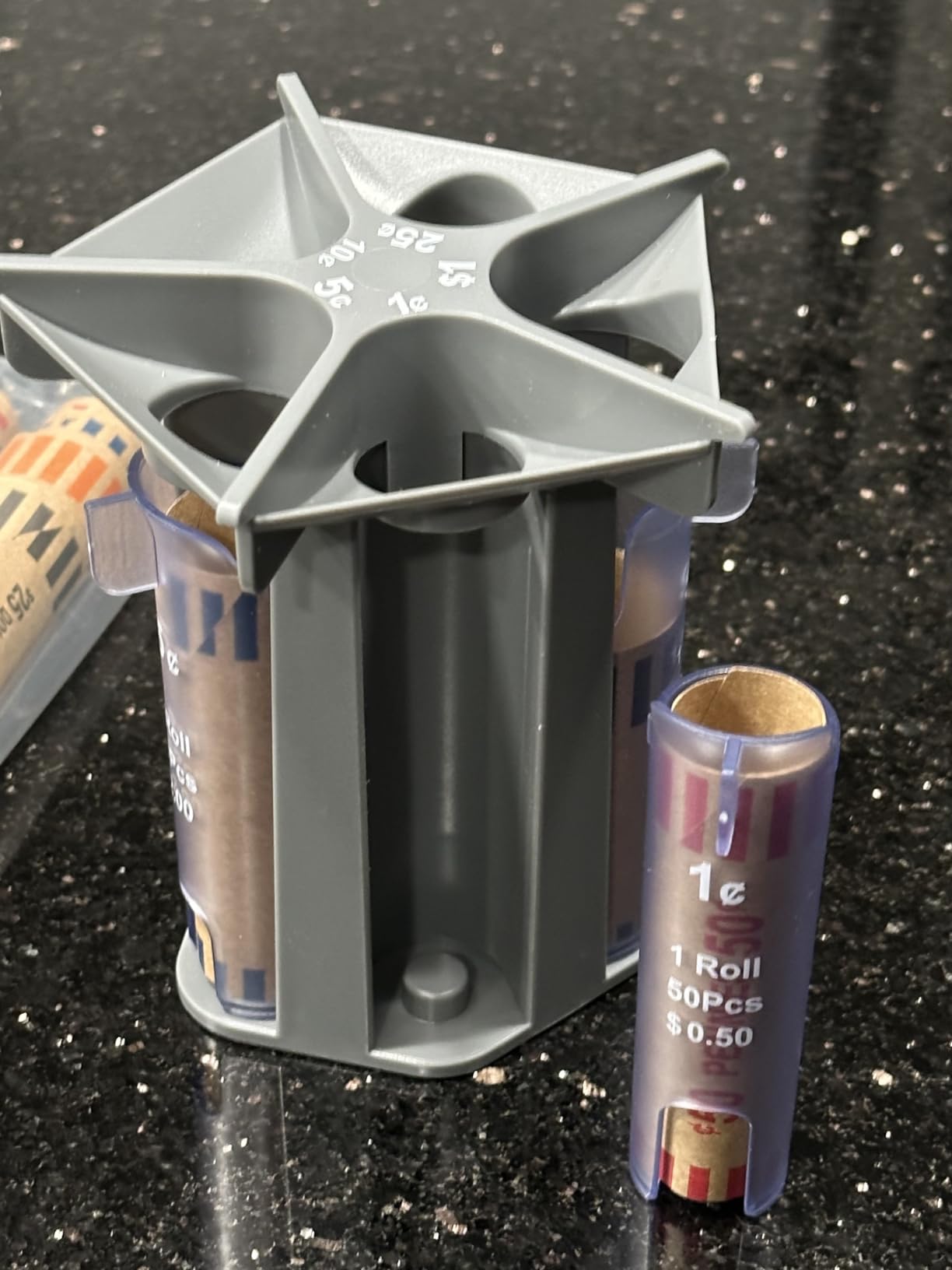
When a compact manual roller is the right call
If the change is a drawer, a jar or a classroom box, a small footprint and no power connection matter more than throughput. It needs no outlet, no setup and no consumables beyond paper wrappers, so it lives in a drawer until a jar reaches a worthwhile size.
For a church or school fundraiser, a set of these handed to several volunteers beats one machine queued in one room, because the sorting can happen in parallel.
The limits of the one-roll-per-tube design
Coins have to be pre-sorted by denomination before you load a tube, which is where the time actually goes. It is calibrated to US coin sizes, so Canadian or other currencies will not produce correct roll amounts. Above a few hundred dollars a month, the math stops working in its favour.
10. ESSENTIAL Trays and Tubes Set – Best Complete Color-Coded Kit
ESSENTIAL Coin Sorter Trays & Coin Counter Tubes
60 coin wrappers
4 tubes and 4 trays
2 coin crimpers
ABA color coding
Pros
- Complete set with 60 wrappers
- tubes
- trays and crimpers
- ABA standard color coding makes denominations obvious
- Translucent plastic shows fill levels
Cons
- Manual operation only
- so nothing counts automatically
- Trays and tubes are separate pieces that must be stacked in order
The ESSENTIAL set is built around completeness, and it is the only manual kit here that also ships two crimpers. One order gives you 60 coin wrappers, four coin counter tubes, four coin sorter trays and two coin crimpers. Nothing else to buy, nothing to source separately, nothing to lose track of.
The color coding follows ABA standards: blue for nickels, green for dimes, orange for quarters and red for pennies. Once you internalize those four colors, you stop reading labels entirely, which is the fastest possible sort. The tubes and trays are translucent durable plastic, so you can see fill levels from the side rather than guessing.
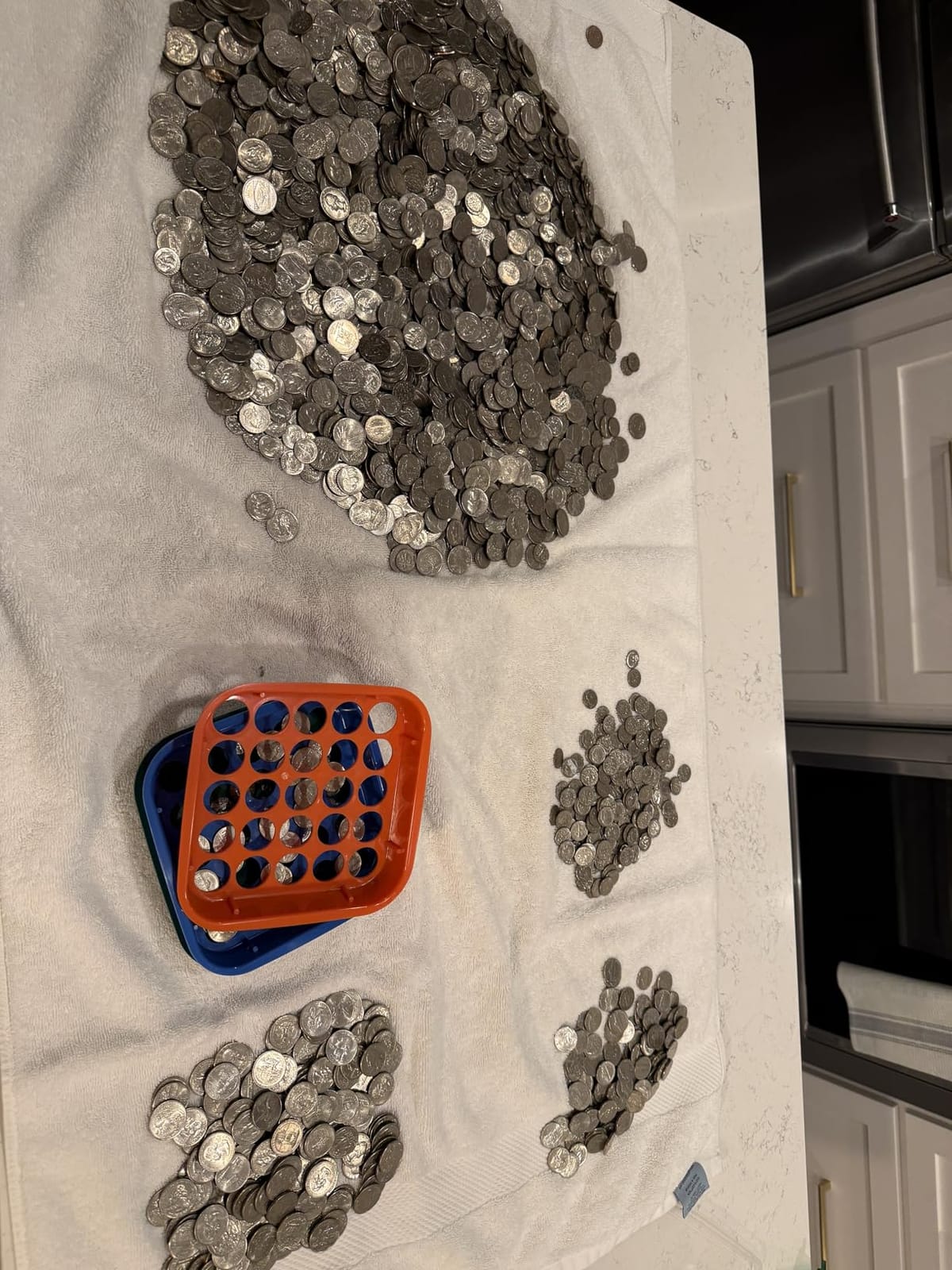
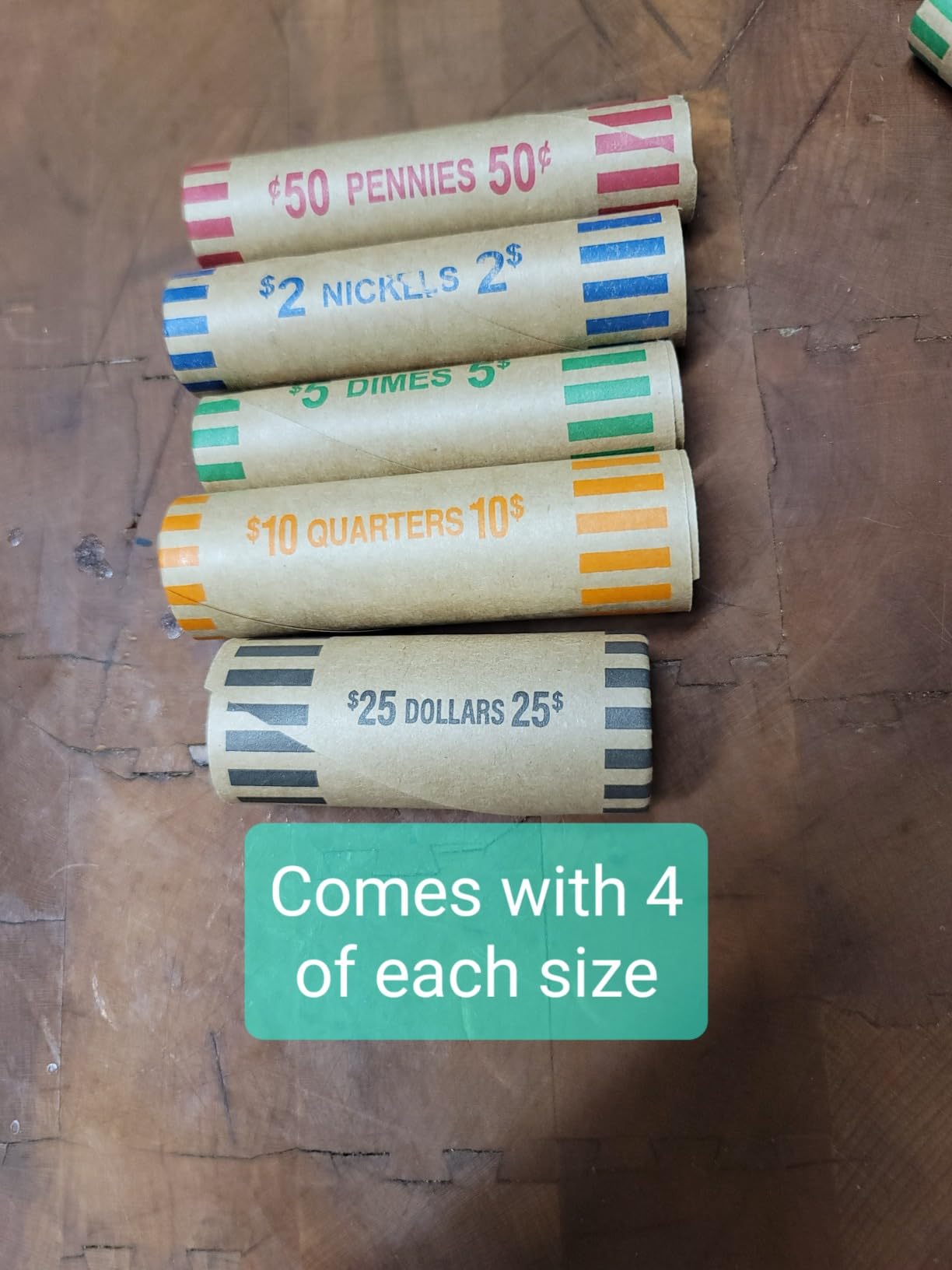
You get 15 wrappers each of quarters, pennies, nickels and dimes, made from sturdy printed paper. The crimpers are the underrated part: they finish a roll neatly without needing a machine, and having two means you can roll at both ends of a table.
At 1.5 pounds and 11.8 by 7.9 by 3.9 inches, the kit is a shelf item rather than a counter item. It is sold for banks, stores and cafes, and it doubles as an educational tool for teaching children to identify coins.
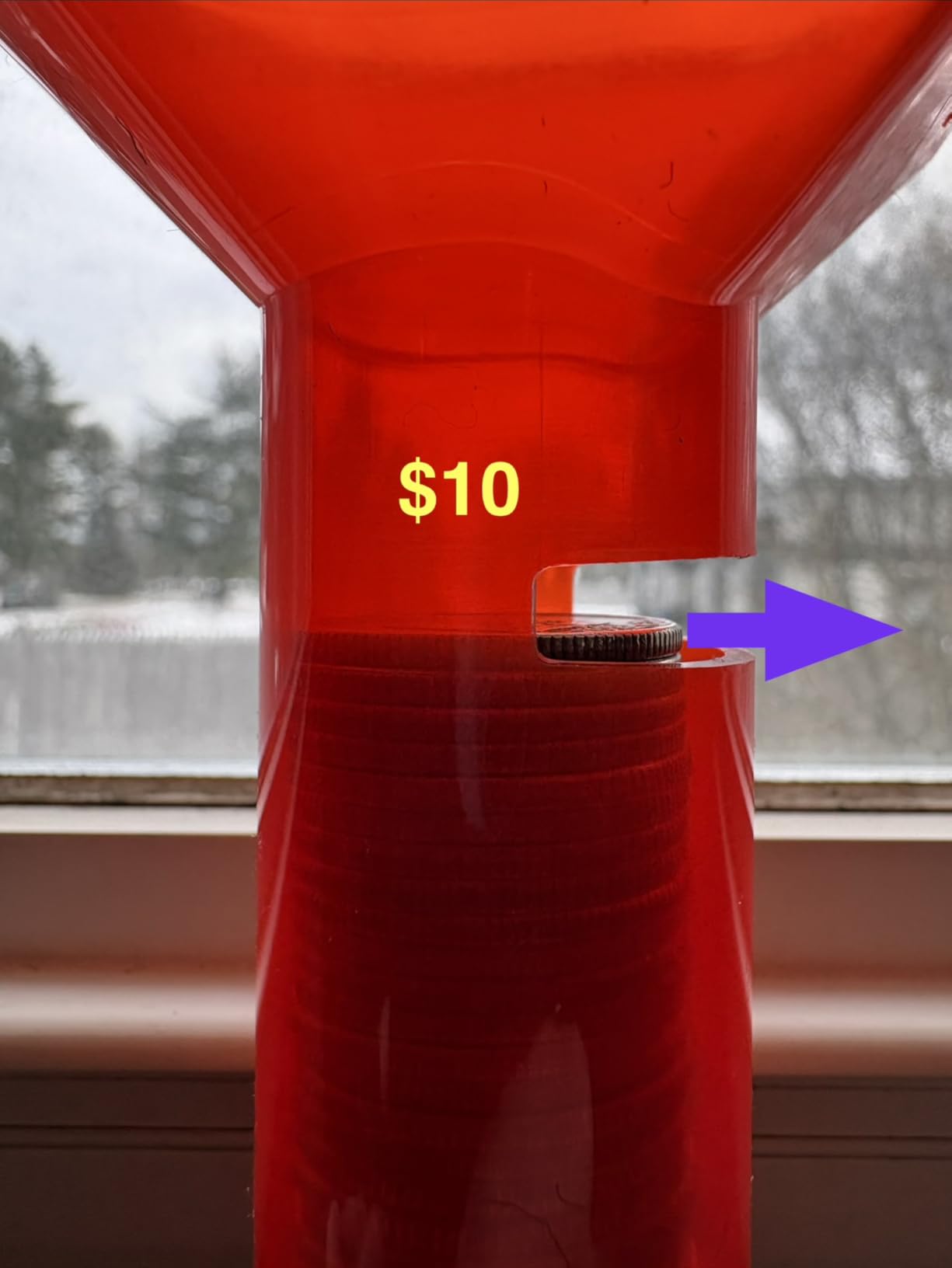
Whether a full kit beats buying pieces as you need them
A kit makes sense if you roll coins regularly, because wrappers are the consumable you will always run out of. If you are sorting a single jar, a single 5-in-1 tube is less money and less shelf space. The crimpers tip it for a business that rolls every week, since a poorly finished roll can be refused at the counter.
Duplicating the set across a church or school fundraiser gives each group its own color-coded station and keeps the wrapping from becoming a bottleneck at one table.
What you give up compared with a machine
Nothing here counts. Every roll is calibrated by eye at the fill line, and the trays and tubes are separate pieces that must be stacked in the correct order to sort at all. That is fine for occasional household sorting and wrong for a car wash drawer emptied nightly.
11. CO5IN1 11-Slot Change Counter – Best Desk Organizer and Storage Tray
CO5IN1 Coin Sorter Change Counter + Pen Holder Coin Organizer Tray Machine
11 compartments
Over 540 coins
360-degree rotation
Center pen holder
Pros
- Stores over 540 coins across 11 slots
- Center compartment doubles as a pen and pencil holder
- Runs smooth and quiet with no moving mechanical parts
- Printed markers show one roll worth per slot
Cons
- Printed value markings reported as inaccurate by some buyers
- Slot allocation is weighted toward quarters
- US dollar denominations only
This is not a sorter in the electrical sense, and we think that is the point. It is an 11-compartment rotating tray that stores over 540 US coins, with printed markers on each slot showing what one roll is worth. It earns the highest average rating of anything in this roundup, at 4.6 stars, because it does one simple thing and does it well.
The 360-degree rotation runs smooth and quiet with no moving mechanical parts beyond the turntable, so there is nothing to break and nothing to plug in. The center compartment doubles as a pen and pencil holder, which turns the whole unit into a desk organizer rather than a coin box that lives in a closet.
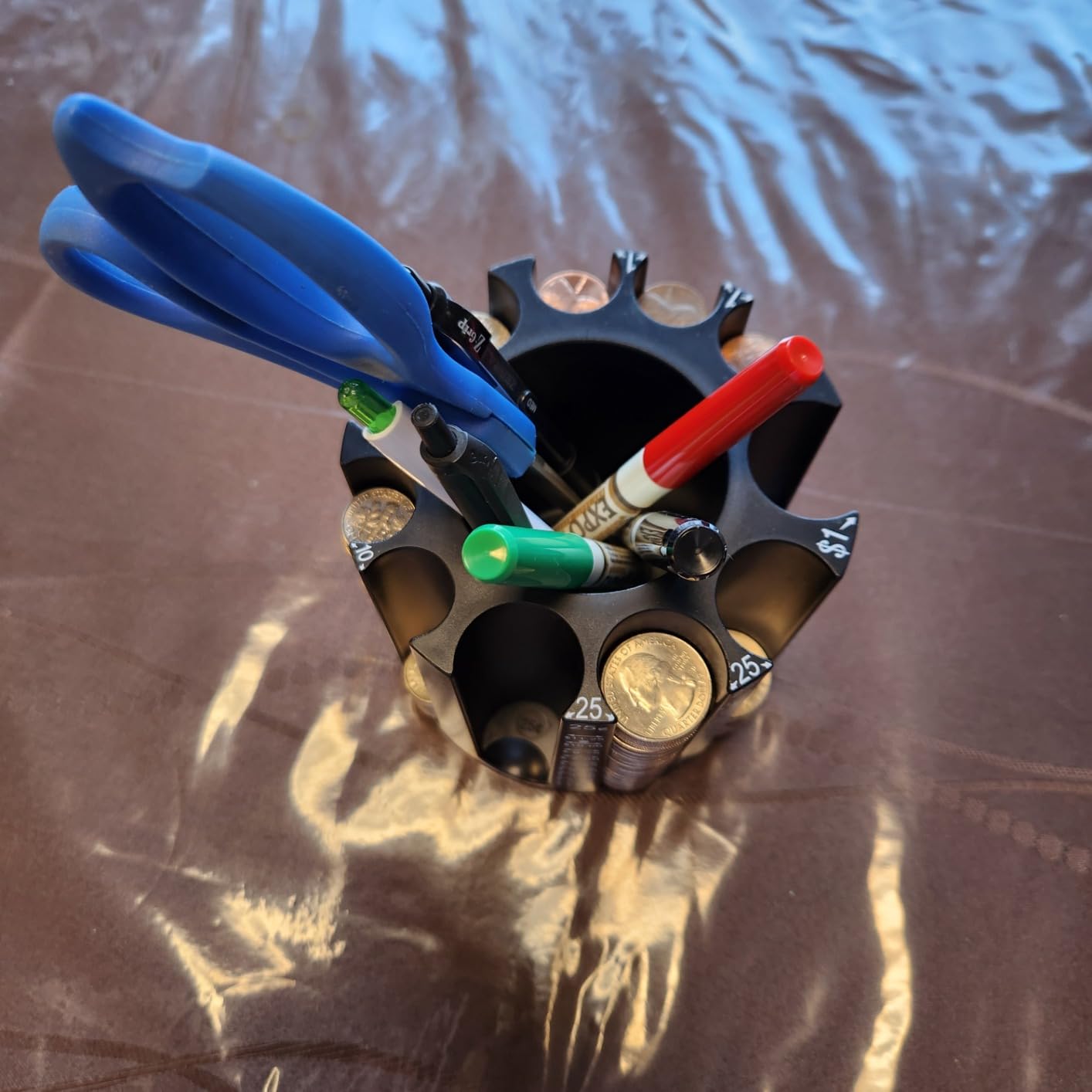
Printed markings show one roll worth per slot, so the wrapping step is a matter of filling each compartment to its line. It is listed at 0.29 kg with a tabletop rectangular plastic mount, so it needs a flat surface and nothing else.
Owners describe the build as high quality for the price, and the rotation means you can bring a compartment to you rather than reaching across a spread of coins.
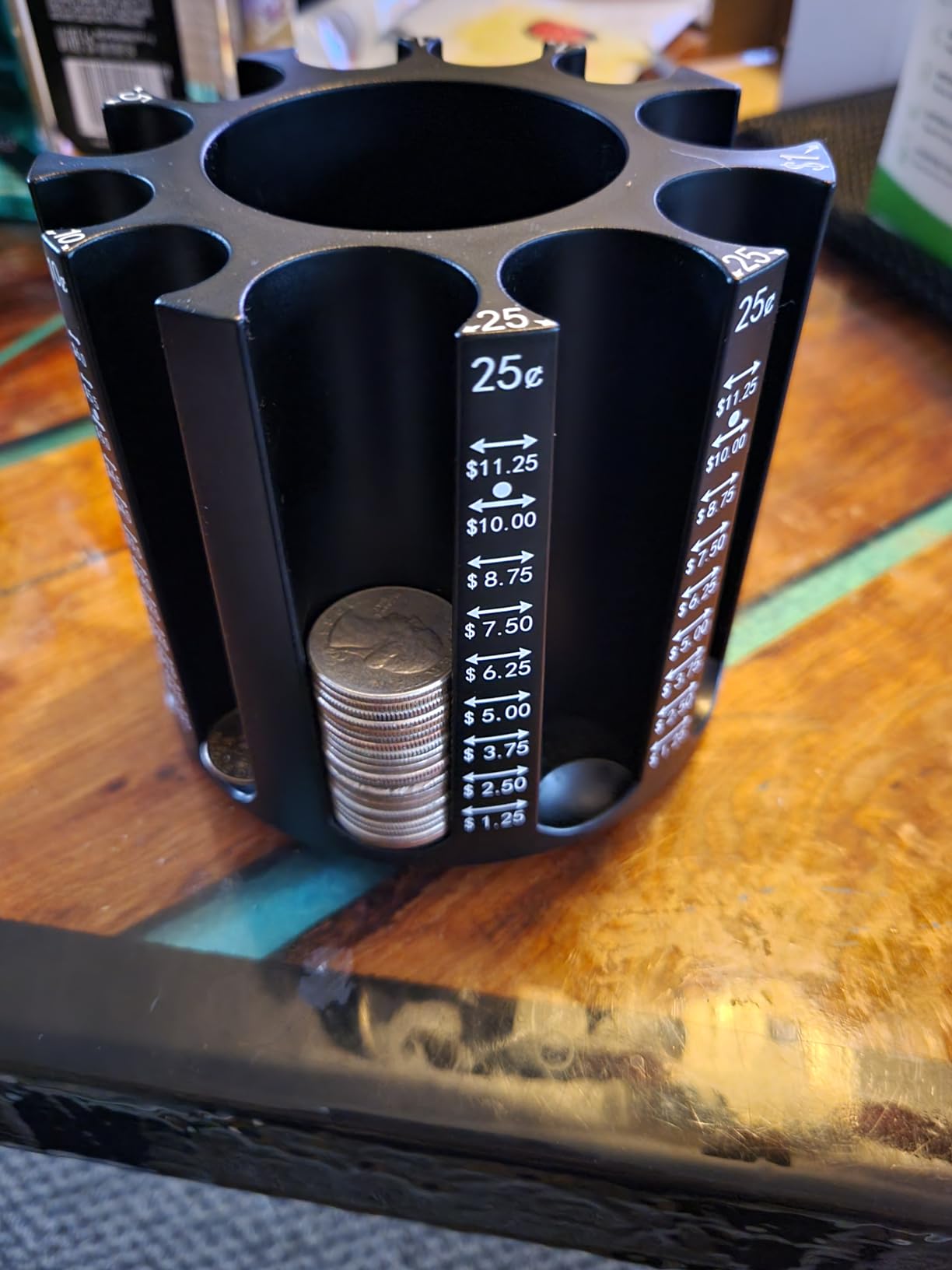
Using it as a sorting station rather than a storage box
Fill one slot at a time. Bring each denomination to its compartment, stop at the printed roll marker, and the tray hands you a finished column to wrap. That turns a table covered in mixed coins into a short, repeatable pass that works well with a family or a small office.
The pen holder in the middle is genuinely useful on a counter or a desk where the tray doubles as stationery storage, and it makes the unit something you keep in view rather than put away.
Where the markings and slots fall short
Some buyers report the printed value markings as inaccurate, so verify a roll against your own count the first few times. The slot allocation is weighted toward quarters with only one slot for dollar coins, which reflects how much loose change actually is. It is also US dollar denominations only, so it will not organize sterling or any other currency.
12. Sumrftn Trays, Tubes and Wrappers – Best Tray and Tube Set
Coin Sorter Tray & Coin Sorter Tube – 4 Color Coded Coin Separator Trays and Coin Sorters Tubes Bundle with 100 PCS Coin Wrappers Assorted
4 color coded trays
4 counting tubes
100 wrappers
ABS plastic
Pros
- Trays
- tubes and 100 wrappers in one bundle
- Color coded trays separate denominations at a glance
- ABS plastic trays and tubes feel sturdy
Cons
- Fully manual with no electronic counting
- Flat wrappers included rather than tube-style
- Trays must be stacked in the correct order
The Sumrftn bundle is built around the shake-sorting method, and it pairs trays and tubes with 100 flat coin wrappers. You get four color-coded sorting trays, four counting tubes and 100 flat coin wrappers, 25 each of quarter, dime, nickel and penny. Nothing extra needs buying before your first roll.
The sorting method is worth understanding before you buy. Stack the trays green, red, blue, orange, put your coins on the orange tray and shake them, and the coins separate by size into the layered trays. From there they go into the matching tube with a wrapper inside.
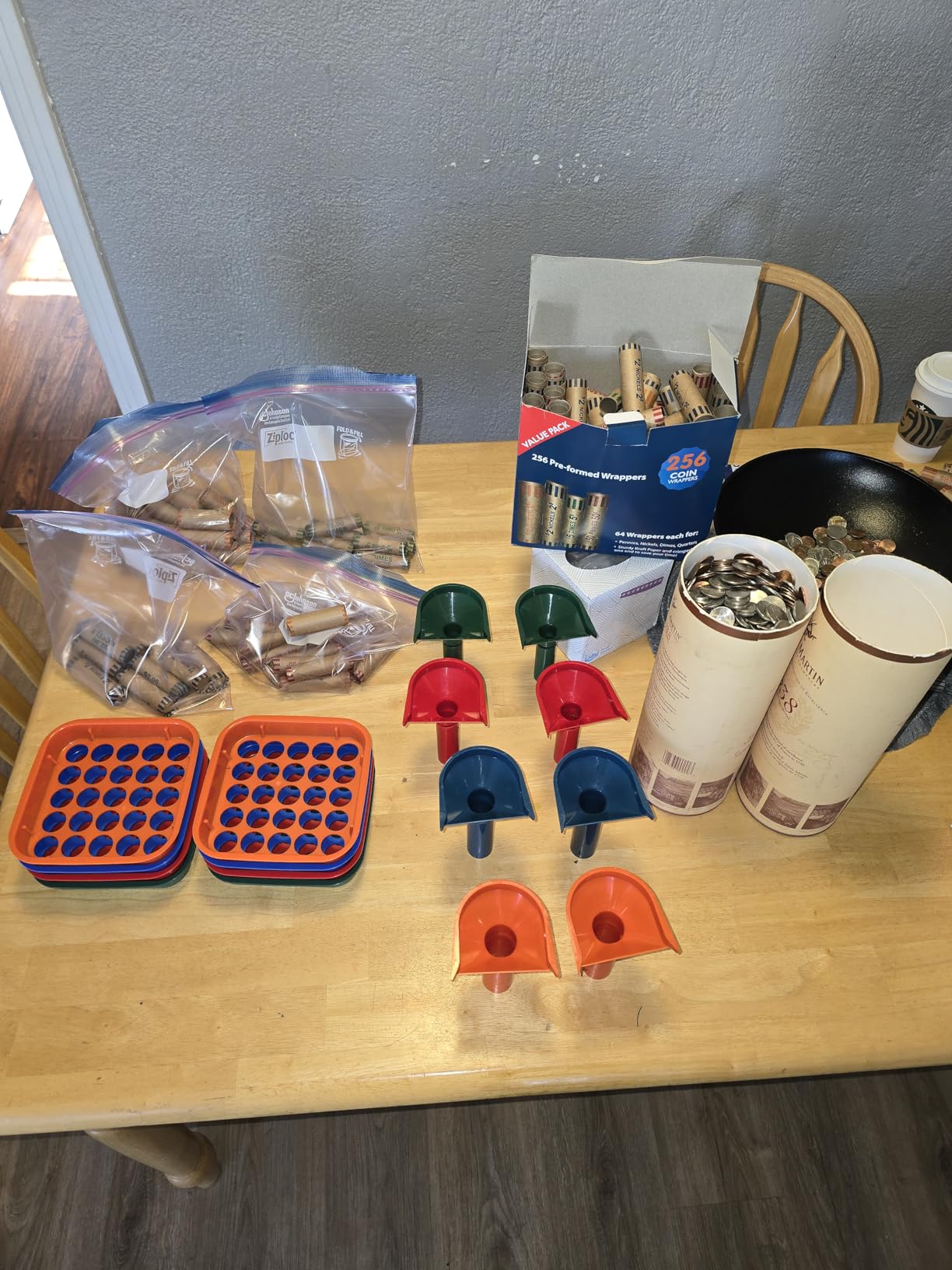
Trays and tubes are made from ABS plastic, which owners describe as sturdy, and the wrappers are Kraft paper rather than the thin printed stock used on some kits. One buyer report cited working through a large mixed batch in about an hour with a comparable manual setup, which is a realistic figure to plan around.
At 1.3 pounds it is a shelf and drawer item, and it stacks neatly when not in use.
When shake-sorting beats a single tube
Sorting by shaking separates several denominations in one motion, which is faster than picking a jar apart one coin at a time into five separate tubes. If your loose change is properly mixed, that up-front separation is the expensive part of manual sorting and this set attacks it directly.
It also works well as a classroom or office station because the shake method needs no accuracy and no instructions to get right.
What you trade away for that convenience
The process is entirely manual, so nothing is counted electronically and the wrapper fill line is your only accuracy check. The wrappers are flat paper rather than tube-style, so they will not seat inside the counting tubes the way rounded wrappers do. And the tray stack order matters: get green, red, blue, orange wrong and the separation quietly fails.
How to Choose a Coin Counter and Sorter in 2026
Most buying mistakes in this category come from matching a machine to a job it was not built for. Work through these seven questions in order and the right category of machine becomes obvious before you look at a single listing.
Match the hopper to your daily coin volume
Under about 500 coins a month, a manual tube and a tray kit will do everything you need, and an electric machine will sit idle. Between roughly 500 and 2000 coins a month, a 1500 to 2000-coin hopper is the sweet spot. Above 2000 coins a day, you want a 2000-coin hopper and 300 coins per minute or better, and you should expect to be emptying trays mid-session.
Hopper capacity is always quoted in coin counts, and the honest comparison is by coin size. A 2000-coin hopper holds a small number of quarters and a large number of dimes, which is why manufacturers quote the dimes figure. Check the bin capacities too, since a small penny bin fills long before the hopper does.
Counting speed in coins per minute
The spread in this group runs from 220 to 350 coins per minute. That sounds meaningful until you do the arithmetic: a 2000-coin hopper takes under seven minutes to clear at 300 coins per minute and about six at 350. Speed matters when you run coins continuously, such as a laundromat or car wash, and it barely registers when you count once a day.
For most small businesses, treat speed as a tiebreaker behind accuracy and jam resistance.
Denominations and the half-dollar question
Almost every machine in this class sorts the five common circulating denominations: pennies, nickels, dimes, quarters and dollar coins. Half dollars are the exception, and the Aneken explicitly does not handle them at all. The Nadex sorts five denominations too, and half dollars or foreign coins are reported to lock up in the mechanism.
If half dollars show up regularly in your stream, pull them by hand before every run. A machine that chokes on one coin type is worse than no machine.
Coin roll wrapping, batch mode and auto-stop
Bins alone give you a sorted pile, not a bankable deposit. Roll filling is what turns loose change into something a bank will credit without a fight. Look for roller tubes or coin tubes, and for a batch setting with auto-stop that halts at a set coin count so a roll fills exactly.
Note which machines include wrappers. The Nadex S540 Pro ships with 48 preformed wrappers, while the Kolibri and both VEVOR models list tubes but not the wrappers themselves. The manual kits all include theirs. For reference, a standard US roll holds 50 pennies, 40 nickels, 50 dimes, 40 quarters, 20 half dollars or 25 dollar coins.
Your coin counter versus a self-service coin counting fee
Self-service coin counting kiosks keep a percentage of everything you deposit rather than paying you a flat rate, and that percentage is what drives people to buy a machine. A one-time machine purchase has to be weighed against the repeated percentage on the volume you actually process, so the honest calculation is monthly coin volume multiplied by the current fee percentage, compared with the machine cost amortized over the number of months you expect to use it. Check the current rate at the counter, because it changes.
Where a machine wins is time. Forum discussions describe manual counting taking three to four hours per thousand dollars of change, which is the real cost nobody prices in. Where a kiosk still wins is convenience: no machine to store, clean and maintain, and no capital outlay for a small volume.
What your bank actually accepts for coin deposits
Most US banks and credit unions want coin rolled, sorted by denomination, and many will not count loose coin at all. Wrappers are frequently free at the counter, though policies vary and many banks have reduced or ended that service. Ask your branch before you buy anything, because if they require their own wrappers, a tube-filling machine saves you a step and a manual roller does not.
A printed count receipt or a hand-kept denomination breakdown is worth having at deposit time, because it is the difference between a smooth transaction and an argument at the teller window.
Manual sorters versus electric machines
A manual tube set costs a fraction of any machine and needs no power, no maintenance and no parts. It fails you in one specific way: coins still have to be separated by hand, and that is the slow part. Electric machines take mixed change directly from the hopper, which is why a laundromat or a restaurant moves up to one quickly.
A middle path works well for a church or school fundraiser: several manual kits used in parallel by volunteers, or one machine if the volume justifies it. If you also collect coins rather than count them, our metal coin set guide covers the hobby side of the same habit, and our geiger counter guide covers another common collector entry point for the same audience.
Frequently Asked Questions
What is the difference between a coin counter, a coin sorter and a coin wrapper?
A coin counter totals the number and value of coins fed into it. A coin sorter separates coins by denomination into bins or tubes. A wrapper packs sorted coins into the paper rolls most US banks require for coin deposits. Machines that do all three are called coin counter sorter and wrapper units.
Do banks still give out coin wrappers for free?
Policies vary by branch and many have reduced or ended free wrappers. Ask your own branch before you buy supplies, since some require their own wrappers and most will not accept loose coin at all.
How much does a coin counting kiosk keep out of every 100 dollars I deposit?
Self-service coin counting kiosks charge a percentage of the total deposited rather than paying a flat rate, and the current percentage varies by operator and location. Check the rate posted at the counter, then compare it against a machine purchase amortized over the months you expect to use it.
Is there a better alternative to paying a coin counting fee?
Yes. A manual 5-in-1 tube and a set of color-coded trays cost a fraction of a machine and remove the fee entirely for household volumes. For a business processing coins daily, an electric counter and sorter with wrapper tubes pays back against the repeated percentage fee on the volume you run.
How accurate are coin counting machines?
On clean, undamaged circulation they are highly consistent, and owners of the machines in this roundup report stable per-tube and total accuracy over long runs. Accuracy drops with worn, bent, flattened or foreign coins, and with overfilled hoppers, so pre-sorting odd coins and feeding coins at a steady rate gives the best results.
Why does my coin sorter keep jamming?
Most jams trace back to coin condition or feed rate rather than a fault. Dirty, bent, partially cleaned and off-size coins are the usual culprits, as is pouring a full shovel of change in at once. Remove odd coins before a run, feed a steady handful at a time, and clean the sensor path periodically with the brush most machines include.
The Best Coin Counter and Sorter for Your Situation
For most people reading this, the best coin counters and sorters choice is the Cassida C300. It handles 300 coins per minute, holds 2000 in the hopper, and its Quick Load tubes remove the single biggest time loss in the wrapping process. It is our pick because it balances speed, capacity and build quality better than anything else in this group, in 2026.
Pick differently if your situation differs. A small business that needs trays and wrappers in the same run should look at the Nadex S540 Pro. A shop that only wants the largest display and the most included accessories should look at the ESSENTIAL trays and tubes set, which holds 60 wrappers, tubes, trays and crimpers in one order. A household with a jar and a rolled-coin habit should start with the Byteen8 tube, and nothing more complex.
One last practical note. Whatever you choose, check what your bank will accept before you start rolling, and pull half dollars and foreign coins out by hand before any powered run. Those two habits solve most of the frustration people report with coin counters and sorters, and they cost nothing.