
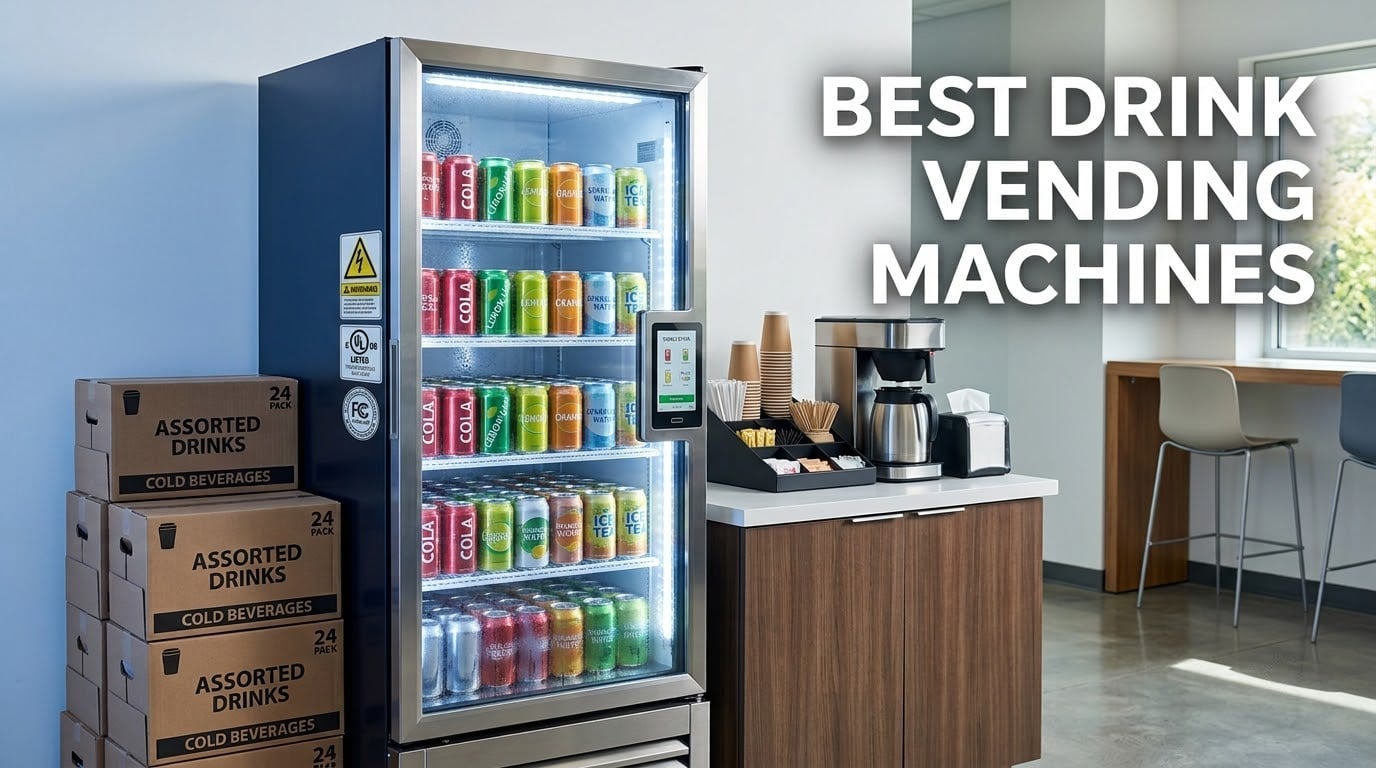
There is no shortage of drink vending machines for sale online, and almost none of them tell you the two things that actually decide whether a placement makes money: how the machine behaves in month eight, and what the payment system quietly costs you every month after that. We went through twelve refrigerated and combo units, pulled the manufacturer specifications, read every verified review we could find, and cross-checked the recurring complaints against what operators say on r/vending and VENDiscuss. The result is a list of the best drink vending machines for 2026, ranked on capacity, cooling, payment flexibility, weight and the strength of the evidence behind them.
Our focus is the machine, not the building. A break room, a gym floor, a factory bay, a hotel lobby and a school corridor all need different things from a cabinet: some care about cash handling, some care about a narrow footprint, some care about surviving a wet mop. The twelve units below cover refrigerated combos, dedicated beverage machines, elevator delivery cabinets and AI grab-and-go coolers, so there is at least one realistic fit for each of those placements. If you are furnishing a lounge rather than a warehouse, our globe drink cabinet picks for home bars cover the glassware side of the same decision.
One warning before we start. The drink vending category is full of white-label machines built on the same chassis, and the review counts are small. A perfect score built on four ratings is not the same as a 4.4 built on twenty-nine. We flag that difference every time it matters, because paying for a 5.0 average that rests on two reviews is a gamble, not a research result.
What follows is the full comparison table, twelve individual machine reviews with the trade-offs spelled out, a buying guide built around the specifications that matter after installation, and answers to the questions operators ask most often. Everything here reflects data available in 2026.
Table of Contents
Top 3 Picks for Drink Vending Machines in 2026
Three machines came out of this group ahead of the rest. The HAHA US-360 wins on evidence and balance, the VendGo 570L AI wins on capacity per square foot, and the EPEX EP-G424 is the compact option for rooms where floor space is the binding constraint.

HAHA Smart Combo US-360
- AI vision checkout
- App-based inventory control
- Cashless NFC
- ETL certified
VendGo 570L AI Combo
- Up to 800 cans
- 18 cubic foot body
- Motorized pickup lanes
- 110V plug-and-play

EPEX EP-G424 Combo
- Compact 32 x 30 x 65 in body
- LED glass front
- Programmable pricing
- Snack and beverage combo
Best Drink Vending Machines in 2026: All 12 Compared
Every machine below is refrigerated, runs on standard 110V power unless noted, and is intended for unattended commercial placement. The table gives you the scan view; the individual reviews that follow explain what each number means in practice.
| Product | Specifications | Action |
|---|---|---|
| HAHA Smart Combo US-360 |
|
Check Latest Price |
| VendGo 570L AI Refrigerated Combo |
|
Check Latest Price |
| EPEX EP-G424 Snack Beverage Combo |
|
Check Latest Price |
 EPEX D648 Refrigerated Elevator EPEX D648 Refrigerated Elevator |
|
Check Latest Price |
 VendGo SM-ZL-N36 Combo VendGo SM-ZL-N36 Combo |
|
Check Latest Price |
 KVM G660 Extra Large Combo KVM G660 Extra Large Combo |
|
Check Latest Price |
 Afen 60 Slot Refrigerated Combo Afen 60 Slot Refrigerated Combo |
|
Check Latest Price |
 MICTER 570L Smart AI Combo MICTER 570L Smart AI Combo |
|
Check Latest Price |
 HAHA 550FT Touch Card Combo HAHA 550FT Touch Card Combo |
|
Check Latest Price |
 Pacau 570L Refrigerated Combo Pacau 570L Refrigerated Combo |
|
Check Latest Price |
| VendGo SM-AI-520 AI Vending |
|
Check Latest Price |
 EPEX G654W Dual Temperature Combo EPEX G654W Dual Temperature Combo |
|
Check Latest Price |
How We Evaluated These Machines
Every unit was assessed on the same five criteria, using the manufacturer’s own specification sheet alongside the full set of verified customer reviews available for that listing.
First, refrigeration: compressor type, refrigerant, defrost method, and whether the temperature band suits cold drinks rather than merely being cold. Second, capacity: selections, total item count and the footprint that capacity consumes. Third, payment: which tender types the machine accepts, and whether the hardware is MDB standard so a different card reader can be fitted later. Fourth, physical logistics: shipping weight, dimensions, and how much rear clearance the unit needs. Fifth, the evidence itself, which is where most of these machines fail the test.
We cross-checked the recurring complaints in reviews against operator discussion on r/vending and the VENDiscuss forums, particularly on service access, payment fees and product damage. Where a machine had a very small review base, we say so rather than treating the score as established.
1. HAHA Smart Combo US-360: The Best All-Round AI Combo
Smart Combo Vending Machine for Business with AI Technology Vending Machine for Sale, Card Reader & App Control Refrigerated Commercial US-360
AI vision checkout
267 lb body
110V 60Hz
ETL certified
Cashless and NFC
Pros
- AI vision checkout handles multi-item grab-and-go purchases
- App-based inventory monitoring with auto-generated replenishment lists
- Fully cashless so there is no coin box to empty
- ETL certified for commercial placement
Cons
- Only 29 ratings so long-term reliability data is thin
- 267 lb body needs planned floor placement and delivery access
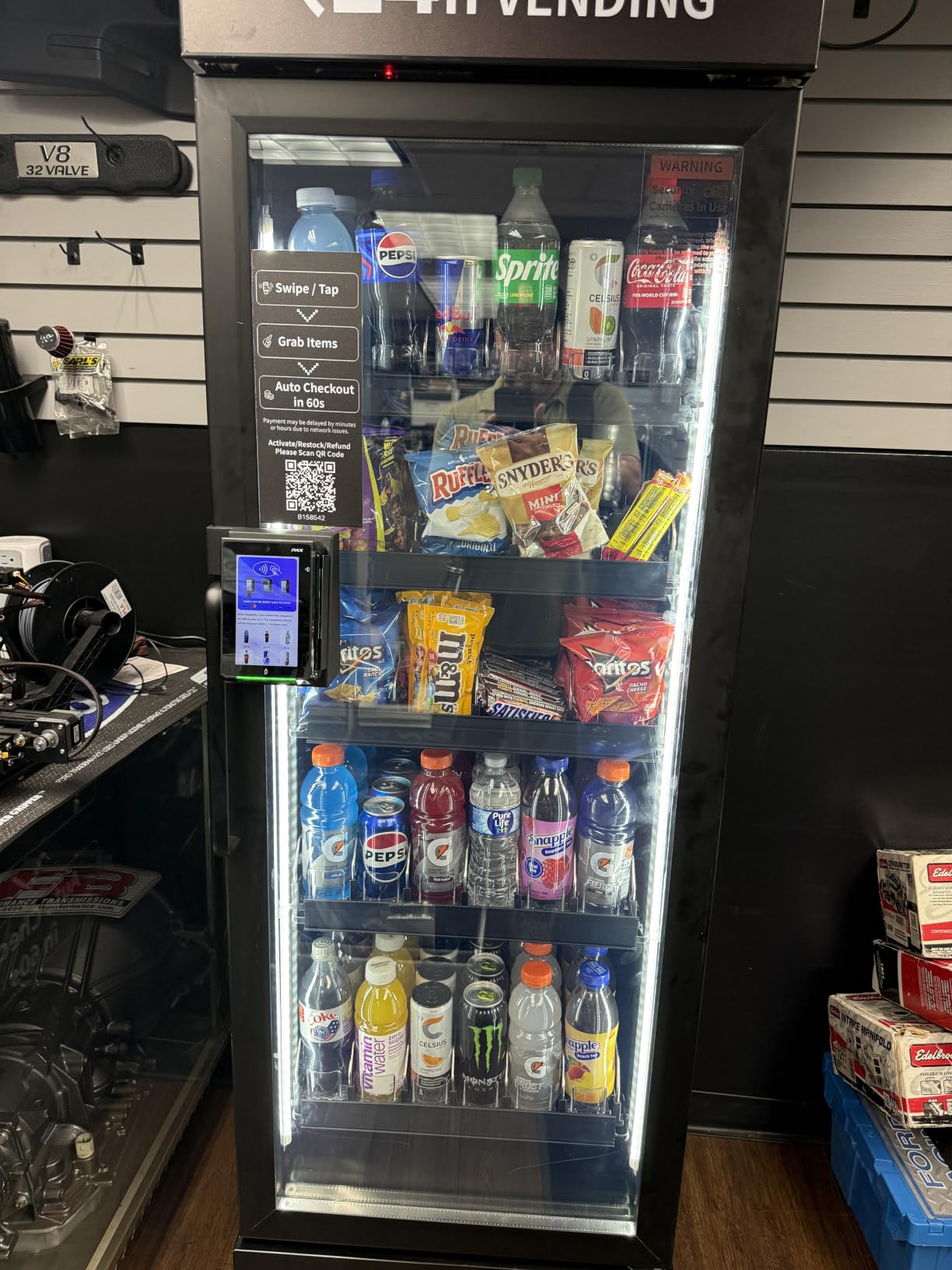
The US-360 is the machine we kept coming back to while working through this list. It is the only unit in the group with both a substantial review history and a genuinely modern checkout system. The AI vision camera reads what a customer takes rather than relying on a spiral motor to push one item forward, which removes the single most common failure mode in vending: a mis-vend, a jam, or a crushed can at the bottom of the bin.
At 267 pounds it is also lighter than most full-size cabinets, which matters more than it sounds. Delivery crews charge by the stair and by the door, and a machine that two people can walk through a doorframe without a pallet jack will save real money on the way in.
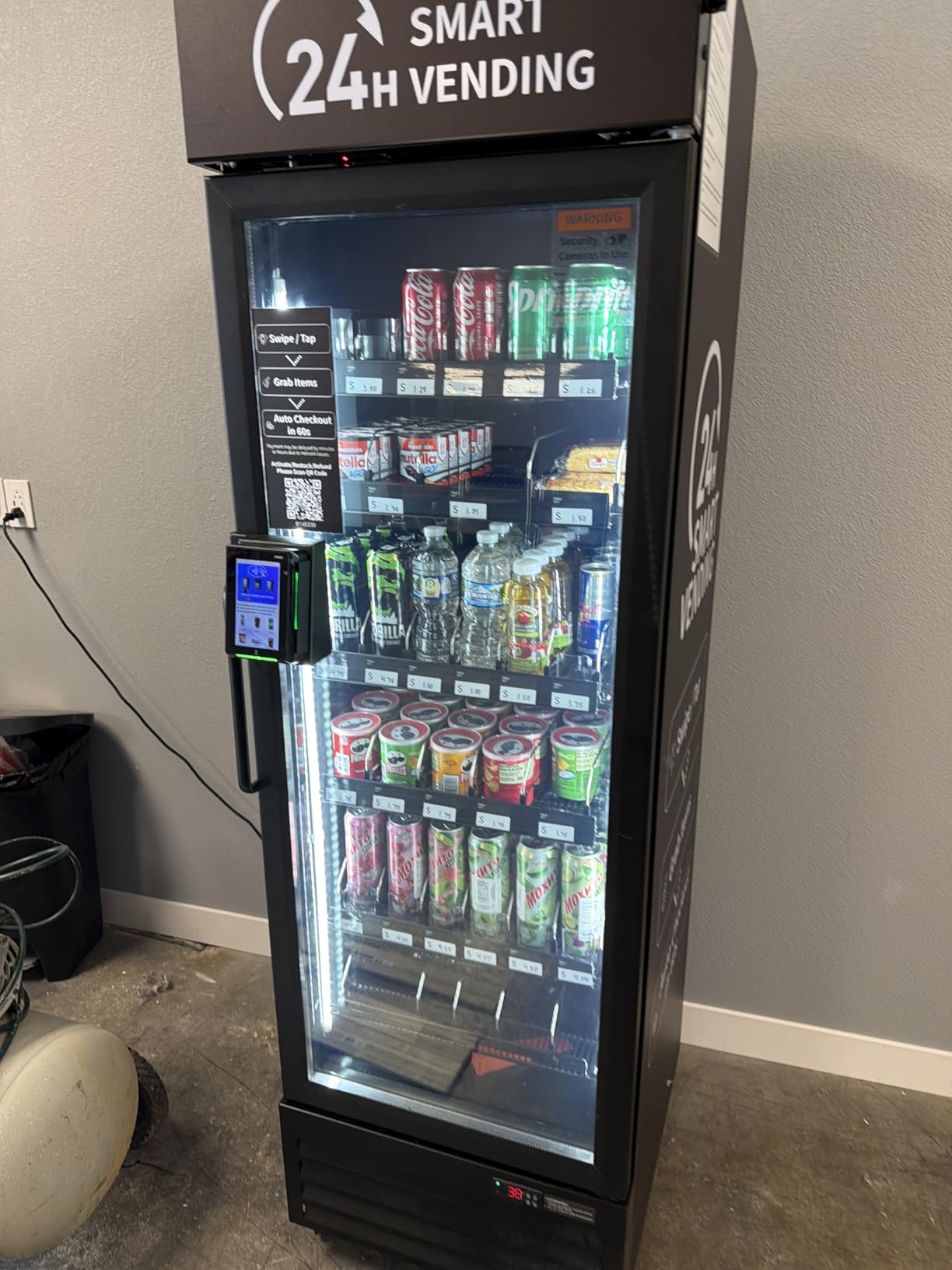
Payment is entirely cashless: credit card, Apple Pay, Google Pay, Samsung Pay, mobile wallets and NFC. For an office, a gym or a campus that skews young, that removes a real barrier to impulse purchases, because nobody carrying a single quarter walks past a machine they have to feed coins into. The spec sheet lists 110V at 60Hz and an ETL certification, which matters if your location manager has facilities standards.
The 267 pound figure and the 76.5 by 31.75 by 26.5 inch package also tell you something about planning. You need a level floor, a clear path to the final position, and roughly six inches of rear clearance for ventilation. Do that work before the machine arrives, because these are not appliances you slide around after the fact.
What you should check before buying
Ask the seller directly what the AI recognition actually costs to run. Cameras that stream video off-site, remote monitoring services and card processing are billed monthly, and vendors are rarely forthcoming about the number until the machine is already earning. Get the recurring figure in writing before you commit, because it changes the payback calculation entirely.
Also confirm the reader hardware. If the machine ships with a fixed reader that only works with one provider, you lose the ability to switch to a cheaper processing contract later. MDB standard compatibility is the feature that keeps your options open.
Who it suits and who it does not
This is the machine for a first placement, a break room with moderate traffic, or a multi-site operator who wants remote visibility from day one. AI grab-and-go machines suit locations where people are comfortable with a self-checkout model, which means offices, gyms, hotels and apartment amenity rooms.
It is the wrong choice for a site that is heavily cash-driven, such as a school corridor or a union hall, and for anyone who cannot get a consistent internet connection to the location. Twenty-nine ratings is the largest evidence base in this group, but it is still twenty-nine.
2. VendGo 570L AI Refrigerated Combo: The Highest Capacity Per Footprint
Smart AI Refrigerated Vending Machine with Card Reader, 6 Layer Snack and Drink Combo, 800 Can Capacity, AI Visual Recognition, App Control, 1 Top and 3 Bottom Motorized Lanes, Easy Pickup(U1-D3)
Up to 800 cans
18 cubic feet
223 lb
110V
Frost free
1-year warranty
Pros
- Holds up to 800 cans and snacks across six layers
- Motorized pickup lanes remove bending and reaching
- Accepts Visa Mastercard Apple Pay Google Pay and Amex
- Plug-and-play 110V setup with remote monitoring
Cons
- Listed annual energy use of 15000 kWh is high for continuous cooling
- Cash is not accepted
- Only 10 ratings and all are five-star so little critical feedback
This machine claims up to 800 beverages in a 28 by 29 by 79 inch body, with 18 cubic feet of refrigerated interior across six shelf layers. If that capacity is real, it changes the economics of a small site. One machine can carry a full drink mix and still be filled in a single refill cycle, which reduces your visit frequency and therefore your labour per sale.
The delivery design is the part that makes the capacity usable. One top and three bottom motorized lanes present the product at a reachable height, so customers are not bending to the floor of the cabinet to retrieve a drink. For an older audience or a lower-height build, that is not a luxury.
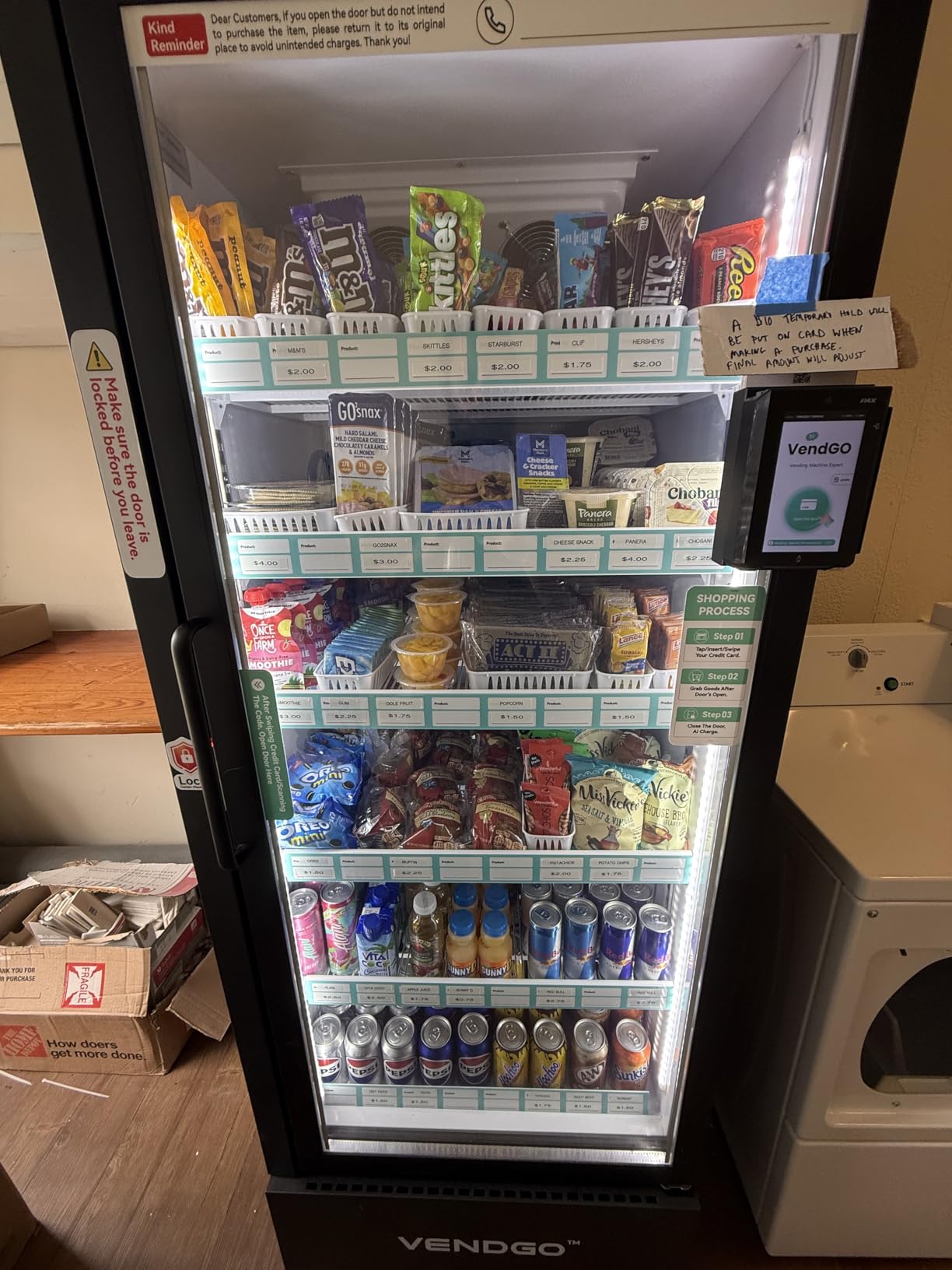
Cooling is compressor based with an automatic, frost-free defrost system, running on 110 volts. The lock structure is described as upgraded for commercial security, which fits the stated use in offices, schools, hospitals, hotels, airports and gyms. Payment runs through a cashless card reader covering Visa, Mastercard, Apple Pay, Google Pay and Amex, with remote monitoring and app control for inventory.
The listed figure of 15000 kWh annual energy consumption is worth a second look. For a unit that may run continuously in a warm corridor, that is a meaningful electricity line item, and it belongs in your total cost of ownership model rather than being ignored. Ask the manufacturer to confirm the rated draw under normal duty.
Capacity versus footprint: the real trade-off
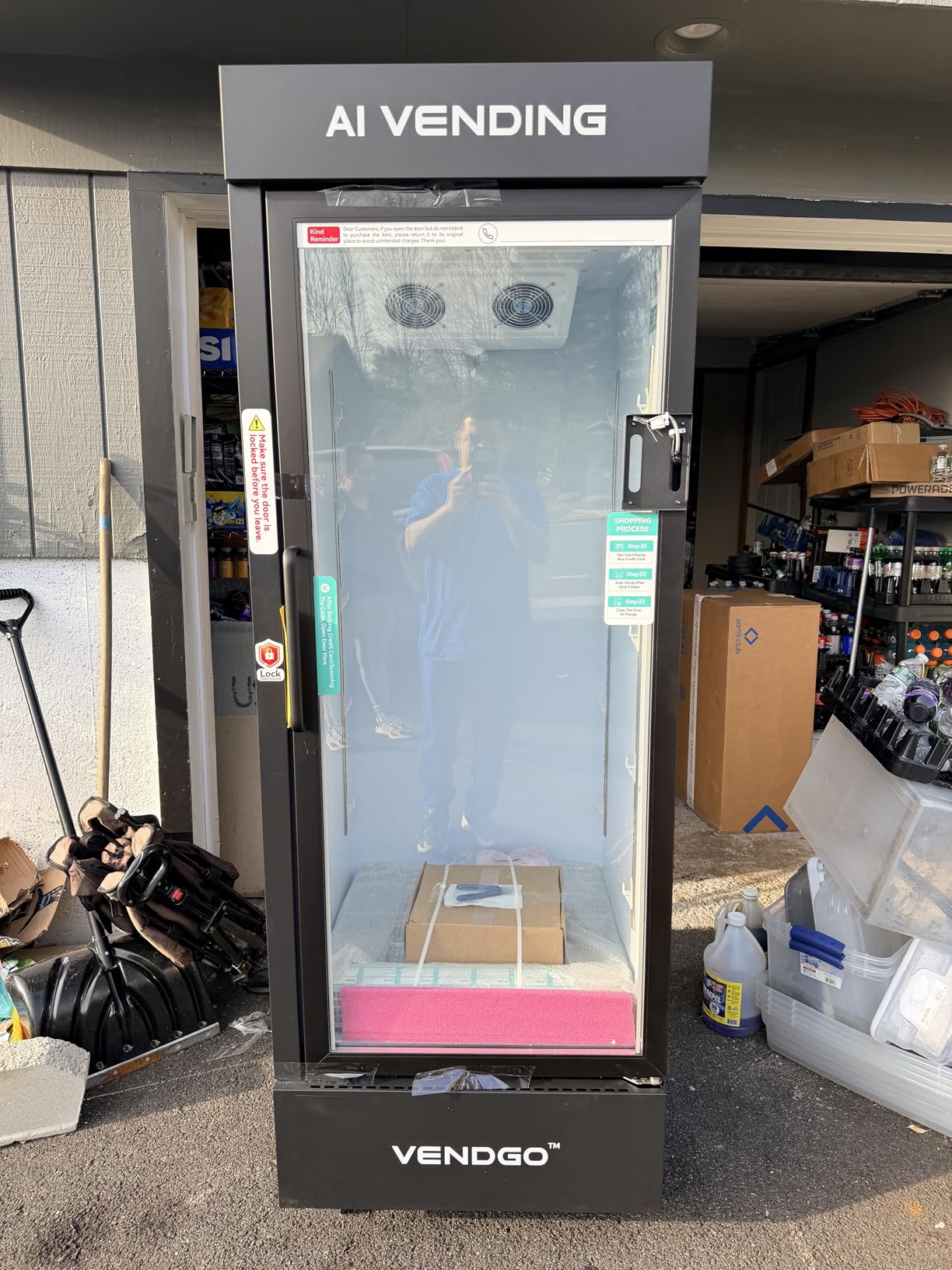
Capacity claims are the easiest specification to inflate, so verify what a capacity number means. Sometimes it counts the maximum units a machine can hold with every shelf fully loaded and no air gap. Sometimes it counts a realistic mixed load of cans, bottles and snacks. Ask which one the figure represents, and ask what the configuration looks like on arrival.
Second, check the refill ergonomics. A high-capacity machine that takes forty minutes to fill is worse for labour than a smaller one that takes fifteen. Pull-out shelves and tillable trays decide this, and they are the feature operators complain about missing when it is too late.
Who it suits and who it does not
It fits a factory floor, a warehouse, a large office or a school where one machine has to cover a lot of people. The motorized lanes and reachable pickup make it a good match for a site with a mixed-age crowd.
It is a poor match for a cash-only location, and a cautious one for anyone reading a five-star score built on ten ratings as proof of reliability. The rating is excellent; the evidence is thin. Treat it as a promising machine, not a proven one.
3. EPEX EP-G424 Combo: The Best Fit for a Small Break Room
EPEX Snack Beverage Combo Vending Machine with LED Glass Front
32 x 30 x 65 in body
408 lb
LED glass front
Programmable pricing
Pros
- Compact footprint suits small break rooms and game rooms
- Easy owner programming with clear instructions
- LED interior lighting displays product well
- Vendor sent setup videos and coordinated delivery
Cons
- Refrigeration failure reported after about four weeks
- Only drops the front item in a lane so stacked stock is not reachable
- One buyer reported the unit was not actually refrigerated
The EP-G424 is the smallest machine we reviewed, at 32 by 30 by 65 inches, and that footprint is the whole reason to consider it. It fits against a wall in a break room, a garage, a game room or a small office where a 79 inch cabinet simply will not go. It weighs 408 pounds, so it still needs a planned move, but the volume it occupies once placed is modest.
Programming is straightforward, which matters if the machine will be run by office staff rather than an operator. One owner in the reviews set a 25 cent price to give free snacks to students, which tells you how flexible the per-selection pricing is. The LED glass front and interior lighting do a good job of showing the product, and impulse sales depend on visibility.
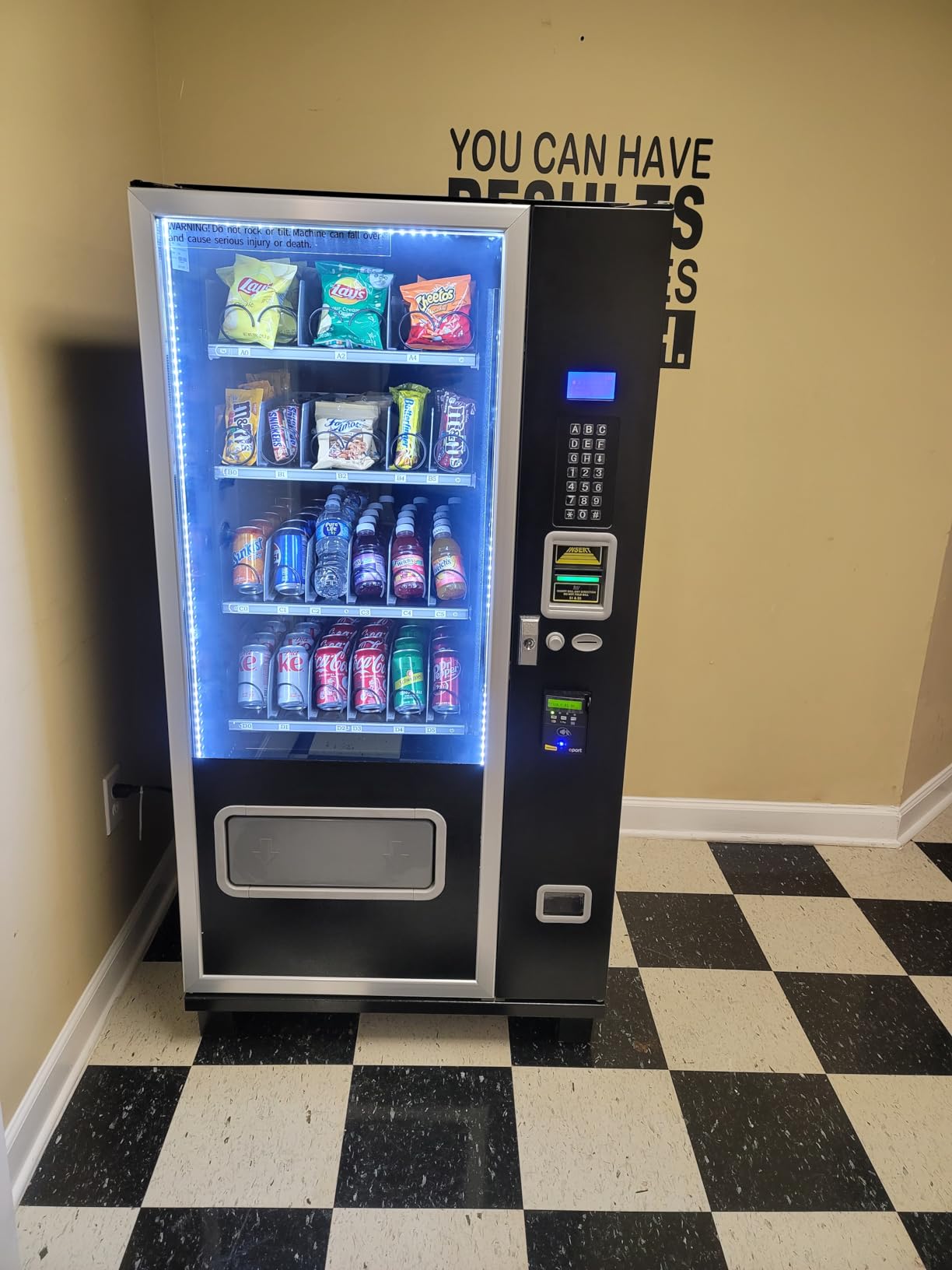
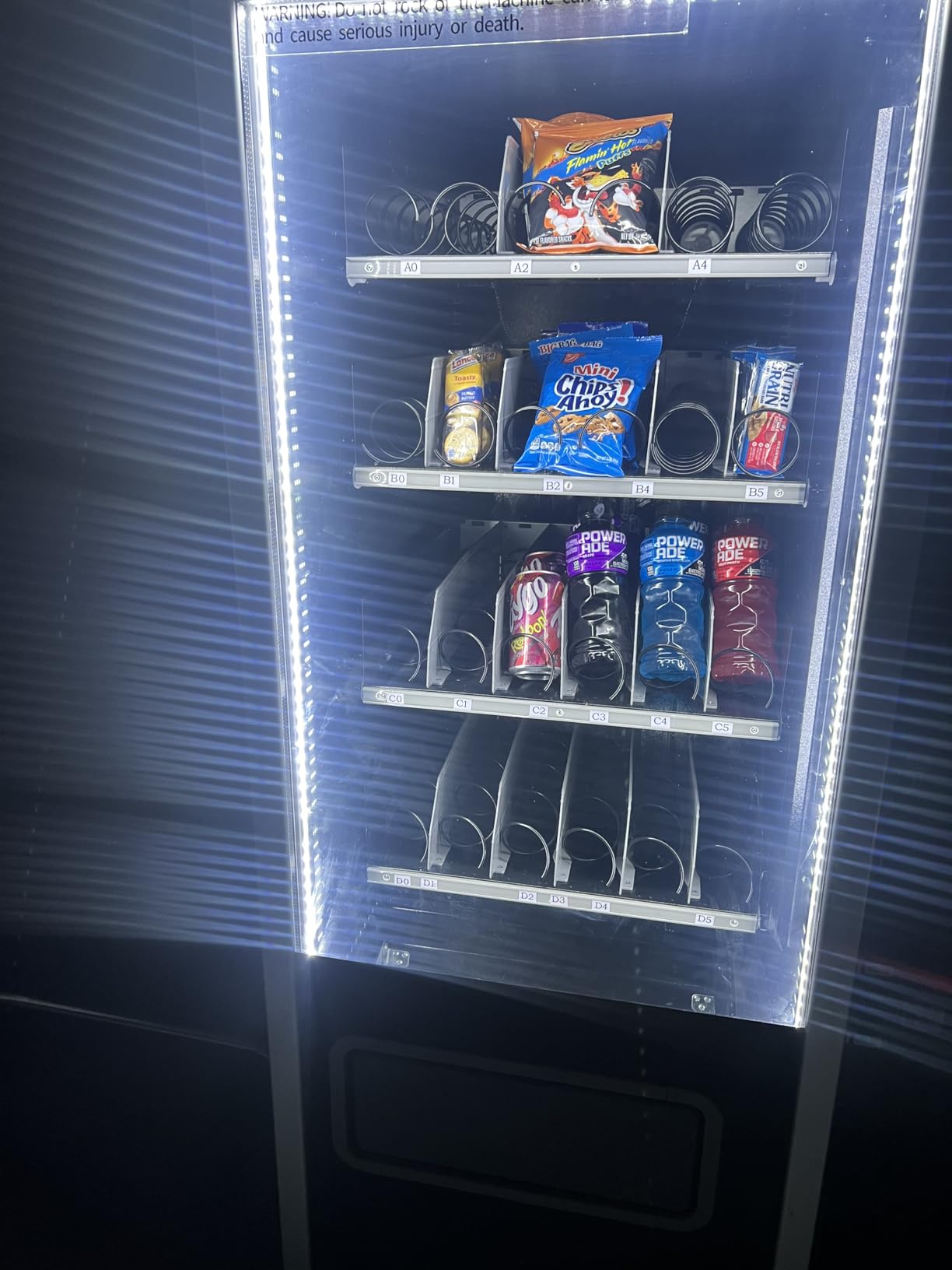
Now the honest part, and it is significant. The 3.5 average across twenty ratings is the second-lowest in this group, and the complaints are consistent: a refrigeration failure reported after roughly four weeks of use that needed an on-site repair, a lane design that drops only the front item so anything stacked behind it is unreachable without rearranging stock, and one buyer who said the unit was not actually refrigerated at all. Refunds and returns reportedly took close to a month to resolve.
The lane design issue is the one that would worry me most in a drink machine. If your load plan assumes two cans deep per lane, this cabinet will not deliver on it, and the second can becomes unsold product that ties up cash and a slot.
Set-up details that matter here
This unit needs a four inch wall clearance behind it, and the manufacturer states it explicitly. Ventilation is not optional on a refrigerated cabinet with a glass front, because the condenser needs airflow to reject heat. Plan the alcove before delivery, not after.
Set the pricing carefully on day one. A programmable price is only an advantage if the per-selection price is high enough to cover your electricity, the location’s revenue share and your labour. Underpricing a drink machine is the most common way an otherwise good placement loses money quietly.
Who it suits and who it does not
It suits a small office, a studio, a waiting room, a garage or a home setup where space is the deciding factor and the owner can check the machine personally between visits. One owner reported the vendor helping coordinate delivery to the correct location, which is the kind of service that matters more than the spec sheet.
It is a poor choice for an unattended remote site, and for anyone who needs the machine to hold a deep stock of a single SKU. The recurring refrigeration complaint and the slow return handling are the two risks to price in if you buy it anyway.
4. EPEX D648 Refrigerated: The Best for Delicate Cans and Tall Bottles
Refrigerated Beverage Vending Machine with Elevator Delivery Temp Control
Elevator delivery
560 lb
200 item load
Hot gas defrost
R-134A
Pros
- Elevator lifts product instead of dropping it
- No shims or cams to change between product formats
- Handles 20 oz bottles and energy drink cans in one machine
- Removable refrigeration deck for easier servicing
Cons
- 3.4 average with roughly a third of ratings at one star
- 560 lb makes installation and repositioning difficult
- Bill validator and coin mechanism need ongoing servicing
Every other machine in this group delivers product with a spiral or a push mechanism and lets gravity finish the job. The D648 uses an elevator instead. The mechanism rotates and lifts the chosen item forward and down into the retrieval bin, which means a tall slim can or a glass bottle arrives intact. If you have ever crated a machine full of dented aluminium, you already know what that is worth.
There is a second practical benefit. Because the elevator grabs one item at a time from a defined position, you do not have to change shims or cams when you switch between a 12 oz can and a 16.9 oz bottle. Mixed-format stocking is the normal case for a drink machine, so this saves real work on every refill visit.
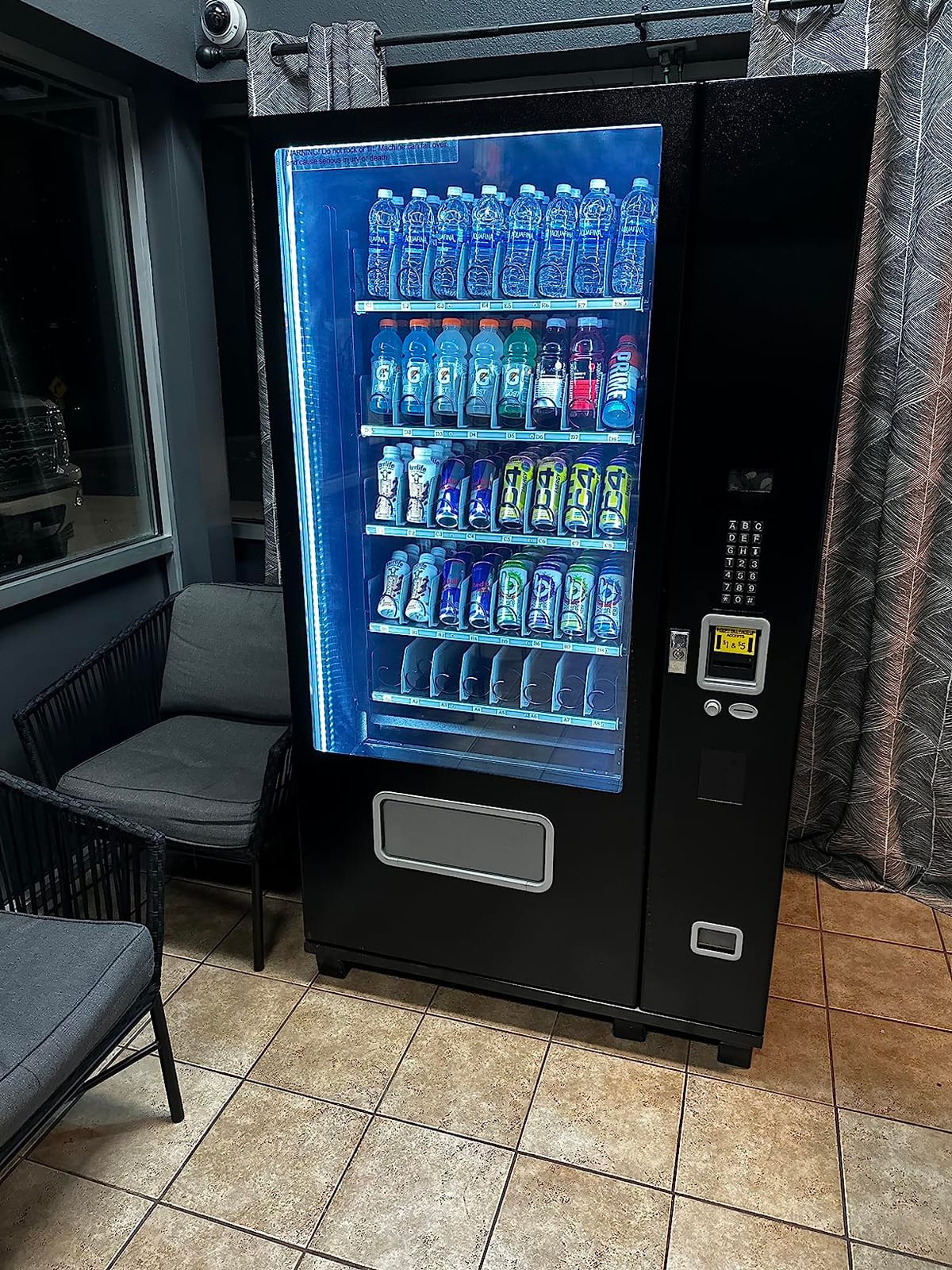
Cooling is compressor based with hot gas defrost and R-134A refrigerant across a 200 item load, with three racks, five sections and six shelves. The refrigeration deck is removable, which shortens a compressor repair considerably, and LED lighting around the glass front improves product visibility. The machine is ready to connect to a credit card reader and MDB standard hardware, so you are not locked into one payment provider.
The 3.4 average from ten ratings is the lowest of the group apart from the G654W, with roughly a third of feedback at one star. Buyers consistently praise the delivery design and fault the long-term durability. At 560 pounds this is the second-heaviest cabinet here, and the bill validator and coin mechanism are both wear items that need attention over the machine’s life.
Service access and the coin question
At 560 pounds with a 30 by 42 by 75 inch body, the delivery is the hard part. Confirm your doorway width and stair clearance before purchase, and budget for professional movers rather than a friend with a hand truck. Ask the seller for the palletised weight as well as the unit weight, because they are rarely the same.
If the machine ships with a bill validator and coin mechanism, decide early whether you want them. Cash components are a genuine revenue source in some locations, but they add two wear items and two service calls. The alternative is to fit an MDB compatible card reader and run the machine cashless.
Who it suits and who it does not
This is the machine for a gym, an office or a hotel where the mix includes energy drinks, sparkling water and glass or aluminium bottles, and where a dented can is a refund and an unhappy customer. The tilt-down pull-out trays also make loading faster.
It is a poor match for a very small break room, since the width and the weight both need real space. And the low average is a genuine signal, not just small-sample noise, so plan for a service reserve if you choose it.
5. VendGo SM-ZL-N36 Combo: The Best for Narrow Hallways
Commercial Vending Machine, Vending Machine Snacks and Drinks Combo with Credit Card & NFC Cashless Payment, Snack Drink Vending Machine for Offices Malls Schools, Wide Variety Easy Operation
36 slots
180 to 300 beverages
227 lb
Cashless and NFC
Slim 27 in body
Pros
- 36 slots hold 180 to 300 beverages plus snacks in one cabinet
- Corrosion-resistant steel body for daily commercial use
- Dispense monitoring flags failed deliveries for refund
- Built for unattended 24 hour operation
Cons
- Only 6 ratings so the perfect score is a very small sample
- Cash is not listed among the accepted payment methods
The problem with most combos is width. A standard cabinet is around 40 inches across, which means a corner of a corridor or the gap beside a copier will not take it. The SM-ZL-N36 is 27 by 28 by 79 inches and 227 pounds, so it fits where a full-size cabinet cannot, and it still carries 36 slots for 180 to 300 beverages depending on configuration.
That footprint makes it a strong candidate for a workplace where the machine has to sit against a wall in a corridor people already walk down, rather than in a dedicated alcove. One of the most common placement mistakes operators describe is putting a machine in a low-traffic corner; a slimmer machine is easier to put where the people actually are.
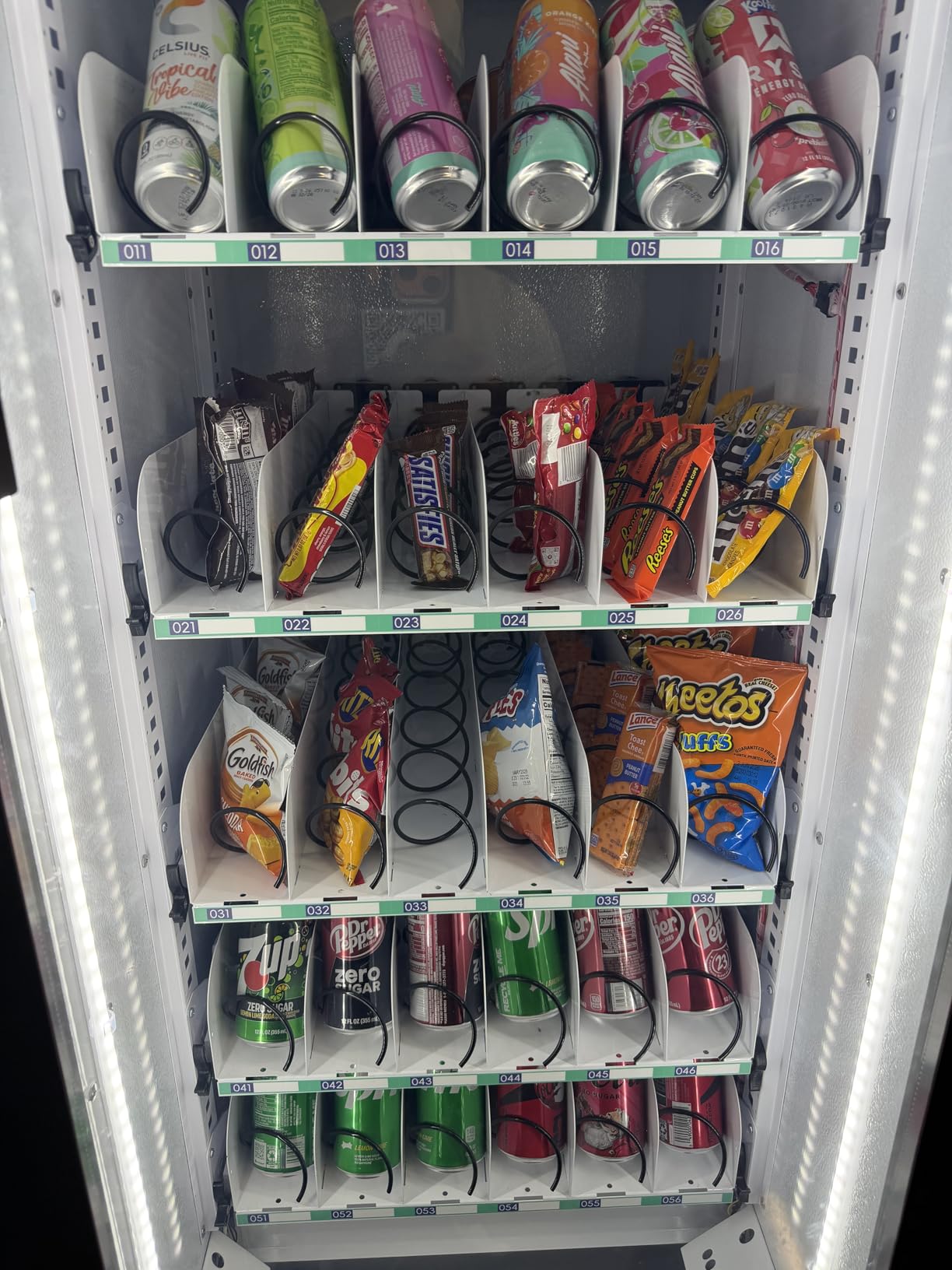
The body is corrosion-resistant steel, and the machine is rated for 24 hour unattended operation in offices, schools, hospitals, hotels, airports and gyms. Payment runs through credit, debit, Apple Pay and Google Pay over NFC. The dispense monitoring function flags a failed delivery, which matters for two reasons: the customer gets a refund rather than an argument, and the failure shows up in your data instead of becoming a silent complaint.
The honest weakness is evidence. Six ratings, all five-star, tells you that nobody who bought one regrets it; it does not tell you how it performs in year three. There is also no cash option listed, which excludes a school corridor or a site with an older customer base.
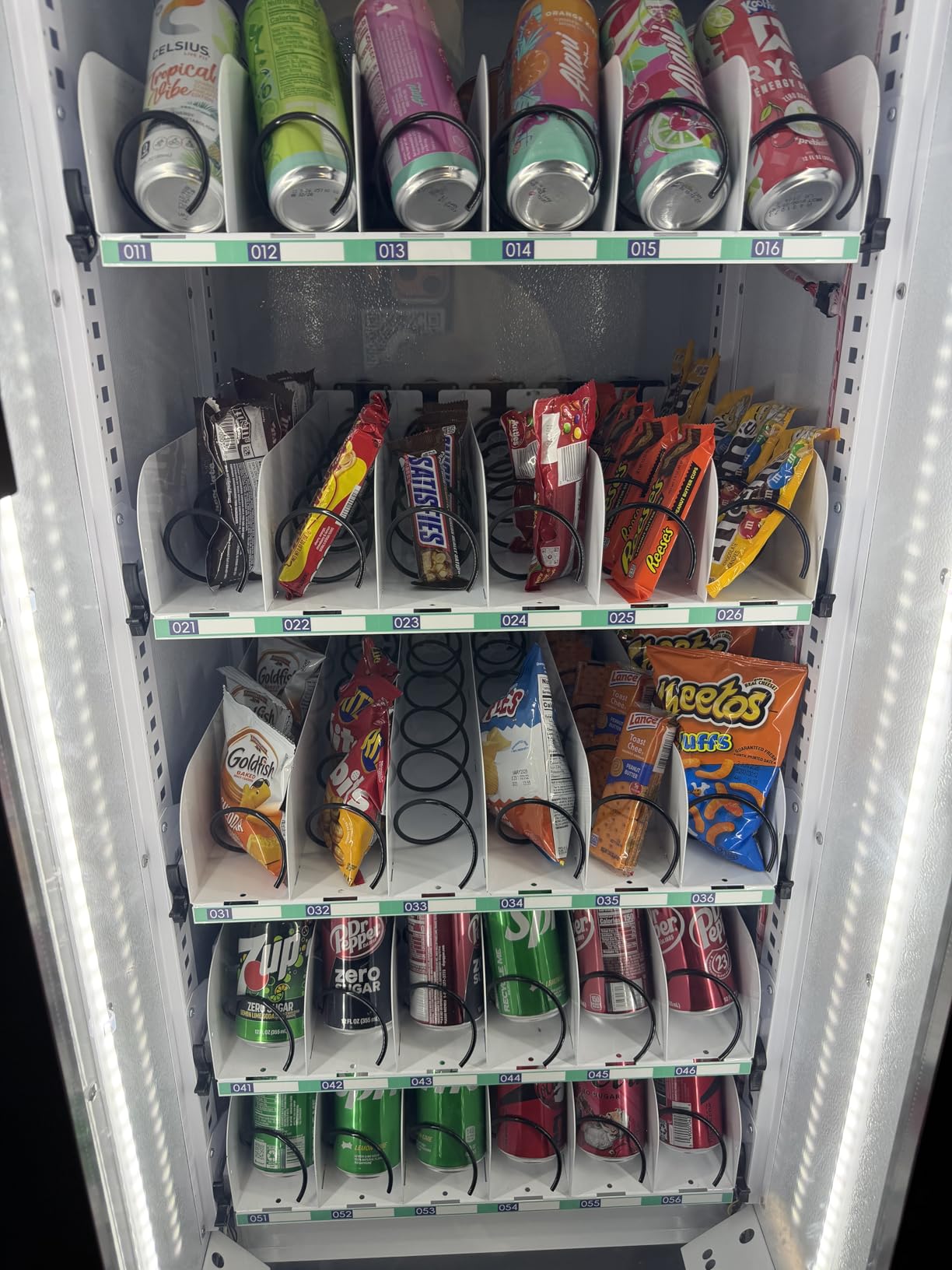
Why footprint beats features in a corridor
Measure the alcove before you shop, including the space needed behind the machine for ventilation and the depth needed to open the door and pull a tray. A machine that is too tall for the space gets discounted by nobody; it gets returned, or it gets wedged in a spot with no airflow, which is how you get a cooling failure in month two.
Second, count your foot traffic per hour rather than your head count. A 300 person office where everyone arrives at 8am and leaves at 5pm will sell in three peaks. A building with shift work will sell steadily all day. The machine should be sized to the pattern, not the population.
Who it suits and who it does not
It suits offices, clinics, hotels, gyms and school corridors where width is the binding constraint and card payment is acceptable. The dispense monitoring is a genuine advantage for a first-time operator because it tells you when a lane is misbehaving.
It is the wrong choice for a cash-heavy location and for anyone who needs a large per-visit load. And with six ratings, this is a machine to buy with a maintenance reserve rather than confidence.
6. KVM G660 Extra Large Combo: The Best for High-Volume Sites
G660 Extra Large Beverage Snack Combo Refrigerated Vending Machine with Stratified Temp Control
61.56 cubic feet
60 selections
560 lb
Donper 1 HP compressor
Pros
- Holds 200 snacks and 100 cans on the default configuration
- 45 and 90 degree two-stage tillable shelves speed up filling
- Drop sensor confirms every vend in the delivery bin
- Automatic defrost with a Donper 1 HP compressor
Cons
- Only 5 ratings so the 4.5 average is not deeply tested
- 560 lb is difficult to move once positioned in place
- Single year parts warranty on the machine
The G660 is the largest cabinet we reviewed: 45 inches wide, 31 deep, 75 high, with 61.56 cubic feet of interior. On the default tray and spiral configuration it holds 200 snacks, 50 bottles and 100 cans across six trays and 60 selections. That volume is the argument. A site with several hundred daily visitors can be served from one machine without a mid-morning refill, which is where the labour saving actually lives.
Refill ergonomics are the detail that separates this from a big cabinet that is merely heavy. The 45 and 90 degree two-stage tillable shelves fold out so you can load the back row without reaching into a dark cavity, and the pull-out design means you are not carrying product over your head at the top of the machine.
Refrigeration and the drop sensor
Cooling runs on a 1 HP Donper compressor with R134A refrigerant, with an automatic defrost system and stratified temperature control across a 120V supply drawing 400 to 500W on average. Stratified control means the cabinet holds a graduated temperature band rather than one flat temperature, which lets you keep cans cold while protecting something more delicate higher or lower in the machine.
The drop sensor in the delivery bin is the feature most first-time buyers underrate. It confirms that an item actually landed in the bin, and if it did not, the machine refunds the customer instead of silently keeping the money. That protects your refund rate and your reputation at the location, and it works while you are asleep.
Who it suits and who it does not
It suits a factory floor, a distribution warehouse, a large office or a school where daily volume is high and a single visit per day is the goal. A 4.5 average from verified buyers, plus a category sales rank that is the strongest in this group, points to real commercial interest.
It is the wrong machine for a small office or a break room. At 560 pounds and 45 inches wide, it will not fit most domestic corridors, and once it is positioned you will not be moving it without a crew. Five ratings is an encouraging signal rather than a proven one.
7. Afen 60-Slot Combo: The Best for Cash and Card Locations
Afen Commercial Vending Machine with Bill & Coin Acceptor and Card Reader, 60 Slot Refrigerated Beverage Snack Combo Vending machine for Business, Durable Cashless Drink Vending in Bulk
60 slots
390 item capacity
647 lb
39F to 77F
Bill coin and card
Pros
- Accepts bills and coins as well as a Nayax card reader
- 60 slots hold 390 items across two spring types
- Refrigerated 39F to 77F with foam insulation and anti-fog glass
- Four casters make it easier to reposition than most full-size cabinets
Cons
- Top of the price range among the machines reviewed
- 647 lb requires careful floor planning and delivery access
- Only 5 ratings so the 4.2 average is a small sample
The Afen AF-CSC-60C is the only machine in this group that takes every kind of tender. It has an ICT bill acceptor that takes one, five and ten dollar notes, a coin acceptor for nickels, dimes, quarters and dollars, and a Nayax card reader. The cashless side covers Visa, Mastercard, Apple Pay, Google Pay, Samsung Pay, Amex, Alipay, PayPal and Venmo.
That combination matters more than it sounds. A school, a hospital staff area or a union facility where older staff and staff with no smartphone wallet still carry cash will lose sales on a cashless-only machine, and losing a sale also loses the chance at an impulse add-on. This one does not force that choice on the location.
Cooling range and glass
The cabinet is refrigerated from 39 to 77 degrees Fahrenheit with compressor cooling, automatic defrost, microporous foam insulation and anti-fog glass across stainless steel shelves. The 39 degree floor is the number that matters for a drink machine, because a soda sitting at 45 degrees is a warm soda, and customers notice. The wide upper end of the range gives you flexibility if the machine carries a mix of drinks that do not all want the same temperature.
Anti-fog glass is worth paying attention to on any machine, because a fogged door front hides your product and your pricing, and impulse sales depend on seeing what is there. The 60 slots across two spring types covering roughly 80 percent of on-market food specifications is a practical figure rather than a theoretical one.
Who it suits and who it does not
It suits locations with a genuinely mixed customer base, a site that wants to keep cash flowing during a card network outage, and an operator who wants a Nayax reader on a machine that also handles bills. The four wheels genuinely help; most full-size cabinets are fixed once placed.
It is the heaviest machine we reviewed at 647 pounds, and it sits at the top of the price range in this group. Confirm your floor loading and your delivery route before ordering, and treat the five-rating sample as thin evidence rather than a settled verdict.
8. MICTER 570L Smart AI Combo: The Best for Touch-Free Checkout
570L Smart AI Vending Machine with Card Reader, Snack & Cold Beverage Combo
570L interior
Up to 800 cans
28 x 29 x 79 in
110V plug-and-play
Pros
- Customers open the door take what they want and leave
- 570L refrigerated interior holds up to 800 cans
- Remote app management for machine status and locations
- Plug-and-play 110V and 60Hz installation with warranty
Cons
- Only 4 ratings and all are five-star so no critical feedback exists
- Cash and paper bills are not accepted which rules out cash-heavy sites
The MICTER 570L is the purest grab-and-go design in this group. There is no selection code and no vend motor. The customer scans or taps, the door unlocks, the camera records what leaves the cabinet, and the account is settled on the way out. For a site where people are on a short break and do not want to wait, removing the selection step is the single biggest usability gain available.
Capacity is 570 litres of refrigerated interior holding up to 800 cans depending on shelf configuration, in a 28 by 29 by 79 inch body. The same six-layer drink and snack mix appears on several machines in this group, which tells you the chassis is now standard. What differs is the software on top of it.
What grab-and-go changes operationally
Grab-and-go shifts the risk from the machine to the accounting. With a spiral machine, a failed vend is a mechanical event. With a camera-based system, every transaction depends on the vision system reading the shelf correctly under changing light, which is why a site with a dark corner or a flickering light is a real risk. Place the machine where it is well lit.
It also changes the loss profile. Product walking out uncharged is the failure mode, and the operator’s recourse is the video log rather than a locked spiral. That is a good trade when the cabinet is monitored and a bad one when it is not.
Who it suits and who it does not
It suits offices, gyms, hotels, apartment amenity rooms and any location where the customer is comfortable with a self-checkout model and connectivity is reliable. The remote app is genuinely useful once you are running more than one machine.
It does not suit cash-heavy sites, since neither coins nor notes are accepted. Four ratings, all five-star, is the smallest evidence base in this entire group; treat it as a promising specification rather than a proven machine.
9. HAHA 550FT Touch Card Combo: The Best for App-Managed Fleets
HAHA Vending Vending Machine Combo,Smart Refrigerated Vending Machine with Touch Card Reader (Black, Plus B)
26 x 26.8 x 77.5 in
286 lb
4G and Wi-Fi
Camera records transactions
Pros
- Camera records the entire door-open process for every transaction
- 4G and Wi-Fi connectivity with a management app
- Supports stacked goods for higher interior capacity
- Narrow 26 inch footprint suits tight placements
Cons
- Only 2 ratings and both are five-star so the score is not meaningfully tested
- Among the more expensive options in this lineup
The 550FT is the narrowest full cabinet here, at 26 by 26.8 by 77.5 inches, and it also stacks product rather than laying it out in a single layer. Both of those features point at the same use case: a site where the wall space is the constraint and the demand is high enough that you need the extra density.
Connectivity is the differentiator. Both 4G and Wi-Fi are supported, which means the machine does not depend on the location having good Wi-Fi coverage, and the camera records the full door-open sequence. For an operator running several machines across different buildings, that record is how you settle a dispute about what left the cabinet.
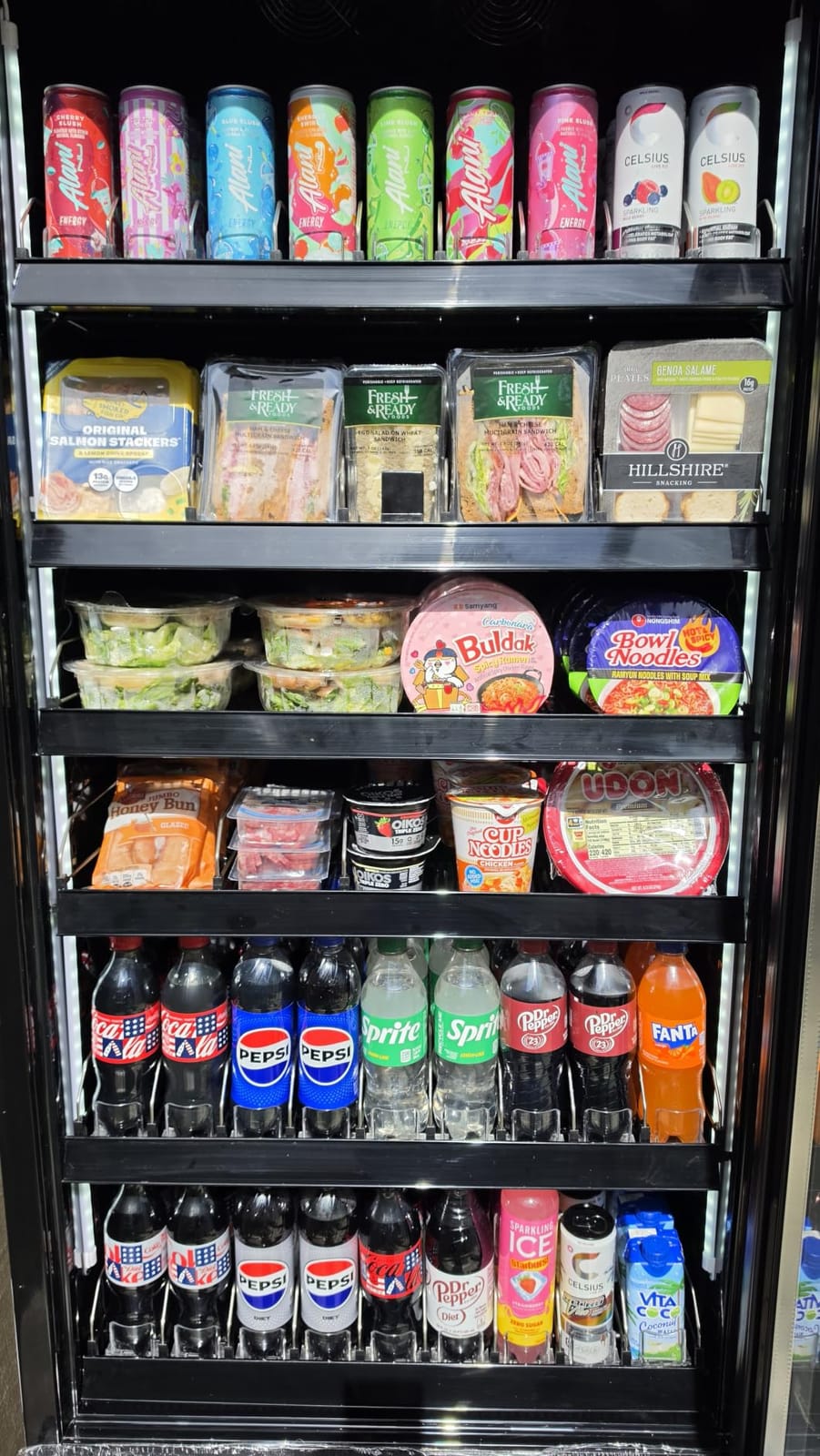
Payment is through a touch card reader covering credit cards, Apple Pay, Google Pay, Samsung Pay, mobile wallets and NFC. It is a fully cashless machine, which removes coin jams and the daily ritual of emptying and counting a coin box, but it also removes your ability to serve customers who only carry cash.
We want to be straight about the evidence: this machine has two ratings, both five-star. That is not enough to call a machine reliable. It is enough to say that the buyer who reviewed it was happy, which is a different and much smaller claim.
Why 4G backup matters more than it looks
A machine that loses its connection cannot take a card payment, and a customer who cannot pay does not buy. A separate cellular connection, rather than relying on the building Wi-Fi, removes a failure mode that is entirely outside your control. It is worth asking any vendor whether the cellular option is included or billed monthly, because that recurring cost belongs in your operating budget.
The same question applies to video storage. If transaction video is uploaded to a hosted service, that is a subscription. If it is stored locally on the machine, it is a capacity question instead. Know which one you are buying before you commit.
Who it suits and who it does not
It suits an operator with several locations, a hotel or gym corridor with tight dimensions, and a business that is fully cashless. The stacking design and narrow footprint together give you a lot of product in a small room.
It is a poor fit for a first-time single-machine buyer, mostly because of the monthly service costs you would be taking on before you understand your own numbers. And with two ratings, we would not call it a proven machine in any category.
10. Pacau 570L Refrigerated Combo: The Best Signal for Repeat Buyers
Commercial Vending Machine for Sale, Refrigerated Vending Machine Snacks and Drinks Combo with Credit Card & NFC Payment, Vending Machine for Home or Office
28 x 29 x 79 in
Refrigerated combo
Cashless and NFC
Factory support
Pros
- One verified owner is buying this as their third machine of the model
- Reportedly reliable with no jamming issues
- Support team described as knowledgeable and fast to respond
- App management works for multi-location operators
Cons
- Only 2 ratings so the perfect score rests on a small sample
- Cash payments are not accepted
Two ratings would normally tell you almost nothing. In this case, one of those reviewers is on their third unit of this model and plans to keep buying. That is the single most useful piece of feedback in this entire group, because repeat purchase is the closest thing to a reliability record that a two-review listing can offer.
The machine itself is a 28 by 29 by 79 inch refrigerated snack and drink combo running on 110V at 60Hz with plug-and-play installation. Payment covers Visa, Mastercard, Apple Pay, Google Pay and other cashless transactions, with remote monitoring for machine status and location management and factory-direct purchasing with technical support on key components.
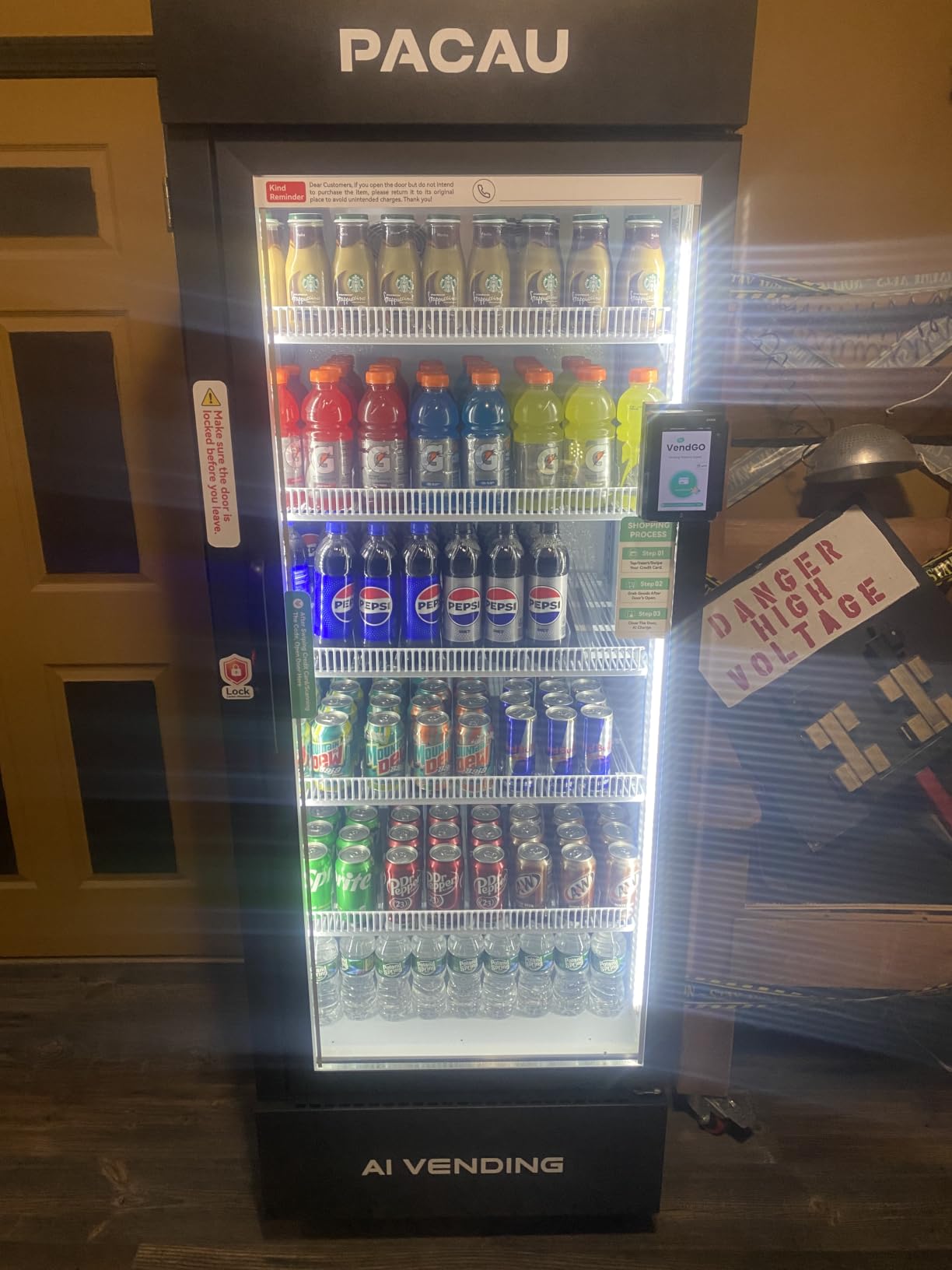
The review signals worth taking seriously are all operational rather than cosmetic: no jamming issues reported, a support team described as knowledgeable and quick to respond by email, and app-based management that works across multiple locations. For a small operator, the last of those three is often worth more than any individual hardware feature.
Buying from the factory rather than a distributor removes a margin that is already paid for by the time the machine arrives, and for a first-time buyer with no dealer relationship, that difference is real money.
Support quality is a buying criterion
Operators consistently raise service access as their biggest operational problem, particularly when a machine uses imported components and there is no local technician. Before you buy anything, find out who services it, how far the nearest technician is, and what the call-out charge is. A machine that is down for two weeks in an unattended location earns nothing while you work out the paperwork.
Ask whether the seller answers support questions by email within a day, and whether there is a replacement parts list you can see before you buy. A vendor who publishes a parts list is a vendor who expects the machine to be repaired rather than replaced.
Who it suits and who it does not
It suits a first-time buyer who wants a single supported machine with factory backing, and a small operator running a handful of locations who needs the app to work. The reported reliability and the responsive support are the two reasons it appears here at all.
It does not suit a cash-only site, and it is a thin-evidence machine despite the perfect score. Buy it on the strength of the repeat purchase and the factory support, not on the 5.0.
11. VendGo SM-AI-520 AI Vending: The Best for the Fastest Setup
Ai Smart Vending Machine with Card Reader, Cashless Payments, Inventory Tracking, Restock Alerts, Commercial-to-Use Design for Business
Up to 700 items
27 x 29 x 78 in
227 lb
NFC tap swipe chip
Pros
- Installed in under 30 minutes with no complicated tools
- Open-style design avoids products getting stuck
- Card reader takes NFC tap swipe and chip plus Amex
- Remote inventory tracking with reorder alerts and heated options
Cons
- One buyer rated it three stars and described it mainly as a fridge
- 38 percent of ratings sit at three stars pulling the average down
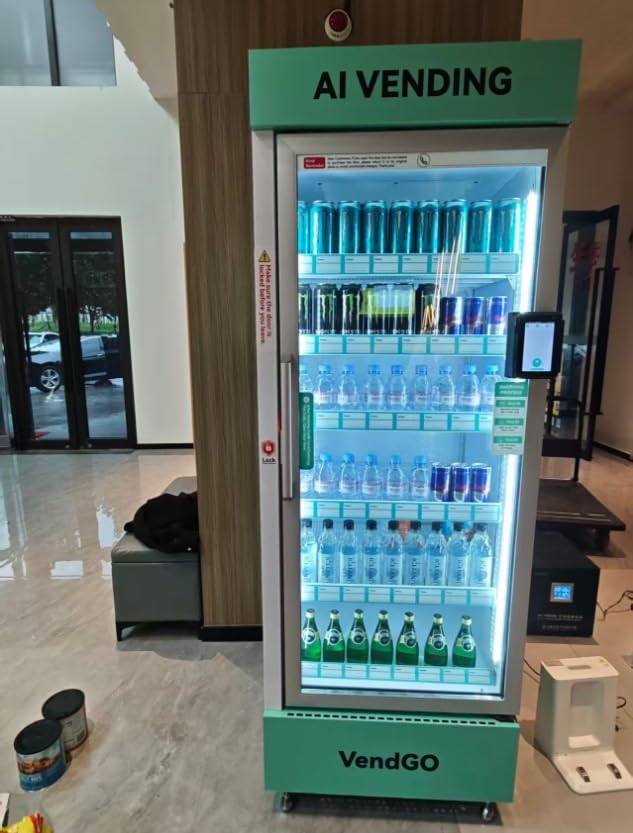
Setup speed is the underrated advantage here. A verified buyer reports installing this machine in under thirty minutes with no complicated tools, and configuring an interface a non-technical owner could actually walk a customer through. For someone placing their first machine, that is worth more than a specification on a label, because the gap between delivery and first sale is dead time you are paying for.
The open-style design is the second thing to understand. Instead of a spiral motor pushing product forward, the layout is open, which reviewers say keeps items from getting stuck. That is a genuine reliability advantage over spiral machines, and it also makes the cabinet easier to fill and easier to see into.
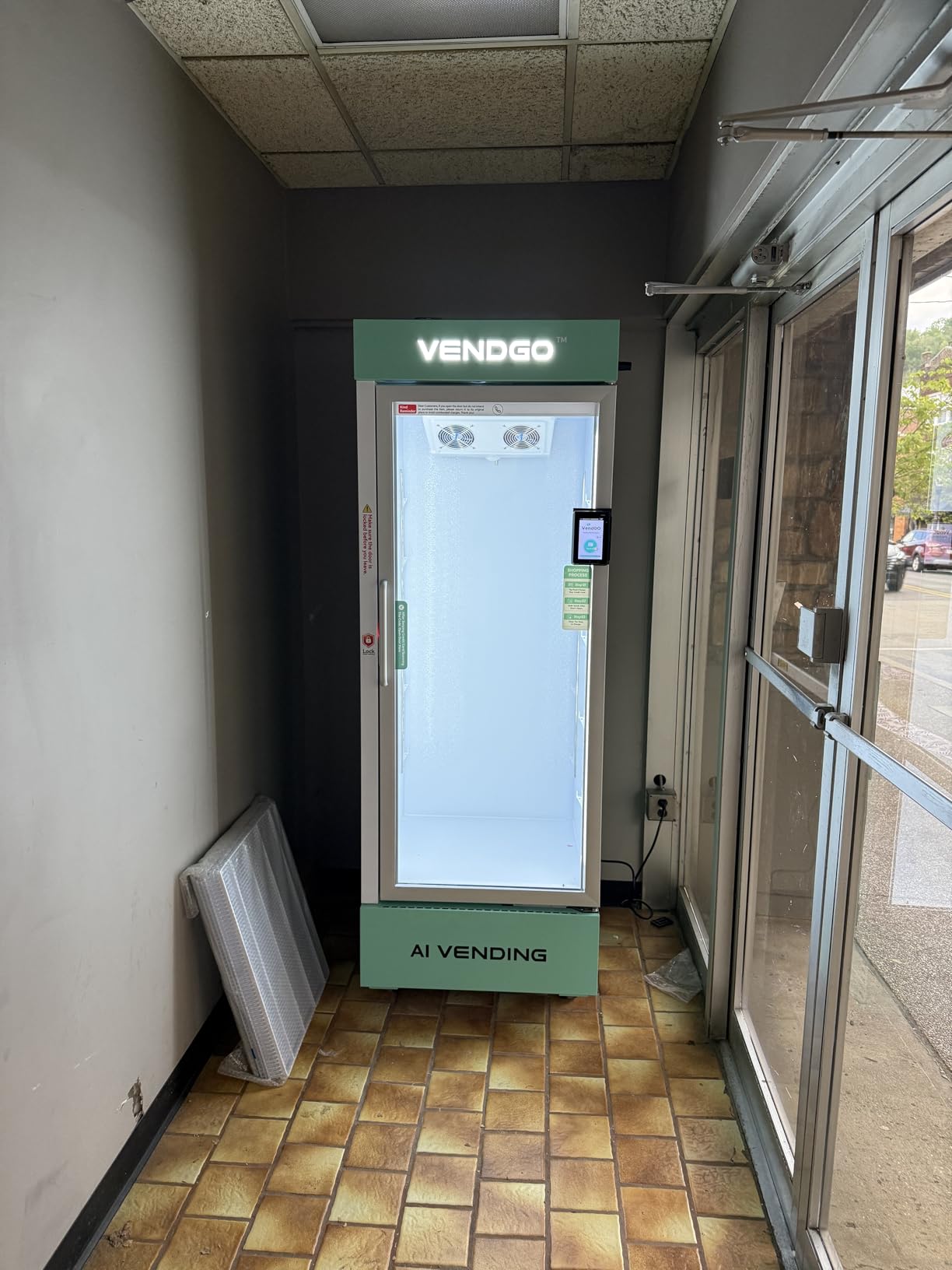
Capacity is up to 700 beverages and snacks in a 27 by 29 by 78 inch body at 227 pounds, refrigerated with heated product options available. The card reader takes Visa, Mastercard, Apple Pay, Google Pay and Amex with NFC tap, swipe and chip. Remote monitoring includes inventory tracking with automatic reorder alerts, and the locking structure is upgraded for commercial security. Installation is plug-and-play on 110V at 60Hz.
The negative is honest and worth repeating. One of the three reviewers rated it three stars and characterised it as essentially a fridge, which suggests the cooling is the strong part and the vending performance is the reason for the score. That is a real limitation for a machine bought to sell drinks, and it is why we have placed this machine in the fastest setup slot rather than higher.
What a fast setup really saves
The obvious saving is the installation call. The less obvious one is the time between the machine arriving and the first customer using it, which is often longer than the thirty minutes of assembly because it includes registration, pricing, connectivity and the first fill. Every day the machine is plugged in and empty is a day of paid electricity and lost sales.
Second, remote inventory tracking with restock alerts means you can run several machines without driving to each one to see what is left. For a solo operator, that turns a weekly chore into a weekly check, which is the difference between a route and a hobby.
Who it suits and who it does not
It suits a first-time buyer, a small office or a short-term placement such as a renovation or an event where the machine needs to be selling within a day of arriving. The non-jamming open layout is a real advantage in a high-use location.
It is a weaker fit for a location where maximum beverage throughput matters more than setup convenience, given the three-star feedback about it behaving like a cooler. Three ratings is not a foundation for a confident purchase, so budget for support rather than assuming it will run unattended indefinitely.
12. EPEX G654W Dual-Temperature Combo: The Best Design for Snacks and Cold Drinks
EPEX G654W Cashless Large Refrigerated Combo Vending Machine with Nayax VPOS Touch Card Reader
Dual temperature zones
336 load
31 x 32 x 75 in
Nayax VPOS reader
Pros
- Only dual temperature machine here with separate snack and drink zones
- Liquid injection foam and argon-gas tempered glass for efficiency
- Embedded glass heater stops condensation on the display
- Drop sensor plus MDB and DEX readiness with telemetry
Cons
- Lowest rating in the group at 2.9 with about half the feedback at one star
- Only 2 ratings so the low average is a small sample
- Electronic lock needs power to release so a fault can lock out product
The G654W is the best-specified machine in this roundup and the worst-reviewed, and both of those statements are true at the same time. It is the only one here with two separate temperature zones: upper trays held at 54 to 64 degrees Fahrenheit for snacks, lower trays at 37 to 57 for cold drinks. On a combo machine, that is the difference between selling a crisp chocolate bar and selling a warm one.
The build details are equally considered. Liquid injection foam insulation and argon-gas tempered door glass, an embedded front glass heater to prevent condensation, sliding tiltable trays, and a drop sensor in the delivery bin. It is MDB and DEX ready with telemetry, which means it can report sales data in a standard format and accept a different card reader later. It is listed as ADA compliant with a one-year parts warranty.
Why the low rating deserves attention
The 2.9 average is the lowest here, with roughly half the feedback at one star, from a sample of just two ratings. Small samples swing hard in both directions, so this is a signal rather than a verdict, and it is the one area of this roundup where we think the hardware and the experience may be pulling apart.
The design flaw worth flagging is the electronic lock. Because it requires power to release, a controller fault can lock the customer out of the product entirely. On a machine in an unattended corridor that is a serious operational risk, and it is the kind of detail that does not appear in a marketing listing.
Who it suits and who it does not
On paper it suits a school, an office or a clinic that wants a genuine snack and drink mix with correct temperatures, an ADA-compliant public placement, and an operator who wants DEX telemetry from day one. The 336-item standard load across flexible columns fits 12 oz cans through 20 oz bottles.
In practice, we would not place it unattended at a site you cannot reach easily. If you buy it, do so with a local service relationship already in place. The specification is the best in the group; the evidence is the thinnest, and that combination deserves a maintenance reserve.
How to Choose a Drink Vending Machine
Most buying mistakes in this category come from optimising the wrong variable. A bigger machine is not automatically a better machine, and the newest payment technology is not automatically a cheaper one. Work through these eight decisions in order and the specification you end up with will fit the location rather than the other way around.
Machine type: elevator, spiral, or grab-and-go
Three delivery approaches cover almost everything. A spiral or gravity machine is the cheapest per slot and the most common, and it is the one that most often damages tall cans and glass bottles. An elevator machine costs more and handles fragile product properly, as the EPEX D648 demonstrates. A grab-and-go cabinet has no selection step at all, and it moves the risk from a mechanical mis-vend to an accounting question.
Decide by product, not by feature. If you are stocking energy drinks, tall cans and glass bottles, an elevator or a grab-and-go design protects both your stock and your margin. If you are stocking standard 12 oz cans in a high-traffic site, a spiral machine is perfectly adequate and cheaper per slot.
Selections versus total capacity
These are different numbers and the distinction causes most of the disappointment. Selections is the number of individual product positions a customer can choose from. Total capacity is the number of items the machine can physically hold, which is often three to four times the selection count because each position is filled to the front and refilled as product is sold.
For planning, divide your required product range by the number of selections to get a facings count, then add a refill frequency you can actually service. A 60-selection machine that holds 350 items needs a deep load to be worthwhile, and a machine you can only visit twice a week needs a different mix from one you can visit daily.
Refrigeration and the temperature that matters
Look past the word refrigerated and read the numbers. Compressor cooling with R134A and automatic defrost is the common commercial arrangement, and Donper compressors appear repeatedly in this category. What you actually want is the temperature floor: a cabinet that runs at 45 degrees is a fridge, not a cold drink machine.
Check the glass as well. Anti-fog glass, an embedded glass heater and double glazing are what keep the front panel clear in a humid corridor. A fogged door hides your product and your price, and it is one of the most common reasons operators report disappointing sales on a perfectly good machine.
Cashless payment and the fees nobody quotes
This is where the recurring cost lives, and it is the question we would ask first. Ask for the full monthly figure in writing: the cellular connection, the card reader rental or purchase, the processing percentage, any per-transaction fee, and any charge tied to door openings or AI data.
Then ask whether you can change provider later. A machine built to MDB standard accepts different card readers, which lets you negotiate processing rates later. A machine with a fixed reader does not, and you are locked into whatever the seller signed you up for. Operators describe proprietary readers as a genuine long-term cost, and it is one of the most common regrets on forums.
Indoor versus outdoor placement and power
Every machine in this roundup is an indoor unit. None of them is weather sealed, and an outdoor placement in a park, a campus yard or an unsheltered area needs a canopy, a temperature-rated cabinet and a lock that resists a determined person, none of which these machines provide.
For power, standard 110V at 60Hz is what most of these machines need, with the G660 rated from 110 to 220V. Ask whether a dedicated circuit is required where you are placing it, and check the weight. The heaviest cabinet here is 647 pounds, and the heaviest machines in the category generally need two people, a liftgate and a clear route. Our practical approach to planning equipment delivery applies as much here as it does there.
New versus remanufactured equipment
Used and remanufactured machines are a legitimate route, particularly for established American brands with a parts network, but operators report expecting two to three times more service calls in the first year. That cost is rarely in the purchase price; it is in your truck, your time and your downtime.
On r/vending and VENDiscuss, the recurring brand consensus is that the durable names in drinks are the long-established American manufacturers, with older models from Dixie Narco and Royal and current lines from Vendo, USI and Wittern, and Crane and CPI for snack hardware. Those brands have parts available for decades. A newer importer with a five-star rating and two reviews does not, and that difference only shows up when something breaks.
Service network and parts availability
Before you buy, find out who fixes the machine near your location and what a call-out costs. This is the criterion the least amount of published information exists about and the one that decides whether a bad month becomes a lost month.
Look for a published parts list, an MDB standard payment interface, and a warranty of more than a single year. A two-year parts warranty with lifetime technical support is a real signal of a manufacturer that intends the machine to keep running. One year on an imported machine is the category baseline, not a red flag, but it is also not reassurance.
What to load, and in what proportions
Water sells constantly and earns little. Canned sodas and energy drinks sell at the volume, and sports and iced tea carry better margin in a hot site. Most drink machines that work well run somewhere near half water, a third or more canned soda and energy, and the balance in sports, iced tea and water mixes.
Load the fast movers deep and the slow movers shallow, and set prices so your per-selection price covers electricity, the location’s revenue share and your labour. Unsold product is not a storage problem; it is cash sitting in a slot that could be selling something else. Our guide to matching equipment to a specific space makes the same argument for a different kind of machine.
Frequently Asked Questions
Are drink vending machines profitable?
Drink machines are profitable when three things line up: enough daily foot traffic, a price per selection that covers electricity, the location revenue share and your labour, and a fill rate low enough that you are not throwing away unsold product. A well-placed machine in an office, gym, factory or hotel can cover its costs quickly, while a machine in a low-traffic corner will not, regardless of how good the hardware is.
What is the most profitable vending machine to own?
A refrigerated drink machine placed in a high-traffic indoor location is generally the most profitable type, because drinks turn over faster than snacks and tolerate a higher price point. Combo machines add revenue per square foot when a site has both demand types, but a dedicated drink machine usually out-earns a combo in a location where beverage demand is strong.
What drinks sell the most in vending machines?
Water moves in the highest volume, but canned soda and energy drinks generate most of the margin, with sports drinks and iced tea performing well in hot or active locations. Most drink machines that sell well run roughly half water, a third or more canned soda and energy, and the balance in sports, iced tea and mixes.
How much does it cost to buy a refrigerated vending machine?
Refrigerated units in this category sit in the mid to upper part of the commercial vending range, with imported combos and AI grab-and-go coolers clustered together and established American glassfront brands carrying a premium. The real figure is the total cost of ownership: purchase, plus any cellular connection, card reader rental and processing fees, plus electricity, plus a service reserve.
What is the typical capacity of a vending machine?
Selection count and total capacity are different numbers. A standard commercial beverage machine offers 24 to 40 selections, while a large combo runs to about 60 selections. Total item capacity is usually three to four times the selection count, so a 60-selection cabinet can hold around 350 products, and large extra-large bodies can reach 800 cans depending on configuration.
Do vending machines need a dedicated circuit?
Most 110V machines in this category are designed for a standard outlet, but a dedicated circuit is worth requesting for any machine on a continuous refrigeration duty, especially in a location where other appliances share the same circuit. Machines in the 400 to 500W range plus continuous compressor cycling are the cases where a shared circuit causes nuisance trips.
Final Verdict: Which Drink Vending Machine Should You Buy?
For most first-time buyers in 2026, the HAHA US-360 is the pick. It combines the largest review base in this group with AI vision checkout that removes the mis-vend problem, a 267 pound body that is manageable to deliver, and ETL certification for commercial sites. If your floor space is tight rather than your budget, the HAHA 550FT is narrower still and records every transaction.
Buy the VendGo 570L when volume is the problem. Up to 800 cans and motorized pickup lanes mean one machine covers a factory floor or a large office on a single visit, though the listed energy consumption belongs in your cost model. Buy the EPEX D648 when your mix includes tall, fragile product, because the elevator protects stock in a way no spiral machine can. Buy the Afen 60-slot when your customers still carry cash, because it is the only machine here that takes bills, coins and a card without compromise.
Whatever you choose, get three numbers in writing before you order: the recurring monthly payment and connectivity cost, the local service response time, and the real per-selection price you will charge. Those three figures decide whether the placement works far more than the model name does.