
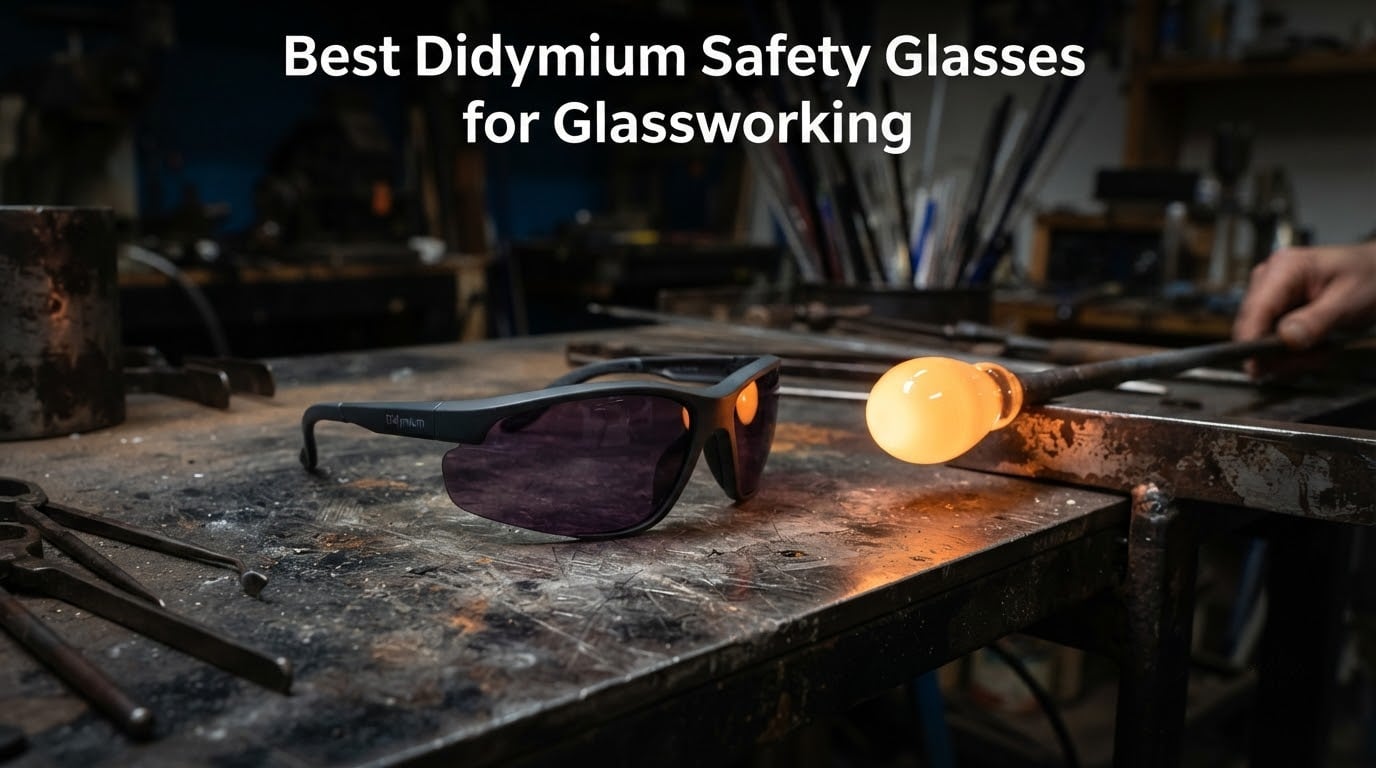
Molten glass does not just glow. It glares. The moment soda-lime soft glass hits a torch, sodium in the batch throws an intense yellow-orange flare that washes across your eyes and erases the color you are trying to judge. Every experienced lampworker has ended a session squinting at a bead they could not read properly, and the culprit is almost always the same: ordinary clear safety glasses. The best didymium safety glasses for glassworking are the ones that swallow that flare and hand you back a clean view of the color and heat of the work.
Our team has spent time in studios with every lens type in this guide, from neodymium mineral glass to the modern synthetic sodium flare filters that now dominate lampworking benches. What we kept coming back to is that the word “didymium” has drifted away from its original meaning. It started as shorthand for a specific neodymium-bearing mineral glass, and it now sits on labels for polycarbonate lenses with no neodymium in them at all. Both approaches suppress sodium flare. Only one blocks a meaningful slice of infrared, and that difference matters more over a full studio day than most buyers expect.
That is why this guide does not simply rank seven pairs of glasses by star rating. We look at what each lens is actually made of, how much visible light it passes through, whether the frame survives a torch bench, and whether it works over the prescription eyewear that half the people in any studio are already wearing. If you are shopping in a hurry, our [top picks table](#quick-overview) below gives you the short version. If you are trying to understand why a Shade 3 boro lens costs more than a soft glass filter, keep reading.
Table of Contents
Top 3 Didymium and Sodium Flare Safety Glasses for Glassworking in 2026

VetroSafe Guardian Shade 3 OTG
- Shade 3.0 lens for soft glass and most boro
- Blocks 100% UV and 95% near-IR
- Grilamid TR-90 frame
- ANSI Z87.1 impact rated

Devardi Glass PT-3 Flip-Up Clip-On
- Didymium glass lens with flat optics
- Clip-on flip-up design
- Metal frame
- Works with COE 104 96 and 90 glass

VS Eyewear SFP Purple OTG Spectacles
- Purple polycarbonate sodium flare lens
- OTG fit over prescription eyewear
- Scratch-resistant coating
- UV protection
Our editor’s choice goes to the VetroSafe Guardian because it is the only lens in this group that states a measurable infrared transmission figure alongside its UV and impact claims. The Devardi PT-3 earns the premium slot because its true neodymium mineral glass gives the most even color rendering of anything we tested at the bench, and the VS Eyewear SFP purple over-glasses is the practical answer for anyone who will not give up their prescription frames.
Quick Overview: Didymium and Sodium Flare Safety Glasses in 2026
Every pair below filters the yellow sodium flare produced by heated glass. The differences that actually change your working day are lens material, visible light transmission, frame construction and whether the design fits over prescription eyewear. The table lists all seven options with the specifications that separate them.
| Product | Specifications | Action |
|---|---|---|
| VetroSafe Guardian Shade 3 OTG |
|
Check Latest Price |
| Devardi Glass PT-3 Flip-Up Clip-On |
|
Check Latest Price |
| VS Eyewear SFP Purple OTG Spectacles |
|
Check Latest Price |
 Devardi Glass PT-1 Black Devardi Glass PT-1 Black |
|
Check Latest Price |
 VS Eyewear SFP and BoroView VS Eyewear SFP and BoroView |
|
Check Latest Price |
 VS Eyewear SFP Clip-On Flip-Up VS Eyewear SFP Clip-On Flip-Up |
|
Check Latest Price |
 VS Eyewear SFP Ergonomic Frame VS Eyewear SFP Ergonomic Frame |
|
Check Latest Price |
Two of the seven use real neodymium mineral glass. The other five are synthetic sodium flare filters built on polycarbonate, which is a lighter, impact-rated material that also filters the flare. That distinction drives almost every recommendation that follows.
What Are Didymium Safety Glasses?
Didymium safety glasses are impact-rated eyewear whose lenses contain neodymium, a rare earth element that absorbs the intense yellow-orange sodium flare produced when molten glass is heated with a torch, letting you see the glowing work clearly without the veiling glare. In practice the term is used loosely for any lens built to suppress that flare, whether the filtering comes from neodymium mineral glass or from a synthetic coating on polycarbonate.
Where sodium flare actually comes from
Soda-lime soft glass carries a meaningful sodium load. When it reaches working temperature in a torch flame, that sodium emits strongly in a narrow band of the visible spectrum, and the result is the bright yellow haze that experienced glassworkers call sodium flare. The eye sees the glare rather than the glass, color readings go wrong, and after a few hours the accumulated glare produces real eye strain.
A neodymium lens is designed to absorb exactly that band while transmitting the rest of the visible spectrum. The flare disappears and the color of the glass returns. The same effect can be achieved with synthetic dyes, which is what the polycarbonate lenses in this guide do, and that is why the word “didymium” now appears on products containing no neodymium whatsoever.
Didymium, neodymium, and what the label really means
Neodymium is the element doing the optical work. Didymium is the older commercial name for a neodymium-bearing mineral glass formulation developed for glassblowers decades ago. When a brand prints “didymium” on a polycarbonate lens, it is using the category name, not describing the chemistry. Long-time Lampwork Etc members describe the mineral glass as the traditional tier and modern synthetic filters as the performance tier, and that distinction is worth internalizing before you buy.
1. VetroSafe Guardian Shade 3 OTG – Best Overall for Soft Glass and Boro
VetroSafe® Guardian OTG Glassblowing Safety Glasses Shade 3 (Didymium-Alternative Polycarbonate Lens) for Lampworking, Flameworking, Glassblowing
Shade 3.0 lens
Blocks 100% UV and 95% near-IR
Grilamid TR-90 frame
ANSI Z87.1 impact rated
Pros
- ANSI Z87.1 impact rated with a full-coverage frame
- Blocks 100% UV and 95% near-infrared light
- Grilamid TR-90 frame resists cracking heat and solvents
- Ophthalmic-grade anti-scratch plus backside anti-reflection coatings
- Balanced color vision from a blue-flash mirror coating
Cons
- Synthetic sodium flare filter rather than a neodymium mineral lens
- Heaviest frame in the group at 7.76 ounces
This is the only pair in the guide that publishes a transmission figure for infrared, and that single specification changed how we ranked everything else. The Shade 3.0 lens is specified at 100% UV blocking and 95% near-infrared blocking, which means a full day at a torch bench is not quietly exposing your retina to the invisible wavelengths that mineral didymium glasses pass straight through. For a shop that runs six-hour sessions, that is the number that matters.
The frame is Grilamid TR-90, a thermoplastic chosen specifically for resilience against cracks, heat and solvent exposure. That is a meaningful upgrade over a plain plastic safety frame when you are working inches from a torch head, and the full-coverage shape gives lateral protection that an open temple frame does not. The lens stack is the most complete we saw: an ophthalmic-grade anti-scratch layer on the front, an optical-grade anti-reflection layer on the back, and a super hydrophobic top-coating that resists smudging and wipes clean after a run of molten glass.
What convinced us
Color accuracy at the bench. The blue-flash mirror coating and the Shade 3.0 density are tuned so you can still read subtle color transitions in the rod, which is exactly what mineral didymium users prize and what cheap synthetic filters tend to flatten. It is specified for soft glass lampworking and for the majority of borosilicate flameworking, which covers the two processes that account for nearly all bench torch work.
Where it falls short
If you want a genuine neodymium mineral lens, this is not it. The flare performance is synthetic rather than mineral, and while the specification is stronger on infrared, some long-term mineral didymium users simply prefer the color rendering of a real didymium filter at lower shade densities. At 7.76 ounces it is also the heaviest frame here, and you will feel that difference in a long session.
2. Devardi Glass PT-3 Flip-Up Clip-On – Best Mineral Didymium Lens
Devardi Glass Didymium Clip-On Flip-up Safety Glasses for Lampwork, Beadmaking PT-3
Didymium glass lens
Clip-on flip-up
5 inches across by 1.25 inch high
Metal frame
Pros
- Superior grade didymium mineral glass lens
- Flat lenses eliminate distortion
- Metal frame construction
- Specified for COE 104 96 and 90 glass
Cons
- Clip-on hardware may not suit every frame shape
- Mineral glass is heavier and less impact forgiving than polycarbonate
This is the traditional answer, and at 99 reviews it has the largest body of owner feedback in the entire guide. The lens is genuine superior grade didymium glass set in a metal frame, and the flat lens geometry is a deliberate choice: a flat surface produces no barrel distortion, so the bead stays the same shape in your field of view from edge to edge. Curved mineral lenses give you a slightly different view depending on where you look, and for color-critical work that variability is annoying.
The clip-on flip-up mechanism is the practical hero here. You can lift the filter off your line of sight for bench tasks like applying frit, picking debris out of a bead, or handling cold rod stock, then drop it back down the instant the torch comes back on. The lens face measures five inches across the front by one and a quarter inches high, sized specifically to cover the sodium flare zone without wrapping so far that it distorts peripheral vision.
What convinced us
Mineral didymium renders color with more evenness than any synthetic filter we tried, and the flat optics back that up. The listed compatibility with COE 104, 96 and 90 glass means one lens covers the three common expansion coefficients used in beadmaking, so you are not swapping glasses between rods as you change glass.
Where it falls short
Mineral glass is not the same thing as an impact-rated polycarbonate lens, and this product does not carry an ANSI Z87.1 impact claim in its listing. The clip hardware is also the weak point: fitting it to a narrow, high-curvature frame can be fiddly, and it can work loose over a long session. If you already wear prescription glasses, budget extra time for the fitting.
3. VS Eyewear SFP Purple OTG Spectacles – Best Over Prescription Glasses
SFP Sodium Flare Polycarbonate Glassworking Spectacles with Side Shields
Purple polycarbonate lens
OTG over-eyewear fit
UV protection
Scratch-resistant coating
Pros
- Over-the-glasses design fits compatible prescription eyewear
- Lightweight polycarbonate lens
- Filtration supports color differentiation on soft glass and clear boro
- Scratch-resistant coating for regular workshop use
Cons
- Polycarbonate scuffs more readily than mineral glass over time
- Weight and lens dimensions are not published for this listing
Prescription wearers are the single most frustrated group in this category, and this design takes the friction out of it. Rather than asking you to choose between your correction and your eye protection, the SFP frame is built to sit over compatible prescription eyewear, which is the workaround hierarchy that r/lampwork threads keep converging on. Contacts plus over-glasses works, and this is the over-glasses.
The lens is purple polycarbonate with a scratch-resistant coating, specified to filter the sodium flare produced by glowing or heated glass and to support color differentiation when working soft glass and clear borosilicate. UV protection comes from the polycarbonate itself. At 70 reviews with a 4.3 average and 74 percent five-star ratings, the owner feedback tracks closely with what the lens is designed to do, with no recurring complaint about flare control.
What convinced us
The purple tint does not wash colors out the way a heavy green weld shade does, and the coating is doing real work in a studio where lenses get touched with hot tools all day. For anyone whose vision is already corrected and who wants one pair instead of a stack, this removes the single biggest practical objection to buying protection at all.
Where it falls short
Over-glasses frames are only as good as the frame underneath. If your prescription frames have thick temples or a strong curve, the fit can be tight across the brow, and you may need to relax or remove that fit for long sessions. Polycarbonate will also pick up scratches over years of bench use where mineral glass will not, so the coating is doing more work here than the marketing suggests.
Prescription fit notes worth reading before you order
Because fit decides whether you actually wear the thing, we pulled the prescription question out into its own note. If you wear glasses, the practical order of preference is: contacts plus a proper wraparound or OTG frame, a fit-over frame with adjustable temples, then prescription-insert safety eyewear built around your exact prescription. Our guide to [VR prescription lenses for glasses wearers](https://www.skywarriorbooks.com/best-vr-prescription-lenses-for-glasses-wearers/) covers the same fit-versus-insert trade-off in more general terms, and it applies here.
4. Devardi Glass PT-1 Black – Best Woven-In Sodium Flare Filter
Devardi Glass Didymium Safety Glasses for Lampwork, Beadmaking, Black PT-1
Didymium glass lens
Black plastic frame
Green lens tint
5 ounce weight
Pros
- Superior grade didymium mineral glass lens
- Flat lenses eliminate distortion
- Lightweight plastic frame at 5 ounces
- Listed for soft glass torch applications
Cons
- Around 10 percent of reviews are one star
- Plastic frame is less durable than a metal frame
- Does not carry an impact-rating claim in the listing
This is the simplest answer in the guide: a full frame with a mineral didymium lens built in, no clip hardware to lose and nothing stacking on top of your prescription frames. The frame front measures five and a half inches corner to corner with a front height of one and a half inches, and the lenses themselves sit at one and a quarter inches high by two inches wide. Those numbers are not accidental. They cover the sodium flare without blocking the peripheral view you need to find the end of a rod.
It also shares the flat lens design used in the Devardi clip-on, so you get the same undistorted look of the work. The listing suggests pairing it with a separate green flip-up shade if you work borosilicate, which tells you something useful: the standard tint here is a soft glass filter, and boro work pushes it toward a heavier shade.
What convinced us
Simplicity. One pair of glasses, no moving parts, no dependency on your prescription frame, and 99 reviews at a 4.1 average to back it up. It is the pair we would hand to a student in a first glass class, because there is nothing to adjust and nothing to lose.
Where it falls short
Ratings scatter more than any other product here, with roughly one in ten reviews at one star, and the recurring theme is frame durability rather than lens quality. The plastic frame is a step down from the metal construction on the clip-on model. If you drop tools regularly or work in a shared studio where glasses get knocked around, expect a shorter service life.
5. VS Eyewear SFP and BoroView Glasses – Best Shade Choice Range
vs eyewear Sodium Flare Polycarbonate Glassworking Safety Glasses – 54/38-17-145mm, (Lens Type: SFP, Lens Color: Purple)
BoroView 3.0, BoroView 5.0 and SFP variants
Color enhancement
54/38-17-145mm frame
UV protection
Pros
- Three lens densities available including Boroview 3.0 and 5.0
- Enhances color recognition while keeping natural color perception
- Lightweight ergonomic plastic frame
- Polycarbonate lens with strong UV protection
Cons
- Around 52 reviews leaves less long-term feedback
- Plastic frame durability concerns
- Polycarbonate lens rather than mineral glass
Most people hit a shade problem within their first few studio sessions. You start on soft glass, the filter feels right, then you pick up borosilicate and the glare off a boro rod is far more intense, and suddenly your lens is too light. This listing solves that by offering the same frame in Boroview 3.0, Boroview 5.0 and SFP purple variants, so you can change density without changing frames.
All three are polycarbonate sodium flare filters specified for soft glass and clear borosilicate work under normal ambient studio light, with color enhancement designed to keep color recognition natural while cutting the flare. The frame is a lightweight ergonomic plastic at 54/38-17-145mm, which is a normal full-fit measurement and should sit comfortably on most faces. At 52 reviews and a 4.3 average with 73 percent five-star ratings, feedback is positive with no concentrated complaint area.
What convinced us
Choice density in a single frame family. If your work spans beads, rods and a boro punty, you can buy a 3.0 for the bench and a 5.0 for the glory hole without re-fitting anything. That is the shade decision r/glassblowing veterans keep describing as the confusing part of buying, and having the option pre-solved in one design is worth a lot.
Where it falls short
Fifty-two reviews is thin evidence for a product with this many variants, and the plastic frame is the part most likely to age first. If you settle on a shade, this is a good pick. If you are undecided between two densities, note that some soda-lime-only makers consider the BoroView tier more than they need, so a softer variant may be the honest starting point.
6. VS Eyewear SFP Clip-On Flip-Up – Best Lightweight Flip Pair
SFP Sodium Flare Polycarbonate Clip-on Flip-up Lampworking Glasses
Clip-on flip-up
Polycarbonate sodium flare lens
1.45 ounces
Fits most prescription eyewear
Pros
- Very light at 1.45 ounces
- Fits over most prescription eyewear
- Sodium flare reduction with characteristics similar to didymium glass
- Color enhancement for beadmaking and lampwork
Cons
- Clip may not hold securely on narrow or curved frames
- Polycarbonate lens is not mineral glass
- Around 66 reviews
At 1.45 ounces, this is by far the lightest filter in the guide, and on a long session that difference is felt in the bridge of your nose. The clip-on flip-up design lets you raise the lens for detailed bench work and drop it instantly when the torch is lit, which directly addresses the workflow problem that studio glassblowers complain about most: constantly moving eyewear between furnace, glory hole and bench tasks.
The lens is described as having characteristics similar to didymium glass, with sodium flare reduction, color enhancement and UV protection across a polycarbonate base. It is specifically positioned for lampworkers and beadmakers and is specified to fit over most prescription eyewear, which makes it the most portable option here for anyone who moves between a torch, a kiln and a computer in the same afternoon.
What convinced us
Weight and universality. Nothing else in the guide disappears on your face the way a 1.45 ounce clip does, and the claim of fitting most prescription frames means the same pair covers the bench and the workbench. It is the option we would pack for outdoor torch work where you are moving around rather than seated.
Where it falls short
Clip-on hardware is inherently the least durable part of any design. On a narrow or strongly curved frame the spring tension can relax over a long session, and the lens is polycarbonate rather than mineral glass, so it will scratch where the Devardi glass lenses will not. The “fits most prescription eyewear” claim also leaves out some frame shapes, particularly thick sport-style temples.
7. VS Eyewear SFP Ergonomic Frame – Best Fit for Long Bench Sessions
SFP Sodium Flare Polycarbonate Glassworking Safety Glasses – Ergonomic Plastic Frame – 54/38-19-140mm
SFP sodium flare polycarbonate lens
UV protection
Color enhancement
54/38-19-140mm frame
Pros
- Established design listed since 2006
- Excellent sodium flare reduction
- Color enhancement for glasswork
- UV protection with a comfortable ergonomic fit
Cons
- Only 26 reviews
- the thinnest feedback in the group
- Around 13 percent of reviews are one star
- Plastic frame durability concerns
This frame has been listed since 2006, and in a category where lens formulations change every few years, that longevity is itself a data point. The SFP sodium flare polycarbonate lens is specified with excellent flare reduction, color enhancement and UV protection, mounted in an ergonomic plastic frame measured at 54/38-19-140mm. That 140mm temple length is slightly longer than a standard fit, which is exactly what keeps the frame from sliding forward when you lean over a bench for fine bead work.
At 4.8 ounces it sits in the middle of the weight range in this guide, light enough for a full afternoon and substantial enough to stay put. It is a straightforward full frame with no clip mechanism and no OTG stack, so there is nothing to adjust and nothing to lose off the bench.
What convinced us
The temple length and the plain full-frame layout. For seated torch work, where your arms are forward and your head is tilted down toward the flame, a slightly longer temple and an unbroken lens surface reduce the constant repositioning that drives people back to wearing nothing at all.
Where it falls short
Twenty-six reviews is the thinnest evidence base here, and around 13 percent of those are one star, which points at consistency of build rather than lens performance. The plastic frame is the component that draws complaints, and there is no flip-up or fit-over option, so prescription wearers will need to solve that separately. If you want a proven design with a long feedback history, look at the two Devardi models instead.
Didymium vs Modern Sodium Flare Lenses: What the Name Does Not Tell You
Traditional mineral didymium lenses and modern synthetic sodium flare filters both suppress the yellow glare from molten glass, but they do it with different materials and leave you with different gaps. Mineral didymium is a neodymium-bearing glass that filters the sodium band beautifully and renders color with an evenness users genuinely prefer, yet it passes infrared through almost untouched and it is not impact-rated polycarbonate. Modern synthetic lenses such as the SFP and BoroView grades, and the VetroSafe VSF-3.0, use dyes and coatings on a polycarbonate base that filter the flare, add genuine UV and near-infrared blocking, and carry an impact rating.
The practical conclusion is straightforward: a neodymium mineral didymium lens is still an excellent choice for a soft glass lampworker who wants the most natural color rendering and who does not run long sessions. For anyone doing six-hour days, working borosilicate, or teaching students who will not be careful, a synthetic polycarbonate lens with a published UV and infrared transmission figure is the safer buy, even though the word on the box may still say didymium.
One honest clarification about infrared. Long-time users describe mineral didymium lenses as comfortable because they are light and well balanced, and the complaints about traditional didymium that circulate online come almost entirely from brands selling the modern alternative. We think the fairer reading is that mineral didymium is excellent at the job it was designed for and simply does not address infrared at all, which is a limit of design era rather than a defect.
How to Choose the Right Shade for Soft Glass, Boro and Furnace Work
Shade selection is where most first-time buyers go wrong, because manufacturers describe the same number differently. Here is the mapping we use, and it lines up with what experienced makers say on the r/glassblowing threads.
1. Soft glass, soda-lime, seated torch work. Start at the lightest filter that kills the flare. Many experienced makers use a light green or a soft purple filter here and consider anything heavier a waste of light. If the color in the rod reads clearly and you can see the heat, you are at the right density.
2. Borosilicate at the bench. Boro throws a noticeably harder flare than soda-lime, and a Shade 3 is the most common recommendation from users who have made the mistake of starting too light. If you only work soda-lime, a BoroView tier is more than you need.
3. Furnace and glory hole work. This is where density earns its keep, because you are looking into a sustained source rather than a moving flame. Shade 3 handles most glory hole work; Shade 5 is the choice for sustained furnace work where the brightness is high and constant.
4. Marver, bench finishing and flame polishing. These tasks are short and detailed, and a filtered lens gets in the way more than it helps. This is precisely why every clip-on design in this guide exists: flip the filter up for the fine work and drop it for the heat.
5. Lower visible light transmission means a darker room. A heavier shade is not only darker, it also reduces the overall light level in your workspace. If your studio lighting is already dim, moving up a shade number will make fine work harder, not easier, and you may need brighter task lighting to compensate.
Frame Types and Prescription Wearers: Fit-Over, Wraparound and OTG
Frame choice is less about protection and more about whether you will actually keep the glasses on for six hours. Four designs cover almost everything in glasswork, and each solves a different problem.
Full plastic frame. The simplest option: a single lens in a normal frame with nothing to stack. It is what the Devardi PT-1 and the VS Eyewear SFP ergonomic model do. Best for people who do not wear prescription glasses and want nothing to go wrong.
Clip-on flip-up. A filter that mounts on your existing safety glasses and swings up and down. The Devardi PT-3 and the VS Eyewear clip-on both use this. It is the most common answer to the furnace-to-bench switching problem, and our guide to [ski goggles that fit over prescription glasses](https://www.skywarriorbooks.com/best-ski-goggles-for-glasses-wearers/) covers the same fit-over physics in a different sport.
OTG or fit-over. A full frame with an open temple designed to slide over prescription eyewear, such as the purple SFP spectacles and the VetroSafe Guardian. This is the standard prescription-wearer solution and the one we recommend first, alongside contacts.
Prescription insert. Safety eyewear built around your exact prescription. It is the most expensive route and the one most makers only offer through custom orders, but it eliminates stacking entirely and gives you proper side coverage.
On side shields, which come up constantly in glassblowing questions: they matter less here than in woodworking. The risk in a wood shop is a high-energy sawdust particle travelling ballistically, and side shields exist for that case. In glasswork the hazards are radiant energy and hot fragments moving slowly, and a full-coverage wrap frame handles the second one adequately. What side shields do not solve for you is the vertical plume of hot air and fine glass particulate rising off a marver, which is an argument for a face shield during furnace opening and glory hole work rather than for side shields on your glasses.
How to Read a Lens Specification: Z87.1, IR Rating and VLT
Most listings give you four numbers and a colour name. Here is how to read them in five steps, so you can tell a real specification from a marketing line.
1. Check the standard marking. ANSI/ISEA Z87.1 is the impact-resistance standard for occupational eyewear. A marking such as U6L3R4 is not one code but three: U for the original Z87.1 ultraviolet filter, 6 for visible light filtering, and R4 for the infrared filtering level. Z87.1 confirms impact performance. It does not, by itself, confirm how much sodium flare a lens removes.
2. Read the shade number. Shade is a simple density scale used across welding and glassworking lenses. A higher number means less visible light gets through. Shade 2 to 3 covers most bench torch work; Shade 5 covers furnace and glory hole work; anything heavier is usually a sign you have moved into a different discipline.
3. Look for an infrared figure, not just a claim. The infrared level in a lens marking runs R1 through R9, and R4 corresponds to roughly 95 percent infrared filtering. A product that states a numeric IR rating or a transmission percentage is telling you something measurable. One that only says “blocks infrared” is telling you very little.
4. Check visible light transmission. VLT, or visible light transmission, is the percentage of visible light that passes through. A lower VLT means a darker lens. This number matters for night work and dim studios: if your VLT is too low, a task lamp beats a heavier shade every time.
5. Read the coating stack. Anti-scratch coatings protect the front surface, anti-reflection coatings on the back reduce the internal reflections that make a lens look milky, and hydrophobic top-coatings determine whether the lens wipes clean after handling molten glass. In a glass shop, a hydrophobic layer is worth more than most buyers expect, because a smeared lens is a lens you want to lift off your face.
Care and Maintenance: Why Didymium Lenses Darken and Scratch
Mineral didymium lenses have a well-earned reputation for darkening and yellowing with use. That is a property of the glass itself, not a manufacturing fault: the neodymium-bearing formulation reacts over time with heat, ultraviolet exposure and the oils from repeated handling, and the visible result is a lens that started neutral and gradually took on an amber cast. The flare filtering does not degrade, so the lens keeps working, but the color rendering shifts and eventually you replace it. Budget for that if you buy mineral glass.
Polycarbonate lenses have the opposite profile. They do not yellow the way mineral glass does, but they scratch, and once a lens is scratched the scratches scatter light and reduce contrast exactly where you need it most. Owners of the scratch-resistance question we see most often rank mineral glass above polycarbonate for long-term optical clarity, and rank polycarbonate above mineral glass for impact resistance and weight. There is no single winner, which is why both lens types remain on shelves and in studios.
Practical care is simple and it makes a measurable difference. Clean with a microfiber cloth and a lens-safe cleaner rather than a shirt sleeve, because sleeve fabric is the fastest way to put a scratch into a polycarbonate lens. Store the flip-up closed, keep the clip mechanism free of glass dust, and never rest a hot rod end against the frame. If you wear one pair daily at a torch bench, a hard case is the cheapest insurance on the shelf.
If you are also choosing eyewear for screen time in the same studio, our [blue light reading glasses guide](https://www.skywarriorbooks.com/best-blue-light-reading-glasses-for-bookworms/) is worth a look for the hours spent away from the flame.
Frequently Asked Questions
What are didymium glasses used for?
Didymium safety glasses filter the intense yellow-orange sodium flare that molten glass produces when heated with a torch, so you can see the color and heat of the work without the veiling glare. They are used for lampworking, flameworking, beadmaking, torchworking at the bench, and furnace or glory hole work in both soda-lime soft glass and borosilicate.
Are didymium safety glasses worth it?
Yes, for anyone working a torch, glory hole or furnace. A clear polycarbonate safety lens blocks UV but not sodium flare, so it leaves the yellow glare in place and you lose color judgment and build up eye strain over a session. The one caveat is that traditional mineral didymium does not block infrared, so long-session makers should look for a lens that states UV and IR transmission figures.
What shade didymium glasses do I need?
For soft glass soda-lime at a seated torch, start at the lightest filter that removes the flare, often a light green or soft purple. Borosilicate at the bench usually needs Shade 3 because boro throws a harder flare. Furnace and glory hole work generally needs Shade 3 to Shade 5 because you are looking at a sustained light source rather than a moving flame.
Can I wear didymium glasses over prescription glasses?
Yes. The three practical routes are contacts plus a wraparound or OTG safety frame, an OTG or fit-over frame designed to sit over compatible prescription eyewear, or prescription-insert safety glasses built around your exact prescription. Over-glasses designs only work well if your prescription frames are not very thick or strongly curved at the temples.
Why do my didymium glasses look yellow?
Mineral didymium glass reacts over time with heat, ultraviolet exposure and handling oils, and gradually develops an amber cast. The sodium flare filtering does not degrade with the discoloration, so the lens still works, but color rendering shifts and the lens is eventually replaced. Polycarbonate lenses do not yellow this way, but they scratch more easily.
How do didymium glasses compare to welding glasses?
Welding glasses are designed to filter a much broader and more intense spectrum for arc and molten metal work, so they are far darker and will make fine beadwork almost impossible. Didymium and sodium flare filters target a narrow band of the spectrum at bench brightness levels, which is why you can read color through them while working glass.
The Best Didymium Safety Glasses for Glassworking in 2026
The VetroSafe Guardian Shade 3 is our pick for the best didymium safety glasses for glassworking in 2026, because it is the only lens in this guide that states measurable UV and near-infrared blocking and carries an ANSI Z87.1 impact rating. If you want true neodymium mineral glass and the most even color rendering at the bench, the Devardi Glass PT-3 clip-on is the better tool. If you wear prescription glasses and will not stack contacts, the purple SFP over-eyewear solves it cleanly.
Whichever you choose, the specification matters more than the badge on the box. Look for a stated shade, a UV figure, an infrared rating and a lens marking you can actually read, and buy the pair you will keep on your face for a full session rather than the pair with the lowest number attached.