
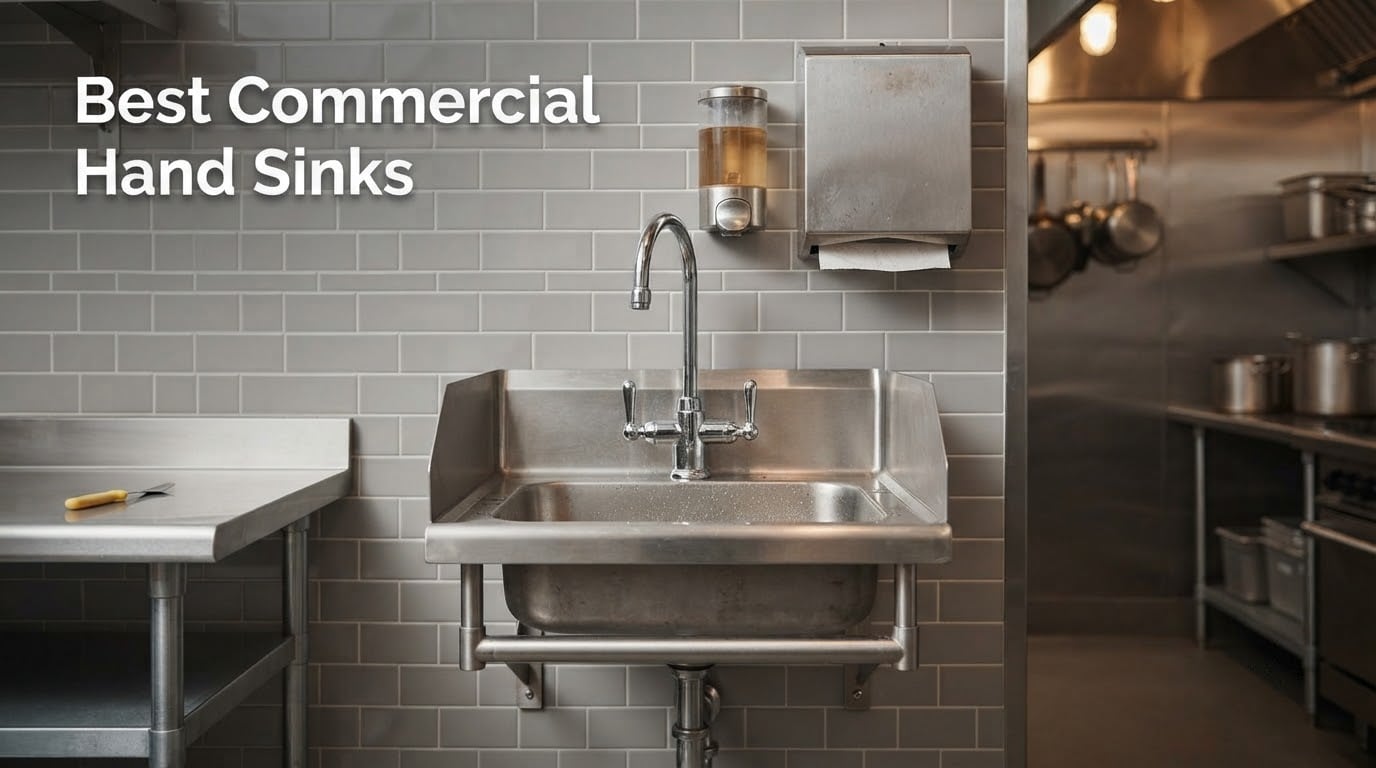
The best commercial hand sink for most kitchens is an NSF-certified, wall-mounted basin in 20-gauge type 304 stainless steel, roughly 17 by 15 inches, with an included gooseneck faucet and a drain basket. That combination is what restaurant owners, food truck operators and clinic managers keep coming back to: it passes a health department look, it survives daily scrubbing, and the faucet is already in the box instead of being a separate line item.
I compared ten of the highest-reviewed hand sinks in the commercial restaurant sinks category, and the differences between them turned out to be less about styling and more about three practical things: the gauge of steel, the real size of the bowl, and whether the mounting hardware can carry a loaded basin on your wall. Those three details decide whether a sink still works in year three or ends up rusting, wobbling, or getting flagged on an inspection.
This guide covers the sinks that hold up in real kitchens, plus the buying decisions that trip people up. If you are outfitting a break room or a small staff kitchen rather than a licensed food operation, our bathroom vanity roundup covers the residential side of the same problem. For a food operation, keep reading.
Table of Contents
Hand Sink vs Utility Sink vs Mop Sink: Decide Before You Buy
This is the first decision, and it is the one buyers most often get wrong. A hand sink, a utility sink and a mop sink look similar from across a kitchen but are built and required for completely different jobs.
A hand sink is a small, shallow, wall-mounted basin reserved exclusively for handwashing. It needs a gooseneck or wrist-blade faucet, a hands-free valve or sensor, soap and paper towel within reach, and nothing else may happen in it. Health codes treat it as a dedicated fixture, so you cannot wash produce, fill a bucket, or rinse equipment in it.
A utility sink is deeper, larger and built for heavy work: washing produce, breaking down boxes, filling containers, or holding dirty dish racks. It usually sits on legs or a floor base and has no hands-free requirement. A mop sink is a floor-level, sometimes wall-hung basin with a plain service faucet and usually a vacuum breaker, used by janitorial staff for mop water and bucket filling.
The cost of getting this wrong is real. Forum discussions on r/smallbusiness and Quora repeatedly surface one question: can a hand sink be converted to a utility or waste sink? The short answer is no. Repurposing a dedicated hand sink for waste handling is a common inspection finding, because the basin is shallow, the drain is small, and the fixture is registered with the health department as handwashing-only.
One more thing that shows up constantly in forum threads: plumbing hookup, not product selection, is what stops people. Adding a compliant hand-washing station often means stubbing a drain into a wall that has no waste line, and several operators describe that as a serious project. Plan the plumbing before you order the basin, and measure your wall space and drain location against the sink’s overall dimensions, not the bowl dimensions.
Top 3 Commercial Hand Sinks in 2026
The three picks below are the strongest combination of rating, review volume and specification clarity we found across all ten models. Every one carries a 304 stainless body and an NSF listing, which is the baseline for a facility that has to pass an inspection.
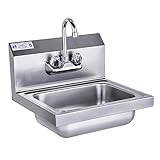
HALLY 17×15 in Wall Mount
- 20-gauge 304 stainless
- NSF certified
- 8 in gooseneck faucet included
- Side splash guard
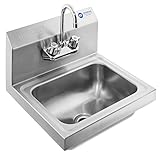
GRIDMANN 17×15.5 in Wall Mount
- Heavy gauge 304 stainless
- NSF certified GR13-SERV1
- Basket strainer and bracket included

VEVOR 17×12.8 in Wall Mount
- Ceramic valve core faucet
- Three high splashbacks
- Stainless basket strainer drain
All 10 Commercial Hand Sinks Compared Side by Side
Every sink below includes a faucet and drain hardware, so the comparison is closer to like for like than a typical retail grid. Read the bowl dimensions more carefully than the headline size: a 17 by 15 inch footprint can hold a bowl far smaller than that.
| Product | Specifications | Action |
|---|---|---|
| HALLY 17×15 in NSF Wall Mount Hand Sink |
|
Check Latest Price |
| GRIDMANN 17×15.5 in NSF Wall Mount Basin |
|
Check Latest Price |
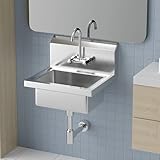 Bonnlo 17.1×15 in Brushed Stainless Hand Basin Bonnlo 17.1×15 in Brushed Stainless Hand Basin |
|
Check Latest Price |
| VEVOR 17×12.8 in Wall Mount Hand Sink |
|
Check Latest Price |
 DuraSteel 16×15 in NSF and CEC Sink DuraSteel 16×15 in NSF and CEC Sink |
|
Check Latest Price |
 WILPREP 17×15 in NSF Stainless Hand Sink WILPREP 17×15 in NSF Stainless Hand Sink |
|
Check Latest Price |
 KoolMore 17×15 in NSF Hand Sink KoolMore 17×15 in NSF Hand Sink |
|
Check Latest Price |
 DuraSteel 20.5×17.5 in High-Capacity Hand Sink DuraSteel 20.5×17.5 in High-Capacity Hand Sink |
|
Check Latest Price |
 AmGood 12×16 in Hand Sink with Splash Guards AmGood 12×16 in Hand Sink with Splash Guards |
|
Check Latest Price |
 BIEAMA 17×15 in NSF Hand Sink BIEAMA 17×15 in NSF Hand Sink |
|
Check Latest Price |
1. HALLY Stainless Steel Sink with Faucet 17×15 in – Best Overall
HALLY Stainless Steel Sink with Faucet 17″x15″ NSF Wall Mount Hand Basin
20-gauge type 304 stainless
17x15 in wall mount
NSF certified
Faucet and drain basket included
Pros
- NSF certified for health-code hand washing
- 20-gauge 304 stainless resists rust and staining
- 8 in gooseneck faucet plus 1-1/2 in drain basket in the box
- Side splash guard keeps the wall dry
- Largest verified review base in our group at 512 reviews
Cons
- Compact 14x10x5.5 in bowl limits washing capacity
- Rounded bowl shape reduces flat usable surface
This is the sink I keep coming back to for a normal restaurant or cafe. It is NSF certified, it is 20-gauge type 304 stainless steel, and the 8-inch gooseneck faucet and 1-1/2-inch drain basket are both in the box, so the install is one trip to the hardware store rather than a second order. The 512-review base is the largest in our test group, and the pattern in that feedback is consistent: people buy it because the certification and the steel grade check the boxes an inspector asks about.
The clip-on wall mount is the detail that stands out in practice. There is no bracket to lose, no template to align, and the sink goes up in minutes. Reviewers also mention the polished surface wiping clean with a damp cloth, which matters more than it sounds in a facility that sanitizes several times a day.
The honest limitation is bowl size. The basin measures 14 by 10 by 5.5 inches inside a 17 by 15 inch body, and the shape is round-cornered rather than square. That is fine for handwashing, which is the only legal job for this fixture, but it means you cannot use it for prep work or for filling anything larger than a small container.
It weighs 4.29 kg, which is light enough for a solo install, and the side board splash guard does its job of stopping water running down the wall. If your inspector wants a dedicated hand sink with a documented NSF listing, this is the least complicated way to satisfy the requirement.
Check the bowl size fits your wall before ordering
The headline 17 by 15 inch figure is the outer body, and the usable basin is noticeably smaller. Measure your available wall width, then leave enough clearance behind the basin for the supply lines and the drain trap to fit without crushing them. Tight clearances behind a wall-mounted sink are the single most common install complaint across this whole category.
Confirm the overall height too. The unit measures 13.5 inches tall, and with the faucet and gooseneck the working surface still needs to land inside your local rim-height limit. If you are fitting into an existing alcove, the faucet centre and the backsplash position decide whether the faucet lands over the drain or off to one side.
Know when this compact basin is the wrong pick
If your facility washes more than hands — think a prep sink for washing produce, or a place where staff rinse down equipment — the 5.5-inch depth will frustrate you quickly. Water splashes over the rim during routine use, and code may not permit that use in a dedicated hand sink anyway.
It is also a single-hole configuration with a pop-up drain, which is a residential-style drain arrangement. That is fine for a hand basin, but it is not what you want anywhere you need a basket strainer to catch debris or where a health inspector expects an open-up drain. In a licensed food operation, verify the drain arrangement against local code before the install day.
2. GRIDMANN NSF Stainless Steel Hand Washing Basin – Best Value
GRIDMANN Commercial NSF Stainless Steel Sink Wall Mount Hand Washing Basin with Faucet
Heavy gauge 304 stainless
17x15.5 in wall mount
NSF certified
Faucet and bracket included
Pros
- Large bowl in a heavy gauge 304 stainless body
- NSF certified for commercial kitchens
- Supplied wall mount plate eases installation
- Gooseneck spout high enough to fill a bucket
- Backed by a 90 day limited manufacturer warranty
Cons
- Tight clearance behind the sink needs 1/2 in brass 90 degree elbows that are not included
- Replacement faucet handles are hard to source
- Shallow bowl depth for heavy shop work
The GRIDMANN is the value pick in this roundup, and the reason is the wall mount plate that comes in the box. Almost every competitor relies on a clip or a hanger, and this one supplies an actual plate, which is why reviewers repeatedly single out installation as straightforward. At 484 reviews and a 4.5 average, it has the second-largest verified feedback base we looked at.
The body is heavy gauge number 304 stainless, and the model is NSF certified under GR13-SERV1. The backsplash is pre-drilled at 7-5/8 inches tall, which tells you the gooseneck faucet was designed to fit this exact body rather than adapted to it. A basket strainer drain and the wall plate are both included.
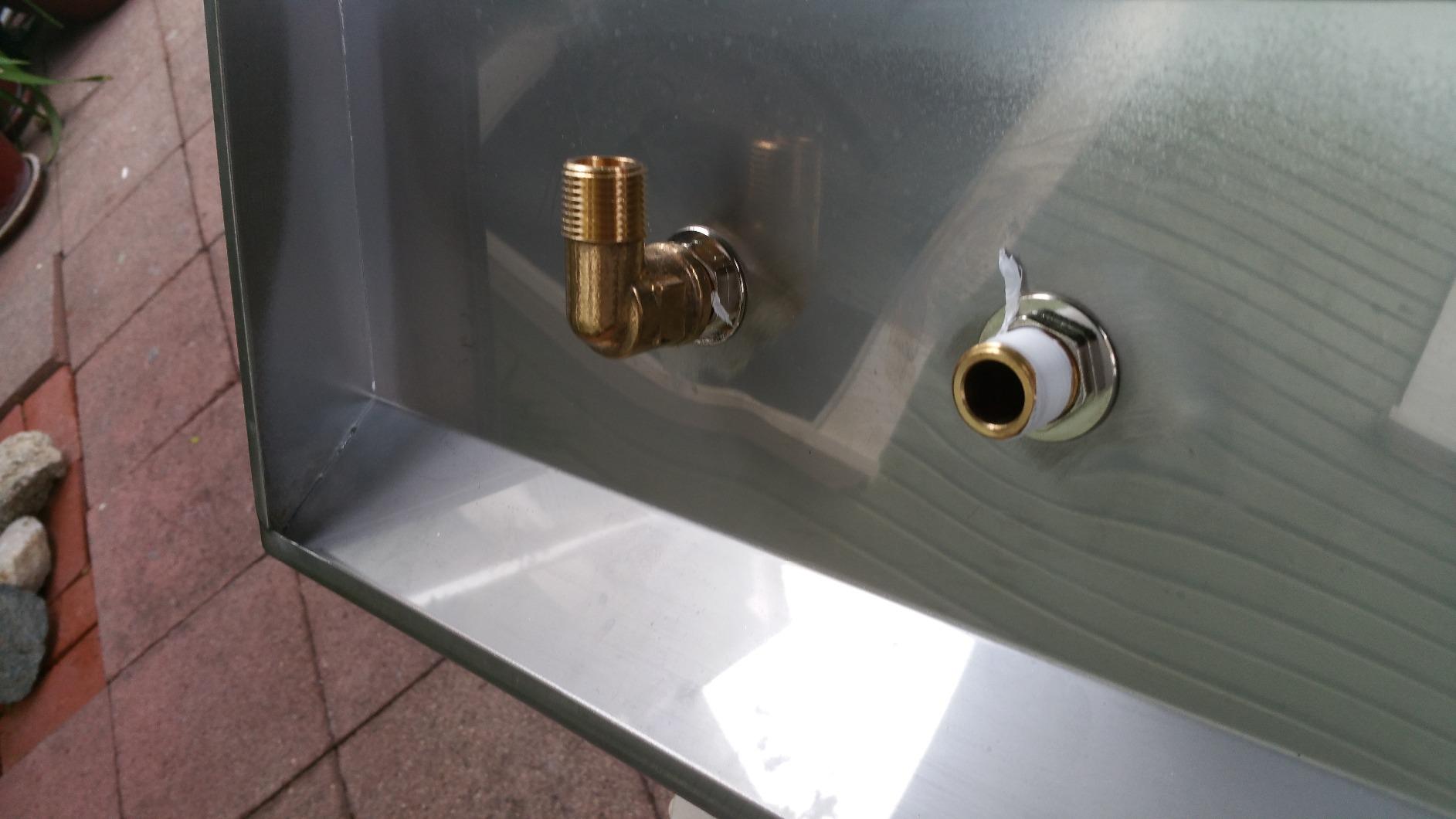
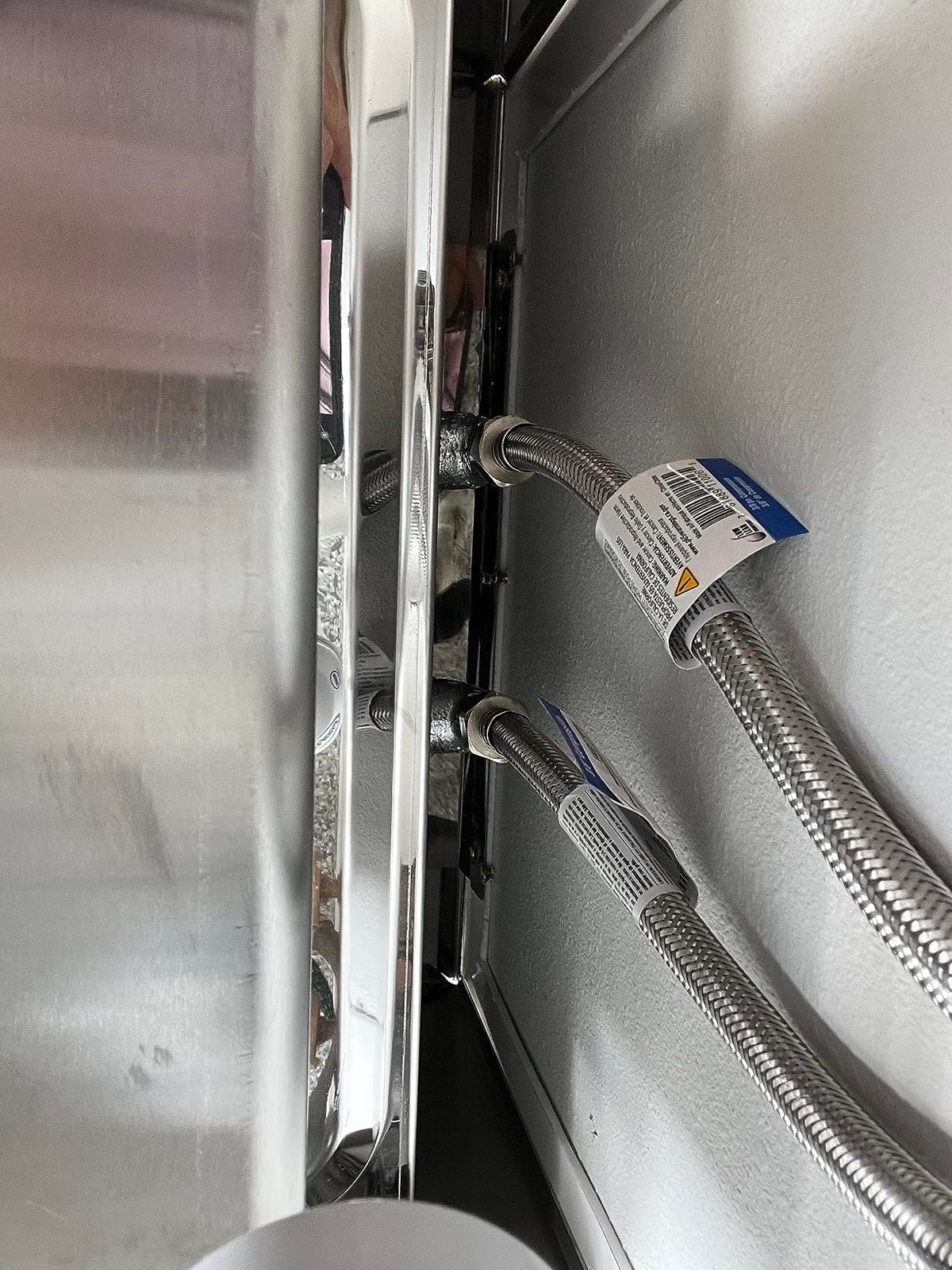
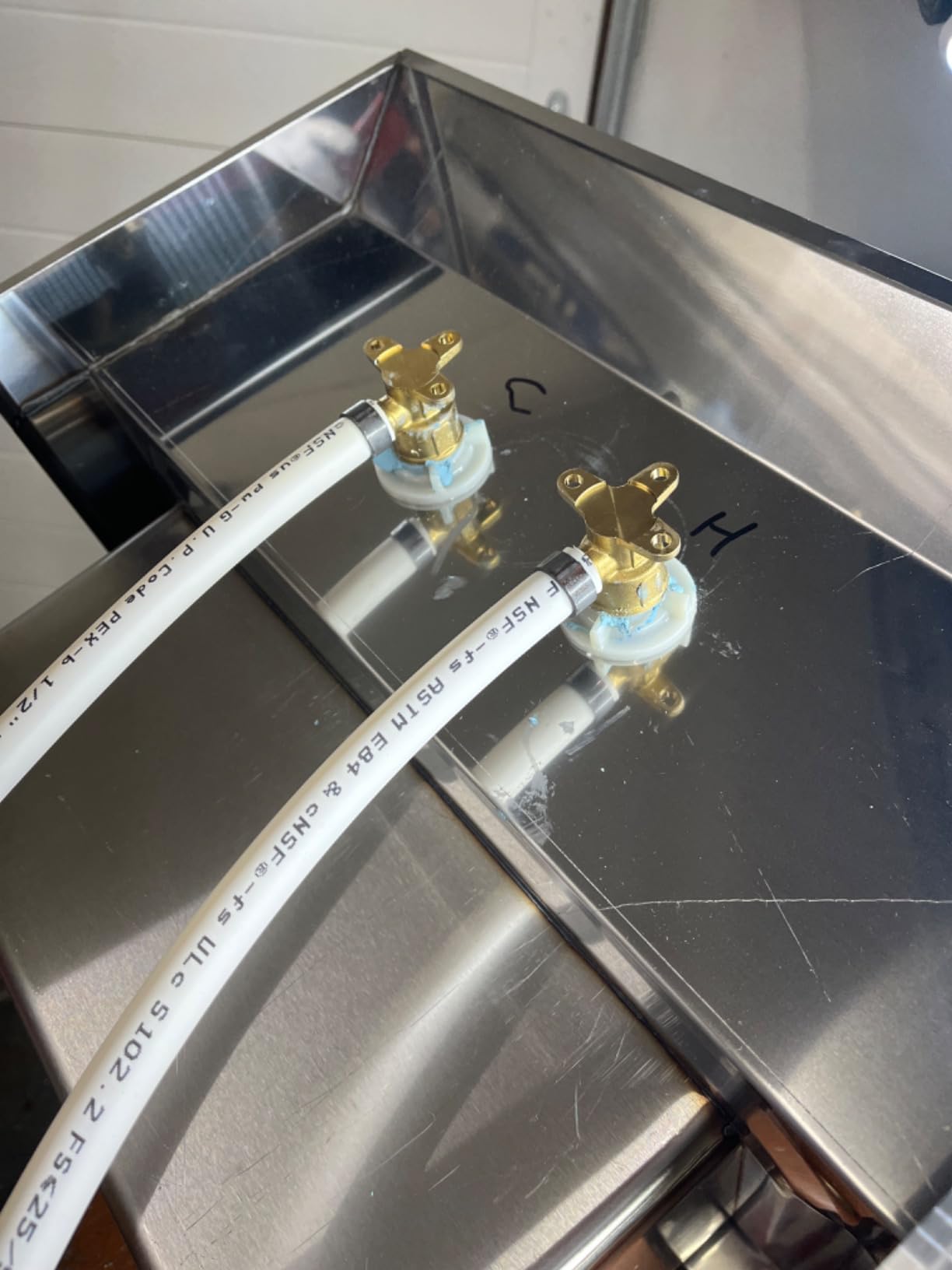
Two practical notes before you commit. The clearance behind the basin is genuinely tight, so most installers end up adding 1/2-inch brass 90-degree elbows to route the supply lines, and those elbows are not in the box. Budget for a small parts run. Second, the included 90-degree faucet handles can strip if they are over-tightened, and matching replacements are difficult to source later.
It weighs 8 pounds, so a single person can lift it into position. Reviewers also mention buying more than one for restaurant use, which is a reasonable signal that the finish holds up when several people work at the same station.
Why the included mounting hardware matters more than it sounds
Wall-mounted hand sinks carry a real load: steel, water, and a person leaning on the edge. Sink manufacturers’ own commercial buying guides make the same point, and it matches what we read in the reviews. A supplied plate or reinforced bracket is the difference between a mount that stays tight for years and one that lets the basin rock against the wall.
If you are mounting into drywall rather than masonry or a reinforced stud, ask what is behind the wall before you buy. Even the better brackets here need something solid to bite into. Backing the wall with a plywood or steel plate is cheap compared with replacing a sink that has sagged.
Watch the bowl depth and the plumbing clearance
Some buyers describe the bowl as shallow for shop use, so if you plan to wash bulky items in it, look at a deeper model instead. The 17 by 15.5 inch footprint is generous, but the interior depth is what determines whether water stays in the basin or goes over the edge.
The clearance behind the sink is the more common frustration. Plan your supply and drain routing before the sink arrives, and pick up the 90-degree fittings at the same time as the sink. One buyer also flagged the gauge as light for permanent outdoor exposure, so if you are installing this outside or in a wet wash-down area, consider a heavier basin.
3. Bonnlo Upgraded Commercial Hand Wash Sink – Budget Pick
Bonnlo Upgraded Commercial Hand Wash Sink Stainless Steel Prep/ Bar Sinks – Wall Mount Utility Sink with Faucet, Heavy Duty Hand Washing Basin for Commercial Restaurant RV Kitchen, 17x 15 x 14
Brushed stainless wall mount
17.1x15 in body
R10 interior corners
360 degree gooseneck faucet
Pros
- Strong value for the amount of steel included
- R10 interior corners are easy to clean
- 7-5/8 in back splash keeps walls and cabinets dry
- Protective foam and carton packaging prevents transit dents
- Wall mount bracket included
Cons
- Thin 200-series steel that some buyers see rust within about 30 days
- Cramped space behind the sink can stop it draining fully
- May need a bead of silicone to stop it shifting on the wall
The Bonnlo is the lowest-cost route into a wall-mounted commercial basin we reviewed, and for a dry utility room or a hobby kitchen it does the job. Reviewers frequently say the metal-to-cost ratio is excellent. The 4.1 average comes from a wide spread, with 64 percent five-star but 10 percent one-star, so know what you are buying before you commit.
Two design points are worth praising. The R10 interior corner radius is generous, which means there is no sharp internal seam to trap food or grime, and the 7-5/8-inch back splash is real. The hot and cold gooseneck faucet swivels 360 degrees, and the unit drains to a standard 1-1/2-inch tail piece, so your trap is a standard part rather than a specialty item.
The weakness is material, and it is not a small one. This is 200-series stainless in thin sheet, not 300-series, and 200-series is vulnerable to rust when it stays wet. Several buyers report rust appearing at the top edges and through the bowl interior within about a month. That is exactly the failure mode a stainless hand sink should not have.
The packaging is genuinely excellent, with a large styrofoam block and fabric bag, and owners report that sinks arrive without dents. But dents are not the risk here; corrosion is. In a licensed food operation or anywhere with persistent moisture, I would step up to a 300-series basin.
Where this budget basin genuinely fits
Dry or infrequently wet environments are the right home for it: a garage, a laundry alcove, a small prep room where the sink gets used a few times a day. The R10 corners and the included bracket make it a competent fixture, and the 6.3-inch bowl depth is deeper than several competitors here, which reduces splashing during longer washes.
The bowl measures 13.4 by 9.4 by 6.3 inches inside a 17.1 by 15 inch body, and the wall mount bracket is included. Check the standard 1/2 NPT male faucet thread, which means most replacement goosenecks will thread in if the supplied one ever fails.
Why we would not put it in a code-required station
Two reasons. The 200-series steel is the more important one, because rust pits make a surface impossible to sanitize properly, and sanitation is the whole point of a dedicated hand sink. The second is the fit: a thin basin that shifts on the wall needs a bead of silicone to stay put, and a moving fixture leaks and fails inspection.
There is also the clearance problem again. Buyers report that the tight space behind the sink forces 90-degree fittings, which in turn can stop the basin draining fully. A sink that holds standing water is a hygiene problem before it is a plumbing problem. If you buy this one, plan the fittings first.
4. VEVOR Commercial Hand Sink 17×12.8 in – Top Rated
VEVOR Commercial Hand Sink 17×12.8 inch Stainless Steel Sink with Faucet & Side Splash, Wall-Mount Small Hand Basin for Restaurant, Kitchen, Bar, Garage, Home
17x15 in wall mount body
Ceramic valve core faucet
Three high splashbacks
Basket strainer drain
Pros
- Ceramic valve core resists leaking compared with rubber-seal faucets
- 360 degree rotatable faucet gives flexible reach
- Three high splashbacks keep walls and cabinets dry
- Stainless basket strainer supports smooth flow
- Installs wall mounted or embedded with toolkit and manual included
Cons
- Heaviest model in our group at 14 lb
- harder for a solo install
- Polished finish shows water spots and needs frequent wiping
The VEVOR has the highest verified rating in this roundup at 4.8, with 89 percent five-star ratings and 1 percent one-star across 170 reviews. That is the cleanest feedback profile of the ten. If you read only one set of reviews while choosing, read this one.
The faucet is the reason. It uses a ceramic valve core rather than a rubber-seal cartridge, and reviewers consistently credit it with fewer leaks and less water waste than the rubber-seal faucets that come with most competitors. It also swivels 360 degrees, so you can fill a tall container from the side without the spout fouling the backsplash.
Splash protection is the other differentiator: three high splashbacks, which is more coverage than the single rear board most of these sinks ship with. The basket strainer and drain assembly are stainless steel, and the whole thing installs either wall mounted or embedded, so it works in a counter cut-out as well as on a bare wall.

Two practical negatives. At 14 pounds it is the heaviest model here, and for a single-handed wall install that matters. The polished finish also shows water spots, so plan for daily wiping if appearance matters to your operation. The toolkit and manual are in the box, which is a small convenience most listings do not offer.
Why the ceramic valve faucet is worth paying up for
A rubber-seal faucet fails predictably: the seal dries out, the faucet starts to drip, and you are either replacing the cartridge or living with a drip. A ceramic cartridge uses two polished ceramic faces that slide rather than compress, and they hold their seal far longer in commercial use where the faucet is being opened and slammed shut dozens of times a day.
There is a second benefit. A drippy faucet means wasted water and a wet basin, and a constantly wet basin is where limescale, staining and biofilm start. The lower maintenance reality of a ceramic core is a real operational saving even if it is not the reason a buyer picks this sink.
Where the weight and finish will slow you down
Fourteen pounds is manageable with two people or a second pair of hands, but it changes the install plan. Have the wall blocking and the stub locations final before the sink arrives rather than lifting it twice. The embedded install option is a genuine alternative if the weight is your sticking point.
The polished finish is the other consideration. It looks excellent in photos and shows every water spot in a busy kitchen. If you want a low-maintenance appearance, a brushed finish hides drying marks better. Wiping the basin down at closing is a small habit, and most operators simply add it to the existing cleaning round.
5. DuraSteel NSF and CEC Wall Mount Sink 16 x 15 in – Best for Laundry and Utility
DuraSteel Stainless Steel Sink – NSF Commercial Wall Mount Kitchen Sink – Small Hand Sink with 12″ x 10″ x 5.5″D Wash Basin – With Sink Strainer and Faucet – For Laundry, Restaurants, Bars, and More
304 rust resistant stainless
16x15 in wall mount
NSF and CEC certified
Lead-free faucet
Pros
- 304 stainless rated for heavy commercial use
- NSF and CEC certified for strict public health standards
- Rounded edges are easy to clean and safe for users
- Basin is deep enough for washing machine discharge
- Wall mount format frees floor space in tight rooms
Cons
- Included faucet leaks from behind the chrome cover on some models
- Upper hanger only mount lets the base wobble against the wall
- Bracket described as too weak for busy restaurant service
This DuraSteel carries dual certification, NSF and CEC, and a lead-free faucet rated under model F-HA-404N-28 with a 4-inch centre. If your operation has to document lead-free fixtures, the dual listing is the reason to choose it. Reviewers consistently praise the 304 stainless body for holding up under heavy use and to the elements.
The 12 by 10 by 5.5-inch wash basin is deeper than the compact models in this group, and several owners use it for washing machine discharge and general laundry work. That is a slightly grey area for a dedicated hand sink, but for a residential or utility-adjacent application it is exactly the capacity you want.
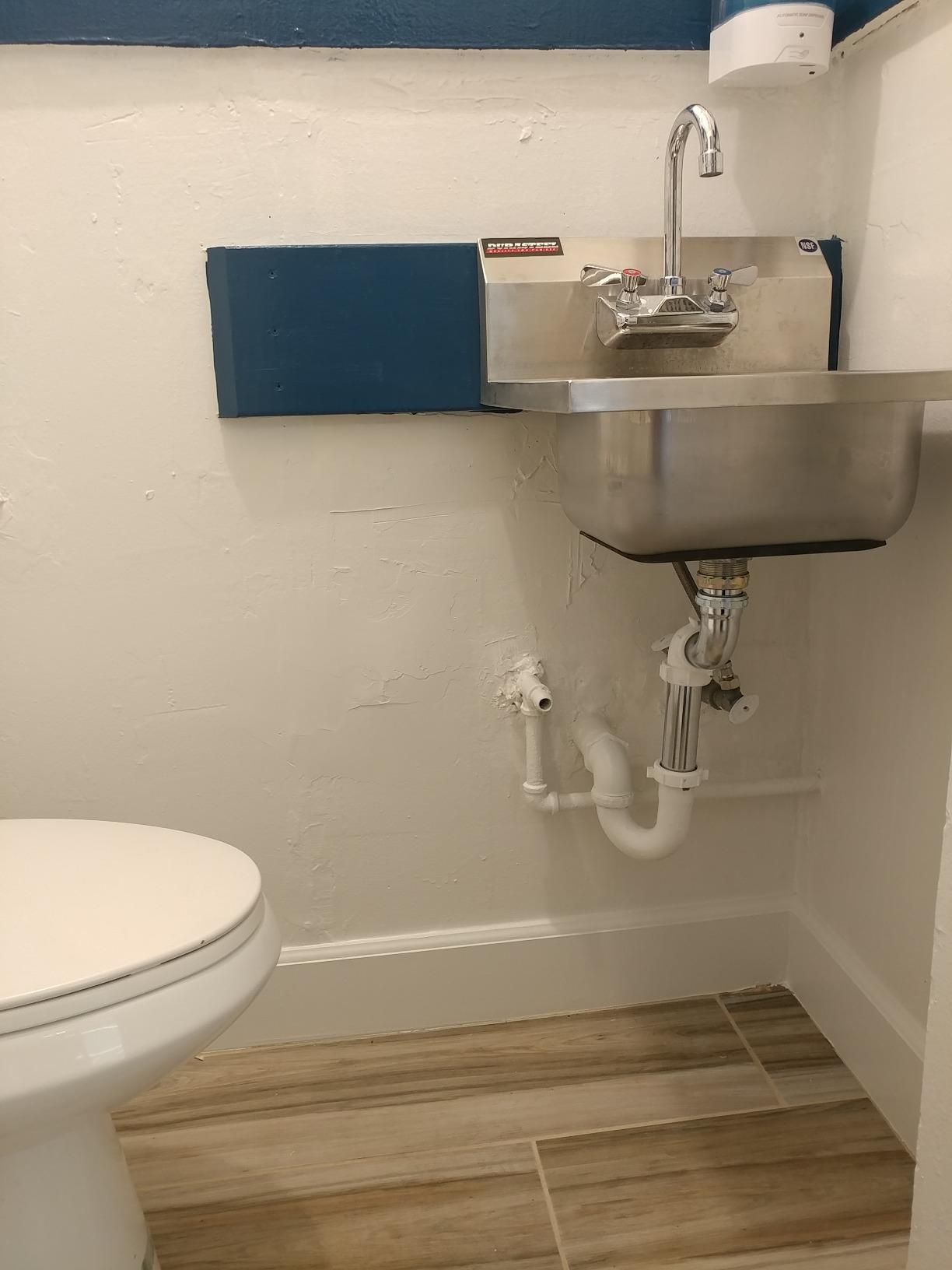
The quality complaints are concentrated and specific. Several reviewers report the included faucet leaking from behind the chrome cover on both the hot and cold sides, and one unit arrived with brass casting debris inside the faucet that had to be flushed before it seated. Separately, the wall mount uses a thin upper hanger with no lower fixing, so the base can wobble against the wall.
One reviewer also reported rough welds and finish on a bowl and drain assembly. That points to inconsistent finish quality between batches rather than a design flaw, but it is worth inspecting the unit the moment it arrives rather than after the wall is closed up.
Check the faucet and the mount before you close the wall
Both of the most common complaints are fixable at install time rather than after. Run both taps for several minutes and check behind the chrome cover for weeping, and if the faucet weeps, replace it before you plaster or tile rather than after. A leaked faucet inside a finished wall is an expensive fix.
For the mount, add a lower fixing. The supplied hanger alone is designed for light service, and a lower screw or bracket into blocking turns a wobbling fixture into a rigid one. If your wall is drywall, install blocking behind the full width of the basin before it goes up.
Know the limits of a 4-inch faucet centre
The 4-inch centre is a benefit when you want to swap in a different gooseneck later, because it is a common commercial size. It is a limitation if you need a wide or wall-mounted faucet, since a pair spread 4 inches apart is narrower than the spout reach some fixtures assume.
Also note the 16 by 15 inch listed size against the 16.7 by 16 inch overall dimensions, and the smaller 12 by 10 inch bowl. Buyers report that the small bowl causes splashing during frequent handwashing, so if your station sees heavy traffic, budget for a deeper basin elsewhere in this list.
6. WILPREP NSF Stainless Steel Hand Sink 17×15 in – Best for Compact Prep Spaces
WILPREP Commercial Hand Sink, NSF Stainless Steel Sink Commercial Utility Sink with Gooseneck Faucet and Strainer, 17×15 Inch Wall Mount Kitchen Sink for Restaurant Bar RV Bathroom Laundry Room
304 corrosion resistant steel
NSF certified
13.8x9.8 in basin
360 degree gooseneck faucet
Pros
- Ranked first in the Commercial Restaurant Sinks category on Amazon
- 304 stainless gives a sleek modern finish
- Sunken basin and side splashes keep floors dry
- Compact footprint suits bar and food prep areas
- Faucet drain valve assembly and wall mount all included
Cons
- Basin is smaller than the 17x15 in footprint suggests
- Only 130 reviews
- a thinner base than the top sellers
The WILPREP sits at the top of the Commercial Restaurant Sinks category on Amazon and carries a 4.6 average from 130 reviews, with 80 percent five-star and only 2 percent one-star. If volume of real installations matters to you, that sales position is a meaningful signal about how widely the unit gets used.
The design detail that stands out is the sunken basin combined with side splashes. Because the basin is recessed rather than flat, water drains inward and the splashes land on the side guards instead of the floor. In a bar or prep area where the floor has to be swept anyway, that is a real reduction in housekeeping time.
Everything needed for the install is in the box: the sink, the gooseneck faucet, the hot and cold inlet valve assembly, the drain and the wall mount. The 360-degree rotatable centre-set faucet lets you work from any angle without bending over the basin, and the rounded edges are straightforward to wipe down.
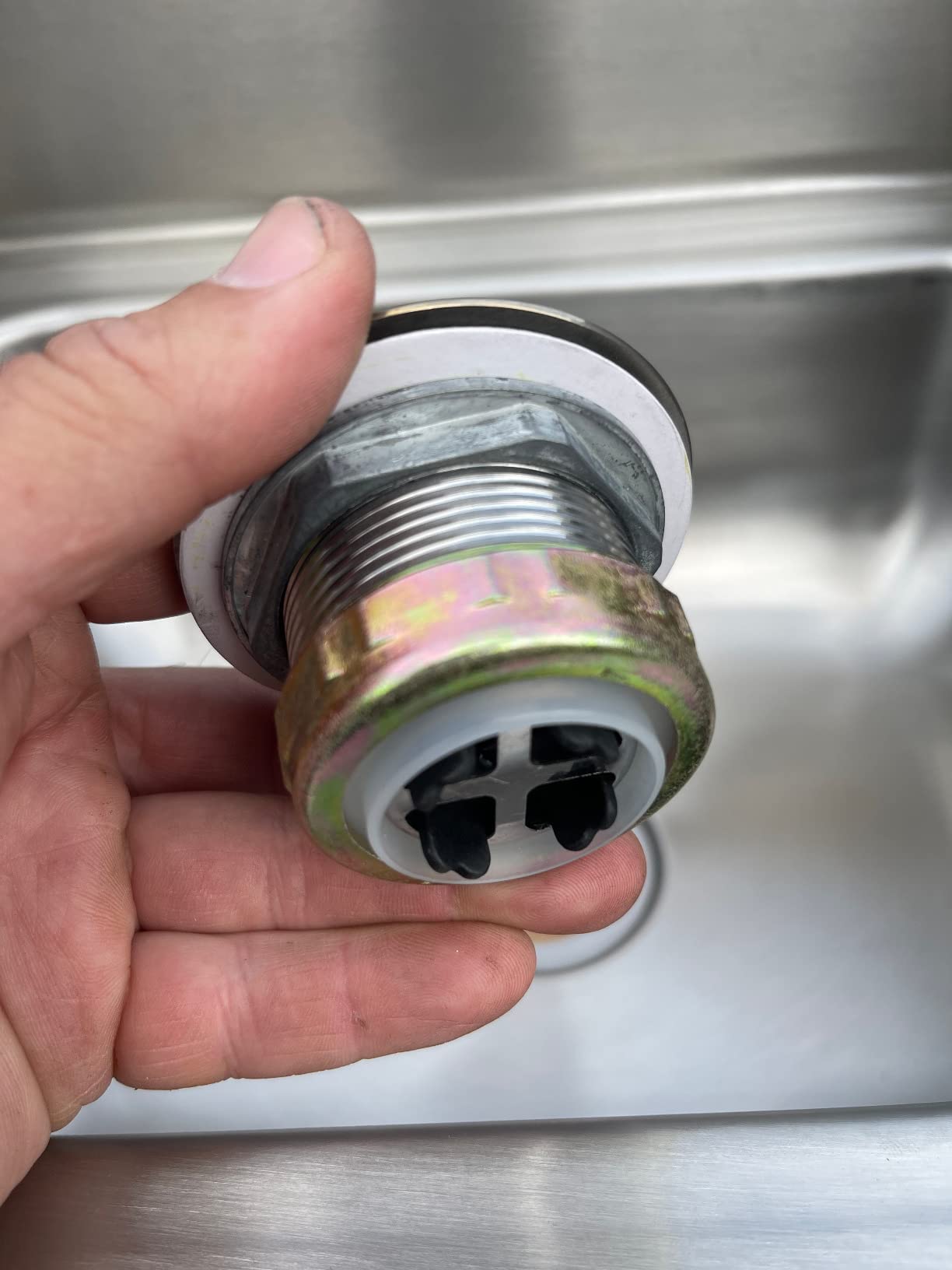
The caveat is dimensional honesty. The body is 17 by 15 inches, but the basin is only 13.8 by 9.8 inches, which is smaller than the headline suggests. Know that going in, because a buyer who expects a full-size basin will be disappointed by a perfectly good compact sink.
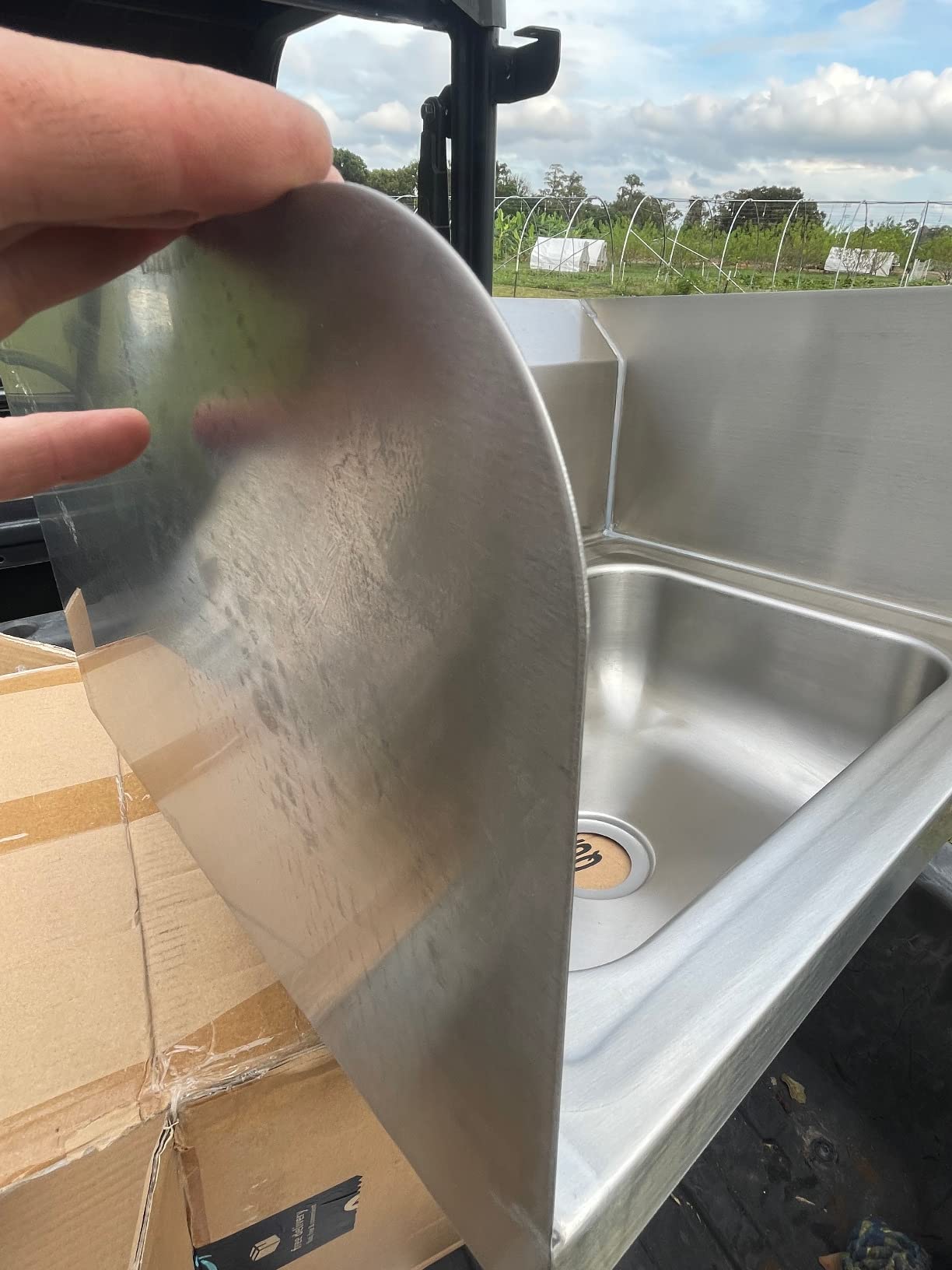
Why a sunken basin helps in a bar or prep area
Flat basins on a wall mount rely entirely on the side guards to stop water. A recessed basin catches the first splash internally, so the guard only has to handle the overflow. In a coffee bar, a cocktail bar or a bakery prep area, that difference shows up as a floor that needs mopping less often.
The valve assembly is also worth noting. Having the hot and cold inlet valve assembly in the box means one connection point rather than two, which is a meaningful simplification when you are working inside a tight wall cavity with limited room behind the basin.
Know what the compact basin cannot do
At 13.8 by 9.8 inches, this is a hand basin, not a prep basin. It will not take a stockpot, a sheet pan, or a large container, and forcing that use is the fastest way to get standing water and a blocked drain. If your space is that tight, the basin size is the correct choice and the discipline has to come from the workflow.
The second thing to know is the 130-review base. It is a solid sample for a commercial sink, but it is thinner than the top sellers here, and the listing ranks first in its category partly because it has been available a long time with a consistent finish. Inspect the finish on arrival and keep the box for transport damage claims.
7. KoolMore NSF Commercial Hand Sink 17×15 in – Best for Preschools and Schools
KoolMore Stainless Steel NSF Commercial Hand Sink with Goosneck Faucet 17″ x 15″ – Wall Mount Hand Wash Sink, Silver (SH17-4GNF)
20 gauge 304 stainless
NSF certified
17x15x13 in wall mount
8 in backsplash, 4 in centre
Pros
- Gooseneck faucet and removable drain basket included
- Roomier than the listed dimensions suggest
- 8 in backsplash protects the wall from splashes
- Wall clip allows a fast install
- Backed by a 90 day manufacturer warranty
Cons
- 20 gauge steel can feel flimsy and tinny in the hands
- Corners can be sharp enough to need padding in public settings
- Included faucet failed after about 18 months of light use
The KoolMore is the pick for childcare and school settings, and the reason is a single detail that does not show up in most spec sheets: the corner profile. One owner set up a preschool hand-washing station with this unit in a couple of hours, and the corner sharpness came up repeatedly enough that we would treat it as a real consideration rather than a nitpick.
On the plus side, several reviewers find it roomier than the dimensions suggest, with a deep usable basin that handles a proper hand wash without splashing. The 8-inch backsplash is taller than the 7-5/8 inch boards on most competitors here, which is meaningful when a wall of small children is washing hands.
The 4-inch centre faucet holes are a standard commercial size, so replacing the gooseneck later is easy. The wall clip mount is quick, the removable drain basket is a genuine convenience for cleaning, and the 20-gauge 304 stainless is corrosion resistant for high-volume use.
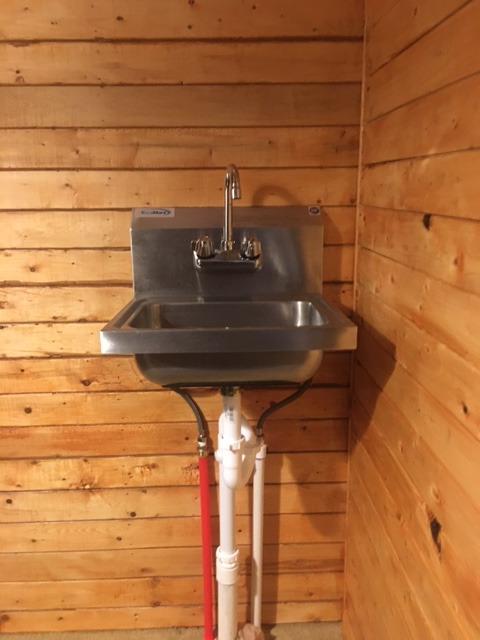
The criticisms are honest ones. Twenty gauge is on the light side and can feel tinny; rust has been reported on some pieces, and one owner received a sink with a bent side that could be straightened but never sat quite right. The included faucet also failed for one owner after roughly 18 months of light use.
Padding the corners before children use it
If this unit goes into a preschool, a daycare or any space with unsupervised small children, add foam or rubber corner guards before sign-off. The guards cost almost nothing and they remove the most frequently reported safety complaint in the reviews. Fix them to the wall or the backsplash, not to the basin, so they cannot be pulled off by a child.
Set the mounting height to the youngest user’s reach rather than the standard adult height, and keep soap within reach of a small child without a step. The wall clip gives you a little flexibility on height because the fixture is not fixed to a countertop bolt pattern.
Where the light gauge and the faucet become a problem
Twenty gauge is fine for handwashing but it is the first thing to flex if someone leans on the rim or if a cleaner knocks it with a bucket. In a school maintenance context, treat the basin as something you do not lean on, and reinforce the wall rather than the sink if the two are in conflict.
The early faucet failure is worth planning around. Because the 4-inch centre is a standard size, budget for a replacement gooseneck rather than expecting the supplied one to last a decade. Check the 90-day manufacturer warranty terms at purchase, since that is the stated coverage on this model.
8. DuraSteel 20.5 x 17.5 in Hand Sink – Best for High-Capacity Washing
DuraSteel 304 Stainless Steel Wall Mount Sink – Commercial Hand Washing Sink – NSF & CEC Certified with Lead-Free Faucet – For Restaurants, Kitchens, Bars, Restroom
304 food-grade stainless NSF HS-2017
18x13x7.5 in tub
7.57 gallon capacity
Lead-free faucet
Pros
- Largest basin in our group at 18x13x7.5 in
- 7.57 gallon capacity handles heavy washing loads
- 304 food-grade stainless with a polished finish
- NSF certified sink paired with a certified lead-free faucet
- Drain basket faucet and wall clip included
Cons
- Bulky 20.5 in width needs more wall area than a standard hand sink
- Thin feedback base at 74 reviews
This is the capacity option in the roundup. The inner tub measures 18 by 13 by 7.5 inches and holds 7.57 gallons, which is roughly three times the volume of the compact basins elsewhere in this list. If you are washing down anything bulky at a hand-washing station, this is the only one of the ten with the depth for it.
The steel is 304 food-grade stainless with a polished finish, and the certification is thorough: the sink is NSF listed under model HS-2017 and the faucet is a CEC and NSF certified lead-free model. For an operation that has to document every component of its hand-washing station, that dual listing is the argument for this model.
The wall mount also frees the floor underneath, which simplifies mopping and keeps the janitorial routine simple. The drain basket, faucet, sink body, user manual and wall clip all arrive together, so there is nothing to source separately for a basic install.
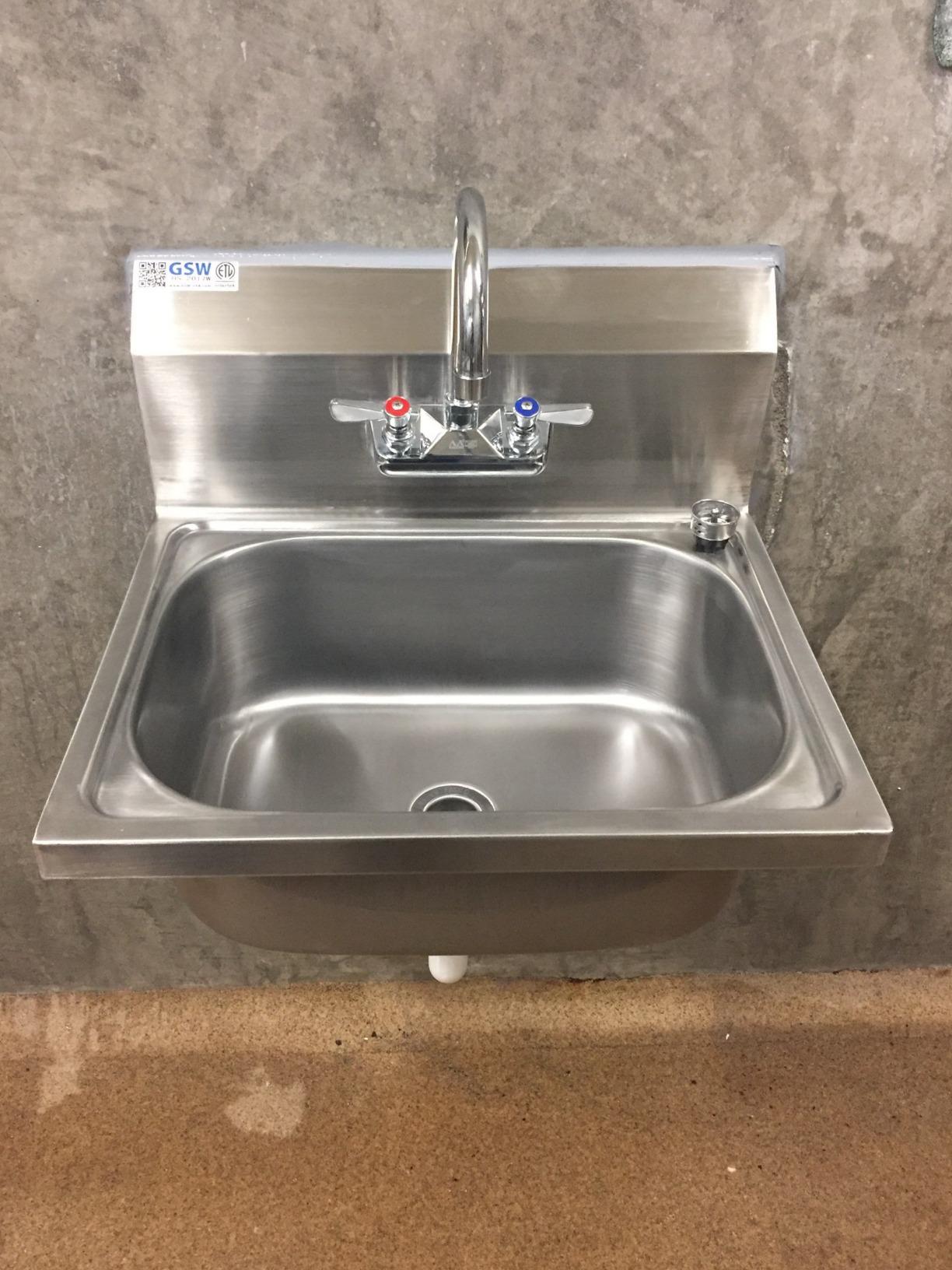
What you give up is footprint. At 20.5 inches wide, it is bulkier than the standard 17 by 15 inch hand sink, and it needs a wider wall area to sit against. The 4.2 average from 74 reviews is also a thinner base than most of the group, so treat the certification and capacity as the deciding factors rather than the review score.
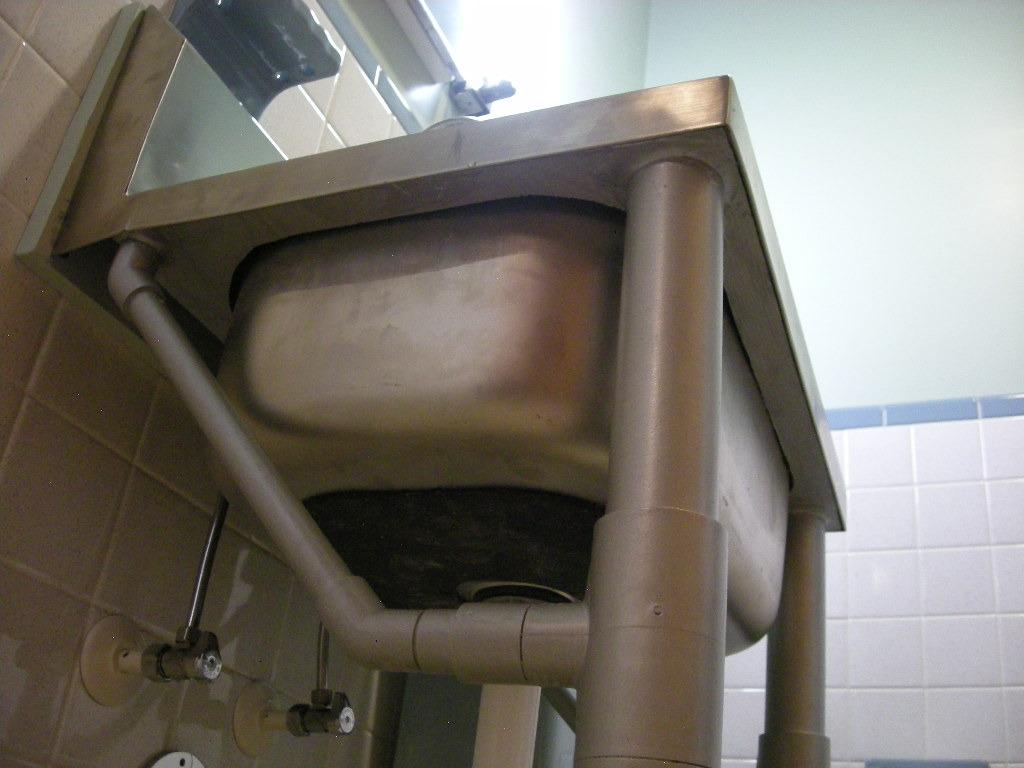
When a 7.57 gallon basin is the right call
Capacity matters when the station sees more than hands. Consider a bakery back-of-house, a food-processing area, or a community kitchen where a single sink absorbs staff handwashing and a steady stream of bucket filling during a service rush. The 7.5-inch tub depth means water stays in the basin instead of going over the rim.
Basket strainers also matter at that volume. A shallow basin with a small drain spout slows to a crawl when a full bowl of soapy water empties, and a drain that runs slowly leaves standing water around the plug. This model pairs the deep tub with a proper basket strainer.
Check the wall area before this one goes in
Measure twice on this one. At 20.5 by 17.5 inches overall, it will not fit into a standard 17-inch alcove without cutting, and cutting a niche for a wall-mounted sink weakens the wall you are hanging it from. Confirm the wall width and the height of the finished floor to the rim before ordering.
At 12.5 pounds it is heavy but still manageable for a two-person lift. The bigger practical note is that a wider sink needs wider blocking behind it. The wall clip is rated for the sink’s own footprint, so extend your blocking to cover the full 20.5 inches rather than only the bowl area.
9. AmGood 12 x 16 in Hand Sink with Splash Guards – Best for Corner Installs
AmGood Wall Mount Hand Sink 12 in. x 16 in. with Splash Guards | 304 Stainless Steel NSF Commercial Hand Wash Sink with Faucet Included | Bowl 9 in. x 9 in. x 4-1/2 in. Deep
20-gauge type 304 stainless
NSF certified
9x9x4-1/2 in bowl
Faucet and drain basket included
Pros
- Rear backsplash plus side splash guards protect a corner wall
- 20-gauge type 304 stainless resists corrosion
- NSF certified for dedicated hand washing
- Gooseneck faucet and drain basket arrive ready to plumb
- Same line offers knee-valve and pedestal configurations
Cons
- Smallest bowl in our group at 9x9x4-1/2 in
- Hand washing only rather than prep or utility work
- Thinnest rating base here at 26 reviews
The AmGood solves a specific problem: the corner install. It carries a rear backsplash plus side splash guards, which is the combination you want when the sink has to sit into a corner with no wall on one or both sides. Most of the wall-mount basins in this roundup ship with a rear board only, which means the side of the basin sprays straight onto a painted or tiled wall.
The material is 20-gauge type 304 stainless, the grade specified for commercial foodservice, and it is more corrosion resistant than the 430 series used in some cheaper sinks. The listing states its NSF certification clearly, for the dedicated hand sink that health codes generally require in commercial food areas.
What stands out most is the dimensional honesty. The bowl is given as 9 by 9 by 4-1/2 inches inside a 12 by 16 inch body, and the manufacturer presents that as a feature rather than burying it. You know exactly what you are fitting before it arrives, which removes the most common complaint in this category.
The 4.7 average is strong, but it rests on 26 reviews, the thinnest base in this group. Treat the rating as encouraging rather than conclusive. The gooseneck faucet and 1-1/2-inch drain basket are in the box, and installation hardware is included as well.
Why three-sided splash protection matters in a corner
Water leaves a basin mostly sideways, and a rear-only backsplash catches the vertical throw but not the sideways spray. Add side guards and you catch both. In a corner, that is the difference between a wall that stays clean and a wall that needs scrubbing and eventually repainting around the fixture.
The same 12 by 16 inch footprint also makes this the easiest unit here to fit into a small alcove or a service closet. If space is the binding constraint, that is worth more to you than basin capacity, because you cannot install a sink that does not fit.
Know when a 4-1/2 inch bowl is too small
This is the smallest bowl in the group at 9 by 9 by 4-1/2 inches, and that depth is the real limit. It is built for hand washing, which is exactly what a dedicated hand sink is for, but it will splash more than the deeper models and it will not accept any prep or utility work. Do not plan to rinse equipment in it.
Given the size, the knee-valve and pedestal configurations in the same line are worth a look if you later want hands-free operation or a freestanding install, because you would be staying within one manufacturer’s parts and support ecosystem. With only 26 reviews, verify the finish and the weld quality on arrival.
10. BIEAMA NSF 17 x 15 in Hand Sink – Best for Garages and Workshops
BIEAMA NSF 17″ x 15″ Hand Sink, Stainless Steel Wall Mount, Side Splashes
Type 304 stainless, oil and stain resistant
17x15 in basin
Three high backsplashes
Pros
- Survives paint brushes and epoxy with no rust or oxidizing
- Three high backsplashes stop splash and wall staining
- 17x15 in capacity handles produce and dish washing too
- Owners report plug-and-play swaps for older restaurant sinks
- Bracket faucet copper valve core and strainer included
Cons
- Sharp edges on the side plates
- 20 gauge steel is thinner than typical and dents easily
- Very small drain spout relative to the basin
The BIEAMA earns its place for chemical resistance. One owner washes paint brushes and epoxy in it with no rust or oxidizing, which tells you something about the passivation quality that a kitchen-only application never tests. For a garage, workshop or a maintenance room where the sink is the one place solvents get rinsed, that is the deciding factor.
The type 304 stainless is deep drawn and polished for an oil and stain resistant finish, and the 17 by 15 inch capacity is large enough that owners use it for washing produce and dishes as well as hands. The three high backsplashes match the best coverage we saw in this group, and the faucet is a 360-degree gooseneck with a copper valve core.
Installation is where it wins points. Owners replacing older restaurant hand sinks describe a plug-and-play swap, and the model installs wall mounted or embedded, so it can go into a counter cut-out. The bracket, faucet, copper valve core and drain strainer are all in the box.
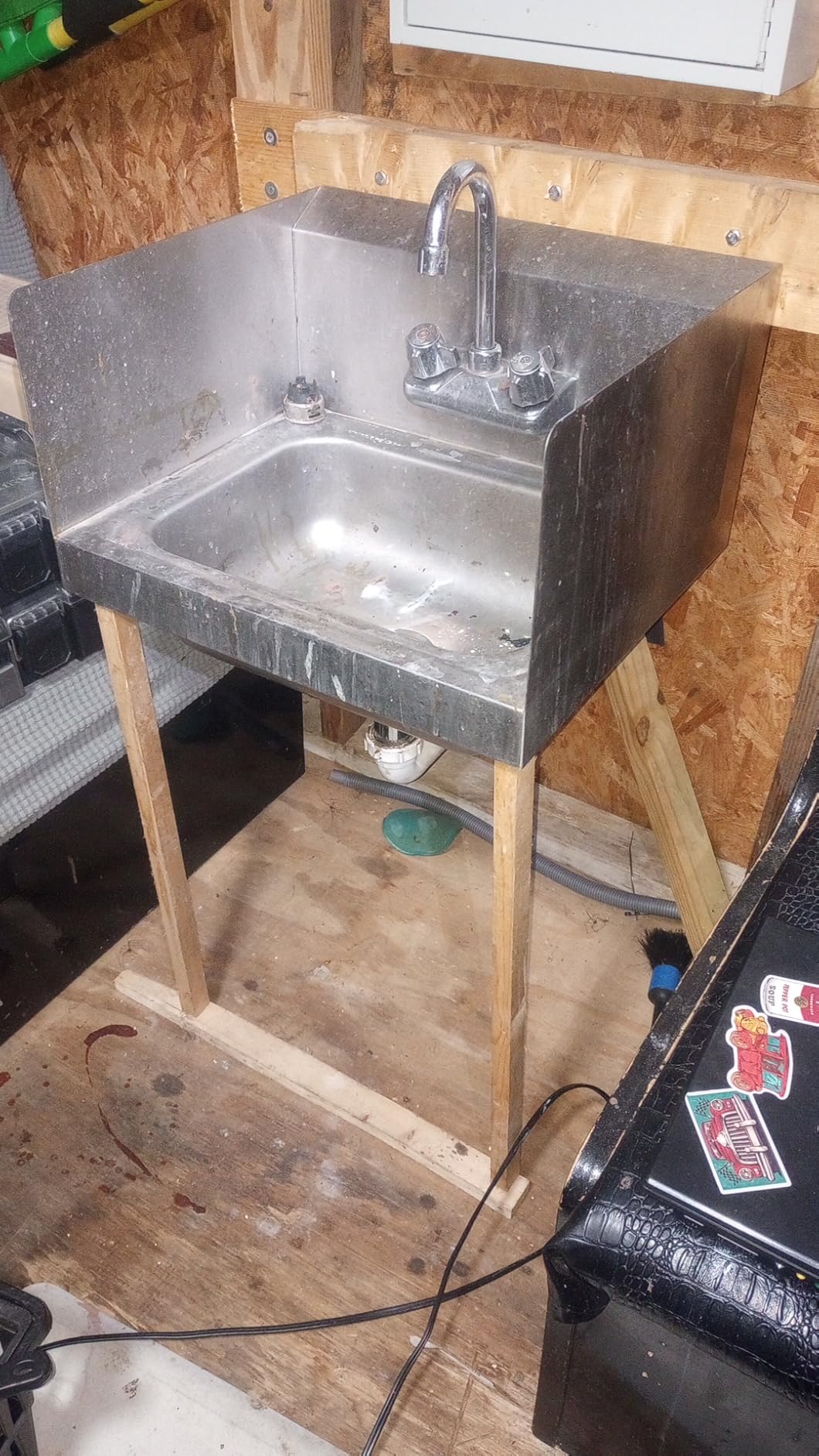
The complaints are physical rather than electrical. Sharp edges on the side plates have caused one owner to apply a rubber protectant to prevent cuts, and the 20-gauge steel is thinner than the 16 to 18 gauge typical elsewhere, so it rattles and dents more easily. The drain spout is also very small relative to the basin, which will slow a full-basin emptying.
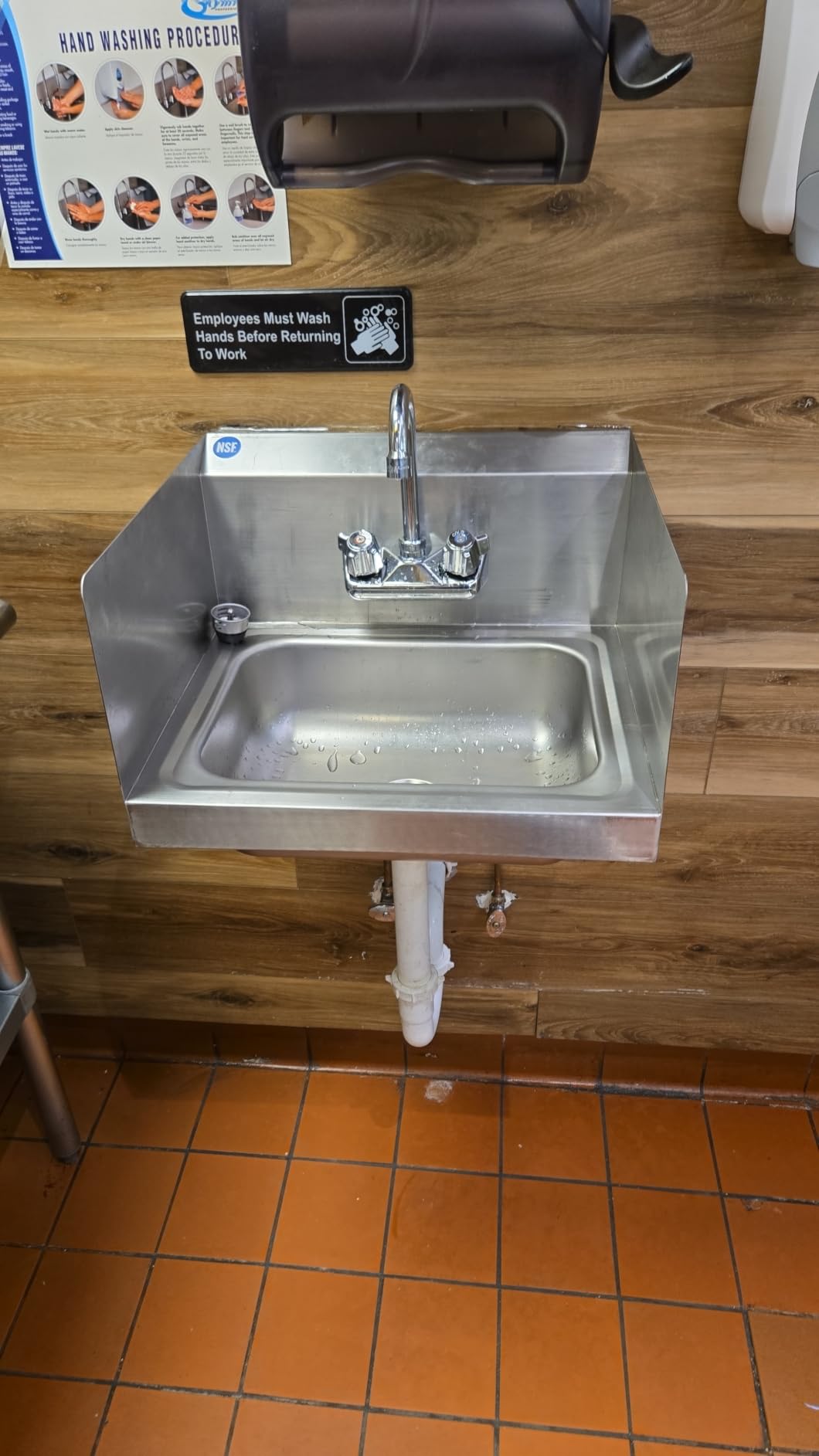
Why 304 stainless handles solvents better
Stainless resists corrosion because of its chromium content, and 304 carries enough of it to hold up against water, salt and mild chemicals. Epoxy and aggressive solvents are the test case, and an owner running paint brushes through the basin with no oxidizing is about as strong a real-world result as you will find in the reviews.
Compare that to the 200-series option in this roundup, which buyers report rusting within about a month. The difference is not a small one for a workshop. If your shop washes down floors, handles fuels or works with acids, look for 304 or 316 and stay away from 200-series entirely.
Fix the sharp edges and the slow drain before service
Deburr or guard the side plate edges at install. The plate edges are where hands run along the wall when setting a bucket down, and a guard strip or a light file takes two minutes and removes the most common complaint. The thin 20-gauge steel is harder to fix, so reinforce the wall instead of the sink.
The small drain spout is the one that will annoy you. A 17 by 15 inch basin that empties through a narrow spout runs slowly with a full bowl of soapy water, and slow drainage leaves residue around the drain. Fit a larger strainer or a short vertical drop and keep the trap run straight, with as few elbows as the wall allows.
Best Commercial Hand Sink Brands by Tier
Brand is the question the search data keeps asking, and it is a reasonable one. The short version is that the tier a brand sits in predicts the certification quality, the parts support and the finish consistency more reliably than the sticker price does.
Premium brands in the commercial food equipment world include Krowne Metal, John Boos, Advance Tabco, Eagle Group and Sani-Lav. These are the names that show up on equipment schedules in restaurant build-outs, and their advantage is parts support: if a gooseneck fails in three years, the service technician can source a replacement. They are also the safest answer when an inspection is imminent and you want documentation you can hand over.
Mid-tier brands include Vollrath, Elkay, Steelton, Atosa and Regency. Vollrath in particular has strong presence in the wall-mounted hand sink category, with a 17 by 15 inch 20-gauge 304 model that reads like the specification baseline for the whole category. The tradeoff at this tier is that finish quality varies more between production runs.
Value brands are where most of the ten sinks in this roundup sit: Gridmann, VEVOR, Bonnlo, AmGood, DuraSteel, KoolMore, WILPREP and BIEAMA. Reliability at this tier is entirely a function of material and hardware choices, which is exactly why the steel grade and the faucet specification deserve more attention than the logo. A 304 stainless body with a ceramic valve faucet at this tier can outperform a heavier-gauge body with a leaking rubber-seal faucet.
Reliability, then, is not about the brand name. It is about three verifiable things: a published NSF listing, a stated steel grade and series, and a faucet you can replace with a standard part. All ten sinks here publish at least two of those three. If you are outfitting an office break room or a staff kitchen rather than a licensed food operation, the selection process is shorter and our office equipment guide covers the rest of that build-out.
How High Should a Commercial Hand Sink Be?
Most codes cap the rim of a hand sink at 34 inches above the finished floor, measured to the top of the basin rather than the faucet or backsplash. Work from the floor surface you will actually have, since a finished floor that goes in after the sink is hung can change the measurement. ADA-accessible installations have their own clearance rules for the space below and around the sink, and childcare settings are typically set lower for children.
Measure from the floor to the top of the bowl, not to the overall product height. Most of the sinks in this roundup list an overall height that includes the backsplash, and the backsplash is not the surface anyone washes at.
Two practical notes. Wall-mounted basins hang off brackets, so setting the height at install means the drain and supply stub locations have to be planned at that same height, before any wall is closed. And in a facility with a mix of adult staff and children, one height rarely serves both, which is a legitimate reason to install two basins rather than compromise on one.
How to Choose a Commercial Hand Sink
Stainless grade and gauge. Look for type 304 or 316 stainless first. The series number matters more than the gauge: 300-series resists rust, 200-series does not, and the 200-series sinks in circulation show rust within weeks in a wet environment. Gauge then decides how much the basin flexes. Eighteen gauge is the heavy commercial default, twenty gauge is common and adequate for handwashing, and sixteen gauge is reserved for utility duty. The Bonnlo in this group is the counterexample to check against, since it is 200-series sheet.
Bowl size and depth. Read the bowl dimensions, not the headline size. A 17 by 15 inch body here holds anything from a 9 by 9 inch bowl to an 18 by 13 inch tub, and that spread decides whether the sink handles hands only or bulk washing. For handwashing, anything above about 5 inches of depth is comfortable. Below 4-1/2 inches, expect splashing during frequent use.
Mount configuration. Wall mount is the default because it frees the floor and keeps the area under the sink mippable. Freestanding pedestal and drop-in models exist for locations where there is no suitable wall or where the fixture must move. Wall mounting transfers the load into the wall, so block it properly. If your wall is drywall with ordinary studs, add backing before the sink arrives.
Backsplash and splash guards. A rear backsplash is standard. Side guards matter in corners, at the end of a run of counters, or anywhere the sink has no wall beside it. The VEVOR and BIEAMA carry three-sided coverage here, and the AmGood is built specifically around side guards for corner installs.
Faucet centres and compatibility. The centre spacing between the faucet holes determines which faucets will fit. Most of these sinks use 4-inch centres, which is a standard commercial size and makes gooseneck replacement easy. An 8-inch centre is unusual and limits your options. Check the centre before you assume any replacement faucet will thread in.
Certification and what is in the box. NSF certification is the checkbox an inspector asks for, and the model number matters, because a listing covers one model. Then confirm whether the faucet, the drain basket, the strainer and the mounting hardware are included. All ten sinks here include a faucet and drain hardware, but the wall plate is not universal: the Gridmann supplies a proper plate, several others supply only a clip or hanger.
Total installed cost. The basin is the small part. Add the 90-degree fittings for supply routing, the trap and tailpiece, any wall blocking, a shut-off valve, a soap dispenser and a paper towel dispenser. Then add the labour. Forum threads on r/smallbusiness and Quora describe plumbing hookup as the real barrier to adding a hand-washing station, and none of that cost appears in a product listing. Budget for the wall work before you order.
Hands-Free Operation: Knee Valve vs Sensor Faucet vs Gooseneck
None of the ten sinks in this roundup ships with a hands-free valve. Every one includes a manual gooseneck faucet, which means hands-free operation is a planned add-on cost on every one of them. That is worth stating plainly, because a hands-free station is a code expectation in many food operations and the basin is only half of it.
A knee valve is a foot-operated valve on the supply lines that the user presses with a knee to start water. It needs no electricity, no batteries and no calibration, and it cannot fail in a way that leaves water running. The trade-off is that it only works with knee clearance under the basin, which rules it out for a sink mounted low or with a cabinet below, and it needs enough legroom to be usable. For a wall-mounted basin in an open kitchen it is the most reliable option available.
A sensor faucet is touchless and reads as more modern, and it is the only option that works at a low mounting height or in an accessible installation. The trade-offs are real: it needs a power source, it needs periodic calibration and battery changes, and sensor faucets at the entry of a busy kitchen can trigger constantly and wear out faster. In a facility with hard water, descale intervals get short.
Wrist-blade handles are the third option and the least common on dedicated hand sinks. They keep hands off the handle but still require a deliberate push, so they are not truly hands-free and will not satisfy a code requirement written for hands-free operation. In a laboratory, a medical scrub room or any clinical setting, the faucet choice is a clinical decision rather than a kitchen one, and the gooseneck reach and splash-free discharge matter as much as the activation method.
For most of the sinks reviewed here, plan the basin and the valve as two separate purchases, and confirm the valve’s port size and connection type against the sink before you commit. The basin is the part you cannot easily change once the wall is finished.
Portable Handwashing Stations and Health Inspections
A portable handwashing station can pass an inspection in some jurisdictions, but it is jurisdiction-specific and the inspector decides. The recurring theme in forum discussions, particularly on r/smallbusiness, is that operators are not sure whether their temporary setup is acceptable and are reluctant to find out during an inspection.
The general principles that hold most places: the station must provide warm water, soap and a means of drying, it must be plumbed to a sanitary drain rather than discharging onto the ground or into a bucket, and it must be accessible from the food preparation area without crossing a dirty zone. A tank fed from a bucket with a drain hose to a bucket is the configuration most likely to draw a finding.
Where the real projects come from is infrastructure, not the unit itself. Forum participants describe wanting a hand-washing station and being blocked by the plumbing, particularly in converted spaces where no waste line is near the food prep area. A permanently plumbed wall-mounted sink from this list, installed into an existing drain, removes the ambiguity entirely and is the safer choice for a licensed operation.
One more constraint worth knowing: code generally prohibits using a dedicated hand sink for anything other than handwashing, and inspectors do check for it. If you have been using one basin for washing produce and hands, split the functions before your next inspection rather than after.
Pre-Purchase Checklist
Confirm seven things before you order, and most install-day problems disappear.
1. Steel grade and series. Type 304 or 316, written on the listing or the spec sheet. Not 200-series, not “stainless steel” with no number.
2. The NSF model number, not just the word NSF. Certification is granted to a specific model, and that number is what goes on your documentation.
3. Bowl dimensions separate from overall dimensions, plus the interior depth in inches.
4. Faucet centre spacing and whether a replacement gooseneck in that size will be available later.
5. What is actually included: faucet, drain basket, strainer, wall plate or clip, and any fittings.
6. Your wall condition. Blocked, masonry, or bare drywall. And your clear width and height against the sink’s overall dimensions, not the bowl.
7. Your drain and supply locations measured against the sink’s tap and waste positions, including the fittings needed to route supply lines out of a tight wall cavity.
Frequently Asked Questions
How high should a commercial hand sink be?
Most codes cap the rim of a commercial hand sink at 34 inches above the finished floor, measured to the top of the basin rather than the faucet or backsplash. ADA-accessible installations have additional clearance requirements for the space below and around the sink, and childcare settings are usually set lower so children can reach. Measure to the basin rim, not the overall product height, and plan the drain and supply stubs at the same height before the wall is closed.
Do commercial hand sinks need to be NSF certified?
In most jurisdictions, yes. Health departments generally expect a dedicated hand-washing sink in commercial food operations to carry an NSF listing, and the listing is per model, so the model number matters as much as the certification itself. Check the listing for the specific model, and keep the documentation, because it is what you present at inspection. A residential-grade sink with no NSF listing is the most common reason a hand-washing station fails.
Is a knee valve better than a sensor faucet?
For most commercial kitchens, a knee valve. It needs no electricity, no batteries and no calibration, and it cannot fail in a way that leaves water running, which matters in a facility that is open long hours. It does require knee clearance under the basin, so it will not work with a low mount or a cabinet below. A sensor faucet is the better choice for low mounting heights and accessible installations, but it needs a power source, periodic calibration and battery changes.
Can a portable handwashing station pass a health department inspection?
Sometimes, but it is jurisdiction-specific and the inspector makes the call. Most places require warm water, soap, a means of drying and a sanitary drain connection, which rules out many temporary setups that discharge into a bucket. A permanently plumbed wall-mounted sink is the safer option for a licensed operation. If you are unsure, ask your local health department before you buy rather than after you are open.
What size hand sink do I need for a commercial kitchen?
A 17 by 15 inch wall-mounted basin is the standard footprint, but the bowl inside it varies enormously, from about 9 by 9 inches up to 18 by 13 inches. For handwashing only, a bowl around 12 by 10 inches with at least 5 inches of depth is comfortable. If you need to wash bulky items or fill buckets at the same station, look for a deeper tub of 7 inches or more. For a high-volume kitchen, a multi-station wash-up sink beats a single larger basin.
Can I use a residential sink in a commercial kitchen?
Not for handwashing. Residential sinks are typically 16 gauge or lighter, use 430 or 200-series stainless, and carry no NSF listing, and health codes expect a dedicated, listed fixture. A residential-style sink also usually has a pop-up drain rather than the basket strainer and open-up arrangement that inspection expects. You can repurpose a residential sink for non-handwashing chores, but the hand-washing station has to be a listed commercial fixture.
Our Verdict on the Best Commercial Hand Sinks
The best commercial hand sink in this group is the HALLY 17 by 15 inch NSF-certified basin, and it wins for the unglamorous reason that it is the least likely to cause you a problem: certified steel, a faucet and drain in the box, a clip-on mount that installs in minutes, and the largest body of real-world feedback of anything we reviewed.
Match the pick to the job. Choose the GRIDMANN when you want a supplied mounting plate and the best value in the set. Choose the VEVOR when you want the cleanest finish quality and a ceramic valve faucet that will not drip. Choose the DuraSteel 20-inch model for the only deep, high-capacity tub here, the BIEAMA for a workshop where solvents and epoxy get rinsed, the AmGood for a corner install, and the KoolMore for a preschool, with corner guards added.
And skip the Bonnlo in any wet or licensed setting. It is the most economical way into a wall-mounted basin we tested, and the 200-series steel is the reason it will not be there in a year.
Whatever you choose, plan the plumbing and the wall before the basin, not after. That is where the real cost and the real delays live, and no sink on this list fixes a missing waste line.