

A commercial gas floor fryer is a freestanding stainless steel unit that burns natural gas or propane to heat a frypot holding roughly 30 to 100 pounds of oil, with total burner output of about 70,000 to 150,000 BTU. It is the standard high-volume frying platform in full-service and quick-service kitchens, and it is the right buy for anyone frying more than about 50 pounds of food per hour.
The number that decides whether a floor fryer keeps up with a dinner rush is recovery time: how fast the oil returns to set temperature after a cold basket hits it. Gas recovers faster than electric in almost every real kitchen, and across an eight-hour service that gap shows up as greasy food, longer ticket times and burn incidents during a lull. Our team spent weeks comparing burner configurations, vat designs, safety controls and certification on the twelve units below, and every pick here is a genuine floor-standing gas model.
One warning before we start. These are not countertop appliances and they are not residential products. A gas floor fryer needs a dedicated gas line, a Type I hood and an ANSUL suppression system, and manufacturer warranties on this category routinely void on non-commercial installation. If you are still shopping at the countertop level, our guides to the [best deep fryers for home kitchens](https://www.skywarriorbooks.com/best-deep-fryers-for-home-kitchens/) and the [best deep fryers for home comfort food cooks](https://www.skywarriorbooks.com/best-deep-fryers-for-home-comfort-food-cooks/) cover that category properly.
Table of Contents
Top 3 Commercial Gas Floor Fryers
Our three fastest overall picks cover the range most kitchens actually need. The CookRite ATFS-40 is the one we would put in a working line, the VEVOR GF90 delivers the most heat per dollar, and the Kratos 29Y-012-NAT is the only unit here that reaches 150,000 BTU for genuine high-volume service.

CookRite ATFS-40
- 102000 BTU natural gas floor fryer
- 3 heating tubes
- 40 lb commercial capacity
- Oil cooling zone


Kratos 29Y-012-NAT
- 70/100 lb oil capacity
- 150000 BTU across five tubes
- ETL certified
- 200-400F thermostatic controls
12 Commercial Gas Floor Fryers Compared in 2026
Every fryer below is floor-standing and gas-fired. Capacities, burner counts and certification labels are taken from the manufacturer spec data, and the table is the fastest way to see which model matches your oil volume and BTU load.
| Product | Specifications | Action |
|---|---|---|
| CookRite ATFS-40 Natural Gas Floor Fryer |
|
Check Latest Price |
| VEVOR GF90 Three-Burner Gas Floor Fryer |
|
Check Latest Price |
| Kratos 29Y-012-NAT Gas Floor Fryer |
|
Check Latest Price |
 Atosa CookRite ATFS-50-NG Atosa CookRite ATFS-50-NG |
|
Check Latest Price |
 Frymaster Dean SR142G Super Runner Frymaster Dean SR142G Super Runner |
|
Check Latest Price |
 Vulcan LG300 Gas Fryer Vulcan LG300 Gas Fryer |
|
Check Latest Price |
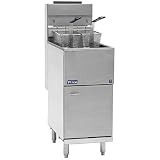 Pitco 40D Tube Fired Gas Floor Fryer Pitco 40D Tube Fired Gas Floor Fryer |
|
Check Latest Price |
 EGGKITPO ECF3-NG Natural Gas Fryer EGGKITPO ECF3-NG Natural Gas Fryer |
|
Check Latest Price |
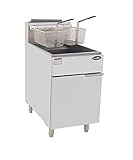 Atosa ATFS-75 Full Pot Gas Fryer Atosa ATFS-75 Full Pot Gas Fryer |
|
Check Latest Price |
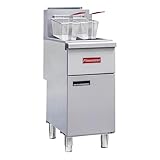 CHUMART 120000 BTU Gas Floor Fryer CHUMART 120000 BTU Gas Floor Fryer |
|
Check Latest Price |
 Frymaster ESG35T Gas Floor Fryer Frymaster ESG35T Gas Floor Fryer |
|
Check Latest Price |
 Value Series 29R-001-NAT Floor Fryer Value Series 29R-001-NAT Floor Fryer |
|
Check Latest Price |
1. CookRite ATFS-40 – Best Overall Commercial Gas Floor Fryer
CookRite ATFS-40 Commercial Deep Fryer with Baskets 3 Tube Stainless Steel Natural Gas Floor Fryers-102000 BTU
40 lb oil capacity
102000 BTU natural gas
3 heating tubes
30.1 x 15.6 x 44.4 in
Pros
- Largest review base in the roundup at 29 reviews
- Oil cooling zone traps residue away from the heat
- Heavy duty burners with standby pilots
- Nickel plated baskets with crumb screen
Cons
- Around 9% of reviews are 1-star
- No built-in filtration on this platform
This is the fryer we would put behind a working fry station. The ATFS-40 runs 102,000 BTU across three heating tubes into a 40 lb tank, which is a genuinely well-matched pairing rather than an oversized burner on a small pot. Buyers consistently point to the same thing: it heats, and it keeps heating when a full basket drops.
What separates it from the cheaper 90,000 BTU units is the oil cooling zone seated in the bottom of the tank, where food residue settles instead of sitting against a burner tube. At 134.5 pounds and 30.1 by 15.6 by 44.4 inches, it fits under a standard line without stealing floor space.
Is 102,000 BTU the right amount for a 40 lb vat?
Yes, and that pairing is why we rate it first. A 40 lb pot at 102,000 BTU sits in the band that covers roughly 60 to 90 pounds of fried food per hour, the volume of a busy quick-service line running fries and a breaded item together. Drop to 90,000 BTU in the same tank and you will notice the recovery delay at peak.
Where this fryer will disappoint you
About 9% of the 29 reviews are one star, clustered around durability and finish consistency rather than heating. And there is no factory filtration on this platform, so budget for a separate system if oil life matters to you.
2. VEVOR GF90 – Budget Pick Commercial Gas Floor Fryer
VEVOR Commercial Deep Fryer, 3-Burner Fryer for Restaurants, Stainless Steel Floor Standing Deep Fryers with Dual Baskets and Adjustable Temperature, Natural Gas Powered, 40 lbs Capacity, 90,000 BTU
40 lb oil capacity
90000 BTU triple burners
Natural gas
CSA certified
Pros
- Highest rated unit here alongside the Atosa 75
- Triple burners give rapid heat-up
- Cool zone design extends oil life
- Flame failure cutoff plus 450F auto shutdown
Cons
- Only 8 reviews so far
- Mechanical dial control is less precise than digital
- No published filtration
The GF90 is the one to buy when the budget is fixed and the fry volume is not negotiable. Ninety thousand BTU spread across three burners in a 40 lb tank is a real commercial configuration, not a scaled-up household appliance, and the 4.4 rating across 8 reviews is the joint second strongest here.
Two safety features stand out: a flame failure gas cutoff that shuts the burners down if the flame is lost, and an automatic 450F shutdown. On a unit that sits over open oil for ten hours a day, those interlocks are worth more than a nicer control dial.
Does a mechanical dial cost you anything in production?
It costs precision, not safety. The dial adjusts across 200 to 400F, and on a busy service the temperature drifts more than a digital thermostat would hold it. For fries and chicken most operators manage that fine; for delicate tempura it shows. The cool oil zone design is the sleeper feature, avoiding carbonization at the tank bottom so you hold less oil overnight and lose less to degradation.
What to watch out for
Eight reviews is a thin base. You are buying a well-built mechanical design with a young listing, so long-term durability data does not exist yet. If you run three shifts a day and cannot absorb a mid-service failure, weigh a Frymaster Dean or a name-brand dealer unit instead.
3. Kratos 29Y-012-NAT – Best for High-Volume Kitchens
Kratos Commercial Gas Floor Fryer, Large 70/100 lb. Deep Fryer
70/100 lb oil capacity
150000 BTU across five tubes
ETL certified
1 year warranty
Pros
- Highest BTU output in this roundup at 150000
- ETL certified with a 1 year warranty
- Adjustable thermostatic controls 200-400F
- Basket hanger rail included
Cons
- 3.8 rating with about 18% of reviews at 1 star
- Reports of a faulty thermal coupling
- 34.3 x 21 in footprint is the widest here
When you are cooking past 100 pounds of fried food per hour, this is the only unit in the roundup built for it. Five 30,000 BTU heating tubes push 150,000 BTU total into a 70/100 lb pot, and buyers running it in real service report easy setup and very good fried chicken.
It is also the widest unit here at 34.3 inches deep by 21 inches wide, so measure your fry line before you commit. Five tubes across a pot that size is a lot of heat in a small footprint, which is what a high-volume line wants and what a small kitchen cannot use.
Is 150,000 BTU overkill for a 70 lb pot?
No. The burner capacity is matched to the pot, which is the whole point of this configuration. You get the recovery headroom to drop a full basket and be back at temperature inside a normal fry cycle, so the fry station does not become the bottleneck on ticket time. Thermostatic controls run 200 to 400F, and the basket hanger rail matters more than it sounds with a second operator on the line.
The honest downside on this one
At 3.8 out of 5 across 14 reviews, this is the second-lowest average in the set. One reviewer reported a faulty thermal coupling on a unit that had never been run and difficulty sourcing a replacement; another reported failure to hold temperature while still under warranty with a slow support response. Settle both questions with your dealer before the unit ships.
4. Atosa CookRite ATFS-50-NG – Best for Breaded Menus
Atosa CookRite ATFS-50-NG 50 lbs Free Standing Floor Fryer with Temperature Control | 4 Cast-Iron Vertical Burner Tubes | 2 Removable Frying Baskets | Stainless Steel, 136,000 BTU, Natural Gas (NG)
50 lb full pot
136000 BTU
4 cast iron tubes
Robert Shaw high limit device
Pros
- 136000 BTU across four cast iron tubes
- Robert Shaw self-reset high temperature limiter
- Twin baskets with front hooks
- Stainless steel exterior
Cons
- Only 3 reviews
- No dimensions published on the spec sheet
- Lower sales rank than most rivals
If your menu is heavily breaded, the oil cooling geometry is what you are buying, and this is the strongest version of it in the roundup at 136,000 BTU in a 50 lb full pot. Front-hooked baskets let a cook hang and drain two products at once without juggling a second rack.
The Robert Shaw self-reset high temperature limiting device is the detail I would not skip. It acts as a second safety layer behind the primary thermostat, so a failed sensing element does not translate into an unattended vat of oil running away.
Why does a 50 lb pot suit breaded food specifically?
Because more oil means more thermal mass, and breaded items drop a lot of cold mass into the tank. The bigger pot absorbs that shock with less temperature drop, and cast iron burner tubes recover faster once the basket comes out. That combination is what keeps breading crisp instead of greasy at the tail of service.
Where the data runs thin
Three reviews, and this listing publishes no dimensions, so confirm the footprint before you order. If you want a similar tube count with a far deeper review base, the CookRite ATFS-40 above is the safer statistical bet.
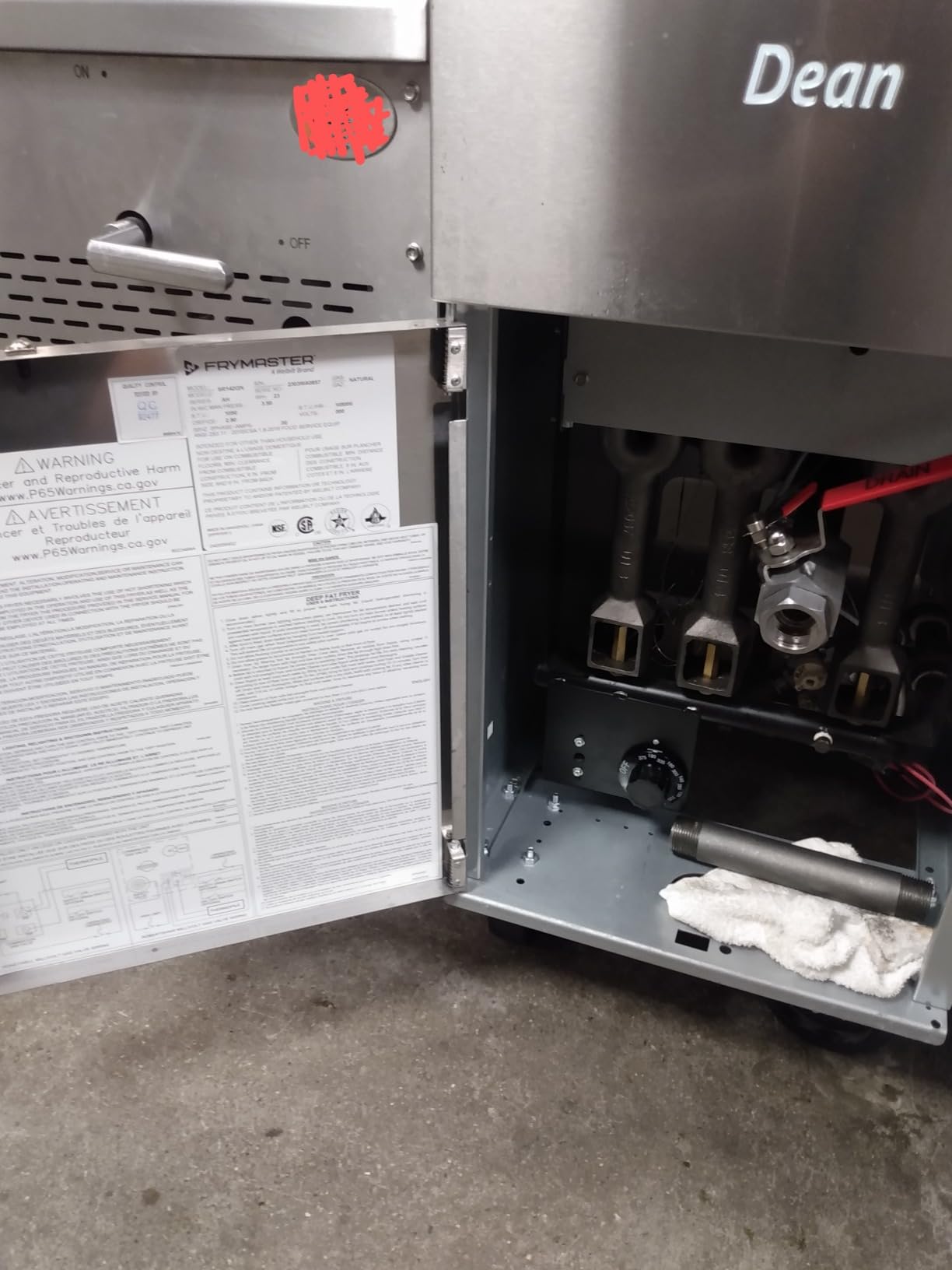
5. Frymaster Dean SR142G – Best for Medium-Volume Service
Frymaster Dean SR142G Super Runner Natural Gas Floor Fryer 43 lb
43 lb oil capacity
105000 BTU input
Stainless steel
29.25 x 15.5 x 45 in
Pros
- 43 lb capacity fits a typical 60-80 lb per hour line
- 105000 BTU input recovers fast
- Stainless steel body
- Strong category sales rank
Cons
- About 13% of reviews are 1-star
- No 3-star reviews reported
- 161 lb shipping weight
The Super Runner platform is one of the most widely deployed commercial gas fryer lines in the world, and the SR142G is the 43 lb natural gas version of it. At 105,000 BTU input into 43 lb of oil, it is a tidy match for a mid-volume kitchen running around 60 to 90 pounds per hour.
Buyers cite solid capacity and heating performance most often, and at 161 pounds and 29.25 by 15.5 by 45 inches it slots into an existing line without re-plumbing the whole station.
Is a 43 lb vat the sweet spot for most restaurants?
For a lot of operators, yes. It is large enough that you can cook two products at once without the baskets fighting over the same oil temperature, and small enough that you can drop and replace the oil in a single service. Frymaster Dean units are also the ones most often found on resale channels after a restaurant closes, a useful sign about the platform longevity and its parts knowledge base.
What the review distribution tells you
Roughly 13% of the 12 reviews are one star, and there are no three-star reviews at all. That is a polarized pattern: buyers either have no problem, or they hit something significant. On a fryer this size the usual culprit is a burner tube or thermostat, so ask your dealer about parts turnaround first.
6. Vulcan LG300 – Best for Cold Zone Oil Life
Vulcan LG300-2 Vulcan LG300 35-40 lb. Capacity Gas Fryer, LP Gas
35-40 lb stainless tank
3 heat exchanger tubes
V-shaped cold zone
LP gas
Pros
- Large V-shaped cold zone slows oil breakdown
- Three heat exchanger tubes for transfer
- Millivolt thermostat 200F-400F
- Twin baskets with coated handles
Cons
- LP gas configuration
- Only 3 reviews
- Low sales rank at 351 in the category
The defining feature of this fryer is the large V-shaped cold zone. In plain terms, that is a section of the tank at the bottom where the oil sits below burner temperature, so crumbs settle into it instead of cooking against a hot tube. Less sediment means longer oil life and far less bitter flavour carryover across a service.
Three heat exchanger tubes handle the heat transfer, a millivolt thermostat adjusts from 200F to 400F, and a built-in flue deflector routes combustion gases properly. Twin baskets with coated handles come standard, and the unit weighs 200 pounds.
What a cold zone does for your food cost
Oil is usually the second or third largest food cost line after protein. A cold zone does not stop degradation, it slows the carbonization that accelerates it, so you replace oil less often and filter less aggressively. The millivolt thermostat also has no electronic control board to fail, which matters in a kitchen running eight to fourteen hours a day.
The configuration problem to check first
This listing is the LP gas version. If your line is on natural gas you need the matching configuration, and you should not assume the two convert. Field conversion between fuel types is one of the clearest ways to void a manufacturer warranty.
7. Pitco 40D – Best for Brand Service Support
Propane Pitco 40D Tube Fired Gas Floor Fryer 40-45 Pound 115,000 BTU
40-45 lb capacity
115000 BTU
Tube fired heating
LP propane configuration
Pros
- Pitco service network is the broadest in the industry
- 115000 BTU tube fired heating
- 40-45 lb covers standard batch sizes
- No negative ratings in the review sample
Cons
- Only 4 reviews
- No dimensions or weight published
- LP propane configuration
Spec sheets are thin on this listing, so let the brand do the work. Pitco runs one of the deepest commercial foodservice service networks in North America, and on a fryer that will sit in your kitchen for a decade, having a technician who has worked on the platform is worth more than a longer feature list.
On the numbers we have, the 40D is a 40 to 45 lb tube-fired gas floor fryer at 115,000 BTU in an LP propane configuration. That output is a good match for the pot size, and tube-fired heating suits a breaded, high-particulate menu.
Is brand support worth paying for on a fryer?
On listings this sparse, yes. A burner tube, a millivolt thermostat and a high-limit switch are simple parts, but a technician still has to be willing to come out, and that willingness tracks brand recognition closely. Pitco units also hold value on the used market.
What we could not verify
No dimensions, no shipping weight and no feature bullets are published for this record, so treat any footprint number from a dealer as the number to plan against. Four reviews is a small sample, though none are negative.
8. EGGKITPO ECF3-NG – Best for Tight Kitchens
EGGKITPO Commercial Natural Gas Fryer 90,000 BTU Stainless Steel Floor Fryer with 40lbs Oil Capacity CSA Certified Deep Fryer with 2 Baskets and 3 Heating Tubes for Restaurants Food Truck Use
40 lb oil capacity
90000 BTU
Natural gas
32.88 x 14 x 45 in
Pros
- Narrowest footprint here at 32.88 inches deep
- Three 30000 BTU cast iron burners
- Millivolt flame-failure safety system
- Four casters with locking front brakes
Cons
- Rating of 4.0 with a heavy 3-star cluster
- Natural gas only as supplied
- No published weight
Footprint is the whole reason to look at this one. At 32.88 inches deep by 14 inches wide, it is the narrowest unit in the roundup, which matters enormously if your fry line runs along a wall or you are replacing a unit in a tight alcove.
The 40 lb tank is fed by three 30,000 BTU cast iron burners for 90,000 BTU total, the temperature probe adjusts 200F to 400F, and four casters with two front locking brakes mean you can roll it out for cleaning and lock it back in place.
Does a narrow footprint cost you capacity?
No, because the width is where the saving happens, not the depth. You still get a 40 lb pot and 90,000 BTU, and the oversized bottom cooling area traps food particles so sediment stays out of the burner zone. Note that this model is supplied as natural gas only; the LP versions are a different model number, so do not plan on a field conversion.
What the reviews flag
At 4.0 out of 5 across 5 reviews, this is the lowest average among the higher-rated units here, and 39% of the feedback sits at three stars. That reads as mid-level performance and setup friction rather than a broken product. Verify your gas type before ordering and install to the manual, because several three-star experiences on gas fryers trace back to commissioning.
9. Atosa ATFS-75 – Top Rated for Large-Pot Frying
Atosa ATFS-75 (5) Burner Stainless Steel Full Pot Gas Fryer | 75 lb.
75 lb full pot capacity
5 burner configuration
Stainless steel
75000 watts listed output
Pros
- Averages 4.7 across 9 reviews with no negative ratings
- 85% of reviews are 5-star
- 75 lb full pot handles high volume
- Stainless steel construction
Cons
- Only 9 reviews
- 15% of feedback sits at 3-star
- No dimensions or per-burner BTU published
This one scores 4.7 out of 5 across 9 reviews, and the distribution behind it is unusual. Eighty-five percent of the feedback is five star, there is not a single one-star or two-star review in the sample, and the only other rating is three star.
On capacity, a 75 lb full pot with a five-burner configuration is a serious high-volume layout. That is the tank size you want for fried chicken by the basket load, large seafood batches, or catering volume fried in bulk rather than in ticket order.
Is a 75 lb pot too large for a mid-volume kitchen?
Frequently, yes. A 75 lb pot means roughly 90 pounds of oil to buy, store, filter and eventually replace, and if your peak service does not fill it, the oil sits at temperature for hours with nothing in it. Heat cycling with no food load is real, and it is the main reason oversized fryers end up with worse food and a higher food cost.
Reading the rating honestly
A small sample with no negative reviews usually means the units shipped correctly and got commissioned properly, not that the design is flawless. With no published dimensions or per-burner BTU on this listing, get the full spec sheet before committing to a 75 lb footprint.
10. CHUMART 120000 BTU Gas Floor Fryer – Best for NSF Approval
CHUMART Commercial Gas Floor Fryer with 2 Baskets, 120000 BTU Natural Gas Fryer-Only Commercial Use, 4 Heating Tubes, 55 lb Oil Capacity Deep Fryer for Restaurants, Fast Food, Food Trucks
55 lb oil capacity
120000 BTU across four tubes
CSA certified and NSF listed
200-400F controller
Pros
- Only unit here that is both CSA certified and NSF listed
- Cast iron heat exchangers
- Full-port drain empties the tank fast
- Automatic 450F shutoff and flame failure protection
Cons
- Only 2 reviews
- Requires a separate regulator
- One report of the wrong model being shipped
Certification is where this one separates from the field. It is the only fryer in the roundup listed as both CSA certified and NSF listed, and for a lot of operators that single fact settles the decision before any spec comparison. NSF listing is the one a health department asks about.
The hardware underneath is strong as well. Four cast iron heat exchanger tubes deliver 120,000 BTU into a 55 lb tank, the millivolt controller runs 200F to 400F with oil sensors, and the full-port drain valve moves 55 pounds of oil out in under 90 seconds according to the manufacturer.
Why does NSF listing matter so much?
Because it is a purchasing gate, not a nicety. Health departments ask for evidence of sanitation listing on equipment that holds food or oil, and if your unit cannot produce that documentation you may be replacing it later anyway. A fryer that is also CSA certified clears the electrical and gas safety side of the same conversation.
Two things to sort before you order
A regulator is required and is not included, and the manufacturer states the warranty is void if service is performed by anyone other than a qualified technician. There is also one report of the seller shipping the wrong model, which the buyer notes was resolved. Verify the fuel type and variant on your confirmation, because this family includes both LP and natural gas versions.
11. Frymaster ESG35T – Best for Energy Efficiency
Frymaster ESG35T Natural Gas 35 lb. High Efficiency Floor Fryer
35 lb high efficiency capacity
Natural gas configuration
Stainless steel
165 lb unit weight
Pros
- High efficiency design targets lower idle fuel draw
- Frymaster is the long-life incumbent in commercial frying
- Stainless steel construction
- Compact 35 lb tank suits moderate volume
Cons
- Only 1 review
- Lowest sales rank in the roundup
- No feature bullets or dimensions published
The ESG35T is the smallest fryer here and the one designed explicitly around efficiency. A 35 lb high-efficiency tank on natural gas, weighing 165 pounds, targets kitchens that fry steadily through service but do not need a 70 lb pot, and want to pay less in gas per hour than a 150,000 BTU unit would cost.
Efficiency on a gas fryer is mostly an idle-draw story. A fryer holding oil at temperature between tickets still burns, and over a full eight-hour shift that idle energy is where the fuel bill lives.
Is a 35 lb fryer big enough to be worth installing?
For a bar and grill doing wings and fries at moderate volume, absolutely. At 35 lb the oil bill and the replacement schedule are both manageable. Below roughly 50 pounds of fried food per hour you are honestly in countertop territory, where a unit like our guide to the [best large air fryers](https://www.skywarriorbooks.com/best-large-air-fryers-for-big-families/) serves the menu with no gas line, no hood and no ANSUL system at all.
The rating is a single data point
One review, rated five stars, describing the unit as efficient and reliable. That is a good sign about one fryer in one kitchen and it is not evidence about the platform. The sales rank is also the lowest in the roundup, so treat this as a buy only if you have a local service relationship with a Frymaster dealer.
12. Value Series 29R-001-NAT – Best Value for a New Kitchen
Value Series Commercial Deep Fryer | 40 lb. Stainless Steel Gas Floor Fryer for Restaurants | 3 Heating Tubes, 90,000 BTU | 2 Fryer Baskets Included | Natural Gas Powered (29R-001-NAT)
40 lb oil capacity
90000 BTU across three tubes
ETL certified
6 month warranty
Pros
- ETL certified for commercial foodservice
- 90000 BTU across three heating tubes
- Compact 30 x 15.5 in footprint
- Two baskets plus a hanger rail
Cons
- Lowest average rating here at 3.7
- About 29% of reviews are 1-star
- Only a 6 month warranty
The Value Series 29R-001-NAT does the fundamentals: 40 lb of oil, 90,000 BTU across three heating tubes, a 3/4 inch gas connection and ETL certification for commercial foodservice. For a new kitchen fitting out on a tight capital budget, it is a defensible starting point and the only unit here with a full 18-review base to read alongside a sub-4.0 rating.
Two fry baskets with plastic coated handles and a basket hanger rail come as standard, and the 30 by 15.5 by 47 inch footprint is a normal floor-fryer size.
What do you get by buying the entry point?
A working commercial gas fryer with a proper certification mark and burner output matched to the tank. You do not get a filtration system, a warranty with real length behind it, or much of a parts cushion. The 6 month warranty is the shortest in the roundup by a wide margin, and that is the number I would push a dealer on.
What the 18 reviews actually say
62% of buyers give five stars and praise the stainless steel build and the basket set. About 29% give one star, a high negative share pointing to a split experience around durability or support. On value-tier fryers the usual failure mode is a burner tube or thermostat that is hard to source, so read the one-star reviews before you buy.
How to Size a Commercial Gas Floor Fryer
Sizing is straightforward once you have one number: peak-hour volume in pounds of finished fried food. A British thermal unit, or BTU, is the heat needed to raise one pound of water by one degree Fahrenheit, and on a fryer it is the total burner output available to recover oil temperature. More BTU does not cook better food; it recovers faster, and only that.
The working rule is roughly 15,000 to 20,000 BTU for every 10 pounds of fried food per hour at peak. Expecting 100 pounds per hour means a 150,000 BTU class unit with a 70 to 100 lb pot. A 60 pound per hour peak calls for a 40 to 50 lb pot at 100,000 to 105,000 BTU.
Pairing matters more than either number alone, because a big burner on a small pot gives you a hot spot and rapid boil-over, while a small burner on a big pot means the whole tank sags each time a basket goes in. And do not size above your peak: a fryer too large for the volume means more oil to buy, more oil to degrade, more gas burned holding an idle pot, and a bigger hood and gas line to install.
Gas vs Electric Floor Fryers: What Actually Changes
Most full-service and quick-service restaurants fry on floor models rather than countertop units, and gas holds the majority share of the commercial fryer market. Electric is gaining ground in food trucks, ghost kitchens and lower-volume sites, but the recovery gap is why gas still wins the main line.
Gas recovers oil temperature in roughly 60 to 75 seconds after a cold basket drop; electric floor fryers typically take 85 to 110 seconds for the same. Over a service with a hundred basket drops, that is the difference between a station that keeps up and one that becomes the bottleneck.
The trade runs the other way too. Electric installs with a plug and a 20 to 30 amp circuit, needs no hood for the fryer itself and has no open flame. Gas needs a dedicated line, a licensed gas fitter, a Type I hood, ANSUL suppression and a fire marshal sign-off, and its electrical draw is negligible.
On running cost, gas wins clearly at volume because there is no resistance element converting electricity to heat, so a gas fryer holds idle temperature on a fraction of the energy an electric unit pulls just to stay warm. Under roughly 50 pounds per hour that advantage shrinks and electric becomes defensible. Above it, gas is the right answer.
Installation, Hoods and Code Compliance
This is the section that surprises first-time gas fryer buyers most, and it is worth reading before you order rather than after. The fryer itself is the cheap part of the installation.
A gas floor fryer requires a Type I ventilation hood sized to the connected load, with a documented overhang. It requires an ANSUL fire suppression system over the fry line, and the system has to be serviced and tagged on a schedule. Many jurisdictions also require the fire suppression to be interlocked with the gas supply so the burners close when it discharges.
The gas connection itself has rules. A flexible gas connector must be used with a restraining cable, the connector must be within the length the code allows, and a quick disconnect device is required at the appliance so the fryer can be moved for cleaning without a technician. A dedicated gas line sized to the fryer BTU load, plus the existing equipment on that meter, is a job for a licensed fitter.
Two warranty traps sit in this section. Manufacturer warranties in this category typically void on residential or non-commercial installation, so a home basement install voids coverage no matter what the paperwork says. They also void on improper field gas conversion, which is why buying the correct natural gas or LP configuration up front matters.
One more item that catches people: gas cooking equipment needs adjustment above 2,000 feet elevation because air is thinner and the burner output falls off. If you are in a mountain market, say so before you buy and get the derating figure for your elevation in writing.
Filtration, Oil Life and the Weekly Boil-Out
Oil is a major food cost line, and a fryer without filtration is the most expensive mistake in this category. Manual filtering burns staff time every service, and in a high-volume operation that labour cost routinely exceeds what a factory filtration system would have added to the purchase.
Filtrate at the end of every service, or at minimum daily. A fryer with a built-in filter and lined paper or powder handles the bulk of the crumb load in a few minutes; a fryer without one means a cook draining hot oil through a small valve into a bucket and straining it, which nobody does properly twice a day.
Boil out weekly. A boil-out heats the oil to a high temperature with the correct solution, circulates it through the tank and burner tubes, then drains and rinses. It is the only way to remove the carbon that builds up on heating surfaces, and skipping it is how a three-year-old fryer ends up tasting burnt while the oil still looks clean.
Choose oil by smoke point and tolerance for repeated heating. A high-oleic oil or refined avocado holds up well at fry temperatures and canola is the general-purpose default. Peanut performs well but introduces an allergen that changes how you handle the fryer and label the menu. And it all comes back to the cold zone: where sediment settles away from the burner it never cooks, and where it does not, you are frying in a carbon slurry that no amount of filter powder fixes.
NSF vs ETL: Why Certification Is a Deal Breaker
Two marks appear on nearly every unit in this roundup and they are not interchangeable. NSF is the sanitation listing, and it is the one a health department asks to see on equipment that holds food or oil. ETL and CSA are the electrical and gas safety listings, and they are what your insurer and the fire marshal look at.
A fryer that is ETL listed but not NSF listed can be perfectly safe and still get challenged. A fryer that is NSF listed but has no CSA or ETL mark leaves a gap in the safety documentation. The CHUMART in this roundup carries both, which is why it is the pick for operators whose local authority is the strictest.
Verification is simple. The mark needs to appear on the spec sheet and on the data plate on the unit, and it needs to be a model-specific listing rather than a brand-level claim. If a dealer cannot give you the listing number, treat the certification as unconfirmed.
The other recurring deal breaker is serviceability. Before you sign, ask who services this brand locally, how long a common part such as a burner tube or thermostat takes to arrive, and whether the warranty covers parts only or parts and labour. The 6 month warranty on the Value Series and the reported parts difficulty on the Kratos are both reasons we flag them honestly rather than hide them.
Frequently Asked Questions
What are the best gas fryers for commercial use?
The best commercial gas floor fryer for most restaurants is a 40 to 50 lb unit in the 100,000 to 105,000 BTU class, such as the CookRite ATFS-40 or the Frymaster Dean SR142G. Above 100 pounds of fried food per hour, move up to a 150,000 BTU model with a 70 to 100 lb pot, such as the Kratos 29Y-012-NAT. Below about 50 pounds per hour, a countertop unit is the better buy.
Which brand of deep fryer is best for a restaurant?
Vulcan and Pitco lead on parts availability and service networks, and Frymaster is the long-standing incumbent for longevity. Atosa, Cook Rite, Kratos and Value Series cover the mid tier, while VEVOR, EGGKITPO and CHUMART cover the value end. Brand matters less than matching BTU to capacity, confirming certification, and buying from a dealer with a local service technician.
How many BTUs should a commercial gas fryer have?
Budget roughly 15,000 to 20,000 BTU for every 10 pounds of fried food you expect to produce per hour. That means a 40 to 50 lb vat at 90,000 to 105,000 BTU for a mid-volume kitchen, and a 70 to 100 lb vat at 150,000 BTU for a line running 100 pounds per hour or more. Matching burner output to pot size matters more than maximizing either number.
Do commercial gas fryers need a ventilation hood?
Yes. A gas floor fryer requires a Type I ventilation hood sized to the connected load, plus an ANSUL fire suppression system over the fry line. In most jurisdictions the suppression system must be serviced on a schedule and is often interlocked with the fryer gas supply. The fryer also needs a dedicated gas line, a quick disconnect fitting and a flexible connector with a restraining cable.
Is a gas fryer better than electric for a restaurant?
For volume above roughly 50 pounds of fried food per hour, yes. Gas typically recovers oil temperature in 60 to 75 seconds after a cold basket drop, versus 85 to 110 seconds for electric, and gas costs less per hour at the stove. Electric wins on installation simplicity, since it needs only a dedicated 20 to 30 amp circuit and no open flame, and it is the better choice in food trucks and low-volume sites.
The Best Commercial Gas Floor Fryer for Your Kitchen
There is no single best commercial gas floor fryer, because the right answer changes with your peak volume, your menu and your local code authority. For most restaurants running 60 to 90 pounds of fried food per hour, the CookRite ATFS-40 is the pick we would defend: 40 lb of oil, 102,000 BTU across three tubes, an oil cooling zone, and the deepest review base in the category at 29 ratings.
For a fixed budget, the VEVOR GF90 gets you 90,000 BTU in a 40 lb tank with flame failure and high-limit shutoffs for the least outlay here. Past 100 pounds per hour, only the Kratos 29Y-012-NAT reaches 150,000 BTU, and you should settle its parts and service questions with your dealer first. Where health department documentation is the sticking point, the CHUMART is the only unit here listed as both CSA certified and NSF listed.
Whichever you choose, buy the fuel configuration you actually run, confirm the hood and gas line before the unit ships, and ask for delivered pricing rather than a bare unit number. Those three questions prevent most of the problems we have seen operators run into with a commercial gas floor fryer.