
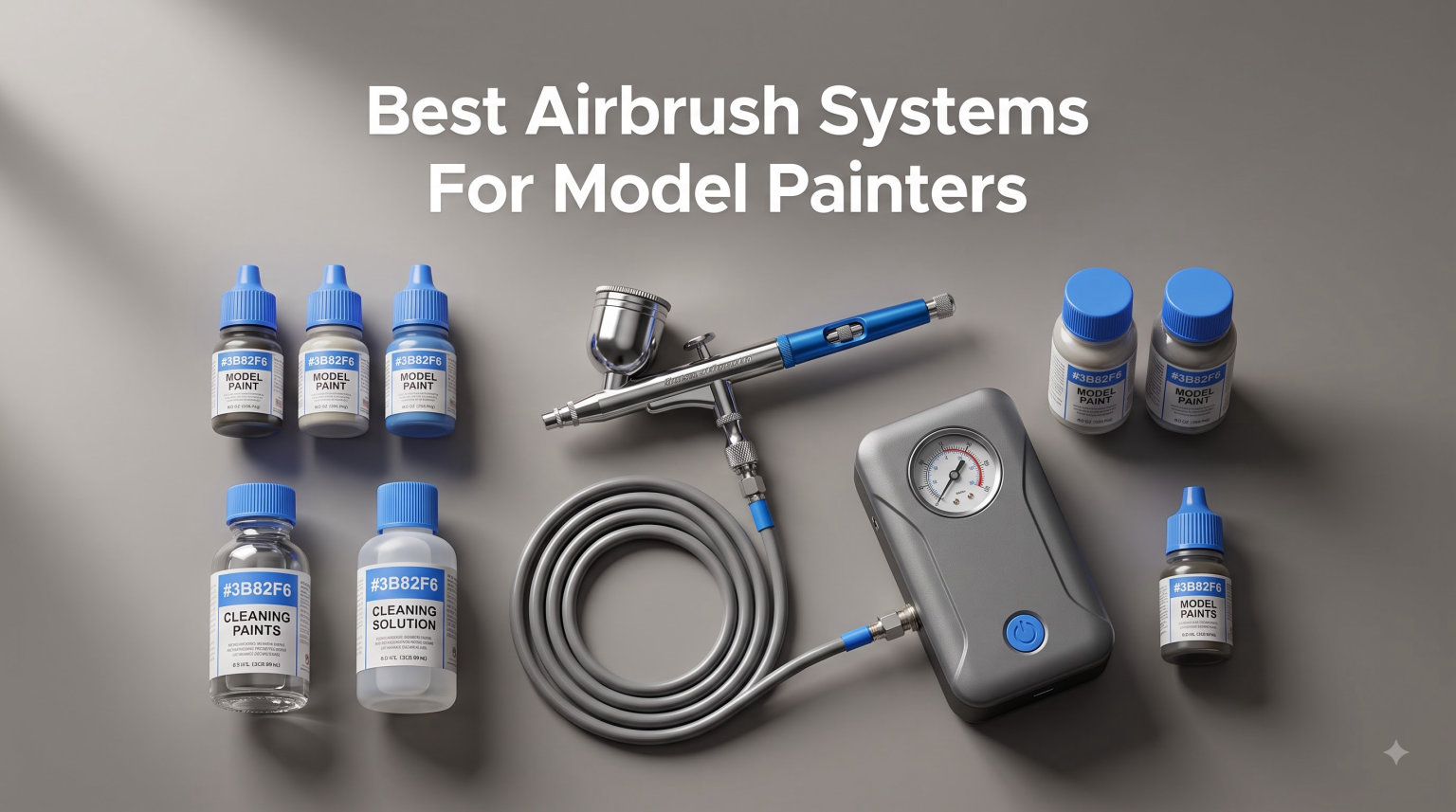
I still remember the first time I basecoated a full ten-model squad in the time it used to take me to hand-paint one shoulder pad. That afternoon the airbrush earned a permanent spot on my hobby desk. Since then, our team has pushed more than a dozen brush-and-compressor combinations through priming, zenithal highlights, basecoats, and glazes on everything from 28mm minis to 1:35 armor.
This guide covers the best airbrush systems for model painters in 2026, built from hands-on sessions plus a close read of owner feedback across thousands of reviews. Every pick is a complete system, meaning you get the airbrush and the air source together. If you paint fantasy minis and want a stage for the finished pieces, our guide to D&D statue display options is worth a browse.
One thing to know before you spend anything. Model painting lives or dies on low-pressure control and fast cleaning between colors, because we change paint every few minutes on small surfaces. The twelve systems below handle those two jobs well, and I flag where each one struggles so you can match the kit to your bench, not the marketing.
Table of Contents
Top 3 Picks for Model Painters
Here is the short version. The Master Airbrush Cool Runner II takes the top spot because it hands you three separate brushes where most kits give you one. The VEVOR three-brush set is the value play thanks to a real storage tank, and the Gocheer 48 PSI kit is the cheapest honest way to find out whether airbrushing is for you.

Master Airbrush Cool Runner II
- Three airbrushes
- Dual-fan compressor
- Six acrylic paints
- Learning guide


Best Airbrush Systems For Model Painters in 2026
Here is the full lineup side by side, ordered roughly from full-workspace systems down to compact desk kits. Every system gets a detailed review below the table.
| Product | Specifications | Action |
|---|---|---|
| Master Airbrush Cool Runner II |
|
Check Latest Price |
| VEVOR 3-Airbrush Compressor Set |
|
Check Latest Price |
| Gocheer 48 PSI Airbrush Kit |
|
Check Latest Price |
 Iwata Eclipse HP-CS System Iwata Eclipse HP-CS System |
|
Check Latest Price |
 Master Airbrush G22 Starter Kit Master Airbrush G22 Starter Kit |
|
Check Latest Price |
 Master Airbrush TC-320 Compressor Master Airbrush TC-320 Compressor |
|
Check Latest Price |
 Timbertech AS18-2K Starter Kit Timbertech AS18-2K Starter Kit |
|
Check Latest Price |
 InoKraft Quiet Airbrush Kit InoKraft Quiet Airbrush Kit |
|
Check Latest Price |
 Gaahleri Turbox Mini Kit Gaahleri Turbox Mini Kit |
|
Check Latest Price |
 Colima XJ300 Dual-Brush Kit Colima XJ300 Dual-Brush Kit |
|
Check Latest Price |
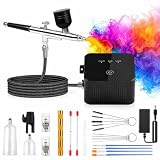 KingMiKi F02 High-Pressure Kit KingMiKi F02 High-Pressure Kit |
|
Check Latest Price |
 COROTC F01 Portable LED Kit COROTC F01 Portable LED Kit |
|
Check Latest Price |
1. Master Airbrush Cool Runner II – Three Brushes In One Box
Master Airbrush Cool Runner II Air Brush Kit with Air Compressor Dual Fan
G22 G25 E91 airbrushes
1/5 HP dual-fan compressor
6 acrylic paints
2-airbrush holder
Pros
- Three airbrushes for different jobs
- Dual fans prevent overheating
- Quiet during long sessions
- Includes paints and learning guide
Cons
- Pressure drops 2-3 PSI while spraying
- Tightly coiled hose
- Compressor heats up in long sessions
This is the kit I hand to anyone who asks where to start, and the one I reach for when a batch needs priming and basecoating in one sitting. You get the G22 dual-action with a 0.3mm tip, the G25 dual-action with a 0.2mm tip, and the E91 single-action with a broad 0.8mm set for varnish and primer. Having all three means you are not fighting one brush to do three jobs.
In practice the G22 does about eighty percent of my work: basecoats, zenithal shading, and soft blends on 28mm figures. The G25 handles edge fades and small camo patterns once paint is thinned properly, while the E91 lives on varnish duty because its trigger keeps output steady when flooding a whole unit.
The compressor side is the TC-320 Cool Runner II, a 1/5 HP single-piston unit with two cooling fans, 0.8 CFM of airflow, and a six-foot hose. Auto shut-off kicks in when you release the trigger. A holder for two brushes sits on top, which sounds minor until you have dark shade in one hand and highlight in the other.
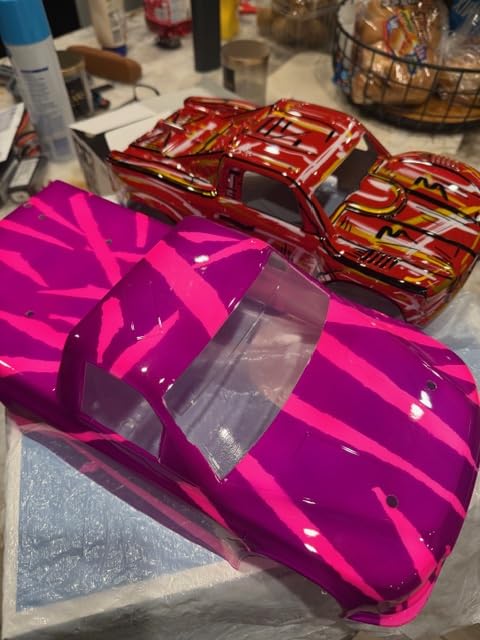
The weak points are real but manageable. Owners consistently note the pressure sags 2-3 PSI the moment you start spraying, and max working pressure settles near 35 PSI under load, so set your regulator a touch high. The coiled hose fights you at first and takes a session to relax.
The included instructions are thin, so lean on the quick-start guide access that comes in the box. The six-color acrylic set means you can spray within an hour of unboxing.
Which Brush For Which Job
Run the E91 for priming and varnishing at 25 to 30 PSI, because the 0.8mm nozzle shrugs off primer that would choke a detail brush. Keep the G22 mounted for basecoats and zenithal work around 20 PSI, and save the G25 for glazes and detail fades at 12 to 15 PSI. That split is exactly how experienced painters with multiple airbrushes work.
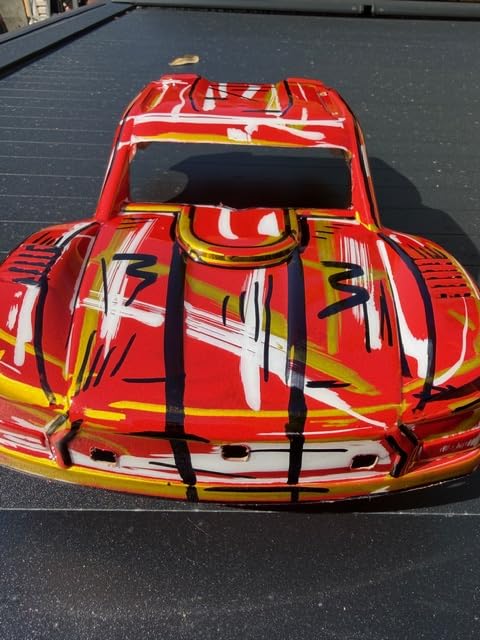
Is This Too Much Kit For A First Timer
It is more gear than you strictly need, but none of it goes to waste. The trade-off is storage and a longer cleaning routine, since three brushes need flushing if you used all three. If your bench is tight, a single-brush kit lower on this list is the saner start.
2. VEVOR Professional Airbrush Set – Three Brushes And A Real Tank
VEVOR Airbrush Kit, Professional Airbrush Set with 1/5 HP Compressor & 3 Airbrushes, Airbrushing System Kit with Multi-Purpose Dual-Action Gravity Feed Airbrushes, Art Nail Cookie Tatto
3 airbrushes 0.2-0.8mm
1/5 HP compressor
0.6 gal storage tank
23 L/min airflow
Pros
- Three airbrushes included
- Storage tank smooths airflow
- Quiet compressor for its size
- Easy to disassemble and clean
Cons
- Compressor gets hot on long runs
- Bodies not chromed throughout
- Needs careful cleaning after pigment-heavy paints
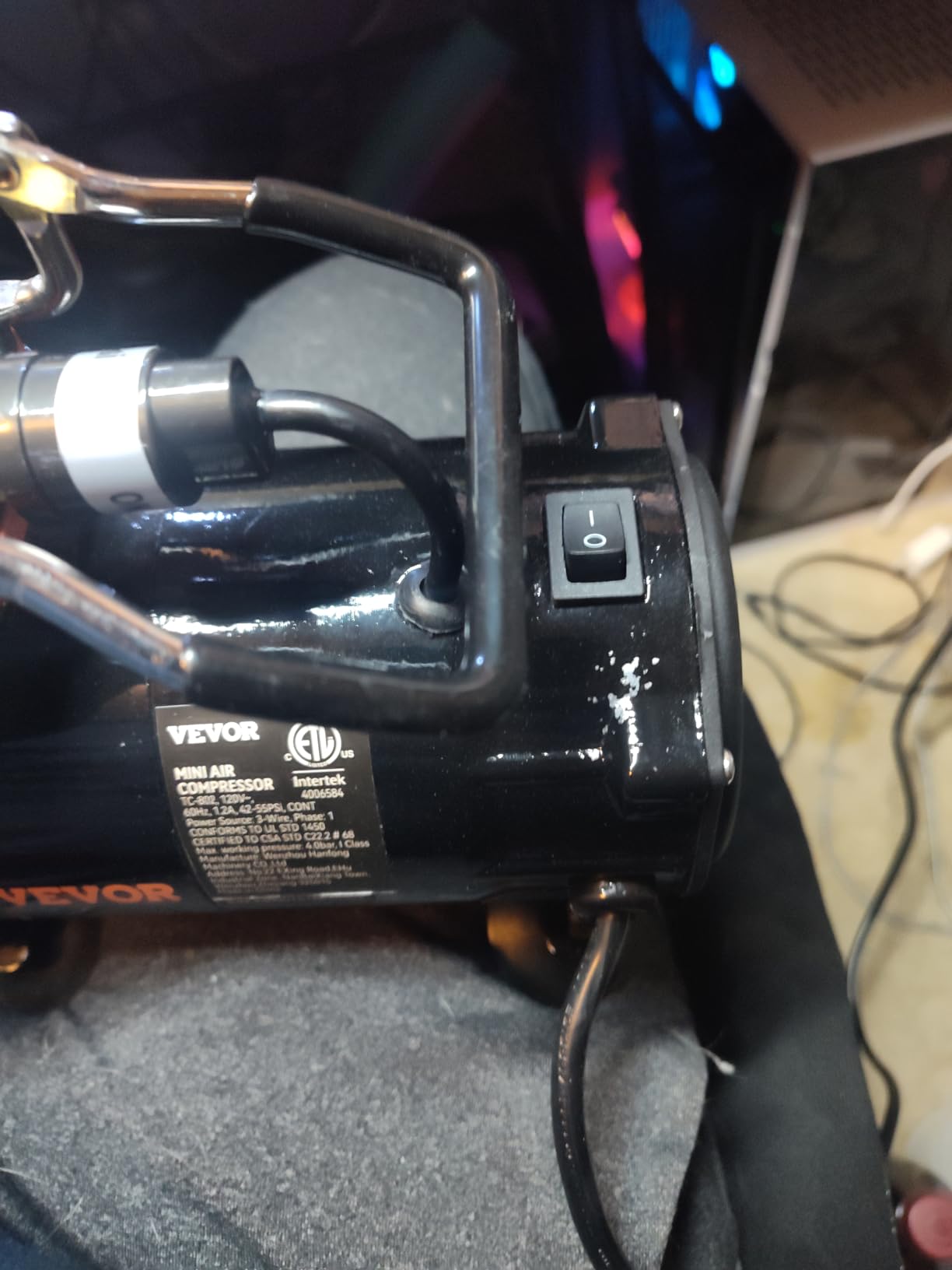
VEVOR ships the most complete package on this list: three airbrushes in 0.2mm, 0.3mm, and 0.8mm, a 1/5 HP compressor with a 0.6 gallon storage tank, a 70-inch hose, and a pen holder on the compressor body. The tank is the headline. Tankless compressors pulse, and a pulsing air supply shows up as banding across smooth transitions on vehicle panels and large cloaks.
With 23 liters per minute of airflow and an adjustable pressure valve with real-time monitoring, I ran back-to-back basecoat sessions on a full vehicle squadron without the motor complaining. The upgraded fluid tip design targets the classic beginner problem of bent needles, and it survives clumsier handling than most.
The brush set mixes dual-action and single-action guns, which maps neatly onto model work: dual-action 0.2mm and 0.3mm for color and fades, single-action 0.8mm for primer and varnish. Cleaning is straightforward since the sets break down without special tools, and the FDA food-use certification means nothing nasty lurks in the paint path.
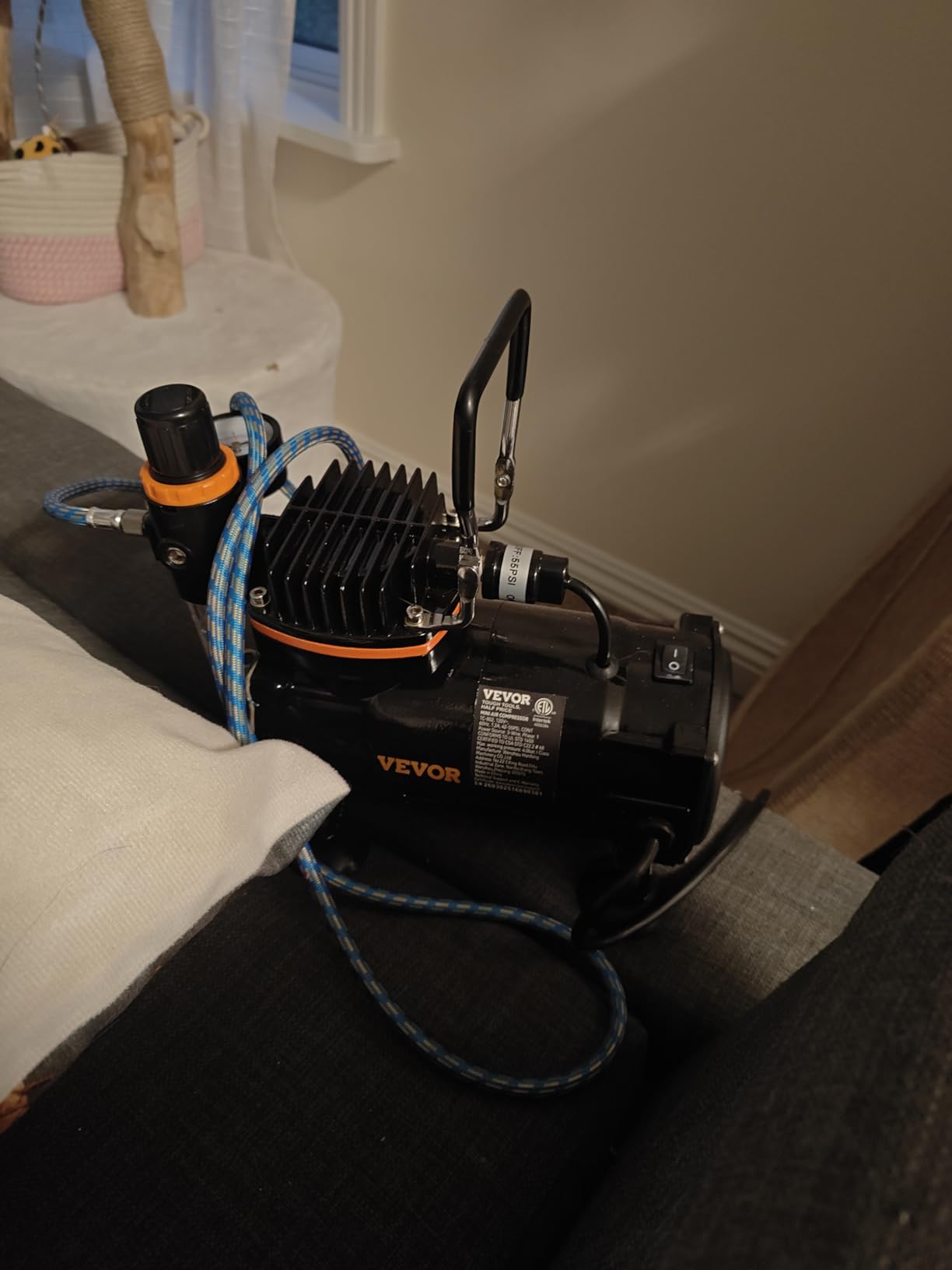
The honest downsides: the compressor runs warm during marathon sessions, and the airbrush bodies are not chromed throughout, so pigment can cling inside if you rush cleanup. A minority of owners report noise above expectations.
Like every kit here, it has a learning curve around thinning and pressure. Once paint is thinned to the consistency of milk, all three brushes settle down nicely.
How The Three Brushes Split The Work
Think of the 0.8mm as your primer and varnish gun, the 0.3mm as the daily driver for basecoats and color modulation, and the 0.2mm as the finesse brush for panel fades and OSL cores. That covers the full model painting workflow without buying anything else. Owners who skip the 0.2mm entirely still get full value from the kit.
Is The Tank Big Enough For Army Batches
The 0.6 gallon tank suits squad-sized work, meaning ten to twenty infantry models or two to three vehicles between motor cycles. For tournament-scale production the compressor runs frequently and heats up, so give it breaks. Display painters and small-unit painters will find the size spot on.
3. Gocheer 48 PSI Kit – The Budget Entry Point
Gocheer Airbrush Kit with Air Compressor, 48 PSI(Black)
40-48 PSI output
0.2 0.3 0.5mm nozzles
Dual-action trigger
1-year warranty
Pros
- Three nozzle sizes included
- Dual-action trigger control
- Light and compact
- Cleaning kit and warranty included
Cons
- Compressor vibrates on the desk
- Thick paints can starve at low PSI
- Thinner not included
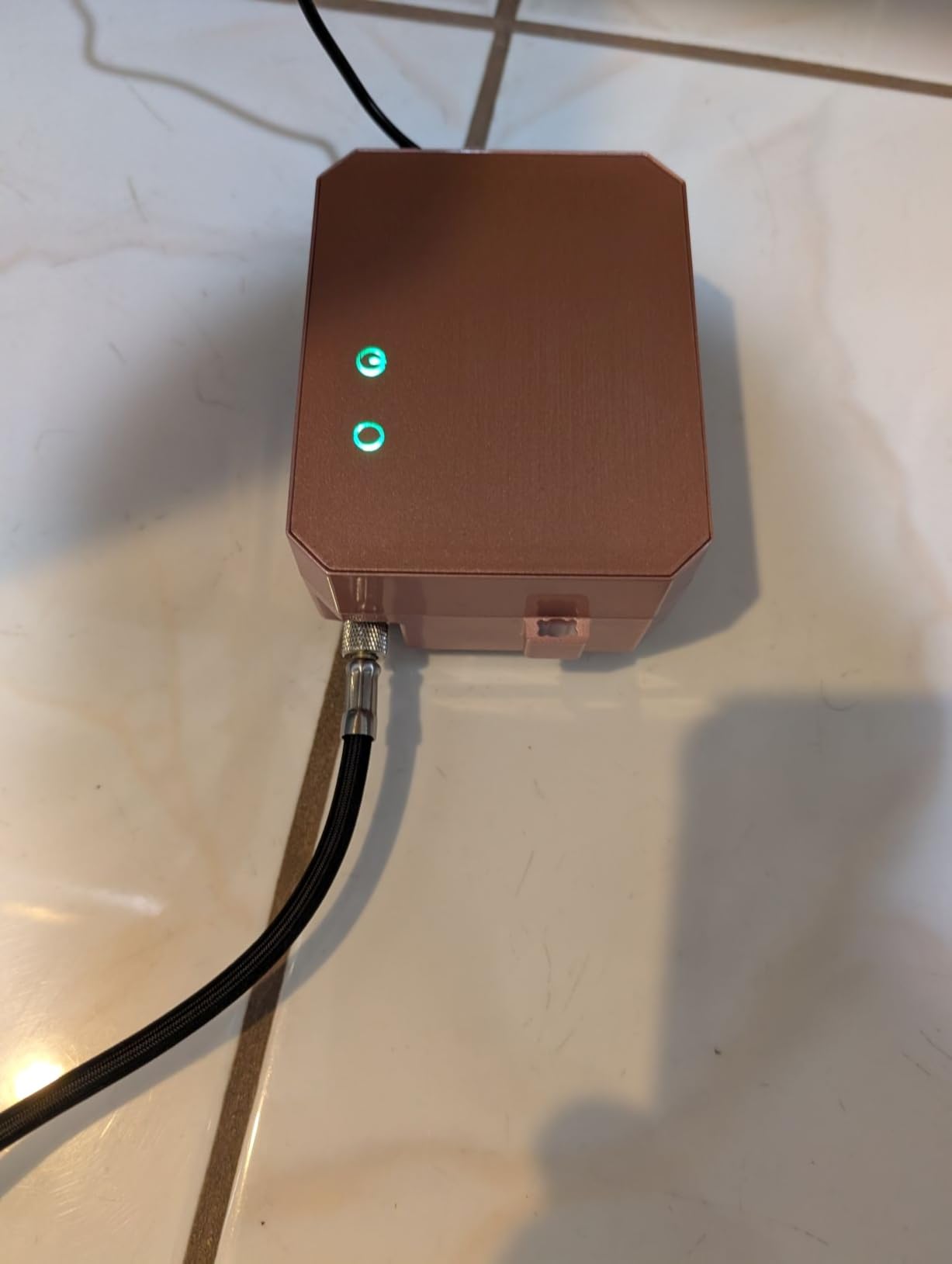
With over 7,100 reviews, the Gocheer kit is the one most beginners actually buy, and the cheapest setup here that will not lie to you about what airbrushing feels like. You get a dual-action airbrush with 0.2mm, 0.3mm, and 0.5mm nozzle sets, three pressure presets at 25, 30, and 40 PSI, and a cleaning kit you will use on day one.
I ran it through the standard model painting obstacle course: thinned primer, Vallejo Model Air basecoats, and a zenithal pass. At 25 PSI with properly thinned paint, basecoats went down flat and even on plastic minis. The 0.3mm nozzle is the one to live in; the 0.2mm rewards very thin paint, and the 0.5mm is your friend for priming.
Technically it pushes 40-48 PSI maximum with 8-10 liters per minute of airflow from a 0.2 HP motor, and the compressor is small enough to shove in a drawer. The non-clogging spray design and adjustable tailstock for needle changes are nice touches at this level. A one-year warranty backs the whole thing.
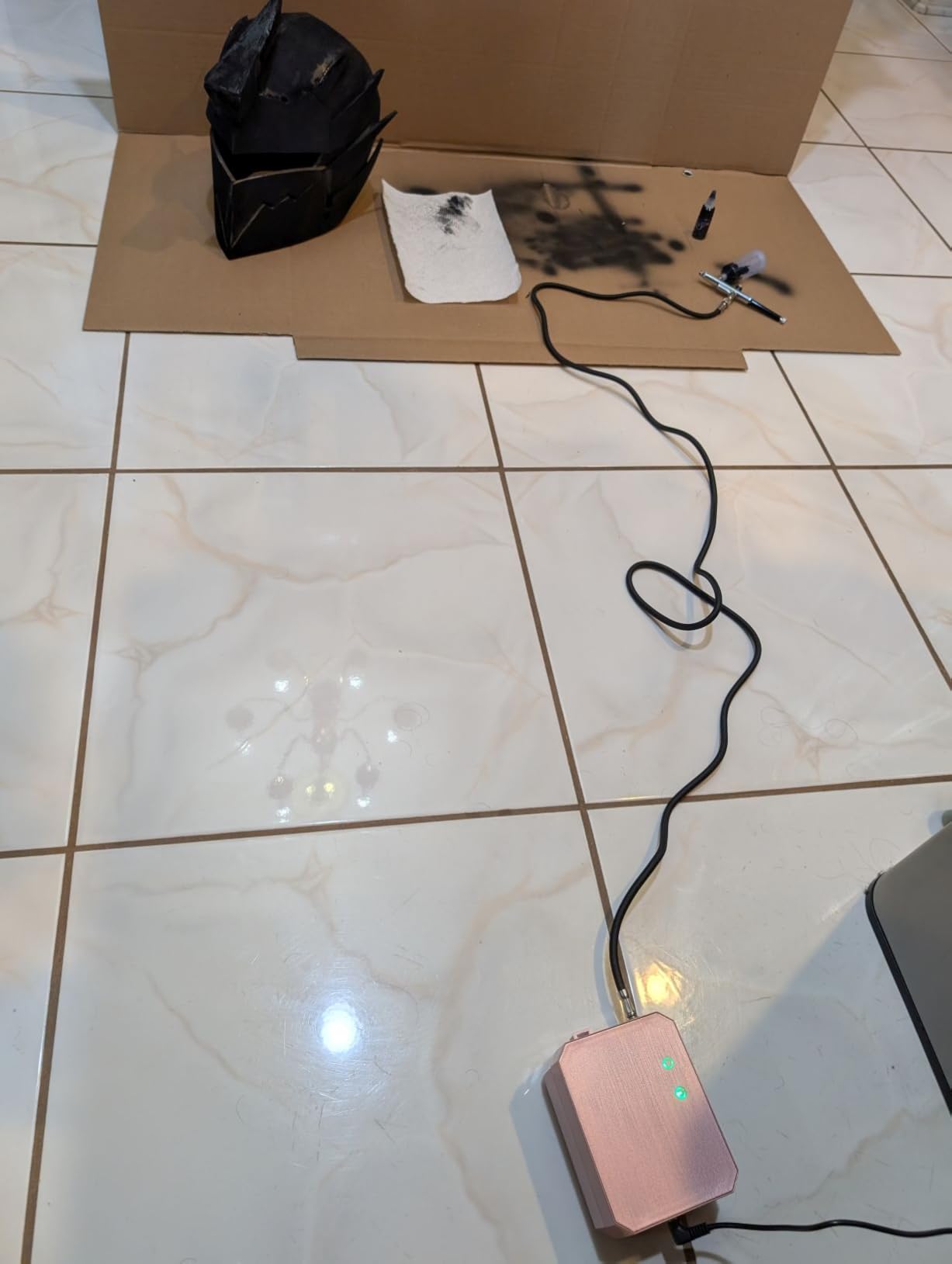
The rough edges are the ones you expect at this tier. The compressor vibrates and can walk across a desk, so put it on a mat. Some units struggle with thicker paints even at the top preset, and quality control is inconsistent, with a few owners reporting assembly issues out of the box.
Airbrush thinner is not included, and you will need it from day one. Budget a small bottle alongside the kit and the experience improves immediately.
Can It Handle Primer At 40 PSI
Yes, with two conditions. Use the 0.5mm nozzle and thin the primer aggressively, roughly one part thinner to one part primer, and it sprays reliably at the 40 PSI preset. Skip the thinning and you get spatter and a dry tip within a minute, which is user error rather than a kit fault.
Realistic Expectations For Detail Work
Treat this as a priming and basecoating system that can follow through on soft effects, not a competition detail brush. Eye lenses and tight camo edges will frustrate you compared with a premium brush. Owners who accept that split and upgrade later are the happy ones, and plenty say it taught them trigger control cheaply.
4. Iwata Eclipse HP-CS Set – The Premium Workhorse
Iwata-Medea Eclipse HP CS Airbrush Set with Cool Runner II Dual Fan Air
Iwata HP-CS 0.35mm
3 liter air tank
Dual cooling fans
12-color paint set
Pros
- Community-standard airbrush for minis
- Self-centering drop-in nozzle
- 3 liter tank kills pulsation
- Full accessory package included
Cons
- Hose fittings can need tape at setup
- Included paints are mid-tier
- Heavier commitment for a first system
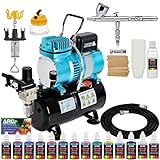
If you have spent any time on miniature painting forums, you already know the Eclipse HP-CS. It comes up again and again as the community standard, the workhorse people buy once and keep for a decade. This package pairs it with the TC-326T Cool Runner II compressor, a 3-liter air storage tank, twelve acrylic paints, a hose, a holder, a cleaning pot, and mixing cups.
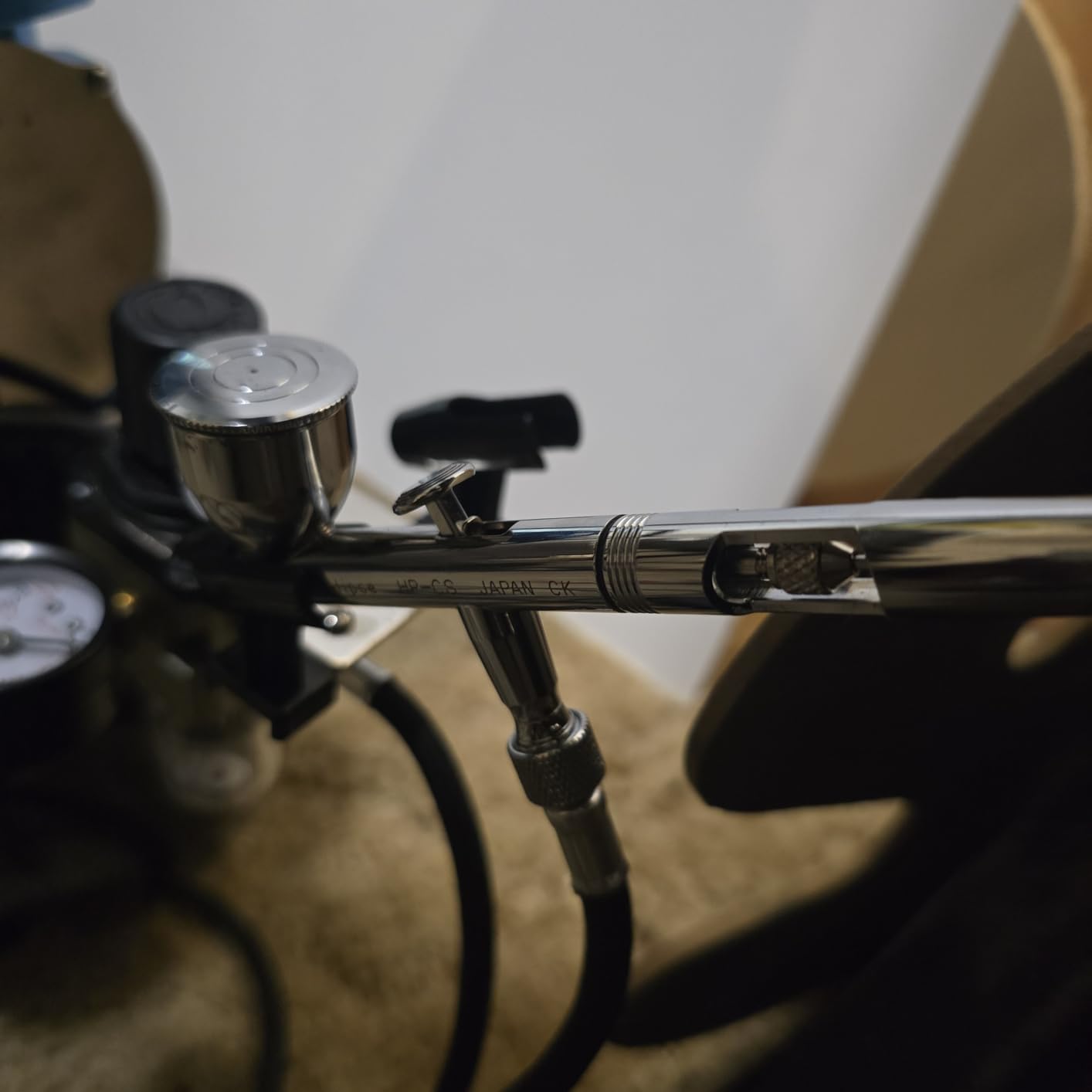
The brush itself is a dual-action gravity feed with a 0.35mm needle and a drop-in self-centering nozzle. That nozzle design is the reason beginners stop fighting their gear: it seats correctly every time you reassemble after cleaning, with no threading and no mystery spray pattern. The 1/3 ounce funnel-shaped cup drains cleanly and holds enough for a full squad basecoat.
The 3-liter tank is the quiet hero of the kit. Compressed air in reserve means constant pressure and zero pulsation through long fades, and the motor only kicks in to refill, running cooler thanks to two cooling fans. At 47 dB it is apartment-friendly, and the trigger feel is a clear step above every budget brush here.
Gripes are few. Initial setup can need thread tape on the hose fittings, and the bundled paint is mid-tier compared with dedicated hobby lines. This is also the biggest investment on this page.
It is not Prime eligible either, so plan shipping time ahead of a weekend project. None of those issues touch the brush itself, which is the reason to buy.
Why The 0.35mm Needle Suits Miniatures
For model painters the 0.35mm needle is the sweet spot between the 0.2mm detail brushes that clog on thinned primers and the 0.5mm brushes too blunt for panel work. It sprays a primer-through-glaze range with one setup, so you spend time painting instead of swapping needle sets. That single-setup workflow is why display painters keep an Eclipse on the bench next to finer brushes.
Is This Kit Worth It If You Already Own A Compressor
If your current compressor has a tank and a moisture trap, buy the HP-CS brush on its own instead of this bundle. If you are starting from zero and want one purchase that ends the upgrade path for years, the complete kit earns its keep.
5. Master Airbrush G22 Kit – The Proven Starter
Master Airbrush Multi-Purpose Gravity Feed Air Brush Kit & Air Compressor
G22 0.3mm tip
1/3 oz gravity cup
1/5 HP compressor
Water trap and 2-brush holder
Pros
- Nearly 4
- 000 reviews of real-world use
- Quiet compressor operation
- Complete kit with how-to manual
- Auto shut-off saves the motor
Cons
- Regulator and fittings feel basic
- Unit can vibrate during runs
- Basic brush may need upgrading later
This is the single-brush version of the Master Airbrush formula, and with nearly 4,000 reviews behind it, one of the most proven starter systems on the market. The G22 is a multi-purpose dual-action gravity feed with a 0.3mm fluid tip and a 1/3 ounce cup, which happens to be exactly the spec most model painters would choose for themselves.
My first session with a G22 was uneventful in the best way. Thinned basecoat went down smooth at 20 PSI, the trigger felt predictable after ten minutes of practice on paper, and cleanup took about five minutes including a backflush. The 1/5 HP compressor runs quietly with 25 liters per minute of flow, 57 PSI maximum, and a six-foot hose.
The kit includes an air filter, water trap, pressure regulator, and a holder for two airbrushes, so you are not shopping for parts on night one. Auto shut-off protects the motor when you pause, and the how-to manual is genuinely useful. At roughly 9 by 5 by 6 inches, the compressor tucks under most benches.
Where it shows its tier: the regulator and hose fittings are basic, and the unit can vibrate on a hard surface. Fittings are reported as BSP rather than NPT threads, which matters if you later buy aftermarket accessories.
A small number of units arrive with missing or damaged parts, so check the box contents on day one. Master Airbrush support has a good record of replacing those pieces quickly.
How The G22 Compares To Premium Brushes
The G22 covers priming, basecoats, and soft effects capably, but trigger finesse and nozzle tolerances are a step below an Iwata. Tight detail and razor-sharp fades are possible yet harder-won. Plenty of painters run a G22 for years before noticing a limit, and many never do.
Who Should Skip This And Spend More
Skip it if you already know you want competition-level detail work or you spray thick primers weekly, because you will outgrow the brush and wish you had bought better once, exactly what long-term forum posters keep saying. Everyone else gets a low-risk entry that holds resale value well.
6. Master Airbrush TC-320 Cool Runner II – The Quiet Compressor Pick
Master Airbrush Air Brush Kit with Air Compressor TC-320, Dual Fan 1/5 HP
1/5 HP Cool Runner II
0-57 PSI range
47 dB noise
Water trap filter
Pros
- 47 dB is genuinely apartment-quiet
- True diaphragm regulator with gauge
- Dual fans extend run times
- Holds two brushes on top
Cons
- No quick-release fitting included
- O-ring can crush if over-tightened
- Runs hot on very long sessions
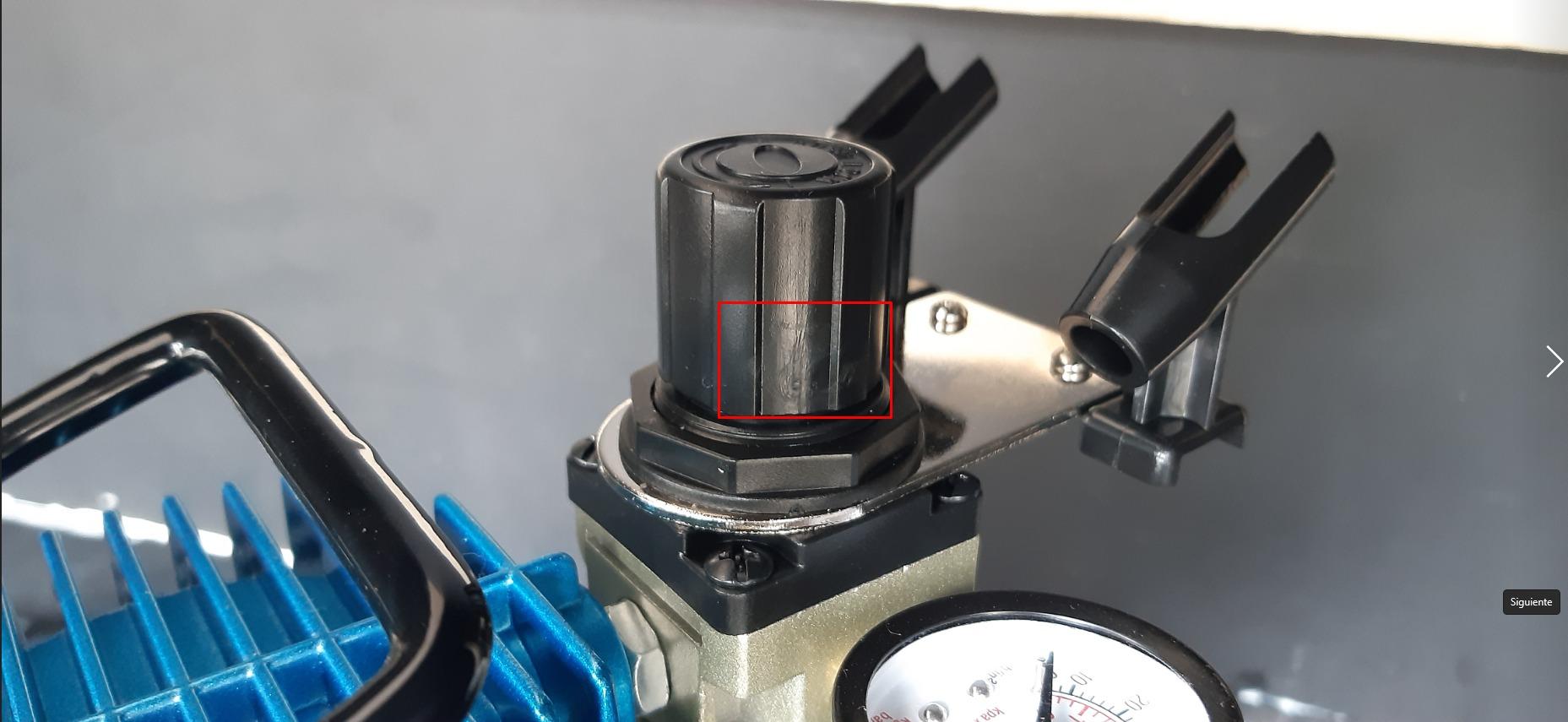
This one is compressor-first: the TC-320 Cool Runner II bundled with hose and a two-airbrush holder rather than a brush. That makes it the smart buy for painters who already own a decent airbrush, or who plan to add a premium brush later without paying for a throwaway one now. It is also the quietest full-size unit on this list at 47 dB.
For context, 47 dB sits between a quiet library and a soft conversation, which is why apartment dwellers keep recommending it. Our team ran it during evening sessions with someone sleeping one room away, and it drew no complaints. The 0 to 57 PSI range with a true diaphragm regulator means you can dial in 15 PSI for glazes and actually read it on the gauge.
The dual cooling fans are the reason to pick this over cheaper tankless units, since they keep the 1/5 HP piston within temperature during long prime-and-basecoat runs. Air-on-demand with automatic shut-off means the motor only runs when you pull the trigger. It is oil-less, maintenance-free, outputs 0.8 CFM, and weighs 9.5 pounds with a carry handle.
Two cautions from owner reports. Snugging the hose too aggressively can crush the O-ring and cause a slow leak, so hand-tight plus a fraction is the rule. No quick-release hardware is included, which is worth a few dollars as an add-on.
It still gets hot during very long continuous sessions despite the fans, so a five-minute break between armies is polite. The instructions are also vaguely written, so plan on forum guides for setup details.
Is 47 dB Quiet Enough For An Apartment
In short, yes for most situations. Short cycling as you spray means brief bursts rather than a constant drone, and with a closed door most people in the next room will not notice. If you paint late at night with shared thin walls, add a folded towel under the unit to kill vibration transfer through the desk.
Pairing It With The Right Airbrush
It drives any hobby brush comfortably thanks to the 0 to 57 PSI range, but model painters get the best results from a gravity-feed dual-action in the 0.3mm to 0.4mm class. Add a moisture trap if your room is humid, since the built-in water trap handles most but not all summer condensation.
7. Timbertech AS18-2K – The Quiet Piston Starter
Timbertech Airbrush Kit With Compressor AS18-2K Basic Start Kit With Air Hose, Cleaning Brushes, and Test Paints for Hobby, Body Tattoo, Model painting, Automotive Graphic, Make-up
0.30mm gravity airbrush
Oil-less piston 47 dB
58 PSI max
Auto start-stop
Pros
- 47 dB oil-less piston compressor
- Auto start at 3 bar and stop at 4 bar
- Regulator with gauge and water trap
- Solid starter accessory bundle
Cons
- Included airbrush clogs if cleaned hastily
- Bundled test paints are weak
- Working pressure caps near 30 PSI
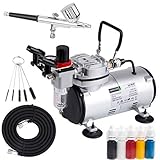
The Timbertech AS18-2K is built around a genuinely good compressor and a very basic brush, and knowing that split up front is the key to being happy with it. The oil-less piston runs at 47 dB, moves 20-23 liters per minute, auto-starts at 3 bar and auto-stops at 4 bar, and carries a regulator with gauge, water trap, and air filter.
As a learning rig it is hard to fault. Our tester primed a batch of 3D printed minis, laid zenithal highlights over them, and did it all in an evening without the compressor complaining. A pressure relief safety valve and overheat protector are included, which I want on anything running for hours in a home office.
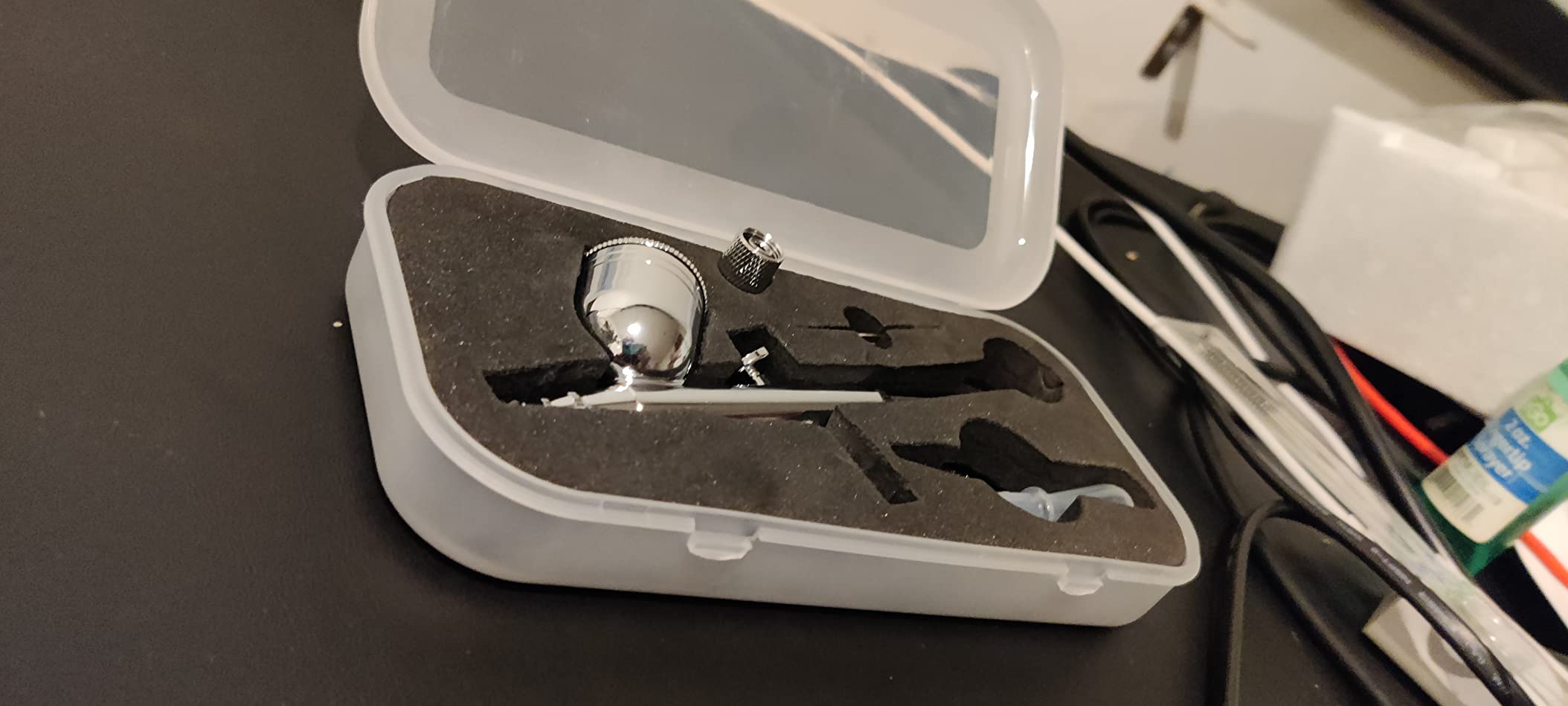
The included brush is a double-action gravity feed with a 0.30mm nozzle, which is the right spec for miniatures on paper. In practice it sprays fine when paint is thinned to the consistency of milk, but it punishes lazy cleaning. The bundled test paints are best used for target practice, not models.

Long-term, the compressor is the keeper here. Working pressure in real use sits near 30 PSI, which covers priming and basecoating. The 9-pound body with a carry handle is bench-friendly at 12.6 by 5.5 by 12.2 inches with a six-foot hose.
Owner history suggests the piston unit outlives the brush by a wide margin. Treat the auto start-stop cycle as a feature, since the motor resting between sprays is what keeps it cool.
How Long The Compressor Lasts
Many owners report years of service from the piston unit with no maintenance beyond filter checks, which is rare at this tier. The brush is the part you eventually replace. That makes this kit a smart buy for someone who suspects they will get serious about the hobby.
When To Upgrade The Included Airbrush
Upgrade once you can consistently lay a smooth basecoat, because at that point the brush, not your hands, is the limit. The signs are a spray pattern you cannot tighten, spatter at correct thinning, and trigger creep mid-line. Bolt a better gravity-feed brush onto this compressor and you have a mid-tier system for a fraction of the cost.
8. InoKraft Airbrush Kit – The Low-Noise Beginner Bundle
InoKraft Air brush Kit with Air Compressor, Quiet, 4 Paint Colors, 3 Tips
0.2 0.3 0.5mm nozzles
1/6 HP quiet compressor
34 PSI steady
4 paint colors
Pros
- Runs under 47 dB
- Three nozzle sizes for real versatility
- Steady 34 PSI with adjustable valve
- Includes guide and one-year warranty
Cons
- 34 PSI ceiling limits thick primers
- Unit is heavy to move at 4.9 kg
- Occasional missing parts reported
InoKraft aims squarely at the gift market, and I mean that as a compliment. The box arrives with a 1/6 HP oil-free compressor, a dual-action airbrush with 0.2mm, 0.3mm, and 0.5mm nozzle sets, four paint colors, a cleaning kit, a practice guide with sheets, a holder, a hose, an oil-water separator, and a stable suction base. It is the most accessorized beginner package here.
The compressor holds a steady 34 PSI with an adjustable valve and stays under 47 dB, which puts it in the same noise class as the Master units. For model painting that means comfortable basecoating and shading at 15 to 25 PSI with headroom for varnish. The suction base keeps the brush parked upright between colors, preventing a lot of tipped-over paint cups.
The three nozzle sizes map cleanly onto the model painting workflow: 0.5mm for priming, 0.3mm for basecoats, 0.2mm for fades and detail. Swapping sets is a five-minute job with the included tools, and the cleaning kit covers interdental-style detail work. A one-year warranty and beginner guide round it out.
Limitations to weigh. The 34 PSI maximum means thick primers need serious thinning, and a few owners report electrical faults after long service along with occasional missing parts in shipments. At 4.9 kilograms, it is heavier than it looks.
That weight makes it more bench fixture than travel kit. If you paint in one spot and value quiet operation, neither issue will slow you down.
Is 34 PSI Enough For Your Workflow
For basecoats, zenithal work, glazes, and varnish, 34 PSI is plenty, since most of that happens at 15 to 25 PSI anyway. Where it pinches is heavily pigmented primers, which want pressure and volume to atomize cleanly. If you prime with pre-thinned acrylic surface primers, you will never miss the extra PSI.
Setup And First Session Experience
Plan about twenty minutes from box to first spray, including washing the factory protectant from the cup and doing a water test. The included guide walks through nozzle swaps and first sprays, and the practice sheets absorb your worst first lines. That onboarding is why this kit works as a gift for someone who has hinted at wanting an airbrush.
9. Gaahleri Turbox Mini – The Compact Desk System
Gaahleri Airbrush Kit, Turbox mini Kit with GHAD-39 0.35mm, Dual-Action Airbrush & Air Compressor with 18 Gear Air Control, Ultra-Quiet, Multi-Scenario, for Painting, Modeling, Cake Decor
GHAD-39 0.35mm
18-gear air control
Digital PSI display
Under 48 dB
Pros
- 18-gear pressure control
- Real-time digital pressure display
- GHAD-39 is a proper hobby-grade brush
- Runs under 48 dB
Cons
- Max pressure near 30 PSI limits heavy priming
- Display can read above actual output
- No moisture trap included
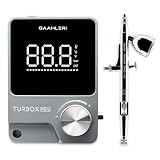
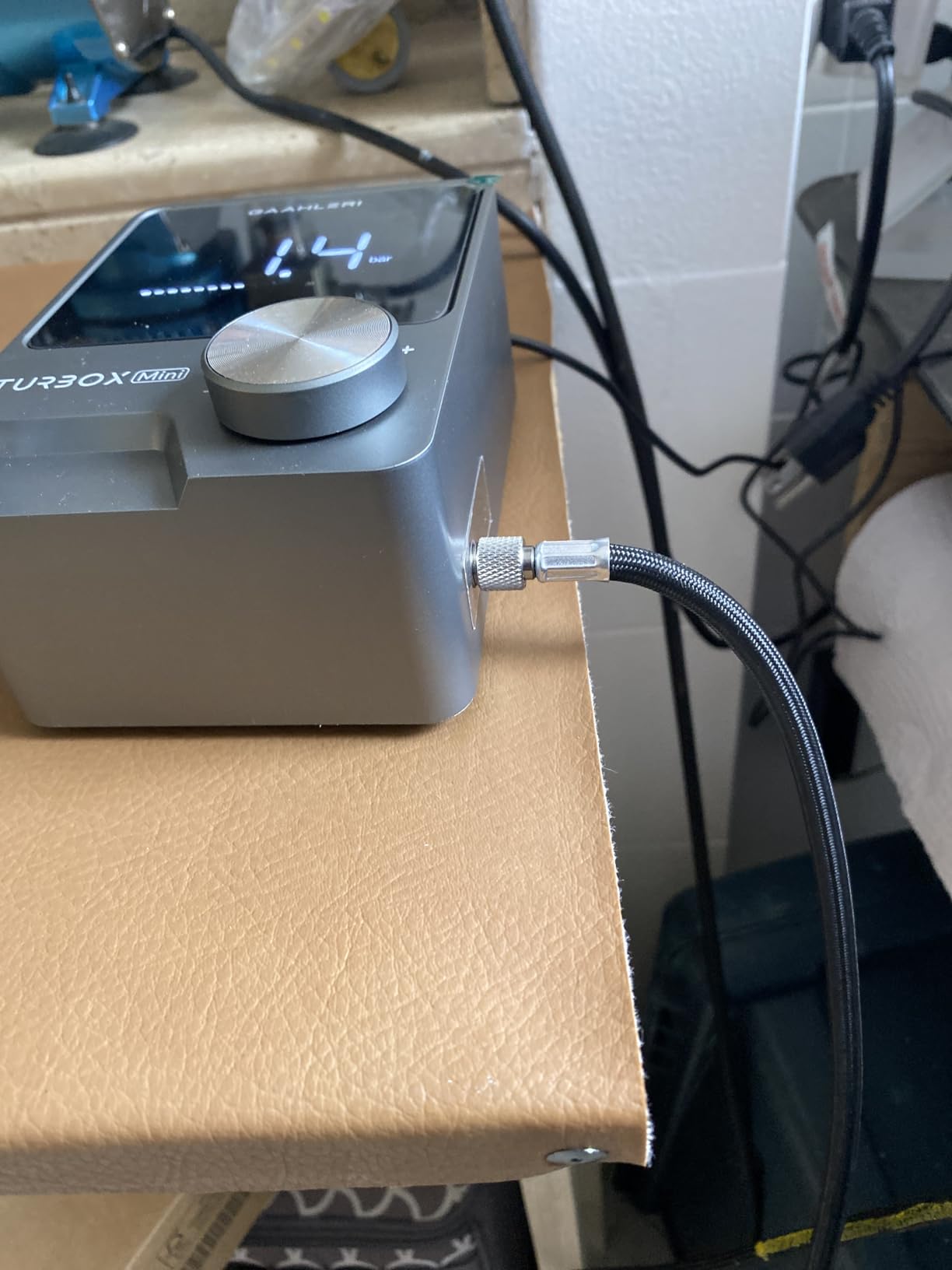
Gaahleri is one of the newer names hobby painters keep recommending, and the Turbox mini kit is their compact argument: a GHAD-39 dual-action airbrush with a 0.35mm nozzle paired with a palm-sized compressor offering 18 gears of air control and a digital display. The whole setup is 5.5 by 3.9 by 2.3 inches and 1.32 pounds.
The GHAD-39 is the reason to take this kit seriously. It is a proper hobby-grade gravity-feed brush with a crisp dual-action trigger, and the 0.35mm spec matches the Iwata Eclipse approach of one setup for everything. Basecoats, color modulation, and soft effects all worked well in our sessions at 10 to 20 PSI working pressure.
The compressor side is where the design gets interesting. The digital display shows real-time pressure with a PSI and Bar switching mode, the 18-gear control gives repeatable settings instead of a vague dial, and an overheat warning system protects the motor. At under 48 dB it suits small studios and shared living spaces.
Know the limits before buying. Maximum pressure lands near 30 PSI, so heavy primer duty is not its job, and several owners note the display reads a couple of PSI above actual output at the brush. No moisture trap or quick connector is included, both worth adding.
Owners in hot climates also report the overheat warning triggering during marathon summer sessions. For normal evening blocks of an hour or two, it never came up for us.
Is The Display PSI Accurate
Treat the readout as a repeatable reference rather than gospel. Mine read about 2 PSI high versus a gauge at the brush, which is consistent with owner reports. Once you know your offset, the 18-gear system is an advantage, because gear 9 always behaves like gear 9 across sessions.
What It Is Like On A Small Desk
This is the kit I would pick for a corner of a bedroom or a shared studio bench. The footprint is smaller than a paperback stack, and the brush parks in the built-in holder. If you paint 28mm minis or Gunpla at a small desk, the Turbox fits without rearranging your room.
10. Colima XJ300 – The Dual-Brush Compact Kit
Colima Airbrush Kit with Air Compressor, 27PSI High Pressure 7 Pressure Levels Air Compressor Dual-Action Air Brush Set for Painting, Modeling, Nails, Tattoo, Makeup, Crafts & Cake Decor
15-27 PSI 7-gear
Dual-action gun
Dual airbrush ports
2.88 lbs total
Pros
- Seven pressure presets from 15 to 27 PSI
- Supports two airbrushes at once
- Light at 2.88 pounds
- Ergonomic grip and dual-action control
Cons
- 27 PSI ceiling for thick coatings
- Hose connections can be finicky
- Runs warm in long sessions
The Colima XJ300 has one feature nobody else on this list offers: it supports connecting two airbrushes at the same time. For model painters, that means a shade-loaded brush in one port and a highlight brush in the other, with no flushing between zenithal passes. If you have ever rinsed dark blue out of a brush only to load white two minutes later, you know why that matters.
Pressure control runs from 15 to 27 PSI across seven gears with smart start-stop for a stable spray. That range is aimed squarely at miniature work rather than automotive coverage, and the 8 to 15 liters per minute airflow keeps up with detail spraying. The dual-action gun includes an adjustable tailstock for needle changes and an ergonomic grip.
At 2.88 pounds and 10 by 6 by 3 inches, it is a genuine desk kit, quiet enough for evening sessions and small enough for a drawer. The 7-gear adjustment makes it easy to teach a friend on, since there is no regulator to misunderstand. Accessories in the box cover cleaning and basic maintenance.
The honest caps: 27 PSI maximum means primers must be thin, and some owners report hose connection issues that need thread tape. The compressor also warms up during long sessions, with occasional quality-control misses.
Within its pressure range, it sprays with more control than its footprint suggests. Owners rate it highly for exactly the low-pressure work miniatures demand.
Who The 27 PSI Ceiling Suits
It suits painters who prime with pre-thinned acrylic primers and spend most sessions at 15 to 22 PSI on basecoats, zenithal fades, and glazes. It does not suit anyone spraying thick lacquer primers or varnishing large vehicle bodies. Match the tool to your paint cabinet and this ceiling never bothers you.
Using The Second Airbrush Port
Load one brush with your shadow tone and one with your highlight, then alternate without a single cleaning cycle mid-session. You will need a second brush and hose, which are cheap additions. Painters who try dual-brush zenithal work rarely go back for batch priming.
11. KingMiKi F02 – The New High-Pressure Kit
KingMiKi Airbrush Kit, Air Brush Kit With Air Compressor.
22/30/50 PSI presets
0.2 0.3 0.5mm nozzles
52 PSI max
Cleaning set included
Pros
- Three pressure presets including 50 PSI
- Three nozzle sizes in the box
- Non-clogging paint path design
- Cleaning accessories included
Cons
- Only 23 reviews so far
- Presets less precise than a regulator
- Needs strict cleaning after every session
The KingMiKi F02 is one of the newest kits on this list and currently holds a perfect rating, though from a small pool of 23 reviews, so read the enthusiasm with that in mind. What drew our attention is the pressure range: presets at 22, 30, and 50 PSI with a 52 PSI maximum, more headroom than most compact kits offer.
For model painters, those presets land usefully. The 22 PSI setting sits right in the basecoat and modulation window, 30 PSI handles thinned acrylic primer, and 50 PSI exists for clearing the nozzle after a stubborn clog. You get 0.2mm, 0.3mm, and 0.5mm nozzle sets along with a full cleaning kit.
The non-clogging design claim held up in our sessions with properly thinned hobby paints, though no airbrush survives unthinned primer. The kit is built for multiple uses including model painting, and the cleaning tools cover nozzle, needle, and cup maintenance. Setup is plug-in and spray, powered from AC.
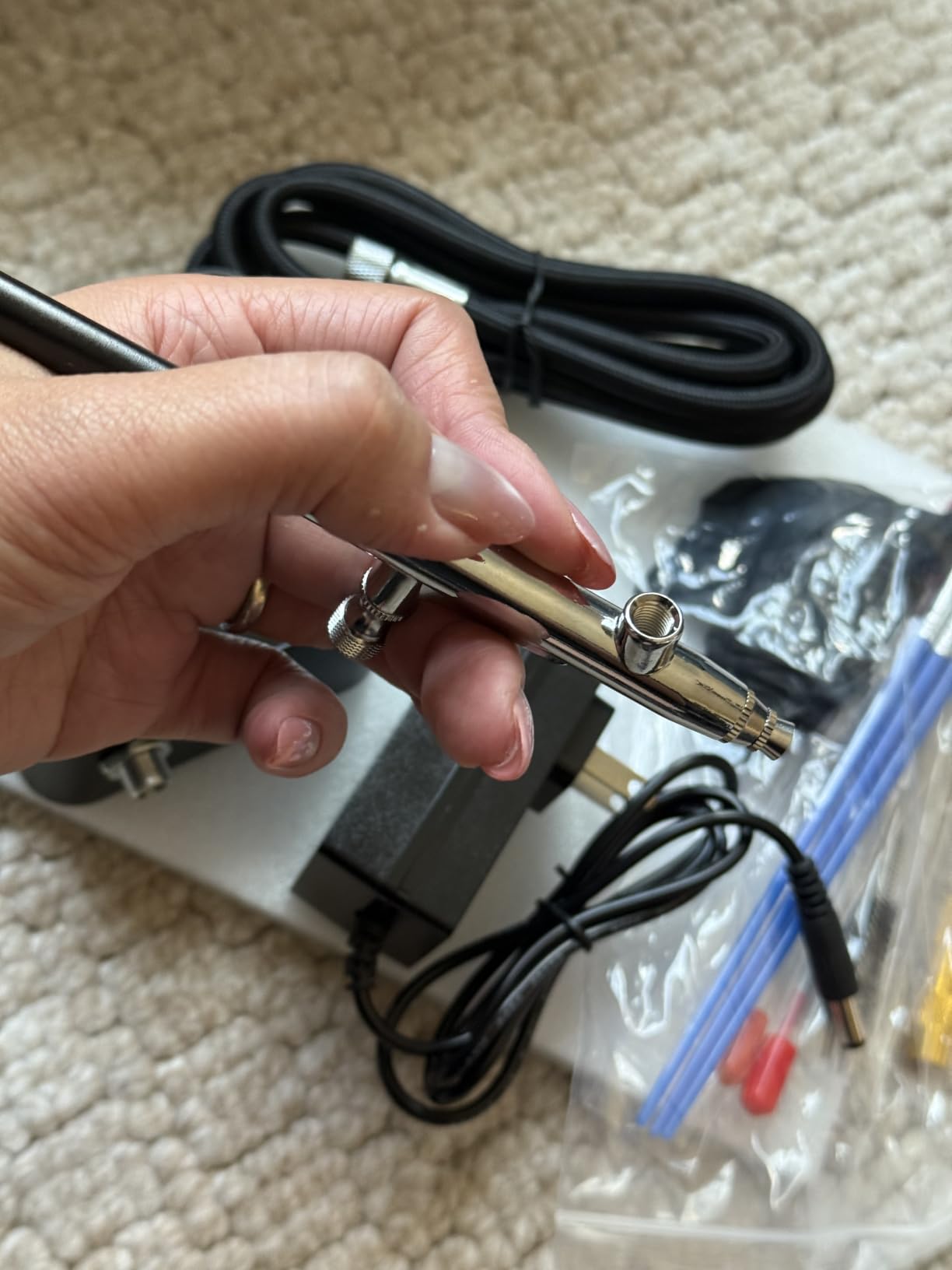
Since the review base is thin, the risks are the usual new-product ones: long-term durability is unproven, and presets are coarser than a true regulator with a gauge. Quality control has not been stress-tested by thousands of owners yet.
In exchange you get a current-generation design and a strong feature set at an entry-level outlay. Early owners praise the consistent airflow and spray pattern, which matches what we saw.
What Those Pressure Presets Mean
Use 22 PSI for basecoats and soft blending, 30 PSI for priming and varnish, and reserve 50 PSI for clearing blockages, because detail work never wants it. Without a fine regulator, drop your thinning slightly at each step to compensate. Painters who like set-and-forget settings will enjoy the presets.
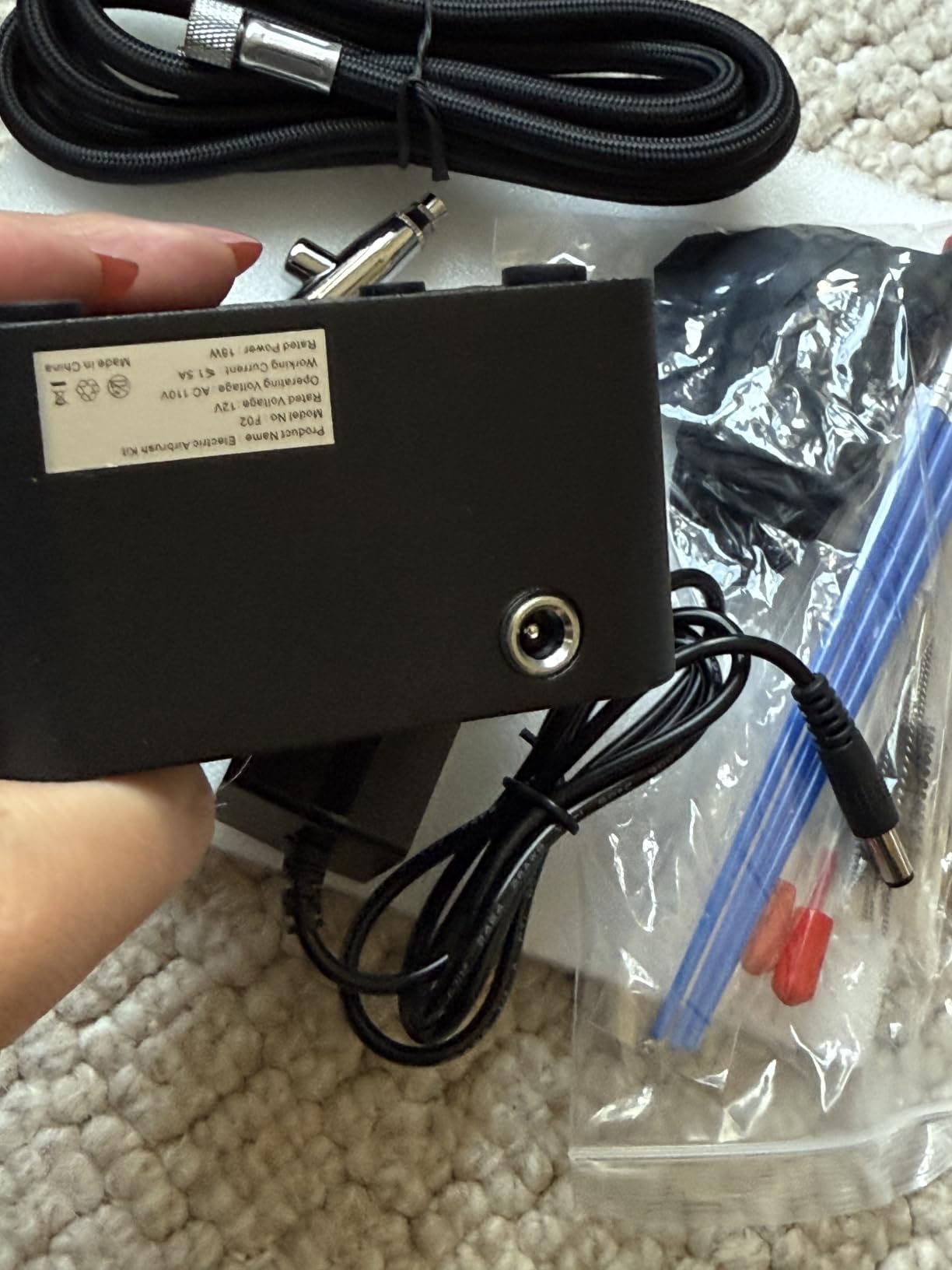
How It Behaves With Thinned Primers
With pre-thinned acrylic primer through the 0.5mm nozzle at 30 PSI, coverage was even across a squad of plastic minis with no spatter. Heavier-bodied primers dried on the tip within a couple of minutes at the same setting. The rule that always applies applies here too: thinner paint at lower pressure beats thick paint at high pressure.
12. COROTC F01 – The Portable LED Kit
COROTC Airbrush Kit with Air Compressor, 20-50 PSI, LED Display, 3 Nozzles
20-50 PSI adjustable
LED digital display
0.2 0.3 0.5mm nozzles
Tool-free setup
Pros
- Ultra-fine atomization for soft effects
- LED display for pressure monitoring
- Sets up tool-free in under two minutes
- Three stainless nozzles included
Cons
- No physical power switch on the unit
- Small cup needs frequent refills
- Only 15 reviews so far
The COROTC F01 is the most portable full system here, with a built-in air pump, an LED digital display, and a rotary knob covering 20 to 50 PSI. It sets up tool-free in under two minutes, which makes it the kit I would throw in a bag for a painting day at a friend’s house or a club night.
Atomization quality is the surprise. The ultra-fine mist it produces is the kind you normally associate with pricier setups, and it shows in soft zenithal transitions on 28mm figures. Three stainless steel nozzles in 0.2mm, 0.3mm, and 0.5mm cover detail through broad coverage, and the dual-action trigger gives real air-then-paint control.
On the technical side, the 20 to 50 PSI range is generous for a pocketable unit, and the LED display makes pressure visible instead of guessed. The whole package sits at 5.8 by 5.8 by 1.72 inches. It is rated for model painting, nails, toys, and 3D model work, and the accessory bundle covers cleaning.
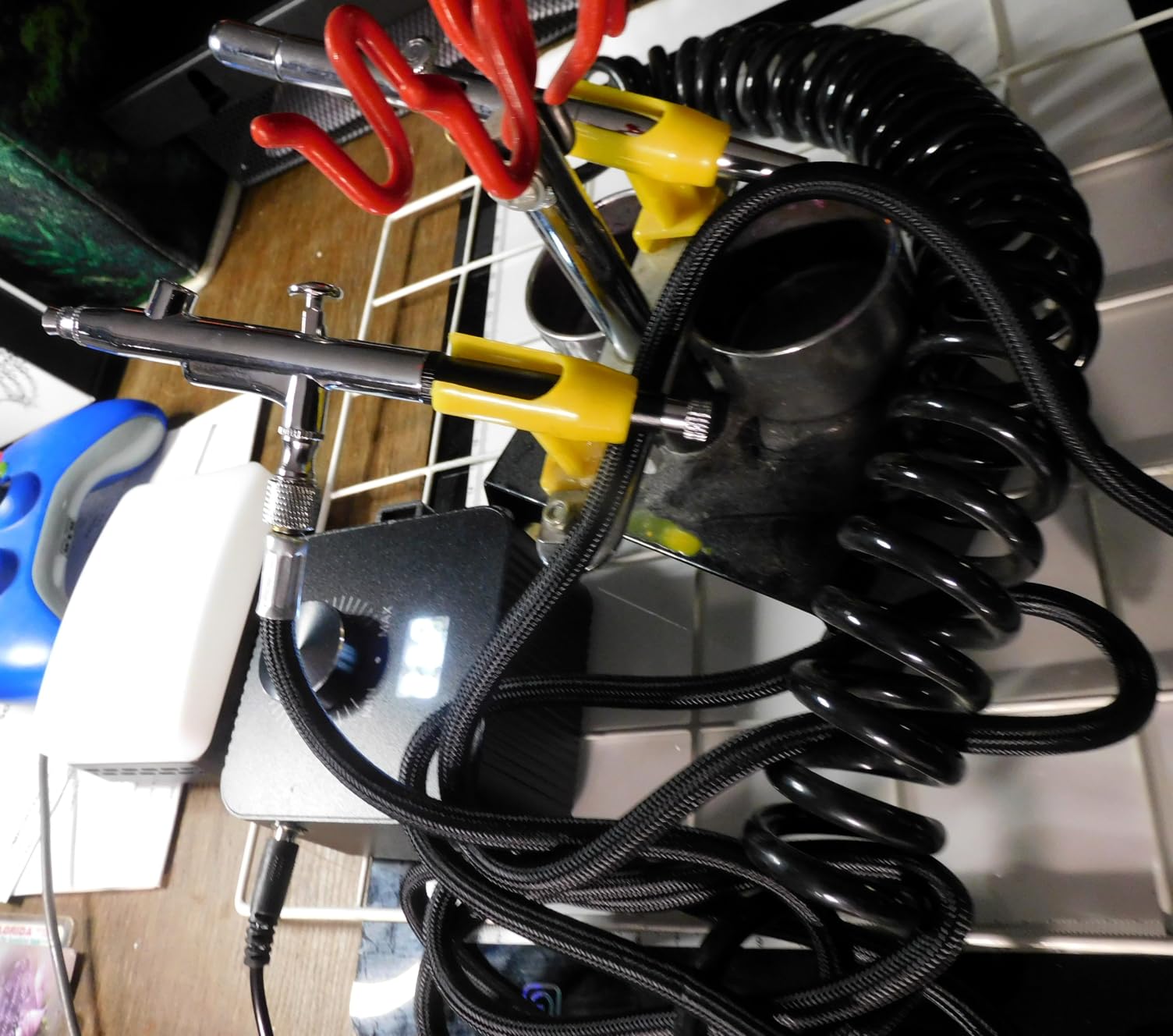
A few cautions deserve attention. There is no physical on/off switch, so you power down by turning the knob to zero, which is easy to forget. The cup is small and needs refills during batch work, and the trigger takes practice like any dual-action.
With only 15 reviews, the long-term record is short, since this model only recently reached the market. Early feedback on atomization and ease of use is strongly positive, which matches our time with it.
Setup Time Out Of The Box
Genuinely under two minutes with no tools: connect the hose, pick a nozzle, thin some paint, and spray. First-timers should still do a water test through the brush before loading color. Of everything here, this is the kit least likely to intimidate a complete beginner.
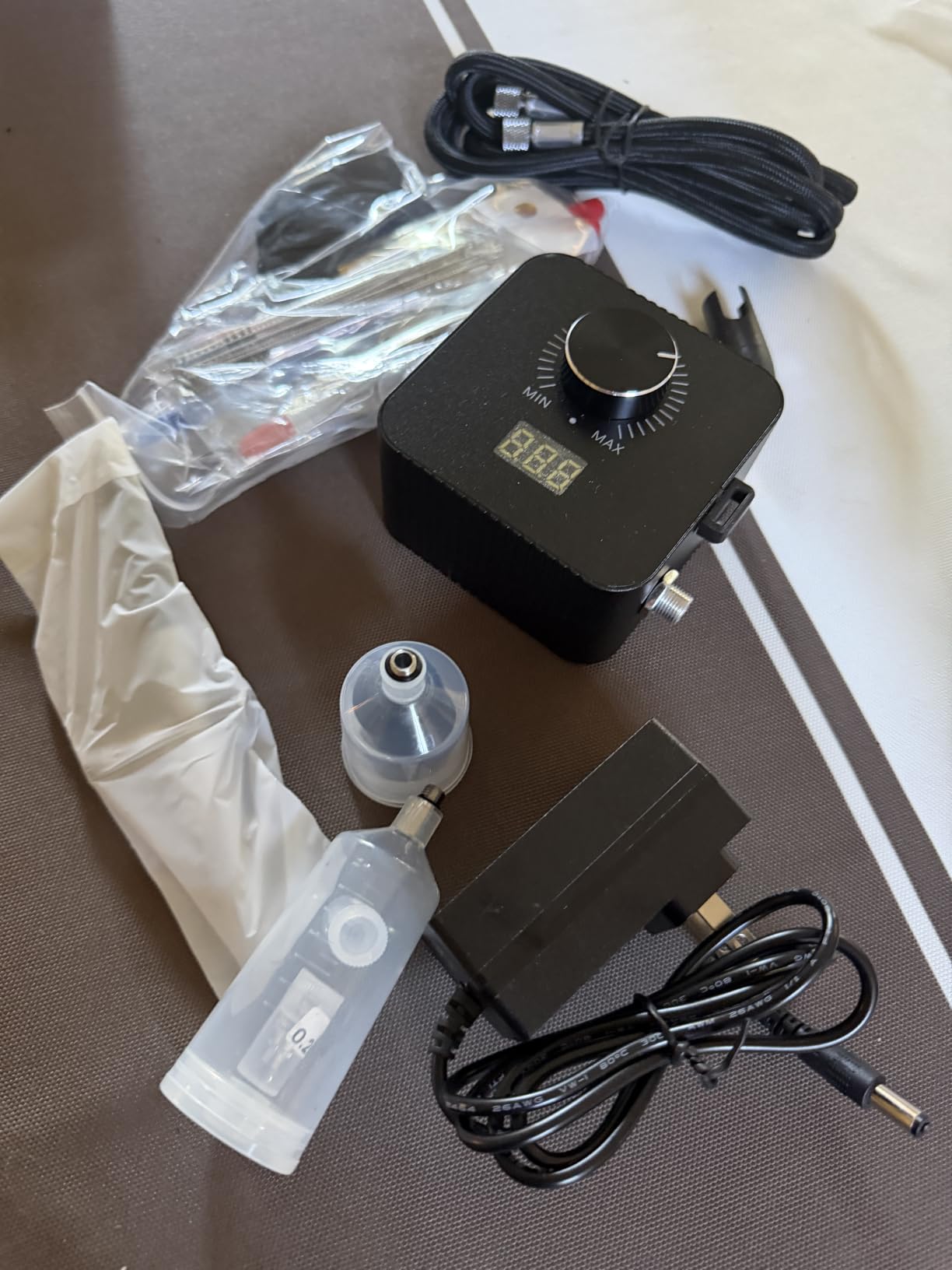
Where This Kit Fits In A Painting Setup
Think of it as a travel and trial system, or a second rig for a kitchen table. It handles priming, basecoats, and soft effects on minis capably within its pressure range. Painters with a fixed bench and heavy batch throughput will eventually want a tank compressor.
How to Choose an Airbrush System for Model Painting
The best airbrush systems for model painters share a handful of traits, and once you know them, every kit on this page becomes easy to judge. Here is what actually matters, based on our bench time and the consensus across miniature painting communities.
Needle Size and Why 0.3mm Is the Sweet Spot
Needle and nozzle size control how fine your line gets and how easily paint passes through. For 28mm miniatures and 1:35 scale work, 0.3mm is the sweet spot, with 0.2mm for fine fades and 0.4mm to 0.5mm for priming and varnish. Anything at 0.5mm and above is a basecoat tool, and owners rightly advise against it for detail work.
Kits with multiple nozzle sizes, like the Gocheer, InoKraft, and KingMiKi, give you that whole range in one purchase.
Gravity Feed vs Siphon Feed
Gravity feed puts a small cup on top and lets paint drop into the air stream, so it sprays reliably at the low pressures miniature painters use. Siphon feed hangs a jar below and needs more pressure to pull paint up, which fights thin paint and small detail. Every serious recommendation says gravity feed is essential for minis, and every brush on this list follows that.
The practical bonus is paint economy. A gravity cup runs on a few drops, which matters when spraying an expensive pot of Citadel or Vallejo.
Dual Action vs Single Action
Dual action means the trigger controls air down and paint back, independently, which is how you feather a fade from full spray to whisper. Single action releases a fixed paint-air mix, which is steady and simple, ideal for priming and varnish. Serious model painting needs at least one dual-action brush, and the multi-brush kits wisely include a single-action for the boring jobs.
Compressor Must-Haves: Tank, Moisture Trap, PSI Range
Look for three things on the air side. A storage tank, even a small one like the 3-liter on the Iwata system, smooths out pulsation that shows up as banding in your blends. A moisture trap keeps condensation from spitting water into your paint on humid days, and a wide PSI range with a real regulator lets you run 15 to 25 PSI for detail and 25 to 30 PSI for primer.
Typical model painting pressures: 25-30 PSI for priming, 20-25 for basecoats, 15-20 for zenithal highlights, and 10-15 for glazes and fine detail with thin paint.
Noise, Workspace, and Apartment Painting
Compressor noise decides when you can paint. Units at 47 to 48 dB, like the Master TC-320, Timbertech, InoKraft, and Gaahleri, run quietly enough for apartments and evening sessions. Add a spray booth or a cardboard box lined with a damp towel for overspray, keep a window open, and wear a respirator with acrylics and always with solvent-based products.
If bench space is the constraint, the compact kits from Gaahleri, Colima, and COROTC were designed for exactly that. For more gear guidance, see our other buying guides.
Paint Compatibility and Thinning
Your existing paints mostly work. Vallejo Model Air, Citadel Air, and AK Interactive airbrush lines are pre-thinned and spray nearly straight from the bottle. Standard base paints want roughly a 1:1 mix with airbrush thinner plus a drop of flow improver, and distilled water alone tends to tip-dry and spray gritty.
Every kit above assumes thinned paint, and the number one cause of clogs and spatter is paint too thick for the pressure you set.
Cleaning Routine That Prevents Clogs
Flush with airbrush cleaner between colors, which takes thirty seconds with a gravity cup, and do a full tear-down with interdental brushes at the end of a session. Backflushing, blocking the nozzle briefly with a rag and letting cleaner bubble back into the cup, clears the paint path fast. Cheap no-name brushes punish skipped cleaning, which is why buying a known kit the first time saves money.
Frequently Asked Questions
What is the best airbrush for painting models?
For most model painters the Iwata Eclipse HP-CS is the best single airbrush thanks to its 0.35mm needle and self-centering drop-in nozzle, which handle everything from priming to fine detail. If you want a full system in one buy, the Master Airbrush Cool Runner II kit with three brushes and a dual-fan compressor is the stronger overall pick.
What is the best airbrush compressor for miniature painting?
A quiet piston compressor with a moisture trap, a regulator, and a 15 to 25 PSI working range is best for miniature painting. The Master Airbrush TC-320 Cool Runner II at 47 dB with a 0 to 57 PSI range is the strongest value, and the 3-liter tank on the Iwata system kit adds pulse-free airflow for long sessions.
What are some professional airbrush kits for models?
The Iwata Eclipse HP-CS system kit sits at the top for professional model painting, pairing a pro-grade brush with a tank compressor and 12 paints. The VEVOR three-airbrush set and the Master Airbrush Cool Runner II are the mid-tier workhorses, while Gaahleri and Colima make compact pro-style kits for small desks.
What PSI should I use for airbrushing miniatures?
Most miniature work happens between 15 and 25 PSI. Prime at 25 to 30 PSI, basecoat at 20 to 25, zenithal highlights at 15 to 20, and drop to 10 to 15 for glazes and fine detail with thin paint. Lower pressure needs thinner paint, so thin the paint first and lower the pressure second.
Can I use regular Citadel or Vallejo paints in an airbrush?
Yes, but thin them first. Citadel Air, Vallejo Model Air, and AK Interactive airbrush lines are pre-thinned and spray almost straight from the bottle. Standard base paints need roughly a 1 to 1 mix with airbrush thinner plus a drop of flow improver, and distilled water alone sprays poorly and dries on the tip.
Final Thoughts on the Best Airbrush Systems For Model Painters
After all the primer, basecoat, and cleanup sessions, the recommendation path is simple. Buy the Master Airbrush Cool Runner II if you want the most capable all-round system with three brushes for the price many brands charge for one. Pick the VEVOR set for a real tank at a mid-tier outlay, the Gocheer kit for the cheapest honest start, and the Iwata Eclipse HP-CS bundle if you want the upgrade path closed in a single purchase.
For small benches and quiet apartments, the Gaahleri Turbox mini, Colima XJ300, and COROTC F01 were made for you, while the Master TC-320, Timbertech, and InoKraft kits split the difference on noise and price. Whatever you choose, budget for thinner and cleaner from day one, because thin paint at low pressure is the whole secret.
The best airbrush systems for model painters in 2026 are quiet, easy to clean, and pressure-flexible, and every kit above clears that bar. Once your first squad comes out with smooth zenithal fades, you will wonder what took you so long. When those painted pieces are ready for a shelf, our guides to medieval display options and steampunk art and sculpture displays have plenty of inspiration for showing them off.