

The best ergonomic keyboards for authors make a long draft feel less like a fight with your wrists and shoulders. A good model keeps the keys within easy reach, gives your hands a more natural angle, and lets you stay focused on the page rather than continually shifting in your chair.
My short answer is this: start with Logitech Wave Keys if you want a familiar, gentle change; choose the wireless Arteck split keyboard if a conventional split shape appeals to you; and consider the EAYBLLY if cross-platform support and a built-in device holder matter most. Every pick below comes from the supplied product specifications and customer-review data, not from invented test results.
Authors who enjoy a more traditional key feel can also compare our best mechanical keyboards for writers, while people drawn to a retro desk setup may prefer these best typewriter style keyboards for authors. This guide focuses on wrist position, long-form drafting, device switching, and the adjustment burden that matters when writing is the work.
Table of Contents
The top 3 picks for authors answer three different writing needs
Logitech Wave Keys is the simplest starting point for many writers because it retains a single-piece layout while adding a wave shape and memory-foam palm support. Arteck’s wireless split model is the stronger fit for a writer who wants a visible left-right separation without moving to two completely detached halves, while EAYBLLY adds broad operating-system support and a holder for a phone or small tablet.


None of these choices requires authors to learn programmable layers before they can write a chapter. That distinction matters: forum discussions repeatedly show that an intimidating layout and a temporary typing-speed dip can stop a useful ergonomic change before muscle memory has time to settle.
These eight ergonomic keyboards for authors cover familiar waves to true splits in 2026
Use this overview to identify the shape, connection method, and feature set that match your desk. A one-piece wave board is usually easier to approach, while a split design gives the hands more room to rest apart; the product sections explain the trade-offs without assuming every author is a touch-typing expert.
| Product | Specifications | Action |
|---|---|---|
| Logitech Wave Keys |
|
View on Amazon |
| Arteck Split Ergonomic Keyboard |
|
View on Amazon |
| EAYBLLY Wireless Ergonomic Keyboard |
|
View on Amazon |
 Nulea Wireless Ergonomic Keyboard Nulea Wireless Ergonomic Keyboard |
|
View on Amazon |
 ProtoArc EK01 Plus ProtoArc EK01 Plus |
|
View on Amazon |
 Arteck Ergonomic USB Wired Keyboard Arteck Ergonomic USB Wired Keyboard |
|
View on Amazon |
 KINESIS Freestyle Edge RGB Plus KINESIS Freestyle Edge RGB Plus |
|
View on Amazon |
 MEETION Wireless Ergonomic Keyboard MEETION Wireless Ergonomic Keyboard |
|
View on Amazon |
1. Logitech Wave Keys is the easiest ergonomic starting point for most authors
Logitech Wave Keys Ergonomic Wireless Keyboard with Palm Rest – Graphite
Wave design
Memory foam palm rest
Bluetooth and Logi Bolt
Pros
- Natural wave shape
- Memory foam palm rest
- Three-device switching
- Up to three years battery
Cons
- Uses two AAA batteries
- Fixed palm-rest feel
Logitech Wave Keys earns the first spot because it changes the hand position without asking an author to relearn a radically split keyboard. Its wavy key field is meant to place hands, wrists, and forearms in a natural typing position, so I would point a first-time ergonomic buyer here before recommending a more specialized board.
The supplied review record shows a 4.3 rating from nearly 3k reviews, giving this pick a deeper pool of feedback than most of the options on this list. Its United States Ergonomics certification and memory-foam palm rest make the comfort case clear on paper, though a fixed rest is never a substitute for checking whether your own palms land comfortably.
For an author who writes on a laptop, tablet, and desktop, the Easy-Switch feature is a practical advantage. Bluetooth and the Logi Bolt receiver support switching among up to three devices, which can make it easier to move from research notes to a manuscript machine without changing keyboards.
The listed battery life reaches up to three years, but it uses two AAA batteries rather than charging by USB-C. The product record lists Windows and Mac support, so it is a sensible familiar-layout option for writers who share work between those two systems.
This keyboard suits authors who want a gentle transition
I would choose Wave Keys for a novelist, journalist, or student who wants less wrist strain but still wants the visual comfort of a normal full-size layout. The rows remain connected, so the board avoids the initial coordination problem that can arrive when hands must work on separate pieces.
It also fits a writer who moves among several devices during the day. The three-device switching is more useful for a research-heavy workflow than decorative extras, especially when a draft, reference material, and messages live on different screens.
This keyboard needs a palm-rest fit check before purchase
Wave Keys includes its own memory-foam palm rest, so you cannot remove it when it does not suit your posture. A forum user reported that a cushioned rest caused discomfort, which is a useful reminder to keep wrists neutral and use a rest for pauses rather than pressing into it while typing.
The listing calls the switch type membrane and does not publish a noise measurement. Authors who work beside a sleeping partner or in a quiet shared room should treat sound as a personal test point rather than assuming any membrane keyboard will meet their needs.
2. Arteck Split Ergonomic Keyboard is the practical wireless split for long drafts
Arteck Split Ergonomic Keyboard with Palm Rest, 2.4G USB Wireless Keyboard
Wireless split design
Cushioned rest
Six-month rechargeable battery
Pros
- Natural split position
- Cushioned wrist rest
- Easy USB receiver setup
- Long battery life
Cons
- Windows support listed
- Only black listed
The Arteck Split Ergonomic Keyboard gives an author a more obvious left-right key separation than a wave board while keeping the entire keyboard in one piece. That makes it a useful middle ground for someone who feels shoulder tension at a standard board but does not want two detached keyboard halves moving around the desk.
Its supplied review data lists a 4.3 rating from more than 1.6k reviews. Readers frequently praised the comfortable split design, wireless connection, and cushioned wrist and palm rest, which aligns well with an author who has several uninterrupted drafting blocks in a typical week.
A nano USB receiver stores on the back of the keyboard, and the product description says setup is immediate once it is connected. That plug-in approach is less flexible than Bluetooth for tablet work, but it removes pairing steps for an author who simply wants to open a document and begin.
The rechargeable battery is listed for up to six months per charge, and the board includes hotkeys and media keys. Its 102-key QWERTY layout is close to a familiar desktop arrangement, so the adjustment comes primarily from the split shape rather than from a compressed key count.
This keyboard suits writers who want split posture without advanced setup
I would recommend this Arteck to a writer who works mainly from one Windows computer and wants a no-fuss wireless split. The centered split encourages the forearms and wrists to take a more relaxed position, but the board does not ask the writer to configure layers or learn a compact layout.
It is also a reasonable candidate for writers who use media controls while reviewing interviews, dictation, or reference audio. Those keys are present without crowding the main QWERTY arrangement with unusual commands.
This keyboard needs a Windows-first workspace
The supplied specifications list Windows 10 as the minimum operating system, so I would not buy it on the assumption that it will serve every platform. Mac, Chrome OS, tablet, and phone users should choose a model whose stated compatibility explicitly includes their device.
The attached wrist support is comfortable for some hands but personal fit still matters. Position the board low enough that elbows can rest near a right angle, then let the palms touch the cushion during breaks instead of bending the wrists upward to reach the keys.
3. EAYBLLY Wireless Ergonomic Keyboard is the flexible entry pick for mixed-device writers
EAYBLLY 2.4G Wireless Ergonomic Keyboard, Full Size Wave Keys with Memory Foam Wrist Rest & 7.28in Phone Holder, USB-C Adapter Included for Windows Mac Chrome OS, Office or Home (Black)
Wave keys
3-layer memory foam
Phone and tablet holder
Pros
- Wide OS support
- Integrated holder
- Adjustable tilt
- Water-resistant body
Cons
- Needs one AA battery
- Smaller review base
EAYBLLY makes a strong entry-level case because its features address the ordinary friction of a writing desk. The wave-shaped keys, three-layer memory-foam wrist rest, and 7.28-inch device holder give a solo author a place for a phone or small tablet without adding a separate stand.
Its product record reports a 4.3 rating from 416 reviews. That is a smaller evidence pool than Logitech or Arteck, but the review summary specifically highlights the wide compatibility, adjustable tilt, and the holder as features people notice in daily use.
The board connects over 2.4G wireless and includes a USB-C adapter. Its stated compatibility includes Windows, Mac OS, and Chrome OS, which is unusually helpful for an author who drafts on one machine and edits or researches on another with a different port.
Two tilt positions, eight and twelve degrees, provide a limited way to change the angle, while the product is also described as water-resistant. It requires one AA battery, which is worth planning for if you prefer a rechargeable keyboard that stays connected by a charging cable.
This keyboard suits authors who need a simple workstation in a small space
I would put EAYBLLY on a compact desk where a phone frequently holds a timer, outline, call notes, or a reference image. A built-in holder can keep that screen up and out of the manuscript area without asking the writer to balance it against a mug or stack of books.
The familiar QWERTY form and wave profile also make it approachable for writers who do not touch type at high speed. You can change one physical habit at a time: settle into the curved rows first, then adjust the tilt only if the wrists still feel bent.
This keyboard needs realistic expectations about support and batteries
The board has fewer reported reviews than the established top picks, so I would read the available recent feedback closely before treating it as a known quantity. Its one-year warranty is also shorter than the two-year coverage listed for either Arteck keyboard in this guide.
The listing includes an AA requirement, and the battery is not supplied. Keep a spare available if a deadline-heavy month makes any interruption unwelcome, and confirm the receiver or adapter works with the particular ports on your writing device.
4. Nulea Wireless Ergonomic Keyboard is the rechargeable split option with a layout warning
Nulea Ergonomic Split Keyboard Wireless Cushioned Wrist Rest Rechargeable
Split keyset
Bluetooth and 2.4G
206-hour rechargeable battery
Pros
- Dual-mode wireless
- Long listed battery life
- Soft oversized rest
- Three tilt angles
Cons
- Dvorak layout listed
- Windows-focused support
Nulea has the highest listed rating in this roundup at 4.5 from 217 reviews, and its hardware checklist is appealing for an author who dislikes disposable batteries. It combines Bluetooth and 2.4G wireless with USB-C recharging, and the supplied specification reports up to 206 hours of battery life.
The broad, leatherette wrist support and three adjustable angles make this keyboard one of the more comfort-focused one-piece split designs here. I like the fact that the writer can change the board angle rather than accepting one fixed posture, since desk height and chair height differ so much from one home office to another.
Dual-mode connectivity adds real usefulness for a writer who alternates between a laptop and a stationary computer. The product information calls out smooth device transitions, although it does not state a numbered multi-device switching limit like the Logitech model does.
The big qualification is its listed Dvorak layout. That is not a minor detail for an author accustomed to QWERTY: Dvorak moves many common letters, so it creates a genuine typing transition rather than merely a change in wrist angle.
This keyboard suits writers who already want a Dvorak ergonomic board
I would consider Nulea first if Dvorak is already part of your writing practice and you want a rechargeable, wireless split keyset. In that case, the separate benefits line up well: a natural split posture, multiple tilt angles, and a connection choice for different devices.
It can also suit a writer intentionally committed to learning Dvorak, but only when the work calendar leaves room for a temporary slowdown. Forum accounts make clear that new ergonomic layouts can interrupt pace before they become familiar, even for experienced typists.
This keyboard needs a firm layout and operating-system check
QWERTY users should not treat this as a casual plug-in replacement because the supplied product details explicitly name Dvorak. A keyboard shortcut sheet and low-stakes practice sessions may help, but they do not erase the retraining involved in putting common letters in new positions.
The listed minimum operating systems are Mac OS 10.12 Sierra and Windows 10, while the review notes describe the board as primarily Windows compatible. Verify your own computer and preferred layout before ordering, particularly if a manuscript deadline leaves little room for a learning period.
5. ProtoArc EK01 Plus is the full-size backlit choice for device switching
ProtoArc EK01 Plus Backlit Bluetooth Ergonomic Keyboard, Full Size, Blue
Full-size split layout
Bluetooth and USB
Rechargeable backlight
Pros
- Three-device switching
- Cushioned wrist rest
- Rechargeable battery
- Wide device support
Cons
- Not programmable
- 2.4G mode excludes Mac and iOS
The ProtoArc EK01 Plus aims at writers who want a full-size wireless split keyboard with a few convenience features built in. Its record lists a cushioned wrist rest, adjustable backlighting, a rechargeable 2000mAh battery, and the ability to switch among three devices.
The review data shows a 4.2 rating from more than 1.3k reviews, which is substantial feedback for a feature-rich keyboard. I would view it as a practical writing tool for someone who works from a laptop, desktop, and tablet rather than as a board for an author seeking deep key remapping.
Bluetooth and USB connectivity cover several workflows, and the supplied compatibility list includes Windows, Mac, and Android. That broad support can simplify a writer’s desk, especially when research clips or editorial feedback arrive on a tablet while the manuscript stays on a computer.
The product is a 117-key QWERTY design, so it retains a complete, familiar key set. Backlighting is useful in a dim room, but it does not tell us how loud the keys are; the supplied record does not include a sound rating.
This keyboard suits authors who routinely switch among three devices
I would choose ProtoArc for a writer whose work flows among a computer, a tablet, and another device during the same day. A stated three-device switching feature has more direct value for that routine than a layout that must be programmed before it feels useful.
It is also a reasonable full-size alternative for writers who want lighted keys and a rechargeable battery in one board. The split shape delivers a more open hand position without taking away the number pad and navigation keys familiar from a desktop keyboard.
This keyboard needs connection-mode awareness on Apple devices
The product record says its 2.4G mode is not compatible with Mac or iOS. That does not rule out Bluetooth use on the listed compatible platforms, but it does mean an Apple-focused writer should choose the connection method deliberately rather than expecting every mode to work.
It is not programmable according to the supplied review notes. Authors who need custom macros, layers, or a completely remapped layout should look at the KINESIS model instead of assuming a multi-device keyboard will supply those deeper controls.
6. Arteck Ergonomic USB Wired Keyboard is the direct plug-in board for a fixed desk
Arteck Split Ergonomic Keyboard with Palm Rest, USB Wired Backlit Keyboard
Wired split design
Cushioned palm rest
Seven-color backlight
Pros
- Instant USB setup
- Low-profile scissor keys
- Adjustable backlight
- Two-year warranty
Cons
- Cable limits placement
- Windows support listed
The wired Arteck is for authors who would rather plug in a keyboard than think about charging, pairing, or receiver storage. Its six-foot USB cable, split design, and cushioned wrist and palm rest describe a straightforward desktop setup with low-profile scissor-switch keys.
The record lists a 4.4 rating from more than 1.1k reviews. Review feedback praises the split arrangement, colored backlighting, and easy setup, so this is a compelling choice when the writing computer stays in one place and a cable is not a burden.
Seven backlight colors and three brightness levels are available, which may help an early-morning or late-night writer locate keys without turning on a bright room light. The key layout is QWERTY, and the board has 101 keys, keeping the familiar full-size workflow intact.
Scissor switches are identified in the product specifications, but the listing does not publish a noise measurement or force specification. I would not promise a specific sound profile for shared spaces on the basis of switch type alone.
This keyboard suits writers with a permanent Windows desk
I would choose this Arteck for an author with a desktop station who wants an immediate setup and does not move the keyboard from room to room. The long cable creates more placement freedom than a short lead, while a wired connection avoids battery maintenance entirely.
The two-year warranty is a welcome practical detail for an everyday writing tool. It also has a classic QWERTY arrangement, so the only meaningful adjustment should be settling into the split angle and low-profile keys.
This keyboard needs cable space and a spill-conscious desk
Its wired connection is a limitation if you draft from a couch, move between rooms, or want the cleanest possible desk. Measure the route from computer to keyboard before relying on the six-foot length, especially if a monitor arm or standing desk changes where the cable must travel.
The product is not water resistant, according to the specifications. Keep drinks away from it during long sessions, because a comfortable manuscript sprint should not end with a spill across an unprotected wired board.
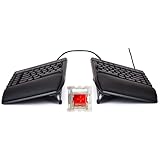
7. KINESIS Freestyle Edge RGB Plus is the mechanical split for writers who want control
KINESIS Freestyle Edge RGB Plus Split Mechanical Keyboard | Hotswap Linear Switches | RGB | Ergonomic | Detachable Palm Support | Fully Programmable | Mac Keycaps Included | Lift Kit Included
Separate mechanical halves
Hot-swap linear switches
Lift Kit included
Pros
- Fully programmable
- Detached split halves
- Hot-swap switches
- Detachable palm support
Cons
- AZERTY layout listed
- Adaptation required
KINESIS Freestyle Edge RGB Plus is the most specialized board in this lineup. It has truly separated keyboard halves, hot-swap linear mechanical switches, full programmability, detachable palm support, and an included Lift Kit, giving an author much more control over spacing and angle than a one-piece keyboard can offer.
Its current supplied review record is 4.3 from 13 reviews, so I would give its specifications more weight than its small feedback sample. This is not the simplest answer for every novelist, but it is the clearest choice for an experienced keyboard user who wants mechanical switches and an adjustable physical setup.
Detached halves can be placed at shoulder width rather than only as far apart as a fixed case allows. The Lift Kit supports tenting, which raises the keyboard center and can help the forearms rotate toward a more natural position when set up thoughtfully.
The listing also states RGB lighting, Windows compatibility, Mac keycaps included, and an AZERTY keyboard layout. Those details call for close attention: included Mac keycaps do not change the stated Windows operating-system family, and AZERTY differs substantially from the QWERTY pattern most English-language authors expect.
This keyboard suits experienced writers who want a fully adjustable split
I would pick KINESIS for a writer who already knows they want detached halves and who sees programming as a useful way to place frequent commands. A screenwriter who repeatedly uses a small set of shortcuts, for example, may appreciate custom controls once they are willing to learn them.
The hot-swap design also appeals to writers who care about mechanical switch feel and want room to experiment. The supplied information identifies linear switches, but it does not provide measured sound data, so shared-room writers should still research the specific switch behavior before committing.
This keyboard needs a serious layout and learning-curve commitment
This is not a casual first ergonomic keyboard. Forum users often describe advanced split boards as intimidating when layers or programming are involved, and that concern is fair when writing output depends on quick, automatic keystrokes.
Confirm the AZERTY layout and Windows compatibility before making this your main manuscript board. If your current habit is QWERTY and your goal is simply a more relaxed writing position, Logitech Wave Keys or an Arteck split model will be the easier first step.
8. MEETION Wireless Ergonomic Keyboard is the familiar wave-board alternative
MEETION Wireless Ergonomic Keyboard with Wave Keys and Wrist Rest – Black
Wave keys
Firm wrist rest
USB-A receiver and USB-C adapter
Pros
- Traditional QWERTY layout
- Wave-shaped keys
- USB-C adapter included
- Auto-sleep feature
Cons
- No Bluetooth
- Firm rather than padded rest
MEETION offers a traditional QWERTY layout in a wave-shaped format, which makes it a reasonable alternative for an author who wants a familiar keyboard without Bluetooth pairing. It connects through a 2.4G USB-A receiver and comes with a USB-C adapter, covering two common computer-port types.
The supplied data lists a 4.2 rating from 176 reviews. Its wave keys, firm wrist rest, integrated stand, media keys, and auto-sleep feature provide a practical set of everyday tools without turning the board into a deeply technical project.
The stated dual-system layout supports Mac and Windows, while the compatibility notes separately exclude Linux, Chrome OS, iOS, Android, and smart TVs. I would therefore think of it as a straightforward computer keyboard for a writer who knows their computer platform, not a universal device-switching solution.
It uses two AAA batteries and has no Bluetooth. That is not necessarily a drawback for someone who prefers a dedicated receiver connection, but it changes how the board fits a tablet-first or receiver-free writing routine.
This keyboard suits authors who want QWERTY familiarity and USB-C convenience
I would choose MEETION for a writer who is nervous about a split keyboard and simply wants a gradual shape change. The wave design can promote more natural finger movement while preserving a layout that lets an author keep attention on the sentence rather than hunt for keys.
The included USB-C adapter is handy for a newer laptop that lacks a USB-A port. Its compact feature set may also appeal to writers who do not need multi-device Bluetooth switching, programmable commands, or separate keyboard halves.
This keyboard needs a preference for a firm rest and receiver-only wireless
The wrist rest is described as firm, not soft padded, so comfort will depend on how your hands meet the front edge. If a palm rest has bothered you before, favor a seller with a workable return path and set the keyboard height carefully after it arrives.
Bluetooth is absent, and the platform exclusions are specific. Writers who draft on Chrome OS, an iPad, or Android tablet should not try to make this model fit; EAYBLLY or ProtoArc has stated broader compatibility in the supplied product data.
The right buying guide starts with your hands, desk, and writing routine
The right ergonomic keyboard is the one that keeps your hands in a more relaxed position without turning every paragraph into a keyboard lesson. Before picking a model, decide whether you need a gentle one-piece wave, a fixed split, or two separate halves; that single choice predicts both the comfort potential and the adjustment time.
A split keyboard helps by letting hands rest farther apart
A split keyboard for authors separates the left and right key areas so the hands do not have to crowd together at the center of a standard board. One-piece splits such as the Arteck and Nulea keep the halves joined, while KINESIS lets you position each side independently.
Tenting is a separate decision from splitting. It raises the center of the keyboard so forearms can rotate less, and it can be useful, but forum feedback suggests that simply going split often supplies most of the immediate benefit for writers.
A familiar layout reduces the chance of a disrupted writing week
Choose QWERTY if your priority is keeping existing muscle memory. Wave Keys, both Arteck models, EAYBLLY, ProtoArc, and MEETION list QWERTY layouts, whereas the Nulea product record lists Dvorak and the KINESIS product record lists AZERTY.
Do not confuse physical ergonomics with a new letter arrangement. A new shape may take several sessions to feel normal; a new layout can slow every word until the new positions become automatic, so timing matters when a revision or submission is due.
A wrist rest works best as support between bursts of typing
Soft memory foam, leatherette, and firm support all feel different, and no one material suits every wrist. Several picks include built-in rests, but the useful goal is a neutral wrist rather than constant pressure on the rest while your fingers are actively reaching for keys.
Set the keyboard low enough that shoulders can stay relaxed, and let the elbows remain comfortably bent. Your keyboard is only one part of the posture question, which is why a supportive chair matters too; see our guide to lumbar support chairs for long writing sessions when the lower back or seat position is part of the problem.
Connection choices should match the devices that hold your manuscript
Bluetooth is useful when you move among devices, while a dedicated 2.4G receiver keeps a permanent computer setup simple. Logitech and ProtoArc have stated multi-device switching, Nulea supplies both Bluetooth and 2.4G, and the wired Arteck removes battery and pairing considerations entirely.
Check platform claims, not just port type. EAYBLLY lists Windows, Mac OS, and Chrome OS support; the wireless Arteck lists Windows 10; and ProtoArc notes that its 2.4G mode does not work with Mac or iOS even though it lists Bluetooth-based compatibility for several systems.
Noise matters when the writing room is shared
Quiet is not a feature that can be guessed from an ergonomic shape. The supplied records identify membrane switches on several models, scissor switches on the wired Arteck, and mechanical switches on KINESIS, but they do not supply standardized noise figures.
If silence is part of your focus routine, read sound-specific feedback for the exact keyboard and consider the other noises in the room. Our guide to noise cancelling headphones for writers can help with the surrounding environment, though headphones will not change what nearby people hear from a keyboard.
Writing software needs standard keys more than a special keyboard mode
The supplied listings do not claim dedicated support for Scrivener, Microsoft Word, Final Draft, Google Docs, or other writing apps. That is not automatically a problem: focus instead on the operating-system compatibility, layout, navigation keys, and any shortcuts you regularly use in your chosen program.
A full-size board makes the number pad and navigation cluster available for editors who use them, while a programmable keyboard may help writers with repeated commands. Test the essential shortcuts early in your return window, particularly when moving between Mac and Windows key conventions.
A gradual setup plan prevents comfort changes from becoming a typing crisis
Begin with short drafting sessions and move the keyboard only a little at a time. Keep the screen, chair, and keyboard height stable for several days so you can tell whether a change actually helps rather than changing five variables at once.
Expect a temporary speed dip with a split board, especially if you are not a confident touch typist. One forum user reported moving from 90 words per minute to 105 within a week on a compact split, but that is one personal experience, not a promise; steady practice is more realistic than forcing a full workday on day one.
Desk height can change everything once a keyboard feels right. Writers building a sit-stand setup can compare our adjustable standing desks for writers and place the keyboard at a height that does not push the shoulders upward.
These common author questions have direct ergonomic keyboard answers
What is the best ergonomic keyboard for writers?
Logitech Wave Keys is the best starting choice for many writers because its one-piece wave layout, memory-foam palm rest, Bluetooth and three-device Easy-Switch provide ergonomic help without a major layout change. Writers who want a more pronounced fixed split can choose the Arteck wireless model, while KINESIS is for experienced users who want detached halves and programming.
Are ergonomic keyboards worth it for long typing sessions?
Ergonomic keyboards can be worthwhile for long typing sessions because split shapes, wave key rows, tenting, and well-fitted palm support can help hands, wrists, and forearms take a more natural position. They are most useful when paired with correct keyboard height and a gradual transition, not treated as a cure for every kind of pain.
What features should authors look for in a keyboard?
Authors should look for a comfortable shape, a familiar layout, connection support for their actual devices, suitable wrist support, and a learning curve that fits their deadline schedule. Also check stated operating-system compatibility, battery or wired preferences, noise information when available, and whether a fixed or detached split fits the desk.
How do split ergonomic keyboards help with typing comfort?
Split ergonomic keyboards help by allowing the left and right hands to work farther apart, which can reduce the inward angle forced by a conventional keyboard. Tenting can add another adjustment by raising the keyboard center, but many writers find that the split itself is the main physical change to try first.
What is the best budget ergonomic keyboard?
EAYBLLY is the budget pick in this roundup because it combines wave keys, a three-layer memory-foam wrist rest, adjustable tilt, a device holder, and stated Windows, Mac OS, and Chrome OS compatibility. MEETION is another lower-entry option for QWERTY writers who prefer a USB receiver and USB-C adapter over Bluetooth.
The best choice is the one that protects your writing rhythm
For most people seeking the best ergonomic keyboards for authors, Logitech Wave Keys is the gentle, well-supported choice, while Arteck’s wireless split keyboard gives a clearer ergonomic separation with an ordinary QWERTY workflow. Choose EAYBLLY for its device holder and broad stated platform coverage, and save KINESIS for the writer who actively wants mechanical switches, tenting, and programmability.
Give yourself time to adapt, keep the wrists neutral, and check compatibility before building a new writing routine around any keyboard. The right board in 2026 should help you put attention back on the manuscript, not ask you to think about the hardware every time a chapter gets moving.