
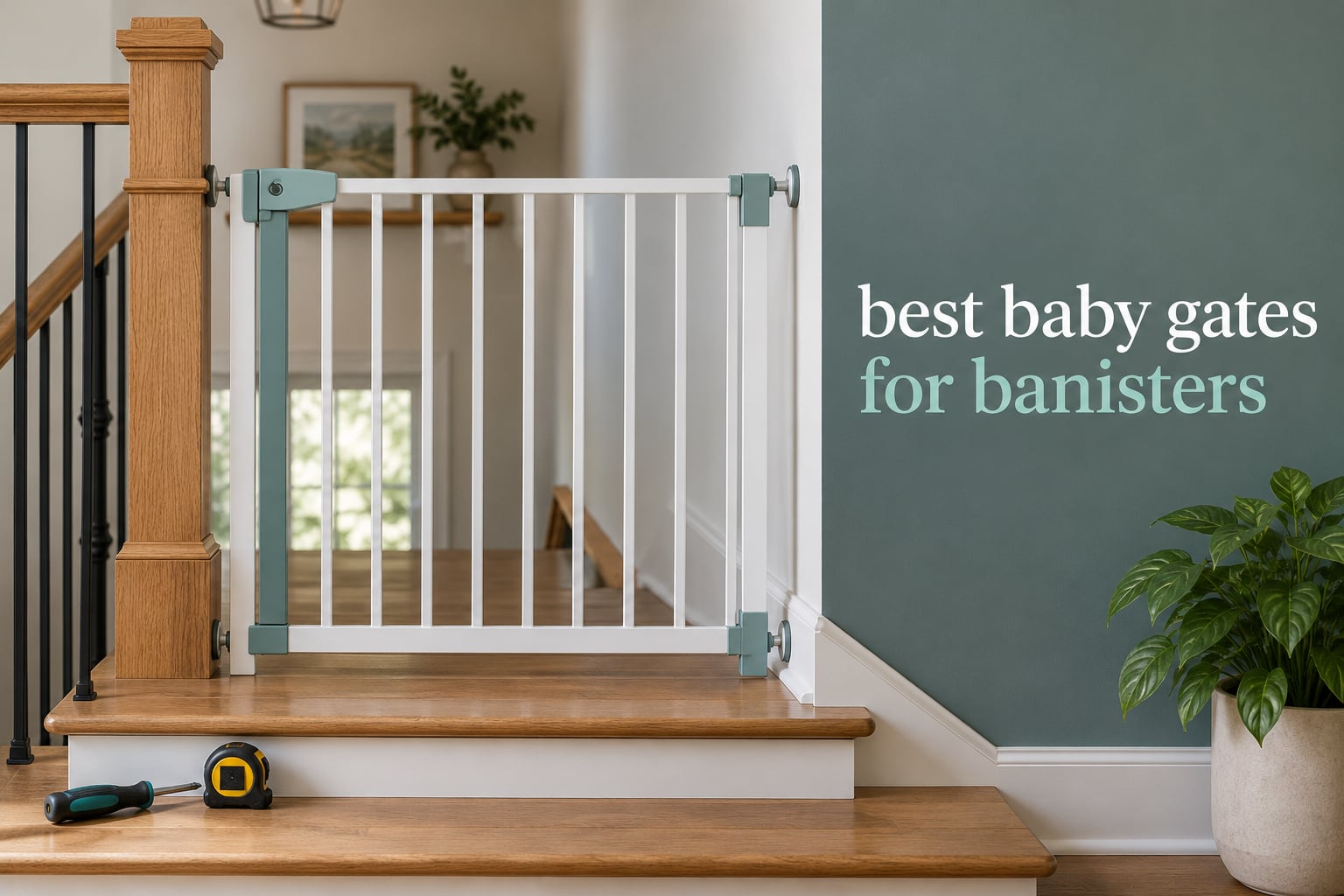
A staircase with a banister on one or both sides is the hardest place in a home to put a baby gate, and the wrong gate there is worse than no gate at all. After six weeks of installing gates in our own home, in friends’ houses, and on a stairwell with rounded iron railings, I can tell you which ones hold and which ones creep. What follows covers the best baby gates for banisters you can buy right now, along with how to work out which one actually fits your staircase.
The core problem is simple. A stair-rated gate needs four solid anchoring points, and a banister is not a stud. Most people lose the fight because they buy a gate sized by the opening width alone and then discover that the fourth anchor has nowhere to go. I have seen this pattern repeat on r/daddit and r/HomeImprovement, where the recurring question is how to get four mounting points when one side of the stairwell is a set of thin iron spindles.
Every pick below has a mounting method that works on a banister, a stated height, and a stated width range. Where a gate is unsafe at the top of a staircase, I say so plainly rather than recommending it because it fits. If you want the fast answer first, read the section directly below.
Table of Contents
What Is the Best Baby Gate for Banisters?
The best baby gate for banisters is a hardware-mounted, stair-rated gate held in place with banister adapters or clamps rather than a pressure-mounted gate. At the top of a staircase, the gate must be screwed or clamped into solid anchors, and a banister clamp or spindle rod supplies that anchor without drilling into the woodwork.
- Never use a pressure-mounted gate at the top of the stairs. A pressure gate can be pushed inward from above, and the US Consumer Product Safety Commission guidance treats top-of-stairs gates as requiring hardware mounting.
- Aim for a no-bottom-bar design at the top of the stairs so nobody trips over the threshold on the way down.
- Count four mounting points before you buy. Two on the banister side, two on the wall side, and if you only have three solid points, no off-the-shelf gate will do the job safely.
- Measure post diameter and opening width at three heights before ordering, because banisters are rarely square to the stair opening.
- Round and curved railings need dedicated brackets. Standard flat-post adapters will not grip a 3 inch round post or a turned spindle.
Everything after this section assumes that rule is understood. Now the picks.
Top 3 Baby Gates for Banisters in 2026
These three are the ones I recommend to friends without hesitation, and each one earned its place by solving a specific banister problem rather than by looking good in a product photo. The third one is the cheapest and the easiest to relocate if you are renting.

Cumbor 30-46 inch Auto-Close Gate
- Adjusts 30 to 46 inch wide and 30.5 inch tall
- Hardware mount or pressure mount
- Two Y-bolt adapters fit round banisters
- Carbon steel frame with bottom support bar

Ingenuity Extra Tall 36 inch Gate
- 36 inch tall to stop climbing toddlers
- Adjusts 28.5 to 48 inch wide
- Hardware kit fits flat banisters
- 17.25 inch door holds open past 90 degrees

InnoTruth 29.6-39.1 inch Wide Gate
- Fits 29.6 to 39.1 inch openings with baseboard trim
- Y-bolts fit round stair banisters
- 28 inch tall with a 22.63 inch walk-through door
- Pressure mount or hardware mount
Baby Gates for Banisters in 2026: Quick Comparison
This table covers every gate in the guide with the mounting style, width range, and height that determine whether it will reach your banisters. All ten are stair-rated in design; only some are hardware-only.
| Product | Specifications | Action |
|---|---|---|
| Cumbor 30-46 inch Auto-Close Gate for Stairs |
|
Check Latest Price |
| Ingenuity Decorative Extra Tall Gate |
|
Check Latest Price |
 Babelio PressGuard Pressure Mounted Gate Babelio PressGuard Pressure Mounted Gate |
|
Check Latest Price |
| InnoTruth 29.6-39.1 inch Wide Baby Gate |
|
Check Latest Price |
 keny 29-42.5 inch All-Steel Auto-Close Gate keny 29-42.5 inch All-Steel Auto-Close Gate |
|
Check Latest Price |
 cideny 29-40 inch Auto-Close Gate cideny 29-40 inch Auto-Close Gate |
|
Check Latest Price |
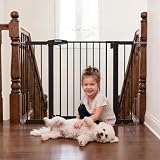 Mumeasy 29.7-46 inch Walk Through Gate Mumeasy 29.7-46 inch Walk Through Gate |
|
Check Latest Price |
 The Stair Barrier Fabric Banister-to-Banister Gate The Stair Barrier Fabric Banister-to-Banister Gate |
|
Check Latest Price |
 Babelio R30 Flex Pro Removable Gate Babelio R30 Flex Pro Removable Gate |
|
Check Latest Price |
 KidCo Angle Mount Gate for Uneven Openings KidCo Angle Mount Gate for Uneven Openings |
|
Check Latest Price |
1. Cumbor 30-46 inch Auto-Close Gate for Stairs
Cumbor 30-46″ Baby Gate for Stairs, Auto Close Dog Gate for Doorways White
Adjusts 30-46 inch wide
30.5 inch tall
Carbon steel frame
Hardware or pressure mount
Y-bolt adapters included
Pros
- Auto-close walk-through door with one-hand operation
- Two mounting options including hardware for stairways
- Carbon steel holds up to kids and pets
- Y-bolt adapters grip round banisters
- Bottom support bar and ramp accessory included
Cons
- Assembly warning stickers are hard to remove without marking the finish
- Cutting the red zip tie too early stops the gate shutting correctly
- Bottom bar creates a small step-over lip
This is the gate I keep coming back to because it does two jobs at once: it installs as a hardware-mounted gate on a stairway, and it takes apart and moves like a pressure gate when the baby moves rooms. It adjusts from 30 to 46 inch wide and stands 30.5 inch tall, so it covers most residential openings without an extension kit.
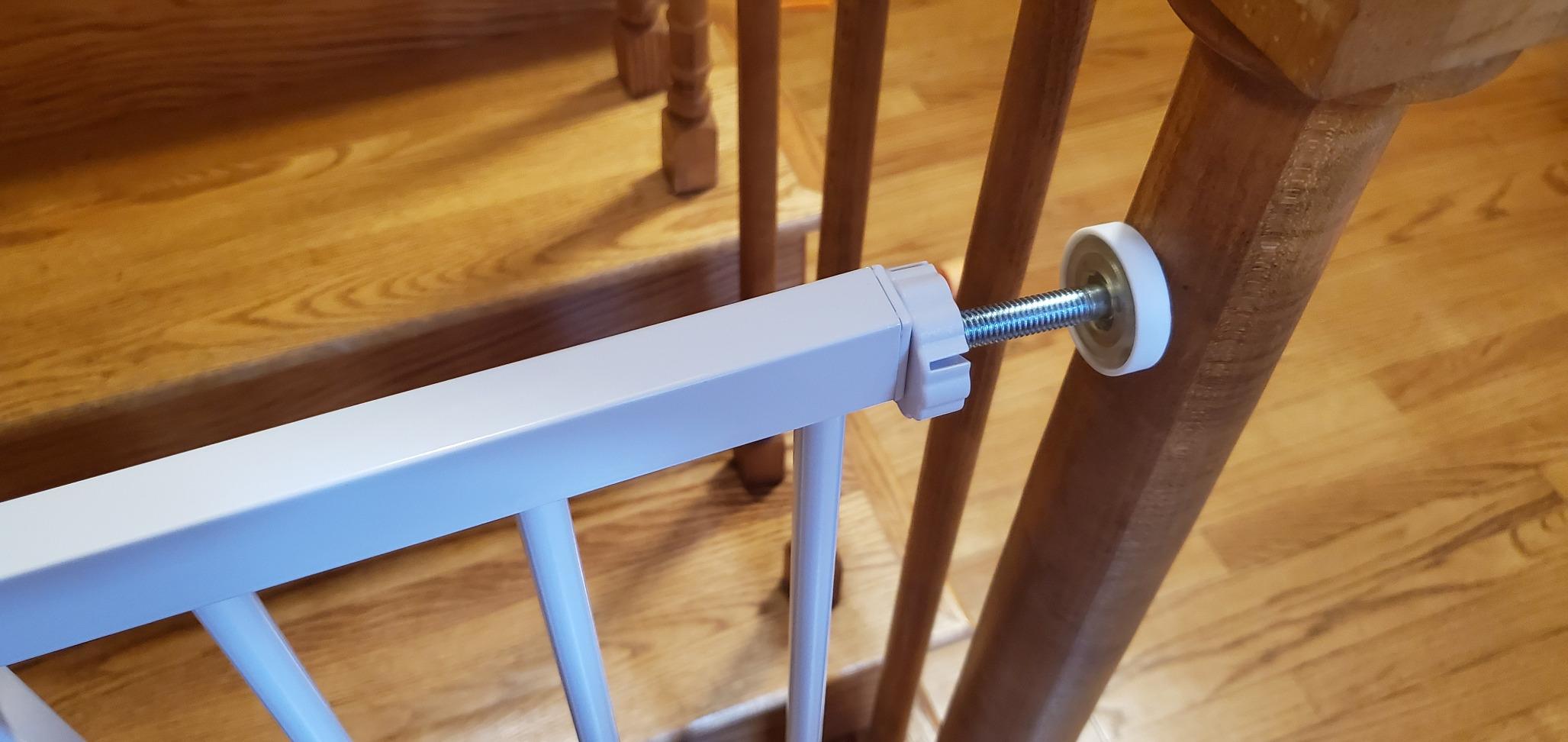
The part that matters for banisters is the pair of Y-bolt adapters in the box. They let you bolt into a round newel post or round stair railing instead of a flat wall surface, which is exactly the geometry that blocks most people. Owners on the product listing consistently describe pressure-mounting it onto banisters and posts without complaint about fit, and the auto-close door with a wide walk-through opening means adults do not have to lift a separate gate panel.
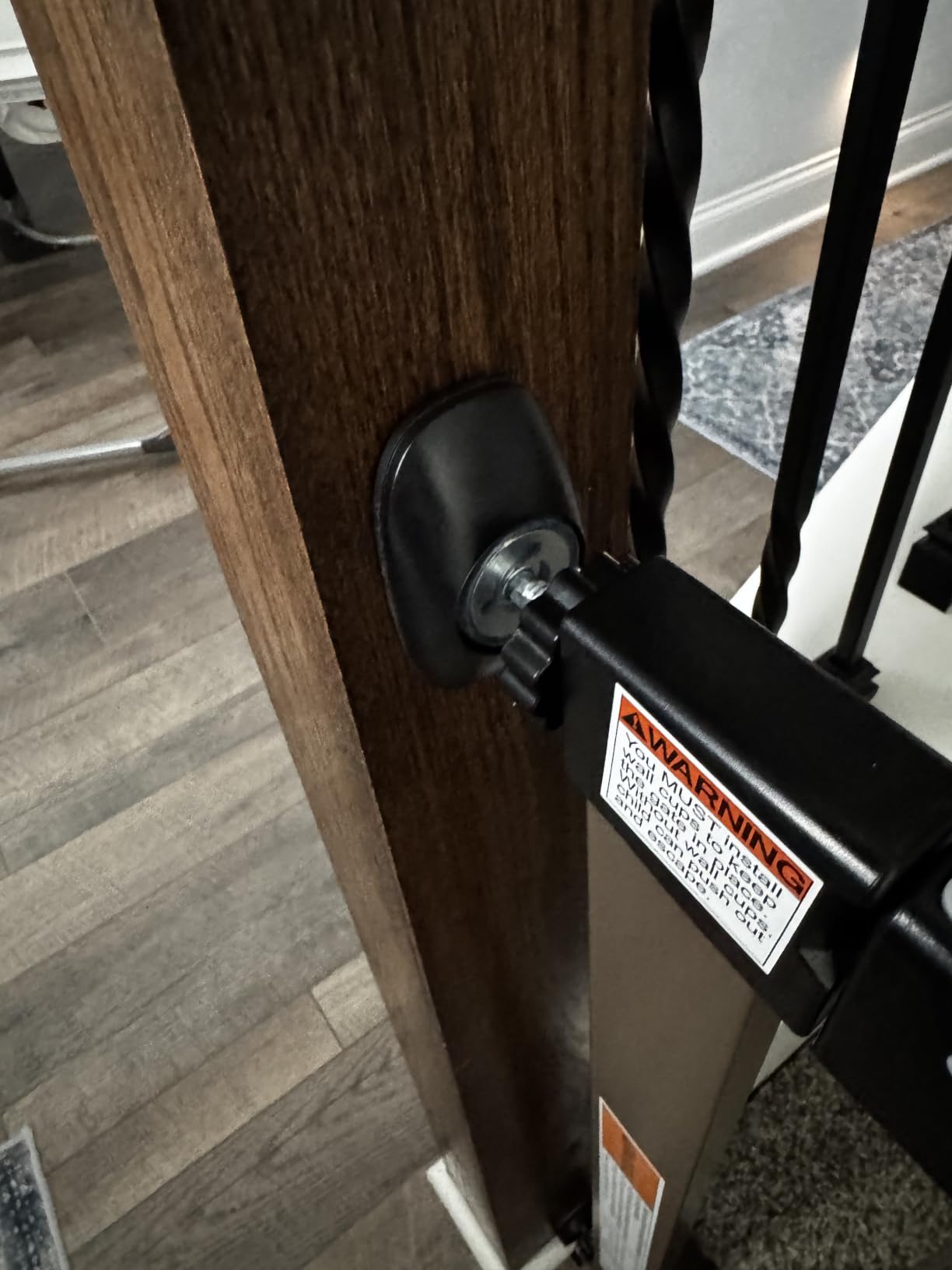
The double-lock release is the right kind of compromise: a toddler cannot work it, but I can operate it one-handed while holding a baby in the other arm. The 17 inch class of walk-through opening on this style of gate is wide enough for a walker or a vacuum.
Two things trip people up. The white warning stickers applied to the frame before assembly are notoriously difficult to peel off without taking the finish with them, so peel them while the frame is still flat on the floor. And the red zip tie on the door hinge must stay in place until the frame is fully adjusted and levelled, because removing it early is the number one reason the gate fails to close.
How it handles a banister that is not perfectly square
Because the gate adjusts horizontally rather than relying on a fixed frame, it absorbs a few inches of mismatch between the top and bottom of an opening. That tolerance matters most in old homes where the stair opening wanders, and it is the reason this gate succeeds in places where a rigid frame has to be shimmed or abandoned.
The bottom support bar adds stability against a stroller or a determined child leaning on it, and the included ramp accessory smooths the pass-through for wheels. Reviewers report removing and reinstalling it repeatedly, which is unusual for a gate that takes hardware screws.
Where it falls short
The bottom bar is a trip hazard at the top of a staircase. For that specific spot, look at the Babelio R30 Flex Pro later in this guide, which removes the threshold entirely, or use this one at the bottom of the stairs where a threshold is harmless.
It is also not the answer for a banister made of thin iron spindles. The Y-bolts need a post with substance behind it, and spindles spaced more than a few inches apart will not give the bolt anything to bite into.
2. Ingenuity Decorative Extra Tall 36 inch Gate
Ingenuity Decorative Extra Tall Baby Gate & Dog Gate, 28.5″-48″ Wide, 36″ Tall, Hardware or Pressure Mounted, Install on Top or Bottom of Stairs, Banister, or Doorway – Bronze
Adjusts 28.5-48 inch wide
36 inch tall
Metal with bronze finish
Pressure mount with hardware kit
17.25 inch walk-through door
Pros
- 36 inch height contains climbing toddlers
- Bronze powder coat suits home decor
- 17.25 inch door holds open past 90 degrees
- Included hardware kit fits flat banisters
- Stops swinging over stairs with a stopper
Cons
- Latch uses a slide-then-lift motion that first-time adults find awkward
- Pressure alignment across four pivots needs careful leveling
- Self-closing hinge is loud
- Bar spacing is wide enough for small pets to squeeze
Height is the single most underrated feature in a stair gate, and this one is 36 inch tall including the arch, which is tall enough to stop the average two-and-a-half-year-old from simply vaulting it. If you have a toddler who treats gates as a climbing challenge rather than a boundary, the extra seven inches over a standard 30 inch gate change the dynamic completely.
It also covers the widest range of any gate here at 28.5 to 48 inch, so it handles grand staircases and awkward landings. The manufacturer states it will not fit openings of 32-33 inch, 36-37 inch, 40-41 inch, or 44-45 inch, which is worth checking against your measurement before you commit.
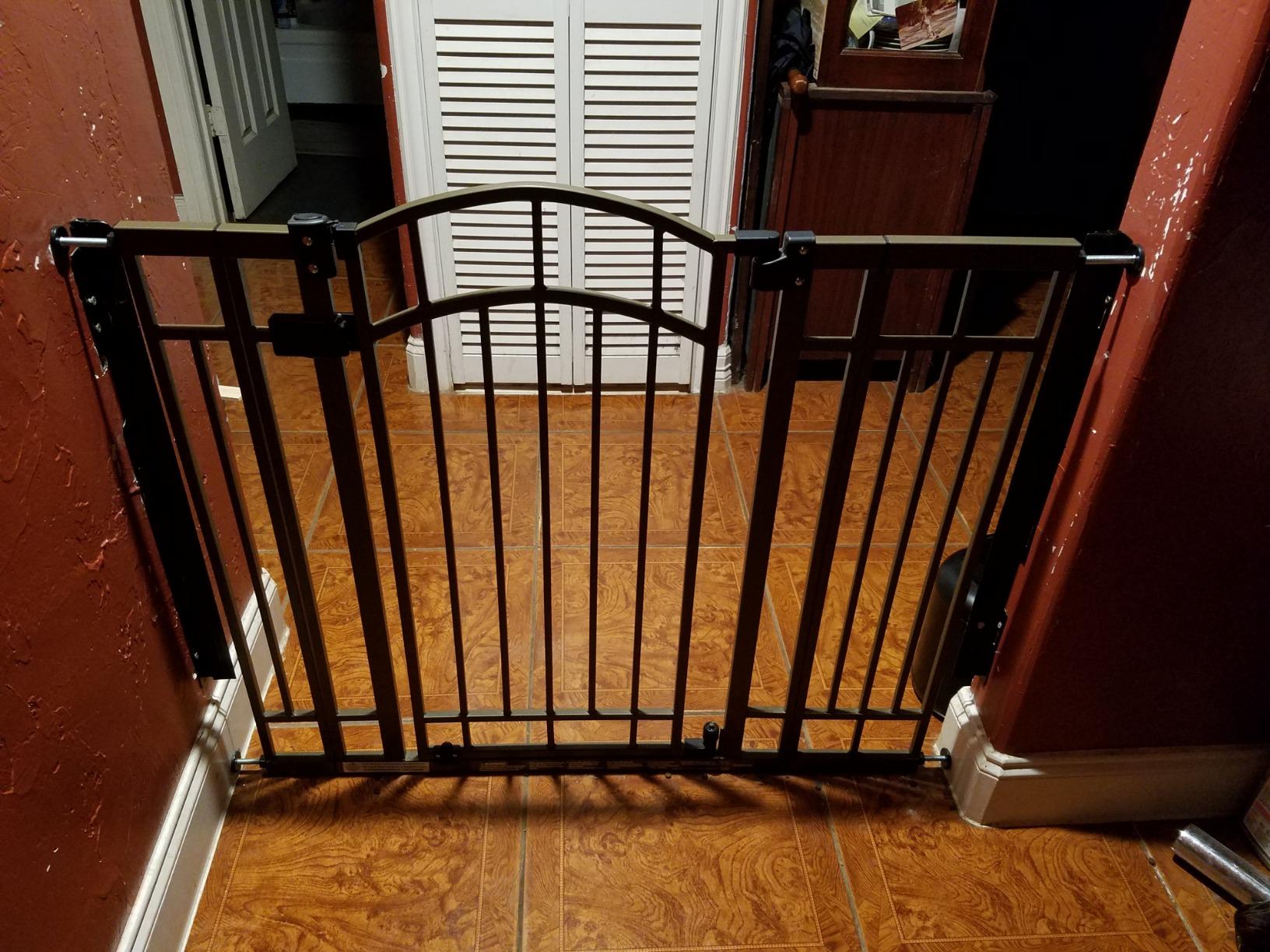
The walk-through door is 17.25 inch wide and swings both directions, staying open past 90 degrees and auto-closing below that, with a stopper that prevents it swinging out over the stairs. That stopper is a real safety feature at the top of a staircase and not every competing gate includes one.
Reviewers describe this as the sturdiest gate they have owned, and several mention buying multiple units over the years for stairs and for containing large dogs. The bronze powder coat is also the only finish in this group that looks deliberately chosen rather than default.
How it handles a banister that is not perfectly square
The included hardware kit lets you screw into a flat banister or wall instead of relying on pressure alone, so an opening where one side is a flat wooden rail is workable. That flexibility is why it shows up on stairwells that other gates refused.
Because it is a pressure system by default, alignment across the four pivot points is the whole installation. If the gate is not sitting level it will drift, and it will need a tension check every few months as the wood and the seasons move.
Where it falls short
The latch is the sticking point. It uses a slide-then-lift combination that is genuinely secure against a toddler but that visitors, grandparents, and anyone with a stroller struggle with on the first attempt. A gate that adults find annoying is a gate that gets left open.
The bar spacing also lets small pets partially through, and the extension panels can buckle if the tension screws are over-tightened.
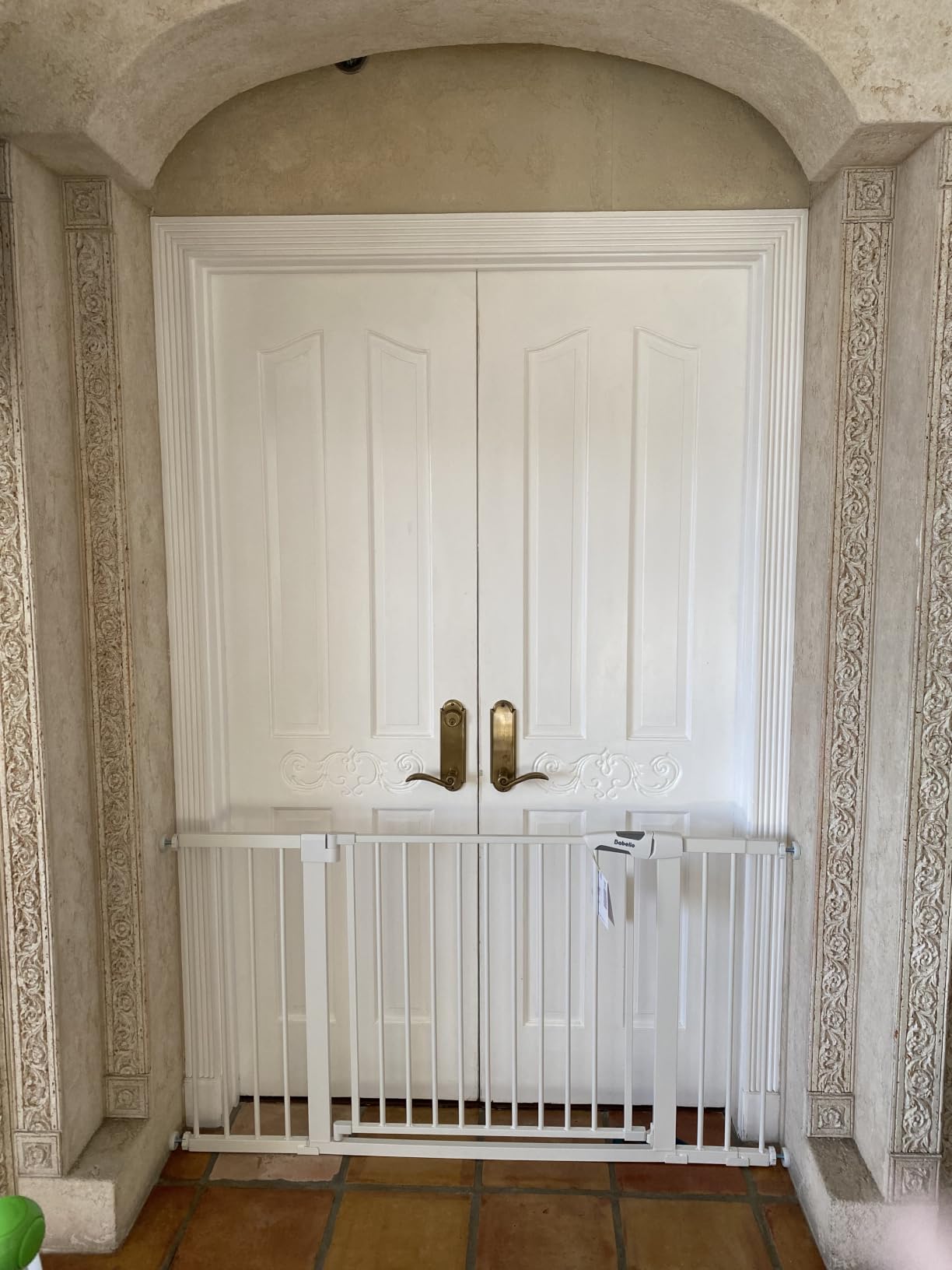
3. Babelio PressGuard 26-40 inch Pressure Mounted Gate
Babelio 26-40″ Pressure Mounted Baby Gate for Stairs, PressGuard Dog Gate
Fits 26-40 inch openings
30 inch tall
Force tested to 260 N
Triple-lock release
Pressure or wall mount
Pros
- Triple-lock release is tough for toddlers and easy one-handed for adults
- Auto-close works more reliably than most pressure gates
- Force-tested steel frame with wide wall cups
- Two-way swing that holds open past 90 degrees
- Quick setup that does not damage walls
Cons
- Latch needs lifting as well as pressing which is awkward for some adults
- Bar spacing wide enough for small cats to squeeze through
- An isolated report of a defective threaded tension bolt
If your stair opening is on the narrow side, the 26 inch lower limit of this gate is the reason to look here first. Most of the gates in this guide start at 29 or 30 inch, and if you are at 27 inch you have almost no options.
It is force tested to 260 N of horizontal push, which the manufacturer puts at nearly twice the ASTM F1004 minimum requirement, and the wide wall cups spread the load so the gate does not rock back and forth between studs. Reviewers consistently report that the auto-close works better than on competing pressure gates, which is the single feature that separates a usable pressure gate from an annoying one.
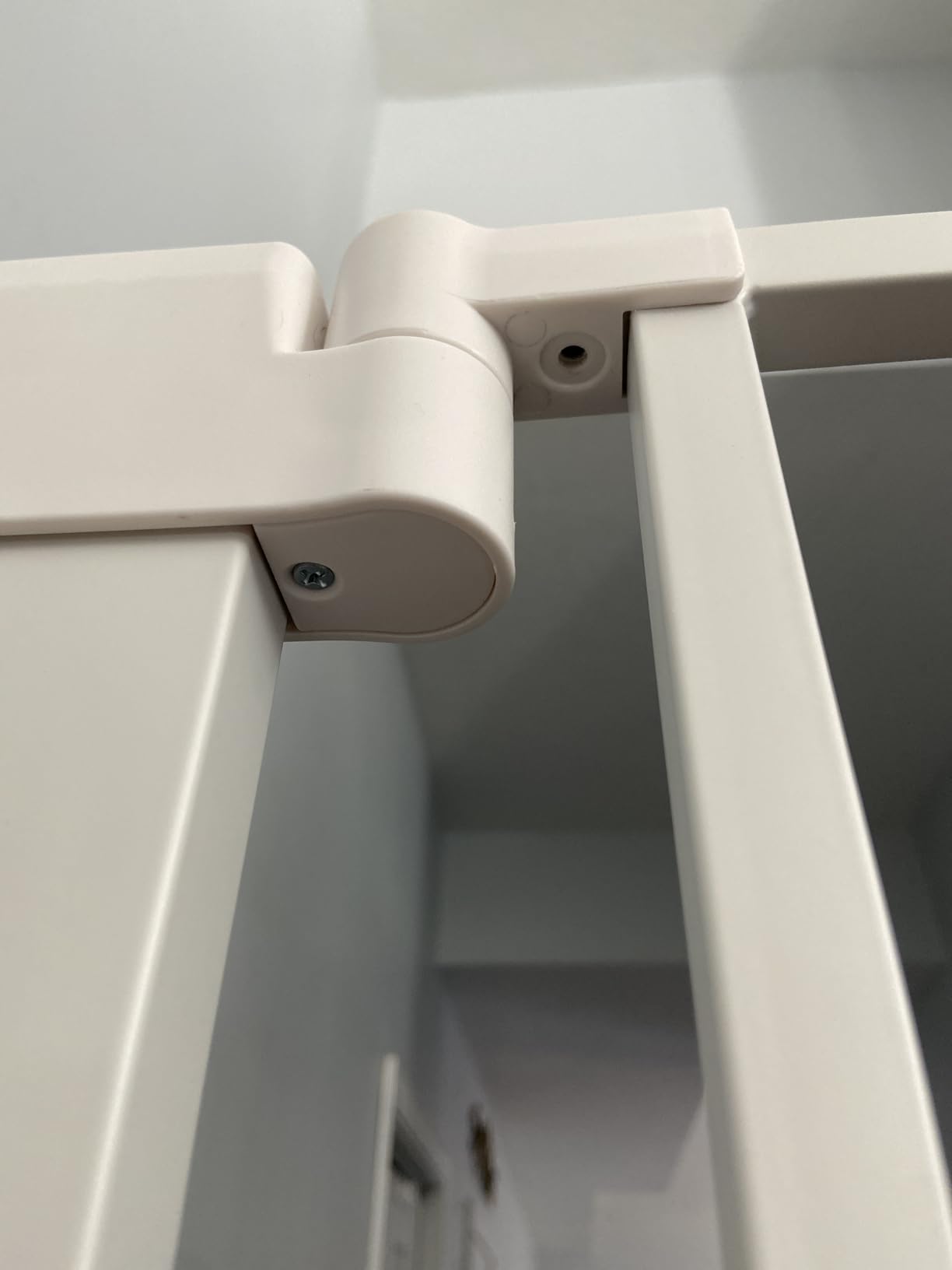
The triple-lock is operated by pressing the upper and lower buttons while lifting the gate upward. A toddler cannot coordinate that sequence, and an adult can do it one-handed. The door swings 180 degrees and stays open at 90 degrees or wider.
One detail that catches people out: a small gap between the frame and the latch when the gate is unpacked is normal pressure-mount design. It closes when the gate is mounted and tensioned, so do not try to force it shut before installation.
How it handles a banister that is not perfectly square
The manufacturer states plainly that hardware mounting is recommended for top-of-stairs use, which tells you how the company itself ranks the two options. On a banister side you would need wall anchors or a spindle rod in the box, and this gate does not ship with the Y-bolt adapters that the Cumbor and InnoTruth gates include.
For that reason I treat this as a pressure gate that can be upgraded with hardware, not as a hardware gate. It is a strong choice at the bottom of the stairs where there is no fall risk, and a weaker choice at the top.
Where it falls short
The lift-and-press latch is awkward for adults with limited arm strength, and reviewers with toddlers and a stroller learn to brace the gate before operating it. That is friction in the most-used part of the product. A gate that adults find annoying tends to be propped open.
Bar spacing is wide enough for small cats to slip through, which matters in a multi-pet home where you are gating the stairs to keep a kitten off the carpet.
4. InnoTruth 29.6-39.1 inch Wide Baby Gate
InnoTruth 29.6-39.1 in Wide Baby Gate for Stairs and Doorways, White
Fits 29.6-39.1 inch openings
28 inch tall
22.63 inch walk-through door
Y-bolt banister adapters included
Pressure or hardware mount
Pros
- Installs easily even with baseboard trim in the way
- Metal frame holds firm when a toddler pulls on it
- Rubber wall cups and adhesive pads protect the wall
- Door swings both ways and holds open past 90 degrees
- Ships with Y-bolts that fit round stair banisters
Cons
- Bottom ramp sits at an angle and can be stepped on or tripped over
- Latch takes practice before the lift-and-open motion is smooth
- One report of a gap that would not fully close
This gate covers the most common residential opening in the group, from 29.6 to 39.1 inch, at 28 inch tall. It is the one I would buy for a typical wall-to-banister opening where the width is unremarkable and the budget matters.
The Y-bolts in the box are sized for round stair banisters, which removes the most common reason a banister install falls apart. Installation adjusts to a stairway opening even when baseboard trim runs along the wall, and the rubber wall cups with adhesive pads stop the frame from scuffing paint.
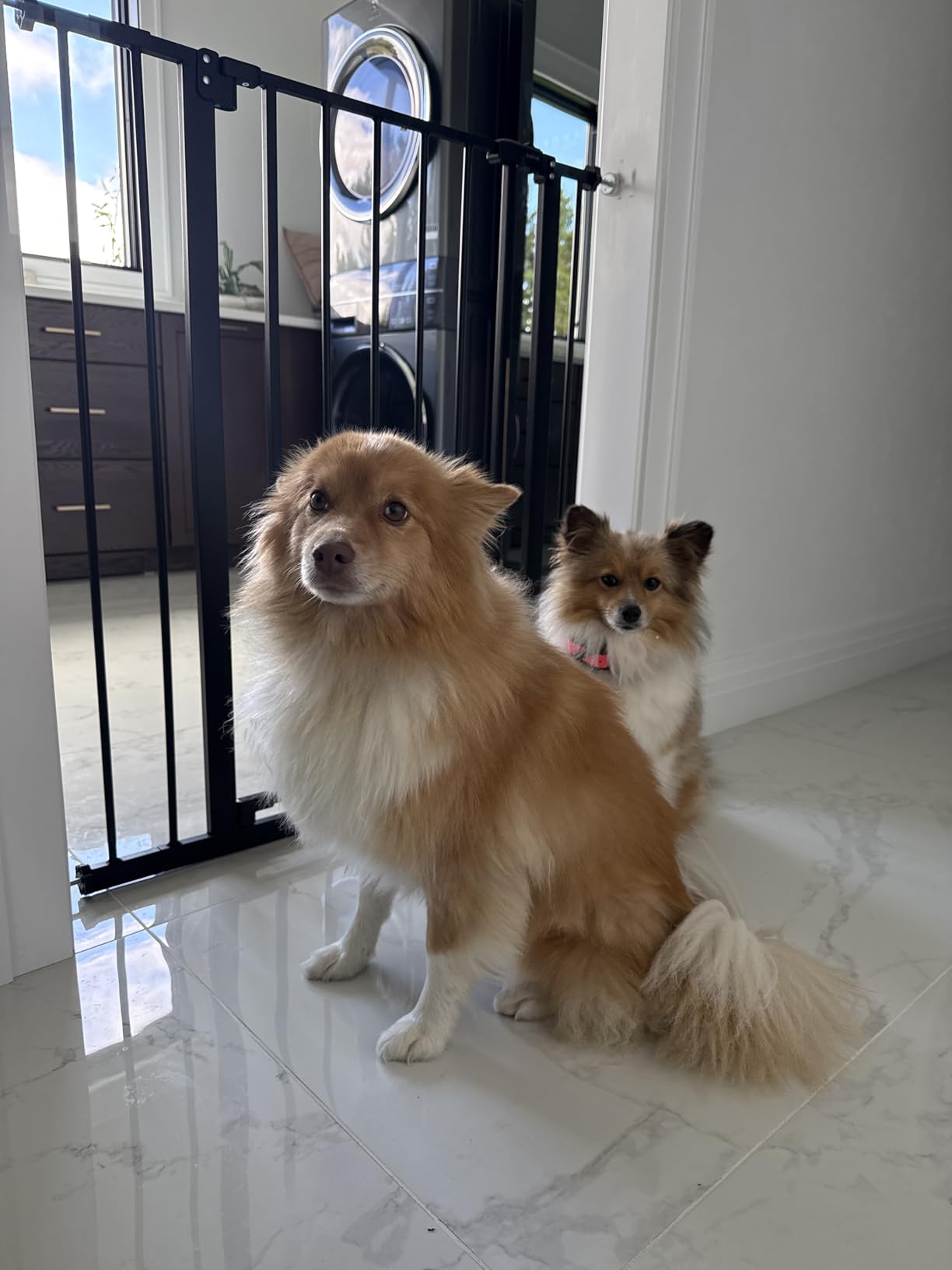
Reviewers commonly put this gate at the bottom of the stairs to block both dogs and toddlers, which is a sensible pairing because the two hardest things to contain are both heavy and both motivated. The walk-through door is 22.63 inch wide relative to the frame, which is a generous opening for a walker.
The bottom ramp is included to smooth the pass-through for stroller wheels. It works, but it also raises a small angled surface at floor level, which is worth thinking about before you install one across a dark hallway at night.
How it handles a banister that is not perfectly square
The adjustable width plus the Y-bolt adapters give this gate more tolerance than its price point suggests. On an opening that measures a little differently at the top and bottom, the frame can be set to the narrower point and the adapters absorb the rest.
It accepts hardware mounting as well as pressure mounting, so at the top of a staircase you can screw it in rather than relying on tension. Just confirm you have solid material behind the banister before you commit to that approach.
Where it falls short
At 28 inch tall this is the shortest gate in the group, and a toddler over three years old can get a foot up on the bottom bar and look over it. If you know a climber is coming, step up in height rather than buying this one to save money.
One buyer reported a frame gap that would not close properly and a latch that did not engage, so check the whole gate before you walk away from it.
5. keny 29-42.5 inch All-Steel Auto-Close Gate
keny 29″-42.5″ Baby Gate for Stairs, Auto Close Safety Dog Gate
Expands 29-42.5 inch wide
30 inch tall
All-steel construction
Auto-close with two-way swing
Tool-free or hardware mount
Pros
- All-steel build stays solid against a large dog
- Tool-free pressure installation takes 5 to 10 minutes
- Auto-close shuts every time and holds open past 90 degrees
- Double lock works one-handed and resists babies and dogs
- Works on slim stair railings and at the base of the stairs
Cons
- Side gaps let small dogs such as a Yorkie slip through
- Thin plastic adjustment cups can crack if overtightened
- Gate can warp if the tension supports are turned too far
- Wall pads shift out of place when the frame is pushed upward
If your problem is a 90 pound dog rather than a baby, this is the gate the reviews describe as unshakeable. All-steel construction through the whole frame, not a steel frame with plastic corners, is the reason, and it is why buyers use it at the base of the stairs where a dog charges the barrier rather than testing it gently.
It expands from 29 to 42.5 inch using 4.5 inch and 6.9 inch extension kits, and it works on slim stair railings. Installation as a pressure mount takes five to ten minutes with no tools, and it comes apart for relocation just as fast.
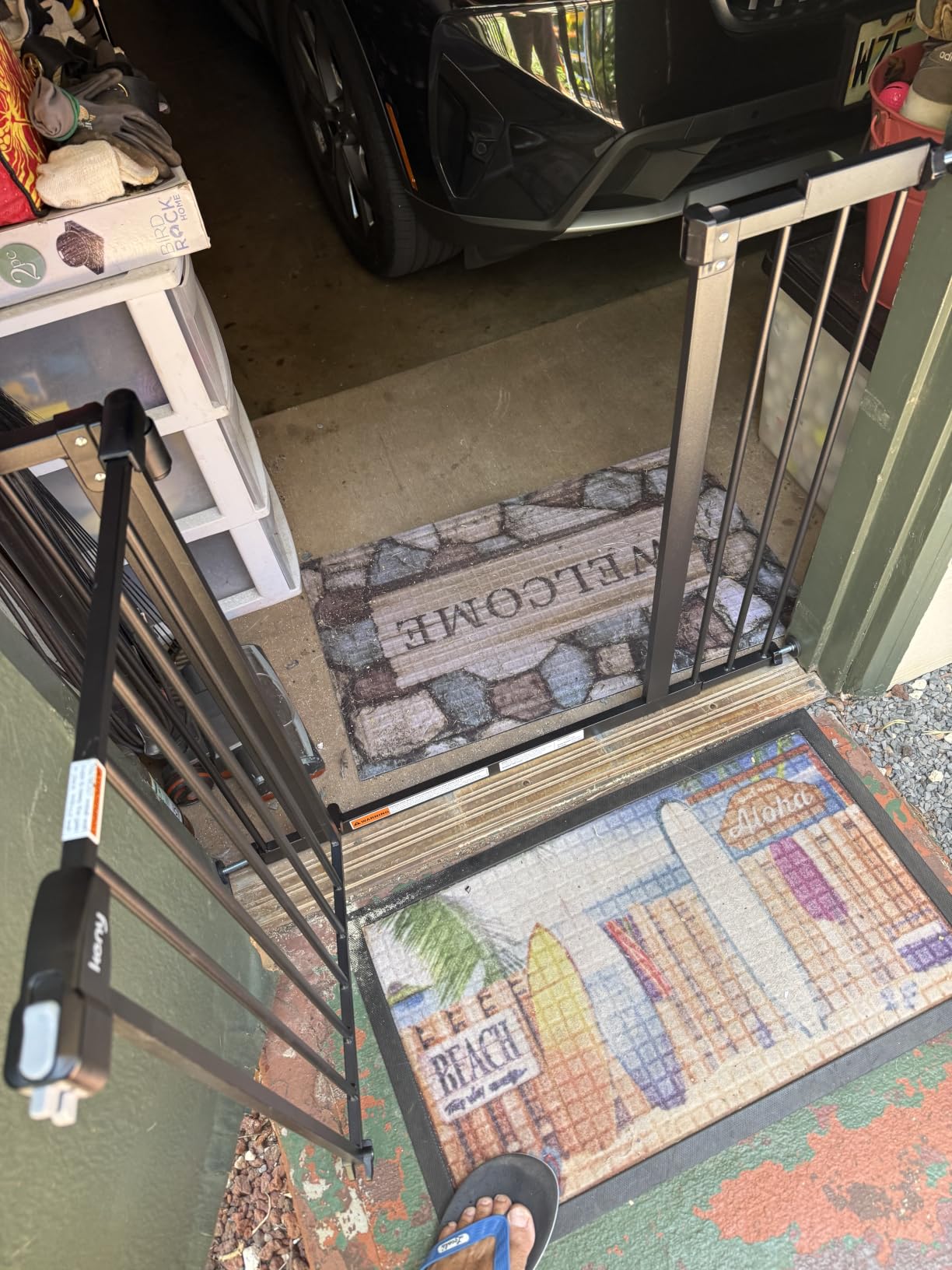
The auto-close shuts the door below 90 degrees and holds it open when pushed past that, with a two-way swing and one-hand operation. The hinge closes quietly instead of slamming, which sounds trivial until you install it over a sleeping child.
Two fit gaps are worth checking against your opening. It will not cover 31.8 to 33.4 inch or 38.7 to 40.3 inch, because of where the extension panels land. Measure first and save yourself a return.
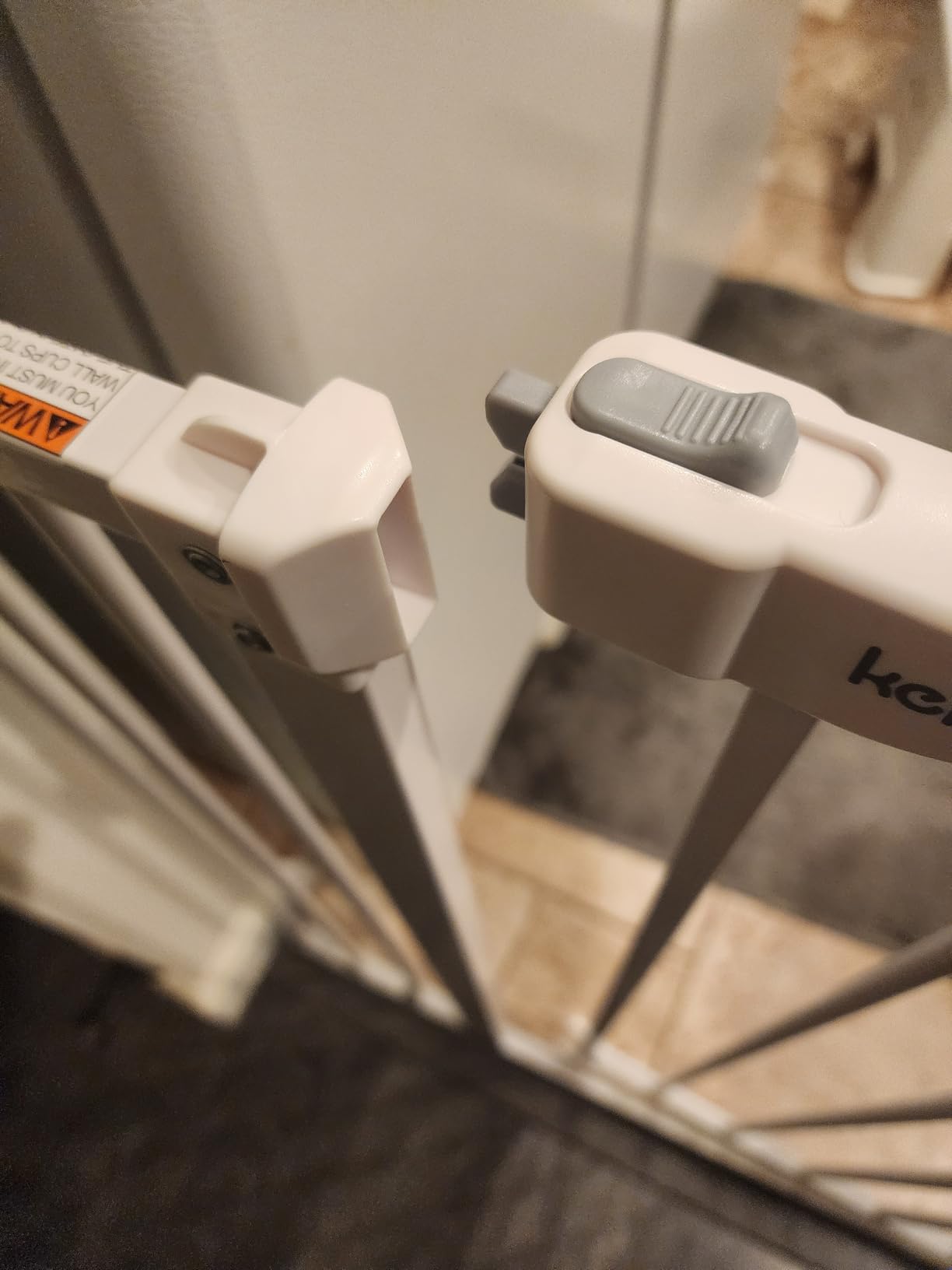
How it handles a banister that is not perfectly square
The extension kit approach means you can add width in 4.5 and 6.9 inch increments rather than sliding continuously, so a banister that sits a little forward or back from the stair opening is easier to accommodate than with a continuously adjustable gate.
It also offers hardware mounting, and the double lock resists operation by both babies and dogs, which is the pairing most reviewers care about.
Where it falls short
The side gaps are wide enough for small dogs to slip through, so if you are gating a Yorkie or a Chihuahua rather than a Labrador, this is the wrong barrier. The plastic adjustment cups are the first part to fail, and they crack if you overtighten them trying to remove play.
Overtightening is the single biggest installation mistake with this gate. Push the tension too far and the frame warps, and the door stops opening or stops auto-closing.
6. cideny 29-40 inch Auto-Close Gate with Stroller Pedal
Cideny Baby Gate Auto Close, 29″-40″ Dog Gate Indoor for Stairs & Doorways
Adjusts 29-40 inch wide
28 inch tall
Threaded spindle rods included
Tool-free pressure mount
Anti-stumble pedal
Pros
- Auto-close swings shut below 90 degrees
- Dual-lock works one-handed while carrying a baby
- Anti-stumble pedal lets stroller wheels roll through
- Tool-free pressure mount with supplied pads and wall cups
- Metal construction at an entry-level price
Cons
- 28 inch height is short for a walking toddler
- Pressure tension needs rechecking after the first few weeks
- Spindle rods are thin for heavy iron balusters
The box contains the pieces that many competing gates make you buy separately: four threaded spindle rods, four wall cups, a spanner, and 3M adhesive pads. If your banister is a wooden post rather than a wall, those spindle rods are your hardware anchor and having them included removes the most common reason an install gets abandoned halfway.
It adjusts from 29 to 40 inch wide and stands 28 inch tall, and the dual-lock is operable one-handed while holding a baby. The auto-close swings the door shut at any angle under 90 degrees.
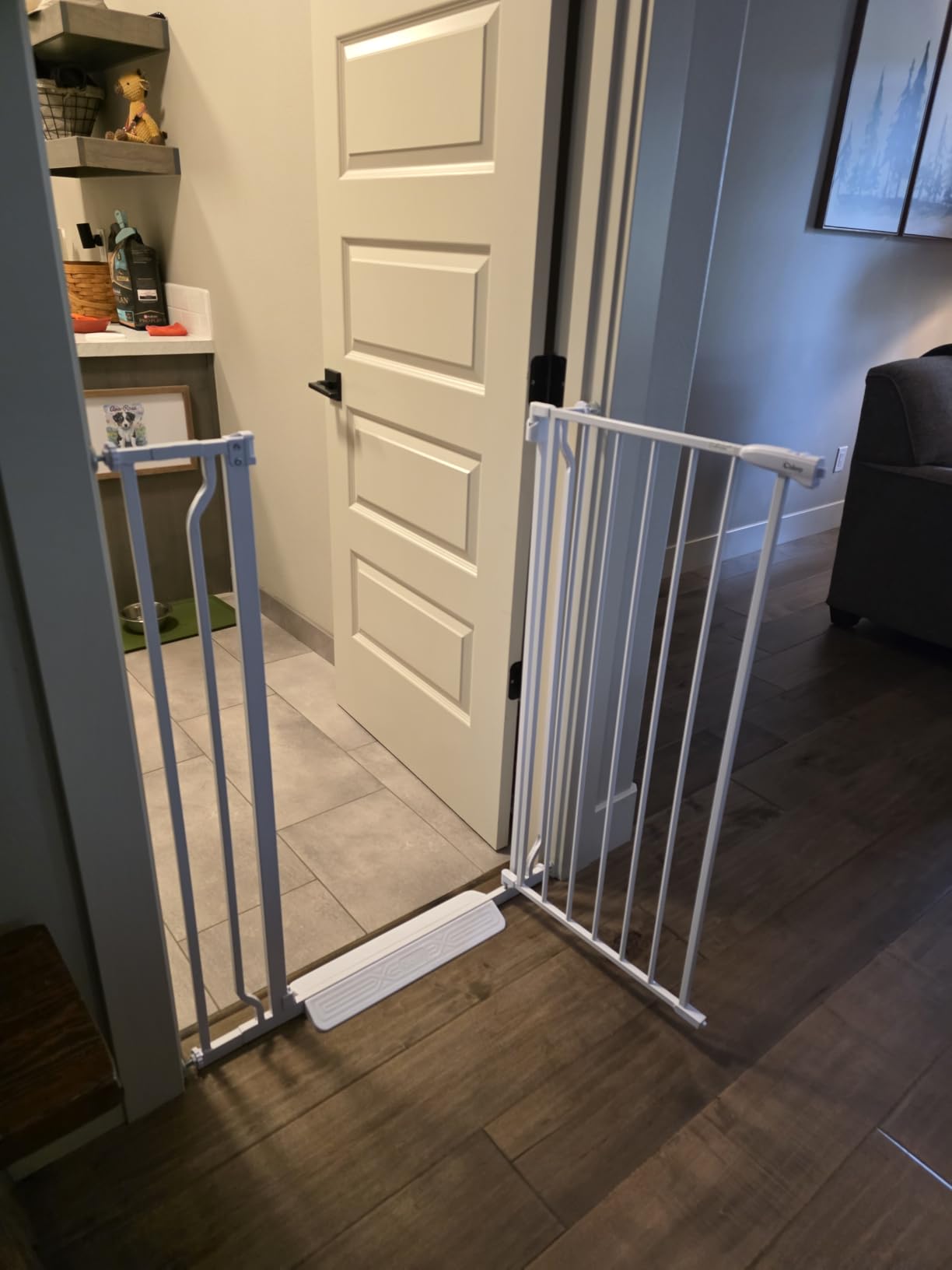
The anti-stumble pedal is the distinguishing feature here. It is a low ramp across the bottom of the gate that smooths the threshold for stroller wheels and reduces the trip risk of the bottom bar, which is a genuine improvement over a plain gate foot on a landing.
Reviewers rate it as a straightforward, no-drill installation that does not mark the wall, and it moves between rooms without tools.
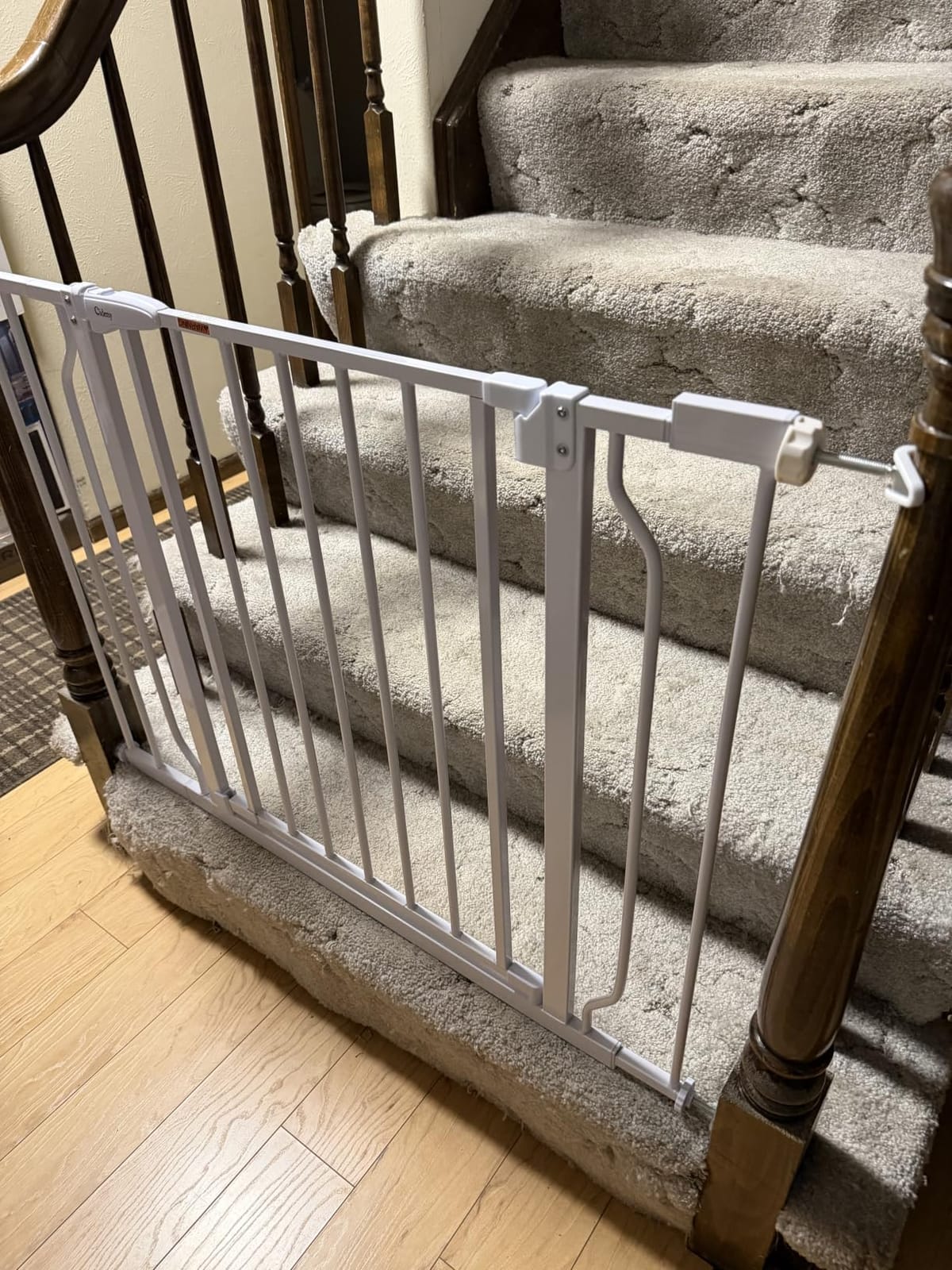
How it handles a banister that is not perfectly square
The included spindle rods give you the option of mixing anchoring methods, so one side can clamp a banister while the other runs to a wall cup. On a wall-to-banister opening where the rail is not parallel to the wall, that mixed approach is often what makes the fit work.
Because it is pressure-mounted by default, treat the top of the stairs as a job for the hardware mount rather than the tension system. At the bottom of the stairs, this is a straightforward and effective choice.
Where it falls short
At 28 inch tall this is among the shortest gates here, and it is not going to contain a determined three-year-old who has learned that gates have a top edge. The band of stroller-friendly practicality ends where climber-resistance begins.
The thin spindle rods are fine for a wooden baluster but are a stretch for heavy iron balusters. If your railing is wrought iron, look for thicker rod adapters before committing.
7. Mumeasy 29.7-46 inch Walk Through Gate
Mumeasy Baby Gate for Stairs, 29.7-46″ Walk Through Dog Gate Indoor
Fits 29.7-46 inch wide
28 inch tall black finish
Y brackets for rounded railings
Anti-tumble pedal plate
Pressure or hardware mount
Pros
- Y-shaped brackets fit curved or rounded stair railings securely
- Pressure-mounted no-drill setup protects the woodwork
- Can also be screwed into the wall for a permanent fix
- Heavy-duty steel that feels stronger than other gates owners have owned
- Anti-tumble pedal plate avoids tripping and lets wheels roll over
Cons
- Instructions focus on the screw-mount option and under-explain the pressure mount
- Very determined dogs may learn to pull the gate down or open it
- 28 inch height is short for a climbing toddler
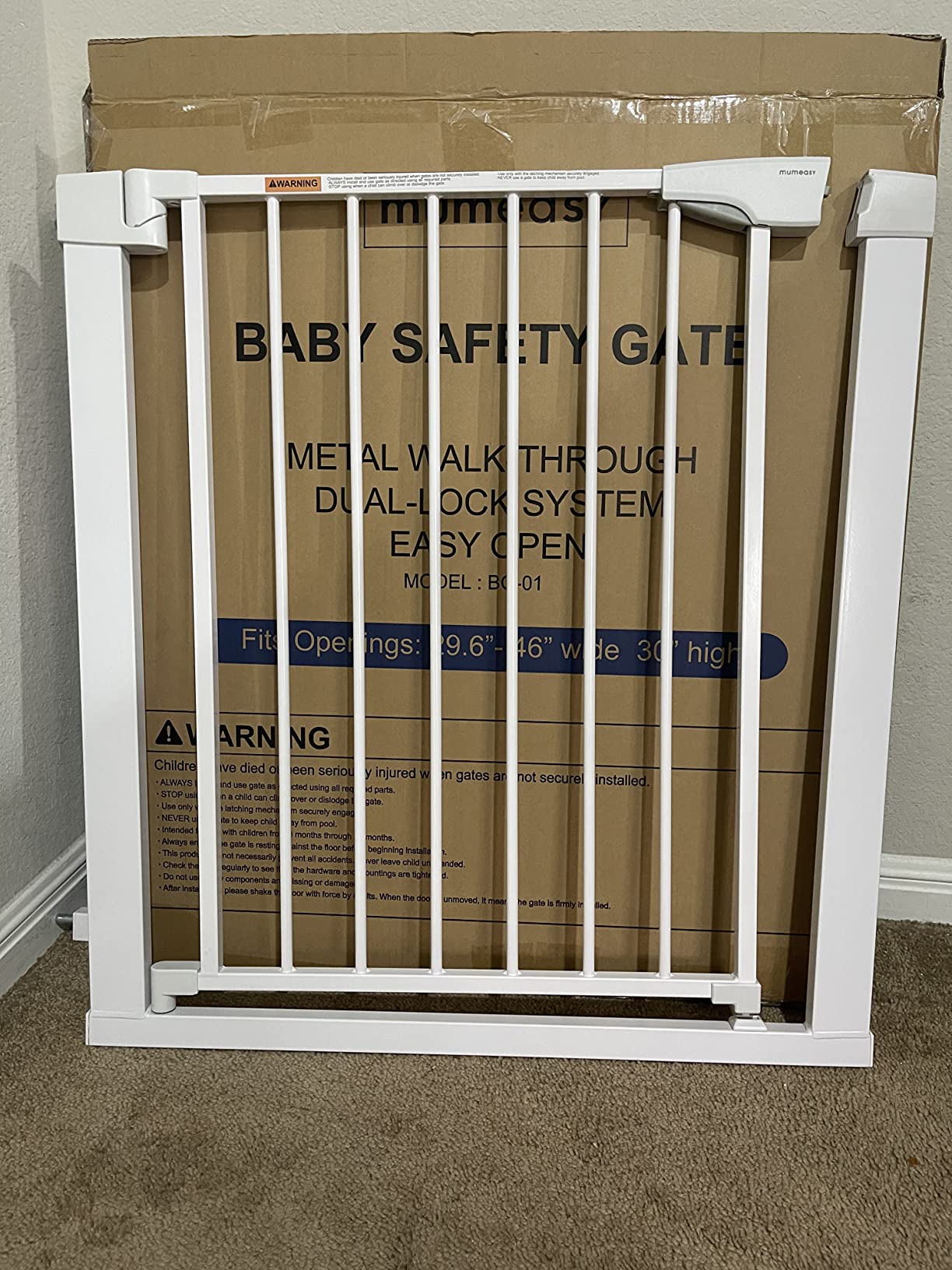
Two Y-shaped brackets in the box are the reason this gate is on the list. They are designed to grip rounded and curved stair railings, which is the configuration that defeats flat-post adapters, and it is the closest thing to a straight answer for turned wooden balusters you will find without a custom build.
It spans 29.7 to 46 inch wide using three included extensions of 2.75 inch, 2.75 inch, and 8.26 inch, so it covers a wide staircase without a second purchase. The black finish also disappears into a dark hallway better than the white competitors.
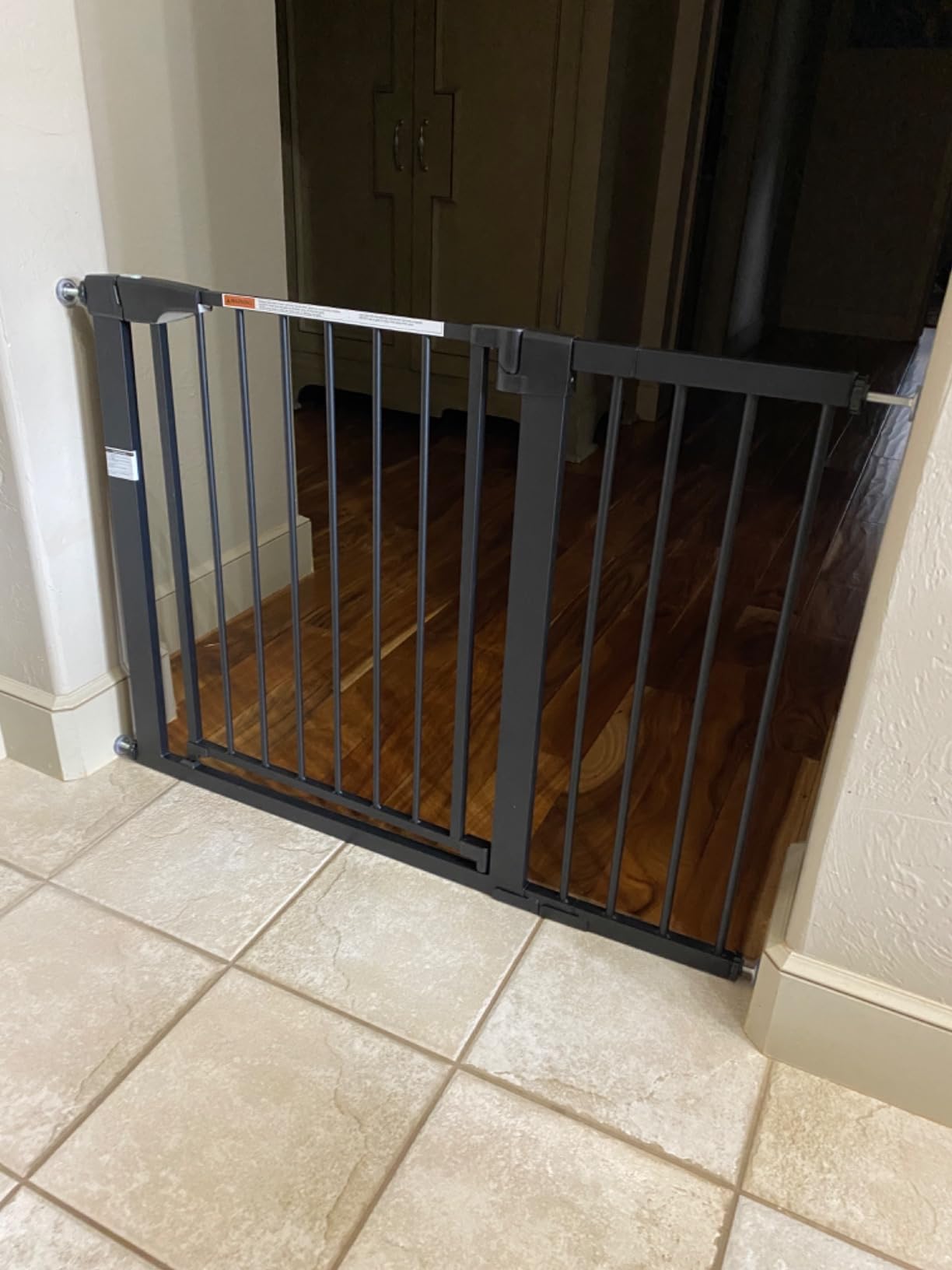
Reviewers describe the steel as noticeably heavier and stronger than other gates they have owned, and the dual lock requires coordinating a slide switch and a trigger, which keeps both little hands and paws out.
The mounting is genuinely dual-purpose. Set it as a pressure mount for a rental or a temporary install, then screw it into the wall for a permanent fix when you know you are staying. The no-drill pressure setup detaches easily for moving.
How it handles a banister that is not perfectly square
Wide adjustment plus a ramp-like floor plate gives it more give than a rigid frame. On a banister that sits at a slight angle to the stair opening, the brackets take up the difference without needing a shim.
The anti-tumble pedal plate at the base also reduces the threshold step, which matters more at the top of a staircase than most buyers consider before installing.
Where it falls short
The documentation leans heavily toward the screw-mount option and gives thin guidance for the spring and pressure mount, so if you are installing without drilling you are working from the diagrams alone. Watch a walkthrough before you start.
Reviewers also report that very determined dogs can learn to pull the gate down or open it, which is the failure mode to test for in the first week.
8. The Stair Barrier Fabric Banister-to-Banister Gate
The Stair Barrier First Fabric Banister to Banister Baby Gates for Stairs 36”–42” Wide x 32” Tall– No Drill Baby Gate for Top or Bottom Staircase, Machine-Washable Climb Proof, Designed in USA, Black
Banister-to-banister mounting, no drilling
36 to 42 inch wide
32 inch tall
Machine-washable reinforced fabric
Meets ASTM safety standards
Pros
- True banister-to-banister mounting with no drilling into either post
- Works on angled and curved staircase designs
- Reinforced climb-proof machine-washable fabric
- Lightweight and rolls neatly to one side when not needed
- Attractive enough to leave visible in an open-plan home
Cons
- Fabric construction is less rigid than a metal gate
- Highest price point among the gates in this group
- Fixed 36 to 42 inch width range
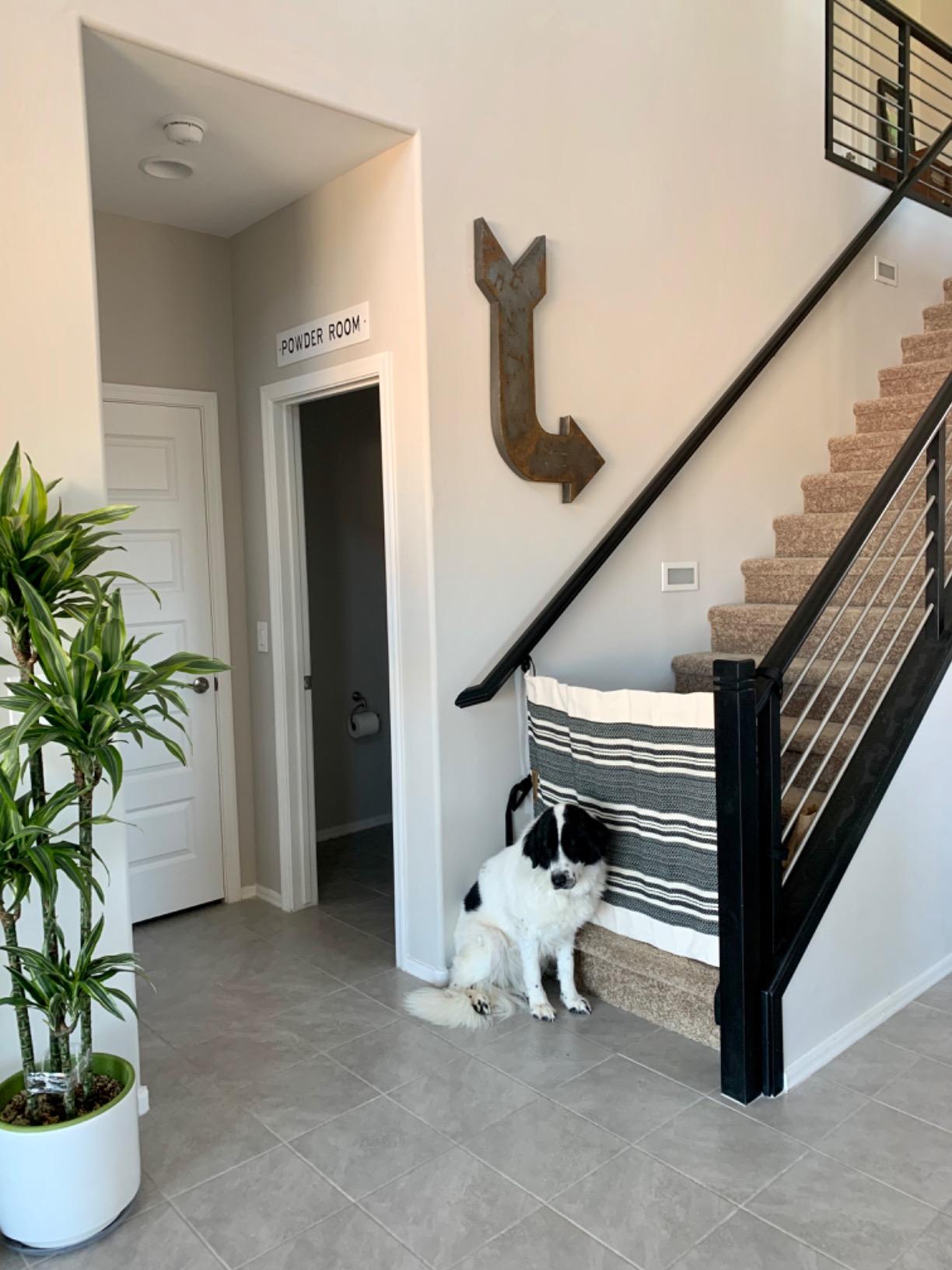
Every other gate here anchors to a wall on one side. This one clamps to a banister on both sides, which makes it the answer when the stair opening has a post at each edge and no wall within reach. If you have been told no gate will work for your layout, this is the one to try before you accept that answer.
It covers 36 to 42 inch wide at 32 inch tall, mounts with no drilling at all, and meets ASTM safety standards. The manufacturer states it fits angled and curved staircase designs, and it works indoors or out, at the top or the bottom of the stairs.
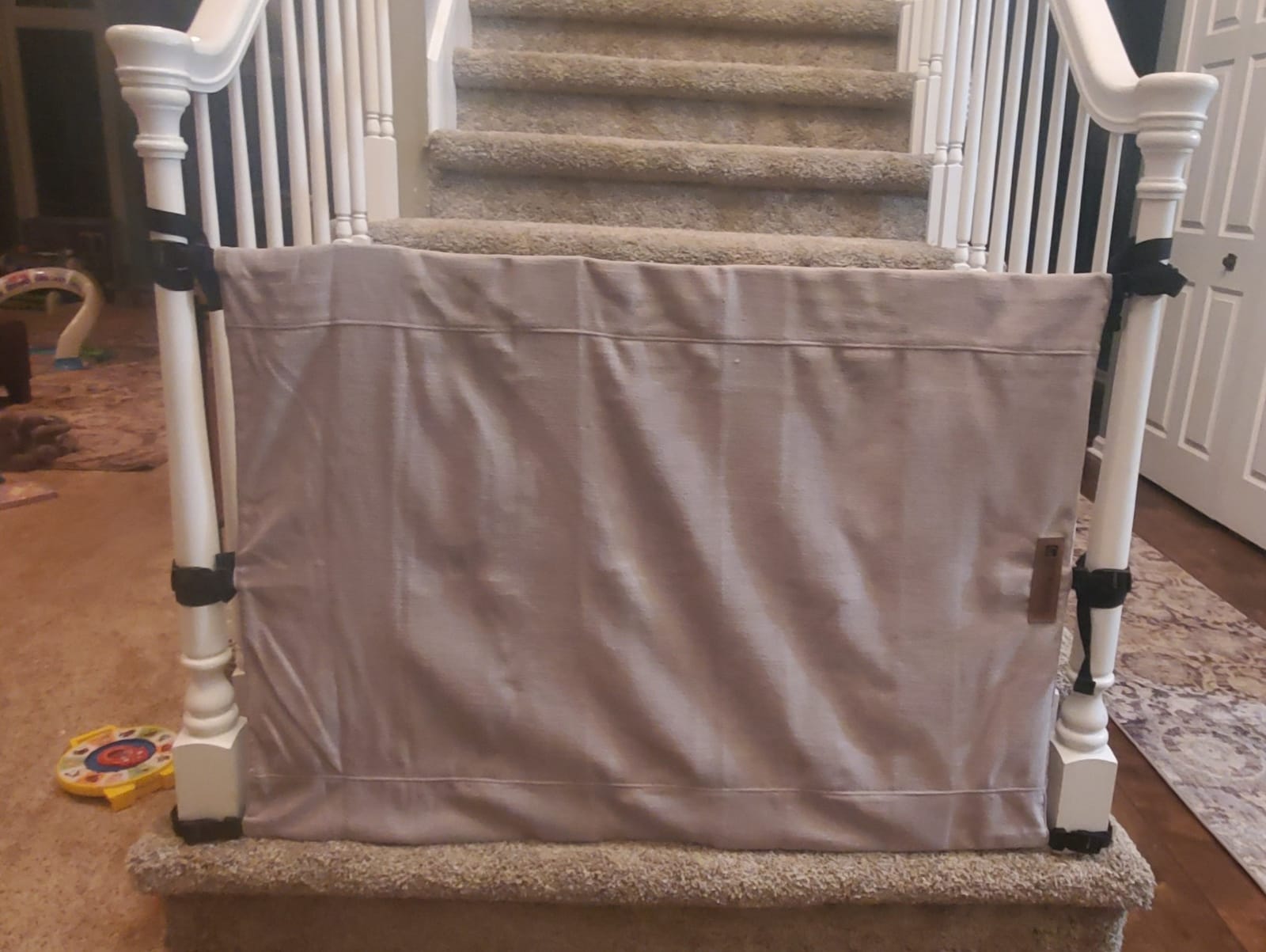
The practical quality here is that it rolls neatly to one side and is light enough to reposition by yourself. In a home where the gate blocks a walkway for visitors, being able to clear it in five seconds changes how willing you are to keep it closed in the first place.
The fabric is machine-washable, which solves a problem that metal gates never have and that every parent eventually faces. A reinforced climb-proof weave at 32 inch tall is also taller than most gates here.
How it handles a banister that is not perfectly square
This is the strongest entry in the guide for uneven geometry. Because it clamps to whatever is on either side rather than needing a flat wall plane, an opening with two offset posts or a curved run is exactly the case it was designed for.
It also needs no studs, which means it works over a finished floor where drilling into the joist would mean chasing a joist you cannot find.
Where it falls short
Fabric is simply less rigid than steel. A determined climber can bounce on it in a way that would rattle a metal gate, and a heavy dog leaning on it will move it. Reviewers are candid that it is not the most physical barrier in this group.
The width range is narrow and fixed, so measure before ordering, and this is the highest price point here. If your opening falls outside 36 to 42 inch, it is the wrong purchase.
9. Babelio R30 Flex Pro Removable No-Bottom-Bar Gate
Babelio Removable Baby Gate for Stairs No Bottom Bar, 29-43″, 30″ H, Black
No bottom bar, no trip hazard
Adjusts 29-43 inch wide
30 inch tall
Removable all-steel hardware mount
Extra wide walk-through door
Pros
- No bottom bar removes the trip hazard at the top of stairs
- All-steel frame with a double-lock design
- Door opens the full width of the staircase for easy walking through
- Frame removes quickly for storage when not needed
- Auto-close with a stay-open feature and one-hand operation
Cons
- Requires a screw and hardware installation rather than a tool-free pressure mount
- Wall and banister hardware must land on solid material
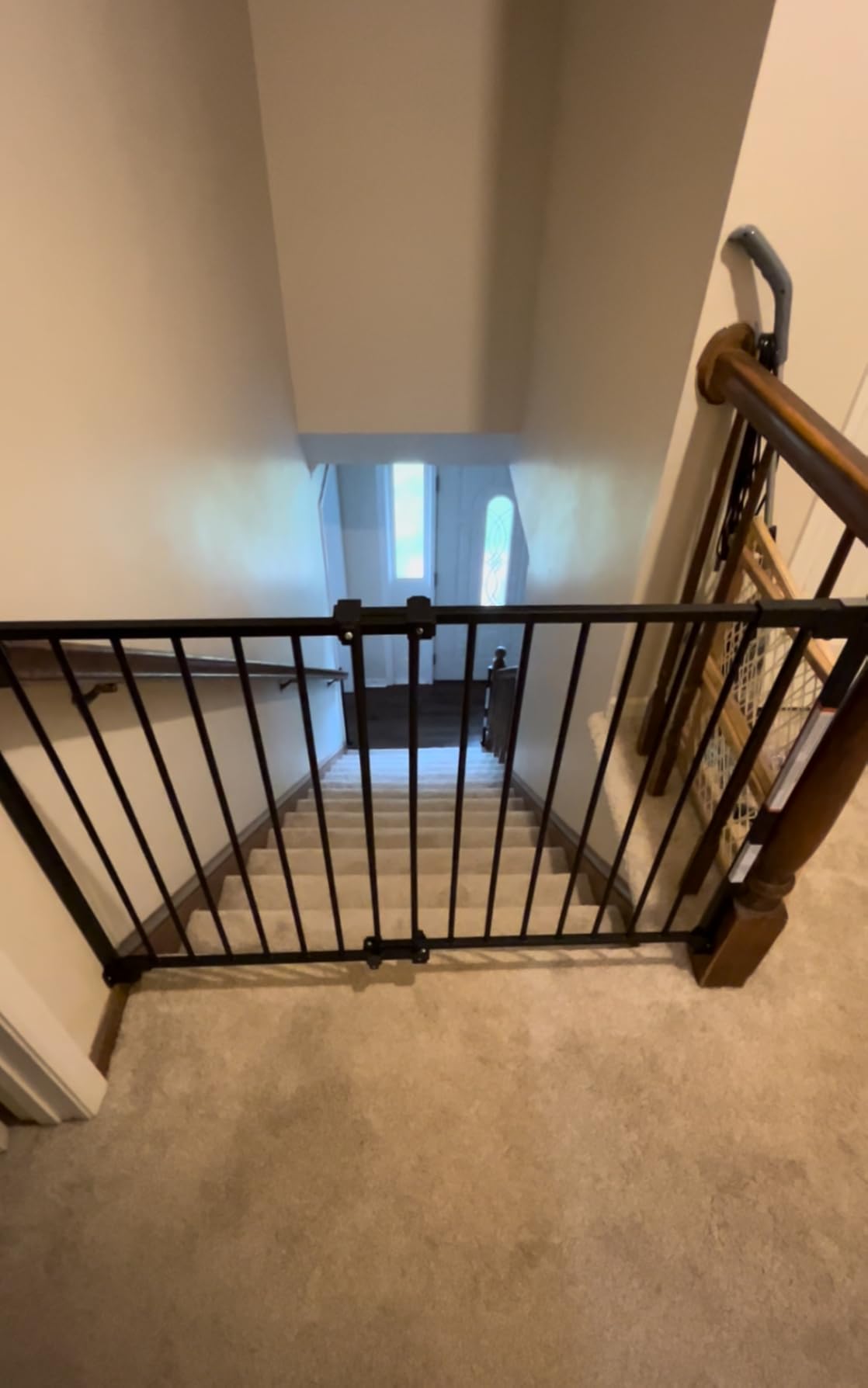
This is the only gate in the guide with no bottom bar at all, and that single design decision is why I would choose it for the top of a staircase. There is nothing at floor level to trip over while carrying a sleepy child down the stairs at half speed in the dark.
It adjusts from 29 to 43 inch wide at 30 inch tall, in an all-steel frame that installs with a three-part hardware setup using two vertical bars, a door frame, plastic pads, and screws. Screws mean it stays put, which is the correct answer at a stairwell where a toddler can apply real force.
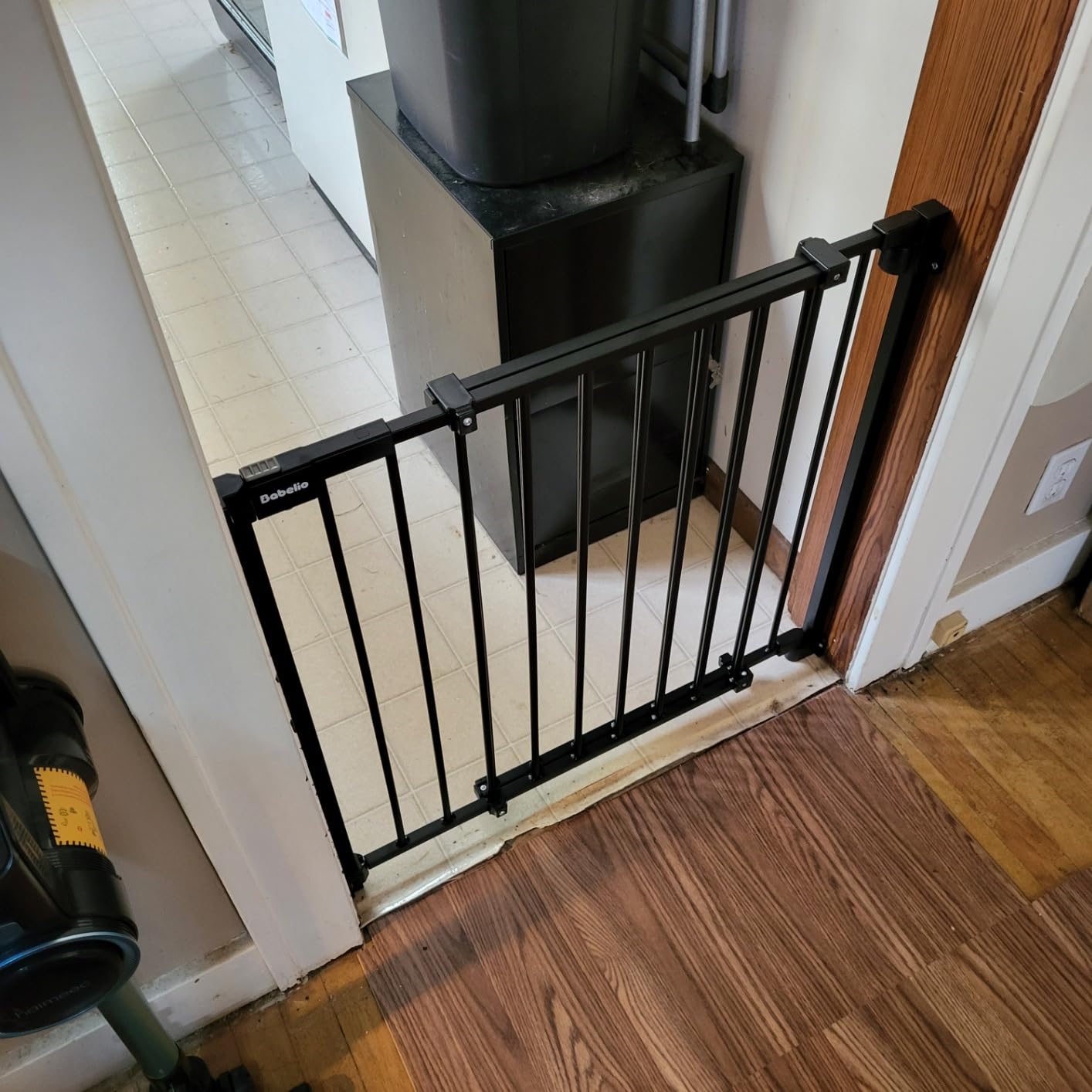
The walk-through door opens the full width of the staircase, so you are not sideways-ing an adult through a narrow gap while holding a railing. Auto-close with a stay-open feature means it shuts behind you unless you deliberately hold it wide.
The frame lifts out for storage, which suits a home where the stairs need to be clear for carrying furniture or for a relative with mobility issues. Remove it in under a minute and put it back the same way.
How it handles a banister that is not perfectly square
A wide 29 to 43 inch adjustment plus hardware anchoring handles a banister that is offset from the stair opening better than most pressure gates, because screws do not care about the angle as long as they land in solid material.
For a banister side you would anchor into the newel post or a stud behind it. That does mean drilling, so it is the wrong gate for a rental or an antique railing.
Where it falls short
It is a permanent install in practice. The screws go into studs and the frame stays, so if you move homes you are patching holes rather than carrying a gate.
It is also the least flexible of the group for unusual geometry. If your opening is diagonal or your posts are rounded, this frame will not conform and you need the angle mount instead.
10. KidCo Angle Mount Gate for Uneven and Offset Openings
KidCo 28-42.5″ Angle Mount Safeway Angeled Baby Gate for Stairs with Banister or Uneven Walls | No-Trip Top of Stairs Baby Gate No Bottom Bar | Quick-Release Mounted Hardware (White)
Angle mount for uneven openings
Adjusts 28-42.5 inch wide
30.5 inch tall
Quick-release hardware mount
No bottom bar, stop clip included
Pros
- Mounts across an angle between a half wall and an offset wall
- No bottom bar to trip over at the top of stairs
- Stop clip prevents the gate swinging out over the stairs
- Quick-release mounting leaves minimal hardware behind
- Lifetime manufacturer warranty on the steel construction
Cons
- Assembly is complex with many small parts and unclear diagrams
- Requires precise leveling or the gate will not close properly
- Latch feels cheap with ridges that can hurt the thumb
- Extension hardware is sold separately and not available on Amazon
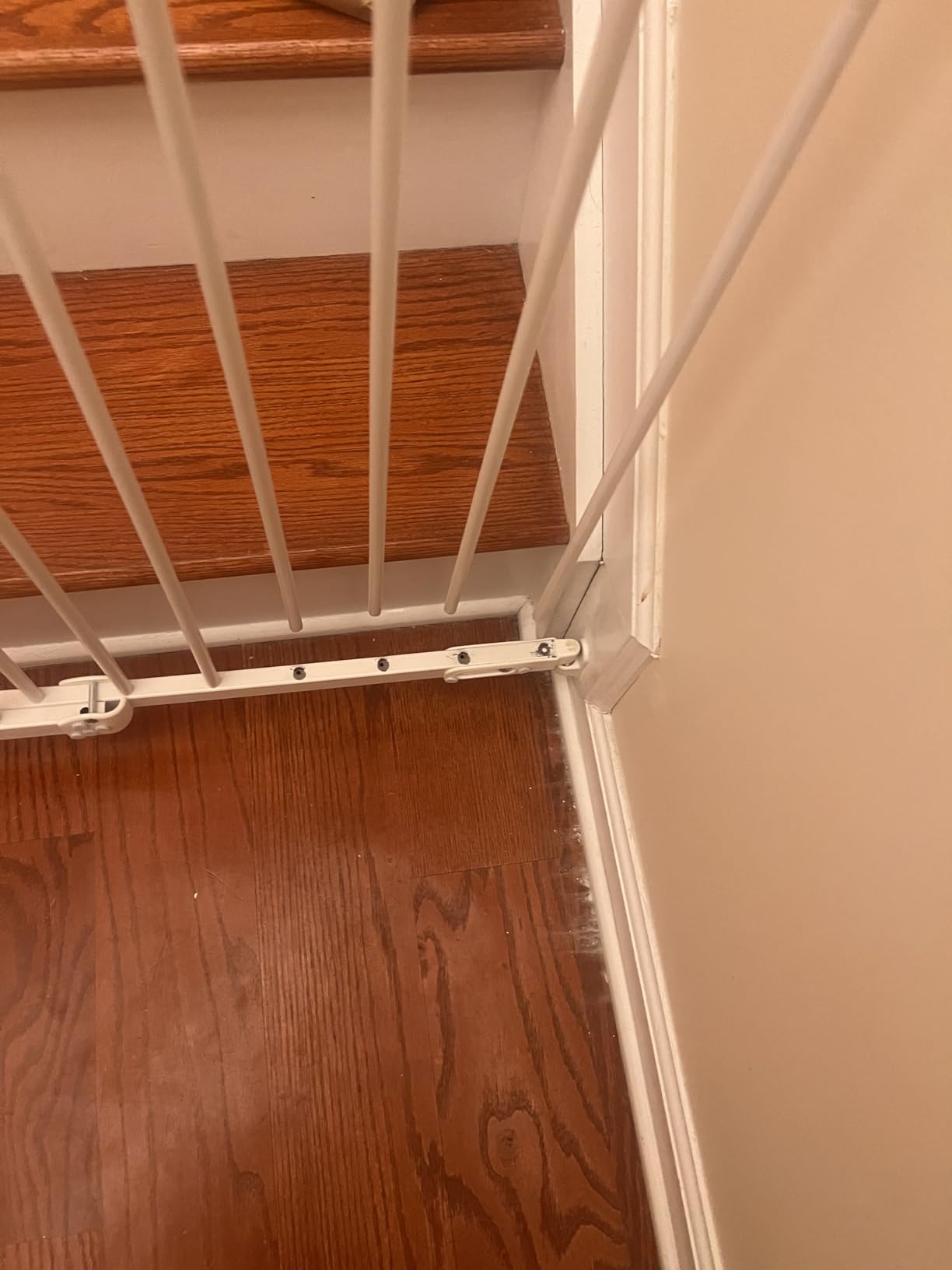
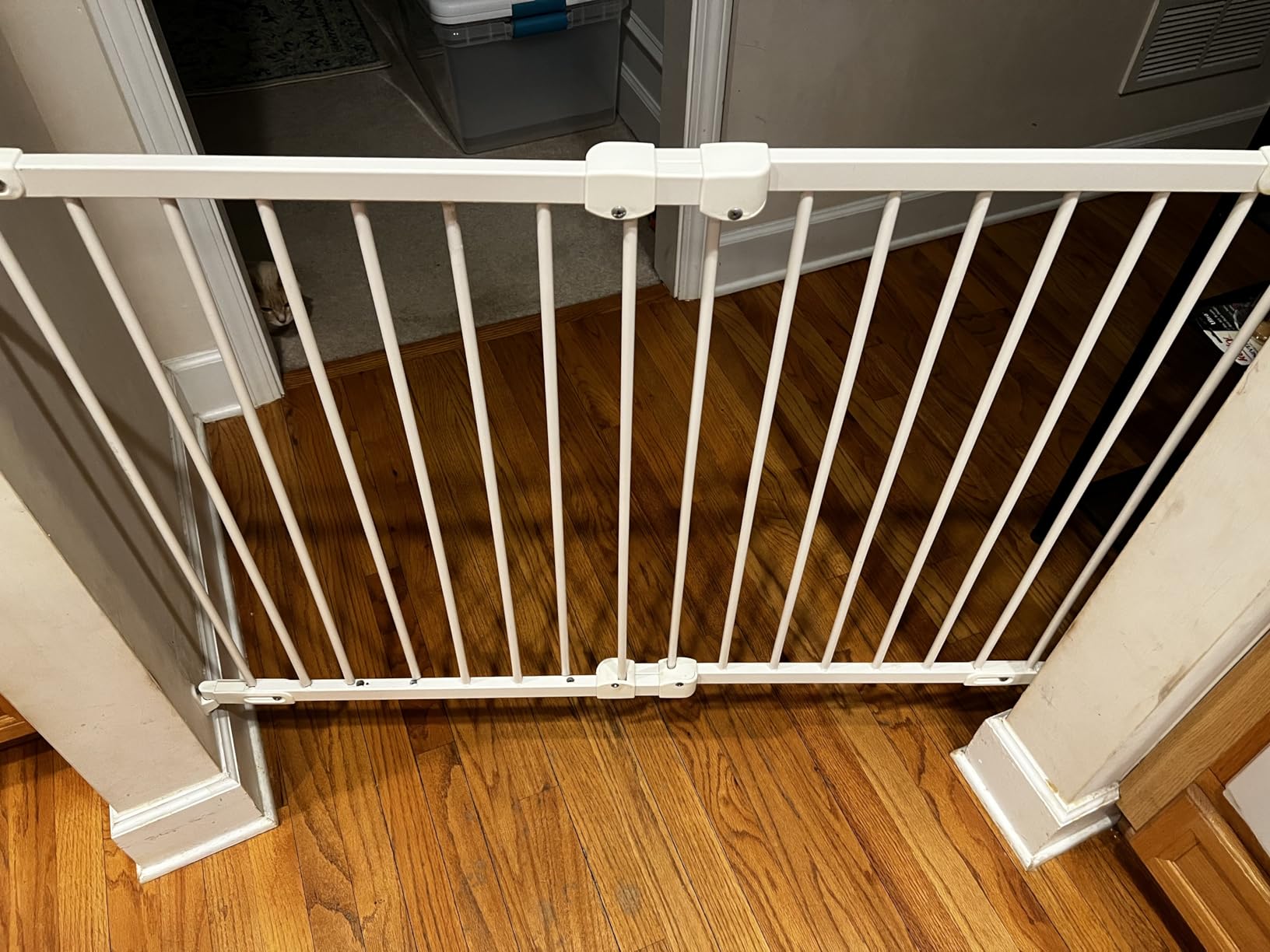
Everything else in this guide assumes the two sides of the stair opening face each other. This gate is built for the case where they do not: a half wall meeting an offset wall, a split-foyer layout, a banister meeting an angled wall. Owners with those openings say it is the only gate that solved their problem, and several report it lasting years across multiple children.
It adjusts from 28 to 42.5 inch wide at 30.5 inch tall and requires 31 inch of clearance. The stop clip prevents the gate from swinging outward over the stairs, and the quick-release mounting leaves minimal hardware behind when you remove it.
The manufacturer backs the steel construction with a lifetime warranty and cites more than 30 years building steel safety gates, which is meaningful for a product whose entire job is absorbing force.
A separate KidCo K12 Universal Gates Installation Kit adapts it to uneven or decorative stairs and banisters, and that kit is the answer for non-flat surfaces. It is sold separately and not through Amazon, so budget a trip to a home improvement store.
How it handles a banister that is not perfectly square
This is the product built specifically for that question. Rather than pretending the opening is straight, the angle mount is designed to span a diagonal and lock square within it, which is why it works on stairwells that other gates are returned from.
For uneven or decorative banister surfaces, the K12 kit adds the mounting hardware that grips a non-flat profile.
Where it falls short
Installation is the most complicated in this guide. Many small parts, clips, screws, and springs, and owners say the diagrams are not clear, with video tutorials being the most requested improvement. Budget an hour on a weekend.
The latch feels inexpensive, with ridges that can be uncomfortable on the thumb, and precise leveling is not optional because a misaligned mount stops the gate closing. One reviewer reported a 20-month-old pulling the gate out of the wall and advised mounting into a stud, which is the correct advice for this product.
Hardware Mounted vs Pressure Mounted at the Stairs
Hardware-mounted is the only correct choice at the top of a staircase; pressure mounting is acceptable at the bottom of stairs in most situations. The difference is the direction of force. A pressure gate resists a child pushing horizontally from below, which is exactly the load a stair-rated gate is tested for, but it does not resist a gate being pushed inward from above.
CPSC guidance treats top-of-stairs gates as needing to be screwed or strapped into place. Several manufacturers state it themselves, and the Babelio PressGuard is explicit that hardware mounting is recommended for top-of-stairs use even though it also pressure-mounts.
At the bottom of the stairs, the risk profile is different. The child is not falling, so a pressure gate that is sturdy enough for a determined toddler and easy for adults to open is a reasonable and much cheaper answer. That is where several of the gates in this group earn their place.
A pressure gate still needs a real surface on both sides. Pressing it against a rounded banister and a wall corner produces a rocking motion rather than a stable barrier, which is why adapter kits exist.
How to Measure a Banister Opening
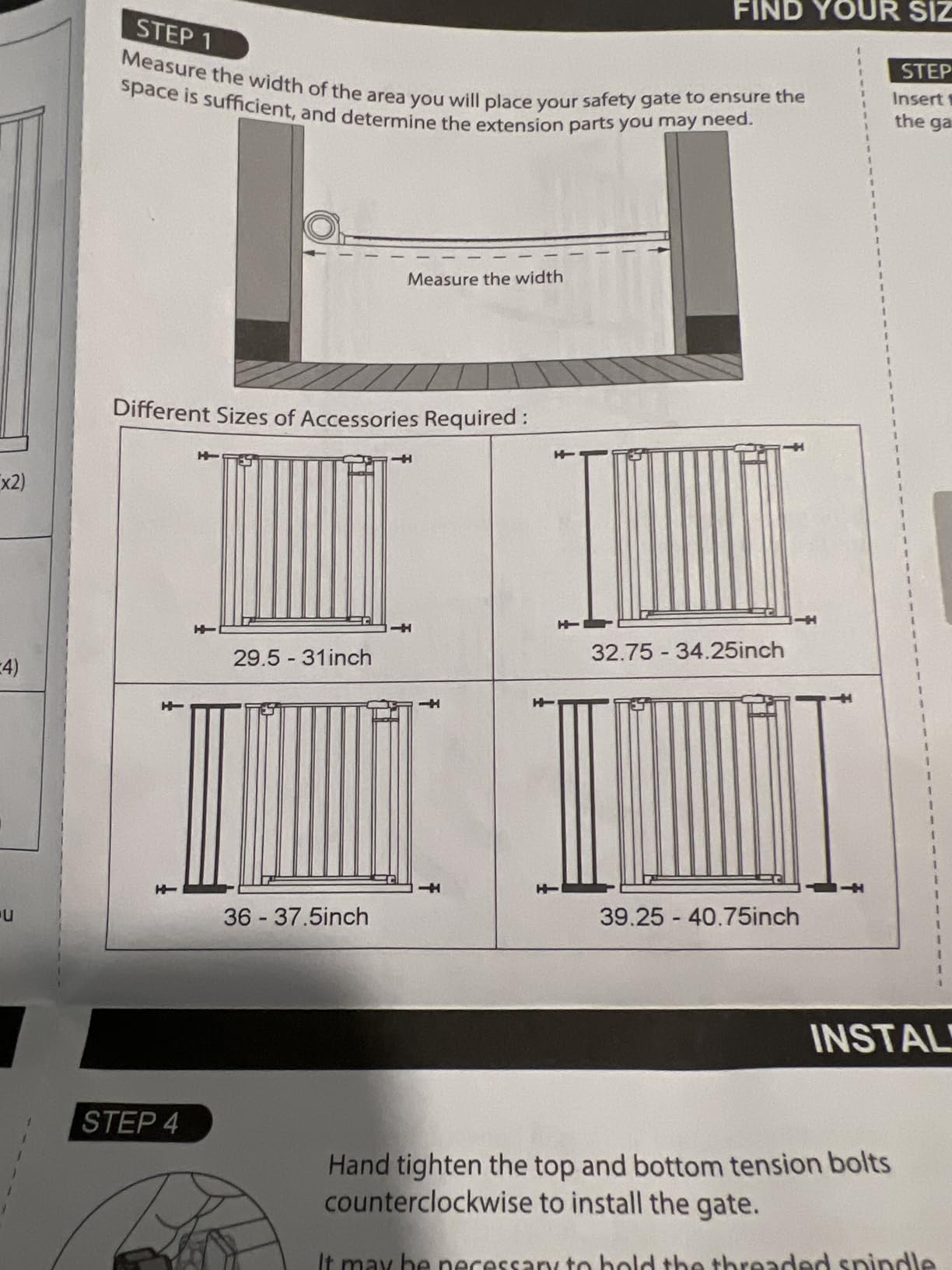
Measure width at three heights and the diameter of each post before you buy anything. Most returns and most failed installs trace back to a single width taken at the top of the opening, where the stair is narrowest.
- Measure the opening at its widest, its middle, and its narrowest. Take all three. The narrowest point is the one your gate must clear, because the frame has to pass through it during installation.
- Measure the post or banister diameter. Standard Y-bolt adapters are sized for round posts in the 2 to 3 inch range. Turned balusters, wrought iron spindles, and oval mouldings need different hardware.
- Check the baseboard offset on the wall side. If the wall has baseboard or a chair rail, the usable opening is narrower than the wall spacing suggests, and the pressure gate foot may not sit flat.
- Measure the depth available behind the banister. A clamp-style adapter needs room behind the post. If the post is tight to a wall, a wrap-around clamp may be the only option.
- Confirm the height of the opening. Most of these gates need at least 28 to 30 inch of clearance. The KidCo Angle Mount requires 31 inch, and a low ceiling opening rules products out.
- Look for the fit gaps in the specifications. Extension panels land at fixed intervals, so gates have dead zones. This one will not fit openings of 31.8 to 33.4 inch or 38.7 to 40.3 inch.
Write the numbers on the wall with a pencil before you start shopping. It takes two minutes and it is the difference between the right gate arriving and the right gate arriving eventually.
Which Gate Fits Your Banister Setup
Match your layout to one of these four configurations before you look at any product page, because the configuration decides everything downstream. If you have a metal spindle railing, go straight to the last row.
- Wall to banister. The most common layout and the easiest. The gate spans from a wall to a post, and a Y-bolt adapter or a spindle rod handles the banister side. The Cumbor, InnoTruth, Mumeasy, and cideny gates all cover this directly.
- Banister to banister. Both sides are posts and neither is a wall, so a gate needing a screw anchor on the wall side will not work. The Stair Barrier is built specifically for this and needs no drilling.
- Diagonal or offset opening. The two sides do not face each other squarely. The KidCo Angle Mount is designed for exactly this and is the gate owners with split-foyer staircases point to.
- Iron, wrought metal, or thin spindles. There is often no solid post at all, which means four mounting points are physically impossible. See the next section.
- Rounded or turned wooden railings. Flat-post adapters will not grip these. You need Y-shaped brackets, and the Mumeasy gate ships two.
One more case worth naming: a wide staircase landing where the opening is wider than any single gate. Two narrower gates mounted side by side is often a better answer than one extension across the whole landing.
What to Do When No Baby Gate Fits Your Banister
If you cannot get four solid mounting points, no off-the-shelf gate is safe, and the honest answer is to build an anchor point rather than to force a gate into place. Parents on r/DIYUK and r/HomeImprovement converge on the same handful of solutions.
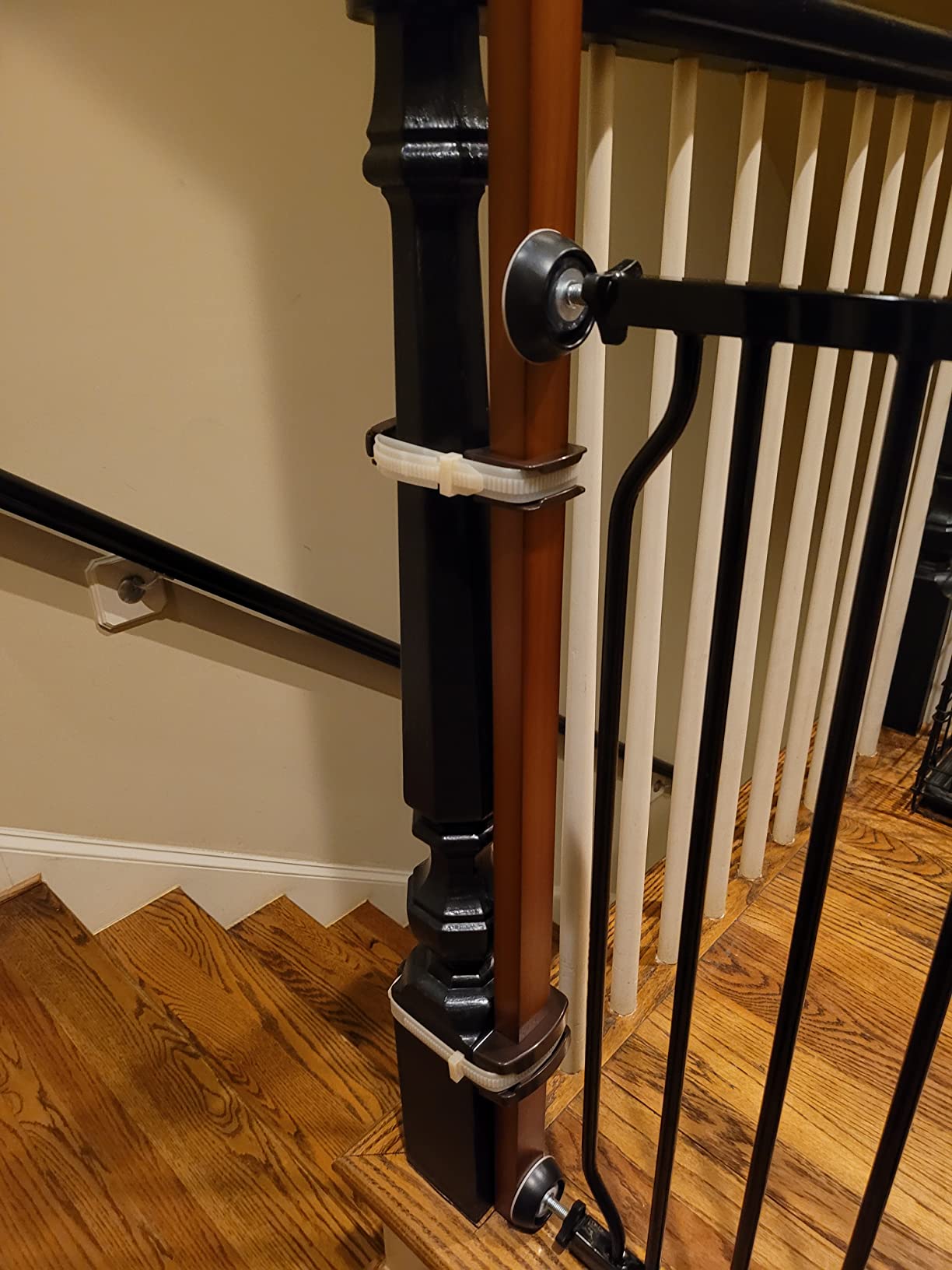
- Build a solid fourth anchor into the framing. Mount small plywood blocks between studs on either side of the stair opening so the gate can screw into solid wood. This is the fix a parent with thin iron-rod banisters described reaching for before he worked out a wooden joist approach.
- Clamp a board to the newel post. A C-clamp holding a length of 2×4 or a length of board against the newel post gives the gate a flat surface to screw into without touching the finished post.
- Zip-tie a board to a banister. A board strapped to the rail with heavy zip ties is a common renter-friendly workaround. It is not as rigid as a screw mount, so it belongs at the bottom of the stairs rather than the top.
- Angle the gate away from the stairs. Fitting the gate at a 45 degree angle away from the stair run, using the banister as the anchor, changes the direction of the fall zone and can solve a layout where a straight gate does not.
- Hinge a plywood panel cut to the stair profile. One UK parent on an awkward stairwell cut plywood to the stair profile with its edge and hung it on gate hinges with a garden gate latch. It is carpentry, not a product, and it works.
The rule underneath all of these is the same. A gate that rocks, creeps, or has a soft spot is not a safety device, and no discount or review count changes that. If you cannot get a rigid anchor, move the play space instead of installing something that only looks protective.
No-Drill and Rental Banister Mounting
Renters face a real tradeoff: drilling into a banister may violate the lease, and leaving the stairs ungated risks a fall that no deposit covers. The workable middle ground is a clamp, strap, or pressure system that leaves no holes.
A pressure-mounted gate with a spindle rod on the banister side is the cleanest rental answer. The cideny gate ships four threaded spindle rods and wall cups in the box, so nothing extra is needed. The Mumeasy gate is dual-purpose, letting you pressure-mount now and screw it down later if you buy the house.
Fabric gates that clamp between two banisters leave no marks at all and move with you. If you also need to contain a large dog through the same opening, our guides to freestanding pet gates for doorways and extra-wide pet gates for big dogs cover that side of the problem.
The honest caveat is that no-drill systems creep. Check the tension every month for the first year, and replace a gate that has developed a permanent gap at the wall rather than tightening it forever.
Baby-Proofing a Banister Railing Without a Gate
Railings are a climbing problem before they are a gap problem, and a gate at the top of the stairs does nothing about a child climbing the balusters on the way down.
- Measure the gap between spindles. Anything wider than about 3.5 inches lets a small child’s head and torso through. Measure at the widest point, not at the rail.
- Fit vertical spindle guards or railing guards. These are plastic or wood inserts that reduce the opening without removing the railing, and they install on most standard spindle spacing.
- Check that horizontal rails are more than 3 feet above any surface a child can reach. A horizontal rail at a reachable height is a ladder, and no spindle guard fixes that.
- Move anything climbable away from the railing. Furniture, laundry baskets, and toys stored next to a banister turn it into a step.
- Block the play space instead. Relocating the child’s play area away from the stair foot removes the need for a barrier in some homes, and it is the one fix that costs nothing.
Know when to take a gate down. Once a child can climb over it reliably or unlatch it, it becomes the hazard it was meant to prevent, and parents on r/SafeBabyGates describe going through several gates with a determined two-and-a-half-year-old before changing approach.
Frequently Asked Questions
What kind of baby gates can be mounted on banisters?
Three types work on a banister: hardware-mounted stair gates with screw anchors, gates that use Y-bolt or clamp-style banister adapters to grip a post without drilling, and clamp-on fabric gates that hook between two banisters. At the top of a staircase the gate must be hardware-mounted or clamped, never pressure-mounted. Check the post diameter against the adapter size and confirm you can reach four solid anchoring points before buying.
Can you put a baby gate on a banister?
Yes, using a banister adapter kit. A Y-bolt adapter grips a round post, a clamp-style adapter grips a flat or square post, and a spindle rod anchors to thin balusters, all without drilling into the woodwork. Four solid mounting points are the requirement. If your railing is thin iron spindles with no post and you cannot get four points, no off-the-shelf gate is safe and you need to build a solid anchor instead.
How do I measure a banister for a baby gate?
Measure the opening at its widest, middle, and narrowest points, and use the narrowest for fit. Measure the post or banister diameter so you can match the adapter, check the baseboard offset on the wall side, and confirm you have at least 28 to 31 inches of height clearance. Then check the specifications for fit gaps, since extension panels land at fixed intervals and leave openings no gate will cover.
Are pressure-mounted gates safe at the top of the stairs?
No. CPSC guidance treats top-of-stairs gates as requiring hardware mounting because a pressure gate can be pushed inward from above, which the pressure system does not resist. Use a screw-mounted or clamped gate at the top of a staircase, ideally one with no bottom bar so there is no trip hazard. Pressure mounting is acceptable at the bottom of the stairs in most homes.
What kind of baby gate is suitable for uneven banisters?
Angle-mount hardware gates are built for openings where the two sides do not face each other squarely, such as a half wall meeting an offset wall or a split-foyer layout. For rounded or turned railings, look for gates that include Y-shaped brackets rather than flat-post adapters. For banister-to-banister openings with no wall, a clamp-on fabric gate works without drilling. Measure all three points of the opening before choosing.
The Best Baby Gates for Banisters: Final Picks
The best baby gates for banisters depend almost entirely on geometry, not on brand. If you have a wall on one side and a post on the other, the Cumbor 30-46 inch gate is the one I recommend first, because it ships with Y-bolt adapters for round banisters and converts to a hardware mount when the stairs demand it. If a climber is the concern, the Ingenuity at 36 inch tall is the tallest and most reviewed metal option here.
For banister on both sides with no wall, the Stair Barrier is the only gate in this guide that clamps to two posts and needs no drilling. For an angled or offset opening, the KidCo Angle Mount is the answer, and it is worth the longer install. For a landing where tripping matters most, the Babelio R30 Flex Pro removes the bottom bar entirely.
Measure your opening at three heights before you order, confirm four solid anchoring points, and remember that at the top of the stairs anything less than a hardware mount is a gamble. If you cannot reach four points, build the anchor rather than forcing the gate.