
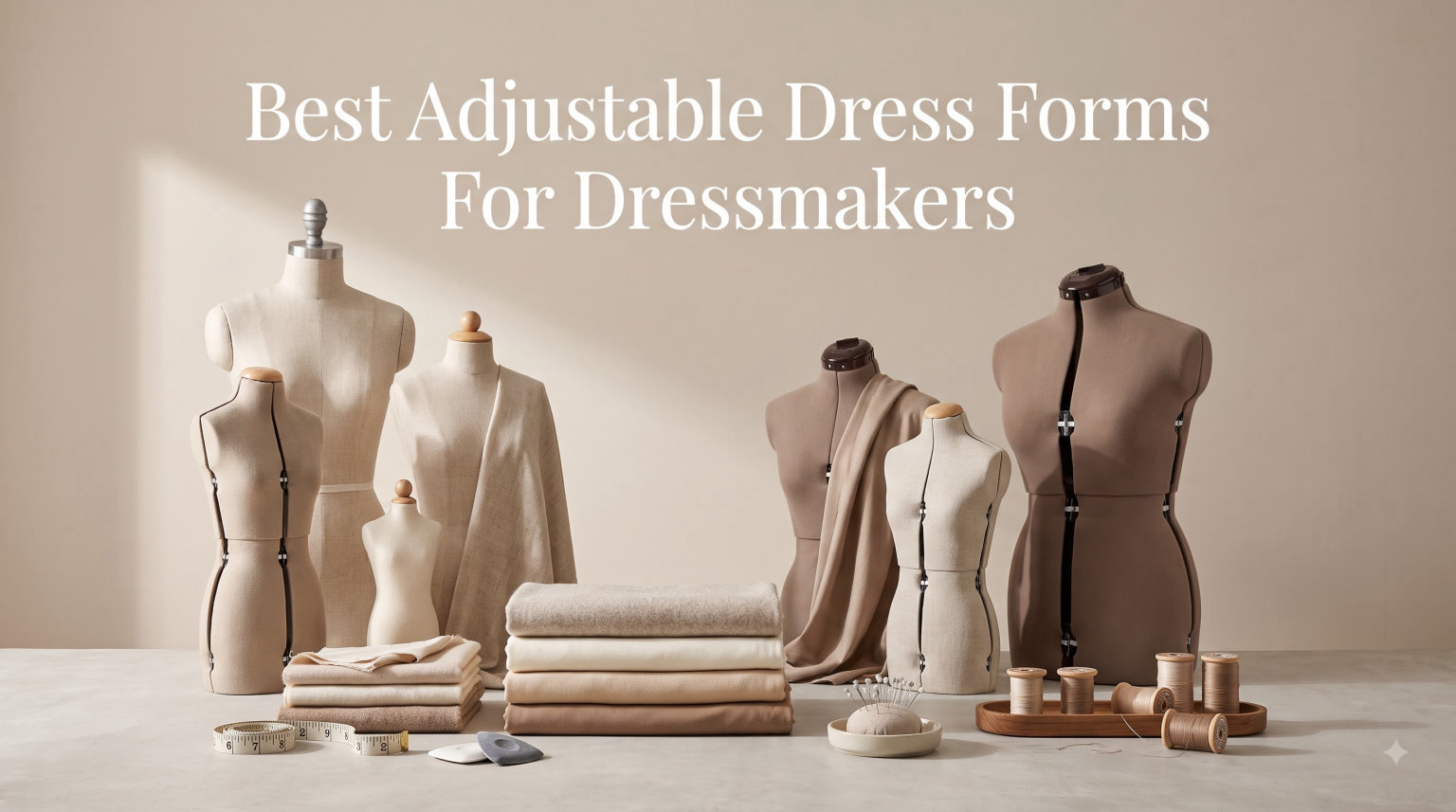
If you have ever tried to pin a hem on yourself, you already know why adjustable dress forms for dressmakers exist. Pinning, fitting, and adjusting garments on your own body is frustrating, imprecise, and sometimes painful. A dress form gives you a three-dimensional representation of the human torso that you can pin into, drape over, and measure against — without holding still for forty minutes.
Our team has spent years working with sewing dress form models across home studios and professional ateliers, and we want to share what actually matters when you are shopping for one. The right dressmaker’s mannequin transforms how you construct garments, alter patterns, and execute fittings. The wrong one collects dust in a corner.
This guide covers everything you need to know about adjustable dress forms in 2026. We break down the types of dress forms available, the adjustment mechanisms that matter, how to choose the right size, and what features separate a worthwhile investment from a disappointing purchase. Whether you are a beginner sewist setting up your first workspace or an experienced dressmaker upgrading your tools, this guide will help you make an informed decision.
Price for adjustable dress forms typically ranges from around $50 for basic models to over $400 for professional-grade units. We will explain exactly what changes as you move up that price ladder, so you can invest confidently at whatever level suits your sewing practice.
Table of Contents
What Is an Adjustable Dress Form
An adjustable dress form is a torso-shaped mannequin mounted on a stand that can be resized to match different body measurements. Unlike a fixed-size tailor’s dummy, an adjustable dress form uses mechanical systems — typically knobs, dials, or pins — to expand or contract the bust, waist, and hip measurements within a specified range.
Think of it as a programmable body double. You set the measurements to match your own (or your client’s), and then you can pin fabric, drape material, mark hems, and check fit without needing a live model. This is especially valuable for solo dressmakers who do not have someone available to help with fittings.
The key components of any adjustable dress form include the torso body (usually foam-covered and fabric-wrapped), the adjustment mechanism (knobs, dials, or pins positioned around the body), the neck cap, the stand (tripod or wheeled base), and a height-adjustment pole. Some models also include hem gauges, pin cushions, and measurement guides printed directly on the surface.
What separates an adjustable form from a simple display mannequin is functionality. A display mannequin looks pretty in a shop window. An adjustable dress form is a working tool designed for pinning, pressing, measuring, and manipulating fabric. The surface needs to accept pins without damage, the structure needs to hold its shape under pressure, and the adjustments need to stay locked in place while you work.
Types of Adjustable Dress Forms in 2026
Not all dress forms serve the same purpose, and understanding the categories will help you narrow your options quickly. The adjustable dress form market breaks down into several distinct types based on intended use, build quality, and adjustment sophistication.
Professional Studio Dress Forms
Professional dress forms are built for ateliers, fashion houses, and serious design studios. These models feature dense foam cores covered in high-quality fabric or linen, with precision-engineered adjustment mechanisms that hold measurements exactly. They often include collapsible shoulders for easy garment removal, magnetic measurement points, and wheeled bases for mobility around a studio.
Professional forms typically cost $250 to $500 or more. They justify that investment with durability, precision, and features that home forms lack. If you sew professionally or produce garments for clients, this is the category to target.
Home Sewing Dress Forms
Home sewing dress forms are designed for hobbyist sewists and intermediate-level dressmakers. These models cover the $100 to $250 range and offer solid adjustability without the premium features of professional units. Most use knob-style adjustment systems that let you expand or contract bust, waist, and hip measurements by several sizes.
The build quality is lighter than professional forms, typically using a foam-and-fabric covering over a plastic or resin shell. The stands are usually tripod-style with caster wheels. For most home sewists, this category offers the best balance of function and affordability.
Budget and Beginner Dress Forms
Entry-level adjustable mannequin models run $50 to $100 and provide basic adjustability for new sewists. They tend to have fewer adjustment points, less precise measurement control, and lighter-duty stands. The surface may not accept pins as cleanly as higher-end models, and the adjustment mechanisms can be less stable.
These forms work well for beginners who are learning to fit and want to practice without a large investment. They also serve well as display pieces for craft shows or small-scale garment construction.
Specialty Forms
Some dress forms are designed for specific purposes beyond standard garment construction. These include petite forms with proportions sized for smaller frames, plus-size forms with extended measurement ranges, and children’s forms for juvenile clothing. There are also partial forms — such as half-scale dress forms used for pattern development and design samples.
If your sewing practice focuses on a particular size range or garment type, a specialty form may serve you better than a general-purpose adjustable model.
Key Features to Look for in Adjustable Dress Forms for Dressmakers
Knowing what features matter most will help you evaluate any dress form, regardless of brand or price point. Here are the features that our team considers essential when assessing adjustable dress forms for dressmakers.
Adjustment Mechanism Quality
The adjustment mechanism is the heart of any adjustable dress form. You want a system that moves smoothly, locks firmly, and holds its position while you work. Test the mechanism by adjusting it several times — it should feel solid, not loose or wobbly. Pay attention to whether the dials or knobs stay in place after you set them, or whether they gradually slip under pressure.
Higher-end forms use metal internal components, while budget models rely on plastic. Metal components last longer and hold measurements more precisely. This is one of the biggest factors in the price difference between entry-level and professional forms.
Size Range and Measurement Coverage
Every adjustable dress form has a specified size range — the minimum and maximum measurements it can achieve at bust, waist, and hip. Check these ranges carefully against your own measurements. A form that adjusts from a 33-inch to a 39-inch bust covers a standard medium-to-large range, but will not work if you need a 42-inch bust.
Look for forms that cover at least four to six dress sizes within a range. This gives you room to work across different projects and accommodates body measurement changes over time. Also consider whether the form adjusts in proportional increments — meaning the bust, waist, and hip all scale together naturally — or whether you can adjust each measurement independently.
Build Quality and Stability
A wobbly dress form makes precise fitting nearly impossible. The stand needs to support the form solidly, without tipping or shaking when you pin into it or press fabric against it. Tripod bases with wide footprints are generally more stable than narrow stands.
Check the construction materials of the stand — powder-coated metal or hardwood dowels are standard for quality forms. The pole should lock firmly at your chosen height and not gradually slide down. If the form includes caster wheels, make sure they lock securely so the form does not roll while you work.
Surface Material and Pin Acceptance
The outer surface of your dress form needs to accept pins easily and hold them firmly. Most quality forms use a layer of foam covered in fabric, linen, or velvet. The foam compresses when you insert a pin, then grips it tightly.
Budget forms sometimes use thin padding over hard shells, which makes pinning difficult and can damage your pins. Test pin acceptance by pressing a pin into the surface — it should go in smoothly and hold without slipping out. The covering fabric should also resist tearing and pilling from repeated use.
Height Adjustability
Height adjustment is separate from measurement adjustment. A height adjustable dress form lets you raise or lower the entire torso on the stand pole, so you can match your own body height. This is essential for accurate hem marking and for checking garment proportions.
Look for forms with a wide height range — ideally at least 12 inches of adjustment. The mechanism should lock firmly at each height. Some professional forms include calibrated markings on the pole so you can set repeatable heights for different projects.
Portability and Storage
If your sewing space is shared with other activities, portability matters. Dress forms take up significant floor space, and you need to be able to move or store them when not in use. Wheeled bases make repositioning easy. Some forms feature collapsible or removable components for compact storage.
Weight is also a factor. A heavy professional form may offer superior stability but can be difficult to move solo. Consider whether you need to transport your form to classes, workshops, or client fittings — if so, weight and packability become primary concerns.
How to Choose the Right Size Dress Form
Selecting the correct size is the single most important decision when buying an adjustable dress form. A form that does not match your measurements is useless, regardless of how well-built it is. Here is our step-by-step process for finding the right fit.
Step 1: Take Accurate Body Measurements
Wear minimal, close-fitting clothing and use a flexible measuring tape. Measure your bust at the fullest point, your natural waist (the narrowest part of your torso), and your hips at the fullest point (usually 7 to 9 inches below the waist). Record each measurement in inches.
Also measure your back length (from the base of your neck to your natural waist), neck circumference, and shoulder width across the back. These secondary measurements matter for fit accuracy, especially if you have proportions that differ from standard sizing.
Step 2: Understand Size Ranges
Most adjustable dress forms are sold in size ranges rather than single sizes. A typical range might be “Small to Medium” (covering bust sizes 33 to 39 inches) or “Large to Extra Large” (covering bust sizes 39 to 46 inches). Match your bust measurement to the middle of a range for maximum flexibility in both directions.
For example, if your bust measures 36 inches, a form with a range of 33 to 39 inches centers your measurement perfectly. A form with a range of 36 to 42 inches puts you at the minimum, limiting your ability to size down for smaller projects.
Step 3: Match the Form to Your Body Type
Pay attention to proportion as well as raw measurements. If you have a full bust with a smaller waist, make sure the form can create that same differential. Some forms adjust bust, waist, and hip proportionally — meaning they move together at standard fashion-industry ratios. Others let you set each measurement independently.
Independent adjustment is more flexible but also more expensive. If your proportions deviate significantly from industry standards, look for a form with independent measurement control at each point.
Step 4: Consider Special Proportions
Petite dressmakers (under 5 feet 4 inches) should look for forms with shorter torso lengths and smaller shoulder measurements. Standard forms are built for average-height bodies and may not represent petite proportions accurately. Similarly, tall dressmakers should verify that the form’s back length and shoulder width accommodate longer torsos.
Plus-size sewists should seek forms specifically designed with extended ranges. A standard form stretched to its maximum measurements may not accurately represent a true plus-size body, because the proportions shift incorrectly at the extremes of the range.
Step 5: Factor in Future Use
Think about who you sew for. If you primarily make garments for yourself, match the form to your own body. If you sew for family members, clients, or for sale, consider a form whose range covers the most common sizes in your practice. Some dressmakers invest in two forms — one for personal fitting and one for client work.
Adjustment Mechanisms Compared: Knob vs Dial vs Pin Systems
The adjustment mechanism determines how precisely you can set measurements and how pleasant the form is to use. The three main systems each have distinct characteristics that affect your daily sewing experience.
Knob-Style Adjustment Systems
Knob systems use small wheels positioned around the body of the form. You turn each wheel clockwise or counterclockwise to expand or contract the measurement at that point. Knob systems are the most common type found on home sewing dress forms in the $100 to $250 range.
The main advantage of knob adjustment is simplicity. Each knob controls a specific measurement zone, and the increments are usually small enough for precise fitting. The downside is that knobs can be fiddly to operate, especially when making large adjustments. Some users find that knob-style forms require frequent re-checking to ensure all points are set correctly.
Dial Adjustment Systems
Dial systems use larger, more ergonomic dials that control measurement changes. These are typically found on mid-range to professional forms. Dials are easier to grip and turn than small knobs, making the adjustment process faster and more comfortable.
Dial systems often provide more measurement points around the circumference of the form, which means more even expansion and contraction. This produces a smoother, more accurate body shape. The trade-off is that dial systems add cost and complexity to the form’s construction.
Pin-Adjusted Forms
Pin-adjusted forms represent the most traditional approach. These forms have a fabric or linen covering over a shaped inner core, and you create your custom measurements by pinning the covering to compress or reshape the form. This is the method used on professional-style forms and is the standard in fashion design schools.
Pin adjustment offers unlimited customization because you are literally sculpting the shape. However, it requires skill and patience to build up an accurate body shape through padding and pinning. This method rewards experienced dressmakers who understand body geometry and want precise control over every curve.
Which System Suits Your Needs
For beginners and casual sewists, knob-style adjustment offers a good balance of function and affordability. For intermediate to advanced dressmakers who want precision and ease of use, dial systems are worth the additional investment. For professionals and those trained in traditional methods, pin-adjusted forms provide the ultimate in customization.
Using Your Dress Form for Different Projects
An adjustable dress form is a versatile tool that supports multiple aspects of garment creation. Understanding the full range of applications helps you get maximum value from your investment.
Fitting and Alterations
The most common use for a dress form is fitting garments during construction. Once your form matches your body measurements, you can slip a partially constructed garment onto the form to check fit, mark alterations, and pin adjustments. This is especially valuable for difficult-to-reach areas like the back of a garment.
For alteration work, the form lets you see the garment from all angles simultaneously. You can identify fitting issues — drag lines, pooling fabric, tight spots — that are invisible when wearing the garment yourself. This transforms alteration from guesswork into a systematic process.
Fabric Draping
Draping is a garment construction method where you create patterns directly on the form using muslin or fashion fabric. The dress form serves as a fabric draping tool that holds material in three-dimensional space, allowing you to sculpt and shape garments without a flat pattern.
For draping, the quality of the form’s surface matters enormously. You need to pin fabric securely at any angle, and the form needs to represent the body accurately enough that your draped design will fit a real person. This is where professional-grade forms earn their premium price.
Pattern Making and Adjustments
A dress form works as a pattern making form that lets you test flat pattern adjustments in three dimensions. If you are grading a pattern up or down a size, checking the result on the form reveals fitting problems before you cut into expensive fabric. You can also use the form to create custom patterns by wrapping and marking directly on the body.
Many dressmakers use their forms to troubleshoot commercial patterns that do not fit well. By comparing the pattern pieces to the form, you can identify where and how to adjust seam lines, darts, and ease for a better fit.
Display and Photography
Beyond construction, dress forms serve as display pieces for finished garments. Whether you are photographing products for an online shop, showcasing work at a craft fair, or organizing your portfolio, a well-shaped form presents garments professionally.
For photography, look for forms with clean lines and neutral coverings that do not distract from the garment. Velvet or linen-covered forms in neutral tones photograph beautifully.
Dress Form Maintenance and Care Tips
A quality adjustable dress form can last for decades with proper care. These maintenance practices will keep your form accurate, functional, and looking good over time.
Cleaning the Surface
Dust and lint accumulate on the padded surface of your dress form, especially if you work with fuzzy fabrics or fleece. Use a lint roller or soft brush regularly to remove debris. For fabric-covered forms, a damp cloth with mild soap handles most stains. Avoid soaking the surface, as moisture can damage the foam core underneath.
If you work with pets nearby, pet hair is a persistent challenge. Velvet and linen coverings resist pet hair better than brushed cotton or jersey-knit covers. A rubber squeegee or dedicated pet hair remover works well for stubborn buildup.
Storage Recommendations
When storing your dress form, cover it with a breathable fabric bag to protect against dust. Avoid plastic covers, which can trap moisture and lead to mold on fabric surfaces. If your form has removable components, disassemble them for more compact storage.
Store the form in a temperature-controlled environment. Extreme heat can soften foam cores and warp plastic components. Extreme cold can make coverings brittle. A closet or corner of your sewing room at normal room temperature is ideal.
Preventing Damage
Avoid leaving pins embedded in the form for extended periods, as they can create permanent holes in the surface. Rotate the form periodically so wear is distributed evenly. If your form has a wheeled base, lock the wheels when the form is stationary to prevent accidental movement and tipping.
Check adjustment mechanisms periodically for tightness. Over time, knobs and dials can work loose from repeated use. Tighten any hardware that feels slack, but avoid over-tightening, which can strip threads or crack components.
Frequently Asked Questions
What is the best adjustable dress form for home use?
The best adjustable dress form for home use balances adjustability, stability, and affordability in the $100 to $250 range. Look for a form with knob or dial adjustment covering at least four dress sizes, a stable tripod base with locking wheels, and a fabric-covered surface that accepts pins easily. Home sewists typically benefit from forms that adjust bust, waist, and hip measurements independently.
How do I choose the right size dress form?
To choose the right size dress form, measure your bust, waist, and hips in inches, then select a form whose range centers your measurements. For example, if your bust is 36 inches, choose a form covering 33 to 39 inches. Also check that back length, neck circumference, and shoulder width are compatible with your proportions. Avoid forms where your measurements fall at the extreme minimum or maximum of the range.
Are expensive dress forms worth the investment?
Expensive dress forms are worth the investment if you sew professionally, work with clients, or need precise fitting capabilities. Professional-grade forms offer superior stability, more measurement points, better surface materials, and longer lifespans. For hobbyist sewists who use a form occasionally, a mid-range model at $100 to $250 provides excellent value without the premium price tag.
What is the difference between professional and beginner dress forms?
Professional dress forms feature dense foam cores, high-quality fabric coverings, precision dial or pin adjustment systems, collapsible shoulders, and heavy-duty wheeled stands. Beginner dress forms use lighter materials, simpler knob adjustments, fewer measurement points, and basic tripod stands. Professional forms hold measurements more precisely and accept pins more cleanly, while beginner forms prioritize affordability and ease of use.
How do you adjust a dress form to your measurements?
To adjust a dress form, start by setting the bust measurement using the knobs or dials around the chest area. Next, adjust the waist to your natural waist measurement. Then set the hips at the fullest point. Finally, adjust the height so the form matches your body proportions. Check each measurement with a tape measure after adjusting, and fine-tune as needed until all points match your body accurately.
Can dress forms be used for quilting and crafting?
Dress forms are primarily designed for garment construction and fitting, but they can support some crafting applications. Crafters use dress forms for displaying finished quilted vests or wearable art, draping fabric for home decor projects like slipcovers, and showcasing handmade accessories. For purely flat quilting work, a dress form is not necessary, but it can be useful for wearable quilted garments and mixed-media textile projects.
Conclusion
Finding the right adjustable dress form for your dressmaking practice comes down to matching features to your needs. Measure your body accurately, choose a form whose range centers your measurements, and select an adjustment mechanism that fits your experience level. Whether you invest $100 in a solid home model or $400 in a professional-grade form, the key is choosing a tool that supports your specific sewing practice.
Adjustable dress forms for dressmakers are not just display pieces — they are working tools that transform how you fit, drape, and construct garments. Take time to research your options, and your dress form will serve you for years of creative sewing.